Published on : 06 Jun 2026
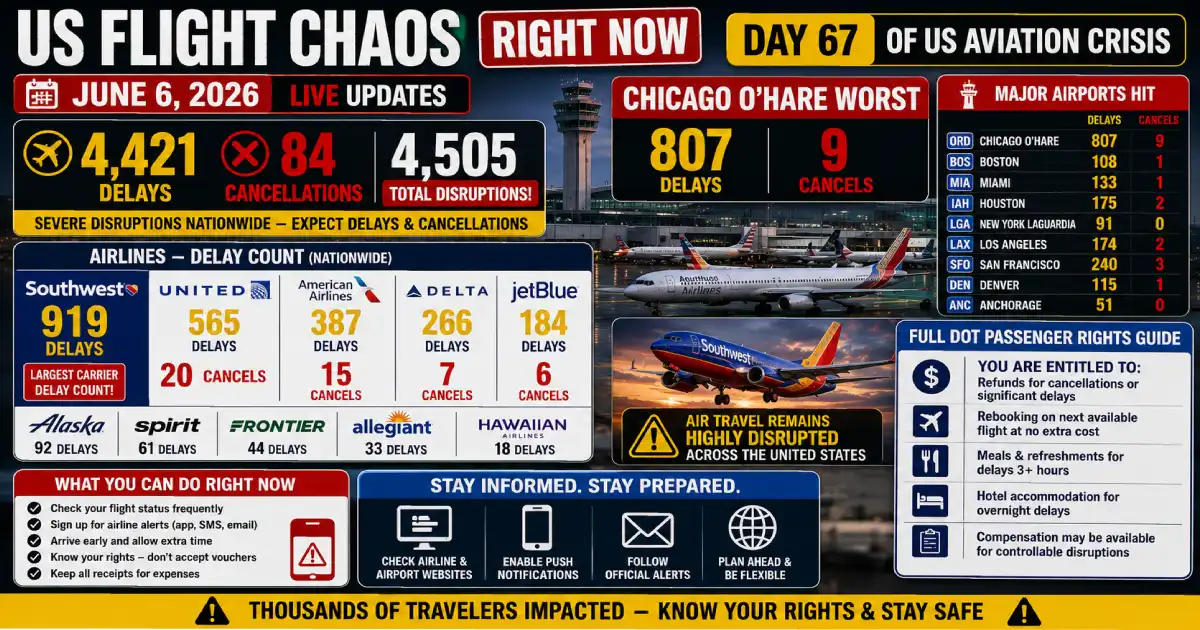
Day 67 of America’s aviation crisis — and it is the worst single day of the week. Right now, at this moment, 4,421 flights across the United States are delayed and 84 have been cancelled outright — 4,505 total disruptions sweeping through every major hub from Chicago to Los Angeles, from Boston to Miami, from Houston to Anchorage. If you are flying in America today, the odds are your flight is affected.
Thousands of travelers face 4,421 delays and 84 cancellations at US airports including Chicago O’Hare, Boston Logan, Miami International, LaGuardia, Teterboro, and Houston, with Southwest, JetBlue, Endeavor Air, Frontier, and more airlines all impacted across domestic and international routes.
United Airlines leads today with 20 cancellations and 565 delays, while Southwest Airlines faces 7 cancellations and 919 delays — the largest single-carrier delay count of any airline in the country today. Other carriers including SkyWest, JetBlue, Alaska Airlines, Endeavor Air, Frontier, Mesa, Horizon, and Hawaiian Airlines are all contributing to widespread passenger disruption across the national network.
The epicentre is Chicago. O’Hare International Airport has recorded 807 delays and 9 cancellations — the single worst disruption count of any US airport today by an enormous margin, and a figure that makes it the de facto ground zero for a cascade that reaches every other hub in the country. When O’Hare delays 807 flights, the entire US network feels it — because O’Hare connects to every major city in America, and every aircraft delayed at ORD is unavailable for its next scheduled rotation at LAX, JFK, MIA, BOS, and beyond.
Published: June 6, 2026 — Saturday (Day 67 · US Aviation Crisis · Summer Peak Weekend) US national total: 84 cancellations + 4,421 delays = 4,505 disruptions Chicago O’Hare (ORD): 807 delays + 9 cancellations = 816 disruptions — worst US airport today San Francisco (SFO): 240 delays — second highest delay count nationally Houston Bush (IAH): 175 delays + 2 cancellations Los Angeles (LAX): 174 delays + 5 cancellations — domestic + international disrupted Miami (MIA): 133 delays + 5 cancellations — Caribbean + Latin America routes hit Boston Logan (BOS): 108 delays + 6 cancellations LaGuardia (LGA): 91 delays + 5 cancellations — New York metro paralysed Denver (DEN): 115 delays Anchorage (ANC): 51 delays — Alaska connections hit Minneapolis-St Paul (MSP): 59 delays Teterboro (TEB): 12 cancellations — private + charter aviation hit Southwest Airlines: 919 delays + 7 cancellations — largest single-carrier delay count in the US today United Airlines: 565 delays + 20 cancellations — largest cancellation count today Other carriers disrupted: SkyWest · JetBlue · Alaska Airlines · Endeavor Air · Frontier · Mesa · Horizon · Hawaiian Airlines · American Airlines DOT cash compensation: ✅ Up to $775 for controllable delays 3+ hours — new 2024 DOT rule Full refund right: ✅ Unconditional for all cancellations Duty of care: ✅ Meals + hotel for overnight controllable disruptions DOT complaint portal: airconsumer.dot.gov
Saturday June 6 is not just any operating day. It is the first Saturday of the summer peak season — the day on which the highest number of leisure travellers simultaneously attempt to begin their summer holidays. Airlines schedule their maximum weekly seat capacity on Saturday. Airports operate at their highest weekly passenger throughput on Saturday. And the US aviation system is entering this Saturday carrying 67 days of uncleared positioning debt.
The Day 67 disruption total of 4,505 is significantly above the recent daily average — Days 63 through 65 averaged approximately 500 to 750 national disruptions on comparable days. The June 6 number is almost six times that average. This is not simply the continuation of the background crisis. This is a peak-demand spike superimposed on a system that has not had a single clean recovery day in over nine weeks.
The FAA’s own daily air traffic report for the region signals the contributing factor clearly: thunderstorms could delay flights in Chicago (MDW, ORD), Minneapolis (MSP), Houston (HOU, IAH) and San Diego (SAN), with gusty winds slowing traffic in Denver (DEN).
The thunderstorm system moving across the Midwest on June 6 is not the sole cause of 4,421 delays — weather never is, in isolation. The weather event is the trigger. The 67-day positioning debt is the accelerant. When a thunderstorm forces a 90-minute ground stop at O’Hare on a normal operating day, the system recovers within three to four hours. When it forces a ground stop on Day 67 of a national crisis — with aircraft already running late, crews already near duty limits, and gate assignments already congested — the recovery window extends from hours to the entire day. That is what 807 O’Hare disruptions on a Saturday looks like.
Chicago O’Hare recorded 807 delays and 9 cancellations — the highest disruption count of any US airport today by an enormous margin — with operational strain cascading across both domestic and international routes.
O’Hare is the nerve centre of the US aviation network — the airport through which United Airlines and American Airlines route the highest proportion of their domestic connections, and the hub from which flights depart to every corner of North America and the world. When ORD produces 816 disruptions in a single day, the cascade mathematics are straightforward and devastating: every delayed departure from Chicago becomes a late arrival at its destination, which becomes a late turnaround, which becomes a delayed departure from that destination for the return leg, which becomes a late arrival back at Chicago for the next rotation.
Thunderstorms, temporary air traffic control limits, and ORD’s heavy congestion quickly push the disruption beyond Chicago and into the wider network. For passengers, that means missed connections, longer waits, and late arrivals on both domestic and international routes.
O’Hare’s international exposure today: United Airlines operates O’Hare transoceanic services to London Heathrow, Frankfurt, Tokyo Narita, Beijing, Shanghai, Seoul, Hong Kong, and Tel Aviv from Terminal 1. American Airlines operates international O’Hare services from Terminal 3 to London Heathrow, Paris CDG, Madrid, Dublin, Zurich, Tokyo, Beijing, and Buenos Aires. A 807-delay day at ORD means hundreds of international passengers — UK holidaymakers connecting through Chicago, Australian business travellers on the O’Hare–Tokyo rotation, Canadian passengers on the Toronto–O’Hare–international chain — are all caught in the cascade.
For passengers at O’Hare right now: Do not go to the service desk queue. Open your airline app immediately. United: united.com → Manage Reservations. American: aa.com → My Trips. Southwest: southwest.com → Manage. The app queues during a 807-delay event are substantially shorter than the terminal service desk queues, which may be running 60+ minutes wait times at peak periods today.
SFO is today’s second-most disrupted US airport by delays — 240 delayed flights across United’s dominant SFO hub operation and the international carriers serving the Pacific gateway. SFO is the primary US West Coast departure point for transpacific services to Japan, South Korea, China, Australia, Hong Kong, and Southeast Asia.
San Francisco International Airport faces 240 delays today, creating significant disruption for both domestic west coast passengers and international travellers on transpacific routes.
For UK, Australian, and Asian passengers connecting through SFO on their transatlantic or transpacific journeys today — the SFO disruption creates a specific connection risk. Any SFO connection shorter than 2 hours today should be treated as elevated-risk. United Airlines’ SFO hub handles the Pacific connections — passengers booked on SFO–Tokyo, SFO–Hong Kong, or SFO–Sydney should monitor United’s app for the latest departure status.
Houston Bush Intercontinental Airport recorded 175 delays and 2 cancellations, with flights to Mexico, the Caribbean, and domestic hubs all impacted.
Houston is United Airlines’ third major hub alongside O’Hare and Newark. IAH handles United’s Latin America network — services to Mexico City, Bogotá, Lima, Santiago, Buenos Aires, São Paulo, and Panama City. The 175 delays at Houston today affect not just domestic US passengers but the entire Latin American connection pipeline that routes through the Texas hub.
Contact: united.com → Manage Reservations | United: 1-800-864-8331
Los Angeles International recorded 174 delays and 5 cancellations, with both domestic and international flights impacted due to operational congestion and ongoing high summer traffic.
LAX is the most complex disruption environment in today’s picture from an international perspective. The airport is simultaneously the US West Coast hub for Australia-bound Qantas and United transpacific services, the departure point for American Airlines’ transpacific routes to Tokyo and Beijing, and the primary transit hub for passengers connecting between the US mainland and Hawaii. A 179-disruption day at LAX affects the Australia-US corridor, the Japan-US corridor, and the Hawaii connection all simultaneously.
For Australian passengers transiting LAX today: Allow a minimum of 3 hours for any LAX domestic-to-international connection. The LAX TBIT (Tom Bradley International Terminal) to domestic terminal transfers add 30–45 minutes on a normal day — on a 174-delay day, the transfer times are longer and the connection risk is substantially elevated.
Contact: lawa.org → LAX Flights | Qantas: 13 13 13 (Australia)
Miami recorded 133 delays and 5 cancellations, with disruptions affecting Caribbean and Latin American routes.
Miami is American Airlines’ primary hub for the Caribbean and Latin American network — the gateway through which passengers travel to the Bahamas, Cuba, Jamaica, Trinidad, Barbados, Colombia, Venezuela, Ecuador, Peru, and Brazil. A 138-disruption day at MIA during the first Saturday of summer peak affects thousands of holiday passengers who have prepaid resort packages, cruise embarkations, and tour itineraries at their Caribbean and Latin American destinations.
Cruise passengers alert: Miami is the world’s largest cruise homeport — on any given Saturday, between 15,000 and 25,000 cruise passengers are departing from or arriving at PortMiami. For cruise passengers flying into Miami today to catch a Saturday afternoon departure — the 133 MIA delays represent a meaningful miss-the-ship risk. If your inbound flight to MIA is delayed by more than 2 hours today, contact your cruise line’s emergency passenger services immediately. Cruise lines have protocols for late-arriving passengers caused by flight disruptions, but these must be invoked before the ship departs.
Contact: aa.com → My Trips | American Airlines MIA hub: 1-800-433-7300
Boston Logan recorded 108 delays and 6 cancellations, primarily impacting northeast US travellers including connections to Canada and Europe.
Boston is a JetBlue and American Airlines co-dominant hub — the primary New England departure point for transatlantic services to London, Dublin, Amsterdam, Paris, and Lisbon, and the domestic hub for the densely-travelled Boston–New York–Washington northeast corridor. Today’s 114 disruptions at BOS affect both leisure summer travellers beginning transatlantic holidays and the high-frequency business corridor between Boston and the tri-state area.
For UK passengers on transatlantic services into Boston today: British Airways, Virgin Atlantic, Aer Lingus, and American Airlines all operate London–Boston services. A delayed Boston arrival on any of these services today creates a connection cascade into New England’s domestic and regional network — particularly JetBlue’s Cape Cod, Martha’s Vineyard, and Nantucket connections.
Contact: BOS live status: massport.com → Logan Airport → Arrivals/Departures
LaGuardia recorded 91 delays and 5 cancellations, creating significant disruption for New York metropolitan area passengers on high-frequency domestic routes.
LaGuardia is America’s most congested domestic-only commercial airport — the point through which the New York business and leisure community accesses the high-frequency shuttle routes to Washington Reagan, Boston Logan, Chicago O’Hare, Miami, and Atlanta. A 96-disruption day at LGA on a Saturday affects not just business travellers but the summer leisure market connecting through New York.
New York passengers note: LaGuardia and JFK are both disrupted today. For passengers with flexibility on their New York-area departure, Newark Liberty International Airport (EWR) — United’s Newark hub — may offer alternative routing. Check united.com for Newark availability on disrupted routes.
Denver International Airport recorded 115 delays today, with gusty winds slowing traffic according to FAA advisories.
Denver is a Frontier Airlines and United Airlines co-hub — the primary Mountain West gateway and the hub through which passengers from Denver, Colorado Springs, Salt Lake City, and the broader Mountain West connect to the national network. Today’s 115 Denver delays particularly affect Frontier Airlines, whose network is DEN-centric, and United Airlines’ Mountain West connection operation.
Anchorage International Airport recorded 51 delays today, contributing to disruption in Alaska connections.
Anchorage is not a hub many continental US passengers think about — but it is the sole gateway for Alaska’s road-inaccessible coastal communities and a critical cargo transit hub. Its 51 delays today affect the Alaska Airlines and Ravn Alaska services that connect Juneau, Ketchikan, Sitka, Kodiak, and remote Alaska communities to the mainland network.
Southwest Airlines faces 919 delays and 7 cancellations today — the largest single-carrier delay count of any airline operating in the United States right now.
Southwest’s 919-delay figure is the consequence of its network architecture colliding with the O’Hare/Chicago thunderstorm system at its worst possible moment. Southwest operates a point-to-point network — unlike hub-and-spoke carriers, its aircraft do not converge on one or two hub airports before dispersing. Instead, each aircraft makes multiple short-haul rotations per day across the entire national network. When one rotation is delayed by weather in Chicago, every subsequent rotation of that aircraft for the rest of the day is late. Multiply that by the number of Southwest aircraft caught in the June 6 Midwest weather system, and 919 delays is the arithmetic result.
Southwest’s June 6 disruption is also compounded by the structural transformation the carrier is undergoing. Having exited O’Hare and Dulles on June 4 as part of its network overhaul, Southwest’s aircraft redeployment is still working through the operational system — the carrier is managing a network that looks slightly different from the one it operated two days ago, while simultaneously absorbing its worst delay day of the summer.
DOT rights for Southwest passengers: Southwest is a US large carrier subject to the new DOT Airline Passenger Protection rules. For controllable delays of 3+ hours: cash compensation up to $775 per passenger. For cancellations: unconditional full refund within 7 days.
Contact: southwest.com → Manage Reservations | Southwest: 1-800-435-9792
United Airlines recorded 565 delays and 20 cancellations today — the highest absolute cancellation count of any US carrier on June 6.
United’s 20 cancellations are concentrated at its three primary hubs — O’Hare, San Francisco, and Houston — which are today’s three most disrupted US airports. The cancellations represent the harder end of United’s disruption picture: not aircraft that are running late but aircraft that have been pulled from the schedule entirely because the crew duty-hour situation, maintenance window, or aircraft positioning debt cannot be resolved in time for the service to operate.
United’s transatlantic and transpacific network — London, Frankfurt, Tokyo, Sydney, Hong Kong, Amsterdam, Zurich — feeds into today’s domestic hub disruptions in both directions. Aircraft arriving from London this morning at ORD or SFO are now unavailable for their scheduled domestic rotations because the international service itself was delayed by the European positioning debt from the Belgium Skeyes strike and Portugal recovery still working through the system.
DOT rights for United passengers: Full DOT Airline Passenger Protection framework applies. Controllable cancellations: refund within 7 days + compensation up to $775 for 3+ hour controllable delays. United’s Customer Care hub: united.com → Help.
Contact: united.com → Manage Reservations | United: 1-800-864-8331
JetBlue is among the carriers impacted today, contributing delays across the northeastern US network.
JetBlue’s Boston-centric operation — its primary T5 hub at Logan — is absorbing disruption from both the O’Hare cascade (JetBlue operates Boston–Chicago services) and the direct BOS disruption of 108 delays. JetBlue’s transatlantic services to London Gatwick, Amsterdam, and Paris CDG from Boston are also at risk on a 108-delay day at BOS.
Contact: jetblue.com → Manage Trips | JetBlue: 1-800-538-2583
Endeavor Air is among the carriers contributing to today’s nationwide disruption picture.
Endeavor Air is Delta’s primary regional feeder carrier, operating CRJ and smaller regional jets on the connection routes that feed Delta’s mainline hubs at JFK, Detroit, Atlanta, and Minneapolis. When Endeavor is under disruption pressure, Delta’s domestic connection architecture is broken at its regional feeder layer — a pattern identical to the Jazz/Air Canada Express dynamic documented in Canada’s crisis reports.
Frontier Airlines is impacted today across its network. Frontier’s Denver-centric ultra-low-cost operation is particularly exposed on a 115-delay day at DEN — its fortress hub. Frontier’s thin crew buffers and high-frequency point-to-point scheduling make it especially vulnerable to cascade effects when its primary hub is disrupted.
Contact: flyfrontier.com → My Trips | Frontier: 1-801-401-9000
The US Department of Transportation’s Airline Passenger Protection rules, which came into force in 2024 and are being actively enforced through 2026, provide cash compensation for US domestic airline passengers when disruptions are caused by factors within the airline’s control.
The weather versus controllable question — critical for June 6:
Today’s disruptions have two layers:
How to determine if your specific disruption is controllable:
Ask at the gate: “What is the stated reason for my delay or cancellation?”
If the airline states: “Weather” — compensation unlikely for the weather-caused element. But if your delay is 6+ hours and weather cleared 3 hours ago — the extended delay beyond the weather window is a controllable positioning failure.
If the airline states: “Aircraft out of position,” “Crew unavailable,” “Scheduling” — this is a controllable disruption. Full DOT compensation applies.
Cash compensation scale:
| Disruption | Delay duration | DOT compensation |
|---|---|---|
| Controllable cancellation | Any | Up to $775 per passenger |
| Controllable delay | 3–6 hours | Up to $775 per passenger |
| Controllable delay | 6+ hours | Up to $775 per passenger |
Every cancelled US domestic or international flight from a US airport entitles the passenger to a full cash refund within 7 business days to the original payment method. Airlines cannot insist on a travel voucher.
Say: “My flight has been cancelled. I am requesting a full cash refund to my original payment method under DOT refund regulations.”
If the airline offers only a voucher — refuse it, state your DOT refund entitlement in writing, and escalate to DOT if unresolved.
3+ hour controllable delay: Meal vouchers — request at the airline service desk immediately. Keep all food receipts regardless of whether vouchers are offered.
Overnight controllable cancellation: Hotel accommodation or reimbursement of reasonable hotel costs. Ground transport between the airport and hotel. If the airline cannot arrange accommodation directly: book independently, keep receipts, submit for reimbursement.
Free rebooking: On the next available service to your final destination at no additional cost.
If your flight is disrupted today and you miss a connecting flight that was booked on the same itinerary — the operating carrier is responsible for rerouting you to your final destination at no cost. This includes:
Ask specifically: “My [flight number] was delayed/cancelled and I missed my connection to [destination]. I need to be rerouted to [destination] at no cost under DOT connection protection rules.”
Step 1: File directly with the airline within 24 hours — use the airline app or website.
Step 2: If unresolved: file at airconsumer.dot.gov → Submit a Complaint (Department of Transportation Aviation Consumer Protection Division).
Step 3: For assisted claims: AirHelp (airhelp.com) operates in the US on a no-win-no-fee basis and can pursue DOT compensation claims on your behalf.
Time limit: 2 years from the disruption date under US consumer law.
Step 1 — Open your airline app immediately. Do not join the service desk queue until you have checked rebooking availability in the app. During a 4,421-delay day, app rebooking is consistently faster than the desk queue.
Step 2 — Check alternate airports. If your Chicago O’Hare flight cannot be recovered today, Midway Airport (MDW) — 16 miles southwest — may have available Southwest capacity on your route. If your LaGuardia flight cannot be recovered, JFK (14 miles east) or Newark (24 miles west) may have available alternatives.
Step 3 — Know your connection buffer. Any domestic connection shorter than 90 minutes at ORD, SFO, or LAX today is at material risk. Any international connection shorter than 3 hours at these airports is at material risk.
Step 4 — Capture the delay reason in writing. Take a screenshot of any airline text or app notification stating the reason for your delay or cancellation. This is your evidence for a DOT compensation claim if the stated reason is controllable.
Step 5 — Request duty of care immediately. For any delay of 3+ hours at a US airport: go to the gate or service desk and request meal vouchers. Do not wait to be offered them proactively.
| Airline | Website | Phone |
|---|---|---|
| Southwest Airlines | southwest.com → Manage | 1-800-435-9792 |
| United Airlines | united.com → Manage Reservations | 1-800-864-8331 |
| JetBlue | jetblue.com → Manage Trips | 1-800-538-2583 |
| American Airlines | aa.com → My Trips | 1-800-433-7300 |
| Alaska Airlines | alaskaair.com → Manage | 1-800-252-7522 |
| Frontier Airlines | flyfrontier.com → My Trips | 1-801-401-9000 |
| Delta Air Lines | delta.com → My Trips | 1-800-221-1212 |
Chicago O’Hare live status: flychicago.com → Flight Tracker Boston Logan live: massport.com → Arrivals/Departures Miami International live: miami-airport.com → Flight Status LaGuardia live: panynj.gov → LGA Flights Houston IAH live: fly2houston.com → Flight Info LAX live: lawa.org → Flight Status FAA traffic control: fly.faa.gov DOT complaints: airconsumer.dot.gov AirHelp US claims: airhelp.com/en-us
Related Articles:
Posted By : Vinay
This article is provided for general informational purposes only and is based on information available at the time of publication. Travel advisories, airline schedules, airport operations, visa requirements, government regulations, and other travel-related information are subject to change without prior notice. While Travel Tourister makes reasonable efforts to verify information using official announcements, government publications, airline and airport communications, and other reliable sources, we cannot guarantee that all information remains complete, accurate, or up to date at all times. Readers should independently verify any information that may affect their travel plans with the relevant airline, airport authority, government agency, embassy, or other official source before making travel, financial, or other decisions. Travel Tourister shall not be liable for any direct or indirect loss, inconvenience, or damages arising from the use of or reliance on the information contained in this article. Nothing in this publication constitutes legal, immigration, financial, or professional travel advice. If you believe any information in this article is inaccurate or outdated, please contact our editorial team. We review all credible correction requests promptly and update our content whenever appropriate.
Lastest News
2nd Floor, 39, Above Kirti Club, DLF Industrial Area, Kirti Nagar, New Delhi, Delhi 110015



Travel Tourister is a leading Travel portal where we introduce travellers to trusted travel agents to make their journey hasselfree, memorable And happy. Travel Tourister is a platform where travellers get Tour packages ,Hotel packages deals through trusted travel companies And hoteliers who are working with us across the world. We always try to find new and more travel agents and hoteliers from every nook and corners across the world so that you could compare the deals with different travel agents and hoteliers and book your tour or hotel with the one you have chosen according to your taste and budget.
Copyright © Travel Tourister, India. All Rights Reserved

 Call
Call Enquiry