Published on : 04 Jun 2026
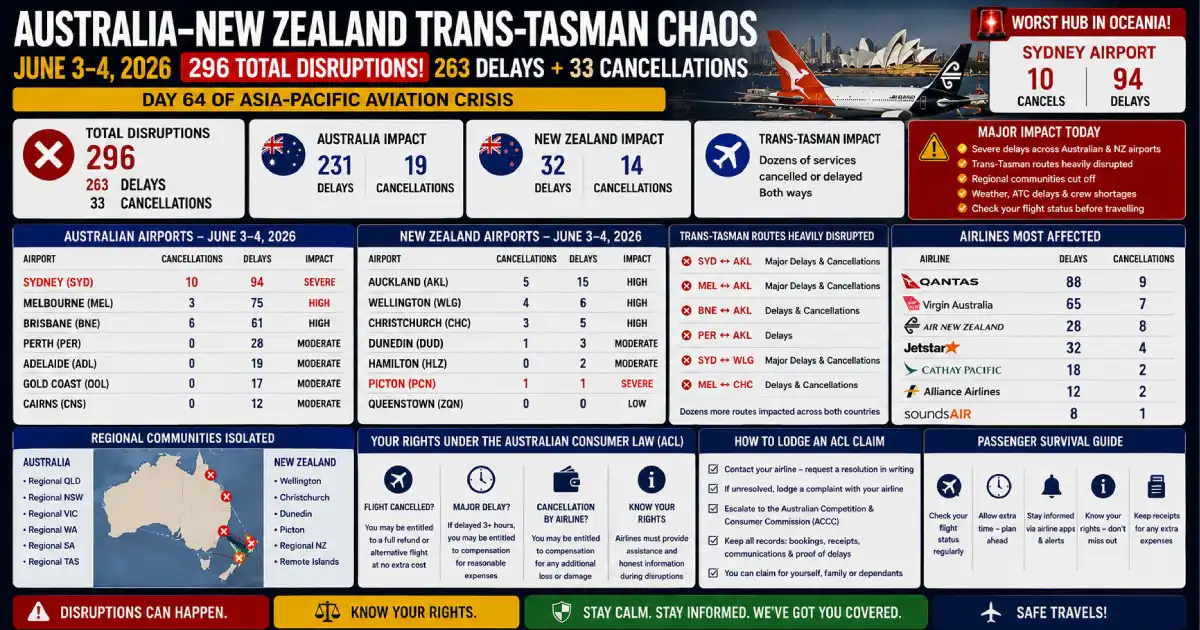
The Trans-Tasman aviation network has entered its 64th consecutive day of elevated crisis — and the first week of the southern hemisphere’s winter travel peak is delivering not recovery but the worst single disruption event since May 27. On June 3–4, 2026, a combined 263 delays and 33 cancellations swept across Australian and New Zealand airports simultaneously, producing 296 total disruptions that severed domestic corridors, broke Trans-Tasman connections, and left thousands of passengers stranded from Sydney’s international terminal to the South Island of New Zealand.
A staggering 263 delays and 33 cancellations struck major Australian and New Zealand airports on June 3, 2026. Sydney Airport suffered the absolute worst disruptions, recording 10 cancellations and 94 delays affecting Qantas, Virgin Australia, and numerous international carriers. Qantas, Virgin Australia, Sounds Air, and Alliance Airlines absorbed the most severe schedule friction across multiple hubs, while international operators including Cathay Pacific, Jetstar, and Air New Zealand suffered heavily delayed arrivals and departures.
The compounding June 4 Oceania network disruptions — 146 delays and 8 cancellations across Sydney, Wellington, and Christchurch, with Qantas recording 28 delays, Jetstar 23 delays, and Virgin Australia 12 delays — confirm that the June 3 positioning debt has carried forward overnight exactly as the Day 64 crisis pattern predicts.
Sydney. Melbourne. Brisbane. Wellington. Christchurch. Dunedin. Picton. The entire Trans-Tasman corridor is broken simultaneously — and the June 4–5 recovery window looks thin.
Published: June 4, 2026 — Thursday (Day 64 · Asia-Pacific Aviation Crisis · Winter Peak Week 1) Australia–NZ combined June 3: 33 cancellations + 263 delays = 296 total disruptions Sydney Airport (SYD): 10 cancellations + 94 delays = 104 disruptions — worst Oceania hub Melbourne Tullamarine (MEL): 3 cancellations + 75 delays = 78 disruptions Brisbane Airport (BNE): 6 cancellations + 61 delays = 67 disruptions June 4 Oceania network: 8 cancellations + 146 delays = 154 further disruptions Christchurch (CHC) June 4: 25 delays + 1 cancellation Wellington (WLG) June 4: Delays confirmed — Air New Zealand network under strain Airlines confirmed disrupted: Qantas · Virgin Australia · Air New Zealand · Jetstar · Alliance Airlines · Sounds Air · Cathay Pacific · QantasLink June 4 carrier detail: Qantas 28 delays · Jetstar 23 delays · Virgin Australia 12 delays Trans-Tasman routes broken: Sydney–Auckland · Melbourne–Auckland · Brisbane–Auckland · Sydney–Christchurch · Melbourne–Christchurch · Sydney–Wellington Context: Day 63 nationally: Trans-Tasman + Typhoon Jangmi (Japan 900 flights cancelled) + US 134 cancels + Canada 306 disruptions — global aviation crisis converging ACL rights: ✅ Full refund for controllable cancellations | ✅ Rebooking at no cost | ⚠️ No automatic cash compensation for delays (Aviation Consumer Protection Scheme pending Parliament) Complaints: ACCC — 1300 302 502 · accc.gov.au | Airline directly
The pattern of the 2026 Asia-Pacific aviation crisis is now well established: each day’s disruptions feed directly into the next day’s positioning debt, the overnight recovery window is too short to clear the backlog, and the summer or winter peak demand period arrives before the system has a clean slate to work from.
The Trans-Tasman network entered winter 2026 — the ski season peak, the school holiday period, and the corporate first-half close travel surge — carrying 63 days of accumulated operational deficit. Qantas has been running at elevated disruption levels since early April. Air New Zealand’s schedule is under structural pressure — Christchurch is the hardest-hit city in its domestic network, losing significant Auckland–Christchurch and Wellington–Christchurch rotations across the May–June schedule, while Nelson faces approximately 140 flight cuts and around 8,000 fewer seats over two months.
The result on June 3–4 is a network where every major Australian hub and every major New Zealand hub is simultaneously disrupted — not by a single dramatic weather event or industrial action, but by the slow accumulation of 64 days of operational stress that has not been fully cleared on any single day since the crisis began.
As of April 2026, Australia does not have aviation-specific delay compensation rules. The proposed Aviation Consumer Protection Scheme, currently before Parliament, would introduce minimum standards including meals for delays and accommodation for overnight disruptions — but these bills have not yet passed into law. This legislative gap means Australian and New Zealand passengers face the June 3–4 disruption wave with weaker consumer protections than their counterparts in the US (DOT), Canada (APPR), or Europe (EU261).
Sydney Airport suffered the worst disruptions of any Oceania hub, recording 10 cancellations and 94 delays — 104 total disruptions — affecting Qantas, Virgin Australia, and numerous international carriers.
Sydney is Australia’s single largest and most consequential aviation hub — the point through which every major long-haul international service arrives and departs, and the primary domestic connection hub for the national network. When Sydney records 104 disruptions in a 24-hour period, the cascade reaches every other Australian airport within hours, and the Trans-Tasman network within the same morning wave.
The 10 cancellations at Sydney today are particularly severe in a Trans-Tasman context. Sydney is the primary gateway for Air New Zealand’s Auckland–Sydney services, Qantas’s Sydney–Auckland and Sydney–Christchurch trans-Tasman routes, and Cathay Pacific’s Hong Kong–Sydney long-haul connection. A cancellation in any of these categories strands not just the Sydney-bound passenger but every onward connection at the receiving end — the Aucklander connecting to London via Sydney, the Christchurch passenger connecting to Tokyo, the Hong Kong traveller connecting to Melbourne.
On June 4, the Sydney positioning debt continues: Sydney absorbed the highest volume of disruption in the Oceania June 4 network, logging 101 severe delays and 2 cancellations, with Qantas (28 delays), Jetstar (23 delays), and Virgin Australia (12 delays) all running significantly behind schedule.
The June 4 numbers — 101 delays and 2 cancellations at Sydney on top of yesterday’s 104 disruptions — confirm that the overnight recovery has not cleared the positioning debt. Aircraft that should have repositioned overnight have not returned to their scheduled rotation baselines, and the June 4 morning wave is operating from the same depleted position as June 3.
Melbourne is Australia’s second hub and the primary gateway for the dense domestic Melbourne–Sydney trunk corridor. Today’s 78 Melbourne disruptions — 75 delays and 3 cancellations — represent significant operational pressure on a hub that handles approximately 37 million passengers annually and operates multiple daily services on Australia’s highest-frequency domestic route.
Virgin Australia’s Melbourne operation is under the most acute pressure. Across the May–June period, Virgin Australia recorded a significant delay impact at Melbourne, primarily driven by high-frequency domestic scheduling pressure and crew positioning constraints. On June 3, Melbourne’s 3 cancellations include both domestic trunk services and at least one Trans-Tasman departure — and the 75 delays span the full range from the short-haul Melbourne–Sydney shuttle to the long-haul Melbourne–London Qantas service.
Brisbane is today’s second-worst Australian airport for cancellations — 6 cancelled services across what is now Jetstar’s primary Queensland hub following the carrier’s recent frequency adjustments. Brisbane reported 6 cancellations and 61 delays as part of the June 3 national disruption picture.
The Brisbane cancellations today carry particular significance for the Queensland ski season market. Brisbane is the departure point for the new Jetstar direct service to Queenstown — which launched on June 15, less than two weeks away. Passengers with forward Jetstar Brisbane–Queenstown bookings for the ski season should monitor their flights carefully: an airline operating 6 cancellations at its Queensland hub on June 3–4 is an airline whose June 15 new-route launch should be tracked closely.
For Queensland-based passengers connecting to international long-haul services — Brisbane to Tokyo, Brisbane to Singapore, Brisbane to London — today’s 61 delays at BNE affect not just domestic services but the international connection pipeline that Qantas, Jetstar International, and Singapore Airlines operate from the Queensland hub.
The New Zealand side of the Trans-Tasman disruption on June 4 tells a specific and geographically significant story. Across the Tasman, New Zealand’s primary aviation infrastructure faced cascading disruption on June 4. Christchurch International logged 25 severe delays and 1 flight cancellation, predominantly driven by Air New Zealand network struggles.
Christchurch (CHC): The South Island’s primary gateway is carrying the heaviest New Zealand disruption load on June 4. Christchurch is the hardest-hit city in Air New Zealand’s domestic network, with significant Auckland–Christchurch and Wellington–Christchurch service reductions across the May–June schedule. The June 4 delays and cancellation at CHC compound an already-reduced service pattern — passengers who booked Christchurch services on the assumption of a full schedule are finding a thinner operation than they expected.
Wellington (WLG): New Zealand’s capital and the primary hub for Air New Zealand’s Cook Strait-adjacent regional network. Wellington delays today affect not just the domestic New Zealand network but the cross-Strait connections to Picton and Nelson — small communities where the aircraft is the primary fast transport option.
Sounds Air (Picton): Sounds Air, the regional carrier serving Picton and the Marlborough Sounds communities, is confirmed in the June 3 Trans-Tasman disruption picture. Sounds Air operates with a thin schedule buffer on its small fleet — a disruption that grounds a Sounds Air aircraft at Wellington or Christchurch for maintenance or crew reasons can strand the entire Picton community for several hours.
Dunedin (DUD): New Zealand’s southernmost major airport, serving Otago and Southland. Any disruption at Dunedin during the winter period hits the Queenstown ski feeder market — passengers routing Sydney–Auckland–Dunedin–Queenstown face a three-leg disruption exposure on a day when two of those segments are under stress.
Qantas is the dominant carrier in today’s Trans-Tasman disruption picture by volume — the highest absolute number of delays across both Australian and New Zealand hubs. Qantas recorded 28 delays at Sydney on June 4 alone, continuing the disruption pattern from June 3’s 94-delay Sydney total.
Qantas’s disruption exposure spans three distinct network layers simultaneously:
Domestic trunk: Sydney–Melbourne (the world’s third-busiest air route), Sydney–Brisbane, Melbourne–Perth, Brisbane–Melbourne. These are Qantas’s highest-frequency, highest-yield domestic corridors — and a delay on the first Sydney–Melbourne departure of the morning cascades through every subsequent rotation of that aircraft for the full day.
Trans-Tasman: Sydney–Auckland, Melbourne–Auckland, Brisbane–Auckland, Sydney–Christchurch. The Trans-Tasman network is where Qantas’s June 3–4 disruptions have the most severe downstream consequences — a cancelled or significantly delayed Sydney–Auckland service strands both Australian outbound passengers and New Zealand inbound passengers, and the next available Trans-Tasman service may not depart for several hours.
Long-haul international: Sydney–London (the Qantas flagship via Perth or Singapore), Sydney–Los Angeles, Sydney–Tokyo, Melbourne–Dallas. Long-haul departures that are delayed on June 3–4 create positioning debt at the far end — a Qantas aircraft that arrives in London late on June 4 cannot depart back to Sydney on its scheduled June 5 outbound rotation.
ACL rights for Qantas passengers:
Under Australian Consumer Law, airlines must provide a remedy such as a refund or rebooking if a cancellation is within their control, but there is no automatic entitlement to meals or cash compensation for delays.
Under the ACL, if a cancellation cannot be remedied or amounts to a major failure, passengers are entitled to a refund. Passengers may also be entitled to compensation for reasonably foreseeable losses caused by the failure.
If Qantas cannot offer an alternative flight within a reasonable timeframe, you are entitled to a full cash refund — not just a flight credit. Under Australian Consumer Law, a voucher-only response to a cancelled service is not compliant if you request a cash refund. If Qantas offers you an alternative flight, you must be given the option to rebook without paying fare differences, provided the alternative is comparable in timing and routing.
Contact: qantas.com → Manage Booking | Qantas customer service: 13 13 13
Virgin Australia was forced off schedule across Sydney, Melbourne, and Brisbane, contributing 12 delays in the June 4 Oceania network total. Virgin’s delay rate relative to its scheduled services is among the highest of any Australian carrier today — reflecting an airline whose schedule has been running at full summer/winter peak capacity without adequate recovery margin for the Day 64 positioning debt.
Virgin Australia is a large carrier — its ACL obligations are identical to Qantas in terms of refund and rebooking rights for controllable cancellations. For passengers whose Virgin Australia service has been cancelled today: you are entitled to rebooking on the next available Virgin or Qantas service at no additional cost, or a full cash refund if no suitable alternative is available within a reasonable timeframe.
Contact: virginaustralia.com → Manage Booking | Virgin Australia: 13 67 89
Jetstar recorded 23 delays in the June 4 Oceania network disruption picture. Jetstar’s Brisbane cancellations on June 3 — 6 of the 67 total Brisbane disruptions — are the more acute story. As Qantas’s low-cost subsidiary and the carrier operating the new Brisbane–Queenstown ski season service, Jetstar’s operational resilience over the next two weeks is directly relevant to every Australian ski traveller with a June booking.
Jetstar passengers have ACL rights identical to Qantas and Virgin Australia for cancellations. However, Jetstar’s conditions of carriage are structured differently from Qantas mainline — passengers on Jetstar Starter fares have more limited voluntary change flexibility, making the ACL mandatory refund right more important when the cancellation is airline-caused.
Contact: jetstar.com → Manage Booking | Jetstar: 131 538
Air New Zealand’s schedule is carrying structural pressure across its domestic New Zealand network — significant Auckland–Christchurch and Wellington–Christchurch rotations have been reduced across the May–June schedule, with Nelson losing approximately 140 flight cuts. The June 4 Christchurch delays and cancellation reflect this underlying schedule thinness rather than a single acute event.
For Trans-Tasman passengers booked on Air New Zealand’s Auckland–Sydney, Auckland–Melbourne, or Auckland–Brisbane services: today’s disruption at the New Zealand end compounds the Australian hub disruptions at the other end. An Air New Zealand Auckland–Sydney service that is delayed on arrival at Sydney cannot turn around on schedule when Sydney itself is running 101 delays.
Contact: airnewzealand.com.au → Manage Booking | Air New Zealand: 13 24 76 (Australia)
Alliance Airlines absorbed significant schedule friction as part of the June 3 Trans-Tasman disruption pattern. Alliance is Australia’s primary FIFO (Fly-In Fly-Out) charter carrier — serving the mining and resources sector across Queensland, Western Australia, and the Northern Territory with dedicated resource industry charters. When Alliance is disrupted, the downstream consequence is not just leisure traveller inconvenience — it is delayed shift changes at remote mine sites, with operational and safety implications for the resources sector.
Contact: allianceairlines.com.au → Bookings
Cathay Pacific suffered heavily delayed arrivals and departures across the Trans-Tasman network on June 3. Cathay’s Australian operation — Hong Kong–Sydney, Hong Kong–Melbourne, Hong Kong–Brisbane — is the primary gateway for Australian travellers connecting to mainland China, Southeast Asia, and Japan via the Hong Kong hub. A delayed Cathay departure from Sydney today means a late arrival at HKG and missed connections to the Cathay network’s morning bank.
Contact: cathaypacific.com → Manage Booking | Cathay Pacific Australia: 1300 880 812
The Trans-Tasman corridor — Australia to New Zealand, across the Tasman Sea — is entirely dependent on air travel. There is no ferry service, no train, no road. When Trans-Tasman flights cancel, the only alternatives are rebooking on the next available Trans-Tasman service (typically the same carrier’s next daily departure, or a competing carrier’s service) or waiting.
Trans-Tasman routes at disruption risk June 3–4:
| Route | Primary carriers | Disruption status |
|---|---|---|
| Sydney (SYD) → Auckland (AKL) | Qantas / Air New Zealand | 🔴 High — SYD 10 cancels, AKL network disrupted |
| Melbourne (MEL) → Auckland (AKL) | Qantas / Air New Zealand | 🟡 Elevated — MEL 3 cancels + 75 delays |
| Brisbane (BNE) → Auckland (AKL) | Qantas / Air New Zealand | 🔴 High — BNE 6 cancels + 61 delays |
| Sydney (SYD) → Christchurch (CHC) | Qantas / Air New Zealand | 🔴 High — both ends disrupted |
| Sydney (SYD) → Wellington (WLG) | Air New Zealand | 🟡 Elevated |
| Melbourne (MEL) → Christchurch (CHC) | Air New Zealand | 🟡 Elevated |
| Brisbane (BNE) → Queenstown (ZQN) | Jetstar (from June 15) | ⚠️ Monitor — BNE disruption ongoing |
If your Trans-Tasman flight is cancelled today:
Step 1 — Call your airline before going to the airport. Rebooking queues at the airport during a multi-hub disruption event are significantly longer than phone or app queues.
Step 2 — Ask to be rebooked on the next available service on any carrier. Qantas and Air New Zealand are codeshare partners on Trans-Tasman routes — a Qantas cancellation may entitle you to rebooking on Air New Zealand’s next available service under the same booking reference.
Step 3 — If your Trans-Tasman cancellation causes you to miss a connecting long-haul departure — for example, a Sydney–Auckland cancellation that causes you to miss Auckland–London — contact both carriers immediately. The connection protection obligation depends on whether the segments were booked on a single itinerary.
Australia’s passenger rights framework is fundamentally different from the US DOT, Canadian APPR, and European EU261/UK261 systems — and understanding the differences is critical for passengers seeking remedies after today’s disruptions.
As of April 2026, Australia does not have aviation-specific delay compensation rules. The proposed Aviation Consumer Protection Scheme, currently before Parliament, would introduce minimum standards including meals for delays and accommodation for overnight disruptions — but these bills have not yet passed into law. Under the existing Australian Consumer Law, airlines must provide a remedy such as a refund or rebooking if a cancellation is within their control, but there is no automatic entitlement to meals or cash compensation for delays.
What this means in plain terms:
Under Australian Consumer Law, if an airline cannot offer an alternative flight within a reasonable timeframe following a controllable cancellation, you are entitled to a full cash refund — not just a flight credit. A voucher-only response to a cancelled service is not compliant under ACL if you explicitly request a cash refund.
Say: “My flight has been cancelled. I am requesting a full cash refund to my original payment method under the Australian Consumer Law consumer guarantee.”
If the airline offers only a credit or voucher — refuse it, state your ACL cash refund entitlement in writing, and keep a copy of the exchange.
If an airline offers you an alternative flight following a cancellation, you must be given the option to rebook without paying fare differences, provided the alternative is comparable in timing and routing.
If the airline attempts to rebook you on a service that departs 24 hours later but demands you pay the fare difference — this is not ACL-compliant. The rebooking must be at no additional cost.
If today’s cancellation caused you to incur provable, reasonably foreseeable costs — a prepaid hotel night lost because your flight was cancelled and you arrived a day late, a connecting flight booked separately that you missed, an event ticket that expired — these consequential losses may be recoverable under ACL Section 267.
Document everything: keep receipts, booking confirmations, and correspondence. You will need a paper trail to support a consequential loss claim.
Unlike the EU, US, and Canadian systems which provide mandatory cash for delays, Australian and New Zealand passengers should rely on travel insurance as their primary protection against delay costs. Comprehensive travel insurance policies typically cover:
Hotel accommodation for overnight delays caused by airline disruption — meal and transport costs during significant delays — connection protection for missed onward flights — trip cancellation reimbursement if the disruption causes the entire journey to be abandoned.
If you are travelling without travel insurance and your flight is significantly delayed today: ask your airline’s service desk for any voluntary goodwill provisions (meal vouchers, hotel accommodation). While not legally required, Qantas, Virgin Australia, and Air New Zealand all have discretionary passenger care provisions that gate agents can activate during significant disruption events.
Step 1: Submit your complaint directly to the airline first — qantas.com, virginaustralia.com, jetstar.com, airnewzealand.com.au → Customer Feedback / Complaints.
Step 2: If the airline does not resolve your complaint within 30 days — escalate to the ACCC (Australian Competition and Consumer Commission) at accc.gov.au → Make a Complaint. The ACCC enforces Australian Consumer Law obligations.
Step 3: For disputes up to AUD $20,000 involving domestic services — state-based consumer tribunals (NCAT in NSW, VCAT in Victoria, QCAT in Queensland) offer a low-cost, legally binding resolution pathway without legal representation requirements.
Step 4: National Consumer Hotline: 1300 302 502
Time limit: Generally 6 years from the date of the breach under ACL contract law.
New Zealand passengers flying with Air New Zealand or Sounds Air on domestic NZ routes are covered by the Civil Aviation Act and the Consumer Guarantees Act (CGA) — not ACL. The NZ framework is broadly similar: unconditional refund or rebooking for cancellations within the carrier’s control, but no mandatory cash compensation for delays.
NZ complaints: Civil Aviation Authority of New Zealand at caa.govt.nz | Consumer NZ at consumer.org.nz
If your Qantas, Virgin or Jetstar domestic service is cancelled:
Open your carrier’s app first — not the airport desk queue. All three carriers have real-time rebooking functionality in their apps that is faster during hub disruption events than the terminal service desk. Select the next available service to your destination and confirm the rebooking at no extra cost.
If your Trans-Tasman service is cancelled:
Call the airline directly — Qantas 13 13 13, Air New Zealand 13 24 76 (from Australia), Jetstar 131 538. Trans-Tasman rebooking typically requires agent involvement because codeshare and competitor-carrier options are not always visible in the self-service app interface.
If you miss a connecting long-haul due to a delayed domestic feeder:
If your domestic feeder (e.g. Melbourne–Sydney Qantas) and your international long-haul (e.g. Sydney–London Qantas) were booked on the same itinerary, Qantas is responsible for rerouting you to London at no extra cost even if the only available option involves routing via a different city or a different date. Insist on this — do not accept a refund of the domestic leg only.
If you are stranded overnight:
Ask the airline for hotel accommodation and ground transport. While not a legal obligation under current Australian law, Qantas, Virgin Australia, and Air New Zealand all have discretionary care provisions. The pending Aviation Consumer Protection Scheme, if passed, will make overnight accommodation mandatory — but until it passes, the provision is at carrier discretion. Ask; you may receive it.
| Airline | Website | Phone |
|---|---|---|
| Qantas | qantas.com → Manage Booking | 13 13 13 (Australia) |
| Virgin Australia | virginaustralia.com → Manage | 13 67 89 (Australia) |
| Jetstar | jetstar.com → Manage Booking | 131 538 (Australia) |
| Air New Zealand | airnewzealand.com.au → Manage | 13 24 76 (from Australia) |
| Alliance Airlines | allianceairlines.com.au | Via booking reference |
| Cathay Pacific | cathaypacific.com → Manage | 1300 880 812 (Australia) |
| Sounds Air | soundsair.com | +64 3 520 3080 (NZ) |
Sydney Airport live status: sydneyairport.com.au → Flight Info Melbourne live status: melbourneairport.com.au → Flights Brisbane live status: bne.com.au → Departures Auckland live status: aucklandairport.co.nz → Flight Info Christchurch live status: christchurchairport.co.nz → Flights FlightAware Sydney: flightaware.com/live/airport/YSSY ACCC complaints: accc.gov.au → Make a Complaint ACCC hotline: 1300 302 502 NZ CAA: caa.govt.nz
Related Articles:
Posted By : Vinay
This article is provided for general informational purposes only and is based on information available at the time of publication. Travel advisories, airline schedules, airport operations, visa requirements, government regulations, and other travel-related information are subject to change without prior notice. While Travel Tourister makes reasonable efforts to verify information using official announcements, government publications, airline and airport communications, and other reliable sources, we cannot guarantee that all information remains complete, accurate, or up to date at all times. Readers should independently verify any information that may affect their travel plans with the relevant airline, airport authority, government agency, embassy, or other official source before making travel, financial, or other decisions. Travel Tourister shall not be liable for any direct or indirect loss, inconvenience, or damages arising from the use of or reliance on the information contained in this article. Nothing in this publication constitutes legal, immigration, financial, or professional travel advice. If you believe any information in this article is inaccurate or outdated, please contact our editorial team. We review all credible correction requests promptly and update our content whenever appropriate.
Lastest News
2nd Floor, 39, Above Kirti Club, DLF Industrial Area, Kirti Nagar, New Delhi, Delhi 110015



Travel Tourister is a leading Travel portal where we introduce travellers to trusted travel agents to make their journey hasselfree, memorable And happy. Travel Tourister is a platform where travellers get Tour packages ,Hotel packages deals through trusted travel companies And hoteliers who are working with us across the world. We always try to find new and more travel agents and hoteliers from every nook and corners across the world so that you could compare the deals with different travel agents and hoteliers and book your tour or hotel with the one you have chosen according to your taste and budget.
Copyright © Travel Tourister, India. All Rights Reserved

 Call
Call Enquiry