Published on : 17 Jun 2026
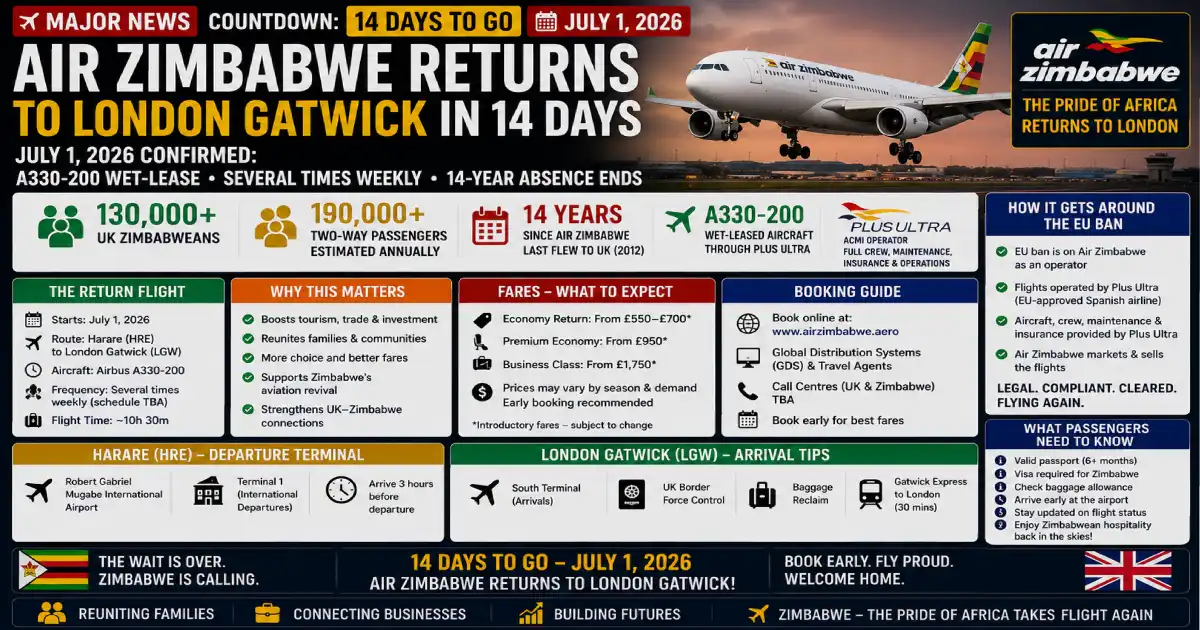
In 14 days, a flight that has not existed for nearly 15 years will take off from Harare and land at London Gatwick.
On July 1, 2026, Air Zimbabwe will operate a direct service between Robert Gabriel Mugabe International Airport in Harare and London Gatwick Airport for the first time since early 2012. The route — once one of Africa’s most emotionally significant air corridors, connecting Zimbabwe’s largest diaspora community to home — has been silent for nearly 15 years. The passengers who relied on it have spent those years routing through Dubai, Doha, Nairobi, Addis Ababa, Johannesburg, and Lusaka, adding 6–14 hours to journeys that, on a direct flight, take approximately 10 hours.
That ends on July 1.
Services between Harare and London Gatwick are scheduled to begin on July 1, 2026, operated using Airbus A330-200 aircraft under an ACMI arrangement in which Plus Ultra provides the aircraft, crew, maintenance and insurance. The deal was brokered by Chapman Freeborn Aviation Services. Flights will operate several times per week under the Air Zimbabwe flight code.
The story of how this flight exists — and why it can exist despite Air Zimbabwe being banned from both the EU and the UK — is one of aviation’s more creative regulatory solutions. The story of who needs this flight, and what it means for the 130,000 Zimbabwe-born residents of the UK who have been flying indirect for years, is the more important one.
Published: June 17, 2026 — (14 Days to Launch) Launch date: Wednesday, July 1, 2026 Route: Harare Robert Gabriel Mugabe International (HRE) → London Gatwick (LGW) Operating carrier: Plus Ultra Líneas Aéreas (Spanish) — on behalf of Air Zimbabwe Flight code: Air Zimbabwe (UM) Aircraft: Airbus A330-200 widebody Arrangement: ACMI wet-lease (Aircraft, Crew, Maintenance, Insurance) — 13 months Brokered by: Chapman Freeborn Aviation Services Frequency: Several times per week (3–4x weekly — exact schedule to be confirmed by Air Zimbabwe) Last Harare–London flight: December 2011 / early 2012 — B767-200, suspended over debt and financial difficulty Air Zimbabwe EU ban: Since May 2017 — EU Air Safety List — “unaddressed safety deficiencies” Air Zimbabwe UK ban: Concurrent with EU ban — prohibited from operating commercial services to, from, and within the UK ACMI regulatory workaround: ✅ Regulators permit banned airlines to exercise traffic rights using wet-leased aircraft from operators meeting required safety standards — Plus Ultra is certified and compliant Plus Ultra previous ACMI deals: Air Algérie · Tunisair (same 13-month structure) UK Zimbabwe-born population: ~130,000 (2021/22 Census) · estimated 40,000 in London alone Two-way UK–Zimbabwe passengers (2025): ~190,000 per year · Harare–London city pair = majority Historical peak frequency: 6x weekly — Harare–London at Air Zimbabwe’s peak Booking: airlinezimbabwe.com or authorised travel agents
Air Zimbabwe last served London Gatwick in early 2012. In December 2011, one of its Boeing 767-200 aircraft was impounded at Gatwick over an unpaid debt, accelerating the airline’s withdrawal from the market. That impoundment — a creditor seizing a national airline’s sole long-haul aircraft at the very airport it served — was a moment of profound institutional humiliation and a snapshot of a broader crisis. Air Zimbabwe had accumulated debts estimated at $300 million. Its fleet had aged beyond the point of economical operation. The political and economic turbulence of Zimbabwe in the 2000s had drained the airline’s revenue base and made fresh capital investment impossible.
The London route went dark. It never came back — until now.
Air Zimbabwe has been barred from operating its own aircraft into both the UK and EU since May 2017. The European Commission added Air Zimbabwe to its EU Air Safety List that year, citing unaddressed safety deficiencies — a classification that applies not because a specific incident occurred but because the airline failed to meet the ongoing safety oversight standards required for European airspace access. The UK, post-Brexit, maintained a parallel prohibition covering commercial operations to, from, and within the UK.
Air Zimbabwe’s entire in-house fleet of two E145s, one B737-200, and one B767-200ER is grounded. It wet leases one ATR42-500 from Kenya’s Renegade Air for domestic flights and a regional link to Dar es Salaam. An airline with no operational long-haul aircraft, banned from the airspace of both its primary long-haul destinations, carrying the weight of accumulated debt — this was the position Air Zimbabwe occupied when it began planning its return to London.
The regulatory framework that makes July 1’s flight possible is elegant in its simplicity. If a ban is safety-related, airlines can get around it by wet leasing aircraft. This means that they can hire aircraft and crew which are maintained in other countries, and so are allowed to operate safely in otherwise restricted airspace.
Under the ACMI model, Air Zimbabwe does not operate the aircraft. Plus Ultra provides the aircraft, crew, maintenance and insurance. The flight operates under Air Zimbabwe’s flight code and commercial identity — passengers book with Air Zimbabwe, check in under Air Zimbabwe, and fly with Air Zimbabwe branding — but the aircraft that lands at Gatwick on July 1 belongs to Plus Ultra, is flown by Plus Ultra crew, and is maintained to Plus Ultra’s safety standards, which meet all UK and EU certification requirements.
For Plus Ultra, the Air Zimbabwe agreement is its third long-term ACMI contract secured with a national airline in the past year, following similar deals with Air Algérie and Tunisair. The Spanish carrier operates five A330-200s and two A330-300s. It has demonstrated that the 13-month ACMI structure is its strategic growth model — taking on banned or under-resourced national carriers and operating their flagship routes under the legal and safety cover of Plus Ultra’s European certifications.
The deal was brokered by Chapman Freeborn Aviation Services, one of the world’s largest air charter and ACMI brokers. The relaunch also aligns with broader efforts by the Mutapa Investment Fund (MIF), Air Zimbabwe’s shareholder, to revive the airline and restore key international routes. MIF Chief Executive Officer John Mangudya has repeatedly highlighted the London route as a cornerstone of the carrier’s recovery strategy.
The aircraft operating the Harare–London Gatwick service will be an Airbus A330-200 widebody, operated by Plus Ultra Líneas Aéreas. This is a significant upgrade from the Boeing 767-200ER that Air Zimbabwe operated on this route in the early 2010s.
A330-200 key specifications:
| Specification | Detail |
|---|---|
| Manufacturer | Airbus (France) |
| Engine | 2x Rolls-Royce Trent 700 or GE CF6-80E1 |
| Typical range | 13,400 km (7,230 nautical miles) |
| Harare–London distance | Approximately 9,100 km |
| Range margin | Comfortable — no technical stops required |
| Typical seating | 250–290 passengers in 2-class configuration |
| Cabin width | 5.28m — wider than Boeing 737 or A321 |
| Plus Ultra A330-200 fleet | 5 aircraft (plus 2 A330-300s) |
What the A330-200 means for passengers on this route: The A330-200 is a twin-aisle widebody aircraft — the same family of aircraft that Air France, Emirates, and Cathay Pacific use on long-haul medium-range routes. For passengers who have spent 14 years transiting through Dubai or Addis Ababa on connecting itineraries — often on narrow-body segments into Harare — the direct service on a widebody represents a material step up in comfort and a dramatic reduction in journey time.
Plus Ultra’s current A330-200 configuration on similar long-haul ACMI routes typically offers Business Class and Economy Class, with personal in-flight entertainment screens, a full galley service, and standard widebody amenities. The specific cabin configuration for the Air Zimbabwe service has not yet been officially published — check airlinezimbabwe.com for the confirmed layout before booking if cabin choice matters.
Route: Harare Robert Gabriel Mugabe International Airport (HRE) ↔ London Gatwick Airport (LGW)
Launch date: July 1, 2026 (Wednesday)
Duration: Approximately 10 hours 15 minutes Harare to London / approximately 10 hours 45 minutes London to Harare (eastbound headwind slightly longer)
Frequency: Several times per week. Aviation analysts estimate the initial schedule will be 3–4 flights per week, with potential to increase if demand justifies expansion. Air Zimbabwe’s peak historical frequency on this route was 6x weekly — it is unlikely to return to that immediately, but the 13-month ACMI contract allows for schedule expansion as loads justify it.
Departure times: Not yet officially published. Check airlinezimbabwe.com for the confirmed schedule from July 1. Past Air Zimbabwe Harare–London departure patterns favoured overnight/late-evening departures from Harare, arriving at Gatwick in the morning — a pattern common across southern Africa long-haul routes that maximises airside connection time and arrival at UK business hours. This may differ under the Plus Ultra operating pattern.
Intermediate stop: Not confirmed. The A330-200’s range of 13,400 km comfortably covers the 9,100km Harare–London routing without a technical stop. However, a commercial stop — potentially at a mid-African hub to collect additional passengers — has not been ruled out. Watch the schedule announcement closely for this detail.
Gatwick terminal: South Terminal or North Terminal — to be confirmed by Air Zimbabwe. Gatwick operates two separate terminals. Always confirm your terminal from your booking confirmation before travel.
Zimbabwe-born residents in the United Kingdom numbered 130,593 according to the 2021/22 Census — 0.2% of the UK population. Regions with significant populations include London, Luton, Leeds, Slough, Milton Keynes, Manchester, Birmingham and Leicester. Estimated Zimbabwean population in London alone: 40,000. Leeds and Luton: approximately 20,000 each.
This is the primary demand base for the Harare–London route. The Zimbabwe-born UK community is one of the most tightly bound diaspora communities in British society — concentrated in healthcare, education, and professional services, with strong family ties to Zimbabwe that generate repeated travel demand: family visits, Christmas and Easter return journeys, weddings, funerals, graduations. For most of these passengers, every journey home since 2012 has required connecting through at least one hub, adding a minimum of 5–7 hours to each direction of travel.
A direct Harare–Gatwick flight at competitive fares is not a convenience improvement for this community. For many, it is the first time in 14 years they will be able to fly home without a connection.
Zimbabwe and the UK maintain deep economic and institutional ties — including significant educational connections (many Zimbabwean students attend UK universities, and many UK-based Zimbabwean professionals have family members studying in Harare), trade relationships, and professional services flows. The business market between the two countries has been underserved by indirect routings for over a decade. A direct service makes Harare accessible from London in a single same-day journey, which changes the economics of short-notice business travel entirely.
Zimbabwe is home to some of the world’s most spectacular tourism assets — Victoria Falls, Hwange National Park, Lake Kariba, Mana Pools, and the Great Zimbabwe ruins. UK outbound tourism to Zimbabwe has been constrained by the absence of direct service: travellers who might choose Zimbabwe for a safari or adventure holiday often default to Kenya, Tanzania, or South Africa precisely because those destinations have direct or more convenient air connections from the UK. The restoration of direct Harare–Gatwick service changes the competitive landscape for Zimbabwe’s tourism sector.
Victoria Falls in particular — Zimbabwe’s most visited destination — is now far more accessible from the UK. Travellers can fly into Harare and connect domestically, or fly into Harare and take the overnight train (approximately 12 hours) or domestic flight (approximately 1 hour) to Victoria Falls Airport.
Australia and New Zealand have their own significant Zimbabwe-born communities — approximately 12,000 White Zimbabweans in Australia and New Zealand alone as of 2006, with the full Zimbabwe-born population across both countries considerably higher. Australians and New Zealanders travelling to Zimbabwe have historically routed through Dubai or Johannesburg. The Harare–London Gatwick route creates a new indirect option: Sydney or Melbourne to London Heathrow (10 minutes by Gatwick Express from LGW), then connecting to Harare on the Air Zimbabwe service. For itinerary purposes, it opens a new one-stop routing that may, depending on fares, be competitive with the Johannesburg or Dubai connection options.
Before July 1, the Harare–London market is served exclusively by carriers routing through intermediate hubs. Based on current market data, connecting fares from Harare to London range from approximately $574 one-way at the lowest available price (typically on Kenya Airways or Ethiopian Airlines with one stop) to higher fares on premium carriers via the Middle East.
Air Zimbabwe’s direct service is expected to be competitively priced — likely at or below the current connecting fare market, given that the direct routing removes the hub carrier’s margin and the airline’s strategic motivation is to win market share from established connecting competitors. Industry observers have noted that direct African–UK services at competitive fares typically generate significant demand suppression release — price-sensitive passengers who deferred travel because the connecting fare was too high, who book when a competitive direct fare appears.
Premium cabin pricing will depend on whether Plus Ultra’s A330-200 configuration for this service includes a proper Business Class or offers a premium economy product. Confirm before booking if a flat-bed Business Class seat matters for a 10-hour overnight sector.
Air Zimbabwe official website: airlinezimbabwe.com — the primary booking channel. The July 1 schedule and seat inventory should be live now or appearing in the coming days. If the website does not yet show July 1 availability, try again in 24 hours — airline websites sometimes publish new schedules on a rolling basis.
Zimbabwe-authorised travel agents: Air Zimbabwe has a network of accredited travel agents in both Zimbabwe and the UK. UK-based Zimbabwe community travel agents — concentrated in London, Luton, and Leeds — will typically have early access to inventory and can confirm bookings by phone or in person if the website experience is unfamiliar.
UK travel agent access: High street travel agents in the UK and online booking platforms (Expedia, Google Flights, Kayak, Skyscanner) may begin showing Air Zimbabwe availability as the Global Distribution System (GDS) publishes the new inventory. Check all channels — the cheapest available fare may appear on a comparison site before it appears on the airline’s own website.
Direct agent contact:
Book as early as possible. This route has been absent for 14 years. The pent-up demand from the UK Zimbabwean diaspora community means that initial inventory will sell quickly — especially for July, August, and the December Christmas/New Year period. Fares are typically lowest when first released.
Compare total journey time. Even if a connecting fare appears cheaper, factor in the value of time. A direct 10-hour flight versus a 17-hour+ connection through Dubai or Nairobi is a significant quality-of-life difference for any passenger, and particularly for families with children or elderly relatives.
Check the intermediate stop. If Air Zimbabwe publishes a schedule that includes a commercial stop, calculate the total journey time including the stop before booking. A direct service is 10 hours; a service with a 90-minute stop is closer to 13 hours total.
Book a flexible fare for July. The route is new. It has not been flight-tested under operational conditions. For July — the first month of operation — booking a fare that allows changes or cancellations without a prohibitive penalty gives you protection if the schedule shifts in the early weeks of operation.
Harare’s international airport is a single-terminal facility serving all international and domestic departures. Check-in for Air Zimbabwe international services opens 3 hours before departure. For a 10-hour long-haul sector, arriving at the airport 3 hours before is strongly recommended — passport control, check-in, baggage, and security at HRE under high-load conditions on departure days can be slow.
Transport to HRE: The airport is approximately 15km southeast of central Harare. Taxis are the primary transport option — negotiate the fare in advance or use a pre-booked transfer. Journey time from central Harare is approximately 20–30 minutes outside peak hours.
Harare airport facilities: Limited retail and dining compared to major hub airports. Passengers are advised to arrive airport-ready — snacks, reading material, and downloaded entertainment — rather than relying on in-terminal shopping.
Gatwick is the UK’s second-largest airport and handles approximately 46 million passengers per year. It operates two separate terminals — North and South — connected by a free shuttle train (approximately 2 minutes). Airlines do not split across terminals on a single service, but the terminal for Air Zimbabwe/Plus Ultra has not yet been officially confirmed. Check your boarding pass and booking confirmation for terminal assignment before travel.
Getting to central London from Gatwick:
For passengers connecting to UK regional cities from Gatwick: Gatwick’s rail connections make it highly accessible for UK destinations beyond London. Trains from Gatwick run directly to Brighton, Reading, and via Thameslink to St Pancras for HS1 connections to the Midlands and North. For Leeds, Manchester, and Birmingham — all with large Zimbabwean communities — take the Thameslink to St Pancras and connect to Midland Mainline or CrossCountry services.
The move follows several missed timelines, including an earlier target for June. This is the honest context. Air Zimbabwe has previously announced London return dates that did not materialise. The July 1 date has more structural backing than previous announcements — a signed 13-month ACMI contract with an established European carrier, a brokered deal through a major aviation services firm, and public statements from Plus Ultra themselves. This is categorically more advanced than previous aspirational announcements. But the route’s history means passengers are right to monitor confirmation of actual departure and arrival schedules before making non-refundable plans around July 1.
Recommendation: Book a flexible/changeable fare for July 1 and early July. Monitor airlinezimbabwe.com and aviation news for schedule confirmation in the 7 days before July 1.
The ACMI arrangement means passengers are flying on Plus Ultra’s aircraft, with Plus Ultra’s crew, to Plus Ultra’s maintenance standards. Plus Ultra is a Spanish airline certified to operate in EU and UK airspace. The safety question is Plus Ultra’s — and Plus Ultra is a certified, operational carrier with an established safety record on long-haul ACMI operations.
The EU ban on Air Zimbabwe applies to Air Zimbabwe’s own aircraft operations. It does not apply to Plus Ultra’s aircraft operating under an Air Zimbabwe commercial arrangement. This is a legally established and regulatorily compliant model used by multiple airlines worldwide.
Direct flights to the UK do not change the visa position. Zimbabwean nationals require a Standard Visitor Visa to enter the UK, which must be obtained before travel. The visa application process for Zimbabwean citizens applying in Zimbabwe is managed through the UK Visas and Immigration (UKVI) system via a designated application centre in Harare. Processing times vary — apply well in advance of intended travel.
UK Visa information: gov.uk → Visas and immigration → Visit the UK
For UK residents travelling to Zimbabwe: Most UK nationals require a tourist visa to enter Zimbabwe. Single-entry tourist visas are available on arrival at Harare airport for approximately $50 USD, or can be obtained as a KAZA Univisa if combining Zimbabwe with Zambia. Check gov.uk → Foreign travel advice → Zimbabwe for the latest entry requirements.
The 13-month ACMI agreement runs from July 1, 2026 through approximately August 2027. MIF Chief Executive John Mangudya has highlighted the London route as a cornerstone of Air Zimbabwe’s recovery strategy. The ACMI structure is explicitly positioned as a bridge — enabling Air Zimbabwe to re-establish the route’s commercial viability, rebuild its brand in the UK market, and generate the revenue case for eventual operation of the service on Air Zimbabwe’s own (future, compliant) aircraft.
If demand over the 13-month ACMI period supports the business case, the logical next step is either an extension of the Plus Ultra ACMI arrangement or — if Air Zimbabwe makes sufficient progress toward removing itself from the EU Air Safety List — a transition to self-operated service. Neither of these outcomes is guaranteed. What is confirmed is that July 1, 2026 is the launch, and the 13 months that follow represent Air Zimbabwe’s most significant opportunity to rebuild its international presence since the route was suspended.
Before July 1, passengers travelling between Harare and London have the following indirect options:
| Carrier | Hub | Approximate journey time HRE–LHR | Stops |
|---|---|---|---|
| British Airways | Johannesburg (JNB) | 16–18 hours | 1 (JNB) |
| Emirates | Dubai (DXB) | 16–18 hours | 1 (DXB) |
| Qatar Airways | Doha (DOH) | 16–18 hours | 1 (DOH) |
| Ethiopian Airlines | Addis Ababa (ADD) | 15–17 hours | 1 (ADD) |
| Kenya Airways | Nairobi (NBO) | 15–17 hours | 1 (NBO) |
| RwandAir | Kigali (KGL) | 16–18 hours | 1 (KGL) |
| Air Zimbabwe (from July 1) | Direct | ~10 hours 15 min | 0 |
The time saving versus every existing connection is 5–8 hours each way. For a return journey, that is 10–16 hours of travel time recovered — the equivalent of a full working day or a night’s rest.
Posted By : Vinay
This article is provided for general informational purposes only and is based on information available at the time of publication. Travel advisories, airline schedules, airport operations, visa requirements, government regulations, and other travel-related information are subject to change without prior notice. While Travel Tourister makes reasonable efforts to verify information using official announcements, government publications, airline and airport communications, and other reliable sources, we cannot guarantee that all information remains complete, accurate, or up to date at all times. Readers should independently verify any information that may affect their travel plans with the relevant airline, airport authority, government agency, embassy, or other official source before making travel, financial, or other decisions. Travel Tourister shall not be liable for any direct or indirect loss, inconvenience, or damages arising from the use of or reliance on the information contained in this article. Nothing in this publication constitutes legal, immigration, financial, or professional travel advice. If you believe any information in this article is inaccurate or outdated, please contact our editorial team. We review all credible correction requests promptly and update our content whenever appropriate.
Lastest News
2nd Floor, 39, Above Kirti Club, DLF Industrial Area, Kirti Nagar, New Delhi, Delhi 110015



Travel Tourister is a leading Travel portal where we introduce travellers to trusted travel agents to make their journey hasselfree, memorable And happy. Travel Tourister is a platform where travellers get Tour packages ,Hotel packages deals through trusted travel companies And hoteliers who are working with us across the world. We always try to find new and more travel agents and hoteliers from every nook and corners across the world so that you could compare the deals with different travel agents and hoteliers and book your tour or hotel with the one you have chosen according to your taste and budget.
Copyright © Travel Tourister, India. All Rights Reserved

 Call
Call Enquiry