Published on : 19 Jun 2026
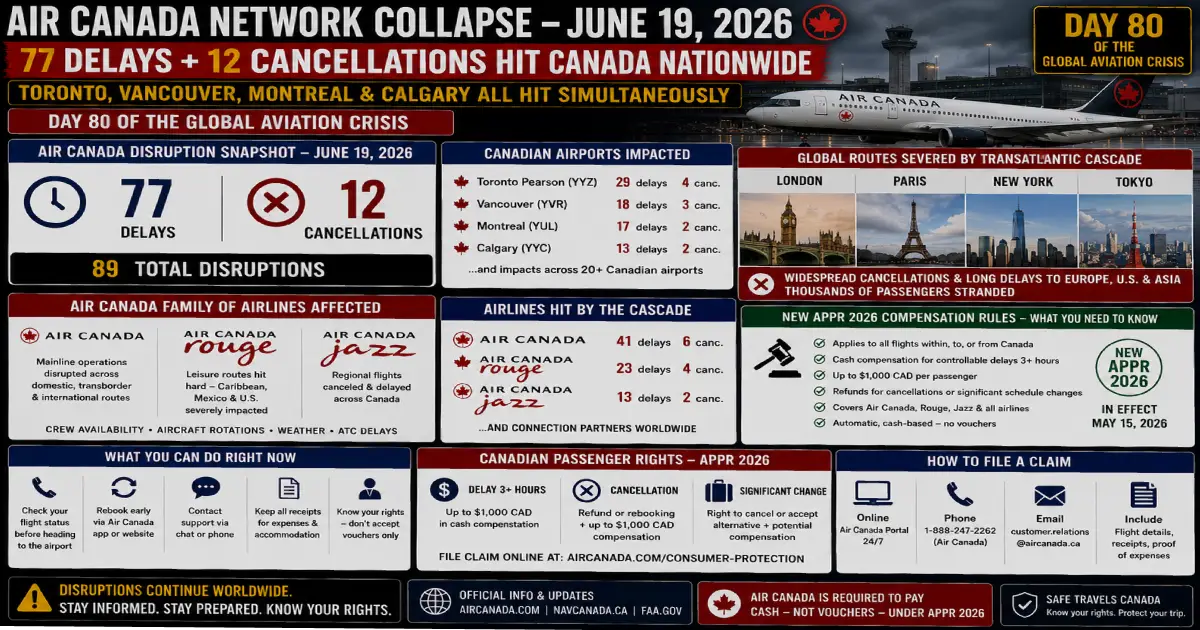
On June 19, 2026 — Day 80 of the continuous US-Canada aviation crisis — Air Canada has recorded 77 flight delays and 12 hard cancellations for a total of 89 network disruptions, simultaneously paralyzing its operations at Toronto Pearson International Airport (YYZ), Vancouver International Airport (YVR), Montréal-Trudeau International Airport (YUL), and Calgary International Airport (YYC). Air Canada Rouge and Jazz Aviation — the two subsidiaries that handle Air Canada’s leisure and regional feeding operations respectively — are also disrupted, making this an Air Canada Group collapse rather than a mainline-only event.
The international cascade is what makes today’s Air Canada disruption materially different from a domestic-only bad day. Air Canada is not just Canada’s domestic carrier. It is the primary operator of Canada’s transatlantic and transpacific international routes — Toronto and Montreal to London, Paris, Frankfurt, and Amsterdam; Toronto and Vancouver to Tokyo, Hong Kong, Seoul, and Sydney. When Air Canada’s Toronto hub records 12 cancellations and 77 delays, the flights that don’t operate today include transatlantic departures to London Heathrow and Paris CDG. The aircraft that don’t make those flights are the same aircraft that were supposed to return from London and Paris tonight. The crews that were supposed to operate tomorrow’s London–Toronto service are now the crews who spent today in a delayed operations recovery mode. Tomorrow’s transatlantic bank starts short.
This is Day 80. The cascade goes in every direction.
Published: June 19, 2026 — Thursday (Day 80 of the North American Aviation Crisis) Air Canada total today: 77 delays + 12 cancellations = 89 network disruptions Hubs paralyzed: Toronto Pearson (YYZ) · Vancouver (YVR) · Montréal-Trudeau (YUL) · Calgary (YYC) Air Canada subsidiaries: Jazz Aviation disrupted · Air Canada Rouge disrupted International cascade confirmed: London Heathrow · London Gatwick · Paris CDG · New York JFK/EWR · Tokyo Narita/Haneda Additional domestic routes severed: Ottawa · Halifax · Winnipeg · Edmonton · Quebec City · St. John’s Disruption cause: Positioning debt from June 17–18 US-Canada disruptions + Day 80 national crisis baseline Previous worst Canada day (this crisis): June 16, 2026 — 594 delays + 77 cancellations nationally June 19 AC context: Significantly lower volume than June 16 peak — but 12 cancellations is AC’s highest single-carrier cancellation count in 8 days Vancouver additional disruptions: Air Canada Rouge + Jazz + WestJet cancel combined 8 further flights at YVR · 31 additional delays · 40+ cities affected APPR compensation: ✅ CAD $400–$1,000 for controllable delays — burden on airline to prove exceptional circumstances 2026 APPR reform: ✅ New third-party dispute resolution body announced Spring 2026 · Backlog clearing initiative active Unconditional refund: ✅ Full cash refund for all cancellations regardless of cause Rebooking obligation: ✅ Next available flight within 48 hours or full refund Air Canada customer service: aircanada.com → My Bookings | 1-888-247-2262 CTA complaints: otc-cta.gc.ca → Air Travel Complaints
Air Canada does not operate as a single airline. It operates as a group of three distinct carriers sharing a common network, hub infrastructure, and code:
Air Canada Mainline operates wide-body and narrow-body jet services on domestic trunk routes (YYZ–YVR, YUL–YYZ), international long-haul (YYZ–LHR, YYZ–CDG, YYZ–NRT, YYZ–HKG, YVR–NRT), and transborder US services.
Jazz Aviation (operating as Air Canada Express) operates turboprop and regional jet services on thin-frequency domestic routes — connecting Atlantic Canada, Quebec communities, and regional Ontario cities to the Air Canada mainline network at Toronto, Montreal, and Halifax. Jazz’s routes are the connective tissue between small Canadian communities and the main Air Canada grid.
Air Canada Rouge operates leisure-configured Airbus A319/A321 aircraft on high-volume leisure routes — sun destinations in the Caribbean and Mexico from Toronto and Montreal, and European seasonal routes in summer.
When all three arms of the Air Canada Group are disrupted simultaneously — as they are today — the disruption is not simply additive. It is multiplicative. A Jazz delay on the Halifax–Toronto feeder keeps a mainline passenger from making their Toronto–London connection. A Rouge cancellation on the Toronto–Cancún flight strands a leisure passenger and simultaneously keeps the Rouge aircraft in the wrong position for its next scheduled rotation. Today’s 89 Air Canada Group disruptions are the result of all three wheels of this machine turning improperly at the same time.
Toronto Pearson is the largest airport in Canada and Air Canada’s primary hub — the gateway through which the vast majority of Air Canada’s international departures and connections flow. Today, YYZ is the epicentre of the Air Canada collapse. The 12 cancellations recorded in Air Canada’s network today are concentrated at Pearson, where the airline’s highest-frequency operations are also the most cascaded.
Toronto international routes disrupted today:
YYZ → London Heathrow (AC848/AC856/AC858): Air Canada’s London services are its highest-revenue transatlantic routes. Any Toronto–London cancellation today is not a recoverable disruption by tomorrow morning — the crew that was supposed to fly YYZ–LHR today needs rest before they can fly the LHR–YYZ return tomorrow. The gap propagates.
YYZ → Paris Charles de Gaulle (AC872): Today is also Paris CDG strike recovery Day 1 (the CDG ground staff walkout ended last night at 23:59). An Air Canada Toronto–Paris service arriving at a CDG that is still rebuilding from its strike is a compound disruption risk — even if the AC flight departs on time from Toronto, the CDG end is still under operational stress. Any AC YYZ–CDG passenger today connecting to an Air France onward service at CDG faces dual disruption.
YYZ → New York (multiple): Air Canada operates YYZ–JFK and YYZ–EWR services. On a day when JFK is itself recording 375 delays (JetBlue’s worst day of the crisis), Air Canada’s New York connections are hitting a disrupted arrival airport even when they depart Toronto on time.
YYZ → Tokyo Narita (AC001/AC003): Air Canada operates its flagship Pacific service Toronto–Vancouver–Tokyo. Today, with Japan’s aviation grid showing 353 delays of its own due to tsuyu rains, the Tokyo end of this service is under independent pressure. A delayed YYZ–NRT departure today arrives into a Narita already dealing with domestic cascade.
Toronto domestic routes disrupted:
Terminal context at YYZ: Air Canada operates from Terminals 1 and 3 at Toronto Pearson. International departures use Terminal 1, Pier F (Star Alliance international) and Pier D/E (US transborder). Domestic Air Canada services depart from Terminal 1, Piers B and C. Jazz operations are from Terminal 1, Pier B gates. If you are at YYZ today, go directly to the Air Canada service desk in your terminal rather than waiting at the gate — desk agents have more rebooking authority and access than gate agents.
Vancouver is Air Canada’s Pacific gateway and its second-most important hub, anchoring the airline’s YVR–Tokyo, YVR–Hong Kong, and YVR–Seoul operations. Today, Vancouver has been hit not just by Air Canada mainline disruptions but by a simultaneous collapse across its subsidiary and partner carriers.
Air Canada Rouge, Jazz Aviation, and WestJet cancelled a combined 8 flights at Vancouver and reported 31 additional delays today, disrupting connections to more than 40 cities spanning Canada, the United States, Germany, Japan, China, and Hong Kong. No specific single cause has been officially disclosed for the Vancouver disruption — the most likely explanation is the accumulation of Day 80 positioning debt, with aircraft and crews arriving at Vancouver out of sequence after yesterday’s disruption.
Vancouver Pacific routes at risk:
Domestic disruptions from Vancouver:
Air Canada Terminal at YVR: Air Canada domestic and international operate from the Domestic Terminal (YVR Main Terminal, Level 3 Departures). International departures from the International Terminal, connected to the Main Terminal. Jazz operations use the domestic gates within the main terminal. Air Canada’s Maple Leaf Lounge at YVR is in the International Terminal — accessible for Aeroplan Altitude members.
Montreal is Air Canada’s primary transatlantic gateway for European routes and its second-largest hub overall. Today’s YUL disruptions are hitting both Air Canada’s direct European services and the Air Transat and Jazz operations that share the airport.
Montreal’s European exposure today: Air Canada operates Montreal direct to London Heathrow, Paris CDG, Geneva, Lyon, Brussels, Lisbon, Dublin, and Barcelona in its summer schedule. YUL is also the primary hub for Air Canada’s service to French-speaking Africa and the Caribbean. Any Montreal–European disruption today is compounded by the Paris CDG strike recovery on the other end — an Air Canada YUL–CDG service arriving at a partially recovered CDG on June 19 is landing into an airport that is still rebuilding from yesterday’s ground staff walkout.
Jazz at Montreal: Jazz Aviation is Air Canada Express at YUL — operating regional feeders from Quebec City (YQB), Sept-Îles (YZV), Val-d’Or (YVO), and Atlantic Canada points into Montreal. These thin-frequency routes — where Jazz often operates the only daily service — are where the June 19 cancellations land hardest. A cancelled YQB–YUL service today means no travel option from Quebec City to the Air Canada mainline network until tomorrow.
Air Transat at YUL: Air Transat is not an Air Canada subsidiary but shares Montreal as its primary base. Today’s YUL disruptions are affecting Air Transat charter leisure services, particularly its European routes. Air Transat passengers are covered by APPR and should follow the same rights framework as Air Canada passengers.
Calgary is Air Canada’s western hub and the primary air gateway for Alberta’s energy industry business traffic. Today’s YYC disruptions are hitting the Alberta–Toronto corridor particularly hard — the highest-frequency business route in the Air Canada Calgary network.
Calgary’s disruption pattern today: YYC is recording delays rather than the cancellation concentration visible at YYZ. The Calgary–Toronto corridor (YYC–YYZ) is Air Canada’s most profitable domestic route. Today, the multiple daily YYC–YYZ services are running delayed rather than cancelled — which creates a different problem for business travellers than a cancellation does. A delayed Calgary–Toronto service that causes a missed YYZ–London connection is more difficult to resolve than a cancelled service, because the passenger is already in transit and cannot easily access a rebooking desk.
The Air Canada international cascade today is not speculative. It is the mechanical consequence of how Air Canada’s fleet rotation works. An Air Canada aircraft that was supposed to fly YYZ–LHR today and then return as LHR–YYZ tomorrow cannot do either if the outbound YYZ–LHR is cancelled. The crew that was supposed to operate the LHR–YYZ return leg tomorrow was positioning today on the cancelled outbound. Tomorrow’s transatlantic service starts without that aircraft and without that crew.
London Heathrow: Air Canada operates 4–5 daily Toronto–London and 1–2 Montreal–London services. Today’s YYZ and YUL disruptions are affecting positioning aircraft and crews for the London routes. UK passengers booked on London–Toronto return services tomorrow should check their flight status today — the June 19 disruption will manifest in the June 20 London departures.
Paris CDG: Air Canada’s YYZ–CDG and YUL–CDG services today arrive into a Paris that is still clearing the June 18 strike recovery. UK and European passengers connecting through Paris on Air Canada–Air France partnerships should assume that YYZ–CDG connecting itineraries today carry elevated disruption risk at both ends simultaneously.
New York JFK / Newark EWR: Air Canada’s transborder US services between Toronto and New York are in the disruption zone. New York JFK is simultaneously recording 375 delays today (JetBlue’s collapse). Air Canada passengers connecting YYZ–JFK or YYZ–EWR today face two disrupted airports in sequence.
Tokyo Narita: Air Canada’s YYZ–YVR–NRT service today operates into a Narita that is recording 353 delays from Japan’s tsuyu disruption. Japanese passengers connecting Toronto–Tokyo on Air Canada should check both the YYZ end (Air Canada delays) and the NRT end (JAL/ANA domestic cascade).
| Date | AC Cancellations | AC Delays | Context |
|---|---|---|---|
| June 5, 2026 | 8 | 41 | Day 66 moderate |
| June 7, 2026 | 11 | 53 | Day 68 elevated |
| June 11, 2026 | 14 | 88 | Day 72 worst June to that point |
| June 15, 2026 | 19 | 145 | Day 76 US crisis peak — Canada absorbed cascade |
| June 16, 2026 | AC mainline 28 (national 77 cancels total) | 594 national | Day 77 Canada’s worst 2026 day |
| June 17, 2026 | AC mainline 109 delays | 526 national disruptions | Day 78 — severe |
| June 19, 2026 | 12 | 77 | Day 80 — 4-hub simultaneous collapse |
Today’s absolute numbers are lower than the June 16 and June 17 peak days, but the four-hub simultaneous pattern — all of Toronto, Vancouver, Montreal, and Calgary disrupted in a single Air Canada event — is notable. On most disruption days, the chaos concentrates at one or two airports. Today it is distributed equally across Canada’s entire major airport system.
This is the rights section that matters most for Canadian passengers in 2026, because the rules are in active transition. Under the 2023 Budget Implementation Act — which reformed the Canada Transportation Act — the APPR framework is being amended by the Canadian Transportation Agency to simplify and strengthen compensation claims. The key change coming:
The burden shift: Under the amended rules being implemented in 2026, airlines will be obligated to provide compensation unless they can prove the disruption was due to clearly defined exceptional circumstances. This is the reverse of the previous framework, where passengers had to establish that the disruption was within airline control. Once implemented, Air Canada will need to prove your disruption was an exceptional circumstance — you will not need to prove it was controllable.
Third-party dispute resolution: The Spring Economic Update 2026 announced a neutral third-party dispute resolution organisation to clear the existing Air Canada complaint backlog. Airlines found at fault by the new body must comply and resolve cases. The confidentiality requirement on complaint outcomes has also been removed — passengers can now discuss what Air Canada agreed to pay.
Until the full amendments are in force: The current APPR rules (as of March 31, 2026) apply today. Here is what you are owed right now.
Under the APPR as currently in force, Air Canada (a large airline) must pay:
| Arrival delay | Compensation |
|---|---|
| 3 hours to under 6 hours | CAD $400 per passenger |
| 6 hours to under 9 hours | CAD $700 per passenger |
| 9 hours or more | CAD $1,000 per passenger |
Applies when: The disruption is within Air Canada’s control and not required for safety. Today’s positioning-debt delays — caused by Day 80’s accumulated crisis rather than by an active weather event at your specific departure airport — have a strong basis for being classified as controllable. Air Canada’s obligation is to prove exceptional circumstances, not yours to disprove them.
The compensation limit: Claims must be filed with Air Canada within 1 year of the travel date. If Air Canada rejects the claim, escalate to the CTA within 1 year of Air Canada’s response.
Full cash refund: For every cancellation today — regardless of cause, regardless of whether Air Canada cites weather or exceptional circumstances — you have an unconditional right to a full cash refund of your fare to your original payment method. Air Canada must process refunds within 30 days under current APPR rules (credit card and other payment methods).
Rebooking: Air Canada must rebook you on the next available Air Canada flight at no additional charge. If Air Canada cannot rebook you within 48 hours of your original departure time, you are entitled to choose a full refund instead.
Meals from 2+ hours: From a 2-hour delay at the airport, Air Canada must provide meals and refreshments in reasonable proportion to your waiting time. This is unconditional — weather events do not exempt Air Canada from the meal obligation.
Hotel for overnight delays: For delays within Air Canada’s control that require an overnight wait, Air Canada must provide hotel accommodation and ground transport to/from the hotel. For weather-related delays, this is voluntary — but Air Canada has historically provided accommodation for overnight weather delays as a customer service measure.
Communication: Air Canada must update you every 30 minutes during a flight disruption if status information is available.
Step 1: File with Air Canada first. Use the online form at aircanada.com → Help → Contact Us → File a Claim. Document your original booking, your actual departure and arrival times, and the stated reason for disruption.
Step 2: If Air Canada rejects or doesn’t respond within 30 days: file with the Canadian Transportation Agency (CTA) at otc-cta.gc.ca → Air Travel Complaints. The CTA’s new third-party dispute body will adjudicate your case. Airlines found at fault must comply.
Step 3: Third-party services — AirHelp Canada, Flightright, or DoNotPay can assist with APPR claims on a contingency basis (typically 25–30% of recovered compensation).
Time limit: Claims must be filed within 1 year of your travel date. File promptly.
For UK passengers whose Air Canada service departs from a UK airport (London Heathrow), UK261 applies to the departure leg. For today’s UK-relevant disruptions — particularly passengers who were supposed to fly YYZ–LHR or YUL–LHR and are now stranded in Toronto or Montreal — the departure was from Canada, so UK261 does not apply. APPR governs.
For tomorrow’s LHR–YYZ Air Canada service (which may be impacted by today’s positioning debt), UK261 applies for the Heathrow departure leg. Check your flight status at aircanada.com → Flight Status from this evening.
US passengers on Air Canada services between the US and Canada are protected by APPR for the Canadian leg and by DOT rules for the US departure leg. For YYZ–EWR or YYZ–JFK services, DOT’s 2024 Final Rule applies for any US departure: automatic cash refunds for 3+ hour domestic or 6+ hour international delays.
The Air Canada disruption on June 19 will carry positioning debt into June 20. Aircraft and crews that failed to complete planned rotations today will be out of position tomorrow morning. Based on Air Canada’s recent disruption recovery patterns:
June 20 (Day 81): Elevated disruption expected at YYZ and YVR. Long-haul transatlantic departures from Toronto and Montreal most at risk in the morning bank. Domestic Jazz feeders at risk throughout the day.
June 21–22: Recovery. Air Canada typically achieves 75–80% normalisation within 48 hours of a moderate disruption event (12 cancellations). Full normalisation by June 22 barring new weather.
June 26: Italy nationwide ground handling strike — does not directly affect Air Canada’s Canadian operations, but passengers connecting YYZ–LHR–Rome or YUL–CDG–Italy on June 26 should monitor the Italy disruption for their European end.
Posted By : Vinay
This article is provided for general informational purposes only and is based on information available at the time of publication. Travel advisories, airline schedules, airport operations, visa requirements, government regulations, and other travel-related information are subject to change without prior notice. While Travel Tourister makes reasonable efforts to verify information using official announcements, government publications, airline and airport communications, and other reliable sources, we cannot guarantee that all information remains complete, accurate, or up to date at all times. Readers should independently verify any information that may affect their travel plans with the relevant airline, airport authority, government agency, embassy, or other official source before making travel, financial, or other decisions. Travel Tourister shall not be liable for any direct or indirect loss, inconvenience, or damages arising from the use of or reliance on the information contained in this article. Nothing in this publication constitutes legal, immigration, financial, or professional travel advice. If you believe any information in this article is inaccurate or outdated, please contact our editorial team. We review all credible correction requests promptly and update our content whenever appropriate.
Lastest News
2nd Floor, 39, Above Kirti Club, DLF Industrial Area, Kirti Nagar, New Delhi, Delhi 110015



Travel Tourister is a leading Travel portal where we introduce travellers to trusted travel agents to make their journey hasselfree, memorable And happy. Travel Tourister is a platform where travellers get Tour packages ,Hotel packages deals through trusted travel companies And hoteliers who are working with us across the world. We always try to find new and more travel agents and hoteliers from every nook and corners across the world so that you could compare the deals with different travel agents and hoteliers and book your tour or hotel with the one you have chosen according to your taste and budget.
Copyright © Travel Tourister, India. All Rights Reserved

 Call
Call Enquiry