Published on : 19 Jun 2026
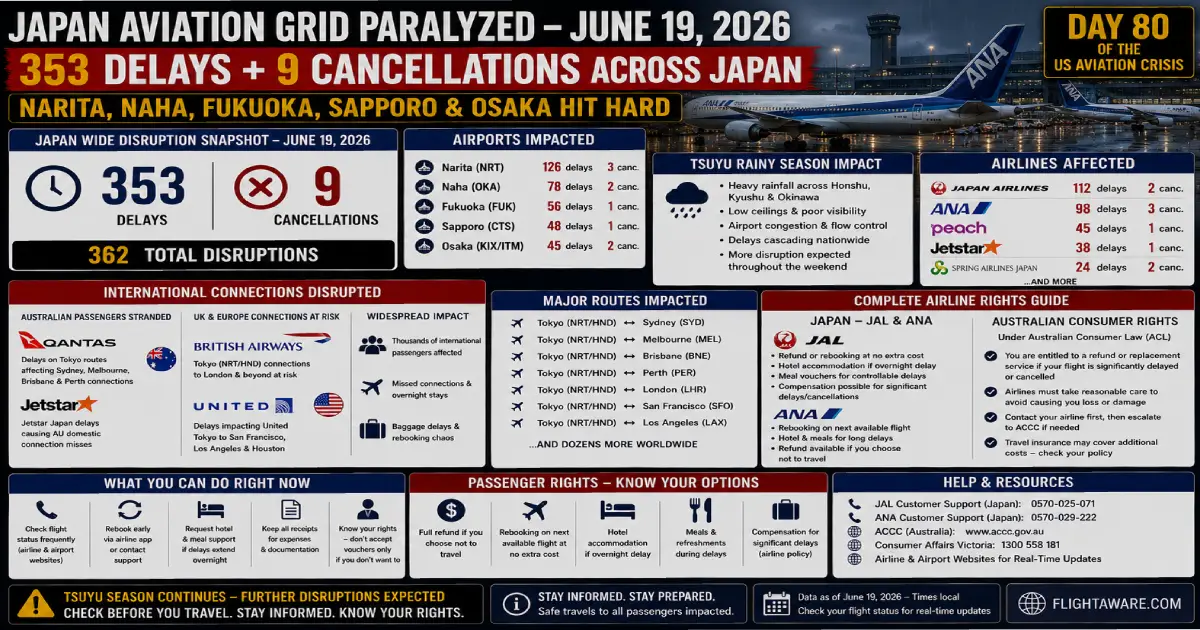
Japan’s aviation network — the most precisely punctual in the world — broke today from Hokkaido to Okinawa.
On June 19, 2026, major Japanese airports descended into a simultaneous operational collapse, with Japan Airlines (JAL), All Nippon Airways (ANA), Peach Aviation, Jetstar Japan, and Spring Airlines recording 353 flight delays and 9 hard cancellations across the country’s aviation grid. Critical transit corridors in Tokyo, Osaka, Fukuoka, Sapporo, and Naha have been paralyzed as Japan’s tsuyu rainy season — which runs from early June through mid-July and in 2026 is tracking heavier than average, especially in Kyushu — delivers a sustained weather disruption at the exact moment the summer tourist peak is ramping up. Heavy rain is sweeping across western Japan today, with Kyushu seeing torrential rain and thunderstorms that are moving eastward toward central Japan and Tohoku.
For the international reader, Japan’s aviation disruption matters beyond its own borders for a specific and often underreported reason: Japan is Australia’s third most popular international destination — surpassing the United States — with over one million Australian visitors annually, served by Qantas, Jetstar, JAL, ANA, and connecting carriers across a 9–10 hour corridor that makes Tokyo, Osaka, and Okinawa among the most accessible long-haul markets from Sydney, Melbourne, and Brisbane. An Australian connecting from Qantas or JAL into Narita today who needs to board a domestic JAL or Peach Aviation service to reach Osaka, Fukuoka, or Okinawa faces a broken onward connection in a country where the alternative — the Shinkansen — exists, but requires knowing it is an option and understanding how to use it.
For UK passengers, JAL and ANA operate Tokyo services from London Heathrow, and multiple carriers route through Tokyo for onward Asia-Pacific connections. A disrupted Narita on June 19 breaks those transit windows.
This article is the only English-language travel news piece today covering Japan’s June 19 aviation disruption with an Australian and UK connecting passenger angle. Here is everything you need to know.
Published: June 19, 2026 — Thursday (European Aviation Crisis Day 80 · Japan Tsuyu Peak) Japan total disruptions today: 353 delays + 9 cancellations = 362 total Airports affected: Tokyo Narita (NRT) · Naha Okinawa (OKA) · Fukuoka (FUK) · Sapporo New Chitose (CTS) · Osaka Kansai (KIX) · Osaka Itami (ITM) · Tokyo Haneda (HND) Primary cause: Tsuyu rainy season — heavy rain and thunderstorms sweeping from Kyushu eastward across western Japan; 2026 tsuyu tracking heavier than average in Kyushu and Tohoku Carriers disrupted: Japan Airlines (JAL) · All Nippon Airways (ANA) · Peach Aviation · Jetstar Japan · Spring Airlines Japan Australian connecting carriers affected: Qantas (SYD/MEL–NRT via JAL codeshare) · Jetstar (SYD–NRT) · JAL (SYD/MEL–NRT) · ANA (SYD/MEL–NRT) UK connecting carriers affected: Japan Airlines (LHR–NRT) · ANA (LHR–NRT) · British Airways (LHR–NRT codeshare) · Virgin Atlantic (LHR–NRT) Most disrupted airports by volume: Naha (OKA) highest concentration · Narita (NRT) international impact · Fukuoka (FUK) Kyushu gateway Shinkansen alternative: ✅ Highly recommended for domestic connections — faster, unaffected by aviation disruption JAL/ANA refund rights: ✅ Full refund for cancellations · ✅ Rebooking · ✅ Meals and accommodation for overnight waits Australian ACL rights: ✅ Australian Consumer Law protections apply for flights departing Australian airports JMA weather alert: Heavy rain warning active for western Japan — Kyushu, Shikoku, and Kansai regions Recovery forecast: 24–48 hours as weather system moves eastward toward Tohoku by June 21
Japan’s rainy season — called tsuyu (梅雨), or “plum rain” — is an annual meteorological event driven by the collision of warm southern air masses from the Pacific with cooler air over China and the Sea of Okhotsk. It sweeps Japan from south to north, beginning in Okinawa in early May and reaching Tohoku by mid-June. In most years it brings overcast skies, on-and-off showers, and elevated humidity — manageable for aviation with minor delays.
2026’s tsuyu is not a normal year. In 2026, the rainfall will be heavier than usual, especially in Kyushu and the Tohoku region. Southern Kyushu entered the rainy season around June 1 and Fukuoka around June 4. By June 19, the rainy front is at or near its peak intensity over western Japan — and today, Kyushu is experiencing torrential rain and thunderstorms, with the system moving eastward toward eastern Japan through June 21.
For Japanese aviation, tsuyu is the most predictable yet most disruptive seasonal weather pattern of the year. Japanese airlines — particularly JAL and ANA — operate at some of the world’s tightest schedule tolerances. ANA in particular has historically ranked among the world’s most on-time airlines, with average delays measured in single-digit minutes. This punctuality is achieved through tightly packed turnaround schedules, minimal ground time between rotations, and precise crew planning with almost no buffer.
When tsuyu delivers sustained, multi-airport rain across Kyushu and Kansai simultaneously, that precision model breaks. Aircraft that were supposed to depart Fukuoka at 09:00 are delayed by rain-related ground operations slowing. They arrive at Narita 45 minutes late. The crew that was supposed to operate the 11:30 Narita–Sapporo service has been flying since 06:00 and is now approaching duty limits. The 11:30 becomes a 13:00. The 13:00 Narita–Osaka cascades into the 15:30 Osaka–Naha. By mid-afternoon, a weather event that began in Fukuoka is producing delays at Naha, Sapporo, and Haneda.
That cascade, today, is 353 delays and 9 cancellations across the entire national grid.
Narita is Japan’s primary international gateway and the airport through which the vast majority of Australian and UK long-haul passengers enter and exit Japan. On June 19, Narita is recording significant delays across its international and domestic connecting operations.
The Australian connecting passenger problem at NRT: An Australian traveller who flew Qantas or JAL from Sydney overnight and lands at Narita this morning faces the following scenario. Their international arrival is processed normally — Narita’s international arrival terminal is not itself disrupted. But the domestic JAL or ANA service they booked from Narita to their onward domestic destination — Osaka, Fukuoka, Naha (Okinawa), Sapporo, or Sendai — is delayed. In some cases, particularly on Naha and Fukuoka routes, the delay is 2–3 hours. For Okinawa-bound Australian tourists who booked a week of island-hopping from the southern islands, a 3-hour delay landing at Naha means a lost afternoon of their holiday.
The UK connecting passenger problem at NRT: JAL operates London Heathrow–Narita (JL43/JL44) and ANA operates Heathrow–Narita (NH211/NH212). Both are long-haul services arriving at Narita in the morning. Passengers who use Narita as a transit point for onward connections to Hong Kong, Seoul, Singapore, or Bangkok — or who connect to domestic JAL/ANA services to reach their Japanese destination — face the same domestic delay cascade as Australian passengers.
Narita today: JAL’s Narita domestic gates are running delays across Narita–Fukuoka, Narita–Naha, and Narita–Sapporo. ANA’s domestic services from Narita are similarly delayed. Peach Aviation, which uses Narita as its primary base, is disrupted across multiple short-haul routes including Narita–Seoul, Narita–Taipei, and Narita–Osaka.
Naha Airport in Okinawa is today’s most disrupted airport in Japan. Naha is the gateway to the Ryukyu Islands — Okinawa, Ishigaki, Miyako — and the primary destination for Australian tourists who have identified Okinawa as a resort-islands alternative to Bali. Okinawa saw a 71% search spike from Australian travellers in early 2026, driven by its subtropical climate, coral reefs, and distinct Ryukyu culture.
Okinawa entered its rainy season early this year — around May 4. By June 19, Okinawa is actually approaching the tail end of its local tsuyu, with the official end typically around June 21. But the weather system sweeping westward across Kyushu today is creating fresh rain at Naha even as the local tsuyu begins to ease. The combination is producing a high concentration of delays and cancellations at Okinawa today — the airport that services the holiday island tens of thousands of Australian tourists chose specifically because it was “not Tokyo.”
For Australian tourists at Naha today: If you are in Okinawa trying to fly back to Tokyo to connect your international Qantas or JAL service home, the disruption at Naha means your outbound domestic flight is at elevated risk. JAL and ANA both operate Naha–Tokyo (Haneda and Narita) services throughout the day. Check your specific flight status before leaving your hotel for the airport.
Key advice: Allow a minimum 4-hour buffer between your Naha domestic arrival at Narita and your international departure. Narita’s international check-in typically requires approximately 3 hours before departure, and on a disruption day with domestic arrival delays, 4 hours is the realistic minimum.
Fukuoka is the gateway to Kyushu and one of Japan’s four major domestic aviation hubs. It is also the airport most directly under the June 19 tsuyu thunderstorm system. Fukuoka entered the rainy season earliest of all Japanese mainland airports, and today’s torrential rain and thunderstorms in the Kyushu region are hitting FUK hardest.
Fukuoka’s disruptions today are both operational and cascade-generating. Every JAL and ANA aircraft that cannot depart Fukuoka on time becomes a late aircraft at its next destination — Narita, Haneda, Osaka, or Sapporo — creating the second ring of disruption that is producing today’s national total.
International connections through Fukuoka: Fukuoka operates international services to Seoul (Korean Air, Jeju Air, Asiana), Busan (Air Busan), and various Chinese cities (Spring Airlines, Air China). Spring Airlines Japan — one of the carriers disrupted today — operates Fukuoka–Shanghai and Fukuoka–domestic routes. Chinese and South Korean passengers connecting through Fukuoka today are in the disruption zone.
Sapporo’s New Chitose Airport is in Hokkaido — Japan’s northernmost main island, which does not experience traditional tsuyu. Hokkaido is the one part of Japan that is largely exempt from the rainy season. In a normal year, disruptions at New Chitose would be rare in June.
Today’s Sapporo disruption is a cascade arrival — it is not caused by local weather at CTS but by the downstream positioning failures propagating north from Tokyo, Osaka, and Fukuoka. Aircraft that were supposed to fly the Tokyo–Sapporo and Osaka–Sapporo routes are late at their origin airports because of the tsuyu disruption. They arrive at New Chitose late, and their outbound Sapporo–Tokyo returns are delayed.
The Hokkaido Summer Festival season launches in early July. Australian and international tourists booked on June 19 domestic services to Sapporo for the start of their Hokkaido summer itinerary are today experiencing delays that eat into their first day in Hokkaido.
Osaka operates two airports: Kansai International (on an artificial island in Osaka Bay, handling long-haul international and domestic) and Itami (exclusively domestic, serving central Osaka’s business market). Both are in the weather impact zone today, with Kansai recording delays on international services to Seoul, Taipei, Shanghai, Hong Kong, and Nagoya, and Itami recording JAL and ANA domestic delays on its high-frequency Osaka–Tokyo route.
The Osaka–Tokyo air corridor (Itami or KIX to Haneda) is Japan’s busiest domestic route. On a normal day, 56+ JAL and ANA flights operate between Osaka and Tokyo. On June 19, with both ends of this route under weather and cascade pressure, the Osaka–Tokyo shuttle is running late throughout the day.
JAL operates the most comprehensive domestic and international network in Japan. Its disruption today spans:
Domestic: Narita–Naha · Narita–Fukuoka · Narita–Sapporo · Haneda–Osaka · Haneda–Fukuoka · Haneda–Naha · Fukuoka–Sapporo and dozens of additional domestic trunk routes.
International from Narita/Haneda: London Heathrow (JL43/JL44) · Sydney (JL771/JL772) · Melbourne · Los Angeles · New York · Paris · Frankfurt · Helsinki · Singapore · Bangkok · Beijing · Shanghai · Hong Kong.
For JAL’s international long-haul services departing Narita and Haneda, the June 19 disruption’s primary impact is on same-day connecting passengers — not on the long-haul aircraft themselves, which typically have separate crew positioning. A JAL Sydney–Narita service that lands at Narita this morning will not itself be delayed by the domestic disruption. But the Australian passenger on board who then connects to a domestic JAL service to Fukuoka or Naha will find that connecting service delayed.
JAL rebooking: jal.com → Manage Booking → Flight Disruption. JAL’s English-language customer service line for international passengers: 0120-25-5931 (Japan) or the local JAL office in your country of origin.
ANA is consistently ranked among the world’s most punctual airlines — in a normal year, its average delay is measured in single-digit minutes. Today’s tsuyu disruption is visible precisely because ANA’s standard is so high. A carrier that normally operates at 94%+ on-time performance recording 353+ network delays in a single day is a dramatic statistical departure.
ANA’s disruption today mirrors JAL’s in structure: domestic trunk routes (Haneda–Osaka, Haneda–Fukuoka, Narita–Sapporo) are the most affected, with international long-haul (Heathrow, Sydney, Melbourne, Los Angeles, Frankfurt) largely insulated except for same-day domestic connections.
ANA rebooking: ana.co.jp → Manage Booking → Flight Disruption. ANA English-language customer support: 0120-029-709 (Japan) or ANA’s international contact centres.
Peach Aviation is Japan’s largest low-cost carrier, operating from its Kansai International base with a network covering domestic Japan, South Korea, Taiwan, Hong Kong, China, and Southeast Asia. Peach has a fleet of approximately 50 A320-family aircraft and a lean operating model — tight turnarounds, minimal spare aircraft — that makes it among the most cascade-vulnerable carriers in the Japanese market.
Today’s Peach disruptions are concentrated at Narita (its secondary base) and Kansai, with delays and cancellations on:
Peach passenger action: en.flypeach.com → Flight Information → Delays and Cancellations.
Important Peach rights note: Peach is a low-cost carrier and its rebooking obligations under Japanese consumer law are narrower than JAL and ANA. However, Japanese aviation regulations require Peach to provide full refunds for cancellations and free rebooking on the next available Peach service. If no Peach alternative is available within a reasonable timeframe, passengers may need to book independently on JAL or ANA and seek reimbursement — keep all receipts.
Jetstar Japan is a joint venture between Qantas Group and Japan Airlines, operating as a low-cost domestic Japanese carrier. This makes Jetstar Japan uniquely important for Australian passengers: it is the carrier that Australian Qantas and Jetstar international passengers most commonly use for their onward Japanese domestic connections after landing at Narita.
An Australian family who flew Qantas Sydney–Tokyo and then booked a Jetstar Japan service from Narita to Okinawa or Sapporo is today at the intersection of two disruption points: the domestic Jetstar Japan delay and the Qantas codeshare relationship that technically makes Qantas responsible for the quality of the connecting experience.
For Australian Qantas passengers connecting to Jetstar Japan: If your Qantas booking includes a Jetstar Japan domestic connection on the same booking reference, Qantas has a responsibility to rebook your entire itinerary if the Jetstar Japan segment is disrupted. Contact Qantas — not Jetstar Japan — if your connecting domestic service is cancelled. Qantas customer service: 13 13 13 (Australia) or qantas.com → Manage Booking.
Jetstar Japan passenger action (standalone bookings): If you booked Jetstar Japan independently, contact Jetstar Japan directly: jal.co.jp/en/js or Jetstar Japan’s Japan customer line: 0570-550-538.
Spring Airlines Japan operates domestic Japanese routes and China connections — Shanghai Pudong, Shanghai Hongqiao, and other Chinese cities from Fukuoka and Narita. Today’s Fukuoka disruption is directly affecting Spring Airlines Japan’s Fukuoka–Shanghai route, which is the primary air link between Kyushu and China.
Spring Airlines Japan contact: en.ch.com → Customer Service.
This is the section that every English-language travel article about Japan aviation disruption fails to include. It is also the most practically useful section for Australian and UK passengers who find themselves with a cancelled or severely delayed domestic Japanese flight.
Japan’s Shinkansen (bullet train) network is one of the best alternatives to domestic aviation anywhere in the world. It is fast, punctual (average annual delays under 1 minute), runs in all weather including heavy rain, and connects every major Japanese city that aviation also serves. On a tsuyu disruption day when the aviation grid is showing 353 delays, the Shinkansen is operating normally.
Shinkansen journey times from Tokyo:
| Destination | Shinkansen time | Flight time (door to door) |
|---|---|---|
| Osaka (Shin-Osaka) | 2h 30min (Nozomi) | ~2h 45min (incl. airport time) |
| Hiroshima | 3h 45min (Nozomi) | ~3h 30min |
| Fukuoka (Hakata) | 5h (Nozomi) | ~4h (incl. airport time) |
| Nagoya | 1h 40min (Nozomi) | ~2h (incl. airport time) |
| Sendai | 1h 30min (Hayabusa) | ~1h 45min |
| Sapporo | 4h 30min (Hokkaido Shinkansen, with transfer) | ~2h |
The practical verdict by route:
JR Pass holders: If you hold a Japan Rail Pass, Shinkansen travel on Nozomi and Mizuho services requires a seat reservation but no additional fare. Hayabusa services are covered by the pass with a reservation. Book seat reservations at any JR ticket counter or via the JR app.
For Australian passengers who don’t have a JR Pass: Single Shinkansen tickets can be purchased at any major station. Tokyo–Osaka Nozomi costs approximately ¥14,720 (~AUD $155). Tokyo–Fukuoka costs approximately ¥22,960 (~AUD $245). These are real-time prices — buy at the station ticket machine or Midori-no-madoguchi counter. JAL or ANA may reimburse reasonable alternative transport costs for cancelled flights — keep your Shinkansen receipt.
Japan has surpassed the United States as Australia’s third most popular international destination, with over one million Australian visitors annually. Japanese destination appeal is driven by cultural novelty, food, safety, the weak yen making Japan exceptional value for Australians, and the 9–10 hour flight time from Sydney and Melbourne that makes Japan significantly closer than European destinations.
From Sydney, Qantas, Jetstar, JAL, and ANA all operate direct services to Tokyo Narita and Haneda. Melbourne is served by JAL, ANA, and Qantas. Brisbane gains connections via Tokyo.
The connectivity picture that makes Japan popular for Australians — direct flights to Tokyo, then a domestic JAL or ANA connection to Osaka, Fukuoka, or Okinawa — is exactly the connection chain that breaks on disruption days. The international leg arrives normally. The domestic connection is delayed. The Australian tourist who planned a first-day dinner in Osaka after landing at Narita in the morning finds themselves sitting in Narita’s domestic terminal at 17:00 waiting for a 3-hours-delayed Narita–Osaka service.
What Australian passengers are owed under JAL/ANA policies today:
Australian Consumer Law (ACL): ACL protections apply to the Australian departure leg of any flight on Qantas or Jetstar departing Australia for Japan. For the Japanese domestic legs operated by JAL, ANA, Peach, or Jetstar Japan, Japanese consumer law applies. These frameworks are not identical — Japanese aviation compensation is less formalised than EU261 — but carriers operating in Japan are required to provide care and refunds for disrupted passengers.
For Australian Qantas Frequent Flyers: If your disrupted domestic Japan segment was booked on a Qantas-marketed flight (QF number) operated by JAL or Jetstar Japan, contact Qantas directly. Qantas has responsibility for the full itinerary on QF-coded flights.
JAL operates London Heathrow–Tokyo Narita (JL43 outbound, JL44 return) as its flagship UK service. ANA operates Heathrow–Narita (NH211/NH212). Both are daily long-haul services that arrive at Narita in the morning — exactly when today’s domestic cascade is most active.
UK passengers on JAL JL43 or ANA NH211 arriving at Narita today have their international legs intact. What is broken is the domestic connection they booked for the onward Japanese journey:
JAL LHR–NRT + JAL NRT–OKA (Okinawa): The LHR–NRT long-haul leg operates normally. The NRT–OKA domestic leg is delayed today because of the Naha disruption and the national cascade. UK passengers who booked Okinawa as their Japan destination face a 2–3 hour domestic delay after a 12-hour long-haul flight.
JAL/ANA LHR–NRT + domestic connection to Osaka, Fukuoka, or Sapporo: Same pattern. International leg intact, domestic leg delayed.
Rights for UK passengers on JAL and ANA departing LHR: For the LHR departure leg, UK261 applies if the service is delayed or cancelled. For the domestic Japanese leg, Japanese consumer law applies. JAL and ANA both have UK261 compliant customer service operations at Heathrow. Contact JAL at Terminal 3 or ANA at Terminal 2 at Heathrow if disrupted on the UK departure end.
Cancellations: Full refund to original payment method or free rebooking on next available JAL/ANA service, including on the other carrier if the original airline cannot accommodate within a reasonable time.
Delays of 2+ hours: Meal vouchers or meal allowance at the airport. JAL and ANA both provide physical meal vouchers at their ground service desks.
Overnight delays: Hotel accommodation and transfers. JAL provides contracted hotel accommodation near Narita and Haneda for passengers whose disruptions require an overnight wait. Present at the JAL or ANA service desk in the domestic terminal.
Language: JAL and ANA both maintain English-language service desks at Narita (Terminal 2 for ANA, Terminal 3 for JAL) and Haneda (Terminal 3 for both international operations). For domestic terminals (Narita Terminal 1, Haneda Terminal 1 and 2), the English-language service may be more limited — use the airline’s app or call the international English line.
Peach and Jetstar Japan have narrower care obligations than JAL and ANA, but Japanese Civil Aeronautics Act requirements still mandate:
For Peach cancellations: If no Peach alternative is available today or tomorrow, you may rebook independently and seek reimbursement. File a claim at en.flypeach.com → Customer Service within 30 days.
Spring Airlines Japan follows standard Japanese LCC consumer protections. For disrupted Spring Japan passengers: en.ch.com → Customer Service → Complaints and Refunds.
Tonight and June 20: The heavy rain system over Kyushu is forecast to move eastward toward Tohoku through June 21. As it moves, Fukuoka, Osaka, and Tokyo should see improving conditions. JAL and ANA typically achieve 70–80% schedule normalisation within 24–48 hours of a tsuyu disruption event — barring a second weather system.
June 21 forecast: Improving. Okinawa officially exits tsuyu around June 21 — which means the worst disruption pressure at Naha should ease by this date.
June 26 — Italy aviation strike: Japan-based carriers and passengers are not directly affected. However, international passengers routing through European hubs (Frankfurt, Amsterdam, London) who then connect to Japanese carriers should note Italy’s nationwide ground handling strike on June 26 does not affect Narita or Haneda operations.
July onwards: Japan’s tsuyu ends around July 19 for Tokyo and Osaka, later for Tohoku. The late-June and early-July period remains the highest-risk window for aviation disruption in Japan. Typhoon season — August and September — introduces a second weather disruption risk period that is more severe than tsuyu for short-notice cancellations.
Australia-Japan routes — summer 2026 outlook: Demand on Sydney/Melbourne–Tokyo routes is at record levels in 2026, driven by the weak yen and Japan’s cultural tourism appeal. Flights are heavily booked. Disruption days mean limited rebooking availability — the next JAL SYD–NRT service with available seats may be 48+ hours away if June 19’s cancellations result in a rebooking backlog.
| Date | Total disruptions | Primary cause |
|---|---|---|
| June 3, 2026 | Typhoon Jangmi — ~900 cancellations | Tropical storm — Narita, Haneda, Okinawa |
| June 4, 2026 | Recovery cascade from June 3 | Positioning debt |
| June 19, 2026 | 353 delays + 9 cancellations | Tsuyu heavy rain — Kyushu to Kansai moving east |
June 19’s disruption is structurally different from June 3’s Typhoon Jangmi event. Jangmi was a violent single-day event with 900 cancellations concentrated in the Kanto and Kansai regions. June 19 is a distributed, lower-intensity event — fewer cancellations but 353 delays across the national grid — typical of the sustained tsuyu pattern where heavy but not typhoon-level rain creates a grinding operational slowdown rather than an acute shutdown.
Posted By : Vinay
This article is provided for general informational purposes only and is based on information available at the time of publication. Travel advisories, airline schedules, airport operations, visa requirements, government regulations, and other travel-related information are subject to change without prior notice. While Travel Tourister makes reasonable efforts to verify information using official announcements, government publications, airline and airport communications, and other reliable sources, we cannot guarantee that all information remains complete, accurate, or up to date at all times. Readers should independently verify any information that may affect their travel plans with the relevant airline, airport authority, government agency, embassy, or other official source before making travel, financial, or other decisions. Travel Tourister shall not be liable for any direct or indirect loss, inconvenience, or damages arising from the use of or reliance on the information contained in this article. Nothing in this publication constitutes legal, immigration, financial, or professional travel advice. If you believe any information in this article is inaccurate or outdated, please contact our editorial team. We review all credible correction requests promptly and update our content whenever appropriate.
Lastest News
2nd Floor, 39, Above Kirti Club, DLF Industrial Area, Kirti Nagar, New Delhi, Delhi 110015



Travel Tourister is a leading Travel portal where we introduce travellers to trusted travel agents to make their journey hasselfree, memorable And happy. Travel Tourister is a platform where travellers get Tour packages ,Hotel packages deals through trusted travel companies And hoteliers who are working with us across the world. We always try to find new and more travel agents and hoteliers from every nook and corners across the world so that you could compare the deals with different travel agents and hoteliers and book your tour or hotel with the one you have chosen according to your taste and budget.
Copyright © Travel Tourister, India. All Rights Reserved

 Call
Call Enquiry