Published on : 30 Jun 2026
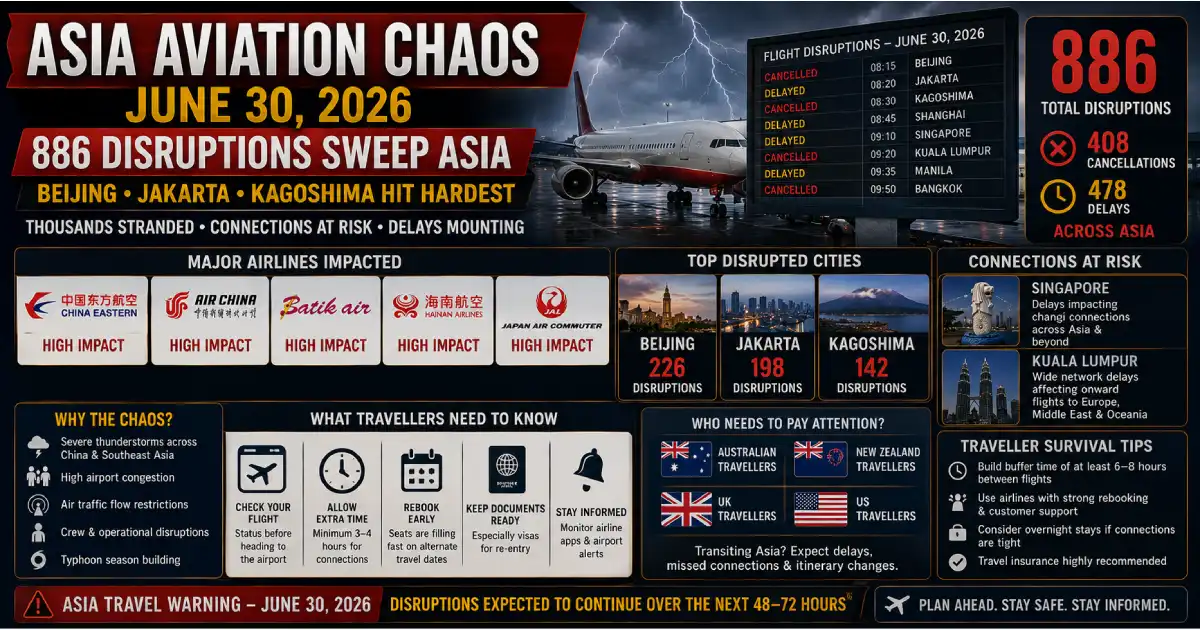
Six airlines. Three countries. 886 disrupted flights. And almost every passenger reading this has a connection running through one of them.
A major wave of aviation disruption has hit Asia’s most important travel corridors today, June 30, 2026, with six carriers — China Eastern, Air China, China Express, Hainan Airlines, Batik Air, and Japan Air Commuter — recording a combined 90 cancellations and 796 delays, for a total of 886 disrupted flights spanning China, Indonesia, and Japan. China alone accounts for more than 90% of the regional impact, with four Chinese carriers combining for 58 cancellations and 748 delays, severely straining hub airports including Beijing Capital, Beijing Daxing, Shanghai Pudong, Shanghai Hongqiao, Guangzhou Baiyun, Shenzhen Bao’an, and Xi’an Xianyang. In Indonesia, Batik Air’s 20 cancellations and 39 delays are concentrated on the island-to-hub network running through Jakarta and Makassar — domestic routes that the vast majority of Indonesian and tourist travel depends on entirely, since there is no road or rail alternative between most of the archipelago’s islands. In Japan, Japan Air Commuter has cancelled 12 flights and delayed nine more across some of the country’s most isolated island communities — Kagoshima, Yakushima, Amami, Tokunoshima, and Naha — where poor visibility has grounded the small turboprop aircraft these routes depend on.
For Australian, New Zealand, UK, and US travellers, today’s disruption matters less for its scale within Asia and more for what it threatens downstream: onward connections into Singapore, Kuala Lumpur, and the broader Southeast Asian hub network that the vast majority of long-haul Australia–Europe and Australia–UK itineraries pass through. A delayed or cancelled feeder flight into Beijing, Shanghai, or Jakarta today does not stay contained to China or Indonesia — it propagates into Singapore Changi and Kuala Lumpur International, the two airports that the largest share of Australian and New Zealand passengers transit en route to London, Frankfurt, Amsterdam, and beyond.
Published: June 30, 2026 — Tuesday Total regional disruptions: 886 (90 cancellations + 796 delays) Countries affected: China · Indonesia · Japan China’s share of total impact: Over 90% — 58 cancellations + 748 delays across four carriers China Eastern: 20 cancellations + 339 delays — most heavily affected carrier by total impact Air China: 15 cancellations + 230 delays China Express Airlines: 5 cancellations + 120 delays Hainan Airlines: 18 cancellations + 59 delays Batik Air (Indonesia): 20 cancellations + 39 delays — tied for highest cancellation count Japan Air Commuter: 12 cancellations + 9 delays China hubs affected: Beijing Capital · Beijing Daxing · Shanghai Pudong · Shanghai Hongqiao · Guangzhou Baiyun · Shenzhen Bao’an · Xi’an Xianyang · Hangzhou Xiaoshan · Chongqing Jiangbei Indonesia hubs affected: Jakarta Soekarno-Hatta · Makassar Sultan Hasanuddin · Manado · Palembang · Semarang Japan island routes affected: Kagoshima · New Tanegashima · Okinoerabu · Naha · Amami · Kikai · Yakushima · Tokunoshima Primary cause China/Indonesia: Aircraft and crew rotation pressure compounding through dense domestic schedules Primary cause Japan: Severe weather — poor visibility and high winds preventing visual-clearance approaches on small island airfields Connections at risk: Singapore Changi · Kuala Lumpur International — primary Australia/NZ transit hubs to Europe and UK Recommended passenger action: Rebook entire itineraries, not single sectors, when disrupted at any of today’s affected hubs
China’s aviation network operates at a scale that has no real equivalent anywhere else in the world — it is the largest domestic aviation market on Earth, with hub airports that individually process passenger volumes comparable to entire small countries’ national networks. When disruption hits at this scale, the structural reason is almost always the same: aircraft and crew rotation failures compounding through an extraordinarily dense schedule with very little built-in slack.
China Eastern’s 339 delays today — the single largest disruption figure recorded by any carrier — illustrate this mechanism clearly. China Eastern’s cancelled services today included routes spanning Beijing Daxing to Xi’an and Shenzhen, Guangzhou to Beijing Daxing and Shanghai Hongqiao, Chongqing to Nanjing and Xi’an, and Fuzhou to Shanghai Hongqiao, with additional disruption touching Kunming, Taiyuan, Xiamen, Jinan, and Wuhan. This is not disruption confined to a single regional weather system or a single airport’s capacity problem — it is the signature of a carrier whose aircraft rotation schedule has broken down across its entire national network simultaneously, with each delayed aircraft creating knock-on pressure for every subsequent flight scheduled to use it that day.
Air China’s 230 delays follow the same pattern, touching Beijing Capital, Beijing Daxing, Wuhan Tianhe, Shenzhen Bao’an, Hangzhou Xiaoshan, Tianjin Binhai, Chengdu Shuangliu, Chengdu Tianfu, Chongqing Jiangbei, Xi’an Xianyang, Guangzhou Baiyun, and Kashgar — a geographic spread covering nearly every major economic region of China simultaneously.
Why this happens at Chinese mega-hubs specifically: Air traffic flow pressure is the first contributing factor — when traffic flow slows at airports as dense as Beijing Capital, Beijing Daxing, Shanghai Pudong, or Guangzhou Baiyun, aircraft queues build extremely quickly given the sheer volume of simultaneous operations these airports handle. The second factor is the domestic Chinese aviation market’s reliance on extremely high aircraft utilisation rates — narrow margins for error mean that a single delayed early-morning sector can cascade into multiple subsequent flights running late or being cancelled outright as the day progresses. The third factor is crew duty time limits: when a flight is delayed long enough, pilots and cabin crew can exceed legally mandated duty hours, forcing cancellations even when the aircraft itself remains fully available and airworthy.
Batik Air’s 20 cancellations and 39 delays today land with disproportionate weight in Indonesia precisely because of the country’s geography. Indonesia’s air network is exceptionally important because of the country’s island geography — unlike continental aviation markets where a cancelled flight can often be substituted with a road or rail alternative, a cancelled domestic flight in Indonesia frequently has no substitute at all. For the millions of Indonesians and international tourists who depend on island-to-hub connections running through Jakarta and Makassar, today’s disruption is not an inconvenience measured in hours — it can mean an entire day, or longer, lost from a trip.
Today’s cancelled and delayed Batik Air routes touch Jakarta, Surabaya, Bali, Medan, Manado, Palembang, and Semarang — spanning Indonesia’s primary tourist gateways and major secondary cities alike. For international visitors specifically, the practical risk is concentrated on travellers using Jakarta as a connecting hub for onward domestic Indonesian travel to Bali, Lombok, or other leisure destinations, where a delayed inbound international flight that then misses its domestic Batik Air connection can result in a lost hotel night, missed tour bookings, and cascading itinerary disruption for the remainder of a trip.
For UK, Australian, and US tourists with Bali or Lombok bookings today or in the coming days: If your itinerary routes through Jakarta on a same-day connection to a domestic Indonesian destination, build in significantly more buffer time than you ordinarily would, and check Batik Air’s live status directly at batikair.com before finalising your day’s plans.
Japan Air Commuter’s disruption today is structurally distinct from the China and Indonesia situations — it is driven by a clear and identifiable meteorological cause rather than aircraft rotation or scheduling pressure. Poor visibility and high winds are the identified, unavoidable triggers forcing cancellations across Japan’s southern island network, because the narrow-body and turboprop aircraft used on these routes simply cannot operate into small airfields without adequate visual clearance.
The affected airports — Kagoshima, New Tanegashima, Okinoerabu, Naha, Amami, Kikai, Yakushima, and Tokunoshima — form the backbone of air connectivity for Japan’s southern Ryukyu and Satsunan island chains. These are communities for whom the cancelled flight is not a travel inconvenience but a genuine isolation event: many of these islands have no alternative transport connection to the Japanese mainland or to each other beyond infrequent ferry services that can take many hours longer than the cancelled flight would have.
For international tourists specifically: Naha is the gateway to Okinawa — one of the most popular destinations for both domestic Japanese tourism and increasingly for international visitors, including a significant and growing Australian visitor base. Yakushima, a UNESCO World Heritage site known for its ancient cedar forests, is similarly dependent on this same vulnerable air network. If your Japan itinerary includes any of today’s affected island destinations, check Japan Air Commuter’s status directly and have a flexible backup plan, since same-day alternatives on these thin-frequency routes are often simply unavailable.
This is the section that matters most for Australian, New Zealand, UK, and US readers who are not flying within China, Indonesia, or Japan today but whose long-haul itineraries pass through this region.
Singapore Changi and Kuala Lumpur International are the two dominant Southeast Asian transit hubs for passengers flying between Australia/New Zealand and Europe/UK. The volume of daily connecting traffic between mainland China, the broader Southeast Asian region, and these two hub airports means that disruption of today’s scale at Chinese and Indonesian airports has a structural tendency to ripple outward into Singapore and Kuala Lumpur’s connecting passenger flows, even when neither hub airport itself records direct disruption.
The mechanism: A passenger flying, for example, Shanghai–Singapore–London on a connecting itinerary is directly exposed if their Shanghai-originating flight is delayed by China Eastern’s network-wide rotation pressure today. Even passengers whose itineraries do not directly touch a Chinese or Indonesian airport can be affected indirectly — aircraft and crew that operate the Singapore or Kuala Lumpur services to and from affected Chinese cities may themselves run late, with that lateness propagating into the connecting hub’s own schedule for the rest of the day.
Practical guidance: Travellers flying through Beijing, Guangzhou, Shanghai, Jakarta, or any of today’s affected airports as part of a longer multi-leg itinerary are strongly advised to rebook full itineraries rather than single sectors if disruption affects their journey — addressing only the first delayed or cancelled leg in isolation risks leaving you stranded mid-journey with a now-invalid onward booking. If you are flying from Australia or New Zealand to the UK or Europe via Singapore or Kuala Lumpur in the coming days, monitor your specific connecting flight’s on-time performance proactively, particularly if your itinerary involves any same-day or tight connection through a Chinese gateway city.
The regulatory and compensation picture differs meaningfully depending on the specific cause and jurisdiction involved in today’s disruption, which is worth understanding before you contact any airline.
China Eastern, Air China, China Express, Hainan Airlines (Chinese domestic disruption): China’s civil aviation passenger protection framework, overseen by the Civil Aviation Administration of China (CAAC), does not provide the same standardised cash compensation structure as EU261 or UK261. Airlines’ own conditions of carriage typically allow for rebooking, refunds, and — for significant delays — meal and accommodation assistance, but specific cash compensation amounts vary by carrier and circumstance. Check each airline’s own published Conditions of Carriage (China Eastern: ceair.com; Air China: airchina.com; Hainan Airlines: hainanairlines.com) for the specific terms applicable to today’s disruption.
Batik Air (Indonesia): Indonesia’s Directorate General of Civil Aviation (DGCA) oversees passenger protection for domestic disruptions. Affected passengers are generally eligible for rebooking or refunds according to official policy, with the specific terms set out in Batik Air’s own conditions of carriage. Check batikair.com for current rebooking options.
Japan Air Commuter (weather-related cancellations): Because today’s Japan disruption is explicitly weather-driven — poor visibility and high winds making safe operation impossible — this falls into the category of cancellations that Japanese carriers, and most international frameworks, treat as outside airline control. Japan Air Commuter’s own conditions of carriage allow for rebooking and refunds in weather-cancellation scenarios; given the route network’s island geography, passengers should expect that same-day alternatives may not exist and should plan for the possibility of an overnight wait.
For passengers on international tickets connecting through any of today’s affected airports: If your overall itinerary is governed by EU261, UK261, or equivalent frameworks because your journey includes a European or UK-departing or EU/UK-carrier-operated segment, those specific legs retain their normal compensation protections regardless of what happens on the Asian domestic legs of your journey — but the Asian domestic disruption itself is governed by the local regulatory framework described above, not by EU261/UK261.
✅ Check your specific flight status now, not later: China Eastern (ceair.com), Air China (airchina.com), China Express, Hainan Airlines (hainanairlines.com), Batik Air (batikair.com), and Japan Air Commuter (jac.co.jp) all maintain live flight status tools. The situation is described as highly dynamic, with airlines continuing to update schedules in real time throughout the day — check again closer to your actual departure time rather than relying on a status check from earlier today.
✅ Rebook your full itinerary, not just the disrupted leg: This is the single most important practical advice from today’s disruption event. If your journey includes onward connections — particularly toward Singapore, Kuala Lumpur, or further international destinations — address the entire remaining itinerary when you contact your airline, rather than fixing only the immediately disrupted sector and assuming downstream connections will sort themselves out.
✅ Avoid tight connections for the next several days: Today’s disruption volume — particularly the 748 combined Chinese delays — signals that positioning debt will likely affect Chinese domestic operations into tomorrow and potentially beyond, even once today’s immediate weather and rotation pressures ease. If you have any flexibility in your travel dates over the coming days, building in additional connection buffer at Chinese, Indonesian, or affected Japanese island airports is a reasonable precaution.
✅ For island-route passengers in Japan specifically: If you are trying to reach or leave Kagoshima, Yakushima, Amami, Naha, or any of today’s affected southern Japan island airports, recognise that same-day rebooking alternatives on these thin-frequency routes are often genuinely unavailable. Contact Japan Air Commuter directly for the earliest realistic alternative, and consider whether a ferry connection — while significantly slower — represents a viable backup if your travel timeline allows for it.
✅ Keep documentation: Screenshot your booking confirmation and flight status, and retain receipts for any meals, accommodation, or alternative transport you arrange independently — these will support any subsequent claim regardless of which specific airline’s conditions of carriage ultimately apply to your situation.
Posted By : Vinay
This article is provided for general informational purposes only and is based on information available at the time of publication. Travel advisories, airline schedules, airport operations, visa requirements, government regulations, and other travel-related information are subject to change without prior notice. While Travel Tourister makes reasonable efforts to verify information using official announcements, government publications, airline and airport communications, and other reliable sources, we cannot guarantee that all information remains complete, accurate, or up to date at all times. Readers should independently verify any information that may affect their travel plans with the relevant airline, airport authority, government agency, embassy, or other official source before making travel, financial, or other decisions. Travel Tourister shall not be liable for any direct or indirect loss, inconvenience, or damages arising from the use of or reliance on the information contained in this article. Nothing in this publication constitutes legal, immigration, financial, or professional travel advice. If you believe any information in this article is inaccurate or outdated, please contact our editorial team. We review all credible correction requests promptly and update our content whenever appropriate.
Lastest News
2nd Floor, 39, Above Kirti Club, DLF Industrial Area, Kirti Nagar, New Delhi, Delhi 110015



Travel Tourister is a leading Travel portal where we introduce travellers to trusted travel agents to make their journey hasselfree, memorable And happy. Travel Tourister is a platform where travellers get Tour packages ,Hotel packages deals through trusted travel companies And hoteliers who are working with us across the world. We always try to find new and more travel agents and hoteliers from every nook and corners across the world so that you could compare the deals with different travel agents and hoteliers and book your tour or hotel with the one you have chosen according to your taste and budget.
Copyright © Travel Tourister, India. All Rights Reserved

 Call
Call Enquiry