Published on : 11 Aug 2026
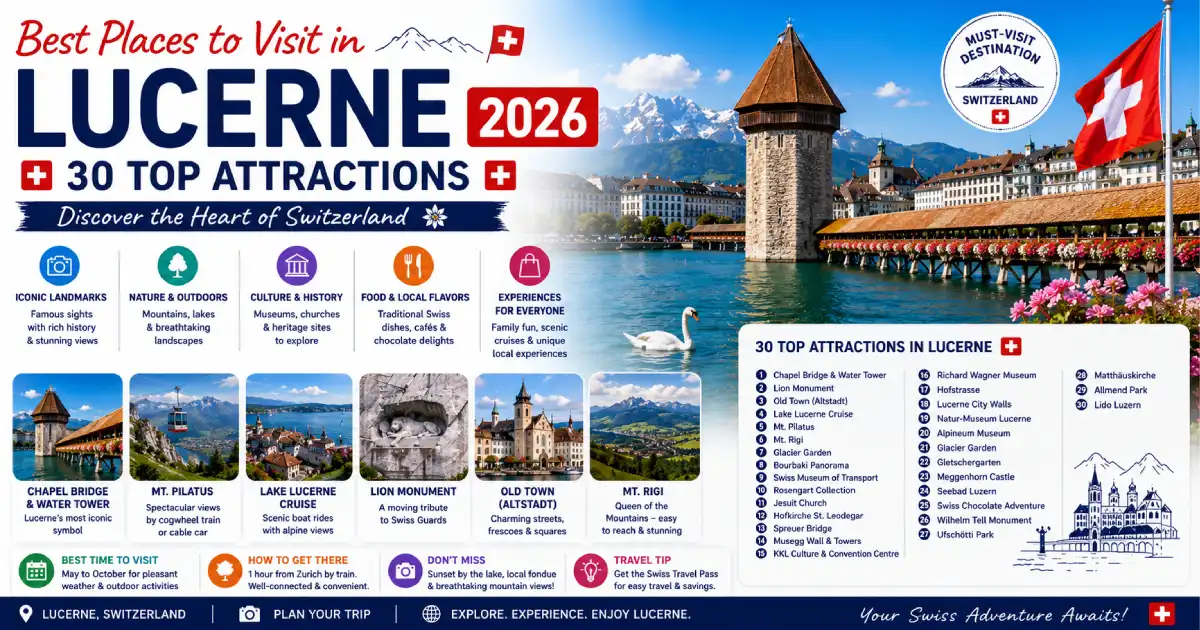
By Travel Tourister | Updated Aug 2026
Lucerne is Switzerland’s most consistently photogenic city — a medieval urban core of extraordinary preservation, set on the northwestern tip of Lake Lucerne (Vierwaldstättersee — the Lake of the Four Forest Cantons, whose name references the founding cantons of the Swiss Confederation) with the pre-Alpine peaks of Mount Pilatus and Mount Rigi forming the dramatic backdrop that has made Lucerne one of the most painted, photographed, and visited cities in Europe since the era of the Grand Tour in the 18th and 19th centuries. The best places to visit in Lucerne are immediately accessible from the city’s compact center — the Chapel Bridge (Kapellbrücke, the oldest preserved wooden covered bridge in Europe, with 17th-century paintings inside its triangular gable panels), the Lion Monument (described by Mark Twain as “the most mournful and moving piece of stone in the world”), the Musegg Wall (the most complete preserved medieval city fortification in Switzerland, with nine intact towers several of which can be climbed freely), and the lake steamer pier (from which the historic paddle steamers of the SGV fleet depart across Lake Lucerne toward the Rigi and Pilatus mountain railways) are all within 15 minutes’ walk of each other and of the SBB main station.
What makes Lucerne genuinely remarkable as a travel destination is the extraordinary compactness of its world-class attractions — the city’s medieval core is sufficiently small that a thorough walking exploration of the Old Town, both historic bridges, the Musegg Wall towers, and the lakefront promenade requires only 2–3 hours of walking, yet the surrounding landscape (Lake Lucerne’s dramatic mountain geography, the Pilatus and Rigi ascent railway options, the river Reuss flowing from the lake through the Old Town center) adds natural grandeur that no amount of careful medieval preservation alone could provide. The combination creates what most visitors describe as the most complete single-city Swiss experience — history, alpine landscape, lake, and mountain access all within one compact, perfectly-maintained urban center. This guide covers the 30 best places to visit in Lucerne with practical details — access, costs, timing, and the insider knowledge that makes each experience fully rewarding.
For complete guides, see our Things to Do in Lucerne 2026, Best Restaurants in Lucerne 2026, Best Places to Visit in Switzerland 2026, and Switzerland Travel Guide 2026 guides.
| Place | Type | Entry Cost | Best For | Time Needed |
|---|---|---|---|---|
| Chapel Bridge (Kapellbrücke) | Historic Bridge | Free | Most photographed bridge in Switzerland | 20–30 min |
| Spreuer Bridge (Spreuerbrücke) | Historic Bridge | Free | Medieval Dance of Death paintings | 15–20 min |
| Lion Monument (Löwendenkmal) | Monument | Free | Most moving sculpture in Switzerland | 15–20 min |
| Musegg Wall and Towers | Medieval Fortification | Free | Best free views, medieval history | 1–1.5 hrs |
| Old Town (Altstadt) | Historic Quarter | Free | Medieval lanes, painted facades | 2–3 hrs |
| Lake Lucerne Steamers (SGV) | Lake Boat | Swiss Travel Pass included | Most beautiful Alpine lake in Switzerland | 2–4 hrs |
| Mount Pilatus | Mountain | CHF 72–89 (Golden Round Trip) | World’s steepest rack railway, panorama | Half day |
| Mount Rigi | Mountain | CHF 65–78 | “Queen of the Mountains,” lake views | Half day |
| Swiss Museum of Transport | Museum | CHF 32 | Switzerland’s most visited museum | 2–3 hrs |
| Rosengart Collection | Museum | CHF 18 | Picasso, Klee, Impressionists | 1.5 hrs |
| KKL (Culture and Congress Centre) | Architecture | Free (exterior) | Jean Nouvel architecture, lakefront | 20 min |
| Reuss River Quays | Promenade | Free | River character, bridge views | 30–45 min |
| Jesuitenkirche (Jesuit Church) | Church | Free | Switzerland’s first large Baroque church | 20–30 min |
| Hofkirche (St. Leodegar) | Church | Free | Largest surviving Renaissance church | 20–30 min |
| Glacier Garden | Museum/Nature | CHF 14 | Ice Age geology, glacial potholes | 1 hr |
| Historisches Museum Luzern | Museum | CHF 10 | Lucerne and Central Swiss history | 1 hr |
| Bourbaki Panorama | Panoramic Painting | CHF 12 | 19th-century panoramic painting | 45 min |
| Stanserhorn | Mountain | CHF 72+ (cable car) | CabriO open-top cable car | Half day |
| Stans (day trip) | Town | Free | Traditional Central Swiss town | Half day |
| Bürgenstock | Resort/Mountain | CHF 30–40 (funicular) | Dramatic clifftop position above the lake | Half day |
| Lake Lucerne Promenade | Lakefront | Free | KKL lakefront, mountain reflections | 1 hr |
| Franziskanerkirche | Church | Free | Medieval Franciscan church | 15 min |
| Wey Square (Weinmarkt) | Square | Free | Most beautiful painted square in Lucerne | 15 min |
| Hirschenplatz | Square | Free | Painted guild house facades | 15 min |
| Richard Wagner Museum | Museum | CHF 10 | Wagner’s Lucerne period 1866-1872 | 1 hr |
| Natur-Museum Luzern | Museum | CHF 8 | Natural history, Alpine ecology | 45 min |
| Kunstmuseum Luzern | Museum | CHF 15 | Swiss and international contemporary art | 1 hr |
| Krienbach Viaduct | Architecture | Free | 19th-century engineering, Old Town views | 15 min |
| Löwengraben | Historic Prison | Guided tour varies | Former city prison, now hostel | 1 hr |
| Alt Stadthaus | Architecture | Free (exterior) | Renaissance civic architecture | 10 min |
Entry: Free | Location: Crossing the Reuss River, Old Town center | Best Time: Dawn for photography (before crowds); any time for crossing | Built: 1333 (restored after 1993 fire)
The Kapellbrücke (Chapel Bridge) is simultaneously the most photographed single structure in Switzerland and the most historically significant surviving medieval covered bridge in Europe — a 204-meter wooden roofed bridge crossing the Reuss River at the point where it exits Lake Lucerne, originally built in 1333 as part of Lucerne’s medieval city fortification system (the bridge’s path was designed to create a defensible water crossing, with the octagonal Water Tower at the bridge’s midpoint serving as treasury, prison, and watchtower simultaneously). The bridge’s most distinguished feature is the series of 112 triangular gable paintings (originally commissioned in the 17th century, depicting scenes from Lucerne’s history and from the lives of saints Leodegar and Mauritius — the city’s patron saints) of which 30 survive from the originals (the remainder destroyed in the 1993 fire that gutted the bridge’s interior, started by a carelessly discarded cigarette in a flower pot) and have been restored or replaced based on historical documentation.
The bridge’s morning photography conditions (the low eastern light of sunrise falling across the flower boxes that decorate the bridge’s exterior railing, the Reuss River’s reflections below, and the Water Tower’s octagonal silhouette at the bridge’s midpoint) create the specific image that appears in essentially every Lucerne tourism material — an image that the actual experience in person exceeds rather than merely matches, because the bridge’s physical presence (the smell of old timber, the sound of footsteps on the original wooden planks, the glimpses of the river through the gaps in the boards) adds sensory dimensions that the photograph cannot communicate.
Insider tips: The Chapel Bridge’s most famous view — the external photograph from the south bank (Schweizerhofquai side) showing the full bridge length with Mount Pilatus in the background — requires positioning on the pedestrian walkway along the south bank approximately 100 meters west of the bridge’s south entrance. Morning light (approximately 7–9 AM) illuminates the flower boxes and painted exterior most flatteringly. The bridge’s interior (walking across it, looking up at the paintings) requires 10–15 minutes of slow walking to appreciate properly rather than the 3-minute crossing that visitors hurrying to the next attraction give it.
Entry: Free | Location: Second historic bridge crossing the Reuss, 500 meters west of Chapel Bridge | Best Time: Any time | Built: 1408 (original paintings 1625–1635)
The Spreuerbrücke (Chaff Bridge — named for the medieval regulation that chaff from grain processing could only be disposed of in the river at this point) is the second of Lucerne’s surviving medieval covered wooden bridges and contains what many consider more historically significant internal paintings than the more famous Chapel Bridge — a complete series of triangular gable panels depicting the “Dance of Death” (Totentanz), painted 1625–1635 by Caspar Meglinger, showing Death (depicted as a skeletal figure) leading representatives of every social class and profession from pope to peasant in the universal equalizing danse macabre that was a specific early-modern European artistic and philosophical preoccupation. The paintings (all 67 original panels survive intact) constitute the most complete surviving Dance of Death series in the original context for which they were commissioned.
The Spreuerbrücke’s much lower tourist traffic than the Chapel Bridge (a 5-minute walk further from the main attractions) creates a significantly more contemplative viewing environment — walking slowly across the less-visited bridge and reading the Death figure’s interaction with each social figure (many panels include small text captions moralizing on the futility of earthly ambition) rewards the visitor who seeks it out specifically rather than stopping only at the more famous bridge.
Insider tips: Visiting the Spreuerbrücke immediately after the Chapel Bridge (a 5-minute walk west along the north bank) creates the most productive comparison — the Chapel Bridge’s more celebratory historical subject matter (Lucerne’s history and saints) alongside the Spreuerbrücke’s memento mori character creates a complete picture of 17th-century Lucerne’s interior world. The Spreuerbrücke’s physical location (between two weir systems that create turbulent water effects at certain water levels — the sound of the rushing water audible from within the bridge) adds an atmospheric dimension absent from the Chapel Bridge’s calmer river position.
Entry: Free | Location: Denkmalstrasse 4, 10 minutes walk north of the Chapel Bridge | Best Time: Morning (before tour groups arrive); quiet for reflection | Created: 1820–1821 by Bertel Thorvaldsen
The Lion Monument (Löwendenkmal) — a dying lion carved into a natural sandstone cliff face, measuring 9 meters in length, created by Danish sculptor Bertel Thorvaldsen (the most celebrated sculptor of the neoclassical era, responsible for monuments throughout Europe) to commemorate the Swiss Guards killed defending the Tuileries Palace during the French Revolution’s August 10, 1792 massacre — was described by Mark Twain as “the most mournful and moving piece of stone in the world” in his 1880 “A Tramp Abroad,” an assessment that most visitors verify upon encountering it for the first time. The specific emotional power of the monument comes from the combination of the lion’s dying posture (lying on its side, one paw still covering a shield bearing the French royal lily, a broken lance in its side, the face expressing resignation rather than heroic defiance), the natural rock setting (the lion carved directly into the cliff face rather than placed on a pedestal, making it appear to emerge from the living rock), and the small pool at the base that reflects the figure in calm conditions, adding a second image below the first.
The historical context (788 Swiss Guards died defending Louis XVI and Marie Antoinette from the revolutionary crowd on August 10, 1792 — the deadliest single event in the 500-year history of Swiss Guard service) gives specific human weight to the abstract allegory, particularly after visiting the carved inscription (HELVETIORUM FIDEI AC VIRTUTI — “To the Loyalty and Bravery of the Swiss”) and the dates 26 Swiss officers and 760 guardsmen carved into the monument’s base.
Insider tips: The monument is set slightly back from the public walkway in a small garden — approaching from the Denkmalstrasse path and stopping at the viewing position directly in front of the carved face (rather than at the walkway’s edge) provides the most direct encounter with the lion’s specific expression. Allowing 10–15 minutes rather than the 3-minute photograph-and-continue that the monument’s tourist-trail position sometimes produces creates the contemplative engagement that Twain’s assessment describes.
Entry: Free (three towers open seasonally) | Location: Northern edge of Old Town, running east-west across the hill | Best Time: April–November (tower open season); morning for light | Duration: 1–1.5 hours for the full wall walk
The Musegg Wall (Museggmauer) — a 900-meter stretch of 14th-century city fortification wall running across the hill above Lucerne’s Old Town, with nine intact medieval towers remaining from the original defensive ring — is the most complete surviving medieval city wall in Switzerland and one of the best-preserved in Central Europe. Three of the nine towers (the Zytturm, Männliturm, and Luegislandturm) are open to the public during the tourist season (approximately April–October, free admission), providing access to the wall’s elevated walkway (the parapet between towers, offering exceptional views over the Old Town rooftops toward the lake and surrounding mountains) and to the towers’ interior spiral staircases ascending to the top viewpoints.
The Zytturm (Clock Tower) contains Lucerne’s oldest operational town clock (installed 1535, maintaining the tradition of running one hour ahead of other city clocks — allegedly so that the surrounding markets could prepare for the official time), while the Luegislandturm (the highest accessible tower) provides the most comprehensive elevated views of the Old Town’s medieval street pattern, the lake, and the Alpine backdrop visible above the rooflines.
Insider tips: The Musegg Wall walk (entering at the eastern end near the Nölliturm and walking the accessible parapet section westward toward the Männliturm) provides an elevated perspective on the Old Town’s medieval street pattern that ground-level exploration cannot deliver — the view from the wall parapet shows the relationship between the cathedral (Hofkirche), the Chapel Bridge, the river, and the Old Town’s building density in a spatial comprehension impossible from street level. This is the most underutilized great free view in Lucerne — the tourist crowds concentrate on the Chapel Bridge and Lion Monument while the Musegg Wall provides equivalent visual reward with a fraction of the visitor numbers.
Entry: Free | Location: Both banks of the Reuss River, city center | Best Time: Early morning (before tour groups) or late afternoon | Duration: 2–3 hours for comprehensive exploration
Lucerne’s Altstadt (Old Town) rewards the slowest possible walking pace — the medieval street pattern (largely unchanged since the 14th century, with street widths and building setbacks reflecting pre-motor-vehicle urban proportions), the guild house painted facades (the Weinmarkt, Hirschenplatz, and Kornmarkt squares hosting the most elaborate examples of 16th–17th century facade painting remaining in Central Switzerland), and the specific Lucerne architectural character (the mix of Late Gothic and Renaissance commercial buildings, the fountain sculptures in the major squares, and the medieval detail — carved keystones, painted shutters, decorative ironwork — accumulated across centuries of urban maintenance) create an environment that rewards detail observation rather than landmark-to-landmark navigation.
The most significant Old Town squares: Weinmarkt (the most beautifully preserved late-Gothic painted square in Lucerne, with the Weinmarktbrunnen fountain at its center and guild house facades on three sides that maintain the specific palette of the 16th-century painting tradition), Hirschenplatz (the commercial center, with guild house facades and the specific social gathering character that medieval market squares maintain in living cities), and Kornmarkt (the grain market, now the Rathaus/Town Hall square, with Lucerne’s Renaissance Rathaus — completed 1606 — providing the square’s most distinguished architectural anchor).
Insider tips: The guild house facades of the Weinmarkt and Hirschenplatz are most photogenically lit in the late afternoon (approximately 4–6 PM in summer, earlier in winter) when the westward-facing facades catch the warm directional light — the same facades in flat midday light appear noticeably less vivid. Morning (before 9 AM) provides empty streets that afternoon and evening visits don’t deliver — the specific pleasure of walking Lucerne’s painted lanes in early morning quiet, before the tour groups that dominate midday descend from their coaches, rewards the early riser with the most complete Old Town experience.
Entry: Included in Swiss Travel Pass; individual tickets CHF 10–40 depending on route | Transport: SGV piers at Bahnhofquai (adjacent to the main station) | Best Time: Morning for clearest mountain reflections; summer for deck enjoyment | Season: Year-round (reduced winter schedule)
Lake Lucerne (Vierwaldstättersee — the Lake of the Four Forest Cantons) is Switzerland’s most dramatically beautiful Alpine lake — not the largest (Lake Geneva holds that distinction) but the most mountain-surrounded and most geographically complex, with the lake’s five arms extending in different directions between the pre-Alpine peaks of Pilatus, Rigi, Bürgenstock, and the Uri Rotstock, creating a continuously changing panorama as lake steamers navigate between destinations. The SGV (Schifffahrtsgesellschaft des Vierwaldstättersees) operates the lake steamer fleet — both modern motor vessels and the historic paddle steamers (the Uri, Unterwalden, Schiller, and Stadt Luzern — among the finest surviving examples of early 20th-century paddle steamer engineering) that provide the most atmospheric lake crossing experience available.
The route from Lucerne to Flüelen (the lake’s southeastern terminus, 4 hours one-way) passes through the lake’s most scenically dramatic sections — the Rütli meadow (where the Swiss Confederation was founded in 1291, accessible only by boat — no road access preserved deliberately), the Tell’s Chapel (marking the location of William Tell’s legendary escape from Gessler’s boat), and the narrowing upper lake sections where the surrounding mountains approach from all sides. A shorter Lucerne-to-Weggis crossing (40 minutes, connecting to the Rigi rack railway) or Lucerne-to-Alpnachstad (connecting to the Pilatus rack railway) completes the Golden Round Trip circuit.
Insider tips: The historic paddle steamers (identifiable by the large paddle wheels visible on both sides of the vessel — check the SGV timetable for which specific departures use paddlesteamers versus motorboats, as the schedules vary by season and day) provide an experience genuinely different from the standard motor boat fleet — the specific motion of a paddlesteamer (slightly different rolling from a propeller-driven vessel), the period interior design (Art Deco dining saloons on some vessels, dating from the 1920s–1930s), and the paddle mechanism visible from the deck create an atmosphere of genuinely historic lake transport.
Entry: CHF 72–89 (Golden Round Trip — boat, rack railway, aerial gondola) | Transport: Boat from Lucerne to Alpnachstad (included in Swiss Travel Pass) + Rack Railway (50% discount with Swiss Travel Pass) | Altitude: 2,132 meters | Best Time: Clear days; morning for best visibility | Season: May–November (rack railway); year-round aerial gondolas
Mount Pilatus (2,132 meters, the distinctive jagged ridge immediately southwest of Lucerne) is named either for the moss-covered profile that medieval imagination connected to Pontius Pilate’s legendary post-crucifixion burial here, or from the Latin word for “cloud-capped” — either derivation is appropriate for a mountain whose specific summit character (jagged, weather-generating, dramatic above the lake and city below) differs completely from the rounded Alpine summits further south. The Pilatus-Bahn ascending from Alpnachstad to the summit is the world’s steepest rack railway (maximum gradient 48%, requiring a specifically designed rack system different from all other rack railways), completing the ascent in 30 minutes through progressively dramatic landscape.
The Pilatus summit complex (two hotels, the Pilatus-Kulm and Hotel Bellevue, a viewing terrace, and the famous Dragon Path hiking trail) provides 360-degree panoramic views encompassing the lake and city below, the Bernese Alps on the southern horizon, and on exceptionally clear days, the Black Forest of Germany and the Alsatian Vosges. The Dragon Path (Drachenpfad, a section of ridge trail connecting the two summit buildings) provides the most dramatic exposure — the path’s narrow construction above steep drops on both sides creates a specifically Alpine edge experience accessible to non-mountaineers.
Insider tips: The Pilatus Golden Round Trip (boat from Lucerne to Alpnachstad → rack railway to Pilatus Kulm → aerial cable car and gondola descent to Kriens → bus back to Lucerne) provides the most varied single-day mountain experience available from Lucerne — four different transport modes, two different ascent/descent routes, and the full lake-to-summit-to-lake circuit. The Swiss Travel Pass discount (50% on the rack railway) makes the Golden Round Trip the clearest Swiss Travel Pass value demonstration available from Lucerne.
Entry: CHF 65–78 return (from Vitznau, lake steamer connection from Lucerne included in Swiss Travel Pass) | Altitude: 1,797 meters | Best Time: Clear days; sunrise and sunset | Season: Year-round
Mount Rigi (1,797 meters, the distinctive rounded massif rising between Lake Lucerne and Lake Zug) is the most historically celebrated mountain accessible by railway in Switzerland — the first mountain railway in Europe (opened 1871) ascended Rigi from Vitznau, and Mark Twain’s 1880 account of his Rigi visit (including the legendary account of his failed sunrise trip to the summit) helped establish the mountain’s international reputation. Queen Victoria visited, a hotel has operated at the summit since 1816, and the tradition of sunrise viewing from the Rigi summit has been a specifically Swiss tourist ritual for 200 years.
The Rigi Kulm summit (1,797 meters) provides 360-degree views across Lake Lucerne, Lake Zug, Lake Lauerz, and on clear days the Bernese Alps (Eiger, Mönch, and Jungfrau visible on the southern horizon) — the most comprehensive single view of the Swiss Mittelland (the central Swiss plateau) available from any accessible summit.
Insider tips: The Rigi is most specifically rewarding as a sunrise experience — staying overnight at the Rigi Kulm Hotel (booking months ahead for summer season) and watching the sunrise panorama from the summit before the day visitors arrive creates one of Switzerland’s most historically resonant single experiences. Day visitors who take the first morning train (departing Vitznau at approximately 7 AM, check current timetable) and ascend for breakfast at the summit hotel experience the early-morning version of this tradition at the cost of an early wake-up rather than an overnight stay.
Entry: CHF 32 adults | Transport: Bus or boat from Lucerne (20 minutes) | Address: Lidostrasse 5 | Best Time: Weekday mornings | Duration: 2–3 hours
The Swiss Museum of Transport (Verkehrshaus der Schweiz) — Switzerland’s most visited single museum and one of the most comprehensively engaging transport museums in the world — covers the complete history of Swiss transportation innovation from the first mountain railways through aviation (the SWISS Boeing 747 suspended in the aviation hall is a specific highlight), road transport (the original vehicles of major Swiss automotive history), shipping (scale models of Lake Lucerne’s SGV fleet and Switzerland’s river transport history), space exploration (the Swiss contributions to space science including contributions to multiple ESA missions), and digital communication — in a complex of 11 exhibition halls that provide genuinely interactive experiences rather than purely display-case static presentation.
The museum’s specific strength (Switzerland’s transportation history is genuinely extraordinary — the alpine railway engineering achievement, the precision manufacturing of Swiss locomotion, and the specific challenge of connecting a landlocked mountain country’s communities that drove generations of engineering innovation) is presented with the specific Swiss museum quality that creates educational engagement without condescension.
Insider tips: The Planetarium (a separate ticket add-on within the Verkehrshaus complex) and the Swiss Chocolate Adventure (a walk-through experience covering Switzerland’s chocolate industry history, also separately ticketed) extend a Verkehrshaus visit into a full afternoon. The museum’s lakeside location (with a restaurant terrace on Lake Lucerne) provides a complete destination rather than simply a museum visit.
Entry: CHF 18 | Transport: 5 minutes walk from the main station | Address: Pilatusstrasse 10 | Best Time: Weekday afternoons | Duration: 1.5 hours
The Rosengart Collection (Sammlung Rosengart), housed in a former bank building in central Lucerne, presents one of Switzerland’s finest private art collections — assembled by art dealer Siegfried Rosengart and his daughter Angela (who maintained a personal friendship with Pablo Picasso from the 1950s until his death in 1973) and consisting of 125 works by Picasso alongside significant holdings in Paul Klee (particularly strong — Lucerne-connected Klee works form a specific chapter of the collection) and Impressionist masterworks (Monet, Renoir, Cézanne, Matisse, and others at museum quality). The basement level presents an extraordinary photographic archive — 200 photographs of Picasso taken by David Douglas Duncan in the Mas La Californie (Picasso’s Cannes home) during 1956–1960, providing intimate documentation of the artist’s daily life.
Insider tips: The Angela Rosengart photographs of Picasso (basement level — some visitors miss this section entirely) provide a dimension of personal connection to the artist that the painted works alone cannot — seeing the same hands that produced the paintings at work in their domestic context creates a biographical engagement that gallery display typically distances. Angela Rosengart’s personal friendship with Picasso (she appears in several of the photographs and several works are dedicated to her specifically) gives the collection’s Picasso holdings a provenance story unavailable at any institutional museum.
Entry: Free (exterior and public areas) | Location: Europaplatz 1, lakefront adjacent to the main station | Best Time: Any time for architecture; concert season September–July for interior access
The KKL Luzern (Kultur- und Kongress Zentrum Luzern) — designed by French architect Jean Nouvel and completed 2000 — is Switzerland’s most architecturally celebrated post-war public building, a complex whose organizing element is a vast overhanging roof (extending 45 meters beyond the building’s glass walls to shade the lakefront terrace and create the specific floating-above-the-water appearance that photographs from across the lake capture most dramatically) hovering above the lakefront at the end of Bahnhofquai. The building houses the concert hall (Konzertsaal, one of the finest acoustically in Europe, home of the Lucerne Festival Orchestra’s annual residency), the event hall (Luzerner Saal), and the Kunstmuseum Luzern (the city’s main contemporary art museum, in the KKL’s southern section).
The KKL’s lakefront terrace (accessible free, the most architecturally significant public outdoor space in Lucerne) and the building’s glass-and-steel transparency (the interior visible from the terrace in a deliberate architectural statement about public accessibility of cultural institutions) create a building that rewards the non-concert-attending visitor as much as the concert-goer.
Insider tips: The KKL’s most photogenic view is from across the lake — standing on the Schweizerhofquai (the south bank promenade) and looking north across the Reuss River outlet toward the KKL creates the specific floating-roof composition that Jean Nouvel specifically designed for this view angle. The building from this position, with the Chapel Bridge visible to the right and Mount Pilatus above the KKL’s roof on clear days, creates one of the most compositionally complete single views in Lucerne.
Entry: Free | Location: Bahnhofstrasse, Old Town south bank | Best Time: Morning light (east-facing interior) | Duration: 20–30 minutes
The Jesuitenkirche (Jesuit Church, completed 1677) is Switzerland’s first large Baroque church and the most significant example of the Baroque style in the country’s predominantly Protestant German-speaking territory — the exterior’s twin onion-domed towers visible from the Chapel Bridge and from multiple Old Town viewpoints provide the most recognizable non-secular skyline element in Lucerne’s medieval streetscape. The interior (entering from the riverfront side) provides the most complete Baroque decorative program in Switzerland — the trompe l’oeil ceiling fresco (creating an illusion of three-dimensional vault vaulting from a flat surface), the stucco decorations, and the overall spatial effect of Jesuit theatrical devotional architecture creates a genuinely surprising interior for visitors accustomed to the austere Protestant interiors that dominate Swiss churches.
Insider tips: The Jesuitenkirche’s morning light (the east-facing interior catches direct morning light through the chancel windows from approximately 9–11 AM) provides the most favorable conditions for the ceiling fresco’s colors — the painted vault’s illusionism requires good overhead lighting to fully convey the depth illusion. The church’s position on the river bank makes it a natural stopping point during the Chapel Bridge–Old Town walking circuit that most Lucerne visitors complete.
Entry: Free | Location: St.-Leodegar-Strasse 6, east of the Old Town | Best Time: Any time | Duration: 20–30 minutes
The Hofkirche (Court Church, officially the Collegiate Church of St. Leodegar and St. Mauritius) is Lucerne’s most important church architecturally — the only major Renaissance church in Switzerland (completed 1644, after the original Romanesque church burned in 1633, with only the Romanesque twin towers surviving from the original structure incorporated into the new Renaissance building), and the most significant religious building in the Diocese of Basel’s Central Swiss territory. The interior combines the Renaissance nave with the original Romanesque towers, creating an architectural hybrid that provides a specific historical reading of the building’s catastrophic fire and reconstruction. The church’s 19th-century organ (the third-largest in Switzerland, 4,950 pipes) and the Renaissance canopy tomb of Karl Borromeo (a significant Counter-Reformation figure with specific Lucerne connections) complete the interior’s historical content.
Insider tips: The Hofkirche’s arcaded courtyard (the Renaissance loggia surrounding the church’s south and west sides, normally accessible) provides one of Lucerne’s most tranquil outdoor spaces — the cloister-like arcade framing the church’s south facade and the garden within creates a specific contemplative environment unavailable in the city’s busier public spaces.
Entry: CHF 14 | Location: Denkmalstrasse 4 (adjacent to the Lion Monument) | Duration: 1 hour | Best Time: Combine with Lion Monument visit
The Glacier Garden (Gletschergarten), discovered in 1872 during construction work and opened to the public in the same year, contains the most accessible examples of glacial geology in any European city — 32 glacial potholes (Gletschertöpfe) carved into the limestone bedrock by the meltwater vortices of the Reuss Glacier approximately 20,000 years ago during the last Ice Age, ranging from the size of a bathtub to cylinders several meters deep and wide, preserved under protective structures since their discovery. The garden also contains erratic boulders deposited by the retreating glacier, fossil palm tree remains demonstrating the warm-climate Switzerland that preceded the Ice Age, and a relief model of the Alps made in 1870 that remains one of the finest physical topographical models of the Alpine region ever produced.
Insider tips: The museum within the Glacier Garden complex (the Glacier Garden Museum, included in the garden admission) contains an extraordinary Belle Époque mirror maze (a 19th-century entertainment installation, one of the few surviving examples in Europe — original to the 1895 period installation, with original mirrors and the specific visual confusion that the era produced deliberately as popular entertainment) that most visitors describe as their most unexpected discovery in Lucerne.
Entry: CHF 10 | Location: Richard-Wagner-Weg 27, Tribschen (lakeside, 30 minutes walk or bus from center) | Hours: Tuesday–Sunday, April–November | Duration: 1 hour
The Richard Wagner Museum, in the villa “Tribschen” on a promontory extending into Lake Lucerne approximately 30 minutes’ walk south of the city center (or accessible by bus), preserves the house where Wagner lived from 1866 to 1872 — the most creatively productive period of his late career, during which he completed “Die Meistersinger von Nürnberg,” worked on “Siegfried” and “Götterdämmerung,” and conducted in Lucerne while developing the artistic vision that culminated in the Bayreuth Festival concept. The villa (with its lakeside garden, the original furniture of Wagner’s living and working rooms preserved as he left them, and the instrument collection including original pianos used by Wagner during the Tribschen period) provides a specifically intimate biographical encounter with a historical figure whose subsequent cultural influence (on music, philosophy, and German cultural nationalism) has been enormous and complex.
Insider tips: The Tribschen promontory (the landscaped lakeside grounds of the museum, accessible free for walking regardless of museum entry) provides one of the finest lake views in the Lucerne area — the promontory’s position extending into the lake creates panoramic views toward Mount Pilatus in one direction and Mount Rigi in the other, with the lake’s characteristic mountain-reflection character visible without the city’s infrastructure in the foreground.
About Travel Tourister Travel Tourister’s destination specialists have explored Lucerne across all seasons — from Chapel Bridge dawn photography and Spreuerbrücke Dance of Death walks through Pilatus Golden Round Trip mornings and Rigi sunrise experiences to Rosengart Collection afternoons and KKL lakefront evenings — to deliver the most practical and honest guide to the best places to visit in Lucerne for every type of 2026 visitor.
Posted By : Vinay
Latest Article
2nd Floor, 39, Above Kirti Club, DLF Industrial Area, Kirti Nagar, New Delhi, Delhi 110015



Travel Tourister is a leading Travel portal where we introduce travellers to trusted travel agents to make their journey hasselfree, memorable And happy. Travel Tourister is a platform where travellers get Tour packages ,Hotel packages deals through trusted travel companies And hoteliers who are working with us across the world. We always try to find new and more travel agents and hoteliers from every nook and corners across the world so that you could compare the deals with different travel agents and hoteliers and book your tour or hotel with the one you have chosen according to your taste and budget.
Copyright © Travel Tourister, India. All Rights Reserved

 Call
Call Enquiry