Published on : 18 Jul 2026
By Travel Tourister | Updated July 2026
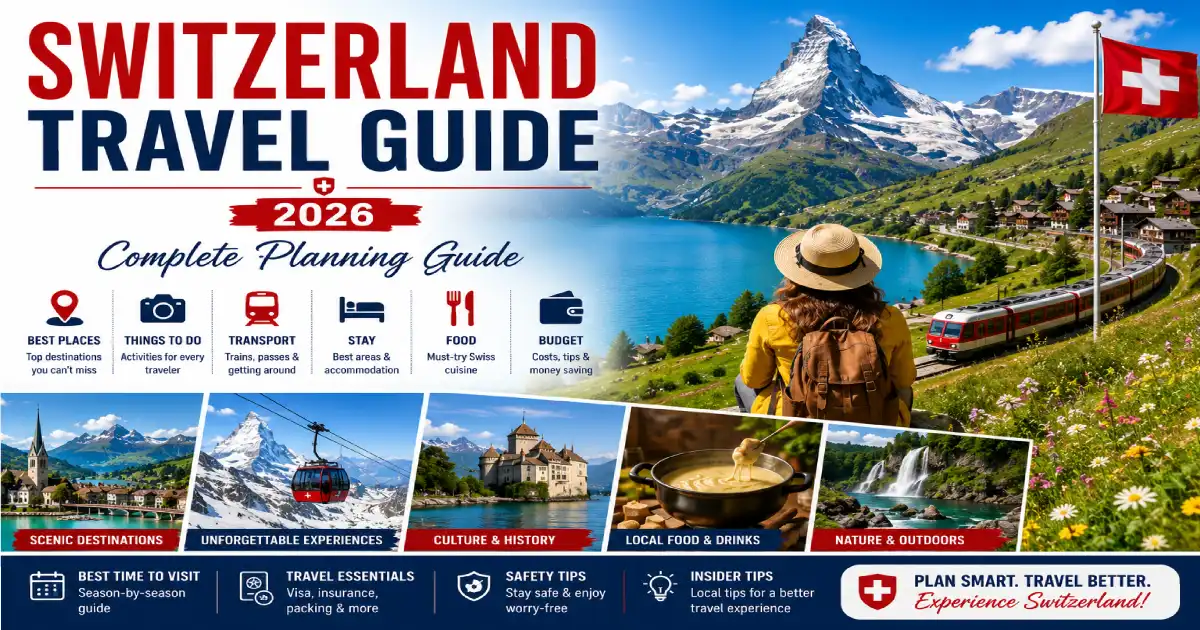
Switzerland rewards careful planning more than almost any other European destination — a country where the difference between a well-organized trip and an improvised one is measured not just in comfort but in hundreds of Swiss francs, given the country’s position as consistently the most expensive travel destination in Europe by standard metrics (hotel prices, restaurant costs, mountain railway excursions) alongside the extraordinary value that specific planning tools (the Swiss Travel Pass, the Half Fare Card, and the America the Beautiful-equivalent GA Travelcard) can unlock for visitors willing to understand them before arrival. The Switzerland Travel Guide 2026 exists to bridge that planning gap — providing the foundational orientation that makes everything else (where to stay, how to get around, how much to budget, what to eat, how to navigate the four-language cultural landscape) immediately more actionable and more cost-effective.
What makes Switzerland genuinely different from neighboring European countries as a travel planning challenge is the combination of extraordinary transportation infrastructure and extraordinary cost — the Swiss Federal Railways (SBB/CFF/FFS) network is among the most precise, comprehensive, and punctual rail systems in the world, connecting essentially every inhabited valley and mountain village with timed connections that function as advertised even at 6-minute transfer windows between mountain rack railways and mainline expresses. Understanding this transportation system (particularly the Swiss Travel Pass and its inclusions) is the single most important planning decision for most Switzerland visitors, often determining whether the trip costs CHF 200 or CHF 400 per day per person for equivalent experiences. Switzerland’s four official languages (German, French, Italian, and Romansh, each dominant in specific geographic regions) and the country’s four distinct cultural personalities that follow those language lines create a complexity that visitors crossing from Zurich to Lausanne to Lugano in a single week encounter more tangibly than any border crossing in Europe.
This guide covers everything needed to plan a 2026 Switzerland trip — from choosing the right transportation pass and understanding the SBB system to budgeting realistically, navigating the language regions, packing appropriately, and avoiding the mistakes that can make Switzerland’s extraordinary price point feel unjustified when the trip is under-prepared.
For specific recommendations, see our Best Places to Visit in Switzerland 2026, Best Time to Visit Switzerland, and Things to Do in Switzerland 2026 guides.
| Category | Details |
|---|---|
| Capital | Bern (federal) |
| Largest City | Zurich |
| Population | 8.9 million |
| Area | 41,285 km² (roughly the size of the Netherlands) |
| Official Languages | German (63%), French (23%), Italian (8%), Romansh (1%) |
| Currency | Swiss Franc (CHF) — NOT Euro (EUR is widely accepted but at poor exchange rates) |
| Exchange Rate | Approximately 1 CHF = 1.10–1.15 USD (check current rates) |
| Electricity | 230V / 50Hz — Type J plugs (3 round pins unique to Switzerland; adaptors required) |
| Time Zone | CET (UTC+1) / CEST (UTC+2 in summer) |
| Emergency Number | 112 (universal EU emergency, also works in Switzerland); Police: 117; Ambulance: 144 |
| Tipping | Not mandatory; rounding up or 5–10% for good service customary |
| Main Airports | Zurich (ZRH), Geneva (GVA), Basel-Mulhouse-Freiburg (BSL/MLH/EAP) |
| Average Daily Budget (Mid-Range) | CHF 250–400/person (hotel, food, transport, activities) |
Zurich Airport (Flughafen Zürich) is Switzerland’s largest and most internationally connected airport — approximately 320 destinations served by 60+ airlines, direct flights from most major global hubs including New York (Swiss, Delta, United — approximately 9 hours), London (multiple airlines, 2 hours), Singapore (Swiss, 13 hours), Tokyo (Swiss, 13 hours), and virtually every European capital with hourly or better service. The airport’s Train Station (directly within the terminal, underground, SBB operated) provides direct trains to Zurich HB (main station) in approximately 10 minutes (CHF 6.80, or included with Swiss Travel Pass), with onward connections from Zurich HB to the entire Swiss rail network departing every 30 minutes or more frequently. The airport’s SBB ticket machines accept credit cards without the PIN requirement that frustrates some visitors at unmanned Swiss ticket machines outside major stations.
Geneva Airport (Aéroport International de Genève) serves as the primary gateway for visitors specifically targeting the French-speaking Léman region (Geneva, Lausanne, Montreux, Interlaken via the Bernese approach) — smaller than Zurich Airport but with comprehensive European connections and several transatlantic services (New York via Swiss and Delta). The airport’s train station (Geneva Aéroport, a direct terminal connection) provides free shuttle rail service to Geneva Cornavin station (8 minutes, free within the airport complex — collect a free shuttle ticket from the machine in the baggage claim area) with onward Swiss rail connections.
A tri-national airport serving Switzerland, France, and Germany simultaneously — physically located on French territory but with separate Swiss and French terminal sections. Train connections to Basel SBB (the main Swiss station, separate from Basel SNCF — France) via shuttle bus (20 minutes, CHF 6) connect to the Swiss rail network. Particularly convenient for visitors specifically visiting Basel, the Bernese Oberland via Bern, or planning rail journeys along the Rhine.
Switzerland is exceptionally accessible by international rail — TGV Lyria connects Paris to Geneva (3 hours 10 minutes, Paris to Basel in 3 hours), EuroCity trains connect Munich to Zurich (3.5 hours) and Milan to Zurich (3.5 hours via the Gotthard Base Tunnel, completed 2016 as the world’s longest railway tunnel at 57 kilometers), and Eurostar connections (London to Paris or Brussels, then onward TGV or EC) make London–Switzerland rail travel feasible in a single long day. The Zurich-to-Paris route (4 hours by TGV Lyria via Basel and Belfort) and the Milan-to-Zurich route (through the Ticino Leventina valley, one of the most scenic international rail approaches to Switzerland) represent the most used international rail entries.
The Swiss Travel Pass is the single most important logistical decision for most Switzerland visitors — a flat-rate unlimited-travel pass covering the entire Swiss Federal Railways network, most lake steamers, most mountain railways and cable cars (with discounts on others), public buses, and city trams throughout Switzerland, available in 3, 4, 6, 8, and 15-day versions for consecutive days of travel.
Fully included (no additional charge):
50% discount (half price with pass):
Not included:
| Duration | Price |
|---|---|
| 3 days | CHF 244 |
| 4 days | CHF 281 |
| 6 days | CHF 352 |
| 8 days | CHF 399 |
| 15 days | CHF 513 |
First class approximately 55–60% more expensive than second class. The Swiss Travel Pass must be purchased outside Switzerland by non-Swiss residents for the best pricing — available through Rail Europe, the SBB international website, and various travel agencies. Swiss citizens and residents use the GA Travelcard (annual unlimited travel, CHF 3,860/year) — not available to tourists.
The break-even calculation: A single day’s travel (Zurich to Lucerne CHF 46 return + Lucerne city tram CHF 4 + lake steamer CHF 30 + basic museum CHF 15) totals approximately CHF 95 for one day of moderate sightseeing. The 3-day pass (CHF 244 at approximately CHF 81/day) breaks even for moderate travelers and provides significant savings for active travelers covering multiple destinations. The 50% Jungfraujoch discount alone saves approximately CHF 80–110 — effectively paying for a day’s pass cost on a single mountain railway excursion.
The pass is most valuable for visitors:
The pass is less valuable for visitors:
The Swiss Half Fare Card (CHF 120 for one month) provides 50% discount on all SBB trains and most transport without the unlimited-travel coverage of the Swiss Travel Pass — an excellent option for visitors staying primarily in one city with occasional regional day trips, or for those whose travel pattern doesn’t justify the full Swiss Travel Pass cost.
Switzerland’s SBB (Schweizerische Bundesbahnen / Chemins de fer fédéraux suisses / Ferrovie federali svizzere — the name changes with each language region but the trains are the same) operates one of Europe’s most punctual and comprehensive rail networks — the nationwide timetable coordinates all SBB trains, PostBuses, lake steamers, and mountain railways into a unified system where connections are timed to allow 6-minute transfers at major junctions and 3-minute transfers at some smaller stations, and the system actually functions as designed with a reliability that visitors from less punctual rail countries find remarkable.
Practical navigation:
Switzerland’s mountain transport infrastructure (over 700 cable cars, gondolas, rack railways, funiculars, and aerial tramways nationwide) represents the world’s densest concentration of mountain uplift systems — essentially every significant Swiss mountain accessible to non-mountaineers has either a railway or cable car providing uplift. Key operational details:
Rack railways (Zahnradbahn) use a central toothed rack rail engaged by a pinion gear on the locomotive — enabling steep gradients impossible for standard rail. Major examples: Jungfrau Railway (steepest sections at 25% gradient), Rigi Kulm, Pilatus (steepest rack railway in the world at 48% gradient).
Aerial gondolas (Gondelbahn) and cable cars (Luftseilbahn) provide the fastest uplift to high elevations — the Eiger Express at Grindelwald covers the distance from valley to Eiger Glacier station in under 15 minutes.
Funiculars (Standseilbahn) operate on a counter-balancing cable system — Lausanne’s Metro Line 1 is technically a funicular, as are connections in Zurich (Polybahn), Bern, and various other cities where the urban terrain requires mechanical assistance.
Understanding Switzerland’s linguistic geography is genuinely important for planning — not because visitors are expected to speak any of the languages (English proficiency is effectively universal in Swiss tourism contexts), but because the cultural character of the country changes meaningfully between regions in ways that affect the visitor experience.
Covers: Zurich, Bern, Basel, Lucerne, Interlaken, Grindelwald, Zermatt, St. Gallen, Winterthur — approximately 63% of Switzerland’s population.
German-speaking Switzerland maintains a specific cultural character that’s distinctly Swiss rather than simply German — the dialect (Schweizerdeutsch or Swiss German) is so different from standard German (Hochdeutsch) that many German visitors initially struggle to follow everyday spoken conversation. Written German is standard Hochdeutsch throughout the region. The German-speaking culture tends toward precision, punctuality, and a certain directness in interpersonal interaction that visitors from more demonstratively warm cultural backgrounds occasionally misread as coldness — Swiss German directness is a cultural style rather than personal unfriendliness. Restaurant service in German-speaking Switzerland is efficient and professional but rarely the effusive warmth visitors might expect from Italian or French hospitality contexts.
Covers: Geneva, Lausanne, Montreux, Neuchâtel, Fribourg (bilingual), parts of Valais — approximately 23% of Switzerland.
The Suisse Romande has a noticeably different cultural character from German-speaking Switzerland — a greater French cultural influence (cafés, brasseries, and the specific urban lifestyle of Geneva and Lausanne feel meaningfully more French than anything in Zurich), a somewhat more expansive social warmth in everyday interactions, and a food and wine culture (raclette, fondue, Chasselas white wine) that feels genuinely tied to agricultural and gastronomic traditions. The Léman region’s wine culture (Lavaux UNESCO vineyards, the lakeside wine villages of the Vaud) and Geneva’s specific international character (UN headquarters, luxury watchmaking, private banking, and a population that’s among the most internationally diverse of any European city) together create a French-Swiss cultural zone quite different from the German-Swiss cities to the east.
Covers: Lugano, Locarno, Bellinzona, Ascona, Mendrisiotto — approximately 8% of Switzerland.
Ticino (the Italian-speaking canton south of the Alps, accessible through the Gotthard Pass and Tunnel from German-speaking Switzerland) operates within Swiss logistical and legal frameworks while maintaining a genuinely Italian cultural personality — espresso rather than filter coffee, aperitivo culture, palm trees along Lake Maggiore, and an architectural character (terracotta roofs, piazzas, stucco facades) entirely distinct from the wooden chalets and cobblestone squares of the north. Ticino is the warmest and sunniest region of Switzerland and the most Mediterranean in cultural orientation — a genuinely different country in atmospheric terms while remaining the same country in every practical sense.
Covers: Parts of Graubünden canton (the Engadine Valley, Surselva, Albula) — approximately 1% of Switzerland, making Romansh the smallest official national language.
Romansh (actually five distinct dialects with a standardized written form, Rumantsch Grischun) is the only language in Switzerland with no major neighboring country where the same language is spoken — a linguistic island surviving from Roman-period Latin in mountain valleys where isolation preserved the language through the medieval period and beyond. For visitors, Romansh is primarily encountered in place names (Pontresina, Silvaplana, Disentis/Mustér — many locations have both Romansh and German names), signage in the Engadine, and the specific cultural identity of St. Moritz’s broader Engadine Valley, where Romansh cultural events, music, and literature maintain an active contemporary presence despite the language’s small speaker community.
Switzerland is the most expensive country in Europe by most standard tourism cost metrics — and understanding why helps visitors manage the experience more effectively. Swiss pricing reflects genuinely high wages (Switzerland has among the highest minimum wages and living standards globally), high operating costs for mountain infrastructure maintenance, and a structural premium on experiences that are globally scarce (there is only one Jungfraujoch, one Matterhorn, one Lake Lucerne). The Swiss Travel Pass, careful restaurant selection (lunch menus — Tagesmenü in German, menu du jour in French — offer two to three courses at prices significantly below à la carte evening dining), and supermarket shopping for picnic provisions substantially reduce costs relative to unplanned consumption patterns.
Staying in hostels (Swiss Youth Hostels — excellent quality, CHF 35–55/dorm bed, widely distributed) or budget hotels (CHF 80–120/night for basic private rooms outside city centers), preparing morning provisions from Migros or Coop (Switzerland’s two primary supermarket chains, providing excellent quality at reasonable Swiss prices — a lunch of bread, cheese, fruit, and sparkling water from Migros costs approximately CHF 8–12), using the Swiss Travel Pass for transportation (included), and limiting mountain railway excursions to one per trip (Jungfraujoch at 50% discount approximately CHF 85 with pass). Restaurant meals at lunch (Tagesmenü approximately CHF 18–25, two courses including drink) rather than dinner service reduce restaurant costs meaningfully.
Three-star hotel or mountain guesthouse (CHF 150–250/night double room), breakfast included at hotel, lunch from supermarket or casual restaurant (CHF 15–25/person), dinner at mid-range restaurant (CHF 35–60/person including wine), Swiss Travel Pass (included in per-day calculation), and 2–3 mountain railway excursions spread across a week’s visit (averaging CHF 40–60/day with Swiss Travel Pass discounts).
Five-star resort accommodation (Badrutt’s Palace in St. Moritz CHF 500–1,200+/night, Kulm Hotel Wengen, various Zurich five-star properties CHF 400–800+/night), all meals at hotel and upscale restaurants (CHF 120–250/person for dinner), private guides and chartered mountain experiences, and helicopter transfers or private rail carriages.
Supermarkets as strategic assets: Migros and Coop carry excellent quality Swiss cheese, charcuterie, bread, chocolate, and fruit at prices that make supermarket picnics one of the most genuinely pleasant Switzerland eating strategies — a Migros deli counter in Grindelwald or Lucerne provides the ingredients for a meal eaten with the Alps as backdrop that no restaurant can replicate, at approximately CHF 10–15/person.
Lunch menus (Tagesmenü/menu du jour): Most Swiss restaurants offer a fixed-price weekday lunch (two or three courses, the same kitchen quality as evening à la carte service, CHF 18–30/person) that provides genuine restaurant dining at approximately half the evening price. Building restaurant dining around lunch rather than dinner is the single most effective mid-range Switzerland cost-reduction strategy.
Swiss Travel Pass timing: Purchasing the pass for the specific days of maximum travel (travel days between cities, days of multiple mountain railway excursions) rather than for the full trip length can reduce pass costs when some trip days involve minimal transport (staying in a single location hiking without rail access).
City tourist cards: Several Swiss cities offer local tourist cards (Zurich Card, Lucerne City Card, Geneva Transport Card — often automatically included with hotel accommodation) providing free public transport, museum entry, and discounts within the specific city during the card’s validity period. These complement rather than replace the Swiss Travel Pass for multi-city visitors.
Zurich: Switzerland’s largest hotel market, with the widest range of accommodation types (international luxury chains, design boutiques, budget hostels, and Airbnb). The Old Town (Altstadt), the Langstrasse district (edgier, more nightlife-oriented), and the lakeside (Seefeld and Enge) neighborhoods each offer distinct character. Staying on the lake adds a premium; staying in Langstrasse reduces costs while maintaining excellent transit connections.
Lucerne: A compact tourist city where location matters — central Old Town hotels (walking distance to Chapel Bridge, lake steamers, train station) command premiums but reduce transit logistics. The Tribschenhorn lakeside neighborhood (slightly south, 15-minute walk) offers quieter accommodation at reduced prices.
Bernese Oberland Mountain Resorts: Grindelwald, Wengen, Mürren, and Lauterbrunnen each offer fundamentally different accommodation characters — Grindelwald has the widest range of hotel types (from luxury resorts to budget guesthouses) and is the most car-accessible; Wengen and Mürren (both car-free, accessible only by railway and cable car respectively) offer the most authentic mountain-village accommodation experience at the cost of greater logistics; Lauterbrunnen is the valley-floor base with the lowest prices and access to both Wengen and Mürren from the same valley station.
Zermatt: A car-free village with accommodation ranging from five-star hotels (Mont Cervin Palace, Alex Hotel) to budget guesthouses and chalets — location within Zermatt matters less than in most resort towns given the village’s compact, walkable scale, but proximity to the Matterhorn view (the view of the peak from Zermatt is not uniform — some accommodations have direct Matterhorn sight lines from windows while others don’t) varies by specific property position.
Lake Geneva region: Montreux offers the most dramatic lake-mountain combination views; Lausanne provides the best city-destination balance; Geneva has the widest international hotel inventory but feels the least specifically Swiss. Vevey (between Lausanne and Montreux, more residential in character) provides excellent value and excellent lake views for visitors willing to take the 15-minute regional train to either major city.
Switzerland’s accommodation books meaningfully further ahead than most European destinations for specific peak periods:
Switzerland’s food identity is geographically specific — not a single national cuisine but regional specialties that reflect the country’s linguistic and agricultural diversity. The foundational Swiss dishes:
Fondue: Melted cheese (typically Gruyère and Vacherin Fribourgeois combined, or Appenzeller variations) in a ceramic pot, with bread cubes for dipping — a communal dish that Swiss food culture has elevated to ritual, governed by specific customs (don’t let the bread fall off the fork, the crust at the bottom of the pot is a delicacy, white wine or tea is the appropriate accompaniment — not water, which is said to cause digestive difficulties with melted cheese). Fondue season traditionally runs autumn through spring; summer fondue is considered slightly eccentric by Swiss standards but fully available for visiting tourists year-round.
Raclette: A semi-hard cow’s milk cheese (named both for the dish and the specific cheese) heated under a special grill until the surface melts, then scraped (racler means “to scrape” in French) onto a plate with potatoes, gherkins, and silverskin onions. Raclette restaurants (serving 2–3 portions of scraped cheese per round, repeating as many times as the table desires) provide one of Switzerland’s most satisfying cold-weather meals, with the Valais region’s specific raclette cheese representing the most celebrated version.
Rösti: A Swiss German potato dish — grated, partially cooked potatoes formed into a pancake and pan-fried until golden on both sides. Swiss Rösti varies between the German-speaking regions (where it’s a staple side dish and occasional main) and the French-speaking Romand (where it’s less common — the cultural division between German and French-speaking Switzerland is sometimes jokingly called the “Rösti dividing line,” the Röstigraben). Zürich Rösti (topped with Zürich-style veal in cream sauce — Zürcher Geschnetzeltes) is the most internationally recognized preparation.
Zürcher Geschnetzeltes: Zurich’s signature dish — thin strips of veal (or sometimes chicken) in a cream and white wine sauce with mushrooms, traditionally served over Rösti or egg noodles. Available throughout the country but prepared with the most consistency in Zurich itself.
Älplermagronen: Alpine macaroni — pasta combined with potatoes, cheese, cream, and fried onions, served with apple sauce on the side. A quintessential mountain guesthouse (Bergrestaurant) dish that provides caloric sustenance appropriate to alpine hiking at very reasonable prices.
Chocolate and confectionery: Switzerland produces approximately 200,000 metric tons of chocolate annually with per-capita consumption among the world’s highest (approximately 10 kg/person/year). The major Swiss chocolate brands (Lindt, Toblerone, Läderach, Frey, Cailler/Nestlé) are widely available, but the specialist confectioners in specific cities (Läderach’s fresh chocolate shops, Teuscher in Zurich’s Old Town, Sprüngli on the Paradeplatz for Luxemburgerli macarons) represent a higher standard than mass-market bars.
Swiss restaurant prices reflect the country’s high labor costs — a simple weekday lunch at a café or restaurant typically costs CHF 18–28 (Tagesmenü/menu du jour, two courses), while dinner at a mid-range restaurant runs CHF 35–65/person without wine. High-end restaurants (one Michelin star and above) typically run CHF 80–150/person for dinner before wine.
Bread charge: Many Swiss restaurants charge separately for bread (CHF 2–4) even when brought automatically to the table — this is normal and expected rather than a billing error.
Water: Swiss restaurants charge for sparkling or still bottled water (CHF 3–5 for a standard bottle). Tap water (Leitungswasser) is excellent quality throughout Switzerland and is legally required to be provided free of charge if requested — asking for Leitungswasser or “tap water” is completely normal and accepted.
Payment: Swiss restaurants typically bring the bill only when requested (“Die Rechnung, bitte” in German; “L’addition, s’il vous plaît” in French; “Il conto, per favore” in Italian). Hovering with a bill before it’s requested is considered poor service. Most Swiss restaurants accept major credit cards, though smaller mountain guesthouses and rural establishments may be cash-only — checking before ordering in remote locations is advisable.
Service charge: Swiss restaurant prices legally include service (service is compris — “included”) — tipping is not mandatory. However, rounding up to the nearest CHF 5 or adding 5–10% for good service is standard practice among Swiss diners and appreciated by servers. The cultural expectation is different from American tipping norms — adequate service doesn’t require 18–20%, and exceptional service might warrant 10–15% rounding.
Switzerland uses Type J plugs — a unique three-round-pin configuration not used in any other country in the world. European two-pin Schuko plugs (used throughout Germany, France, Austria, and most of Europe) do NOT fit Swiss Type J sockets without adapters. Visitors from the UK and North America require specific Switzerland adapters — not the standard “European travel adapter” that works throughout the Continent. This specific plug type catches many visitors off guard; purchasing a Switzerland-specific adapter before departure or immediately upon arrival at a Swiss electronics retailer (Media Markt, Fust) is essential.
Switzerland’s mobile network (primarily Swisscom, Sunrise, and Salt) provides excellent coverage throughout the country including in many mountain areas — Zermatt, Grindelwald, and Wengen (car-free alpine villages) have full 4G coverage. EU roaming agreements do NOT apply to Switzerland (Switzerland is not an EU member), meaning EU-based SIM cards charge roaming fees in Switzerland. Visitors from North America and Asia should check their specific carrier’s Switzerland roaming rates before departure; purchasing a Swiss SIM (Swisscom tourist SIMs available at airports and larger train stations, CHF 20–40 for 10–30 GB of data) provides the most cost-effective connectivity for stays of a week or more.
Swiss tipping etiquette differs from both American expectations (where not tipping is considered rude) and some European expectations (where tipping is entirely discretionary):
The key principle: in Switzerland, tipping is a genuine expression of appreciation for service above expectations, not a mandatory supplement to below-living-wage base pay as in the American system — tips are genuinely received as gratitude rather than as the server’s actual income.
Switzerland maintains excellent universal healthcare (for Swiss residents) and provides high-quality medical care to visitors (at Swiss prices, which are significant). European Health Insurance Cards (EHIC) provide limited reciprocal coverage in Switzerland (Switzerland participates in certain EHIC arrangements despite not being an EU member — coverage is limited and not equivalent to EU-to-EU EHIC use). Travel insurance covering medical evacuation is particularly important in Switzerland given the genuine costs of mountain rescue operations — a helicopter evacuation from a Swiss alpine emergency can cost CHF 5,000–15,000+ without coverage, and the REGA (Swiss Air Rescue) strongly recommends a REGA subscription (CHF 40/year) or equivalent travel insurance coverage for any visitor planning mountain activities.
Switzerland’s national holiday (August 1, Swiss National Day) results in widespread business closures. Regional canton-specific holidays (each of Switzerland’s 26 cantons has its own additional public holidays beyond the national calendar) can result in unexpected closures — visiting a shop in Zurich on a Zurich cantonal holiday while equivalent shops in Geneva remain open creates surprise for visitors moving between cantons. Checking specific cantonal holiday calendars when planning time-sensitive purchases or museum visits in smaller cities is worthwhile for visitors specifically in those cantons during their holiday periods.
Sunday closures: Switzerland maintains strong Sunday trading restrictions — most retail shops close on Sundays, with exceptions only in major railway station commercial areas (Zurich HB’s ShopVille, Geneva Cornavin’s station shops) and tourist resort commercial areas with specific exemptions. Planning grocery shopping and non-essential retail for weekday or Saturday hours avoids Sunday-closure frustration.
Day 1: Arrive Zurich. Old Town walk (Grossmünster, Fraumünster, Lindenhügel viewpoint), Zurich lakeside swim or walk, Kunsthaus Zürich. Day 2: Day trip to Lucerne (48 min by train). Chapel Bridge, Lion Monument, Old Town, Musegg Wall, lake steamer across Lake Lucerne to Weggis or Vitznau (for Rigi rack railway optional). Day 3: Interlaken and Bernese Oberland. Train from Zurich to Interlaken Ost (2 hrs), then Jungfraujoch excursion (allow full day including transit — departure before 9 AM from Interlaken for best summit light). Overnight Interlaken or Grindelwald. Day 4: Grindelwald or Lauterbrunnen Valley. Hiking or Eiger Express gondola (First Cliff Walk). Afternoon lake steamer on Lake Brienz from Interlaken Ost to Brienz and return. Day 5: Bern (55 min from Interlaken). Old Town arcades, Münster, Rose Garden viewpoint, Zytglogge clock tower, train to Zurich Airport (via Bern, 1 hr 45 min direct or 1 hr 10 Bern–Zurich).
Day 1–2: Zurich (city, museums, lakeside) Day 3: Lucerne and Lake Lucerne Day 4: Interlaken and Jungfraujoch Day 5: Zermatt (train from Visp/Brig, approximately 3.5 hours from Interlaken via Bern) Day 6: Zermatt hiking (Five Lakes Walk) or Matterhorn Glacier Paradise Day 7: Geneva (train from Zermatt via Sion/Lausanne, approximately 3 hours). Old Town, Jet d’Eau, departure via Geneva Airport.
Day 1–2: Zurich (city, foundation Beyeler in Basel day trip) Day 3: Rhine Falls and Stein am Rhein day trip from Zurich Day 4: Lucerne and Lake Lucerne steamer Day 5–6: Bernese Oberland (Interlaken/Grindelwald/Lauterbrunnen, Jungfraujoch) Day 7–8: Zermatt (Matterhorn, Five Lakes Walk, Gornergrat) Day 9: Glacier Express Zermatt to St. Moritz (or to Chur, then onward by fast train) Day 10: Lugano (via Bellinzona, 2 hours from Chur or St. Moritz area). Departure via Zurich or Milan.
Switzerland’s rail network is extraordinary but mountain destinations add significant time beyond what flat-land railway schedules suggest — Interlaken to Jungfraujoch is 2+ hours of mountain railway travel each way (plus the time at the summit), meaning the “day trip to Jungfraujoch from Zurich” requires leaving Zurich by 7–8 AM and accepting that the full day is consumed by this single excursion. Cramming a mountain railway excursion into a half-day itinerary alongside city sightseeing consistently disappoints.
The Jungfraujoch costs CHF 160–220 round trip (or approximately CHF 80–110 with Swiss Travel Pass 50% discount) — one of Switzerland’s most significant single visitor expenses. Visiting when the summit is cloud-covered (common, particularly in the afternoon, and on overcast days entirely) produces a very expensive trip into white cloud. Checking the Jungfrau Railways live webcams (jungfrau.ch/en-gb/planning/webcams/) in the 24–48 hours before the planned excursion date and being willing to reschedule based on weather is the single most important Jungfraujoch planning decision.
Switzerland uses the Swiss Franc (CHF) — NOT the Euro. While Euros are accepted at many Swiss tourist destinations and hotels (and sometimes preferred by retailers near borders), the exchange rate applied is always less favorable than using CHF or paying in the local currency. Withdrawing CHF from a Swiss ATM immediately upon arrival provides better exchange rates than bringing Euros from home or exchanging at airport currency desks.
Switzerland’s Type J plugs (three-round-pin, unique to Switzerland) are not compatible with standard European “two-pin” adaptors. Travelers arriving from Europe with only standard European adaptors will find them useless — see the Electricity section above.
Switzerland’s concentrated excellence (multiple world-class attractions within short distances) creates the temptation to schedule 3–4 major sites per day — a pace that works in flat, compact cities (Amsterdam, Brussels) but fails in Switzerland, where mountain railway excursions consume full days, weather can close summit sites, and the most rewarding Swiss experiences reward lingering rather than checking off. Two major experiences per day is a more realistic and more satisfying framework for Swiss itinerary planning.
About Travel Tourister Travel Tourister’s destination specialists have navigated Switzerland across all four language regions and all four seasons — from Swiss Travel Pass logistics on the Glacier Express and Jungfraujoch webcam-checking mornings to supermarket picnics above Grindelwald and raclette evenings in Zermatt — to deliver the most practical and honest planning guide for 2026 Switzerland visitors of every experience level and budget.
Posted By : Vinay
Latest Article
2nd Floor, 39, Above Kirti Club, DLF Industrial Area, Kirti Nagar, New Delhi, Delhi 110015



Travel Tourister is a leading Travel portal where we introduce travellers to trusted travel agents to make their journey hasselfree, memorable And happy. Travel Tourister is a platform where travellers get Tour packages ,Hotel packages deals through trusted travel companies And hoteliers who are working with us across the world. We always try to find new and more travel agents and hoteliers from every nook and corners across the world so that you could compare the deals with different travel agents and hoteliers and book your tour or hotel with the one you have chosen according to your taste and budget.
Copyright © Travel Tourister, India. All Rights Reserved

 Call
Call Enquiry