Published on : 04 Sep 2026
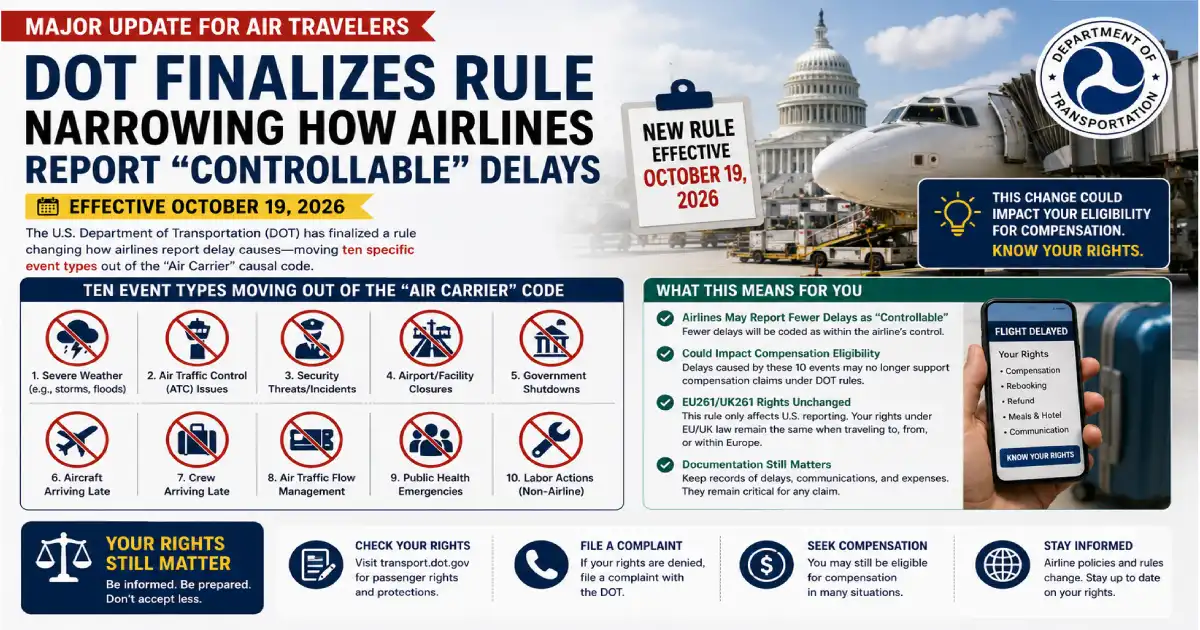
A regulatory change that sounds purely technical is about to reshape one of the most consequential numbers in air travel: how often your airline is officially blamed for your delay.
The US Department of Transportation published a final rule in the Federal Register on September 3, 2026, amending 14 CFR 234.4 — the regulation governing how airlines classify and report the causes of flight delays and cancellations to the Bureau of Transportation Statistics. The rule implements Section 511(b) of the FAA Reauthorization Act of 2024, which directed DOT to create a new reporting category for ten specific types of events that Congress determined should never be counted against an airline as a “controllable” delay, even when they happen. The rule takes effect October 19, 2026, giving airlines a 45-day transition window to update their internal data systems and coding practices.
This matters well beyond government spreadsheets. The “Air Carrier” causal code is the foundation most compensation frameworks and airline customer-service commitments build on — it’s the classification that determines whether a delay was the airline’s fault (and therefore potentially compensable) or something outside its control (and therefore typically not). By statute, one confirmed example of what moves into the new category is unscheduled maintenance that cannot be deferred — a type of event that, under the old framework, could sometimes get logged as an airline-controllable cause even when the airline argues it had no real choice in the matter.
Published: September 4, 2026 — Friday Final rule published: Federal Register, September 3, 2026 (Docket No. DOT-OST-2026-1257) Effective date: October 19, 2026 Implements: Section 511(b) of the FAA Reauthorization Act of 2024 Regulation amended: 14 CFR 234.4 (airline delay/cancellation cause reporting) What changes: Creates a new “Section 511(b) category” for 10 specific event types, removing them from the “Air Carrier” causal code Confirmed example event type: Unscheduled maintenance that cannot be deferred Who this affects: All US air carriers required to report causal data to DOT’s Bureau of Transportation Statistics Transition window: 45 days from publication for carriers to update data systems and coding logic Public visibility: Changes will appear in DOT’s on-time performance dashboards and public rankings once post-October 19 data accumulates Upcoming related DOT event: Aviation Consumer Protection Advisory Committee virtual meeting, September 22-23, 2026, covering passenger rights disclosures, know-your-rights airport posters, and airline customer service dashboards Doesn’t change: Your existing right to a full refund for any cancelled flight, regardless of causal classification
It’s easy to read “reporting rule” and assume this is bureaucratic housekeeping with no real-world consequence. It isn’t. The “Air Carrier” causal code is the single most important classification in US airline accountability — it’s what feeds the on-time performance dashboards DOT publishes, the compensation commitments major carriers have voluntarily made (like the up-to-$775 controllable-delay compensation this site regularly covers in its daily disruption reporting), and the data journalists, consumer advocates, and this site itself rely on to identify which airlines and airports are genuinely underperforming versus which are absorbing disruption from causes outside their control.
Section 511(b) was written into the 2024 FAA Reauthorization Act specifically because Congress concluded that some events were being coded as “airline’s fault” when, in its judgment, they shouldn’t be. The clearest example confirmed in the rule text: unscheduled maintenance that genuinely cannot be deferred. Under the prior framework, an airline pulling a plane for an urgent, safety-critical repair could see that event logged in the same broad “Air Carrier” bucket as a scheduling failure or an inadequate spare-aircraft buffer — even though, as the airline would argue, deferring safety-critical maintenance was never a realistic option.
The full list of all ten Section 511(b) event types wasn’t detailed in the reporting reviewed for this piece beyond the confirmed maintenance example — the underlying statutory language is described as technical, and DOT’s Bureau of Transportation Statistics is expected to continue refining detailed guidance and examples in its on-time performance technical documentation as the October 19 effective date approaches. This site will update this coverage as more of the specific event categories become clear.
What is clear is the mechanism: rather than eliminating any delay data or hiding disruption from public view, the rule simply moves qualifying events into a distinctly labeled column, separate from the “Air Carrier” code. The disruption still gets reported — travelers and researchers will still be able to see it happened — but it will no longer be counted toward an airline’s controllable-delay statistics or, by extension, the metrics most closely tied to compensation eligibility.
Before October 19, 2026: The existing “Air Carrier” causal code framework remains in effect. If you’re dealing with a delay or cancellation before this date, today’s DOT rights guidance — including the standard up-to-$775 compensation commitment for controllable delays of 3+ hours — applies as it always has.
After October 19, 2026: If your specific delay is caused by one of the ten Section 511(b) event types (unscheduled, non-deferrable maintenance being the confirmed example), expect airlines to classify it outside the “Air Carrier” code going forward — meaning any voluntary compensation commitment tied to that classification is less likely to apply, even though the underlying situation (your flight was delayed because of the airline’s own aircraft) might look, to a passenger, indistinguishable from a “controllable” cause.
What doesn’t change regardless of classification: Your right to a full refund for any cancelled flight remains completely separate from this causal-code system and is untouched by this rule. Refund rights are based on whether you flew, not on why the airline says your flight didn’t operate.
This site’s daily disruption reporting regularly cites airline-specific cancellation and delay rankings — Frontier’s, American’s, United’s performance data among them — as a way of helping readers choose more reliable carriers and routes. Once this rule takes effect and airlines begin reporting under the new framework, some of those headline “controllable delay” statistics could shift, not because airlines are performing any differently in practice, but because a portion of previously “Air Carrier”-coded events will now be classified separately. Readers and researchers comparing pre- and post-October 19 data should account for this reporting change rather than assuming it reflects a genuine operational improvement.
DOT’s own Aviation Consumer Protection Advisory Committee is holding a public virtual meeting September 22-23, 2026, covering related passenger-rights topics — including the one-page passenger rights summaries airlines must provide and the know-your-rights posters required at airports — that may offer further clarity on how this reclassification interacts with existing consumer protections.
✅ For any delay or cancellation before October 19, 2026: Current DOT rights guidance applies unchanged — ask your airline for the specific stated cause in writing, and pursue refund or compensation claims under the existing framework.
✅ For travel after October 19, 2026: If you receive a causal explanation citing “unscheduled maintenance” or similar language, ask specifically whether it falls under the new Section 511(b) category, since this may affect your compensation eligibility even though your refund rights remain unchanged.
✅ Always request the refund separately from any compensation claim — refund rights for cancelled flights are unconditional and don’t depend on causal classification under this or any future rule change.
Federal Register final rule: federalregister.gov, Docket No. DOT-OST-2026-1257 DOT Aviation Consumer Protection: transportation.gov/airconsumer DOT complaint portal: airconsumer.dot.gov Bureau of Transportation Statistics on-time data: transtats.bts.gov
Related Articles:
Posted By : Vinay
This article is provided for general informational purposes only and is based on information available at the time of publication. Travel advisories, airline schedules, airport operations, visa requirements, government regulations, and other travel-related information are subject to change without prior notice. While Travel Tourister makes reasonable efforts to verify information using official announcements, government publications, airline and airport communications, and other reliable sources, we cannot guarantee that all information remains complete, accurate, or up to date at all times. Readers should independently verify any information that may affect their travel plans with the relevant airline, airport authority, government agency, embassy, or other official source before making travel, financial, or other decisions. Travel Tourister shall not be liable for any direct or indirect loss, inconvenience, or damages arising from the use of or reliance on the information contained in this article. Nothing in this publication constitutes legal, immigration, financial, or professional travel advice. If you believe any information in this article is inaccurate or outdated, please contact our editorial team. We review all credible correction requests promptly and update our content whenever appropriate.
Lastest News
2nd Floor, 39, Above Kirti Club, DLF Industrial Area, Kirti Nagar, New Delhi, Delhi 110015



Travel Tourister is a leading Travel portal where we introduce travellers to trusted travel agents to make their journey hasselfree, memorable And happy. Travel Tourister is a platform where travellers get Tour packages ,Hotel packages deals through trusted travel companies And hoteliers who are working with us across the world. We always try to find new and more travel agents and hoteliers from every nook and corners across the world so that you could compare the deals with different travel agents and hoteliers and book your tour or hotel with the one you have chosen according to your taste and budget.
Copyright © Travel Tourister, India. All Rights Reserved

 Call
Call Enquiry