Published on : 18 Sep 2026
By Travel Tourister | Updated Sep 2026
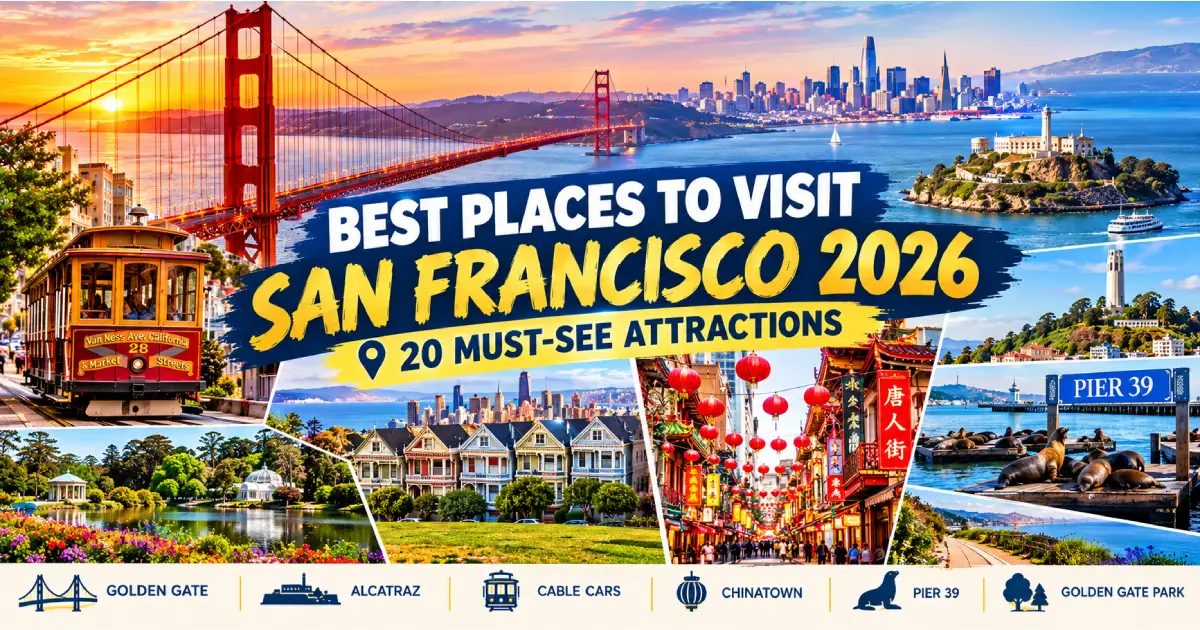
San Francisco rewards the visitor who approaches it as a collection of distinct places rather than a single destination — a city where the Golden Gate Bridge’s engineering grandeur, the Mission District’s mural-covered walls, and the Ferry Building’s artisan food market each represent different aspects of the same city’s extraordinary character, and where the specific neighborhood geography (the 7×7-mile peninsula divided into dozens of distinct neighborhoods, each with its own architectural character, food culture, and social identity) provides more genuinely different urban experiences per square mile than any other American city of comparable size. The best places to visit in San Francisco in 2026 reflect this neighborhood specificity: not just the internationally famous (the Golden Gate Bridge, Alcatraz, Fisherman’s Wharf) but the equally rewarding and less crowded (the Lands End Trail’s Pacific coastal drama, the Alamo Square Painted Ladies’ Victorian-meets-skyline composition, the Ferry Building Farmers Market’s Saturday morning food community).
What distinguishes San Francisco’s places from those of other American cities is their specific intensity — the city’s compressed geography (the seven-by-seven mile peninsula means that nothing is far from anything else) concentrating the diversity of experience into a walkable, transit-accessible urban landscape. The Golden Gate Bridge is 30 minutes from the Mission District burrito lunch. The Alcatraz ferry terminal is 15 minutes from the Chinatown dim sum. The de Young Museum is 20 minutes from the North Beach Beat Generation bookstore. This geographic compression means that a thoughtfully planned San Francisco visit can engage with the city’s full range of character without the car-dependent dispersal that Los Angeles, Houston, or Phoenix require. This guide covers the 20 best places to visit in San Francisco with the depth and practical specificity to make each genuinely rewarding.
For related guides, see our Things to Do in San Francisco 2026, Best Restaurants in San Francisco 2026, Best Time to Visit San Francisco 2026, and Day Trips from San Francisco 2026.
| Place | Type | Cost | Best For | Duration |
|---|---|---|---|---|
| Golden Gate Bridge | Landmark | Free | Iconic views, walk, photography | 2–3 hrs |
| Alcatraz Island | Historic Site | $44–$57 | History, bay views, audio tour | 3–4 hrs |
| Golden Gate Park | Urban Park | Free | Museums, nature, gardens | Half–full day |
| Ferry Building | Market/Food Hall | Free entry | Saturday farmers market, artisan food | 1–2 hrs |
| Fisherman’s Wharf | Waterfront | Free to walk | Sea lions, crab, Pier 39 | 1.5–2 hrs |
| Chinatown | Historic Neighborhood | Free | Oldest US Chinatown, dim sum, markets | 1.5 hrs |
| The Mission District | Neighborhood | Free | Murals, burritos, diverse culture | 2–3 hrs |
| North Beach | Neighborhood | Free | Beat Generation, Italian culture, City Lights | 1.5 hrs |
| Alamo Square (Painted Ladies) | Viewpoint | Free | Victorian houses, skyline photo | 30–45 min |
| Twin Peaks | Viewpoint | Free | 360° city panorama | 45 min |
| The Castro | LGBTQ+ Neighborhood | Free | History, culture, Harvey Milk legacy | 1.5 hrs |
| Haight-Ashbury | Historic Neighborhood | Free | 1960s counterculture history | 1.5 hrs |
| Lands End Trail | Coastal Trail | Free | Pacific views, Sutro Baths ruins | 2 hrs |
| Palace of Fine Arts | Architecture | Free | Rotunda, lagoon, photography | 30–45 min |
| Lombard Street | Sightseeing | Free | Crookedest street, Russian Hill | 20 min |
| Coit Tower and Telegraph Hill | Viewpoint | $15 (tower) | Panoramic views, murals, parrots | 1.5 hrs |
| SFMOMA | Museum | $25 | Modern and contemporary art | 2–3 hrs |
| de Young Museum | Museum | $25 | American and international art | 2–3 hrs |
| Muir Woods (Day Trip) | Nature | $18 | Ancient redwood forest | Half day |
| Sausalito (Day Trip) | Town | $14–$16 ferry | Bay views, waterfront village | Half day |
Cost: Free (pedestrian walk) | Location: Golden Gate Bridge, northern San Francisco | Best time: Early morning for clarity; fog conditions for atmosphere | Duration: 2–3 hours (round-trip walk plus viewpoints) | Parking: Available at both Vista Point (Marin) and the Welcome Center (SF side) — arrive early
The Golden Gate Bridge (the 1937 Art Deco suspension bridge whose International Orange paint, twin 227-meter towers, and 2.7-kilometer main span have made it the most globally recognized single piece of American civil engineering) is the starting point for every understanding of San Francisco — not just as a tourist attraction but as the geographic fact that defines the city’s relationship with the Pacific world. The bridge stands at the precise point where the San Francisco Bay opens to the Pacific Ocean — the “Golden Gate” (the name given to the strait by John C. Frémont in 1846, referencing the golden light of the sunset on the water rather than the gold rush that the name’s retrospective association suggests) being the only navigable breach in the Coast Range mountains for hundreds of miles, which is why San Francisco Bay exists as a major harbor and why San Francisco became the West Coast’s primary commercial city.
Walking the bridge: The 2.7-kilometer pedestrian walkway crossing (accessible 5 AM–9 PM on the east sidewalk, the west sidewalk designated for cyclists) provides the most directly physical encounter with the bridge’s scale and engineering — the specific sensation of walking across the mid-span (the bridge’s center section moving visibly in wind, the hum of the cables and the traffic creating the specific acoustic environment that the bridge’s interior produces), the view directly down to the water 67 meters below, and the progressive revelation of the bay-and-Pacific geography as the span is crossed.
The best bridge viewpoints:
Battery Spencer, Marin Headlands: The single finest Golden Gate Bridge viewpoint — the elevated military battery on the Marin side of the bridge provides the complete bridge composition (both towers and the full main span) with the San Francisco skyline directly behind it and the Pacific to the left. Access by car (first exit north of the bridge on US-101, then the winding Conzelman Road to the battery overlooks) or by the hiking trail from the Vista Point parking area.
Fort Point (below the south anchorage, San Francisco side): The most unusual viewpoint — at the water level directly beneath the south anchorage, the bridge visible looking straight up at 67 meters above, the specific engineering of the anchorage visible in extreme close-up from the National Historic Site grounds. Free access, unique perspective, and the specific drama of the ocean waves crashing against the Fort Point rocks creating the most visceral single Golden Gate encounter.
Vista Point (north end, Marin side): The most convenient and most popular single Golden Gate viewpoint — the parking area and overlook immediately north of the bridge’s Marin anchorage, the bridge visible in profile from the east-facing viewpoint with the San Francisco skyline beyond. Available 24 hours.
Insider tips: The Golden Gate Bridge in the specific morning fog (the summer marine layer that rolls through the Golden Gate between approximately 7 AM and noon on most June-through-August days — the bridge towers disappearing into the grey bank while the base and the roadway remain visible) is the most photographically distinctive and most specifically San Francisco single version of the bridge. The fog-tower composition (the International Orange towers emerging from grey fog above the clear roadway) is the image most specifically associated with San Francisco in international photography.
Cost: $44.25 (day ferry + tour); $57 (evening tour) | Access: Pier 33, The Embarcadero | Duration: 3–4 hours minimum | Book: alcatrazcruises.com — weeks to months ahead | Year-round
Alcatraz (the 22-acre island 2.4 kilometers offshore in San Francisco Bay — the former federal penitentiary operating 1934–1963, now a National Park Service Historic Site and the most visited single attraction in the National Park System west of the Rocky Mountains) is simultaneously the most historically significant and the most atmospherically compelling single San Francisco destination: the ferry approach (the island growing progressively larger from the Pier 33 departure, the cellhouse building on the island’s summit visible throughout the approach, the bay’s specific cold and strong-current character perceptible even from the ferry’s sheltered deck), the island itself (the 22 acres containing the cellhouse, the prison industries building, the warden’s house ruins, the gardens maintained by former prisoners’ families during the operational period, and the lighthouse — the oldest lighthouse on the West Coast, 1854 — all visible in a self-guided exploration), and the cellhouse audio tour (the most acclaimed single NPS audio tour in the system, narrated by former guards and inmates whose specific personal accounts transform the empty cells and corridors into inhabited historical spaces).
The cellhouse audio tour specifics: The multi-award-winning Alcatraz audio tour (included with the ferry ticket — no additional cost) allows self-paced exploration of the entire cellhouse, including the specific cells of famous inmates (Al Capone’s cell, the Birdman Robert Stroud’s cell history [Stroud was never actually the Birdman of Alcatraz — he was not permitted to keep birds at Alcatraz, only at the Leavenworth prison — the Hollywood film’s title being one of the most persistently perpetuated American prison myths]), the solitary confinement block (D Block, where the most recalcitrant prisoners were held in the specific “hole” cells), and the specific locations of the 14 escape attempts (the most celebrated being the 1962 escape by Frank Morris and the Anglin Brothers, the three men who excavated their cell backs with sharpened spoons, created papier-mâché heads to deceive the night guards, and disappeared into the bay — their fate officially unknown, the case remaining open [though presumed drowned by the FBI] to this day).
Day tour vs. evening tour: The evening tour (departing approximately 5:55 PM, returning approximately 9:30 PM — check current 2026 schedule at alcatrazcruises.com) provides additional programming not available on the day tour: ranger-led talks at specific historically significant locations, access to the prison industries building (not on the standard day tour), and the specific atmospheric quality of the cellhouse in the early evening’s lower light. The extra $13 premium is worthwhile for visitors seeking the most complete Alcatraz experience rather than the most efficient one.
Cost: Free to walk | Location: Northern waterfront, Jefferson Street between Hyde and Taylor | Best time: Morning (before noon) for the freshest crab | Duration: 1.5–2 hours | Year-round
Fisherman’s Wharf (the northern San Francisco waterfront from Pier 33 through Pier 45, centered on the Pier 39 commercial complex and the Jefferson Street crab stands) is the single most visited San Francisco destination by visitor count — a waterfront commercial district whose tourist-facing character San Francisco residents regularly complain about and whose specific authentically worthwhile elements (the sea lion colony, the Dungeness crab, the historic ship museums, and the specific bay views) regularly get obscured in the dismissal.
The genuinely worthwhile Fisherman’s Wharf:
Pier 39 sea lions (K Dock): The California sea lion colony that spontaneously colonized the K Dock boat slips in January 1990 — the 300–1,500 animals (population varying seasonally, with the largest numbers during the breeding and pupping season of May–July and the smallest during the winter herring-following migration) providing the most accessible close-range wild marine mammal encounter available at any American urban location. The viewing platform (free, public) extends to within 3–5 meters of the floating dock where the sea lions rest, bark, jostle, and sleep.
The Dungeness crab stands (Jefferson Street): The fresh-cooked whole Dungeness crab from the sidewalk stands along Jefferson Street between Taylor and Jones — the Dungeness (Cancer magister, the Pacific Ocean’s most commercially significant crab species, its meat significantly sweeter and more complex than the East Coast’s blue crab) at its most accessible directly from the crab stands’ steaming pots. The cracking of a whole Dungeness at an outdoor table overlooking the bay is the most specifically San Francisco waterfront food experience.
USS Pampanito (Pier 45) and SS Jeremiah O’Brien (Pier 45): The two preserved historic vessels at Pier 45 — the USS Pampanito (the WWII fleet submarine that conducted six war patrols in the Pacific, $20 admission for the self-guided tour through the submarine’s interior, the torpedo room and the crew’s quarters creating the most physically immediate single WWII naval encounter in California) and the SS Jeremiah O’Brien (one of only two operational Liberty Ships remaining in the world, $20 admission, the annual “Hike the Bay” cruises in which the ship actually steams around the bay being the most specifically extraordinary single San Francisco maritime event of the year).
Cost: Free entry | Location: The Embarcadero at Market Street | Farmers market hours: Saturday 8 AM–2 PM; Tuesday and Thursday 10 AM–2 PM | Year-round
The Ferry Building (the 1898 Beaux-Arts transportation hub at the foot of Market Street — the building’s 75-meter clock tower the most recognizable single Embarcadero structure, the building serving as the terminus for the trans-bay ferries from the East Bay until the Bay Bridge’s 1936 opening and subsequently declining before the 2003 restoration that converted the building’s ground floor to a gourmet food market) is simultaneously San Francisco’s finest food market building and the waterfront’s most architecturally significant structure.
The Ferry Building interior: The restored ground-floor marketplace (the permanent tenants — Cowgirl Creamery, Boccalone Salumeria, Acme Bread Company, Blue Bottle Coffee, The Slanted Door [one of SF’s most celebrated Vietnamese restaurants], and the various other artisan food businesses that permanent tenancy in the Ferry Building confers) provides the most concentrated single artisan food-shopping experience in San Francisco on any day of the week. On Tuesday, Thursday, and Saturday, the farmers market extends outside the building.
The Embarcadero walk: The waterfront promenade from the Ferry Building north to Pier 39 (approximately 2 km) provides the most continuously bay-front walking in San Francisco — the bay visible throughout, the piers visible as the route progresses north, and the Alcatraz island visible in the bay throughout. The specific quality of the Embarcadero in the early morning (before the commuter and tourist traffic peaks, the bay still and the light on the water in the specific pre-tourist-hour clarity) is the most contemplative version of the route.
Cost: Free | Location: Between 14th Street and Cesar Chavez, Valencia Street and Mission Street | Best time: Daytime for murals; all day for food | Duration: 2–3 hours
The Mission District is the most culturally complex and most specifically alive neighborhood in San Francisco — the layered history (the 1776 Spanish mission [Mission Dolores, the oldest surviving building in San Francisco], the 19th-century German and Irish working-class community, the 20th-century Mexican and Central American immigration that gave the neighborhood its current Latino character, and the 21st-century tech-boom gentrification creating the specific tensions that the Mission’s political murals address directly) visible simultaneously in the buildings, the restaurants, and the street life.
Mission Dolores (16th Street at Dolores Street, entry $7): The oldest building in San Francisco — the 1791 adobe church (the original construction from hand-made adobe bricks produced on-site, the walls 1.2 meters thick for thermal regulation in the pre-electricity California climate) and the adjacent basilica (the 1918 decorative church that dwarfs the original in size while the original adobe maintains its specific quiet historical character) together create the most specifically historically layered single San Francisco site. The cemetery behind the original church (where some of San Francisco’s earliest European and mission-period residents are buried, the Native American converts buried in a separate section — the specific social stratification of the colonial-period California mission system visible in the grave placement) provides the most historically resonant single outdoor space in the Mission.
Balmy Alley murals (between 24th and 25th Streets, Treat and Harrison): The most celebrated single mural corridor in the United States — the full block of continuous murals that the Precita Eyes Mural Arts organization has developed and maintained since 1973, the political content (the Central American solidarity murals of the 1980s, the immigrant rights murals of the 2000s, and the various individual artists’ contributions creating a layered political visual archive) providing the most specifically Mission District single outdoor art encounter. The Precita Eyes organization offers guided mural tours ($20, Saturday and Sunday at 1:30 PM — check precitaeyes.org for current 2026 schedule) that provide the most contextually complete engagement with the murals’ political and artistic content.
Valencia Street (between 16th and 24th Streets): The Mission’s most specifically gentrification-visible commercial street — the independent bookstores, the specialty coffee shops, the farm-to-table restaurants, and the vintage clothing stores that the tech-boom demographic has supported alongside (and in some cases replacing) the Mexican restaurants and Latino businesses that the street previously concentrated. The specific tension between the two economies is visible in the current Valencia Street mix — the Mission’s most directly San Francisco-socioeconomic-conflict single street.
Cost: Free | Location: Columbus Avenue between Broadway and Filbert Street | Duration: 1.5 hours | Best time: Morning for the Italian café culture; evening for the bar atmosphere
North Beach (the San Francisco neighborhood at the base of Telegraph Hill — historically the Italian-American quarter of the city [the bocce courts, the Italian social clubs, and the North Beach restaurants that maintained the immigrant community’s cultural institutions through the 20th century] that subsequently became the specific geographic center of the Beat Generation literary movement of the 1950s, when Lawrence Ferlinghetti opened City Lights Bookstore and the neighborhood’s coffeehouses and bars became the gathering place for Allen Ginsberg, Jack Kerouac, Gregory Corso, and the surrounding literary community) provides the most specifically literary-historically significant single San Francisco neighborhood walk.
City Lights Bookstore (261 Columbus Avenue): The most historically significant single San Francisco address in American literary history — the three-floor independent bookstore that Ferlinghetti founded in 1953 (the first all-paperback bookstore in the US, a specific democratization of book pricing), that published Allen Ginsberg’s “Howl” in 1956 (the poem’s obscenity prosecution and City Lights’ legal victory establishing American literary freedom precedent), and that continues to operate in 2026 in the same Columbus Avenue location with the same commitment to the radical literary tradition. The upstairs poetry room (the dedicated poetry section on the second floor, the seating and the specific selection philosophy maintaining the Beat-era literary identity) is the most specifically literary-atmospheric single room in San Francisco.
Washington Square Park: The North Beach public park — the green at the corner of Columbus and Union, where the neighborhood’s Italian and Chinese-American residents play bocce in the afternoon, the morning tai chi practitioners gather before 8 AM, and the afternoon dog-walkers and picnickers constitute the most specifically neighborhood-integrated single San Francisco park community. The Saints Peter and Paul Church (the Catholic church at the park’s north edge whose 1922 Romanesque Revival facade provides the most specifically Italian-neighborhood architectural backdrop in the city) and the Joe DiMaggio connection (the North Beach neighborhood kid who became baseball’s most celebrated center fielder, married Marilyn Monroe in a small ceremony at the church in 1954) together create the most condensed single San Francisco Italian-American cultural reference point.
Cost: Free | Location: Castro Street between 17th and 19th Streets | Duration: 1.5 hours | Historical significance: The most important LGBTQ+ neighborhood in American history
The Castro (the San Francisco neighborhood centered on Castro Street between Market and 19th Streets — the most historically significant LGBTQ+ neighborhood in the United States, the community that Harvey Milk represented as the first openly gay man elected to public office in California [as a San Francisco Board of Supervisors member in 1977], the neighborhood whose specific cultural and political achievements in the 1970s established the foundation for the subsequent American LGBTQ+ rights movement) provides the most historically consequential single San Francisco neighborhood walk for any visitor interested in American civil rights history.
The Harvey Milk Camera Store (575 Castro Street): The address where Harvey Milk operated his camera shop while simultaneously building the political community that elected him to the Board of Supervisors — the specific address (now marked with a historical plaque, the commercial use having changed multiple times since Milk’s 1978 assassination) representing the most directly historically associated single Harvey Milk location accessible to the public.
The GLBT Historical Society Museum (4127 18th Street, $5): The museum dedicated to LGBTQ+ San Francisco history — the Harvey Milk archive (the most comprehensive single collection of materials related to Milk’s life and political career), the documentation of the Castro’s development as an LGBTQ+ neighborhood from the 1960s through the AIDS crisis, and the specific community history of the organization and advocacy that made the Castro the most politically significant LGBTQ+ neighborhood in American history.
The Castro Theatre (429 Castro Street): The 1922 movie palace whose specific Churrigueresque Spanish Baroque facade is the Castro’s most architecturally dramatic single building — the theater that continues to operate as a single-screen cinema (increasingly augmented by live performances and special events), the organ that rises from the orchestra pit for the pre-show player-organ performance before select screenings, and the specific role of the Castro Theatre in the neighborhood’s cultural life (the annual LGBT film festivals, the midnight movie tradition, and the general cinema programming reflecting the neighborhood’s cultural identity).
Cost: Free | Location: Haight Street between Stanyan Street and Central Avenue | Duration: 1.5 hours | Historical significance: Center of the 1967 Summer of Love counterculture
Haight-Ashbury (the neighborhood at the eastern edge of Golden Gate Park — the Victorian residential district that became the geographic center of the 1967 Summer of Love [the specific cultural moment when 100,000 young Americans converged on the Haight to participate in the countercultural community that the San Francisco psychedelic rock, free clinic, and commune culture had been building since 1965], the community that produced Janis Joplin, Jefferson Airplane, the Grateful Dead, and the specific San Francisco psychedelic music and art that defined the counterculture’s aesthetic) provides the most specifically 1960s-historically significant single San Francisco neighborhood walk.
The Grateful Dead house (710 Ashbury Street): The Victorian house where the Grateful Dead lived and rehearsed in 1966–1968 — the specific address (a private residence, not open for tours) where the band developed the specific improvisational style that their live performances became famous for. The house’s specific exterior character (unchanged from the 1960s photograph that most Grateful Dead historical documentation reproduces) provides the most immediately recognizable single Haight-Ashbury historic landmark.
The Haight-Ashbury Free Clinic (558 Clayton Street): The clinic founded by Dr. David Smith in 1967 specifically to provide medical care to the Summer of Love’s young visitors without insurance or money — the specific institution that the counterculture’s most practically humanitarian impulse produced, operating as a free medical clinic to this day (the name now changed to the Haight Ashbury Free Clinic Foundation), the 55+ years of continuous operation making it one of San Francisco’s most specifically durable single social institutions.
The current Haight Street: The commercial strip that the neighborhood’s Victorian buildings create (the vintage clothing shops, the independent record stores [Amoeba Records, the largest independent music store in the US, on Haight Street — free to browse, the specific San Francisco used and new record store culture at its most concentrated], and the restaurants that the neighborhood’s specific mix of long-term residents and tourist traffic supports) provides the most specifically 1960s-to-present-day cultural arc of any San Francisco commercial street.
Cost: Free (park); paid (museums within) | Size: 1,017 acres | Location: Western San Francisco | Duration: Half to full day | Year-round
Golden Gate Park (the 1,017-acre public park extending from Stanyan Street to the Pacific Ocean — the most comprehensively programmed urban park in California, containing within its boundaries two world-class art museums, an aquarium-planetarium-natural history museum, the oldest public Japanese garden in the US, the oldest Victorian greenhouse in the Western Hemisphere, a herd of American bison, and two working Dutch windmills) is the single most complex single address in San Francisco — a destination that rewards multiple visits and multiple approaches (the museum-focused visit, the botanical walk, the Sunday afternoon people-watching at Hippie Hill, and the western Sunset District coastal approach all providing completely different Golden Gate Park encounters).
The park’s essential cultural institutions:
de Young Museum (50 Hagiwara Tea Garden Drive, $25): The city’s finest single art museum — the American painting collection (the most comprehensive American art collection on the West Coast, from the 17th-century colonial portraits through the Impressionist and Western landscape period to the 20th century), the African, Oceanic, and Americas collections (the de Young’s most internationally significant holdings — the specific depth of the textile and ceremonial object collections from these traditions representing curatorial ambition that the American painting focus obscures in the museum’s marketing), and the Hamon Tower’s free observation level (360-degree Golden Gate Park and city panorama, accessible without museum admission).
California Academy of Sciences (55 Music Concourse Drive, $35): The combined natural history museum, aquarium, and planetarium — the living roof (the 2.5-acre roof planted with 1.7 million California native wildflowers, visible from the Hamon Tower across the Music Concourse), the Philippine Coral Reef tank (the largest living coral reef display in the world, the 90,000-gallon tank containing a 25-foot-deep slice of Philippine reef ecosystem with the specific biodiversity that the coral-reef system’s complexity represents), and the Morrison Planetarium (the world’s largest all-digital dome theater, the specific immersive full-dome presentations of astronomical content the most technically advanced available at any public planetarium).
Japanese Tea Garden (75 Hagiwara Tea Garden Drive, $13): The oldest public Japanese garden in the United States, established 1894 — the 5.5-acre garden with its koi ponds, traditional arched bridges, pagodas, and the original 1894 Japanese village exhibit structures creating the most historically complete Japanese garden atmosphere in an American urban park. The specific spring bloom (the cherry blossoms and the azaleas in March-April creating the garden’s most photographed seasonal condition) and the autumn maple color (October-November creating the most dramatically colored single Golden Gate Park botanical display) provide the most specifically Japanese-garden-aesthetically resonant visits.
Cost: Free | Location: Outer Richmond, northwestern San Francisco | Access: 38 Geary bus to 48th Avenue, or drive to Merrie Way parking | Duration: 2 hours full trail | Best time: Morning on clear days
The Lands End Trail (the 3.5-mile coastal trail along San Francisco’s northwestern bluff — running through the Golden Gate National Recreation Area from the USS San Francisco Memorial through the Sutro Baths ruins to the Cliff House) is the single most dramatically scenic urban trail in San Francisco: the specific combination of the Pacific Ocean crashing against the exposed rock formations below the trail, the Golden Gate Bridge visible to the northeast throughout the western portion of the trail, the coastal scrub vegetation (the native coyote brush, monkey flower, and seaside daisy that the GGNRA’s restoration program has reestablished along the bluff face), and the Sutro Baths ruins at the trail’s eastern end creating a 2-hour coastal walk of extraordinary varied quality.
The Sutro Baths ruins: The tidal pools occupying the former swimming pool basins of Adolph Sutro’s 1896 saltwater swimming complex (the largest indoor swimming establishment in the world when built — 1,500 daily visitors using the three salt-water and three fresh-water pools beneath the glass-and-iron roof structure, the specific 19th-century democratic leisure ideal expressed in the free or nominally-priced admission) now collect Pacific Ocean water through the sea cave that connects to the open ocean below — the concrete pool walls, the scattered rubble, and the tidal pool inhabitants (the sea anemones, the hermit crabs, and the various intertidal species that have colonized the man-made basins) creating the most atmospherically complete single San Francisco historic ruin.
Cost: Free | Location: 3301 Lyon Street, Marina District | Access: Walk from Fisherman’s Wharf (20 min) or Muni 30 bus | Hours: Grounds always open | Duration: 30–45 minutes
The Palace of Fine Arts (the 1915 Panama-Pacific International Exposition rotunda — the only surviving structure from the Exposition, the architect Bernard Maybeck’s specific interpretation of a “ruined classical monument” [designed specifically to appear as an ancient ruin being reclaimed by nature rather than as a new building dressed in classical costume] rebuilt in permanent concrete in 1965 to preserve what became one of San Francisco’s most beloved architectural spaces) provides the most specifically romantic single San Francisco outdoor architectural experience: the 56-meter rotunda reflected in the lagoon (the still water of the artificial lagoon creating the rotunda reflection that is the Palace’s most reproduced photographic composition), the weeping Monterey pines and other mature trees creating a specifically park-like landscape around the classical structure, and the specific late-afternoon light (the western sun illuminating the rotunda’s warm ochre paint in the hour before sunset creating the most dramatically lit version of the composition).
The Palace of Fine Arts for photography: The rotunda-and-lagoon reflection (most complete in the morning when the lagoon is calmest), the rotunda-under-fog (the specific atmospheric version when the marine layer creates a grey diffused-light backdrop), and the sunset coloration of the painted concrete (the specific warm tone that the ochre paint achieves in the last hour of sunlight) provide three completely different photographic conditions at the same location — each specifically rewarding and each specifically San Francisco in its particular character.
Cost: Free | Location: Lincoln Boulevard at Bowley Street, Presidio | Access: 29 bus or drive | Best time: Late afternoon for the Golden Gate Bridge view | Season: Year-round; summer fog moderates temperatures
Baker Beach (the 1-mile sandy beach within the Presidio of San Francisco, the National Park Service managed former military installation that occupies the northwestern corner of San Francisco peninsula) provides the most dramatically positioned urban beach in the United States: the Golden Gate Bridge visible at close range to the north (the south anchorage approximately 800 meters from the beach’s northern end, the bridge appearing enormous from this proximity compared to any more distant viewpoint), the Pacific Ocean crashing on the beach’s western edge, and the Marin Headlands visible across the water creating the most specifically San Francisco single beach composition.
The Baker Beach swimming reality: Baker Beach is a surfing and sunbathing beach rather than a swimming beach — the specific Pacific Ocean currents at this location (the combination of the outgoing tidal flow through the Golden Gate and the coastal rip currents) create swimming conditions that the NPS specifically cautions against. The beach’s value is in the walk, the photography, and the specific coastal exposure rather than the swimming.
Cost: $15 (tower elevator); free (Filbert Street steps and parrots) | Location: 1 Telegraph Hill Boulevard | Access: 39 Coit bus or Filbert Street steps from the Embarcadero | Duration: 1.5 hours | Best time: Morning for the parrot feeding and the light on the murals
Coit Tower (the 210-foot concrete tower on the summit of Telegraph Hill — built 1933 with funds donated by Lillie Hitchcock Coit to “add beauty to the city I have always loved,” the exterior visible from throughout San Francisco’s northeastern neighborhoods and the interior containing the most historically significant single collection of New Deal public murals in California) provides two simultaneously worthwhile San Francisco experiences: the tower’s panoramic view (the 360-degree San Francisco panorama from the observation level — the bay, the bay bridges, the Golden Gate, and the city’s grid visible simultaneously) and the WPA murals (the 25 Depression-era frescoes covering the tower’s interior walls, painted by 26 artists in 1934 in a specifically politically-charged style [the scene of a California farmworker reaching for a pamphlet titled “Western Worker” — an IWW publication — caused a work stoppage and political controversy that delayed the tower’s opening]).
The wild parrots of Telegraph Hill: The flock of approximately 200 wild cherry-headed conures (the specific parrot species that a handful of escaped or released pets established as a self-sustaining wild population in the early 1990s) that roosts in the gardens and trees of the Filbert Street steps below Coit Tower represents the most specifically delightful single urban wildlife encounter in San Francisco. The parrots are most concentrated in the gardens around the Grace Marchant Garden (the terraced gardens on the Filbert Street steps’ upper section) in the morning hours (7–10 AM), when they feed on the seeds and fruits of the garden’s plantings.
Cost: $25 adults; free (selected floors, permanent collection) | Location: 151 Third Street, SoMa | Hours: Thursday–Tuesday 10 AM–5 PM | Duration: 2–3 hours
SFMOMA (the San Francisco Museum of Modern Art, the 2016-expanded building tripling the exhibition space to 235,000 square feet — the largest museum of modern art in the western United States) houses the most comprehensive single modern art collection on the West Coast: the Matisse “Femme au Chapeau” (1905, the Fauvist painting whose specific relationship with SFMOMA began when the museum purchased it from the Stein family — the Gertrude and Leo Stein who had purchased it directly from Matisse’s 1905 Salon d’Automne debut, the painting’s provenance providing the most specifically historically connected single SFMOMA artwork), the photography collection (the most comprehensive West Coast museum photography collection — the Ansel Adams Archive, the Dorothea Lange holdings, and the contemporary photography collection together representing the most specifically Bay Area-connected photography at any museum), and the architecture and design collection (the applied arts and industrial design collection whose specific California modernist holdings provide the most complete single encounter with Bay Area design history available at any public institution).
Cost: $25 | Location: 50 Hagiwara Tea Garden Drive, Golden Gate Park | Hours: Tuesday–Sunday 9:30 AM–5:15 PM (Friday until 8:45 PM) | Duration: 2–3 hours
The de Young Museum (the Golden Gate Park art museum, the current building a 2005 Herzog & de Meuron design — the copper-clad facade intended to oxidize over decades from its original copper-orange through the specific green patina that the Bay Area’s maritime climate produces, the building’s distinctive perforated copper skin already showing the specific green-and-brown patina that the architects designed for) provides the most comprehensively American single fine art collection on the West Coast: the American art collection from colonial period through the 20th century (the most complete timeline of American painting at any West Coast institution), the African, Oceanic, and Americas collection (the de Young’s most internationally significant holdings — the Huichol beaded sculpture, the Oceanic ceremonial objects, and the African textile and mask collections representing curatorial depth that the American art focus obscures).
The Hamon Tower (free): The glass-enclosed observation tower at the de Young’s northern end (accessible from inside the museum without a paid admission ticket) providing 360-degree views over Golden Gate Park — the most complete single-elevation park overview available, the full park extent visible in both directions and the city’s neighborhoods visible beyond the park’s tree canopy in all directions. The Hamon Tower is the specific de Young amenity most frequently overlooked by visitors who focus on the paid museum galleries.
Cost: $18 (entry reservation, mandatory) | Location: 17 miles north of San Francisco, Marin County | Access: Shuttle from Sausalito (preferred) or drive + parking reservation | Duration: Half day | Book: recreation.gov — essential
Muir Woods (the 554-acre old-growth coast redwood grove in the Marin County hills — the trees reaching 78+ meters in height and 800+ years in age, the Cathedral Grove’s specific old-growth character representing the most accessible ancient forest experience in the San Francisco Bay Area) provides the most immediately humbling single natural encounter within day-trip distance of any major American city. The specific sensory quality of an old-growth redwood grove — the light filtering through a 70-meter canopy 100 meters above, the specific chemical smell of the redwood bark (the natural terpenes that the bark produces as a fire and insect repellent, creating the most specifically Northern California forest aroma available), and the acoustic environment (the sound-dampening effect of the grove’s moisture and the massive trunks creating a quietude that no other natural Bay Area setting replicates) — is the most specifically non-urban natural experience available within a half-day from San Francisco’s Ferry Building.
Cost: $14–$16 (Golden Gate Ferry round-trip from Ferry Building) | Duration: Half day | Access: Golden Gate Ferry from the Ferry Building landing stage | Season: Year-round; summer fog lifts by afternoon
Sausalito (the affluent Marin County waterfront town 15 minutes by ferry from the Ferry Building — the specific combination of the Mediterranean hillside residential character [the houses cascading down the Marin hills to the water’s edge in the specific tight-packed Mediterranean style that the Bay Area’s comparable topography to the Ligurian coast has encouraged since the early settlers noticed the resemblance], the yacht harbor, and the Main Street commercial strip creating the most immediately beautiful single Bay Area community accessible by public transit) provides the most dramatically scenically-staged San Francisco Bay Area day trip: the bay crossing’s progressive views of the San Francisco skyline receding and the Marin Headlands approaching, and the ferry’s specific Golden Gate Bridge sighting (the bridge visible in profile from the water’s surface as the ferry rounds the Marin Headlands) creating the most cinematically staged approach to any single Bay Area destination.
The Bay Model Visitor Center (2100 Bridgeway, free): The US Army Corps of Engineers’ hydraulic model of the entire San Francisco Bay and Sacramento-San Joaquin Delta — the 1.5-acre working model built in 1957 to study tidal hydraulics and water quality (the model was used to evaluate the Reber Plan, the 1940s proposal to dam the bay and convert it to a freshwater reservoir, whose rejection the model’s hydraulic studies supported), now a free visitor center with the model visible (though not always in hydraulic operation — check hours at spn.usace.army.mil for the current 2026 operating schedule).
About Travel Tourister Travel Tourister’s destination specialists have explored every neighborhood and attraction in this guide across multiple San Francisco visits — from Golden Gate Bridge Battery Spencer dawn panoramas and Alcatraz evening tour atmospheric cellhouse encounters through Mission District Balmy Alley mural morning walks and North Beach City Lights bookstore browsing afternoons to Lands End Trail Sutro Baths sunset photography sessions, Castro Harvey Milk Camera Store historical reflections, Golden Gate Park de Young Hamon Tower free panorama mornings, and Muir Woods Cathedral Grove pre-crowd early-entry quietude — to deliver the most complete and practically honest guide to San Francisco’s best places for 2026 visitors.
Posted By : Vinay
Latest Article
2nd Floor, 39, Above Kirti Club, DLF Industrial Area, Kirti Nagar, New Delhi, Delhi 110015



Travel Tourister is a leading Travel portal where we introduce travellers to trusted travel agents to make their journey hasselfree, memorable And happy. Travel Tourister is a platform where travellers get Tour packages ,Hotel packages deals through trusted travel companies And hoteliers who are working with us across the world. We always try to find new and more travel agents and hoteliers from every nook and corners across the world so that you could compare the deals with different travel agents and hoteliers and book your tour or hotel with the one you have chosen according to your taste and budget.
Copyright © Travel Tourister, India. All Rights Reserved

 Call
Call Enquiry