Published on : 21 Sep 2026
By Travel Tourister | Updated Sep 2026
The United States contains more genuinely distinct major city experiences than any other country on Earth — a nation whose 330-million-person diversity is most specifically expressed in the cultural variety of its major cities, where Chicago’s specific Great Lakes industrial-to-cultural transformation, New Orleans’ French-Spanish-African layering, San Francisco’s Pacific-facing tech-and-bohemian tension, Nashville’s country-music-to-bachelorette-capital evolution, and New York’s everything-simultaneously density all represent entirely different versions of what it means to be an American city. The best cities to visit in the USA in 2026 are not simply the largest or the most famous — Los Angeles (second largest US city) provides a fundamentally different travel experience from New Orleans (52nd largest but arguably more food-and-culture-dense per square mile than anywhere else in the country), and Chicago (third largest) provides a more walkable and more museum-rich visitor experience than many smaller American cities that receive more tourism attention.
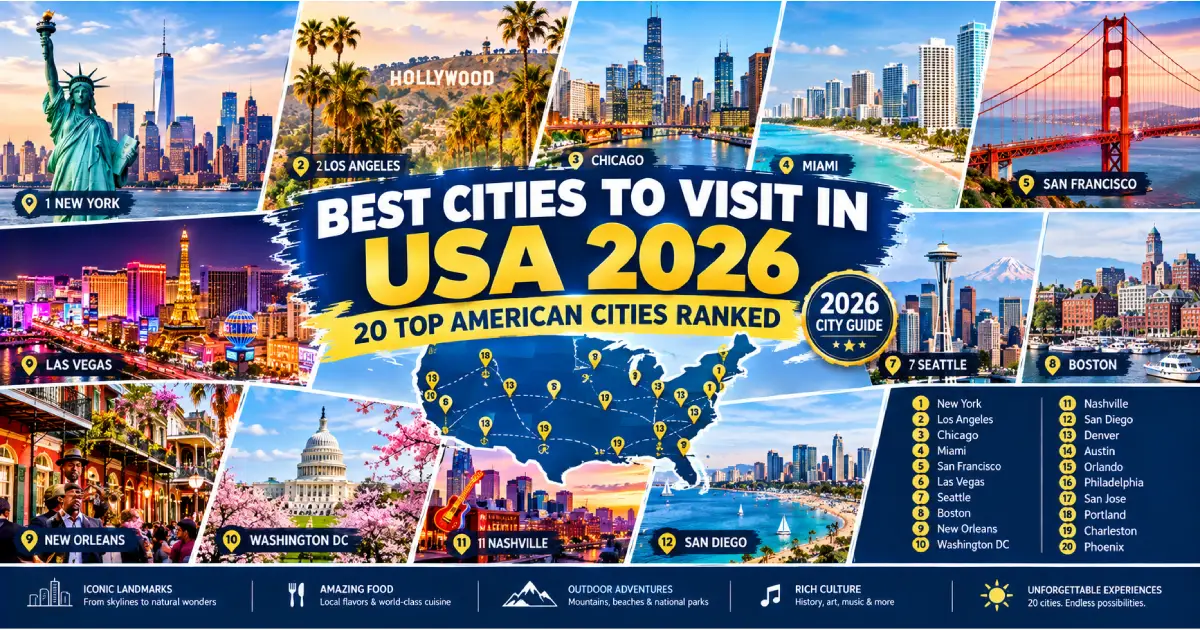
This guide ranks and describes the 20 best American cities for 2026 visitors — organized by their specific travel value rather than population or fame, with honest assessments of what each city provides that others don’t, who specifically benefits from each destination, and the practical planning considerations that separate a genuinely rewarding visit from a list-checking disappointment.
For complete city guides, see our articles on New York City, New Orleans, San Francisco, Chicago, and Nashville.
| Rank | City | State | Best For | Recommended Stay |
|---|---|---|---|---|
| 1 | New York City | New York | Everything — the ultimate urban experience | 4–7 nights |
| 2 | New Orleans | Louisiana | Food, music, culture, Mardi Gras | 3–4 nights |
| 3 | Chicago | Illinois | Architecture, food, museums, lakefront | 3–4 nights |
| 4 | San Francisco | California | Tech culture, neighborhoods, day trips | 3–4 nights |
| 5 | Nashville | Tennessee | Music, food, Southern hospitality | 2–3 nights |
| 6 | New York (Brooklyn) | New York | Alternative NYC, food, culture | Add to NYC trip |
| 7 | Washington DC | DC | History, free museums, monuments | 3–4 nights |
| 8 | Miami | Florida | Beaches, nightlife, Art Deco | 3–4 nights |
| 9 | Los Angeles | California | Entertainment, beaches, diversity | 4–5 nights |
| 10 | Savannah | Georgia | Historic charm, Southern food, squares | 2–3 nights |
| 11 | Seattle | Washington | Coffee culture, food, mountains | 2–3 nights |
| 12 | Austin | Texas | Live music, food trucks, Tex-Mex | 2–3 nights |
| 13 | Boston | Massachusetts | History, universities, seafood | 2–3 nights |
| 14 | Denver | Colorado | Outdoor gateway, food scene, craft beer | 2–3 nights |
| 15 | Portland | Oregon | Food, coffee, nature, eccentricity | 2–3 nights |
| 16 | Philadelphia | Pennsylvania | Independence Hall, food, art | 2–3 nights |
| 17 | Charleston | South Carolina | History, food, antebellum architecture | 2–3 nights |
| 18 | Las Vegas | Nevada | Entertainment, spectacle, food | 3–4 nights |
| 19 | San Antonio | Texas | River Walk, The Alamo, Tex-Mex | 2–3 nights |
| 20 | Asheville | North Carolina | Music, craft beer, Blue Ridge Parkway | 2–3 nights |
Population: 8.3 million (city); 20 million (metro) | Best for: Everything — the most complete single city experience in the world | Recommended stay: 4–7 nights | Best season: April–June and September–November
New York City is the most comprehensively rewarding urban destination in the world — not because it does any single thing better than every other city (though it is arguably the world’s finest food city, has the most impressive museum landscape of any American city, and provides the most physically dramatic skyline of any city built primarily in steel and glass), but because it does everything simultaneously, at the highest possible level, in the most compressed geographic space available at any world-class urban destination. The Metropolitan Museum of Art, the Brooklyn Bridge, Central Park, the High Line, Times Square, the Chelsea galleries, the West Village restaurant scene, the Brooklyn food culture, the specific New York energy — all available within a single day of each other in a city where the subway connects the Lincoln Center to the Tenement Museum to the Brooklyn Flea to Eleven Madison Park in under 45 minutes of transit.
What makes NYC irreplaceable:
Practical planning: New York is expensive ($250–$450/night for mid-range hotels, $40–$80/person for casual dinners) but provides the most activity-per-dollar of any premium-priced American city destination — the subway’s $2.90 fare connecting the entire five boroughs, the many free attractions (Central Park, the High Line, the Brooklyn Bridge walk, the Staten Island Ferry for Manhattan skyline views), and the sheer density of things to do eliminating the transport-between-attractions cost that car-dependent cities impose.
Population: 383,000 | Best for: Food, music, history, Mardi Gras, the most specific American regional culture | Recommended stay: 3–4 nights | Best season: October–November and February (Mardi Gras)
New Orleans is America’s most singular city — the only American urban destination whose specific combination of food culture (the most distinctive regional American cuisine, the gumbo, the po’boy, the étouffée, and the beignet representing a culinary tradition with no equivalent anywhere else in the country), music (the birthplace of jazz, the home of the second-line parade tradition, and the living continuation of the most specifically American musical form on Frenchmen Street nightly), and architecture (the French Quarter’s Creole townhouse ironwork, the Garden District’s Greek Revival mansions, and the Tremé’s historic African American community all within walking distance) creates a city experience that cannot be approximately replicated elsewhere in the US.
What makes New Orleans irreplaceable:
See our complete guide: Things to Do in New Orleans 2026
Population: 2.7 million (city); 9.5 million (metro) | Best for: Architecture, food, museums, the lakefront, the most walkable large American city after NYC | Recommended stay: 3–4 nights | Best season: June–September (avoid January–February cold)
Chicago is consistently named by travel professionals as the most underrated major American city — the specific combination of the world’s finest concentration of 20th-century architectural achievement (the Loop’s building sequence represents the most complete single urban architectural history of modernism available anywhere in the world, from Louis Sullivan’s proto-modern ornament through Mies van der Rohe’s steel-and-glass minimalism through the postmodern giants of the 1970s and 1980s through the contemporary period), the most walkable downtown of any American city outside New York (the lakefront, the Magnificent Mile, and the River Walk creating a pedestrian-scale downtown of extraordinary quality), and the most specifically diverse and affordable food scene of any top-five American city (the Chicago-style deep-dish pizza, the Chicago hot dog, the Giordano’s stuffed pizza, and the tasting menus of Alinea creating the most specifically Chicago food experience).
What makes Chicago irreplaceable:
Population: 873,000 | Best for: Iconic landmarks, neighborhood character, day trips, the most walkable West Coast city | Recommended stay: 3–4 nights | Best season: September–October (least fog, best weather)
San Francisco’s specific travel value: the Golden Gate Bridge (the world’s most dramatic single pedestrian experience, free), the compact walkable neighborhood sequence (the Mission, the Castro, North Beach, Chinatown, and the Embarcadero all within walking or single-Muni-ride distance), the Ferry Building’s Saturday Farmers Market (the finest artisan food market in the US), the Alcatraz audio tour (the most acclaimed NPS audio experience in the National Park system), and the extraordinary day-trip access (Muir Woods, Napa Valley, Point Reyes, and Yosemite all within achievable distance) together creating the most geographically advantaged single American city visit.
See our complete guide: Things to Do in San Francisco 2026
Population: 715,000 | Best for: Live music, Southern food, hot chicken, a city in dynamic cultural transition | Recommended stay: 2–3 nights | Best season: April–May and September–October
Nashville has experienced the most dramatic transformation of any American city in the past decade — the specific combination of the country music tradition (the Grand Ole Opry, the Country Music Hall of Fame and Museum, and the specific honky-tonk bars of Lower Broadway that have maintained the live-music-every-night tradition) with the city’s rapid population growth (Nashville added 100 people per day for much of the 2010s, the tech and healthcare industries transforming the economic base) and culinary evolution (the nationally-known hot chicken tradition, the farm-to-table restaurant scene that has grown alongside the population, and the specific Nashville food culture that the bachelorette-party economy has both elevated and complicated) creating the most culturally dynamic single American city of the current period.
What makes Nashville irreplaceable:
Population: 689,000 | Best for: American history, the Smithsonian museums (all free), the monuments | Recommended stay: 3–4 nights | Best season: April (cherry blossoms) and September–October
Washington DC is the single best value major American city for visitors who prioritize museums — the Smithsonian Institution’s 19 museums and galleries on and around the National Mall are all free to enter, creating the most substantial free museum day available anywhere in the United States. The National Air and Space Museum, the National Museum of American History, the National Museum of Natural History, the National Gallery of Art, and the National Portrait Gallery together constitute the most comprehensively documented American history and culture collection available at any free-admission institution.
What makes DC irreplaceable:
Population: 470,000 (city); 6.2 million (metro) | Best for: Beaches, nightlife, Art Deco architecture, Latin culture, international character | Recommended stay: 3–4 nights | Best season: December–April (avoid hurricane season June–October)
Miami is America’s most specifically international city after New York — the specific combination of the Latin American cultural majority (the largest Cuban-American community in the US in Little Havana, the Venezuelan, Colombian, Argentine, and Brazilian communities in the surrounding neighborhoods creating the most specifically Latin-American single US city character), the Art Deco Historic District of South Beach (the most concentrated surviving Art Deco architectural neighborhood in the world, the pastel-painted hotels and the Ocean Drive promenade creating the most specifically 1930s-Hollywood-tropical single American streetscape), and the Wynwood Walls (the converted Miami warehouse district whose outdoor mural program has become one of the world’s most celebrated street art destinations) together creating the most visually striking and most internationally cultured single American Sun Belt city.
What makes Miami irreplaceable:
Population: 3.9 million | Best for: Entertainment industry, beaches, ethnic food diversity, the Getty Center | Recommended stay: 4–5 nights (car required) | Best season: March–May and September–November
Los Angeles provides the largest single American city variety at the cost of the most significant transport infrastructure requirement — the rental car that most LA visitors require adds meaningful cost and planning complexity to what the hotel and restaurant lists suggest. Within that constraint, the Getty Center (one of the finest single museum experiences in the US), the beach culture (Malibu, Santa Monica, and Venice providing the most specifically swimmable Pacific beaches available from any major US city), and the extraordinary ethnic food diversity (Korean BBQ, the finest Mexican food in the US, exceptional Japanese food, and the food truck culture that LA essentially invented for the modern era) create a city of extraordinary range.
Population: 147,000 | Best for: Historic squares, antebellum architecture, Southern food, Spanish moss, the most photogenic American city | Recommended stay: 2–3 nights | Best season: March–May and September–November
Savannah (the Georgia coastal city whose 22 historic squares — the tree-shaded public gardens that James Oglethorpe’s 1733 city plan created and that Savannah has maintained as the organizing principle of its urban design through 290 years of development) is the single most photogenic American city outside of San Francisco — the live oak canopy draped with Spanish moss, the antebellum architecture surrounding each square, and the specific Savannah pedestrian scale (the city’s compact historic district is walkable from end to end in under 30 minutes) creating the most immediately beautiful American historic urban environment available at any Southern city.
What makes Savannah irreplaceable:
Population: 749,000 | Best for: Coffee culture, Pike Place Market, the natural beauty gateway (Mt. Rainier, Olympic Peninsula), the most specifically Pacific Northwest city | Recommended stay: 2–3 nights | Best season: June–September (driest months)
Seattle is the most specifically Pacific Northwest American city — the combination of the coffee culture (Starbucks was founded here in 1971, the Pike Place Market Starbucks being the original location, and the subsequent artisan coffee movement [Caffe Vita, Victrola, Lighthouse] making Seattle the most coffee-per-capita American city), the Pike Place Market (the oldest continuously operating farmers market in the United States, the fish-throwing fishmongers being the market’s most theatrical single element), and the gateway access to the Pacific Northwest’s extraordinary natural landscape (Mt. Rainier visible on clear days from the city, the Olympic Peninsula accessible by ferry, and the Cascade Mountains beginning 45 minutes east) create a city of specific Pacific Northwest character.
What makes Seattle irreplaceable:
Population: 979,000 | Best for: Live music (6th Street), tacos, Tex-Mex, the most specifically Texas city that doesn’t feel like Texas | Recommended stay: 2–3 nights | Best season: March (SXSW) and October–November
Austin (the Texas state capital and university city whose specific combination of the live music scene [the “Live Music Capital of the World” designation based on the sheer number of music venues per capita], the Tex-Mex and taco culture [the Franklin Barbecue, the Veracruz All Natural taco, and the Torchy’s Tacos representing the most specifically Austin food culture at three different price points], and the SXSW festival [the annual March festival combining the world’s most significant music-industry showcasing event with the most important tech and film industry conference of the year] creates the most dynamically culturally evolving single Texas city) provides the most specifically urban Texas cultural experience.
The Franklin Barbecue queue: The single most specifically Austin food experience — the Franklin Barbecue (the James Beard Award-winning brisket that Aaron Franklin has been producing since 2009, the line forming from 7 AM for the 11 AM opening, the brisket selling out by 1 PM most days — the specific line culture [the folding chairs, the community of waiting strangers, and the 3-hour wait transformed by the shared anticipation] as much a part of the Franklin experience as the brisket itself) represents the most completely committed single American food-pilgrimage experience.
Population: 675,000 | Best for: American colonial history, the Freedom Trail, New England seafood, university culture | Recommended stay: 2–3 nights | Best season: April–June (spring) and September–October (fall foliage)
Boston (the Massachusetts capital and America’s most historically concentrated major city — the Freedom Trail’s 2.5-mile walking route connecting 16 historically significant sites from the Boston Common to the Paul Revere House to the Bunker Hill Monument, the oldest baseball park in the major leagues [Fenway Park, 1912], and the specific New England seafood [the clam chowder, the lobster roll, and the Cape Cod oysters] creating the most specifically American colonial-history experience available at any living city) provides the most concentrated single American history encounter in a walkable, transit-accessible urban environment.
What makes Boston irreplaceable:
Population: 749,000 | Best for: Outdoor access (Rocky Mountain National Park, ski resorts), craft beer, farm-to-table food, the most specifically outdoors-lifestyle American city | Recommended stay: 2–3 nights | Best season: June–October (hiking); December–March (skiing)
Denver (the Colorado capital city at 5,280 feet altitude — the “Mile High City” — whose specific position as the gateway to the Rocky Mountain recreational landscape [Rocky Mountain National Park 1.5 hours west, world-class ski resorts [Breckenridge, Vail, Aspen] 1.5–3 hours west, and the spectacular Pikes Peak and Garden of the Gods south of the city] creates the most specifically outdoors-lifestyle single American city) provides the most outdoor-recreation-accessible major American city experience: the specific Denver day-trip landscape (the most mountain-adjacent major American city) combined with the increasingly impressive urban food and craft beer scene (Denver has the most craft breweries per capita of any major American city, the specific Colorado beer culture having matured from the 1990s microbrew novelty into a genuine craft tradition of sophisticated quality).
Population: 652,000 | Best for: Food, coffee, independent retail, eccentricity, the most specifically alternative American city character | Recommended stay: 2–3 nights | Best season: June–September
Portland (the Oregon city whose specific cultural identity — the “Keep Portland Weird” slogan that the local business community adopted as a serious civic philosophy, the most specifically independent-retail-per-capita major American city, the food cart culture [the largest concentration of food cart pods in the US, providing the most ethnically diverse street food at the most affordable prices of any American city], and the specific Pacific Northwest outdoor culture that Powell’s Books [the largest independent bookstore in the world] and the Forest Park hiking trails both reflect) provides the most specifically alternative-American single city experience.
What makes Portland irreplaceable:
Population: 1.57 million | Best for: Colonial history, the most underrated American food scene, the specific Philadelphia grit-and-character | Recommended stay: 2–3 nights | Best season: April–June and September–October
Philadelphia (the city where the Declaration of Independence was signed, where the Constitution was written, and where the Liberty Bell still hangs — the most historically significant single American colonial city for the specific documents that defined the country’s founding ideals) has developed in the past 15 years into one of America’s most specifically dynamic food cities: the Reading Terminal Market (the most historically complete single American urban food market building, the indoor market whose operating stalls have been continuously occupied since 1893), the specific Philly food culture (the cheesesteak, the roast pork Italian hoagie at Tommy DiNic’s, and the Vietnamese food of South Philadelphia creating the most specifically Philly food identity), and the Fishtown and East Passyunk neighborhoods (the most specifically restaurant-concentrated and most specifically neighborhood-cool single Philadelphia areas, the restaurant scenes in both neighborhoods having matured from the 2010s food-scene emergence into genuine culinary destinations).
Population: 150,000 | Best for: Antebellum architecture, the most photogenic Southern historic district, Lowcountry food, Southern hospitality | Recommended stay: 2–3 nights | Best season: March–May and September–November
Charleston (the South Carolina coastal city whose specific combination of the Colonial and antebellum historic district [the most architecturally complete surviving 18th and 19th-century American city center south of Savannah], the Lowcountry food culture [the shrimp and grits, the she-crab soup, and the specific rice-culture Gullah Geechee culinary tradition that the Lowcountry’s enslaved African community developed and that Charleston’s best restaurants specifically engage], and the specific Charleston grace [the deliberate hospitality culture that the city maintains as a civic identity] creates the most specifically Southern charming single American city experience) provides the most specifically small-scale Southern city visit available at any Atlantic seaboard destination.
Population: 660,000 | Best for: Entertainment, spectacle, gambling, world-class restaurants, and the most concentrated single human-constructed excess in the world | Recommended stay: 3–4 nights | Best season: March–May and September–November (avoid July–August 110°F heat)
Las Vegas is the most specifically American single city in the world — the specific American willingness to build an entire city of maximum spectacle in the middle of the Mojave Desert, to staff it with the world’s finest chefs (the Las Vegas restaurant scene has grown into the most Michelin-starred single destination outside of San Francisco and New York for non-resident chef restaurant operations, the specific chef-resort partnership producing outposts of Joël Robuchon, Guy Savoy, and various other internationally significant chefs), and to provide an entertainment calendar (the residencies of the world’s most commercially successful performers, the sporting events, the boxing matches, and the Formula 1 Grand Prix [Formula 1’s return to Las Vegas in recent years creating the most specifically Las Vegas addition to the global motor racing calendar]) that no other American city approaches.
Population: 1.45 million | Best for: The River Walk, The Alamo, the most specifically authentic Tex-Mex in Texas, Mexican-American heritage | Recommended stay: 2–3 nights | Best season: October–April (avoid summer heat)
San Antonio (the Texas city whose specific combination of the San Antonio River Walk [the 15-mile network of walkways along the San Antonio River, the most specifically successful American urban waterfront-development project of the 20th century, the hotels, restaurants, and tourist facilities that the river level provides creating a pedestrian commercial zone invisible from the street level above], the Alamo [the 1836 battle site and the most historically significant single structure in Texas history], and the specific San Antonio Mexican-American food culture [the puffy taco, the breakfast taco, and the specific San Antonio Tex-Mex tradition that the city’s 70% Hispanic/Latino population maintains as the most authentically Mexican-influenced Tex-Mex available in the state]) provides the most specifically Hispanic-cultural American city experience.
Population: 94,000 | Best for: Blue Ridge Parkway, craft beer, arts scene, the most specifically bohemian small American city | Recommended stay: 2–3 nights | Best season: October (fall foliage peak) and May–June
Asheville (the western North Carolina mountain city at 2,134 feet altitude whose specific combination of the Blue Ridge Parkway [the 469-mile scenic highway running along the Appalachian Mountain crests, the most visited single unit in the National Park Service, the most specifically spectacular mountain-skyline American road available by car], the craft beer scene [the most breweries per capita of any American city under 100,000 population, the specific Asheville beer culture having produced regional brands [Wicked Weed, Sierra Nevada’s Asheville facility, Burial Beer] of national significance], and the downtown arts scene [the River Arts District, the downtown galleries, and the specific Asheville creative-class culture that has attracted artists from across the American South] creates the most specifically arts-and-nature combined small American city experience) provides the most rewarding single small-city American destination.
The October timing: Asheville in October (the Blue Ridge Parkway fall foliage peak, typically reaching its most vibrant color in mid-to-late October at the higher elevations and early November at the lower Asheville elevation) provides the single most dramatically beautiful seasonal American city experience available outside of New England’s fall foliage — the specific combination of the mountain landscape colors, the Asheville downtown character, and the fall beer release season (the specific autumn beers that the Asheville breweries release in October, the pumpkin ales and the amber lagers reflecting the seasonal character) creating the most complete single Asheville visit.
Population: 25,000 | Best for: The most specifically eccentric small American city, the Hemingway connection, the Florida sunsets, the most southern point in the continental US | Recommended stay: 2–3 nights | Best season: December–April
Key West (the southernmost city in the continental United States, accessible via the 113-mile Overseas Highway [the most specifically dramatic single road drive in Florida — the causeway running island-to-island across the Florida Keys with the Gulf of Mexico on the left and the Atlantic Ocean on the right for 42 miles of the approach] and maintaining the most specifically eccentric small American city character — the Duval Street bar crawl, the Ernest Hemingway Home and Museum [the specific house where Hemingway wrote “A Farewell to Arms” and “For Whom the Bell Tolls,” the descendants of his six-toed cat still resident in the house], and the specific Key West sunset celebration at Mallory Square [the daily gathering where the entire local population celebrates the sunset with street performers, cold drinks, and genuine communal appreciation of the specific tropical sunset that the Key West geography provides]) provides the most specifically character-rich small American destination.
New York City + New Orleans + one of {San Francisco / Chicago / Nashville}
This classic American circuit provides the most genuinely diverse American city experience available in a single trip — the world-city density of NYC, the uniquely American cultural character of New Orleans, and a third city providing either the Pacific Coast drama (SF), the architectural and food culture of the Midwest (Chicago), or the musical heritage of the South (Nashville).
New Orleans + Chicago + San Francisco + New York
The four cities with the most specifically rewarding and most diverse food cultures at the highest quality levels — New Orleans for Creole and soul food, Chicago for deep-dish and Alinea, San Francisco for farm-to-table and the Ferry Building, and New York for the full spectrum of global food culture in a single city.
Boston + Philadelphia + Washington DC + Charleston + Savannah
The East Coast historical circuit — the American colonial and founding history of Boston and Philadelphia, the monuments and Smithsonian museums of DC, and the antebellum Southern architecture of Charleston and Savannah.
Nashville + New Orleans + Austin + Memphis (day trip from Nashville)
The American music cities — Nashville for country, New Orleans for jazz and second-line, Austin for live music across every genre, and Memphis (an easy Nashville day trip) for the blues and the specific Stax and Sun Studio recording history.
Denver + Portland + Seattle + San Francisco
The mountain and Pacific Northwest gateway cities — Denver for Rocky Mountain access, Portland for the Columbia River Gorge and the coast, Seattle for Mt. Rainier and the Olympic Peninsula, and San Francisco for Muir Woods, Point Reyes, and the Napa Valley.
About Travel Tourister Travel Tourister’s destination specialists have spent extended time in every city on this list — from New York Met Impressionist galleries and New Orleans Frenchmen Street jazz nights through Chicago Architecture River Cruise mornings and San Francisco Ferry Building Saturday markets to Nashville Franklin Barbecue 3-hour line waits, Savannah Spanish-moss square morning walks, Washington DC Smithsonian free-museum full days, Miami Wynwood Walls Saturday evenings, Seattle Pike Place fish-throw mornings, Austin 6th Street live music nights, and Asheville Blue Ridge Parkway October peak-foliage drives — to deliver the most honestly calibrated and most practically useful ranked guide to
Posted By : Vinay
Latest Article
2nd Floor, 39, Above Kirti Club, DLF Industrial Area, Kirti Nagar, New Delhi, Delhi 110015



Travel Tourister is a leading Travel portal where we introduce travellers to trusted travel agents to make their journey hasselfree, memorable And happy. Travel Tourister is a platform where travellers get Tour packages ,Hotel packages deals through trusted travel companies And hoteliers who are working with us across the world. We always try to find new and more travel agents and hoteliers from every nook and corners across the world so that you could compare the deals with different travel agents and hoteliers and book your tour or hotel with the one you have chosen according to your taste and budget.
Copyright © Travel Tourister, India. All Rights Reserved

 Call
 Enquiry