Published on : 19 Sep 2026
By Travel Tourister | Updated Sep 2026
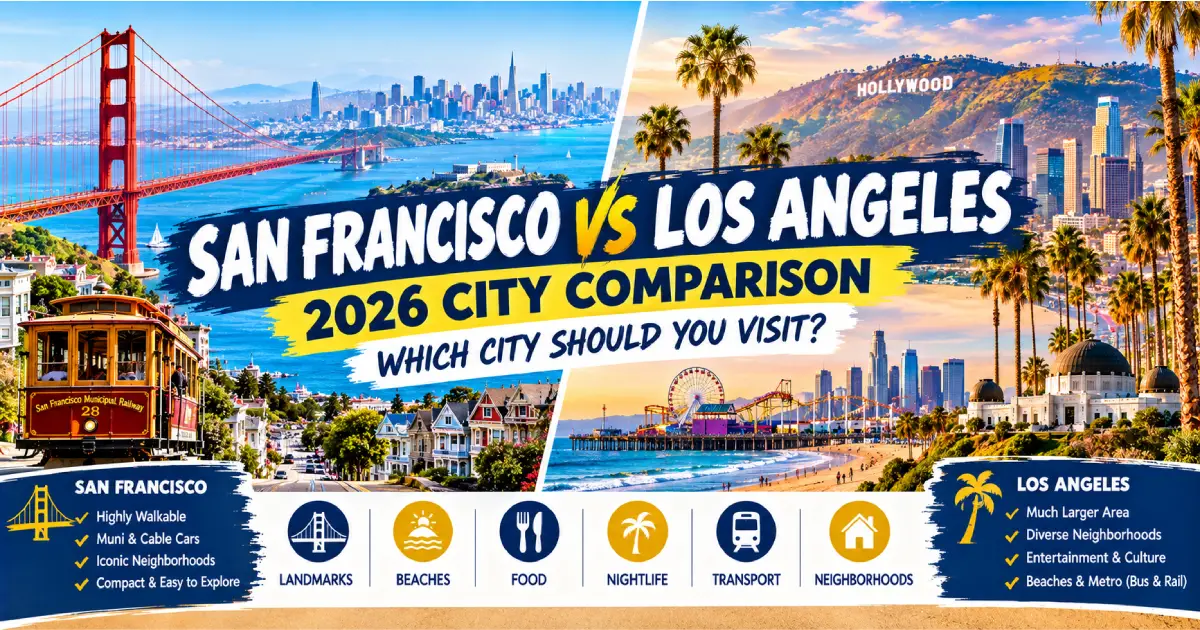
San Francisco versus Los Angeles is the defining California travel decision — the choice between the two cities that most comprehensively represent California’s range of character, and the decision that most visitors to California face when planning a first or returning trip to the state. The two cities are 380 miles apart by car, 1 hour 10 minutes by air, and approximately 50 years apart in cultural self-image: San Francisco the older, denser, hillier, foggier, more specifically European-influenced city of 870,000 that considers itself the intellectually serious California while Los Angeles is the newer, flatter, sunnier, more sprawling, more specifically American-reinvention city of 3.9 million (and 13 million in the greater metro area) that considers culture to be whatever the entertainment industry produces this quarter.
Both characterizations are simultaneously accurate and unfair. San Francisco is intellectually serious and genuinely beautiful but also a city whose tech-economy wealth has driven its working-class communities into a housing crisis that creates visible social consequences on every walk through the Tenderloin. Los Angeles is genuinely sun-soaked and culturally productive but also genuinely car-dependent in a way that punishes the visitor who arrives without a rental car or who stays in the wrong neighborhood relative to their interests. Understanding the San Francisco vs. Los Angeles decision requires understanding these specific truths about each city rather than the marketing versions — the specific experiences each provides that the other doesn’t, the practical planning requirements each imposes, and the visitor types for whom each city is specifically the right choice.
For complete city guides, see our Things to Do in San Francisco 2026, Things to Do in Los Angeles 2026, San Francisco Trip Cost 2026, and Best Time to Visit San Francisco 2026.
| Category | San Francisco | Los Angeles |
|---|---|---|
| Population (city) | 873,000 | 3.9 million |
| Population (metro) | 4.7 million | 13.2 million |
| Area (city) | 47 square miles | 503 square miles |
| Average daily high (July) | 65°F / 18°C | 84°F / 29°C |
| Average daily high (January) | 57°F / 14°C | 68°F / 20°C |
| Summer fog | Very common | Rare (coastal fog only) |
| Annual rainfall | 23 inches | 15 inches |
| Airport | SFO / OAK / SJC | LAX / BUR / LGB / SNA |
| Mid-range hotel/night | $200–$350 | $160–$280 |
| Casual dinner/person | $30–$55 | $25–$45 |
| Car necessary? | No (walkable + transit) | Yes (most visitors) |
| Best neighborhoods | Mission, Castro, North Beach, Nob Hill | Silver Lake, Venice, Los Feliz, Santa Monica |
| Beaches | Baker Beach (cold Pacific) | Santa Monica, Malibu, Venice (warm, swimmable) |
| Most famous landmark | Golden Gate Bridge | Hollywood Sign / Griffith Observatory |
| Best day trip | Muir Woods, Napa Valley | Malibu, Joshua Tree, Santa Barbara |
| Michelin stars | 54 (highest per capita in US) | 21 |
| Public transit | Excellent (Muni, BART, ferry) | Limited (but improving) |
| Drive to airport | 30 min (SFO) | 30–90 min (LAX) — notorious traffic |
San Francisco’s weather is the single most consistently misunderstood element of California travel planning — the specific Mark Twain (mis)attribution (“the coldest winter I ever spent was a summer in San Francisco”) capturing the precise truth that most visitors from warmer climates experience firsthand. The summer marine layer (the cold California Current upwelling generating the temperature differential that pulls fog through the Golden Gate daily in June, July, and August) keeps San Francisco’s summer temperatures at 63–65°F/17–18°C average highs — requiring a jacket in July that visitors arriving from Dallas or Phoenix find genuinely surprising.
San Francisco’s weather by season:
Los Angeles delivers the California sunshine that San Francisco’s marketing implies but the marine layer frequently withholds — the specific Southern California Mediterranean climate (warm, sunny, dry for approximately 9 months of the year) creating the outdoor lifestyle that the California dream specifically promises. The “June Gloom” (the coastal marine layer that affects the immediate beachfront communities of Santa Monica, Venice, and Malibu in May and June) is Los Angeles’ closest equivalent to San Francisco’s summer fog — but it clears by noon in most beach areas and barely affects the inland neighborhoods at all.
Los Angeles’ weather by season:
The weather verdict: Los Angeles wins decisively for visitors who prioritize sunshine, beach weather, and warm temperatures. San Francisco wins for visitors who prefer the temperate Mediterranean character (never very hot, never very cold) and who specifically value the atmospheric drama of the fog.
San Francisco consistently ranks as one of America’s two or three most expensive hotel markets — driven by the tech economy’s housing price compression and the geographic constraint of the seven-by-seven mile peninsula. Los Angeles hotels, while not cheap, provide meaningfully more value at equivalent price points, partially because the metropolitan spread (the 503-square-mile city creates hotel competition across dozens of neighborhood markets rather than the concentrated Union Square / Financial District demand that drives SF pricing).
| Category | San Francisco/night | Los Angeles/night | Savings in LA |
|---|---|---|---|
| Budget (hostel dorm) | $55–$85 | $35–$60 | 25–35% |
| Budget hotel | $130–$175 | $100–$150 | 15–25% |
| Mid-range hotel | $200–$350 | $160–$280 | 15–25% |
| Boutique hotel | $280–$450 | $200–$380 | 15–20% |
| Luxury hotel | $500–$900+ | $400–$800+ | 10–15% |
The LA hotel caveat: Los Angeles hotel costs are meaningfully lower than San Francisco’s in absolute terms, but the car-dependent nature of LA (the rental car requirement that most LA visitors accept) adds $65–$120/day in car rental and $25–$50/day in parking costs — partially or completely erasing the hotel savings in the overall daily transport budget.
San Francisco has the highest concentration of Michelin-starred restaurants per capita of any American city, and the general restaurant price level reflects both the tech-economy expense-account culture and the specific premium that the Bay Area’s food culture has developed. Los Angeles food is generally 15–25% cheaper at equivalent quality levels, with the specific advantage of the city’s extraordinary ethnic food diversity (the most diverse restaurant ecosystem in the US, the Korean Town, Little Ethiopia, Thai Town, and the various other food-cultural communities providing exceptional quality at dramatically below-SF pricing).
| Category | San Francisco | Los Angeles |
|---|---|---|
| Coffee (specialty) | $5.50–$7 | $4.50–$6.50 |
| Casual lunch | $18–$30 | $15–$25 |
| Mid-range dinner | $45–$75 | $35–$60 |
| Fine dining (tasting menu) | $200–$400+ | $150–$300+ |
| Craft beer (bar) | $8–$12 | $7–$10 |
| Cocktail | $16–$22 | $14–$20 |
San Francisco is the most walkable major American city after New York — the seven-by-seven mile peninsula’s geographic compression means that most visitor-relevant destinations are within walking distance or a single Muni ride of each other. The cable cars, the Muni buses and light rail, the BART rapid transit, and the bay ferries together create a public transit network that most visitors use more than any American city except New York. The Golden Gate Bridge, the Ferry Building, Alcatraz (by ferry), Fisherman’s Wharf, Chinatown, the Mission, and the Castro are all accessible without a car.
Car-free San Francisco reality:
When a car is useful in SF:
Los Angeles is the definitive American car city — the metropolitan area’s 503 square miles, the dispersal of neighborhoods across the basin, and the specific design of the city (built primarily in the 1920s–1950s around the automobile) creates a visitor experience that is genuinely impractical without a car for most destinations. The Metro system (the LA County Metropolitan Transportation Authority’s subway and bus rapid transit network) serves the downtown corridor and major east-west routes adequately, but most visitor-relevant destinations (Malibu, the Getty Villa, the Griffith Observatory, the Hollywood Hills hikes, and the various beach communities beyond Santa Monica) require either a car or significant taxi/rideshare expense.
Car reality in Los Angeles:
The LA car calculation: A 5-day Los Angeles visit with a rental car and parking adds approximately $500–$750 to the total trip cost beyond what the hotel and food budgets show — the most significant hidden cost in any LA trip budget. The specific LA vs. SF comparison: SF’s higher hotel rates are partially offset by the car-free transport option that saves $500–$750 over 5 days.
San Francisco’s Pacific Ocean beaches (Baker Beach, Ocean Beach, and the various smaller cove beaches along the western and northern peninsula coastline) are dramatically beautiful and genuinely cold — the Pacific California Current that generates the summer fog keeps the San Francisco-area ocean at 55–60°F/13–16°C year-round, cold enough to make extended swimming uncomfortable without a wetsuit and cold enough to make sitting on the beach in summer (when the fog is present) genuinely chilly. The San Francisco beach experience is about the drama (the waves, the fog, the sea lions, the Golden Gate Bridge view from Baker Beach) rather than the sun-and-swim pleasure that Southern California delivers.
Los Angeles delivers the California beach experience that the global imagination associates with the state — the warm Pacific (68–72°F/20–22°C in summer, meaningfully more swimmable than the Northern California alternatives), the miles of sandy beach from Malibu through Santa Monica and Venice to Hermosa Beach, and the specific beach culture (the beach volleyball courts, the boardwalk cyclists, and the specifically LA blend of fitness culture with recreational beach use) that no Northern California beach replicates.
The top LA beaches:
The beach verdict: Los Angeles wins completely for beach-focused travelers. San Francisco’s beaches are worth experiencing for their dramatic beauty but not for swimming or sunbathing in any conventional summer beach sense.
San Francisco’s neighborhoods are the most specifically distinct of any American city’s — the geographic compression of the seven-by-seven mile peninsula creating neighborhood transitions (from the Castro’s LGBTQ+ history to the Mission’s Latino culture to the Financial District’s tech wealth to the Haight’s 1960s counterculture legacy) within walking distances that cities of equivalent cultural diversity spread across 40+ miles of metro area.
San Francisco’s defining neighborhoods:
The Mission District: The most specifically alive — the Latino cultural community, the murals, the Mission burrito, the Valencia Street independent retail, and the Dolores Park social gathering that the neighborhood provides
The Castro: The most historically significant LGBTQ+ neighborhood in American history — the Harvey Milk legacy, the specific community character, and the Castro Theatre’s programmatic identity
North Beach: The Beat Generation’s geographic home — City Lights Bookstore, Vesuvio Café, and the specific literary history that the neighborhood has maintained across 70 years
The Haight: The 1960s Summer of Love neighborhood — the Grateful Dead house, the Haight-Ashbury Free Clinic, and the surviving counterculture character on Haight Street
The Embarcadero and Ferry Building: The most specifically San Francisco food-and-waterfront experience — the Saturday Farmers Market, the bay views, and the ferry connections to the East Bay
Los Angeles’ neighborhoods require more geographic navigation to experience than San Francisco’s (the car requirement creating the specific planning overhead of routing between Silver Lake, Los Feliz, West Hollywood, Venice, and Malibu in a single day), but they provide an equally diverse and equally distinctive set of cultural environments.
Los Angeles’ defining neighborhoods:
Silver Lake: The most specifically contemporary creative neighborhood — the independent cafés, the record stores, the restaurants, and the Silver Lake Reservoir walk creating the most specifically local-feeling LA neighborhood experience
Venice: The beach boardwalk culture, the Abbot Kinney Boulevard independent retail, and the specific Venice canal residential character
Los Feliz / Griffith Park: The most specifically neighborhood-and-nature combined — the Griffith Observatory (the most dramatically positioned urban observatory in the US, the LA basin visible in its full extent from the observatory terrace), the Los Feliz village streets, and the Franklin Village café culture
Koreatown: The most specifically ethnic-food-concentrated single LA neighborhood — the 24-hour Korean BBQ restaurants, the karaoke bars, and the specific Korean-American cultural community that the area represents
Malibu: Not a conventional neighborhood but a lifestyle statement — the 27 miles of Pacific coastline, the celebrity residential community, and the specific Malibu-as-aspiration character that represents the most internationally recognized single LA area
San Francisco’s food culture is the most critically recognized single American city food scene by Michelin star concentration per capita (54 stars in the Bay Area, the highest per-capita star concentration in the US) and by the specific influence of the Alice Waters / Chez Panisse farm-to-table philosophy that has shaped American restaurant culture since 1971. The specific SF food strengths:
SF’s food advantages:
Los Angeles has arguably the most diverse restaurant ecosystem of any American city — the Korean BBQ of Koreatown, the Mexican food of East LA (among the finest Mexican food in the United States, the specific California-Mexico border food tradition producing preparations not available in Mexico City or Guadalajara), the Japanese food of Little Tokyo (sushi quality approaching Tokyo at LA Restaurant prices), and the extraordinary proliferation of food truck culture (the Kogi BBQ truck that Roy Choi launched in 2008 creating the modern US food truck industry) together providing the broadest single-city food range in the country.
LA’s food advantages:
The food verdict: San Francisco wins on Michelin star density, specific artisan food tradition, and the specific California farm-to-table quality. Los Angeles wins on food diversity, value (the taco, the Korean BBQ, and the various ethnic food communities providing extraordinary quality at dramatically lower prices than SF equivalents), and the specific entertainment-industry dining culture. Neither city is wrong — they offer fundamentally different food experiences.
San Francisco punches above its population weight in cultural institution quality — the de Young Museum (the finest American art collection on the West Coast), the SFMOMA (the largest modern art museum in the western US), the California Academy of Sciences (the finest natural history and aquarium combination in the western US), and the specific literary culture (City Lights, the Beat Generation geography, and the specific San Francisco intellectual tradition) together creating the most concentrated cultural-institution landscape of any US West Coast city.
Key SF cultural advantages:
Los Angeles has undergone a cultural institution renaissance since the 1990s — the Getty Center and Getty Villa (the most extraordinary single museum campus in the western US, the J. Paul Getty Trust’s investment producing a collection and a building of genuinely world-class quality), the Los Angeles County Museum of Art (LACMA, the largest art museum in the western US by collection size), the Museum of Contemporary Art (MOCA), and the Hammer Museum together creating the most ambitious single American West Coast museum development of the past 30 years.
Key LA cultural advantages:
San Francisco provides the most specifically varied natural access of any American major city within a 2-hour radius: the ancient coast redwoods of Muir Woods (17 miles), the Pacific drama of Point Reyes National Seashore (40 miles), the Napa Valley wine country (55 miles), the Yosemite National Park gateway (200 miles), and the Sonoma Coast’s dramatic cliffs (50 miles) all within achievable day-trip distance.
Los Angeles provides the most specifically diverse natural access — the Pacific beaches (immediately adjacent), the San Gabriel Mountains (the Angeles National Forest within 45 minutes of downtown, the Mt. Wilson Observatory and the specific mountain hikes above the urban basin visible from the summit), the Joshua Tree National Park (2.5 hours east, the desert landscape immediately after the urban sprawl’s abrupt edge), and the Channel Islands National Park (accessible by ferry from Ventura, the islands providing the most specifically remote natural experience accessible by public transport from any Southern California base).
Los Angeles’ specific advantage that San Francisco cannot replicate: the entertainment industry. Hollywood studios, celebrity sightings, the historic film locations, the Walk of Fame, the Paramount Pictures studio tour, and the specific LA character as the city where American popular culture is produced — all specific to Los Angeles and not found in San Francisco.
LA entertainment-specific experiences:
✅ Walkable urban exploration is the priority — SF’s compact geography rewards walkers in a way that LA’s sprawl cannot ✅ The specific historic neighborhoods matter — the Beat Generation, the Summer of Love, the LGBTQ+ Civil Rights history, and the Mission’s Latino culture are SF-specific ✅ Food culture at the artisan and Michelin-star level is the focus — SF’s Michelin star density and farm-to-table tradition exceeds LA’s ✅ A car-free trip is preferred or required — SF’s public transit handles the vast majority of visitor needs without a rental car ✅ The natural landscape access via day trips is important — Muir Woods, Point Reyes, Napa, and the Pacific coastal drama within 2 hours ✅ You’re visiting in September or October — SF’s finest season, the fog has retreated and the Hardly Strictly Bluegrass festival is free ✅ A smaller, more intimate city character is preferred — SF’s 873,000 population creates a human scale that LA’s 3.9 million doesn’t
✅ Beach weather and swimming is the priority — LA’s Pacific (68–72°F/20–22°C in summer) vs. SF’s Pacific (55–60°F/13–16°C year-round) ✅ The entertainment industry and Hollywood are specifically interesting — studio tours, film locations, celebrity culture ✅ Food diversity at every price point matters — LA’s Korean BBQ, Mexican food, Japanese food, and taco truck culture provide more ethnic food diversity at lower prices ✅ Warm, sunny weather is specifically important — LA’s 330+ days of sunshine vs. SF’s summer fog and 23 inches of annual rain ✅ The Getty Center or LACMA are specific cultural priorities — LA’s museum renaissance has produced world-class institutions that SF doesn’t match at this level ✅ A budget-flexible visitor — LA hotels are 15–25% cheaper, food is 15–25% cheaper, and the overall daily spend is meaningfully lower ✅ You’re traveling with children — the beach culture, Universal Studios, the accessible outdoor spaces, and the generally warmer weather make LA specifically more family-friendly for the standard family vacation
✅ The California road trip along Highway 1 — the Pacific Coast Highway from San Francisco to Los Angeles (or vice versa) through Big Sur, Carmel, Monterey, and the Central Coast provides the most comprehensively California single travel experience, with both cities as the endpoints of the most scenic American road trip
✅ 10+ days in California — the two cities’ 380-mile separation, the Pacific Coast Highway connection, and the complementary characters (SF’s intellectual density + LA’s sprawling sunshine) together provide the most complete California experience available in a single extended trip
About Travel Tourister Travel Tourister’s destination specialists have spent extended time in both San Francisco and Los Angeles across multiple visits and all seasons — eating Mission burritos and Koreatown Korean BBQ on consecutive days, riding the Powell-Hyde cable car and renting a car for the PCH, watching SF fog roll through the Golden Gate and watching LA sunshine hit the Santa Monica pier, attending Hardly Strictly Bluegrass in Golden Gate Park and the Hollywood Bowl’s summer Philharmonic series, browsing City Lights Bookstore and the Getty Center’s Irises — to deliver the most honestly calibrated and most practically useful San Francisco vs. Los Angeles comparison for every type of California 2026 visitor.
Posted By : Vinay
Latest Article
2nd Floor, 39, Above Kirti Club, DLF Industrial Area, Kirti Nagar, New Delhi, Delhi 110015



Travel Tourister is a leading Travel portal where we introduce travellers to trusted travel agents to make their journey hasselfree, memorable And happy. Travel Tourister is a platform where travellers get Tour packages ,Hotel packages deals through trusted travel companies And hoteliers who are working with us across the world. We always try to find new and more travel agents and hoteliers from every nook and corners across the world so that you could compare the deals with different travel agents and hoteliers and book your tour or hotel with the one you have chosen according to your taste and budget.
Copyright © Travel Tourister, India. All Rights Reserved

 Call
 Enquiry