Published on : 26 Sep 2026
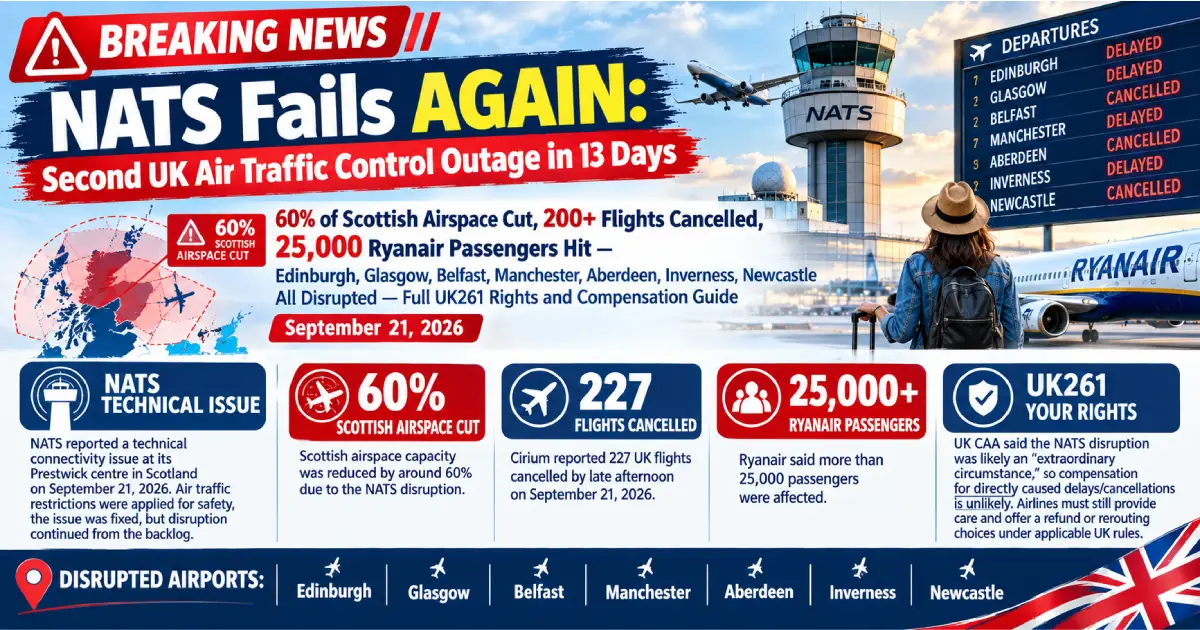
Britain’s air traffic control provider NATS suffered its second major system failure in 13 days on Monday September 21, 2026. A connectivity fault at the Prestwick Centre in South Ayrshire forced controllers to slash Scottish airspace capacity by 60 per cent to maintain safety, triggering a cascade of cancellations and delays across Scotland, Northern Ireland and northern England. ITV News reported more than 200 flights cancelled. Ryanair confirmed disruption to 25,000 passengers. Cirium counted 227 cancelled UK arrivals and departures by late afternoon. Loganair grounded inter-island services entirely. Airlines including Ryanair, easyJet, British Airways and Jet2 publicly demanded action. This is the third notable NATS disruption in three years — and airlines say “lessons learned” is no longer an acceptable public line. Here is everything you need to know, and exactly what you are owed.
Early on the morning of Monday September 21, 2026, a connectivity fault hit the Flight Data Processing System at NATS’ Prestwick Centre in South Ayrshire, Scotland. To maintain the safety of aircraft, air traffic controllers applied immediate traffic regulations — cutting the volume of aircraft they could safely accept through Scottish-controlled airspace by 60 per cent.
Airspace capacity under Scottish control was reduced by around 60 per cent during the disruption, affecting flights departing from Scottish airports as well as services travelling north through UK airspace.
The fault was fixed by approximately 10:30 AM local time. Manchester Airport confirmed that operations would soon be back to normal but added that there may still be knock-on delays. The knock-on effects — aircraft and crews out of position — continued to ripple through schedules for days afterwards.
NATS was precise and deliberate in its public statement: “This was a connectivity issue with part of our systems network, specific to the operation in Scotland. It is nothing to do with the problem we had earlier this month. To maintain safety, air traffic regulations were applied to manage traffic demand while our engineers investigated. The issue has now been fixed and we are working closely with airports and airlines to safely remove the remaining air traffic restrictions as quickly as possible.
Most passengers have never heard of Prestwick Centre. That invisibility is part of why its failures are so damaging.
NATS operates two principal en-route control centres in the United Kingdom: Swanwick in Hampshire, which covers southern England and the London-area airspace that feeds Heathrow, Gatwick, Stansted and London City; and Prestwick in South Ayrshire, which covers everything north of that — Scottish airspace, Northern Ireland, northern England, and crucially, the Shanwick Oceanic sectors over the North Atlantic.
Almost all air traffic travelling between the United States and Northern Europe also passes through Prestwick-controlled airspace, so a local processing failure becomes a problem for transatlantic operations almost instantly.
Prestwick Centre manages the upper airspace above Scotland and handles heavy transatlantic traffic heading for the oceanic entry gates over the North Atlantic. A fault there therefore affects far more than Scottish domestic flights.
That is why a connectivity problem in Ayrshire showed up on departure boards at Manchester, Liverpool, Newcastle, Belfast and even London Gatwick and London City within minutes of the restriction being applied. NATS said flights south of Manchester were broadly unaffected. That containment limited the scale compared to the September 8 nationwide failure — but it is cold comfort if your flight was on the wrong side of that line.
| Airport | Status September 21 |
|---|---|
| Edinburgh (EDI) | Delays and cancellations — inside 60% airspace cut zone |
| Glasgow (GLA) | Delays and cancellations — inside 60% airspace cut zone |
| Aberdeen (ABZ) | Delays — inside airspace cut zone |
| Inverness (INV) | Delays — HIAL network affected |
| Dundee | Delays — HIAL network affected |
| Islay | Delays — HIAL remote island network affected |
| Belfast International (BFS) | 10 Belfast flights cancelled — Edinburgh and Glasgow routes severed |
| City of Derry (LDY) | 2 Derry flights cancelled — Edinburgh and Glasgow routes |
| Manchester (MAN) | Delays — on the boundary of the restriction zone |
| Liverpool John Lennon (LPL) | Delays — northern England affected |
| Newcastle (NCL) | Departure delays warned — northern UK routes hit |
| Glasgow Prestwick (PIK) | The centre’s own adjacent airport — delays |
| London Gatwick (LGW) | Some disruption warned — rotational knock-on |
| London City (LCY) | Some disruption warned — rotational knock-on |
Ten Belfast flights and two Derry flights to and from Edinburgh and Glasgow were among those cancelled as a result of the Prestwick air traffic control failure on Monday 21 September 2026.
Glasgow and Edinburgh airports reported delays, while Highlands and Islands Airports Limited said the technical issue was affecting flight schedules across its network, including airports such as Inverness, Dundee and Islay.
Ryanair was the bluntest of any carrier in stating exactly where the fault lay, publishing a formal passenger statement: “We have been advised of a NATS Air Traffic Control equipment failure today affecting the airspace above Scotland/Northern England. As a result, we expect some delays to flights to/from the UK and Ireland.” Ryanair confirmed disruption to 25,000 passengers across its Scottish and northern UK network.
Loganair grounded several inter-island services during Monday’s outage. For remote Scottish island communities — Orkney, Shetland, the Western Isles — Loganair’s flights are not a convenience but an essential lifeline. A NATS failure that grounds inter-island services cuts off medical connections, freight, and residents who have no other practical transport option.
British Airways, easyJet and Ryanair all warned of delays. BA’s Scotland and Northern Ireland routes — Edinburgh, Glasgow, Belfast, Inverness — were directly in the disruption zone.
easyJet operates heavy short-haul frequencies across Scottish and Northern Irish airports. The carrier issued a passenger advisory and warned of knock-on effects across its northern UK network through the day.
Airlines including Ryanair, easyJet, British Airways and Jet2 demanded action on Monday, 21 September 2026, after a connectivity fault at NATS’ Prestwick centre disrupted flights across Scotland, Northern Ireland and northern England.
Final count: Cirium counted 227 cancelled UK arrivals and departures by late afternoon. ITV News reported more than 200 flights cancelled in total.
Your readers who followed our September 8 NATS coverage need to understand that these are two entirely different failures — but together they form one devastating pattern.
| September 8, 2026 | September 21, 2026 | |
|---|---|---|
| Centre affected | Swanwick, Hampshire (London Area Control) | Prestwick, South Ayrshire (Scottish Area Control) |
| Cause | Software defect in flight data system allocating aircraft ID codes — millisecond timing error | Connectivity fault in Flight Data Processing System |
| Scale | Nationwide — all UK airspace | Scotland, N. Ireland, northern England (60% capacity cut) |
| Flights cancelled | 2,000+ | 227 (Cirium) / 200+ (ITV News) |
| Passengers disrupted | Hundreds of thousands — BA alone cancelled 550 flights affecting 85,000+ | 25,000+ (Ryanair alone) |
| Resolution time | System restored same day; recovery took days | Fixed by 10:30 AM; knock-on delays ran all day |
| Government response | Independent review ordered; CAA reminded airlines of care duties | Airlines demanded further action |
| NATS statement | Preliminary report published September 18 | “Entirely separate issue” — Prestwick-specific |
| Compensation ruling | CAA: likely extraordinary circumstances — care rights apply, cash comp unlikely | CAA: same position |
A preliminary NATS investigation published on September 18 identified a software defect in a specific part of the National Airspace System’s flight data software as the cause. According to NATS, the September 8 failure involved software used to allocate aircraft identification codes.
Three days after that preliminary report was published, a completely separate fault hit a completely separate centre. A third notable NATS disruption in three years — 2023, a smaller 2025 radar-related event, then September 2026 twice — has left airlines arguing that “lessons learned” is no longer an acceptable public line.
NATS CEO Martin Rolfe, in the aftermath of the September 8 failure, noted over £1 billion of technology investment in the past decade. The UK CAA said NATS would provide a technical report and that the Government asked it to run an independent review into what happened and NATS’ future resilience; it also reminded airlines of passenger care duties and said the disruption was likely “extraordinary circumstances”, limiting delay compensation eligibility.
Airlines are no longer satisfied with that response. After two failures in 13 days across two different centres affecting two different systems, Ryanair, easyJet, British Airways and Jet2 have publicly demanded action — not another review, not another preliminary report, not another “lessons learned” exercise.
The pressure points are clear:
The UK government has ordered an independent review into the September 8 failure. Airlines are now demanding that review be expanded to cover the entire NATS network’s resilience — not just the Swanwick software defect.
The UK Civil Aviation Authority has confirmed its position clearly: the CAA said directly affected cancellations and delays were likely to be extraordinary circumstances, so airlines still owed care and refund or re-routing rights, but fixed cash compensation was unlikely.
Here is exactly what that means for you:
| Situation | What You Are Owed |
|---|---|
| Flight cancelled | Full refund to original payment OR rebooking on next available flight — your choice |
| Delay 2+ hours (short-haul) | Meals and refreshments — you must ask; airlines do not always offer proactively |
| Delay 3+ hours (medium-haul) | Meals and refreshments |
| Overnight delay | Hotel accommodation AND transport to/from hotel — airline must arrange or reimburse |
| Fixed cash compensation (€250/€400/€600) | Unlikely — CAA has indicated NATS failures are extraordinary circumstances |
| Travel insurance claim | Check your policy — most comprehensive policies cover trip delays of 4+ hours |
Critical distinction: “Extraordinary circumstances” removes the airline’s obligation to pay fixed cash compensation. It does NOT remove your right to a refund if the flight is cancelled, or your right to meals and accommodation during a significant delay. Airlines sometimes try to use “extraordinary circumstances” to refuse all assistance — that is incorrect. Care rights always apply.
How to claim:
If your September 21 flight was cancelled or delayed more than 3 hours due to the Prestwick failure, claim your care expenses now — the deadline for submitting claims is typically 6 years under UK law, but the sooner you submit the better. You are not entitled to fixed compensation but you are entitled to every out-of-pocket expense incurred as a direct result of the delay or cancellation.
Because Prestwick manages the Shanwick Oceanic sector — the handoff point between UK and oceanic (mid-Atlantic) airspace — transatlantic flights routing over Scotland were affected. If your US or Canada-departing transatlantic flight was delayed because of the Prestwick failure on September 21, your rights depend on the direction of travel. UK261 applies to flights departing UK airports; US DOT rules apply to flights departing US airports. Canadian passengers on Air Canada or WestJet transatlantic services delayed by the Prestwick failure are entitled to rebooking under APPR.
Australian and NZ passengers connecting through UK airports on the Kangaroo Route (typically via Singapore or Dubai into Heathrow or Gatwick) were generally south of the disruption zone. However, passengers who had onward connections to Scotland or Northern Ireland from London were directly affected. Qantas Conditions of Carriage entitle you to rebooking when a disruption is caused by circumstances beyond the airline’s control.
| Date | Failure | Scale | Cause |
|---|---|---|---|
| August 28, 2023 | NATS nationwide system failure | 1,500+ flights cancelled; 700,000+ passengers affected | Software processing error at Swanwick — flight plan parsing fault |
| 2025 | Radar-related disruption (smaller) | Limited regional — not fully publicly reported | Radar equipment issue |
| September 8, 2026 | NATS Swanwick software defect | 2,000+ flights cancelled; BA alone cancelled 550 affecting 85,000+ | Flight data allocation software — millisecond timing defect |
| September 21, 2026 | NATS Prestwick connectivity fault | 227 Cirium-counted cancellations; 25,000+ Ryanair passengers | Flight Data Processing System connectivity failure |
Four events. Three years. Two different control centres. Two different causes in the same month. Airlines have lost patience.
Posted By : Vinay
This article is provided for general informational purposes only and is based on information available at the time of publication. Travel advisories, airline schedules, airport operations, visa requirements, government regulations, and other travel-related information are subject to change without prior notice. While Travel Tourister makes reasonable efforts to verify information using official announcements, government publications, airline and airport communications, and other reliable sources, we cannot guarantee that all information remains complete, accurate, or up to date at all times. Readers should independently verify any information that may affect their travel plans with the relevant airline, airport authority, government agency, embassy, or other official source before making travel, financial, or other decisions. Travel Tourister shall not be liable for any direct or indirect loss, inconvenience, or damages arising from the use of or reliance on the information contained in this article. Nothing in this publication constitutes legal, immigration, financial, or professional travel advice. If you believe any information in this article is inaccurate or outdated, please contact our editorial team. We review all credible correction requests promptly and update our content whenever appropriate.
Lastest News
2nd Floor, 39, Above Kirti Club, DLF Industrial Area, Kirti Nagar, New Delhi, Delhi 110015



Travel Tourister is a leading Travel portal where we introduce travellers to trusted travel agents to make their journey hasselfree, memorable And happy. Travel Tourister is a platform where travellers get Tour packages ,Hotel packages deals through trusted travel companies And hoteliers who are working with us across the world. We always try to find new and more travel agents and hoteliers from every nook and corners across the world so that you could compare the deals with different travel agents and hoteliers and book your tour or hotel with the one you have chosen according to your taste and budget.
Copyright © Travel Tourister, India. All Rights Reserved

 Call
Call Enquiry