Published on : 28 Sep 2026
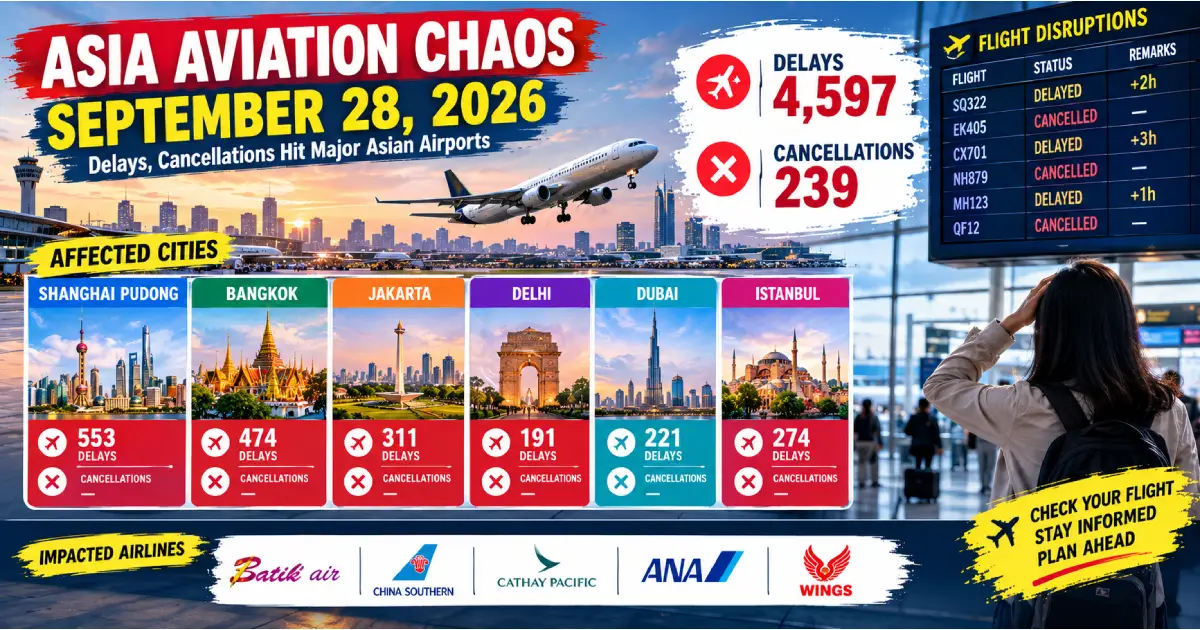
While the US Northeast choked under nor’easter chaos and Britain enforced its new ferry passport rule, Asia’s aviation network recorded its own major disruption on September 28, 2026. Widespread schedule friction has triggered 239 cancellations and 4,597 flight delays across Asia’s primary aviation arteries — placing heavy pressure on the transit hubs that millions of Australian, UK, US and Canadian passengers depend on to connect to their final destinations. Shanghai Pudong leads all Asian airports with 553 delays. Bangkok Suvarnabhumi follows with 474. Jakarta is down 311. Istanbul is absorbing 274 and Dubai 221. If you are transiting through any Asian hub today — this is everything you need to know before you reach your connecting gate.
Data recorded on 27 September 2026 at 2:48pm ET USA (28 September 2026, 2:49am Shanghai Time, GMT+8). Primary source: FlightAware, verified by Travel and Tour World editorial desk.
| Metric | September 28, 2026 |
|---|---|
| Total Asia delays | 4,597 |
| Total Asia cancellations | 239 |
| Worst airport — delays | Shanghai Pudong (PVG) — 553 delays |
| Worst airport — cancellations | Jakarta Soekarno-Hatta (CGK) — 15 cancellations |
| Worst carrier — cancellations | Batik Air — 16 cancellations |
| Worst carrier — delays | Turkish Airlines — 282 delays |
| Primary cause | Adverse weather cells, slot-restricted airspace, peak terminal congestion |
| Yesterday’s total | 341 cancellations + 4,959 delays — today is an improvement but still severe |
Shanghai Pudong International Airport recorded 553 delays and 8 cancellations — the highest delay count of any Asian airport today. Mainland China remains the most heavily impacted market, with regional satellite hubs including Shanghai Hongqiao registering 120 delays alongside 17 cancellations, and Hangzhou Xiaoshan logging 116 delays with 8 cancellations.
The three Shanghai-cluster airports combined account for over 789 delays and 33 cancellations — a figure that cascades across every carrier operating through China’s aviation system.
Why it matters for your readers: Shanghai Pudong is a primary transit hub for Australian passengers flying Qantas, China Eastern and China Southern via Shanghai to Europe and North America. Every delayed PVG rotation affects connections onward.
Bangkok Suvarnabhumi’s 474 delays make it Asia’s second worst airport today. Bangkok Suvarnabhumi logged 474 delays driven by a combination of weather cells over the Gulf of Thailand and peak terminal gate occupancy as Thailand’s post-monsoon travel season reaches its September peak.
Thai Airways’ 76 percent delay rate across its entire operation is the single most alarming airline-level statistic in today’s data — meaning more than three in every four Thai Airways flights operated late today.
Why it matters: Bangkok is Australia’s most popular Southeast Asia hub. Every Qantas, Thai Airways and AirAsia flight routing through BKK is exposed.
Jakarta Soekarno-Hatta International Airport recorded 311 delays and 15 cancellations. Batik Air’s 16 cancellations — its worst day of the period — are concentrated here, with the carrier recording a 5 percent cancellation rate and 25 percent delay rate across its Indonesian network.
Jakarta is routinely the highest-cancellation airport in Asia during periods of regional disruption because of its tight aircraft turnaround schedules and Indonesia’s vast domestic network. A single weather-caused ground hold at CGK ripples into Surabaya, Bali, Makassar and Lombok within hours.
Why it matters: Jakarta is a key transit point for Australian travellers to Bali and Eastern Indonesia, and for UK and US passengers connecting through Garuda Indonesia or Batik Air.
Istanbul Airport’s 274 delays and 7 cancellations reflect Turkish Airlines’ network-wide pressure today. Turkish Airlines managed 282 delays and 6 cancellations — a 17 percent delay rate. Istanbul is the primary one-stop hub connecting Europe to Asia, the Middle East, Africa and the Indian Subcontinent — when Turkish Airlines absorbs a delay wave, it propagates across more international routes than almost any other carrier in the world.
Why it matters: Huge numbers of UK passengers fly Turkish Airlines via Istanbul to Bangkok, Delhi, Singapore, Bali and Tokyo. Today’s disruption directly affects those connections.
Dubai’s 221 delays and 11 cancellations are lower than its typical disruption days but still significant given the airport’s role as the world’s busiest international hub by passenger volume. FlyDubai recorded 99 delays and 3 cancellations, while Emirates absorbed 83 delays across its network.
Why it matters: Dubai is the primary transit hub for Australian passengers flying Emirates to Europe, and for UK passengers flying Emirates and FlyDubai to Asia. Delays at DXB propagate into Heathrow, Manchester, Birmingham and virtually every major UK regional airport within hours.
Delhi’s 191 delays and 7 cancellations are driven by the September monsoon transition — the period when the southwest monsoon retreats from northern India, creating sudden atmospheric instability over the Indo-Gangetic Plain. IndiGo recorded 161 delays and 1 cancellation at Delhi today.
Why it matters: Delhi is a major transit hub for Australian, UK and Canadian passengers connecting to South Asia. It is also a primary origin airport for the large South Asian diaspora communities in Australia, the UK and Canada.
| Airport | Code | Delays | Cancellations |
|---|---|---|---|
| Shanghai Pudong | PVG | 553 | 8 |
| Bangkok Suvarnabhumi | BKK | 474 | 3 |
| Jakarta Soekarno-Hatta | CGK | 311 | 15 |
| Istanbul | IST | 274 | 7 |
| Dubai International | DXB | 221 | 11 |
| Delhi Indira Gandhi | DEL | 191 | 7 |
| Shanghai Hongqiao | SHA | 120 | 17 |
| Hangzhou Xiaoshan | HGH | 116 | 8 |
| Airline | Delays | Cancellations | Key Stat |
|---|---|---|---|
| Turkish Airlines | 282 | 6 | 17% delay rate — network-wide |
| ANA + ANA Wings | 161 | 7 | Combined Japan domestic + regional |
| China Southern | 126 | 2 | China’s third-largest carrier |
| IndiGo | 161 | 1 | India’s largest carrier |
| Cathay Pacific | 93 | 2 | 22% delay rate |
| FlyDubai | 99 | 3 | Gulf LCC heavily exposed |
| Batik Air | 80 | 16 | 5% cancellation rate — worst today |
| SpiceJet | 22 | 13 | 20% cancellation rate — severe |
| Shanghai Airlines | 84 | 7 | China Eastern subsidiary |
| Thai Airways | 185 | 2 | 76% delay rate — catastrophic |
| Jetstar Japan | 16 | 8 | 7% cancellation rate |
Batik Air documented 16 cancellations and 80 delays, reflecting a 5 percent cancellation rate and 25 percent delay rate. Batik Air is Indonesia’s second-largest carrier and operates a high-frequency domestic network connecting Jakarta to more than 40 Indonesian cities. Its 16 cancellations today effectively sever connections between Jakarta and regional Indonesian destinations — Surabaya, Denpasar, Makassar, Balikpapan and Lombok among them.
For Australian travellers connecting to Bali through Jakarta on a Batik Air onward sector, today’s cancellation rate is a direct risk to their journey.
All Nippon Airways and ANA Wings combined for 7 cancellations and 161 delays across domestic and regional international routes. ANA Wings operates the dense inter-island network connecting Japan’s main islands to remote communities in Hokkaido and Okinawa. Its cancellations today affect passengers with no realistic alternative transport.
Cathay Pacific recorded 93 delays at a 22 percent delay rate and 2 cancellations. Cathay’s 22 percent delay rate means roughly one in five Cathay Pacific flights is operating late today — significant for Australian and UK passengers transiting through Hong Kong on Cathay routes.
More than 76 percent of Thai Airways scheduled flights suffered operational setbacks in today’s 24-hour cycle. A 76 percent delay rate means that if you are booked on a Thai Airways flight today, the odds of departing on time are less than one in four. Thai Airways operates the majority of Bangkok Suvarnabhumi’s intercontinental routes, including services to Australia (Sydney, Melbourne, Brisbane), the UK (London Heathrow) and across Asia.
Asia’s aviation network has unique structural characteristics that amplify regional disruption into a global problem within hours.
Airlines across Asia operate aircraft on tight multi-sector rotations — often flying four to six domestic legs per aircraft daily — a sixty-minute delay in the early morning at Delhi or Guangzhou inevitably turns into a multi-hour evening delay or midnight cancellation downline.
Three structural factors make September particularly volatile:
1. Monsoon transition: The simultaneous retreat of the Southwest Monsoon from India, Bangladesh and Myanmar in late September creates sudden atmospheric instability over the densest air corridors in Asia. Holding patterns above Mumbai, Bangkok and Jakarta compound slot restrictions at airports already running at near-capacity.
2. Peak pre-Golden Week traffic: China’s Golden Week holiday begins October 1 — Chinese carriers are operating at peak schedule density this week, with minimal buffer for recovery. Every delayed rotation today creates a compounding effect heading into next week’s holiday traffic surge.
3. Network interdependency: Shanghai, Bangkok, Jakarta and Dubai are not isolated hubs — they are the four corners of the most interconnected aviation network on earth. A ground hold in Shanghai delays a Jakarta-bound feeder flight. That delay mispositions a crew in Jakarta who were due to operate a Bangkok departure. The Bangkok flight runs late. The Bangkok-Dubai sector is delayed. The Dubai-London connection misses its slot. By the time you trace it back, a weather hold in Pudong has cancelled a UK passenger’s onward connection from Heathrow.
This is the most important section for your Australian readership. Every major Australian transit hub through Asia is disrupted today:
If you are transiting through any of these airports today on a single ticket, your airline is legally obligated to rebook you at no extra cost if you miss a connection because of a delay on the inbound sector. Under Australian Consumer Law as applied to international aviation, you are entitled to care — meals and accommodation — during a significant delay regardless of cause.
Qantas specifically: Check the Qantas app before your first departure today if your itinerary transits Shanghai, Bangkok or Dubai. Qantas’ Conditions of Carriage entitle you to rebooking at no additional cost when disruption is caused by circumstances beyond the airline’s control.
UK passengers on Turkish Airlines via Istanbul, Emirates via Dubai, Cathay Pacific via Hong Kong and Thai Airways via Bangkok are all directly exposed today. UK261 rights apply to your outbound UK-departing flight. On return legs departing from Asian airports, local regulations apply — which for most Asian countries means the airline’s own Conditions of Carriage rather than a mandatory compensation scheme equivalent to UK261.
Key practical point: If you miss a connection at an Asian hub because of a delayed inbound flight on the same ticket, demand rebooking immediately at the airline’s transfer desk — do not leave the transit area and do not rebook independently without first confirming the airline will not cover your costs.
US passengers transiting through Asian hubs — particularly Shanghai for China-US routes and Dubai/Istanbul for Middle East connections — are exposed. Under US DOT rules, protections apply to US-departing and US-arriving flights. For purely international connections outside the US, your rights are governed by the airline’s Conditions of Carriage and the local regulatory framework of the country where the disruption occurs.
Canadian passengers on Air Canada via Shanghai, Vancouver–Tokyo connections or Toronto–Dubai services should check their APPR entitlements — rebooking at no extra cost is required; compensation depends on whether the disruption is within the airline’s control.
Air New Zealand routes connecting Auckland to London, New York and Asia transit through Los Angeles, Singapore and increasingly through Shanghai. NZ passengers connecting through affected Asian hubs today should monitor via the Air New Zealand app and contact the airline immediately if a delay threatens a connection.
| Hub Country | Framework | Cancelled Flight | Delay 3+ Hours | Missed Connection |
|---|---|---|---|---|
| China | CAAC | Rebooking + meals | Meals after 4hrs; hotel after 8hrs | Airline obligation on same ticket |
| Thailand | DCA Thailand | Rebooking | Meals after 2hrs | Airline obligation on same ticket |
| Indonesia | DGCA Indonesia | Rebooking + refund | Meals; hotel if overnight | Airline obligation on same ticket |
| India | DGCA India | Refund or rebooking | Meals after 2hrs; hotel if overnight | Airline obligation on same ticket |
| UAE | GCAA | Rebooking + refund | Meals; hotel if overnight | Airline obligation on same ticket |
| Turkey | DGCA Turkey + EU261 mirrors | Rebooking + potential €250–600 | Care rights | Airline obligation |
| UK (outbound) | UK261 | Refund or rerouting | Meals + hotel | Rebooking obligation |
The key rule at every Asian hub: If your onward connection is on the same ticket as your delayed inbound flight, the operating carrier of the delayed flight is responsible for getting you to your final destination. Go directly to the airline’s transfer or customer service desk — do not rebook independently.
Posted By : Vinay
This article is provided for general informational purposes only and is based on information available at the time of publication. Travel advisories, airline schedules, airport operations, visa requirements, government regulations, and other travel-related information are subject to change without prior notice. While Travel Tourister makes reasonable efforts to verify information using official announcements, government publications, airline and airport communications, and other reliable sources, we cannot guarantee that all information remains complete, accurate, or up to date at all times. Readers should independently verify any information that may affect their travel plans with the relevant airline, airport authority, government agency, embassy, or other official source before making travel, financial, or other decisions. Travel Tourister shall not be liable for any direct or indirect loss, inconvenience, or damages arising from the use of or reliance on the information contained in this article. Nothing in this publication constitutes legal, immigration, financial, or professional travel advice. If you believe any information in this article is inaccurate or outdated, please contact our editorial team. We review all credible correction requests promptly and update our content whenever appropriate.
Lastest News
2nd Floor, 39, Above Kirti Club, DLF Industrial Area, Kirti Nagar, New Delhi, Delhi 110015



Travel Tourister is a leading Travel portal where we introduce travellers to trusted travel agents to make their journey hasselfree, memorable And happy. Travel Tourister is a platform where travellers get Tour packages ,Hotel packages deals through trusted travel companies And hoteliers who are working with us across the world. We always try to find new and more travel agents and hoteliers from every nook and corners across the world so that you could compare the deals with different travel agents and hoteliers and book your tour or hotel with the one you have chosen according to your taste and budget.
Copyright © Travel Tourister, India. All Rights Reserved

 Call
Call Enquiry