Published on : 14 Sep 2026
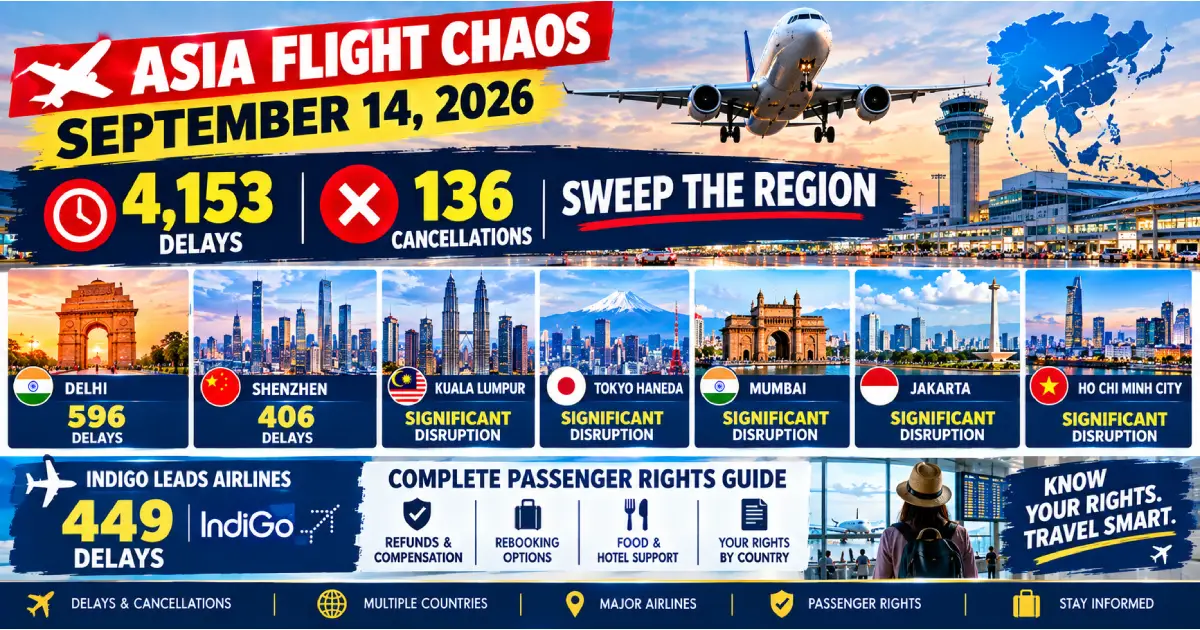
Seven major Asian gateways are absorbing significant disruption on the same day, in a pattern that has become increasingly familiar across the region this September.
Verified flight-tracking data logged via FlightAware confirmed 4,153 flight delays and 136 cancellations across major Asian aviation hubs today. Delhi’s Indira Gandhi International Airport recorded the highest delay count in the region at 596, followed by Shenzhen at 406, Kuala Lumpur at 211, Tokyo Haneda at 210, Mumbai at 203, Jakarta’s Soekarno-Hatta at 193, and Ho Chi Minh City’s Tan Son Nhat at 197. At the airline level, India’s IndiGo recorded the highest delay count of any single carrier at 449, followed by China Southern Airlines at 267, China Eastern at 207 (alongside 8 cancellations), Air China at 158, and Air India Express at 121.
Cancellations were led by Saudia with 18, followed by Indonesia’s Batik Air with 16, China Eastern with 8, SpiceJet with 7, and Citilink with 6. This is now at least the fourth time this month this site has tracked a four-figure Asian disruption day, following similar events on September 4-5, September 7-8, and September 11-12 — a pattern that reflects both the sheer density of Asia’s interconnected flight network and its ongoing exposure to monsoon-season weather across South and Southeast Asia.
Published: September 14, 2026 — Monday Regional total: 4,153 delays + 136 cancellations Data source: FlightAware, logged September 13, 2:20 PM ET (September 14, 2:22 AM China Time) Worst-hit airport: Delhi Indira Gandhi International (DEL) — 596 delays Also significantly affected: Shenzhen (406) · Kuala Lumpur (211) · Tokyo Haneda (210) · Mumbai (203) · Jakarta Soekarno-Hatta (193) · Ho Chi Minh City Tan Son Nhat (197) · Manila (128 delays/2 cancellations) Kuala Lumpur breakdown: AirAsia 64 delays/2 cancellations (13% delay rate) · Malindo Air 59 delays (42% delay rate) · Malaysia Airlines 42 delays/1 cancellation Indonesia breakdown: Batik Air 57 delays/16 cancellations (17% delay rate) · Citilink 17 delays/6 cancellations · Garuda Indonesia 19 delays/1 cancellation Worst airline for delays: IndiGo — 449 Also heavily affected: China Southern (267) · China Eastern (207 delays/8 cancellations) · Air China (158) · Air India Express (121) Worst airline for cancellations: Saudia — 18 Also cancelling: Batik Air (16) · China Eastern (8) · SpiceJet (7) · Citilink (6) GACA (Saudi) compensation rule: Cancellations with under 14 days’ notice entitle passengers to 50-100% of ticket value, plus rerouting, hotel accommodation, and ground transit support Recommended connection buffer: 3.5-4 hours minimum when self-connecting through Delhi, Jakarta, or Kuala Lumpur
This isn’t the first time this site has covered a disruption day of this scale in Asia this month, and understanding why requires looking at the region’s underlying structure rather than any single day’s specific cause. Asia-Pacific aviation operates with some of the highest aircraft utilization rates and densest airway corridors anywhere in the world — meaning individual aircraft typically fly more sectors per day with tighter turnaround times than comparable Western networks, leaving very little schedule slack to absorb disruption once it starts. When a delay hits one leg of a rotation at a hub like Delhi or Shenzhen, that same aircraft’s next three or four scheduled flights that day are all put at risk simultaneously.
Layered on top of that structural tightness, September sits within South and Southeast Asia’s monsoon season, meaning localized thunderstorms and saturated airspace remain a recurring background risk throughout the month — a pattern distinct from, but comparable in effect to, the hurricane-season disruption this site has tracked across the US Gulf Coast this same September.
Delhi’s 596 delays represent the highest total of any airport in the region today. As one of South Asia’s primary international and domestic connecting hubs, disruption here has outsized network effects — IndiGo, India’s largest carrier by a significant margin, recorded the highest delay count of any airline in the entire dataset at 449, reflecting its dominant position in the Indian domestic market and its correspondingly large exposure to any Delhi-specific disruption.
Kuala Lumpur’s 211 delays broke down distinctly by carrier: AirAsia recorded 64 delays against a comparatively modest 13% delay rate given its large schedule, while Malindo Air’s 59 delays represented a much steeper 42% delay rate — suggesting Malindo’s smaller overall schedule left it proportionally harder hit than AirAsia’s larger network. Malaysia Airlines recorded 42 delays and a single cancellation.
Indonesia’s disruption was concentrated on Batik Air, which recorded both the highest delay count (57, a 17% delay rate) and the highest cancellation count (16) of any Indonesian carrier today. Citilink and Garuda Indonesia both recorded more modest disruption by comparison.
Saudia’s 18 cancellations led all carriers in the region today. Under Saudi Arabia’s GACA consumer protection framework, passengers whose flights are cancelled with less than 14 days’ advance notice are entitled to compensation ranging from 50% to 100% of their ticket value, in addition to rerouting, hotel accommodation, and ground transport support — a notably stronger baseline protection than several other jurisdictions represented in today’s disruption data.
Buffer your connections generously. When self-connecting between different airlines or booking split-ticket itineraries through Delhi, Jakarta, or Kuala Lumpur, maintain a minimum layover of 3.5 to 4 hours — significantly more than the 60-90 minutes that might suffice at a less congested airport.
Budget extra time for terminal transfers. International-to-domestic transfers at Delhi (between Terminal 1 and Terminal 3) or Jakarta (between Terminal 2 and Terminal 3 via the Skytrain) require exiting security and re-checking luggage — a process that can consume 45-60 minutes on its own before accounting for any queue delays.
Check your specific airline’s cancellation policy before departure, since compensation frameworks vary significantly by country: Saudi Arabia’s GACA framework offers meaningful cash compensation for short-notice cancellations, while several other jurisdictions represented in today’s data — including India and Indonesia — do not have equivalent statutory cash compensation regimes, leaving refund and rebooking as the primary guaranteed rights.
50-100% of ticket value for short-notice cancellations, plus rerouting, hotel accommodation, and ground transit support.
These jurisdictions generally guarantee rebooking and refund rights for cancelled flights, but do not have a EU261-style mandated cash compensation framework. Check your specific airline’s own conditions of carriage for any voluntary compensation commitments beyond the legal minimum.
Regardless of jurisdiction, a cancelled flight generally entitles you to either a refund or rebooking on the next available service — confirm which your specific airline is offering before accepting either option.
✅ Arrive earlier than usual if departing from Delhi, Shenzhen, Jakarta, Mumbai, or Kuala Lumpur today, given the elevated disruption across all five ✅ Contact your airline immediately if cancelled, to secure rebooking before available seats fill up ✅ Keep all documentation — boarding passes, booking confirmations, and airline communications — to support any rebooking, refund, or compensation claim ✅ Review onward connections carefully if your first sector today was delayed, since knock-on effects on later flights are common during a disruption day of this scale
Related Articles:
Posted By : Vinay
This article is provided for general informational purposes only and is based on information available at the time of publication. Travel advisories, airline schedules, airport operations, visa requirements, government regulations, and other travel-related information are subject to change without prior notice. While Travel Tourister makes reasonable efforts to verify information using official announcements, government publications, airline and airport communications, and other reliable sources, we cannot guarantee that all information remains complete, accurate, or up to date at all times. Readers should independently verify any information that may affect their travel plans with the relevant airline, airport authority, government agency, embassy, or other official source before making travel, financial, or other decisions. Travel Tourister shall not be liable for any direct or indirect loss, inconvenience, or damages arising from the use of or reliance on the information contained in this article. Nothing in this publication constitutes legal, immigration, financial, or professional travel advice. If you believe any information in this article is inaccurate or outdated, please contact our editorial team. We review all credible correction requests promptly and update our content whenever appropriate.
Lastest News
2nd Floor, 39, Above Kirti Club, DLF Industrial Area, Kirti Nagar, New Delhi, Delhi 110015



Travel Tourister is a leading Travel portal where we introduce travellers to trusted travel agents to make their journey hasselfree, memorable And happy. Travel Tourister is a platform where travellers get Tour packages ,Hotel packages deals through trusted travel companies And hoteliers who are working with us across the world. We always try to find new and more travel agents and hoteliers from every nook and corners across the world so that you could compare the deals with different travel agents and hoteliers and book your tour or hotel with the one you have chosen according to your taste and budget.
Copyright © Travel Tourister, India. All Rights Reserved

 Call
Call Enquiry