Published on : 30 Sep 2026
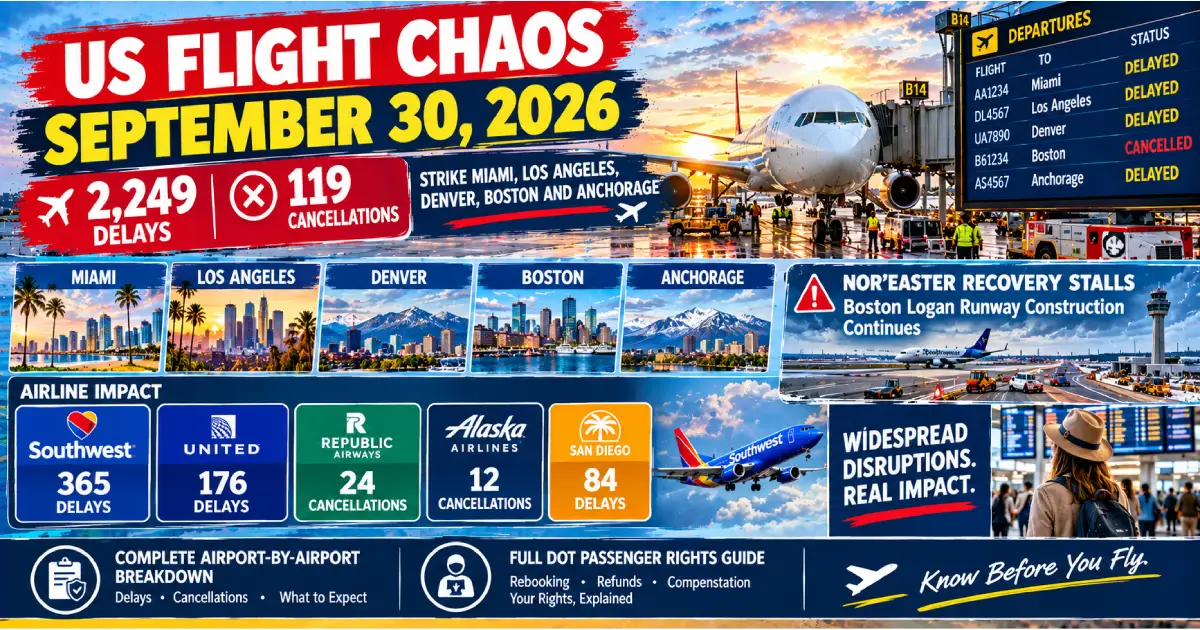
America’s aviation network is ending September 2026 the same way it spent all of it — under sustained operational pressure. After the most disruptive nine-day stretch of US aviation since 2022, which included the FAA fibre cable outage, Hurricane Nolo, and three consecutive days of nor’easter destruction that wiped 301 flights from Boston Logan in a single afternoon, today’s 2,249 delays and 119 cancellations represent the aviation system beginning to breathe again — but only beginning. Boston Logan is still under a runway construction ground delay programme. Miami’s convective weather is still generating 170 delays. Los Angeles is recording 126 delays from coastal marine layer airspace sequencing. Denver is at 125 delays. And in Alaska, Anchorage International Airport is recording 8 cancellations — the highest cancellation rate at any US gateway today. For hundreds of thousands of Wednesday travellers, this is still a disrupted American sky.
Date: Wednesday, September 30, 2026 Data source: FlightAware real-time airspace monitoring, FAA System Operations Command Center advisories Total US delays today: 2,249 Total US cancellations today: 119 Worst airport by delays: Miami International — 170 delays, 5 cancellations Worst airport by cancellation rate: Anchorage International — 40 delays, 8 cancellations Worst airline by delays: Southwest Airlines — 365 delays, 4 cancellations Worst airline by cancellations: Republic Airways — 60 delays, 24 cancellations Primary disruption drivers: Boston Logan runway rehabilitation (ongoing), Miami convective weather, LA coastal marine layer, Anchorage Alaska network sequencing, post-nor’easter rotation recovery JetBlue rebooking waiver: Expires today at midnight — act now Delta Boston waiver: Expires today — final hours DOT refund right: Full cash refund within 7 days for any cancelled flight DOT 3-hour tarmac rule: Applicable for domestic flights today
The numbers today — 2,249 delays and 119 cancellations — look modest next to the catastrophic peaks of September 28 (4,338 delays, 481 cancellations) and September 29 (4,072 delays, 354 cancellations). But context is everything.
The US aviation network is not recovered. It is recovering. There is a meaningful difference between those two states.
When the nor’easter grounded 301 flights at Boston Logan on September 28 alone, it did not simply cancel those flights and move on. Every cancellation displaced an aircraft that should have been somewhere else. Every displaced aircraft meant a crew assigned to fly it was now sitting in the wrong city. Every crew in the wrong city meant the next day’s flight from that city was short of the personnel to operate it legally. The ripple effect of three consecutive nor’easter days at Boston is still working its way westward through Southwest’s point-to-point network, United’s Newark and Denver corridors, and Alaska’s Pacific Northwest system.
Today is day two of the national recovery from the nor’easter. The system is coming back — but it is coming back slowly, unevenly, and with pockets of acute disruption that are invisible in the headline numbers.
The passengers who need to read this article today are not the passengers who got cancelled last Saturday. They are the passengers flying today who have no idea their aircraft was supposed to be in Boston yesterday and never made it.
Miami International is today’s most delayed airport in the United States. With 170 delays and 5 cancellations, Miami is recording a 16% outbound delay rate as convective weather transitions over South Florida’s coastal approaches interact with one of the busiest departure banks on the eastern seaboard.
Miami International handles more than 1,200 daily flights and sits at the intersection of US domestic traffic, Latin American international connections, and transatlantic services to Europe and the UK. When Miami delays, the cascade does not stay in Miami. American Airlines, United, Delta, and the Latin American carriers — LATAM, Avianca, Copa — all use Miami as a network node. A 170-delay afternoon at MIA pushes late-arriving aircraft into evening departure banks at Dallas, Charlotte, and New York.
For UK and Australian passengers using Miami as a transatlantic gateway: the delays today are concentrated in the afternoon departure window. Flights departing before noon are largely unaffected. Flights departing from 14:00 onward carry a materially higher risk of delay today as the convective weather builds.
Miami’s top disrupted airline today: American Airlines accounts for the largest share of Miami delays, consistent with its dominant market position at MFL. Passengers on American Miami connections should add 60 minutes to their expected connection buffer this afternoon.
Los Angeles International is the second most-delayed airport in the United States today. With 126 delays and 4 cancellations, LAX is recording a 9% arrival delay rate driven by a coastal marine layer airspace sequencing programme — the same meteorological pattern that has disrupted Southern California operations repeatedly throughout September 2026.
The marine layer at LAX is a structural problem, not a one-day event. When low cloud rolls in off the Pacific and settles over the airport’s approach corridors, air traffic controllers must increase spacing between arriving aircraft to maintain safe visual separation. Increased spacing means fewer aircraft per hour land. Fewer aircraft landing means gates back up. Gates backing up means departing aircraft cannot push back on time. The cascade runs from the marine layer to your departure gate in under 45 minutes.
For international passengers arriving into LAX from the UK, Australia, or Canada today: your long-haul flight arriving this morning is almost certainly landing on schedule — the marine layer primarily affects the domestic approach corridors, not the international transoceanic tracks. The disruption risk is in your onward domestic connection from LAX, not your inbound long-haul.
Airline most exposed at LAX today: Alaska Airlines, which operates the largest number of LAX domestic departures of any carrier, is recording 97 delays and 12 cancellations across its entire network today — a significant proportion of which are concentrated in the Los Angeles basin and Pacific Northwest corridor.
Denver International is the third most-delayed airport in the United States today with 125 delays and 3 cancellations, recording a 6% arrival and departure delay rate. Denver’s disruption today is primarily structural — the post-nor’easter rotation recovery is creating aircraft positioning mismatches that are most visible at connecting hubs like Denver, where flights from the disrupted Northeast corridor arrive late and compress the tight turnaround windows that United’s Denver bank schedule depends on.
Denver International is the fifth-busiest airport in the United States by total passengers and handles more connecting traffic per gate than any other hub except Chicago O’Hare. When rotation aircraft arrive 45–60 minutes late from the Northeast — as they are today — United’s Denver bank collapses inward, pushing the delay into its next rotations toward the West Coast, Mexico, and Canada.
United Airlines at Denver today: United is the dominant carrier at Denver and is recording 176 delays and 15 cancellations across its entire network today, with Denver absorbing a significant portion of those Newark and Northeast corridor adjustments. United passengers connecting at Denver today should treat any connection shorter than 90 minutes as elevated risk.
Boston Logan is not the most-delayed airport in absolute numbers today — but it remains the most systemically important disruption node in the US network right now. With 263 delays and 45 cancellations, Logan is recording a 26% arrival delay rate driven by the FAA runway rehabilitation ground delay programme that has been in effect since the start of September.
The ground delay programme at Boston Logan has been active for 30 consecutive operating days. It restricts the hourly rate of arriving aircraft at Logan, creating a metering backlog that forces aircraft to hold in the air over the approaches before being cleared to land. The average inbound delay under today’s FAA ground delay programme is running at approximately 45–60 minutes for arrivals from the South and West, and longer for flights coming in from the Northeast where airspace is most compressed.
What makes Boston Logan’s disruption today particularly consequential is its relationship with the nor’easter recovery. Under normal conditions, Logan’s runway construction programme creates moderate delay cascades that ripple into JetBlue’s New England network and Delta’s Northeast routes. Under nor’easter recovery conditions — with aircraft that were supposed to be in Boston on Saturday still being repositioned from Providence, Manchester, and Albany — the cascade is amplified by the accumulated rotation deficit.
JetBlue at Boston today: JetBlue is Logan’s second-largest carrier by operations and the carrier most acutely exposed to Logan’s ground delay programme. Today is the final day of JetBlue’s nor’easter weather waiver — passengers affected by the September 25–27 disruption have until midnight tonight to use the rebooking waiver at no cost. If you have a JetBlue booking affected by the nor’easter, act in the next few hours.
Delta at Boston today: Delta’s Boston weather waiver for nor’easter-affected travel through September 29 also expires today, September 30. Delta passengers who have not yet reboooked should go to delta.com immediately.
Anchorage is today’s most acute cancellation story. With 40 delays and 8 cancellations, Anchorage Ted Stevens International Airport is recording the highest outright cancellation rate of any US gateway today in percentage terms.
Anchorage’s 8 cancellations represent a disproportionate share of a small schedule. Alaska Airlines is the dominant carrier at Anchorage and is managing acute network sequencing challenges as its aircraft and crew cycles recover from the nor’easter displacement — the airline repositioned significant Pacific Northwest assets during the nor’easter and is now managing the restoration of its Anchorage network alongside its West Coast schedule.
For passengers flying to or from Anchorage today — particularly on Alaska Airlines connections through Seattle-Tacoma (SEA): check your flight status before leaving for the airport. The 8 Anchorage cancellations affect a high proportion of the airport’s total daily schedule, and the downstream effect for passengers connecting Seattle-to-Anchorage or Anchorage-to-Seattle is material.
Southwest Airlines launched its inaugural Anchorage service from Denver and Las Vegas in May 2026. Southwest is not the primary carrier at Anchorage, but its new Anchorage routes are exposed to network recovery pressures today and passengers should check their Southwest Anchorage flights specifically.
San Diego International is recording 84 delays and 1 cancellation today under FAA airspace volume restrictions — a relatively contained disruption compared to San Diego’s worst September days (including 299 delays on September 12 and 247 delays during the nor’easter peak on September 28). The coastal marine layer that is squeezing LAX today is also affecting San Diego’s approach corridors, and Southwest’s heavy San Diego schedule is absorbing the bulk of the delay load.
| Airport | Delays | Cancellations | Primary Driver |
|---|---|---|---|
| Boston Logan (BOS) | 263 | 45 | FAA GDP — runway construction (Day 30) |
| Miami International (MIA) | 170 | 5 | Convective weather — afternoon departures |
| Los Angeles (LAX) | 126 | 4 | Marine layer — airspace sequencing |
| Denver (DEN) | 125 | 3 | Post-nor’easter rotation recovery |
| Anchorage (ANC) | 40 | 8 | Alaska network sequencing — highest cancel rate |
| San Diego (SAN) | 84 | 1 | Coastal marine layer — volume programme |
| Airline | Delays | Cancellations | Root Cause Today |
|---|---|---|---|
| Southwest Airlines | 365 | 4 | Point-to-point rotation recovery, FL + CA hubs |
| United Airlines | 176 | 15 | Denver + Newark corridor — rotation deficit |
| Republic Airways | 60 | 24 | Regional feeder — highest cancel count today |
| Alaska Airlines | 97 | 12 | Anchorage + Pacific Northwest sequencing |
| American Airlines | Elevated | Elevated | Miami convective weather cascade |
Southwest is the most-delayed airline in the United States today with 365 delays. For a carrier that operates a pure point-to-point network — no hubs, no banks, every aircraft cycling through multiple cities all day — the nor’easter’s disruption to the Northeast corner of Southwest’s network has produced ripple effects that are still working westward through its Florida and California schedules.
Southwest’s 365 delays today are not concentrated at one airport. They are distributed across its entire network — Dallas Love Field, Las Vegas, Denver, Phoenix, Baltimore — as aircraft that were late arriving at their Northeast stations on Saturday, Sunday, and Monday are still running behind their published schedule by varying amounts of time.
Southwest’s post-nor’easter recovery is slower than mainline carriers because Southwest does not interline — it cannot put its passengers on Delta, United, or American when its own aircraft are not available. Every delayed Southwest aircraft stays delayed until Southwest itself catches up.
For Southwest passengers today: Go to southwest.com → Manage Reservations now. If your flight is showing a delay of 3+ hours, you are entitled to request a full refund even if you originally booked a non-refundable fare — under DOT regulations, a 3-hour delay on a Southwest flight triggered by factors within Southwest’s control (rotation recovery qualifies) entitles you to a full refund.
United is the second-most-delayed airline in the United States today with 176 delays and 15 cancellations. United’s disruption is concentrated in its Newark and Denver corridors — two of its largest hub operations — as the rotation aircraft that were repositioned during the nor’easter continue to find their way back to their correct schedule positions.
United’s 15 cancellations today represent a meaningful operational stress for a Wednesday. United’s typical Wednesday cancellation count under normal September conditions runs at 5–8. The elevated number today directly reflects the nor’easter aftermath.
For United passengers today: Check united.com → My Trips. United’s travel waiver for Boston and Northeast hub passengers affected by the nor’easter covers rebooking flexibility, but with specific date windows — check whether your booking falls within the waiver’s terms before the end of today.
Republic Airways is today’s most aggressive canceller in the US. With 24 outright cancellations against 60 delays, Republic is running a higher cancellation-to-delay ratio than any other major US carrier today.
Republic operates as a regional carrier for American Airlines (under the American Eagle brand), Delta Connection, and United Express — which means Republic’s 24 cancellations today translate directly into cancelled American, Delta, and United feeder flights across dozens of smaller markets. If your ticket says Delta Connection, American Eagle, or United Express, and your route operates through a smaller regional gateway, Republic’s cancellations today may have already affected your itinerary.
Republic’s higher cancellation rate relative to its delay count reflects a conscious operational choice: it is better to cancel early and give passengers maximum rebooking time than to delay and cancel at the gate. This is the correct operational choice from a passenger welfare perspective — but it means Republic’s official cancellation count looks worse than airlines that delay and cancel late.
For American Eagle, Delta Connection, or United Express passengers today: Check your airline app — not Republic’s, as Republic does not offer direct passenger services — for rebooking options if your flight is cancelled.
Alaska Airlines is managing a complex recovery today across its Pacific Northwest and Alaska network. With 97 delays and 12 cancellations, Alaska’s disruption is concentrated at its Anchorage station (8 cancellations) and across its Los Angeles basin operations.
This is also the day after Alaska announced its most ambitious product overhaul in company history — Aurora Suites on 737 MAX 10s and 787s, Premium Reserve cabin, and a 41,000 sq ft Seattle lounge complex. Alaska’s operational team managing today’s disruption and its product team unveiling Aurora Suites simultaneously is a reminder that airlines never get a quiet day to make big announcements.
Today is September 30. The month ends with the following confirmed disruption record:
| Event | Date | US Delays | US Cancellations |
|---|---|---|---|
| FAA fibre cable cut (NJ construction crew) | Sept 21 | 6,452 | 1,018 |
| Hurricane Nolo | Sept 25 | 4,375 | 107 |
| Nor’easter Day 1 | Sept 26 | 1,494 | 425 |
| Nor’easter Day 2 | Sept 27 | Elevated | Elevated |
| Nor’easter Day 3 | Sept 28 | 4,338 | 481 |
| Post-nor’easter Day 1 | Sept 29 | 4,072 | 354 |
| Post-nor’easter Day 2 — TODAY | Sept 30 | 2,249 | 119 |
The trajectory is improving — from 4,338 on September 28 to 2,249 today. But “improving” is not “recovered.” The nor’easter deposited a rotation deficit across the US network that will take three to five operating days to fully absorb. The FAA runway rehabilitation programme at Boston Logan is not ending — it runs through October. And the Caribbean hurricane season, which produced Nolo in September, does not end until November 30.
October 2026 opens with a US aviation system that is exhausted, still rotating its way out of September’s accumulated damage, and carrying a Boston Logan runway programme that will continue to suppress arrival capacity at America’s sixth-busiest airport for weeks to come.
Under US Department of Transportation regulations, every passenger on a cancelled flight is entitled to a full cash refund to the original payment method within 7 business days — regardless of whether the flight was cancelled because of weather, ATC, or airline operations. The airline cannot substitute a travel voucher without your explicit consent.
How to claim: Go to your airline’s app or website — Manage Booking — and request a refund. State clearly: “I am requesting a full cash refund under DOT regulations, not a travel voucher.”
If the airline offers only a voucher: escalate to DOT at airconsumer.dot.gov. DOT processes refund complaints within 60 days. Airlines that fail to refund within 7 business days can be fined.
Under the DOT’s strengthened passenger rights rules that came into effect in October 2024, passengers on domestic flights delayed by 3+ hours AND on international flights delayed by 6+ hours are entitled to the same full cash refund right as cancellations — if the delay is caused by factors within the airline’s control.
Today’s application: Post-nor’easter rotation recovery is within the airline’s operational control — it is a consequence of prior scheduling decisions and network management, not a force majeure event. Southwest’s 365 delays and United’s 176 delays today are largely rotation-recovery delays — controllable under DOT’s definition.
How to claim: Track your delay time from your original scheduled departure. If your delay reaches 3 hours (domestic) or 6 hours (international), go to your airline’s customer service desk or app and state: “My delay has exceeded 3 hours and the cause is within the airline’s control. I am requesting the option of a full cash refund under DOT regulations.”
Under DOT rules, airlines cannot keep passengers on a domestic aircraft on the tarmac for more than 3 hours without offering the option to deplane. For international flights, the limit is 4 hours.
If you are on an aircraft today that is holding on the tarmac and approaching the 3-hour mark, the airline is required to offer you the opportunity to deplane — with two exceptions: if the pilot determines that deplaning would compromise safety or security, or if ATC has confirmed the aircraft will take off imminently.
The tarmac rule also requires airlines to provide food and water after 2 hours on the tarmac, and to maintain working lavatories.
JetBlue nor’easter waiver: Covers flights operated between September 25 and September 27 touching Boston, New York JFK, New York LaGuardia, Newark, Providence, and Worcester. Rebook without a fee by midnight tonight. Go to jetblue.com → Manage Trips.
Delta Boston waiver: Covers eligible travel to, from, or through Boston between September 26 and September 29. Rebook without a change fee by midnight tonight. Go to delta.com → My Trips.
American Airlines waiver: American’s nor’easter rebooking window closed September 29. American passengers who have not yet reboooked must contact American directly at 1-800-433-7300 and request a Customer Relations exception.
If your airline refuses a refund you are entitled to under DOT rules, file at:
Action 1 — Check your flight status on your airline’s app. Not Google, not the airport website — the airline’s own app refreshes fastest and shows you the most current gate, departure time, and delay reason.
Action 2 — Act on expiring waivers NOW. JetBlue and Delta nor’easter waivers expire at midnight tonight. If you were disrupted between September 25 and September 29, go to your airline’s manage-booking page in the next few hours — do not wait until tonight.
Action 3 — If flying Miami this afternoon, add 90 minutes to your buffer. Miami’s convective weather is building through the afternoon. Departures after 13:00 from MIA carry a higher delay risk today. If you have a connection out of Miami this afternoon, 90 minutes is the minimum safe window.
Action 4 — If connecting through Denver, add 60 minutes to your buffer. United’s Denver banks are running late from the rotation recovery. Any Denver connection under 60 minutes is a missed-connection risk today.
Action 5 — If flying Alaska Airlines from Anchorage, check before leaving. 8 cancellations at Anchorage today against a small schedule means a high proportion of Anchorage’s flights have already cancelled. Go to alaskaair.com → Manage Booking before you drive to Ted Stevens International.
Action 6 — Know your refund right before you need it. If your flight is cancelled today, you are entitled to a full cash refund within 7 business days — unconditionally. If your flight is delayed 3+ hours by a controllable cause (rotation recovery, equipment, crew), you have the option to request a full refund instead of travelling.
Action 7 — Do not accept a voucher if you want cash. Airlines routinely offer travel vouchers in place of cash refunds. State clearly: “I am requesting a cash refund to my original payment method, not a travel voucher.” Put it in writing via the airline’s chat function.
Action 8 — Republic Airways passengers — check American Eagle, Delta Connection, or United Express specifically. Republic’s 24 cancellations today are spread across regional feeder routes operated under the American, Delta, and United brands. Your ticket may say American or Delta but your aircraft is operated by Republic.
Action 9 — On-tarmac: know your 3-hour right. If your aircraft begins holding on the tarmac, note the time. After 2 hours, the airline must provide food and water. After 3 hours, the airline must offer you the option to deplane. Politely ask the crew at the 2.5-hour mark.
Action 10 — Save these contacts now.
| Airline | Status | Rebooking |
|---|---|---|
| Southwest | southwest.com | 1-800-435-9792 |
| United | united.com → My Trips | 1-800-864-8331 |
| Republic/American Eagle | aa.com → My Trips | 1-800-433-7300 |
| Alaska Airlines | alaskaair.com → Manage | 1-800-252-7522 |
| JetBlue | jetblue.com → Manage | 1-800-538-2583 |
| Delta | delta.com → My Trips | 1-800-221-1212 |
| FAA live status | fly.faa.gov | Live NASSTATUS |
| FlightAware live | flightaware.com | MiseryMap |
| DOT complaints | airconsumer.dot.gov | File a Complaint |
The nor’easter has cleared. Hurricane Nolo has moved on. The FAA fibre cable has been repaired. But the Boston Logan runway rehabilitation programme — the structural cause of September’s elevated disruption baseline — continues into October with no confirmed end date. Massport, the airport’s operator, has said the construction programme will run through the autumn maintenance window.
For travellers flying through Boston in October: the FAA ground delay programme at Logan will continue to suppress arrival throughput on high-demand days. The 30-minute-to-60-minute average arrival delays that characterised Boston in September will continue to characterise it in October. The practical advice is unchanged: add 90 minutes to any Boston connection buffer, check in online before arriving at the airport, and carry on luggage if at all possible.
October also brings the start of the winter weather season across the Northeast and the Great Lakes — the same corridor that produced this month’s nor’easter disruption. The aviation system enters that season carrying accumulated rotation fatigue from September’s five major disruption events. The buffer is thinner than it should be.
Monitor this page for updates as September 30 progresses. FlightAware data refreshes every 15 minutes and we will update the tables if the disruption picture changes materially through the afternoon.
Related Articles:
Posted By : Vinay
This article is provided for general informational purposes only and is based on information available at the time of publication. Travel advisories, airline schedules, airport operations, visa requirements, government regulations, and other travel-related information are subject to change without prior notice. While Travel Tourister makes reasonable efforts to verify information using official announcements, government publications, airline and airport communications, and other reliable sources, we cannot guarantee that all information remains complete, accurate, or up to date at all times. Readers should independently verify any information that may affect their travel plans with the relevant airline, airport authority, government agency, embassy, or other official source before making travel, financial, or other decisions. Travel Tourister shall not be liable for any direct or indirect loss, inconvenience, or damages arising from the use of or reliance on the information contained in this article. Nothing in this publication constitutes legal, immigration, financial, or professional travel advice. If you believe any information in this article is inaccurate or outdated, please contact our editorial team. We review all credible correction requests promptly and update our content whenever appropriate.
Lastest News
2nd Floor, 39, Above Kirti Club, DLF Industrial Area, Kirti Nagar, New Delhi, Delhi 110015



Travel Tourister is a leading Travel portal where we introduce travellers to trusted travel agents to make their journey hasselfree, memorable And happy. Travel Tourister is a platform where travellers get Tour packages ,Hotel packages deals through trusted travel companies And hoteliers who are working with us across the world. We always try to find new and more travel agents and hoteliers from every nook and corners across the world so that you could compare the deals with different travel agents and hoteliers and book your tour or hotel with the one you have chosen according to your taste and budget.
Copyright © Travel Tourister, India. All Rights Reserved

 Call
Call Enquiry