Published on : 15 Sep 2026
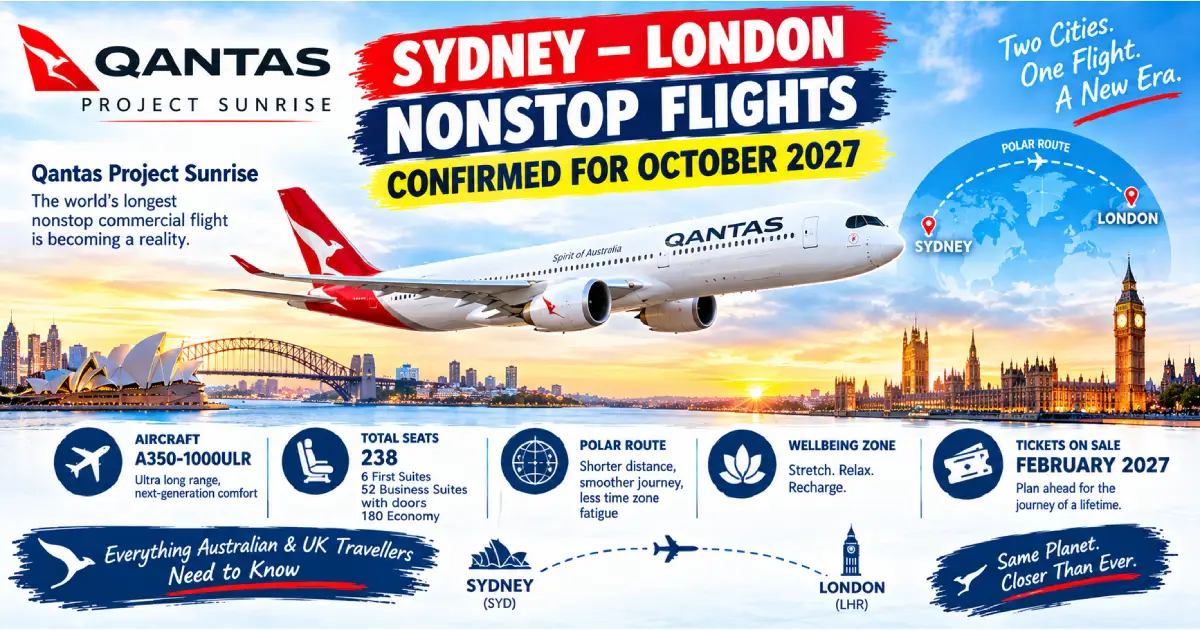
Nearly a decade after Qantas first declared it would conquer the final frontier of aviation, the world’s longest commercial flight now has a date, an aircraft, a cabin, and a route. Sydney to London. Nonstop. October 2027. No stopover. No Singapore. No Dubai. Just you, an Airbus, and 22 hours in the sky.
Qantas has confirmed that it will launch nonstop flights between Sydney and London in October 2027, marking the first time the historic Kangaroo Route will operate without any intermediate stops from Australia’s east coast. The route will be operated by the Airbus A350-1000ULR — a specially modified ultra-long-range version of Airbus’s flagship widebody, configured specifically for Project Sunrise with just 238 seats across four cabins: the lowest seat density of any A350 in the world.
Tickets go on sale in February 2027. Sydney–New York is confirmed as the second Project Sunrise route, launching after Sydney–London. A fleet of 12 aircraft has been ordered.
This is not simply a new airline route. It is a structural transformation in how Australia connects to the world — and specifically to the United Kingdom. For the estimated 1.2 million British-born residents of Australia and the hundreds of thousands of Australians who visit the UK every year, Project Sunrise eliminates the stopover that has defined this journey for a century. The Kangaroo Route has had many forms — seven stops in the 1940s, three in the 1970s, one in the 2020s. From October 2027, it will have none.
Published: September 15, 2026 First route: Sydney–London Heathrow — October 2027 Second route: Sydney–New York — to follow Aircraft: Airbus A350-1000ULR Fleet size: 12 aircraft First aircraft delivery: April 2027 Ticket sales open: February 2027 Total seats: 238 — lowest seat density of any A350 in the world First Class: 6 enclosed suites · 1-1-1 configuration · 80-inch flatbed Business: 52 suites with sliding doors · 1-2-1 configuration · 80-inch flatbed Premium Economy: 40 seats · 2-4-2 · winged privacy Economy Plus: 42 seats · 34-inch pitch · front of economy cabin Economy: 140 seats · 3-3-3 · 70%+ of aircraft at 33+ inch pitch Wellbeing Zone: Dedicated movement and hydration area IFE: Panasonic Avionics Maximum range: More than 16,000km (10,000 nautical miles) Maximum flight time: Up to 22 hours Additional fuel capacity: 20,000 litres in new rear centre tank Extra fuel total: 168,000 litres capacity Research partner: University of Sydney Charles Perkins Centre Design partner: Caon Design Office Seat supplier (Business): Safran Seats Seat supplier (Economy): RECARO Aircraft Seating Crew training: 360+ pilots · 1,200+ cabin crew
Qantas was built on the belief that Australia’s distance from the rest of the world should never stand in the way. CEO Vanessa Hudson, who has led Qantas since 2022 and championed Project Sunrise through supply chain delays and a global pandemic, described the confirmation as breaking the tyranny of distance.
For nearly a century, the journey between Australia and the United Kingdom has been defined by the stopover — a pause, a transit, a layover in Singapore, Dubai, Doha, Hong Kong, or Bangkok. The Perth–London nonstop, launched by Qantas in 2018 using the Boeing 787-9 Dreamliner, was a significant breakthrough. But Perth is 2,700km from Sydney. For the overwhelming majority of Australians who live in Sydney, Melbourne, Brisbane, and the east coast, that nonstop still required a domestic connection.
Qantas has confirmed that it will launch nonstop flights between Sydney and London in October 2027, marking the first time the historic Kangaroo Route will operate without any intermediate stops from Australia’s east coast.
The project’s name, Project Sunrise, is a deliberate reference to history. In the 1940s, Qantas Catalina flying boats operated some of the earliest Australia–England services. One critical stretch, across the Indian Ocean, kept those aircraft aloft for 33 hours. Because the Sun rose twice during that passage — the aircraft was flying long enough for night to become day, then night again — the route became known as the Double Sunrise. Project Sunrise honours that pioneering era while inverting its central challenge: where those early flights were limited by engine range and the laws of physics, today’s challenge is purely commercial and engineering — and it has been solved.
CNN aviation expert Richard Quest, who attended Qantas’s Project Sunrise reveal in Toulouse, France in June 2026, described it as a pivotal moment for the European aerospace company — comparable to the debut launch of the A380 superjumbo with Singapore Airlines nearly two decades ago.
The Airbus A350-1000ULR is not an off-the-shelf aircraft. It is a specifically engineered variant of the A350-1000 — already the longest-range widebody in commercial service — modified to carry additional fuel sufficient to sustain 22+ hours of nonstop flight.
To make the math work, Qantas capped seat count on the A350-1000ULR at 238 (down from a typical -1000 capacity of 375), and Airbus further facilitated this low-density, premium-heavy, four-class configuration by optimising the Airspace cabin on board to ensure passenger comfort.
The fuel modification: The A350-1000ULR features an extra rear centre tank holding approximately 20,000 litres of additional fuel, bringing total capacity to 168,000 litres — enabling a maximum range of more than 16,000km (10,000 nautical miles) and a maximum mission duration of up to 22 hours.
The weight trade-off: Every additional kilogram of fuel requires the aircraft to be lighter elsewhere. With 20,000 litres of extra fuel at approximately 0.8kg per litre, the aircraft carries an additional 16,000kg of fuel weight at departure. This is partly compensated by the dramatically reduced passenger count — 238 seats versus the 375 or more that a standard A350-1000 might carry. Fewer passengers means fewer bags, fewer catering trolleys, and a lighter total passenger payload. The mathematics are precise: the weight saved by flying fewer people enables the fuel required to fly them further.
Test flight status: The test aircraft completed its first flight on June 2, 2026, from Toulouse, France. A second aircraft has already entered its eight-week testing and certification programme after completing its maiden flight. Testing covers fuel management systems, engine performance at cruise altitudes, autopilot systems, and emergency procedures.
Fleet: 12 A350-1000ULR aircraft have been ordered. The first planned delivery is April 2027, with services beginning October 2027 — giving Qantas approximately six months of pre-service crew training, operational testing, and schedule preparation.
The routing of Sydney–London on the A350-1000ULR is itself a significant aviation development. When Qantas introduces the first nonstop flights between Sydney and London in October 2027, passengers might find themselves on an unexpected route. Rather than the typical eastbound crossing of Australia or the extended passage over India, they might head directly north on the longest commercial flight to operate — a new polar route.
The polar route heads directly north from Sydney, crossing the equator, traversing Asian airspace, arcing over the polar regions, and descending into London from the north. This routing optimises the great-circle distance between the two cities while avoiding the Gulf airspace that has been subject to extended restrictions throughout 2026 (a subject this publication has covered separately in today’s Gulf airspace crisis article).
Flight times: The northbound flight to London can last up to 21 hours, depending on prevailing winds; the return service can be one to two hours shorter since the aircraft often benefits from tailwinds. Under optimal conditions, the journey will complete in approximately 20 hours — saving up to four hours compared to today’s fastest one-stop alternatives.
For context: a typical Sydney–Singapore–London journey (the most common routing today) takes approximately 24–25 hours including the Singapore stopover and connection time. The fastest one-stop alternatives via Doha or Dubai take approximately 23–24 hours. Project Sunrise delivers Sydney–London in 20–22 hours with zero stops, zero transit, and zero lost baggage.
The Project Sunrise cabin was revealed on June 18, 2026, at Airbus’s manufacturing facility in Toulouse and confirmed via the Qantas Newsroom. Every element has been designed to help customers arrive at their destination feeling their best, drawing on a decade of research with the University of Sydney’s Charles Perkins Centre and close collaboration with Caon Design Office and technology partners.
Six enclosed First suites feature a two-metre-long (80-inch) flat bed engineered with multi-layer memory foam, a separate reclining armchair, and a flexible dining and work space for one or two guests — all designed to deliver the ultimate in luxury.
The 1-1-1 configuration means every First Class passenger has direct aisle access — no climbing over anyone, no disturbing a neighbour. The full-length wardrobe and multiple storage areas are specifically designed for a 20-22 hour journey where passengers will want to change into pyjamas, use their wardrobe multiple times, and treat the suite as a private room rather than an aircraft seat.
Six suites on an aircraft of this range is an extraordinarily exclusive ratio. On a standard long-haul A350-1000 configured for 375+ passengers, First Class (if it exists at all) might have 8–10 seats. On Project Sunrise’s 238-seat configuration, six First Class suites serve approximately 2.5% of the aircraft’s total capacity — a level of space dedication that is genuinely unprecedented.
The 52 Business suites sit in a 1-2-1 configuration. For the first time, Qantas Business suites will feature a sliding door for privacy, plus an adjustable divider between the alternating centre seats. Each suite includes an 80-inch flatbed, a large dining table and work surface and more storage.
The sliding door on Qantas Business Class is a significant product development. Until now, Qantas’s Business Class product — while excellent — used a partial privacy screen rather than a full closing door. The introduction of a sliding door on Project Sunrise brings Qantas into line with the premium business class products offered by Qatar Airways Qsuite, Singapore Airlines Business Class, and Cathay Pacific Business Class — products that have consistently rated among the world’s best partly because of their door-closing privacy.
52 Business suites makes Project Sunrise Business Class the largest single cabin on the aircraft. Business passengers will represent the commercial heart of this route — the lawyers, bankers, executives, and premium leisure travellers for whom saving 4 hours on a journey and arriving without a transfer is worth a significant price premium.
Each of the 40 seats in the 2-4-2-configured premium economy section of the Qantas A350-1000ULR will feature winged privacy and what the airline assures will be “the most generous seat pitch of any Qantas aircraft.”
The 2-4-2 configuration means window-seat passengers never need to climb over anyone — critical for a 20+ hour journey where the ability to move to the aisle for stretching or bathroom visits without waking a neighbour is a significant quality-of-life factor.
Qantas Economy Plus, a new way to add even more comfort and space to the Economy experience. Positioned at the front of the cabin, the 42 seats offer a 34-inch pitch, priority boarding and priority access to overhead lockers.
Economy Plus is positioned as an upgrade within the Economy class structure — not Premium Economy, but meaningfully better than standard Economy. At 34-inch pitch across 42 seats (arranged in the same 3-3-3 as standard Economy), Economy Plus passengers will have approximately 3–4 inches more legroom than standard Economy — significant on a 20+ hour flight.
The Economy cabin completes the configuration with 140 seats in a 3-3-3 layout. Across the aircraft, more than 70% of seats will offer at least 33 inches of pitch.
This is the most important Economy fact on Project Sunrise: the deliberate low-density configuration that reduces seat count from 375 to 238 does not only benefit Business and First passengers — it creates a measurably better Economy experience too. Standard Economy on Project Sunrise will have more space per seat than the Economy class on many short-haul aircraft.
Seat supplier: RECARO Aircraft Seating will supply Economy class seating.
The most distinctive feature of Project Sunrise is not any individual seat or suite. It is the Wellbeing Zone — a dedicated area of the aircraft designed specifically for movement, hydration, and the mitigation of the physical toll of flying for 20+ hours.
Qantas has revealed enclosed First suites, private Business suites, redesigned Premium Economy, Economy Plus seating and a dedicated Wellbeing Zone for movement, hydration and inflight comfort.
The Wellbeing Zone reflects a decade of research with the University of Sydney’s Charles Perkins Centre — one of Australia’s leading research institutions focused on the intersection of lifestyle, health, and chronic disease. The research focused on how passengers can reduce the negative physiological effects of very long-haul flight: deep vein thrombosis risk reduction through movement, jet lag management through circadian rhythm alignment, hydration maintenance, and mental wellbeing through access to open space on a vehicle where most surfaces are seats.
The specific facilities within the Wellbeing Zone have not all been publicly detailed, but confirmed elements include dedicated stretching and movement areas, hydration stations, and lighting systems designed to gradually align passengers with their destination’s time zone throughout the flight — a specific anti-jet-lag technology developed in collaboration with Caon Design Office.
Panasonic Avionics is supplying the inflight entertainment system — designed to deliver cinema-grade picture quality and high-fidelity audio, with enough power to fast-charge all passenger devices. The solution is designed to be lightweight to reduce fuel burn, and yet still evolve and keep pace with technology on the ground.
Fast charging on a 20+ hour flight matters more than on a 10-hour service — passengers will use their devices extensively and need reliable power availability throughout the journey. Panasonic Avionics is also the IFE supplier for Qantas’s existing fleet, ensuring continuity of the interface that Qantas passengers already know.
Ticket sales open: February 2027. Qantas has confirmed that tickets go on sale in February 2027 for services launching October 2027 — giving passengers approximately 8 months of advance booking window on the inaugural services.
How to be ready for February 2027:
Estimated pricing: Qantas has not published official fares. Industry analysts estimate Sydney–London Project Sunrise Business Class will command a significant premium over current one-stop Business Class fares — potentially 20–40% above equivalent Qantas one-stop Business pricing, reflecting the travel time saving and the new premium product. Some sources have speculated on very high First Class pricing — none should be treated as confirmed until Qantas publishes official fares in February 2027.
Sydney–New York is confirmed as the second Project Sunrise route, following Sydney–London.
Sydney–New York nonstop is, by great-circle distance, a shorter mission than Sydney–London (approximately 16,000km vs 17,000km). This means Sydney–New York, while still the longest or second-longest nonstop flight in the world, is technically less demanding for the A350-1000ULR than Sydney–London. Its second-route designation reflects Qantas’s desire to debut with the most iconic possible inaugural — the Kangaroo Route — before expanding to New York.
No launch date for Sydney–New York has been confirmed. Industry observers expect it will begin in 2028, potentially using aircraft numbers 3–6 of the 12-aircraft fleet as deliveries proceed.
| Metric | Figure |
|---|---|
| First route | Sydney–London Heathrow |
| Service launch | October 2027 |
| Second route | Sydney–New York (date TBC) |
| Ticket sales open | February 2027 |
| Aircraft type | Airbus A350-1000ULR |
| Fleet ordered | 12 aircraft |
| First delivery | April 2027 |
| Maximum range | 16,000km+ (10,000 nautical miles) |
| Maximum flight time | Up to 22 hours |
| Sydney–London flight time | ~20–22 hours (tailwind dependent) |
| Time saving vs one-stop | Up to 4 hours |
| Extra fuel capacity | 20,000 litres (rear centre tank) |
| Total fuel capacity | 168,000 litres |
| Total seats | 238 — lowest density A350 in the world |
| First Class suites | 6 · enclosed · 1-1-1 · 80-inch flatbed |
| Business Class suites | 52 · sliding door · 1-2-1 · 80-inch flatbed |
| Premium Economy seats | 40 · 2-4-2 · winged privacy |
| Economy Plus seats | 42 · 34-inch pitch · front of Economy |
| Economy seats | 140 · 3-3-3 |
| Pitch (70%+ of aircraft) | 33+ inches |
| Wellbeing Zone | Yes — dedicated movement + hydration area |
| IFE | Panasonic Avionics |
| Business seat supplier | Safran Seats |
| Economy seat supplier | RECARO Aircraft Seating |
| Research partner | University of Sydney Charles Perkins Centre |
| Design partner | Caon Design Office |
| Route | Polar (north) — not traditional east or west |
| Pilots to train | 360+ |
| Cabin crew to train | 1,200+ |
For Australians travelling to the UK: The fundamental change is the elimination of the transfer. Currently, the fastest way to fly Sydney–London involves a minimum of one stop — typically Singapore (Qantas/Singapore Airlines/Cathay Pacific), Dubai (Emirates), Doha (Qatar Airways), or Hong Kong (Cathay Pacific). Each stop adds 1.5–3 hours of connection time, plus the disorientation of a terminal change, a customs transit, and a second boarding. Project Sunrise eliminates all of this. You board in Sydney and arrive in London. One aircraft, one boarding, one arrival.
For UK travellers coming to Australia: The same logic in reverse. Currently, a London–Sydney journey almost always requires a stop. From October 2027, UK travellers can board at Heathrow and arrive in Sydney without stepping off the aircraft. The overnight flight option — departing London in the evening, arriving Sydney morning of the day after next — becomes a viable seamless journey rather than a two-stage marathon.
For the Australian–UK diaspora: An estimated 1.2 million British-born people live in Australia. Hundreds of thousands of Australians have family in the UK. The Kangaroo Route is not just a commercial aviation route — it is the lifeline between two communities separated by geography. Every year, millions of family visits, life events, and cultural connections are made along this route. Project Sunrise makes every one of those connections faster, simpler, and less physically punishing.
Related Articles:
Posted By : Vinay
This article is provided for general informational purposes only and is based on information available at the time of publication. Travel advisories, airline schedules, airport operations, visa requirements, government regulations, and other travel-related information are subject to change without prior notice. While Travel Tourister makes reasonable efforts to verify information using official announcements, government publications, airline and airport communications, and other reliable sources, we cannot guarantee that all information remains complete, accurate, or up to date at all times. Readers should independently verify any information that may affect their travel plans with the relevant airline, airport authority, government agency, embassy, or other official source before making travel, financial, or other decisions. Travel Tourister shall not be liable for any direct or indirect loss, inconvenience, or damages arising from the use of or reliance on the information contained in this article. Nothing in this publication constitutes legal, immigration, financial, or professional travel advice. If you believe any information in this article is inaccurate or outdated, please contact our editorial team. We review all credible correction requests promptly and update our content whenever appropriate.
Lastest News
2nd Floor, 39, Above Kirti Club, DLF Industrial Area, Kirti Nagar, New Delhi, Delhi 110015



Travel Tourister is a leading Travel portal where we introduce travellers to trusted travel agents to make their journey hasselfree, memorable And happy. Travel Tourister is a platform where travellers get Tour packages ,Hotel packages deals through trusted travel companies And hoteliers who are working with us across the world. We always try to find new and more travel agents and hoteliers from every nook and corners across the world so that you could compare the deals with different travel agents and hoteliers and book your tour or hotel with the one you have chosen according to your taste and budget.
Copyright © Travel Tourister, India. All Rights Reserved

 Call
Call Enquiry