Published on : 10 Oct 2026
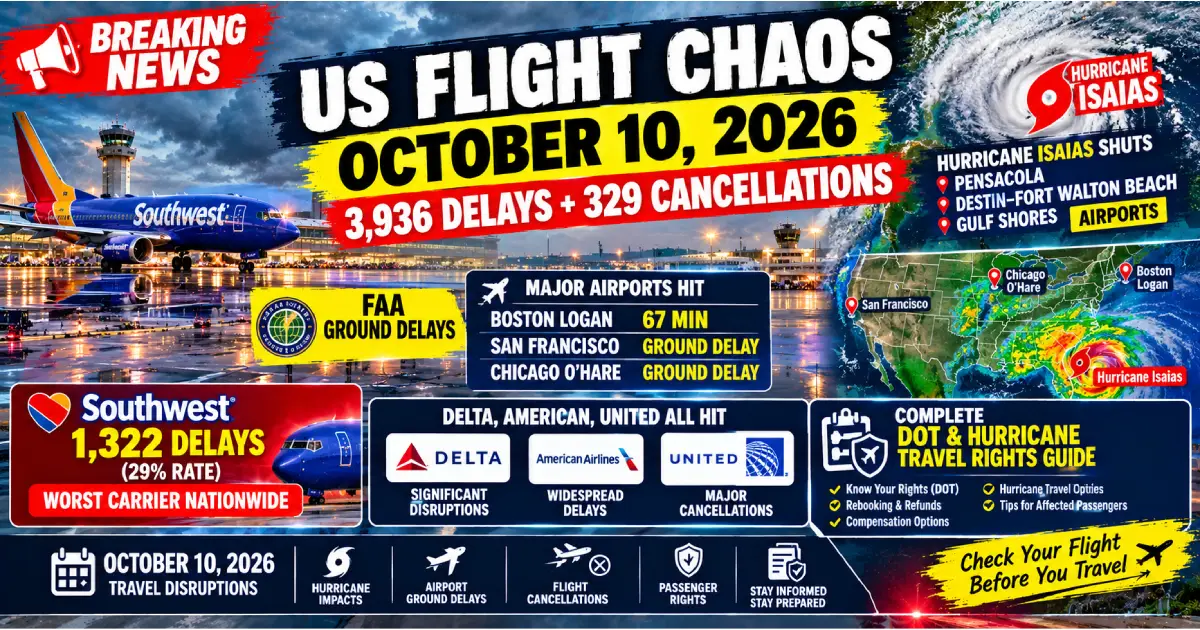
Published: October 10, 2026 — Saturday (Hurricane Isaias Landfall Day · Florida Panhandle Airports Closed · FAA Ground Programs Active Coast to Coast · Data: FlightAware verified October 10, 2026 · Source: NBAA, FlightAware)
Three things happened to US aviation simultaneously today, and the combination produced one of the most disruptive Saturdays of the autumn travel season.
Hurricane Isaias — a major Category 3 hurricane with sustained winds of 120 mph — made landfall on the northern Gulf Coast overnight and is now grinding through the Florida Panhandle, closing airports, severing routes, and generating cascading delays across the southern half of the country. Simultaneously, the Federal Aviation Administration activated Traffic Management Programs at Boston Logan (wind-related ground delay programme, average delay 67 minutes), San Francisco International (airspace holds for an air show plus volume constraints), and Chicago O’Hare (emergency response protocols). And Southwest Airlines — still rebuilding from the Amadeus vendor outage that hit its systems on October 9 — absorbed 1,322 flight delays today, a 29 percent delay rate across its entire domestic network and the highest single-carrier delay volume of any US airline today.
The total count: 3,936 flight delays and 329 outright cancellations across the United States, confirmed by FlightAware data captured at 2:46pm Eastern Time and reported at 01:24 GMT+5:30 on October 10, 2026.
If you are at a US airport today, travelling through a Gulf Coast city, or connected to any Southwest, Delta, American, or United service — this is the complete picture and your full DOT rights guide.
Published: October 10, 2026 Total US delays today: 3,936 flights ✈️⏱️ Total US cancellations today: 329 flights ✈️❌ Data source: FlightAware — captured October 9, 2026 at 2:46pm ET / reported October 10 — Primary cause 1: Hurricane Isaias — Category 3 — 120 mph sustained winds — Florida Panhandle landfall overnight October 9–10 Primary cause 2: FAA Ground Delay Programs — Boston Logan (wind) · San Francisco (air show + volume) · Chicago O’Hare (emergency response) · San Diego (volume) · Austin (volume) Contributing cause 3: Southwest Amadeus vendor outage residual — October 9 baggage/boarding system failure cascading into October 10 schedule
AIRPORTS CLOSED — Hurricane Isaias:
FAA GROUND DELAY PROGRAMS ACTIVE TODAY:
WORST CARRIER — DELAYS:
Travel waivers issued:
DOT classification — Hurricane Isaias closures: ⚠️ WEATHER/EXTRAORDINARY CIRCUMSTANCES — no cash compensation — but full refund + rebooking rights apply DOT classification — FAA GDP (Boston, SFO, O’Hare): ⚠️ Primarily weather/ATC-driven — extraordinary circumstances likely — full refund + rebooking rights apply Southwest Amadeus residual delays: May be classified as CARRIER-CAUSED if traceable to October 9 vendor outage — compensation potentially claimable DOT refund right: ✅ Full cash refund if flight cancelled — any cause — absolute right Live flight tracking: flightaware.com · flightradar24.com · fly.faa.gov Southwest travel waiver: southwest.com → Change/Cancel Flights Delta travel waiver: delta.com → My Trips → Travel Waiver
Hurricane Isaias arrived at the northern Gulf Coast as a Category 3 major hurricane with maximum sustained winds of 120 mph. The storm was tracking directly toward the Florida Panhandle — one of the most tourism-dense coastal regions in the United States, known for its white-sand beaches and served by a cluster of regional airports connecting visitors from across the country.
The NBAA’s Air Traffic Services confirmed on October 9 at 13:00z that Isaias had strengthened into a major hurricane and was “expected to make landfall along the northern Gulf Coast tonight or early Saturday.” The storm prompted the closure of Pensacola International Airport alongside protective shutdowns of airport surveillance radars, lighting systems, and ATC facilities across Alabama and Florida. The FAA simultaneously implemented active en route restrictions and severe weather avoidance procedures for multiple regional airports across the affected zone.
The closures unfolded in sequence across Thursday evening through Friday morning:
Destin–Fort Walton Beach Airport (VPS) moved first, closing all operations at 9:00pm local time on Thursday October 8. The airport made its closure decision based on the storm track and intensity forecast, giving airlines maximum time to ferry aircraft out of harm’s way before the weather arrived.
Pensacola International Airport (PNS) announced a two-stage closure: the terminal closed to commercial flights at 10:00am local time on Friday October 9, with full airport closure (tower, TRACON, and terminal) at 6:00pm local time. Pensacola Mayor D.C. was among the officials communicating the timeline to residents and visitors via the city’s emergency channels. The airport’s communication was direct: “The reopening date and time remain to be determined and will depend on damage assessments and confirmation that operations can safely resume.”
Gulf Shores International Airport (GUF) is also confirmed closed. Northwest Florida Beaches International Airport / Panama City (ECP), the most recently built of the Panhandle airports, reported no current plans to close as of Thursday October 9 — but with storm conditions arriving overnight, its operational status today is fluid.
Airlines responded quickly. Delta issued a travel waiver covering no fewer than nine airports: Pensacola (PNS), Panama City (ECP), Destin–Fort Walton Beach (VPS), Mobile (MOB), Montgomery (MGM), Dothan (DHN), Birmingham (BHM), Gulfport/Biloxi (GPT), and Columbus, Mississippi (GTR) — for October 9 and 10. Southwest listed four airports under its waiver: Destin/Fort Walton Beach, Panama City Beach, Pensacola, and New Orleans (MSY) — covering October 8 through 10.
The hurricane’s impact is not limited to the airports it has directly forced closed. The disruption radiates outward through hub connections. A passenger whose Pensacola flight was cancelled today, connecting through Atlanta or Dallas, has missed their onward connection. An aircraft that was supposed to be based overnight in Pensacola is instead sitting somewhere else. A crew that was supposed to work a Pensacola–Atlanta–Chicago rotation is out of position. These cascades are part of why 3,936 delays are recorded across the country today — not just in Florida.
Southwest Airlines absorbed the highest single-carrier delay volume in the United States today — 1,322 delayed flights, representing a 29 percent delay rate across its entire domestic point-to-point network.
The scale of Southwest’s disruption today is the product of two compounding problems, not one.
The first is structural. Southwest operates a point-to-point network model rather than a hub-and-spoke model. Every Southwest aircraft flies multiple short legs per day — Dallas to Austin to Albuquerque to Phoenix to Las Vegas in a single day is a typical Southwest rotation. This model achieves extraordinary aircraft utilisation in normal conditions. In abnormal conditions — when a slot delay, FAA ground hold, or airport closure interrupts any leg in the chain — the delay cascades automatically and uncontrollably through every subsequent flight that aircraft was supposed to operate.
Hurricane Isaias has closed some of Southwest’s busiest leisure destinations in its Gulf Coast network. The FAA ground delay programme at Boston Logan (67-minute average delay, wind-related) has slowed one of Southwest’s key northeast hubs. Volume constraints at San Diego and Austin — two more Southwest strongholds — have added pressure from the west and south simultaneously.
The second problem is residual. On October 9 — yesterday — Southwest experienced a vendor technology outage affecting its Amadeus-supplied baggage checking and boarding systems. Gate agents had to check bags and board passengers manually for several hours starting before 8:00am EDT, generating nearly 900 delayed flights and 43 cancellations on Friday. The aircraft and crews that were displaced, delayed, and repositioned on Friday arrived Saturday already behind schedule, carrying yesterday’s disruption into today’s operation.
Southwest confirmed the October 9 cause: “a brief outage affecting the systems used to check baggage and board flights, attributing the interruption to a system outage at its vendor, Amadeus.” Amadeus is the same vendor whose outage affected multiple carriers in the October 1–6 cascade. Southwest’s vulnerability to Amadeus disruption — a second confirmed Amadeus-linked Southwest incident in eight days — raises legitimate questions about the carrier’s vendor diversification and backup systems.
For Southwest passengers today: the carrier’s travel waiver covering Gulf Coast airports remains active at southwest.com → Change/Cancel Flights. Southwest does not interline with other carriers — if your Southwest flight is cancelled, your options are the next available Southwest service or a full refund. No partner carrier rebooking.
Beyond the Florida closures, today’s disruption is simultaneously attacking the country from multiple other directions through FAA Traffic Management Programs.
Boston Logan (BOS) — Ground Delay Programme, 67-minute average:
Boston Logan is today’s most severely constrained non-hurricane airport. The FAA activated a Ground Delay Programme at BOS due to wind conditions, producing an average ground delay of 67 minutes per arrival. This means every aircraft trying to land at Boston is being held at its departure airport for more than an hour before it is given clearance to depart — an hour of delay that cascades into the aircraft’s next departure and all subsequent flights in that aircraft’s rotation.
Boston is a critical hub for JetBlue (its largest base), Delta, American, and United, with significant international services to London, Dublin, and beyond. Any transatlantic service arriving at Boston today is competing for runway access with domestic arrivals that are already backed up. Passengers connecting at Boston today — particularly from European arrivals to onward domestic connections — face a high risk of missed connections.
San Francisco International (SFO) — 171 delays, 5 cancellations:
SFO’s disruption today is driven by a combination of an air show creating restricted airspace in the Bay Area — a pre-planned constraint — and high traffic volume through one of the West Coast’s most constrained airports. The combination has produced a Ground Delay Programme that is generating 171 delays across all carriers. United Airlines — which operates SFO as its primary West Coast hub — is absorbing the largest SFO delay volume. Alaska Airlines, American, and Delta are all also affected.
Chicago O’Hare (ORD) — emergency response protocols:
Chicago O’Hare has activated emergency response protocols today with active ground delays across both United’s Terminal 1/2 operations and American’s Terminal 3 operations. O’Hare is consistently the single most impactful airport in the US aviation network when it faces constraints — its position in the country’s geographic centre means delays at ORD ripple east, west, north, and south simultaneously. Any delay at O’Hare today will have produced knock-on effects across the country by this evening.
San Diego (SAN) and Austin (AUS) — volume constraints:
Both San Diego and Austin are under volume constraints today — meaning traffic demand exceeds available capacity without any single weather or ATC event as the specific cause. This is a regular autumn Saturday phenomenon at both airports, exacerbated today by the general disruption across the network that is pushing passengers to rebook through alternative routing through these hubs.
All four major network carriers have issued travel waivers for the Gulf Coast airports affected by Hurricane Isaias. Here is exactly what each waiver covers.
Delta Air Lines:
Delta’s waiver covers travel to, from, or through Pensacola (PNS), Panama City (ECP), Destin–Fort Walton Beach (VPS), Mobile (MOB), Montgomery (MGM), Dothan (DHN), Birmingham (BHM), Gulfport/Biloxi (GPT), and Columbus, Mississippi (GTR) on October 9 and 10, 2026.
Under the waiver: passengers can rebook on the next available Delta service to the same destination at no charge, waiving fare difference and change fees. Passengers who choose not to rebook can request a full refund. Access at delta.com → My Trips → look for the travel waiver notification.
Southwest Airlines:
Southwest’s waiver covers Destin/Fort Walton Beach, Panama City Beach, Pensacola, and New Orleans (MSY) for October 8 through 10. Southwest’s policy: change to another available flight with no change fee. Request a full refund if you choose not to travel. Access at southwest.com → Change/Cancel Flights.
American Airlines:
American’s waiver covers Gulf Coast and affected Alabama/Mississippi airports for October 9 and 10. Passengers can rebook without change fees or fare difference on American services to the same city pair. Access at aa.com → Travel Waiver.
United Airlines:
United’s waiver covers Gulf Coast airports for October 9 and 10. Access at united.com → My Trips for the active waiver and rebooking options.
Important waiver rule — city pairs:
All four carriers require that rebooking is to the same city pair — the same origin and destination airports. You cannot use a hurricane waiver to change your destination. If you want to rebook to a different destination, that is a separate change and will be treated under normal fare rules.
Hurricane and weather closures — the DOT rule:
Hurricane Isaias is a genuine natural event — a category that qualifies as extraordinary circumstances under DOT rules. This means that for flights cancelled specifically due to the hurricane-driven airport closures (Pensacola, Destin–Fort Walton Beach, Gulf Shores), airlines are not required to provide cash compensation for the disruption. However, your core rights are fully intact regardless of extraordinary circumstances.
What you ARE owed today — regardless of cause:
Your most important right in any cancellation scenario is the right to a full cash refund to your original payment method if your flight is cancelled and you choose not to rebook. This right is absolute and unconditional under DOT rules — it applies to weather cancellations as much as to any other cause. The airline cannot substitute a travel voucher or credit without your explicit agreement. If you want cash back, request it specifically and do not accept a voucher as the default.
Your second core right is rebooking on the next available service to your destination at no additional cost. This applies regardless of whether the cancellation was weather-caused.
Southwest’s Amadeus residual delays — a different calculation:
If your Southwest flight was delayed or cancelled today as a direct consequence of the Amadeus vendor outage on October 9 — rather than due to Hurricane Isaias or the FAA ground programmes — the classification changes. Vendor technology outages are carrier-caused events under DOT rules, as confirmed by DOT’s position after the CrowdStrike/Delta meltdown of 2024 and confirmed again when the DOT reviewed the October 6 Southwest weather data outage. If your delay is traceable to Southwest’s Amadeus problem rather than the hurricane, you may be entitled to meal vouchers (from 3+ hour delay) and hotel accommodation (if stranded overnight) beyond what weather rules require.
The practical challenge is proving which cause drove your specific delay. If Southwest confirms in writing that your delay was weather-related, you are in the extraordinary circumstances category. If Southwest’s own flight tracking shows your aircraft left an unaffected hub and was delayed by the Amadeus system rather than weather, the carrier-caused category applies. Push for clarification from the airline.
The three-step claim process:
If you are owed a refund or expense reimbursement from today’s disruption:
First, submit directly to the airline through its app or website — this is the fastest route and the one most likely to produce quick resolution. Use each carrier’s specific refund portal: delta.com/refund, united.com/refund, aa.com/refunds, southwest.com/cancel.
Second, if the airline refuses a legitimate refund claim after 30 days, file a complaint with the DOT at transportation.gov/airconsumer/file-consumer-complaint. After the Delta/CrowdStrike precedent, the DOT takes refund compliance seriously and follows up on complaints against specific carriers.
Third, if you purchased travel insurance, contact your insurer. Many comprehensive policies cover trip interruption due to hurricanes and named storms — but only if you purchased the policy before the storm was named and forecast. Hurricane Isaias was named and publicly forecast several days ago. If you purchased insurance after the storm was announced, coverage for Isaias is likely excluded.
Pensacola International Airport has not announced a reopening date. The airport’s statement is clear: “A reopening date has not been announced and will be determined after all damage assessments are made.” This is standard post-hurricane protocol and the correct approach — Pensacola was severely damaged by Hurricane Sally in 2020 and Hurricane Ivan in 2004, and the city’s emergency management takes structural assessment seriously before restoring commercial aviation operations.
Destin–Fort Walton Beach Airport similarly has no confirmed reopening date: “Airport officials said they will reopen when it is safe to do so.”
Based on past Gulf Coast hurricane recovery timelines, smaller regional airports like PNS and VPS typically reopen within 24–72 hours of a storm’s passage if structural damage is limited to fencing, signage, and surface flooding. If there is runway or instrument damage, restoration can take several days or longer. Passengers booked into or out of these airports this weekend should assume disruption through at least Sunday October 11 and plan for possible disruption into Monday October 12.
The most effective tracking tools for Panhandle airport reopening:
Pensacola International Airport: pensacolaairport.com and the airport’s official Facebook page — which has been the primary channel for real-time updates throughout the storm.
Destin–Fort Walton Beach Airport: destinfwbairport.com.
Check these sources directly rather than relying on airline apps for reopening news — airports typically announce their own reopening status before airlines update their booking systems.
| Tool | What It Shows | Link |
|---|---|---|
| FlightAware | Live delay/cancel status nationwide | flightaware.com |
| FlightRadar24 | Live aircraft positions | flightradar24.com |
| FAA Command Centre | Active ground delays + ground stops | fly.faa.gov/flyfaa/usmap.jsp |
| Pensacola Airport updates | PNS reopening status | pensacolaairport.com |
| NHC Hurricane Isaias | Storm track + intensity | nhc.noaa.gov |
| Carrier | Gulf Coast Waiver | Rebooking | Refund |
|---|---|---|---|
| Southwest Airlines | southwest.com → Change/Cancel | southwest.com | southwest.com/cancel |
| Southwest phone | 1-800-435-9792 | — | — |
| Delta Air Lines | delta.com → My Trips | Fly Delta app | delta.com/refund |
| Delta phone | 1-800-221-1212 | — | — |
| American Airlines | aa.com → Travel Waiver | AA app | aa.com/refunds |
| American phone | 1-800-433-7300 | — | — |
| United Airlines | united.com → My Trips | United app | united.com/refund |
| United phone | 1-800-864-8331 | — | — |
| JetBlue | jetblue.com → Manage | JetBlue app | jetblue.com/refund |
| Pensacola Airport | pensacolaairport.com | Reopening updates | — |
| Destin–FWB Airport | destinfwbairport.com | Reopening updates | — |
| DOT Passenger Rights | transportation.gov/airconsumer | All US carriers | File complaint online |
| NHC Hurricane Isaias | nhc.noaa.gov | Storm track | Evacuation guidance |
Related Articles:
Posted By : Vinay
This article is provided for general informational purposes only and is based on information available at the time of publication. Travel advisories, airline schedules, airport operations, visa requirements, government regulations, and other travel-related information are subject to change without prior notice. While Travel Tourister makes reasonable efforts to verify information using official announcements, government publications, airline and airport communications, and other reliable sources, we cannot guarantee that all information remains complete, accurate, or up to date at all times. Readers should independently verify any information that may affect their travel plans with the relevant airline, airport authority, government agency, embassy, or other official source before making travel, financial, or other decisions. Travel Tourister shall not be liable for any direct or indirect loss, inconvenience, or damages arising from the use of or reliance on the information contained in this article. Nothing in this publication constitutes legal, immigration, financial, or professional travel advice. If you believe any information in this article is inaccurate or outdated, please contact our editorial team. We review all credible correction requests promptly and update our content whenever appropriate.
Lastest News
2nd Floor, 39, Above Kirti Club, DLF Industrial Area, Kirti Nagar, New Delhi, Delhi 110015



Travel Tourister is a leading Travel portal where we introduce travellers to trusted travel agents to make their journey hasselfree, memorable And happy. Travel Tourister is a platform where travellers get Tour packages ,Hotel packages deals through trusted travel companies And hoteliers who are working with us across the world. We always try to find new and more travel agents and hoteliers from every nook and corners across the world so that you could compare the deals with different travel agents and hoteliers and book your tour or hotel with the one you have chosen according to your taste and budget.
Copyright © Travel Tourister, India. All Rights Reserved

 Call
Call Enquiry