Published on : 07 Oct 2026
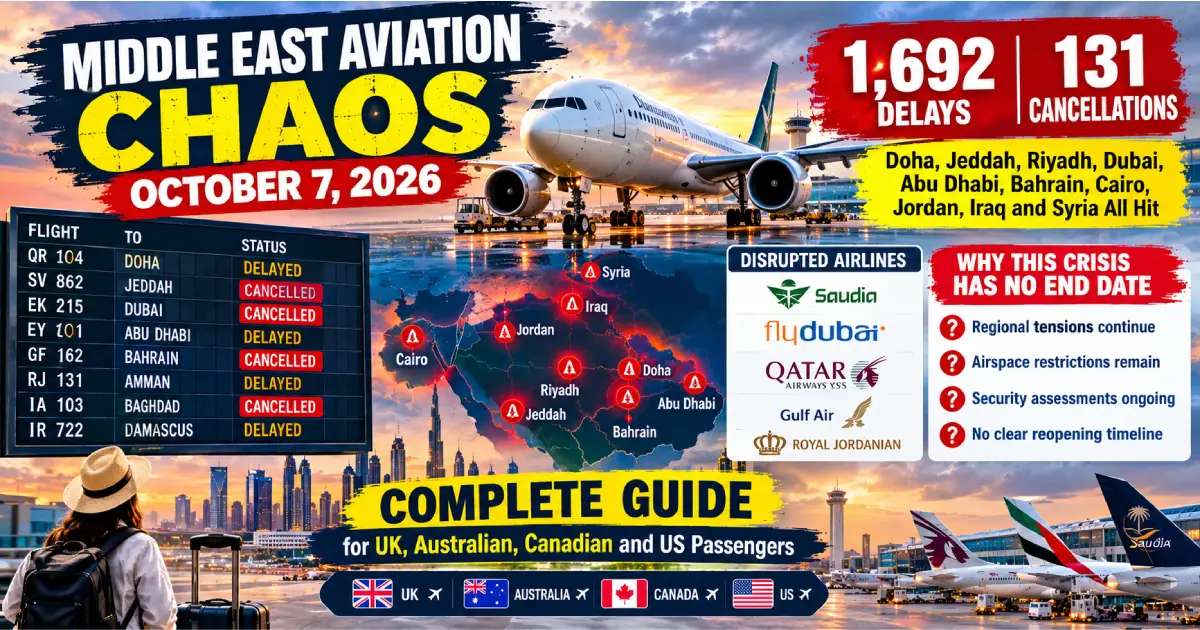
The Middle East aviation network recorded 1,692 flight delays and 131 cancellations on Wednesday October 7, 2026, in the latest daily disruption event driven by the ongoing 2026 Iran conflict. Airports across Saudi Arabia, Qatar, the UAE, Bahrain, Egypt, Jordan, Iraq and Syria are all recording active delays and cancellations. Doha’s Hamad International, Jeddah’s King Abdulaziz, Riyadh’s King Khalid, Dubai International, Abu Dhabi, Cairo, Amman, Erbil and Damascus are all in today’s disruption data. The Middle East aviation crisis — which began with the closure of seven nations’ airspace on February 28, 2026 — has now entered its eighth consecutive month with no resolution in sight. Cathay Pacific has just extended its Dubai suspension to January 31, 2027. Air Canada is suspended to March 2027. Virgin Atlantic to October 2027. This is the most comprehensive single-day Middle East aviation breakdown available in English — and what every UK, Australian, Canadian and US passenger needs to know right now.
Data published October 7, 2026 at 03:59 GMT+5:30 by sourced from FlightAware real-time tracking.
| Metric | October 7, 2026 |
|---|---|
| Total Middle East delays | 1,692 |
| Total Middle East cancellations | 131 |
| Worst airport — delays | Riyadh King Khalid (RUH) — 234 delays |
| Worst airport — cancellations | Riyadh King Khalid (RUH) — 7 cancellations |
| Highest cancellation rate | Bahrain International (BAH) — 4–5% |
| Disrupted countries | Saudi Arabia, UAE, Qatar, Bahrain, Egypt, Jordan, Iraq, Syria |
| Primary cause | Iran conflict airspace restrictions + geopolitical rerouting pressure |
| Crisis duration | 8 months — February 28 to October 7, 2026 |
Qatar’s Hamad International Airport logged 107 delays and 2 cancellations, creating tight transfer windows for long-haul connections. Airports in Doha, Jeddah, Riyadh, Dubai, Abu Dhabi, Cairo, Istanbul, and other places have reported delays or cancellations. Doha is the primary connecting hub for Qatar Airways — one of the few Gulf carriers still operating a full long-haul network. When Hamad records 130+ delays, every Qatar Airways long-haul connection faces cascading risk.
For your readers: UK passengers on Qatar Airways via Doha to Australia, New Zealand, South Asia and East Asia are directly exposed. Australian passengers on QF/QR codeshare itineraries through Doha are similarly at risk. Doha remains one of the most stable Gulf hubs despite today’s disruption — but 130 delays is still significant at a hub of this importance.
King Khalid International Airport in Riyadh registered 234 delays and 7 cancellations. Riyadh’s sustained position as the most disrupted Saudi hub reflects two converging pressures: Saudia’s network-wide operational strain from carrying diverted traffic that would previously have transited Iranian airspace, and the direct security threat to Saudi aviation infrastructure from Houthi missile and drone attacks that began earlier in 2026.
King Abdulaziz International Airport in Jeddah logged 125 delays and 4 cancellations. Jeddah is Saudi Arabia’s second-largest international hub and the gateway for Umrah pilgrims — the ongoing disruption to Jeddah’s schedule has compounded the logistical pressure on religious travellers from the UK, Australia, Canada and the US trying to reach Mecca.
Dubai and Abu Dhabi both feature in today’s disruption data. Emirates and Etihad — both still fully operating — are absorbing significant delay pressure from the rerouting constraints that add 30–90 minutes to virtually every flight that would previously have transited Iranian or Iraqi airspace directly. See our dedicated UAE Flights October 7 live update article for the full Emirates and Etihad breakdown.
Bahrain International Airport reported 16 delays alongside 11 cancellations — a 4% origin / 5% destination cancellation rate. Bahrain’s high cancellation-to-delay ratio reflects Gulf Air’s ongoing operational challenges. A 4–5% cancellation rate at a single airport is significantly above normal operational tolerance — meaning roughly 1 in 20 Bahrain-originating or Bahrain-arriving flights is being cancelled outright rather than delayed.
Gulf Air context: Gulf Air also has 13 cancellations, representing 9%, and 15 delays, representing 10%. Gulf Air’s 9% cancellation rate across its network today makes it the highest-cancellation-rate airline in the Middle East — a stark indicator of Bahrain’s operational exposure to the ongoing conflict.
Cairo International registered 119 delays and 1 cancellation, with high regional feeder flight delays. Egypt sits at the western edge of the Middle East disruption zone — Cairo’s 119 delays reflect the pressure on Egypt’s airspace from rerouted traffic avoiding Israeli, Lebanese, Syrian and Iraqi airspace to its east and northeast.
EgyptAir is Cairo’s dominant carrier, and its delays cascade into connections across Africa, Europe and the Gulf. Cairo is a primary transit hub for UK and European passengers connecting to East Africa and West Africa.
Queen Alia International Airport in Jordan recorded 28 delays and 1 cancellation — Levant transit corridor holding delays. Erbil International Airport in Iraq reports two delays and two cancellations, while Damascus International Airport in Syria has six delays and four cancellations.
Jordan’s airspace has been progressively reopened since the initial February closure, but residual rerouting pressure and the proximity of active conflict zones in Syria and Iraq continue to create slot restrictions and holding patterns over Jordanian airspace.
Erbil International Airport in Iraq reports two delays and two cancellations, while Damascus International Airport in Syria has six delays and four cancellations. Iraq and Syria remain among the most restricted airspace environments in the world — commercial operations continue only on carefully managed corridors under constant security review.
Full Airport Table — October 7, 2026:
| Airport | Code | Country | Delays | Cancellations | Notes |
|---|---|---|---|---|---|
| King Khalid International | RUH | Saudi Arabia | 234 | 7 | Most delays — Saudi hub pressure |
| King Abdulaziz International | JED | Saudi Arabia | 125 | 4 | Umrah gateway pressure |
| Hamad International | DOH | Qatar | 130 | 14 | Qatar Airways long-haul hub |
| Dubai International | DXB | UAE | Active | Active | See UAE article |
| Abu Dhabi International | AUH | UAE | Active | Active | See UAE article |
| Cairo International | CAI | Egypt | 119 | 1 | West Levant corridor pressure |
| Bahrain International | BAH | Bahrain | 16 | 11 | Highest cancellation rate |
| Queen Alia International | AMM | Jordan | 43 | 1 | Levant transit disruption |
| Erbil International | EBL | Iraq | 2 | 2 | Northern Iraq security pacing |
| Damascus International | DAM | Syria | 6 | 4 | Restricted corridor operations |
Saudia is carrying the heaviest operational burden of any Middle East carrier today. Saudia and flydubai tied for the highest delay percentage, with both carriers reporting 25% of their scheduled operations delayed. A 25% delay rate means one in four Saudia flights is running late today — a network-wide indicator of the pressure on Saudi Arabia’s flag carrier from eight months of sustained conflict disruption.
Saudia’s challenge is structural: it operates one of the most geographically exposed route networks in the world, with heavy frequencies to Jeddah, Riyadh, Medina, Dammam and Abha — all within range of Houthi drone and missile attacks from Yemen, which have intensified throughout 2026. The carrier has simultaneously been absorbing diverted traffic from routes that would previously have passed through Iranian and Iraqi airspace.
flydubai tied for the highest delay percentage with 25% of scheduled operations delayed. flydubai operates from Dubai International as a low-cost carrier targeting secondary and regional Middle Eastern cities — including routes into Syria, Iraq, Lebanon and Iran-adjacent territories that are among the most disrupted in today’s data. Its 25% delay rate reflects that geographic exposure directly.
Qatar Airways accounts for the majority of Hamad International’s 130 delays today. Qatar Airways is operating its full long-haul network — including London Heathrow, Manchester, Birmingham, Sydney, Melbourne, Brisbane, Los Angeles, New York, Toronto and dozens of other global destinations — and the pressure at Doha’s hub creates tight connection windows for passengers transiting today.
Critical for connecting passengers: Qatar Airways’ minimum connection time at Doha is 45 minutes international-to-international. With 130 delays at the hub, any connection under 75 minutes is at elevated risk today. If your Doha connection is under 90 minutes, alert a Qatar Airways transfer agent before boarding your inbound flight.
Gulf Air also has 13 cancellations, representing 9%, and 15 delays, representing 10%. Gulf Air’s 9% cancellation rate is the highest of any carrier across both Middle East and Asia today. Gulf Air operates from Bahrain to London Heathrow, Manchester, Birmingham, Frankfurt, Paris, Athens, Mumbai, Delhi, Bangkok and a range of other global destinations — making its cancellation rate directly relevant to UK, Australian, US and Canadian passengers.
Royal Jordanian has two cancellations, or 1%, and 16 delays, or 11%. Royal Jordanian operates Amman–London, Amman–New York, Amman–Chicago and Amman–Sydney routes that are directly affected by today’s Queen Alia disruption.
Complete Airline Table — October 7, 2026:
| Airline | Country | Delays | Cancellations | Rate | Key Routes Affected |
|---|---|---|---|---|---|
| Saudia | Saudi Arabia | — | — | 25% delay | All Saudi domestic + international |
| flydubai | UAE | — | — | 25% delay | Dubai regional network |
| Qatar Airways | Qatar | 130+ | 14 | Hub pressure | All QR long-haul connecting |
| Gulf Air | Bahrain | 15 | 13 | 9% cancel | Bahrain–London, Bahrain–India |
| Royal Jordanian | Jordan | 16 | 2 | 1% cancel | Amman–London, Amman–New York |
| EgyptAir | Egypt | 119+ | 1 | High delay | Cairo–Europe, Cairo–Africa |
Today’s 1,692 delays and 131 cancellations are a snapshot within a crisis that began on February 28, 2026, when the US-Israel military operation against Iran triggered the closure of seven nations’ airspace simultaneously and produced 1,800 cancellations in a single day.
The crisis that has now persisted for eight consecutive months has progressively shifted from acute emergency to chronic disruption. The initial mass closures have been replaced by selective reopenings, partial restorations and airport-by-airport operational decisions — but the structural damage to Middle East aviation remains profound.
The eight-month toll:
| Phase | Period | Disruption Character |
|---|---|---|
| Acute emergency | Feb 28 – Mar 15, 2026 | 7 nations’ airspace closed; 1,800+ cancellations/day |
| Partial recovery | Mar 16 – Apr 25, 2026 | Kuwait, Iraq, Jordan partially reopened; daily disruption 400–800 |
| Selective resumption | Apr 26 – Jul 31, 2026 | Airlines cautiously rebuilding; daily disruption 600–1,200 |
| Extended suspension era | Aug – Oct 2026 | Airlines pushing returns to 2027; daily disruption 1,000–2,000 |
| Today | Oct 7, 2026 | 1,692 delays + 131 cancellations — chronic, ongoing |
The extension of Cathay Pacific’s Dubai suspension to January 31, 2027 — announced September 28, just nine days ago — is the clearest signal yet that the industry does not expect material improvement before Q1 2027 at the earliest.
The Middle East crisis affects UK passengers in three primary ways:
1. Suspended direct routes: Virgin Atlantic Dubai (October 2027), British Airways Abu Dhabi (winter 2027-28), British Airways Bahrain (March 2027) — all suspended. BA Dubai returns November 3.
2. Extended flight times: Every UK–Asia flight routing over the Middle East now takes 30–90 minutes longer due to Iranian airspace avoidance. A London–Sydney flight that previously took 21 hours now takes up to 23 hours on certain routings.
3. Connecting hub pressure: UK passengers on Qatar Airways via Doha, Gulf Air via Bahrain, and Royal Jordanian via Amman are directly exposed to today’s disruption at those hubs.
UK261 rights apply to your UK-departing flight regardless of the cause of disruption. If your flight is cancelled, you are entitled to a full refund or rebooking. Care rights (meals, hotel if overnight) are unconditional.
Australia’s primary Middle East exposure runs through Dubai (Emirates) and Doha (Qatar Airways / Qantas codeshare). Both hubs are active today with delays.
Emirates is fully operational from Sydney, Melbourne, Brisbane, Perth and Adelaide — but rerouting around Iranian airspace adds time to every flight. Perth–Dubai typically runs 10–11 hours; many current routings are 12–13 hours due to the conflict.
Qatar Airways / Qantas codeshare via Doha: With 130 delays at Hamad today, Australian passengers on the Qantas-marketed QR codeshare should build a minimum 90-minute Doha connection window.
Under Australian Consumer Law, airlines must rebook you at no extra cost if you miss a connection due to a delay on the same ticket.
Air Canada’s March 2027 Dubai suspension leaves Canadian passengers without a direct Toronto–Dubai service. The primary alternatives from Canada:
Under Canada’s APPR, if your Air Canada connection is disrupted due to the airline’s Dubai suspension, you are entitled to rebooking at no extra cost.
United Airlines’ March 2027 Newark–Dubai suspension removes a key US–UAE route. US passengers wanting to fly to Dubai have Emirates (JFK, LAX, IAH, IAD, DFW all fully operating) as the most reliable option. Qatar Airways (multiple US gateways via Doha) is active but subject to today’s hub delays.
| Disruption Location | Your Rights |
|---|---|
| Saudi Arabia | GACA rules: rebooking + refund; meals after 2hrs; hotel if overnight |
| Qatar (DOH) | QCAA rules: rebooking; care rights; Qatar Airways Conditions of Carriage |
| UAE (DXB/AUH) | GCAA rules: rebooking + refund; meals; hotel overnight |
| Bahrain | CAAB rules: rebooking + refund; care rights |
| Jordan (AMM) | CARC rules: rebooking; care rights apply |
| UK-departing flights | UK261: full refund or rerouting; compensation if under 14 days notice |
| US-departing flights | US DOT: full cash refund if cancelled for any reason |
| Australian-departing flights | Australian Consumer Law: rebooking at no extra cost |
| Canadian-departing flights | APPR: rebooking; care rights regardless of cause |
Universal key rule: At every hub worldwide, if you miss a connection because of a delayed inbound flight on the same ticket, the operating carrier is responsible for getting you to your final destination. Go directly to the airline’s transfer desk — do not rebook independently without first confirming the airline will cover costs.
Posted By : Vinay
This article is provided for general informational purposes only and is based on information available at the time of publication. Travel advisories, airline schedules, airport operations, visa requirements, government regulations, and other travel-related information are subject to change without prior notice. While Travel Tourister makes reasonable efforts to verify information using official announcements, government publications, airline and airport communications, and other reliable sources, we cannot guarantee that all information remains complete, accurate, or up to date at all times. Readers should independently verify any information that may affect their travel plans with the relevant airline, airport authority, government agency, embassy, or other official source before making travel, financial, or other decisions. Travel Tourister shall not be liable for any direct or indirect loss, inconvenience, or damages arising from the use of or reliance on the information contained in this article. Nothing in this publication constitutes legal, immigration, financial, or professional travel advice. If you believe any information in this article is inaccurate or outdated, please contact our editorial team. We review all credible correction requests promptly and update our content whenever appropriate.
Lastest News
2nd Floor, 39, Above Kirti Club, DLF Industrial Area, Kirti Nagar, New Delhi, Delhi 110015



Travel Tourister is a leading Travel portal where we introduce travellers to trusted travel agents to make their journey hasselfree, memorable And happy. Travel Tourister is a platform where travellers get Tour packages ,Hotel packages deals through trusted travel companies And hoteliers who are working with us across the world. We always try to find new and more travel agents and hoteliers from every nook and corners across the world so that you could compare the deals with different travel agents and hoteliers and book your tour or hotel with the one you have chosen according to your taste and budget.
Copyright © Travel Tourister, India. All Rights Reserved

 Call
Call Enquiry