Published on : 10 Oct 2026
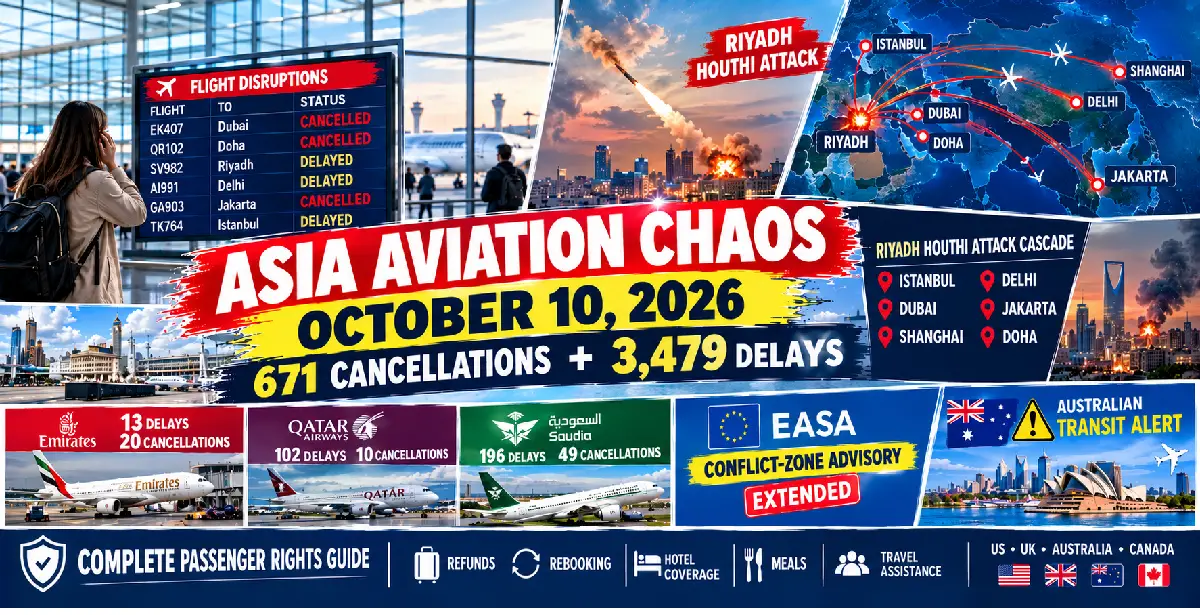
Published: October 10, 2026 — Saturday (Data: FlightAware — October 9, 2026 at 3:23pm ET / October 10 at 3:25am CST · Sources: NBAA, Reuters, EASA — all verified October 10, 2026)
One security event in Riyadh has caused 4,150 disruption instances across an entire continent.
A single Houthi missile attack on Riyadh’s King Khalid International Airport on October 8, 2026 — the attack that killed three people, damaged a parked Saudia Airbus A320, and forced the temporary closure of the Saudi capital’s main airport — has now cascaded through the Asian and Middle Eastern aviation network with full force. The verified data, captured by FlightAware on October 9, 2026 at 3:23pm Eastern Time and published at 01:19 GMT+5:30 on October 10, documents 671 flight cancellations and 3,479 delays across a network stretching from Istanbul to Jakarta, Guangzhou to Delhi, and Dubai to Doha.
This is not a localised Middle East story. It is a trans-continental cascade that is directly relevant to Australian, UK, Canadian, and US travellers who transit through Dubai, Doha, or Istanbul to reach destinations across Asia, Africa, and the Indian subcontinent. Emirates logged 113 delays and 20 cancellations today. Qatar Airways logged 102 delays and 10 cancellations. Istanbul Airport recorded one of the highest delay totals of any transit hub in the region. And EASA — the European Union Aviation Safety Agency — renewed its conflict-zone advisory covering Gulf airspace on October 9, adding a second layer of operational pressure on European and Asian carriers already managing disrupted Saudi routings.
For Australians: every Qantas, Emirates, Qatar Airways, Etihad, and Singapore Airlines service that transits Dubai, Doha, Abu Dhabi, or Istanbul today is operating against a backdrop of unprecedented Gulf airspace pressure. If your connection is in Dubai or Doha tonight, check your flight status right now.
Published: October 10, 2026 Data capture: FlightAware — October 9, 2026 at 3:23pm ET (October 10 at 3:25am China Standard Time) Total delays across Asia/Middle East today: 3,479 flights ✈️⏱️ Total cancellations today: 671 flights ✈️❌ Combined disruptions: 4,150
ROOT CAUSE: Houthi missile attacks on King Khalid International Airport, Riyadh (RUH) — October 6–8, 2026
AIRPORTS — WORST HIT TODAY:
| Airport | Code | Country | Delays | Cancellations | Cancel Rate |
|---|---|---|---|---|---|
| Jakarta Soekarno-Hatta | CGK | Indonesia | 294 | 15 | 1% |
| Shanghai Pudong | PVG | China | 165 | 10 | 0% |
| Hamad International, Doha | DOH | Qatar | 115 | 10 | 0–1% |
| Guangzhou Baiyun | CAN | China | — | — | High |
| Istanbul Airport | IST | Türkiye | Significant | Significant | Rerouting cascade |
| Delhi Indira Gandhi | DEL | India | Significant | Significant | India suspension cascade |
| Dubai International | DXB | UAE | Significant | 20+ | Emirates hub pressure |
| Riyadh King Khalid | RUH | Saudi Arabia | 162 | 278 | 29–40% |
AIRLINES — DISRUPTION BREAKDOWN:
| Airline | Delays | Cancellations | Delay Rate |
|---|---|---|---|
| Saudia | 196 | 49 | 37% |
| Emirates | 113 | 20 | 21% |
| Qatar Airways | 102 | 10 | 16% |
| Turkish Airlines | 299 | 25 | 18% |
| Air Arabia | 88 | 5 | 36% |
| Etihad Airways | 95 | 2 | 28% |
| flynas | 120 | 2 | 45% |
| flyadeal | 78 | 5 | 43% |
| EgyptAir | 44 | 10 | 15% |
| Riyadh Air | 18 | 2 | 64% |
| Royal Jordanian | 12 | 4 | 8% |
| Oman Air | 16 | 2 | 15% |
EASA CONFLICT-ZONE ADVISORY: ✅ Renewed October 9 — covers Gulf airspace including UAE, Qatar, Bahrain, Kuwait and Oman Travel advisories:
The Riyadh King Khalid Airport Houthi attack of October 8 did not just disrupt Saudi aviation. It disrupted the entire western Asia and Middle Eastern routing network — and understanding why helps every affected traveller make sense of delays they are experiencing thousands of miles from Riyadh.
Modern aviation across the Asia-Middle East corridor operates on an interconnected network logic. A widebody aircraft that departs Sydney at 21:30 reaches Dubai at approximately 14:00 local time the next day. It might then turn around for a Frankfurt departure at 17:00 before heading back to Dubai overnight and returning to Australia. Every leg in that rotation depends on the previous leg completing normally. If the Dubai turnaround is disrupted by a crew that has run out of duty hours — because an inbound from Riyadh sat on the apron for four hours waiting for clearance — the Frankfurt service is late, the overnight service is late, and the Sydney arrival the following morning is late.
This is the cascade mechanism that turned a security event at one Saudi airport into 4,150 disruption instances across an entire continent.
King Khalid International Airport in Riyadh recorded 162 delays and 278 cancellations on October 9, with an origin cancellation rate of 29 percent and a destination cancellation rate of 40 percent — meaning four in ten aircraft that were supposed to arrive at Riyadh did not. Those aircraft were supposed to turn around and fly outward. They could not. The positions they were supposed to hold in Dubai, Doha, Istanbul, Delhi, and Jakarta were left vacant. The aircraft that replaced them — where replacements were possible — were already running late from their own prior commitments.
EASA’s renewal of its Gulf airspace conflict-zone advisory on October 9 added a second layer of pressure. The advisory covers Gulf airspace including areas associated with the UAE, Qatar, Bahrain, Kuwait, and Oman — meaning European carriers operating to those destinations are required to apply heightened safety assessment protocols, alter routing, and in some cases increase fuel loads to support longer routing around advisory zones. Longer routes mean higher costs, more fuel, longer flight times, and in some cases narrower crew duty-hour margins. All of these factors are operating simultaneously today.
Jakarta Soekarno-Hatta International (CGK) — 294 delays, 15 cancellations
Jakarta is today’s highest-delay airport in the Asia Pacific region — a striking result for an airport that is geographically far removed from the Saudi security event. The explanation is rotational: Southeast Asian aviation is deeply interconnected with Middle Eastern hub carriers. Emirates, Qatar Airways, and Etihad all operate multiple daily services between Indonesia and their respective hubs. Aircraft rotation delays from Gulf hub disruptions arrive in Jakarta as delays on inbound services, and those aircraft’s subsequent departures are then late. Jakarta’s 294 delays reflect the compounded effect of Gulf disruption on one of Southeast Asia’s busiest airports.
Jakarta Soekarno-Hatta is also the primary international gateway for Australian travellers connecting to Bali and other Indonesian destinations via the Gulf. Passengers on Emirates or Qatar Airways services between Australia and Bali — routing through Dubai or Doha — face double exposure today: delay at the Gulf hub and delay at CGK.
Shanghai Pudong International (PVG) — 165 delays, 10 cancellations
Shanghai Pudong’s 165 delays reflect the East Asian traffic metering pressure that has built through October as a result of Gulf and Middle Eastern airspace disruptions. Shanghai is the primary hub for China Eastern — one of the highest-volume long-haul operators in the region — and its delays today are consistent with the broader pattern of East Asian airports absorbing the secondary effects of Gulf airspace disruption. China Eastern alone registered 106 cancellations and 259 delays across Asia in the October 9 data set.
Hamad International, Doha (DOH) — 115 delays, 10 cancellations
Hamad International is the home hub of Qatar Airways — one of the two primary transit hubs for Australian long-haul travel to Europe, the UK, the US, and beyond. With Qatar Airways recording 102 delays and 10 cancellations today, Doha’s transit environment is significantly more complex than normal. Passengers connecting through Doha today — particularly those on long-haul transfers from Australia or Southeast Asia to Europe — should check their connection status actively and be prepared for gate changes, delayed boarding, and potential rebooking if minimum connection time is breached.
Istanbul Airport (IST) — Turkish Airlines 299 delays, 25 cancellations
Istanbul Airport has absorbed one of the highest absolute delay totals of any single carrier in the region today, driven by Turkish Airlines’ 299 delays and 25 cancellations across its network. Turkish Airlines serves Riyadh and multiple Saudi destinations that have been severely disrupted, and the rerouting of Turkish’s Saudi services around conflict-zone advisories has created holding patterns, flight time extensions, and crew scheduling complications that are generating cascading delays across the Istanbul hub’s broader European, Asian, and African operations.
Turkish Airlines’ Istanbul hub is a critical connecting point for UK and European passengers routing to India, Southeast Asia, and sub-Saharan Africa. Any delay at IST today affects a wide geographic sweep of onward connections.
Dubai International (DXB) — Emirates 113 delays, 20 cancellations
Dubai International is Emirates’ home base and the world’s busiest international airport by passenger volume. Emirates’ 113 delays and 20 cancellations today represent a 21 percent delay rate across its network — unusually high for an airline that typically runs among the most punctual long-haul operations globally. The Gulf airspace disruption from Riyadh, combined with the volume of Saudi-related cancellations across Emirates’ network (Dubai is a natural connecting point for Saudi-destined passengers who cannot fly Saudia or direct), is creating congestion at DXB that is rippling through every rotation the airline operates.
For Australian passengers: Emirates operates the world’s highest-frequency Australia-Dubai service from Sydney, Melbourne, Brisbane, Perth, and Adelaide. Any significant disruption at DXB today directly affects Australian passengers both outbound to Europe and inbound returning home.
The Gulf and Middle Eastern carrier disruption today is documented in a separate data set covering 326 cancellations and 2,272 delays specifically across the Gulf region — part of the broader 671 cancellation and 3,479 delay total for Asia.
Saudia is bearing the most acute single-carrier disruption: 196 delays representing a 37 percent delay rate, and 49 cancellations representing a 10 percent cancellation rate. This is the direct consequence of the October 8 attack at Riyadh King Khalid Airport. Saudia operates as the flag carrier of Saudi Arabia with its primary hub at King Khalid International — the epicentre of the attack. With nearly half of arrivals at Riyadh cancelled and a 29 percent cancellation rate on departures, Saudia’s entire rotation has been disrupted from the inside out.
Turkish Airlines recorded 299 delays and 25 cancellations, making it the highest absolute delay carrier in the region today — higher even than Emirates. This reflects the scale of Turkish Airlines’ network and its exposure to both Saudi destinations and the airspace rerouting requirements across Gulf advisory zones.
Emirates’ 21 percent delay rate and 20 cancellations represent the highest proportional disruption the airline has recorded in a single day during this crisis period. flyadeal — Saudi Arabia’s low-cost carrier — recorded a 43 percent delay rate, and flynas recorded a 45 percent delay rate, reflecting the total paralysis of Saudi Arabia’s domestic aviation market following the Riyadh attacks.
Riyadh Air — the new Saudi carrier that only began commercial operations in October 2025 — recorded a 64 percent delay rate on October 9, the highest percentage delay rate of any carrier in the region. This reflects the extraordinary exposure of an airline whose entire network is built around the airport that has just been attacked.
On October 9, 2026, the European Union Aviation Safety Agency renewed its conflict-zone advisory covering Gulf airspace — including areas associated with the UAE, Qatar, Bahrain, Kuwait, and Oman.
This advisory does not ground European carriers operating to those countries. It requires them to undertake an enhanced safety risk assessment before each flight to or through the covered airspace, and in many cases to alter routes, add fuel margins for alternative routing, and apply specific crew briefing protocols.
The practical consequences for passengers are indirect but real. An aircraft flying from London Heathrow to Dubai that now needs to carry additional fuel for an alternative routing to Abu Dhabi is heavier, uses more runway on departure, and may face a slight fuel-related payload restriction. A crew that has been briefed on three alternative routing scenarios rather than one is spending more time in pre-flight preparation. A dispatcher who has filed flight plans to multiple Gulf destinations is managing a more complex workload than on a normal day.
Cumulatively, these factors slow operations and create the small timing margins that compound across a hub network into the kind of delays documented today. The EASA advisory is not grounding flights — but it is adding friction to every flight that operates across Gulf airspace, and friction at scale becomes delay data.
Australia is uniquely exposed to today’s Asian aviation chaos because of its transit dependency on the Gulf hubs.
The three primary transit hubs for Australian long-haul travel are:
Dubai International (DXB) — Emirates: Australia’s largest single long-haul carrier by seat capacity. Emirates flies from Sydney, Melbourne, Brisbane, Perth, and Adelaide to Dubai multiple times daily, with connections to more than 90 onward destinations. Today, Emirates is recording a 21 percent delay rate and 20 cancellations. Any Australian passenger in transit at Dubai today, or inbound to Dubai from Australia tonight, should verify their onward connection status right now.
Hamad International, Doha (DOH) — Qatar Airways: The second primary Australian transit hub. Qatar Airways connects Australian cities to more than 150 destinations via Doha. Today Doha is recording 115 delays and 10 cancellations. Qatar Airways’ 16 percent delay rate is lower than Emirates but still significantly elevated above normal.
Zayed International, Abu Dhabi (AUH) — Etihad Airways: The third primary transit hub. Etihad records 95 delays and 2 cancellations today. Abu Dhabi is the least disrupted of the three Gulf hubs on today’s data.
What Australian passengers must do right now:
If you are currently in Australia and flying to Europe, the UK, the US, India, or Africa via Dubai, Doha, or Abu Dhabi in the next 24–48 hours: check your flight status now through your carrier’s app before leaving home. A missed connection in Dubai is significantly harder to resolve from Australian soil than it is resolved proactively before departure.
If you are currently in transit at Dubai, Doha, or Abu Dhabi: go to your carrier’s customer service desk rather than waiting at your gate. During high-disruption periods, proactive rebooking at the hub is faster than rebooking after a missed connection.
If your Australia-bound flight from a European or Asian city is being delayed at a Gulf hub: contact Qantas (if code-sharing with Emirates), Qatar Airways, or your ticketing airline directly. For delays of 3+ hours at the hub due to the carrier’s own operational disruption, EU261 applies if your flight departed from a European airport, and Australian Consumer Law care rights apply to Australian departures.
India’s aviation authorities moved quickly in response to the October 8 Riyadh attack. Air India, IndiGo, and Akasa Air all enacted immediate flight suspensions and cancellations between October 8 and October 10.
The India-Saudi Arabia aviation corridor is one of the largest bilateral aviation markets in the world — driven by the approximately 2.5 million Indian workers, students, and expatriates living in Saudi Arabia, plus significant business and Hajj/Umrah pilgrimage traffic. The suspension of all three Indian carriers’ Riyadh services for a 72-hour window starting October 8 has left an estimated tens of thousands of Indian passengers displaced, rebooked, or stranded.
IndiGo’s suspension was confirmed through October 9 specifically — today. Air India and Akasa Air’s suspensions run through October 10. The resumption of services on October 11 — if confirmed — depends entirely on the security situation at King Khalid Airport and the advice of India’s Directorate General of Civil Aviation.
For passengers affected by these Indian carrier suspensions: contact your airline directly. Air India: airindia.com → Manage Booking. IndiGo: goindigo.in → Manage Booking. Akasa Air: akasaair.com → Manage Booking.
For flights departing from EU or UK airports — EU261/UK261 applies:
If your flight was delayed 3+ hours at your destination or cancelled because of today’s Gulf disruption, and your flight departed from a European or UK airport, EU261 (for EU departures) or UK261 (for UK departures) may apply. The critical question is whether the disruption is classified as extraordinary circumstances.
The Riyadh Houthi attacks are a security event outside any airline’s control — genuine extraordinary circumstances that will be applied by airlines and upheld by aviation authorities. Cash compensation of €250–600 (EU261) or £220–520 (UK261) is therefore unlikely to be claimable. However, your rights to a full refund if you choose not to travel, and to care (meals, hotel) during the delay, apply regardless of extraordinary circumstances.
For flights departing from Australian airports — Australian Consumer Law applies:
The extraordinary circumstances position is the same. Houthi attacks are outside the airline’s control. Australian Consumer Law care rights — meal and accommodation costs during an extended delay — apply regardless.
Your most important right in all markets — the refund right:
If your flight is cancelled for any reason — including extraordinary circumstances — you have the absolute right to a full cash refund to your original payment method if you choose not to rebook. No airline can substitute a travel credit or voucher without your explicit agreement. This right applies universally across the US, EU, UK, and Australian frameworks.
| Carrier | Disruption Status | Manage Booking | Customer Service |
|---|---|---|---|
| Emirates | ⚠️ 113 delays + 20 cancels | emirates.com → Manage | emirates.com/help |
| Qatar Airways | ⚠️ 102 delays + 10 cancels | qatarairways.com → Manage | qatarairways.com/contact |
| Etihad Airways | ⚠️ 95 delays + 2 cancels | etihad.com → Manage | etihad.com/help |
| Turkish Airlines | ⚠️ 299 delays + 25 cancels | turkishairlines.com → Manage | turkishairlines.com/help |
| Saudia | 🔴 196 delays + 49 cancels | saudia.com → Manage | saudia.com/contact |
| Air India | ❌ Suspended to RUH Oct 8–10 | airindia.com | airindia.com/contact |
| IndiGo | ❌ Suspended to RUH today | goindigo.in | goindigo.in/contact |
| Akasa Air | ❌ Suspended to RUH Oct 8–10 | akasaair.com | akasaair.com/contact |
| Dubai Airport | dubaiairports.ae | +971 4 224 5555 | Live flight status |
| Doha Hamad Airport | dohahamadairport.com | +974 4010 1010 | Live flight status |
| EASA Advisory | easa.europa.eu | Gulf airspace advisory | Updated October 9 |
| DFAT (Australia) | smartraveller.gov.au | Saudi Arabia advisory | 1300 555 135 |
| FCDO (UK) | gov.uk/foreign-travel-advice/saudi-arabia | Saudi Arabia advisory | +44 20 7008 5000 |
Related Articles:
Posted By : Vinay
This article is provided for general informational purposes only and is based on information available at the time of publication. Travel advisories, airline schedules, airport operations, visa requirements, government regulations, and other travel-related information are subject to change without prior notice. While Travel Tourister makes reasonable efforts to verify information using official announcements, government publications, airline and airport communications, and other reliable sources, we cannot guarantee that all information remains complete, accurate, or up to date at all times. Readers should independently verify any information that may affect their travel plans with the relevant airline, airport authority, government agency, embassy, or other official source before making travel, financial, or other decisions. Travel Tourister shall not be liable for any direct or indirect loss, inconvenience, or damages arising from the use of or reliance on the information contained in this article. Nothing in this publication constitutes legal, immigration, financial, or professional travel advice. If you believe any information in this article is inaccurate or outdated, please contact our editorial team. We review all credible correction requests promptly and update our content whenever appropriate.
Lastest News
2nd Floor, 39, Above Kirti Club, DLF Industrial Area, Kirti Nagar, New Delhi, Delhi 110015



Travel Tourister is a leading Travel portal where we introduce travellers to trusted travel agents to make their journey hasselfree, memorable And happy. Travel Tourister is a platform where travellers get Tour packages ,Hotel packages deals through trusted travel companies And hoteliers who are working with us across the world. We always try to find new and more travel agents and hoteliers from every nook and corners across the world so that you could compare the deals with different travel agents and hoteliers and book your tour or hotel with the one you have chosen according to your taste and budget.
Copyright © Travel Tourister, India. All Rights Reserved

 Call
Call Enquiry