Published on : 08 Oct 2026
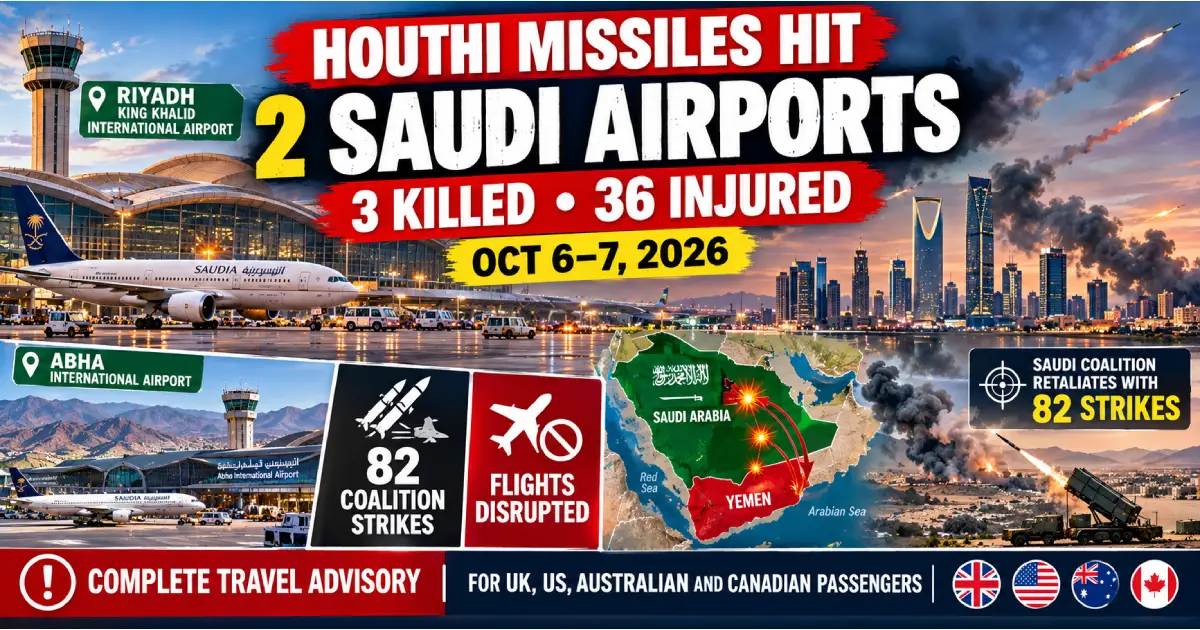
Houthi forces attacked two Saudi Arabian civilian airports in separate strikes within a 24-hour window — the most significant escalation targeting commercial aviation infrastructure since the conflict began on February 28, 2026. Abha International Airport was struck on October 6 by ballistic missiles and drones, killing two female residents and injuring 28 people. King Khalid International Airport in Riyadh was struck on October 7 — the Houthi military spokesperson claimed the strike was “precise and direct” and “caused air traffic to stop” at Riyadh. One person was killed and eight injured. Saudi Arabia’s General Authority of Civil Aviation has confirmed both attacks, total casualties of 3 dead and 36 injured, and material damage to both facilities. The Saudi-led coalition has retaliated with 82 military strikes targeting Houthi positions in Yemen. If you are booked to fly to, from, or through Saudi Arabia — this is the most important article you will read today.
Abha International Airport, located in the Asir region of southwestern Saudi Arabia near the Yemen border, was struck by Houthi ballistic missiles and drones on Tuesday October 6.
GACA said Abha International Airport and King Khalid International Airport in Riyadh were targeted in two separate attacks Tuesday and Wednesday, with emergency and relevant authorities responding to both incidents.
The attack on Abha International Airport on Tuesday killed two female residents, one Moroccan and one Algerian national, and wounded 28 others, including Saudi citizens as well as Bangladeshi and Filipino residents.
The Houthis claimed the Abha strike used ballistic missiles and drones and said it disrupted airport operations. Abha has been targeted multiple times since Houthi attacks began — on 13 July 2026, the airport was attacked by Houthi drones with no casualties reported — but October 6 produced the deadliest Abha strike of 2026.
Riyadh’s King Khalid International Airport — one of Saudi Arabia’s busiest hubs, handling international flights from Europe, Asia, North America and Australia — was struck on Wednesday October 7.
At King Khalid International Airport, a Sudanese national was killed and eight people were injured, including five Saudi, two Egyptian and a Pakistani national, the authority said.
The Houthi-controlled armed forces claimed responsibility for both attacks. The group said it had targeted King Khalid International Airport with a ballistic missile and claimed the strike disrupted air traffic in Riyadh.
The Houthi military spokesperson stated the Riyadh strike was “precise and direct” and that it “caused disruption of air traffic” at King Khalid International Airport. This claim — that air traffic was stopped — is the most operationally significant statement from either attack. Saudi GACA has confirmed material damage to both facilities but has not confirmed a complete operational suspension.
Houthi military spokesperson Brigadier General Yahya Saree said the group carried out “three qualitative military operations using a large number of ballistic and cruise missiles and drones.” According to Saree, the third operation targeted Abha Airport, Khamis Mushait Air Base and the Aqifa camp in Asir, as well as “other critical sites in Najran and Jizan.”
The Saudi-led coalition response was immediate and large-scale.
Saudi-led coalition forces claimed that they destroyed 82 military targets belonging to the Houthi militia in Yemen after the attacks on civilian facilities in Saudi Arabia. “The brutal attacks by the Terrorist Houthi Militia on civilians and civilian objects in the Kingdom, most recently targeting King Khalid International Airport in Riyadh and Abha International Airport, will not go unpunished,” Al-Maliki said.
The Saudi-led coalition also said it destroyed a ballistic missile launch platform used in the attack on Riyadh. The Gulf Cooperation Council Secretary-General Jassim Mohammed al-Budaiwi strongly condemned the Houthi attacks, describing them as “systematic crimes” targeting civilians.
The 82-strike retaliation is the largest single retaliatory operation Saudi Arabia has conducted since the 2026 conflict began. The scale of the response reflects the severity of targeting two commercial airports — civilian infrastructure protected under international humanitarian law — in a 24-hour window.
Abha International Airport serves the southwestern Asir region and operates domestic routes within Saudi Arabia plus limited international services. Saudia, flyadeal and flynas are the primary carriers operating from Abha.
The conflict flared up in July 2026, shortly after the US-Iran ceasefire unravelled, with Houthi missile attacks on Saudi oil facilities and tankers in an expansion of the Middle East war.
Abha has now been struck multiple times during 2026. Each attack creates a pattern of temporary operational suspension, damage assessment, and cautious resumption — typically within 24–48 hours for domestic services. However, international airlines that had been considering restoring Abha services are unlikely to advance those plans in the near term.
For passengers: If you hold a ticket to or from Abha (AHB) on any date in the coming weeks — contact your airline immediately. Do not travel to the airport without confirming your flight is operating. Check your government’s travel advisory (see Part 7 below) before any travel to the Asir region.
King Khalid International Airport is Saudi Arabia’s primary international gateway — the hub for Saudia’s long-haul network and a connecting point for dozens of international carriers. It handled over 40 million passengers in 2025.
The Houthi claim that air traffic was “caused to stop” at Riyadh on October 7 aligns with the disruption data already documented in TravelTourister’s Asia Aviation Chaos October 7 article — Riyadh King Khalid recorded 333 delays and 23 cancellations yesterday, the highest single-airport disruption count in Asia that day.
Saudi Arabia’s GACA has confirmed material damage at King Khalid but has not announced a full operational suspension. Saudia’s domestic and international services are expected to continue operating, though individual flight disruptions and precautionary holds are likely during active security incidents.
Airlines known to serve Riyadh (RUH) that may be affected:
| Airline | Route | Status |
|---|---|---|
| Saudia | All domestic + international hubs | Monitor saudia.com |
| flyadeal | Domestic Saudi network | Monitor flyadeal.com |
| flynas | Domestic + regional | Monitor flynas.com |
| British Airways | London Heathrow–Riyadh (resumes Nov 3) | Pre-launch — monitor ba.com |
| Lufthansa | Frankfurt–Riyadh (planned resumption) | On hold — contact Lufthansa |
| Turkish Airlines | Istanbul–Riyadh | Operating — monitor thy.com |
| Qatar Airways | Doha–Riyadh | Operating — monitor qatarairways.com |
| Emirates | Dubai–Riyadh | Operating — monitor emirates.com |
Saudi aviation authority says both Abha International Airport, near the Yemen border, and King Khalid International Airport in Riyadh have come under attack.
The significance of the October 6–7 attacks extends well beyond the immediate casualty figures. Two aspects make this the most serious aviation security event of the 2026 conflict:
1. The geographic escalation: Abha to Riyadh
Abha has been targeted repeatedly throughout the conflict — it sits less than 200km from the Yemen border and has historically been the closest major Saudi airport to Houthi launch positions. Its targeting, while serious, follows an established pattern.
King Khalid International Airport in Riyadh is different. Riyadh is Saudi Arabia’s capital and its largest city — located approximately 1,000km north of the Yemeni border. A successful strike on the capital’s international airport represents a significant extension of Houthi operational reach and targeting ambition. This is not a border strike. It is a strike on the nerve centre of Saudi Arabia’s international connectivity.
2. The “disruption of air traffic” claim
The Houthi spokesperson’s specific claim that the Riyadh strike “caused disruption of air traffic” is a deliberate message to international aviation: civilian airports are valid targets, and the disruption of commercial aviation is an explicit operational goal. That claim — whether fully accurate or partially exaggerated — will inform every airline’s risk assessment for Riyadh operations in the coming weeks.
Citizens should be aware of potential flight cancellations, airspace closures, and travel disruptions, advising them to check flight departure status directly with their airline and the airport.
Every government with citizens in Saudi Arabia has updated its travel posture since the 2026 conflict began. Here is the current advisory status from all four of your Tier-1 governments:
The FCDO advises against all travel to within 10km of the Saudi-Yemen border, including the southern parts of the Asir, Jizan and Najran regions. Abha sits in the Asir region — check the FCDO’s specific Abha guidance at gov.uk/foreign-travel-advice/saudi-arabia before any travel to this region. Riyadh is not subject to a blanket advisory but the FCDO notes that terrorist and Houthi attacks are an ongoing risk across Saudi Arabia.
Citizens should be aware of potential flight cancellations, airspace closures, and travel disruptions, advising citizens to check flight departure status directly with their airline and the airport. The State Department maintains a Level 2 advisory (Exercise Increased Caution) for Saudi Arabia overall and Level 4 (Do Not Travel) for areas near the Yemen border, which includes the broader Asir region around Abha.
Smartraveller advises Australians to reconsider their need to travel to Saudi Arabia due to the threat of Houthi missile and drone attacks. The Asir, Jizan, Najran and Tabuk regions carry a Do Not Travel advisory. Riyadh is Reconsider Your Need to Travel. Check smartraveller.gov.au for the latest.
Canada advises travellers to avoid non-essential travel to the UAE because of the volatile regional security situation. For Saudi Arabia specifically, Global Affairs Canada advises Canadians to avoid non-essential travel to areas near the Yemen border — including the Asir region — and to exercise a high degree of caution throughout the rest of Saudi Arabia including Riyadh.
The Houthi attacks on Saudi airports are security events outside any airline’s control. The passenger rights picture is nuanced:
| Situation | Your Rights |
|---|---|
| Airline cancels flight to Riyadh (RUH) or Abha (AHB) | Full cash refund to original payment OR free rebooking — your choice |
| Your government issues Do Not Travel advisory for your destination | Most travel insurance policies treat this as a valid cancellation trigger — check your policy |
| Flight operates but you choose not to fly | No automatic right to refund unless waiver issued — contact airline |
| UK261 — UK-departing flights cancelled | Full refund or rerouting; extraordinary circumstances likely limits cash compensation |
| US DOT — US-departing flights cancelled | Full cash refund to original payment — unconditional |
| APPR — Canadian-departing flights cancelled | Full refund or rebooking at no extra cost |
| Australian Consumer Law | Rebooking at no extra cost; refund if rerouting not acceptable |
Key rule: Extraordinary circumstances — which a Houthi missile attack on a civilian airport almost certainly qualifies as — removes an airline’s obligation to pay fixed cash compensation under EU261/UK261. It never removes your right to a full refund if the airline cancels your flight.
Travel insurance — critical points:
| Date | Target | Weapons | Casualties | Impact |
|---|---|---|---|---|
| Feb 28, 2026 | Multiple Saudi facilities | Missiles + drones | Not disclosed | 7 nations’ airspace closed; 1,800 flight cancellations |
| Mar 14, 2026 | Kuwait Airport radar | Drones | Not disclosed | Primary surveillance radar destroyed |
| Jul 13, 2026 | Abha Airport | Drones | None | No casualties; disruption reported |
| Jul 16, 2026 | Abha Airport (prior entry) | Missiles | Casualties previously reported | Major disruption — see TravelTourister July 16 article |
| Sept 19, 2026 | King Khalid Airport, Riyadh | Ballistic missile | — | Aramco fuel depot at Rabigh also hit |
| Oct 6, 2026 | Abha Airport | Ballistic missiles + drones | 2 killed, 28 injured | Most deadly Abha attack of 2026 |
| Oct 7, 2026 | King Khalid Airport, Riyadh | Ballistic missile | 1 killed, 8 injured | Air traffic claimed disrupted |
The October 6–7 combined casualty toll of 3 dead and 36 injured represents the highest single 24-hour aviation-related death toll in the 2026 conflict.
British Airways is planning to resume Riyadh services on November 3 — less than 4 weeks away. Yesterday’s King Khalid strike puts that resumption date under immediate review. Monitor ba.com for any announcement. UK travellers currently in Saudi Arabia should register with FCDO if not already done and follow local authority guidance. If your return flight is disrupted, UK261 entitles you to rebooking at no extra cost.
No US carrier operates direct Saudi Arabia services. US passengers flying via Doha, Dubai or Istanbul to reach Saudi Arabia are at risk of knock-on disruption if their Saudi destination airport faces operational suspension. Under US DOT rules, if a US carrier cancels your transatlantic flight due to the security situation, you are entitled to a full cash refund unconditionally.
Australians fly to Saudi Arabia primarily via Emirates (Dubai) and Qatar Airways (Doha). Both carriers are monitoring the situation. If you are transiting Dubai or Doha to reach Riyadh or Abha, your onward Saudi connection is at higher risk than your hub connection. Contact your airline about your specific Saudi Arabia sector.
Air Canada suspended Dubai flights until March 2027. Canadian passengers reaching Saudi Arabia typically route via Doha (Qatar Airways) or Istanbul (Turkish Airlines). Both carriers are operating Saudi routes — check their latest advisory pages before travel.
Posted By : Vinay
This article is provided for general informational purposes only and is based on information available at the time of publication. Travel advisories, airline schedules, airport operations, visa requirements, government regulations, and other travel-related information are subject to change without prior notice. While Travel Tourister makes reasonable efforts to verify information using official announcements, government publications, airline and airport communications, and other reliable sources, we cannot guarantee that all information remains complete, accurate, or up to date at all times. Readers should independently verify any information that may affect their travel plans with the relevant airline, airport authority, government agency, embassy, or other official source before making travel, financial, or other decisions. Travel Tourister shall not be liable for any direct or indirect loss, inconvenience, or damages arising from the use of or reliance on the information contained in this article. Nothing in this publication constitutes legal, immigration, financial, or professional travel advice. If you believe any information in this article is inaccurate or outdated, please contact our editorial team. We review all credible correction requests promptly and update our content whenever appropriate.
Lastest News
2nd Floor, 39, Above Kirti Club, DLF Industrial Area, Kirti Nagar, New Delhi, Delhi 110015



Travel Tourister is a leading Travel portal where we introduce travellers to trusted travel agents to make their journey hasselfree, memorable And happy. Travel Tourister is a platform where travellers get Tour packages ,Hotel packages deals through trusted travel companies And hoteliers who are working with us across the world. We always try to find new and more travel agents and hoteliers from every nook and corners across the world so that you could compare the deals with different travel agents and hoteliers and book your tour or hotel with the one you have chosen according to your taste and budget.
Copyright © Travel Tourister, India. All Rights Reserved

 Call
Call Enquiry