Published on : 11 Oct 2026
Published: October 11, 2026 — Sunday (CEO Quote: Friday October 9, CNBC · Third-Quarter Results Call · October 11: Passenger Terminal Blast at Riyadh · Sources: CNB
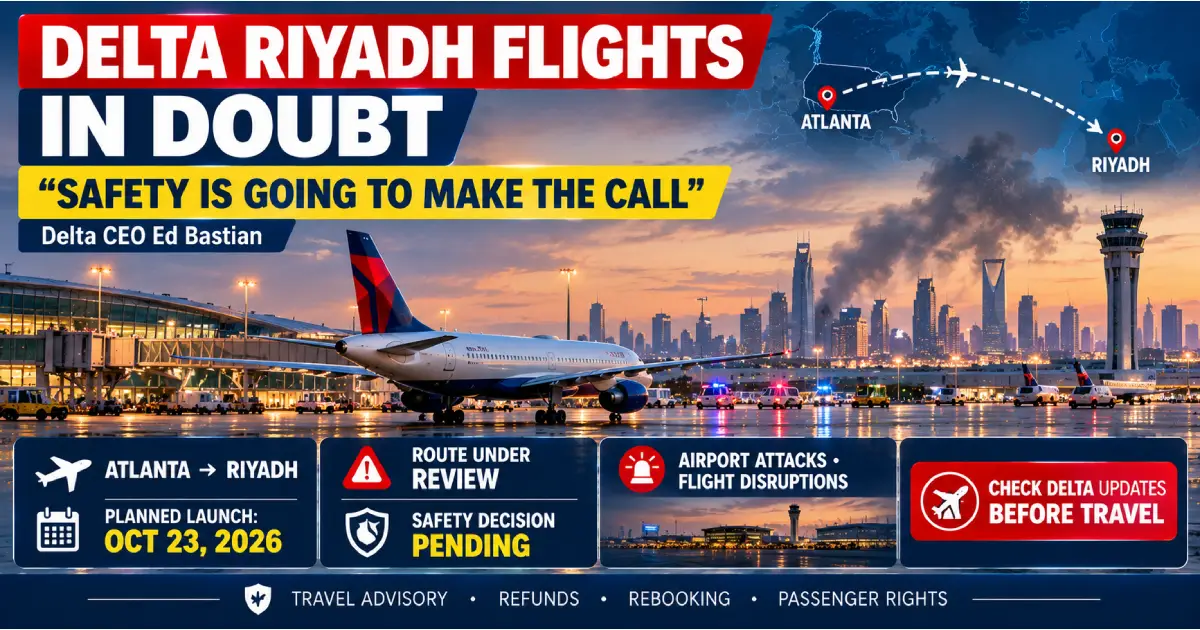
Delta Air Lines CEO Ed Bastian made the statement on Friday that aviation watchers have been quoting all weekend: “Safety is going to make the call.”
He was talking about the October 23 inaugural flight between Atlanta Hartsfield-Jackson Airport and Riyadh’s King Khalid International Airport — Delta’s most controversial route announcement of 2026, the first nonstop US airline service to Saudi Arabia’s capital, and the flight that is now in genuine jeopardy twelve days before it was supposed to depart.
The weekend has not made the situation easier. On Friday, Bastian admitted on CNBC during Delta’s third-quarter earnings call that the launch was no longer guaranteed, attributing the decision to the airline’s internal safety and security department. On Saturday October 11, a fresh attack struck Riyadh Airport — eyewitnesses reporting at least two explosions, one of which is believed to have struck a passenger terminal, leaving multiple people wounded. As of Sunday October 11, Delta has not announced any change to the October 23 launch date. But its CEO has said, on record, on national television, that safety will decide. And in the 72 hours since he said it, Riyadh Airport has been attacked again.
The contradiction at the heart of this story is not subtle. Delta is currently selling tickets on a route it has not confirmed will fly, on an aircraft its own corporate security team is warning employees to avoid, to a destination under a US State Department Level 3 — Reconsider Travel advisory, into an airport that has been attacked on four separate occasions in six days.
This is the complete account of what happened, what it means for passengers who have booked, what the October 23 flight actually is, and exactly what Delta is and is not obliged to do.
Published: October 11, 2026 CEO statement: Ed Bastian — Friday October 9, 2026 — CNBC interview during Q3 earnings call Exact quote: “Obviously, we were disappointed to see the news this week. Safety is going to make the call.” CNBC reporter: Leslie Josephs — October 9, 2026 Route: Atlanta Hartsfield-Jackson (ATL) → Riyadh King Khalid International (RUH) — nonstop Route distance: Approximately 9,695 km / 6,028 miles / 5,238 nautical miles Aircraft: Airbus A350-900 — Delta flagship widebody Cabin configuration: 40 Delta One suites · 40 Premium Select · 36 Delta Comfort+ · 159 Delta Main Cabin — 275 total seats Planned schedule:
Delta’s third-quarter earnings call on Friday October 9 is a routine event — an investor briefing where the CEO and CFO walk analysts through quarterly financial performance, answer questions about the business outlook, and provide forward guidance.
This one was not routine.
When CNBC’s Leslie Josephs asked Bastian directly whether Delta would proceed with the October 23 Atlanta–Riyadh launch in the wake of the Houthi attacks on King Khalid International Airport, the CEO said: “Obviously, we were disappointed to see the news this week. Safety is going to make the call.”
He added that the airline would let customers know of its decision soon.
This statement, made by a CEO during a public earnings call and reported by CNBC, does several things simultaneously.
It formally acknowledges that the launch is no longer certain — Bastian did not say “we remain committed to the October 23 date.” He said safety will decide. That is a conditional statement, not a commitment.
It delegates the decision to Delta’s internal safety and security department — a standard framing for airline CEOs when they want to depoliticise a commercially and diplomatically sensitive decision. By saying “safety is going to make the call,” Bastian is effectively saying: this will not be a commercial decision or a diplomatic one. It will be a security assessment. That assessment has not yet been made public.
It gives customers advance notice that a decision is coming without committing to a timeline. “We will let customers know of our decision soon” tells affected passengers to watch their email, but does not tell them when.
What Bastian did not say is equally significant. He did not say the route was cancelled. He did not say it was postponed. He did not say the October 23 date was still firmly intact. He said safety would decide. As of Sunday October 11, two days after that statement, no decision has been announced.
While Ed Bastian was telling CNBC that safety would make the call, Delta’s corporate security team had already made one.
Aviation watchdog JonNYC — whose tracking of aviation security alerts has a strong record of accuracy — confirmed that Delta issued an internal corporate security “active threat alert” to employees, advising against travel to Riyadh for the period October 8–12.
The alert is an internal corporate security document, not a public announcement. It applies to Delta employees — cabin crew, ground staff, corporate personnel — not to revenue passengers. Delta can issue such an alert without being legally required to inform the public or halt ticket sales for the same destination.
But the optics are stark. Delta’s corporate security department is telling the airline’s own staff not to go to Riyadh from October 8 through October 12. Delta’s route to Riyadh is scheduled to launch with passengers on October 23. The staff advisory expires October 12. The passenger flight departs October 23. That is an eleven-day gap between the two dates — eleven days in which the security situation would need to be assessed as sufficiently improved for Delta to feel comfortable putting a revenue aircraft and passengers into an airport that three attacks have struck in a single week.
The contrast is what makes this story distinctive. Delta has not told its customers what it has told its employees. Customers can see the booking page. The flights appear active. Tickets continue to be priced and sold. But Delta staff, reading the same intelligence picture, have been formally advised by the company’s own security infrastructure not to travel to the same place.
This is not unusual in aviation — airlines regularly issue internal security advisories that differ from their public-facing ticket availability — but it is rarely this visible, rarely this documented, and rarely this timed in proximity to an inaugural launch.
The security context that Bastian was responding to on Friday has worsened since he spoke.
The attack sequence at and around Saudi Arabia’s aviation infrastructure over the past week:
Tuesday October 6 — Abha International Airport: A Houthi missile or drone attack struck Abha Airport in southwestern Saudi Arabia, killing two women and injuring 28 others. Abha is a regional airport near the Yemeni border — a target Houthis have struck multiple times since 2019.
Wednesday October 7 — Riyadh King Khalid International Airport: Riyadh’s main international airport, which handles all international commercial aviation into the Saudi capital, was targeted for the first time in this escalation cycle.
Thursday October 8 — Riyadh King Khalid International Airport (second attack): A more serious strike on Riyadh Airport. A parked Saudia Airbus A320 was destroyed. Three people were killed, including a Saudia pilot. The airport was temporarily closed. Saudi Arabia’s civil aviation authority confirmed the attack and the casualties. The Houthis claimed responsibility.
Saturday October 11 — Riyadh Airport (third Riyadh attack): Eyewitnesses reported at least two explosions at Riyadh Airport, with at least one believed to have struck a passenger terminal, leaving multiple people wounded. Saudi authorities have not officially confirmed all details at time of publication. This attack occurred the day after Bastian’s CNBC statement and the day before this article was published.
The pattern is escalation, not de-escalation. Three attacks on Riyadh Airport in five days. The Houthis have publicly stated an intention to continue targeting Saudi aviation infrastructure as long as the coalition operations in Yemen continue. Saudi Arabia’s civil aviation authority issued statements after each attack but has not closed King Khalid International Airport for commercial operations — the airport is attempting to operate normally between incidents.
For Delta’s safety assessment team, the question is not whether there has been an attack. There have been three. The question is whether the security environment on October 23 — twelve days from today — can be assessed as safe enough for a commercial aircraft with 275 passengers to operate into King Khalid International Airport.
For readers unfamiliar with the route itself, context helps explain why Delta chose this destination and why the launch has always been commercially complex.
Delta announced the Atlanta–Riyadh nonstop in August 2026, billing it as a historic first — no US airline has ever operated a nonstop scheduled service between the United States and Riyadh. American Airlines operates a US-Saudi route, but to Jeddah, not Riyadh. United Airlines serves Riyadh, but via connections. Delta’s October 23 service would be genuinely unprecedented in US aviation history — the first direct link between a US hub and the Saudi capital.
The aircraft is Delta’s flagship Airbus A350-900, configured with 275 seats across four cabins: 40 Delta One suites in business class, 40 Premium Select in premium economy, 36 Delta Comfort+ in enhanced economy, and 159 seats in Delta Main Cabin. At approximately 9,695 kilometres, the ATL–RUH route would rank among the longest in Delta’s network.
The commercial logic is Saudi Vision 2030 — the Kingdom’s ambitious multi-trillion-dollar economic transformation programme that is generating significant US-Saudi business travel, corporate investment flows, and eventually tourism as the country opens to international visitors. Delta’s bet is that the business travel market between Atlanta (and the wider eastern United States feeding through Atlanta) and Riyadh justifies the operation.
Two commercial challenges existed even before the attacks arrived.
The first: demand has been below expectations. Simple Flying reported in August that Delta had been offering steep discounts on Atlanta–Riyadh fares due to lower-than-expected ticket sales. The route’s commercial case is not yet proven in the ticket market. Delta acknowledged this in its August 2026 reporting cycle.
The second: codeshares and interlining agreements with Riyadh Air and Saudi carriers are not yet in place. Without those agreements, a passenger flying Delta from Atlanta to Riyadh cannot connect seamlessly on Riyadh Air or Saudia to onward Saudi domestic destinations or the wider Riyadh Air international network. They must book two separate itineraries. This limits the route’s attractiveness to travellers who need Riyadh as a final destination only — not as a connecting hub — a smaller market than the broader Saudi connectivity play Delta envisioned.
As of Sunday October 11, four outcomes remain possible.
Scenario 1 — Delta proceeds on October 23 as planned:
The security situation stabilises over the next twelve days. Delta’s internal security assessment concludes that King Khalid International Airport is safe for commercial operations. The inaugural Atlanta–Riyadh flight departs on schedule. This scenario requires no further Houthi attacks on Riyadh Airport and a positive assessment from Delta’s security and intelligence team.
Scenario 2 — Delta postpones the October 23 launch to a later date:
Delta announces a postponement — citing safety — and resets the launch for a later date, possibly after January 2027. This is the most commercially face-saving option and allows Delta to maintain the route without either cancelling it entirely or proceeding into a demonstrably unsafe situation. Passengers with October bookings are offered full refunds or rebooking. The route remains part of Delta’s announced network.
Scenario 3 — Delta suspends the route indefinitely:
Delta announces that the October 23 launch is cancelled and that the route’s future is under review, with no specific restart date. This is the clearest acknowledgement that the security environment has made the route unviable in its current form. Full refunds are issued. Delta retains the option to relaunch when conditions permit.
Scenario 4 — Delta launches then suspends:
Delta proceeds on October 23, completes its first week of daily operations, then suspends from October 30 when the frequency was due to drop to three weekly flights anyway. This allows Delta to claim the historic first, complete the launch, and then step back from active operations without formally cancelling. This scenario requires the security situation to be assessed as manageable for the first week.
As of the time of writing, Bastian’s “safety is going to make the call” positions Delta most naturally toward Scenario 2 or 3. A CEO who says that publicly is not setting up his airline to proceed without a clear positive security assessment.
If you have booked a Delta flight on the Atlanta–Riyadh route — whether on October 23 or any subsequent date — here is exactly what you need to know.
If Delta cancels or postpones the launch:
Your DOT refund right is absolute. If Delta cancels your specific flight, you are entitled to a full cash refund to your original payment method — credit card, bank account, or however you paid. Delta cannot offer only a travel credit or eCredit without your consent. You must actively request the cash refund rather than accepting the default rebooking option.
The refund timeline under the DOT’s 2024 Automatic Refund Rule is seven business days for credit card payments, twenty business days for other payment methods.
If Delta does NOT cancel and you want to change your plans due to safety concerns:
If Delta does not formally cancel or postpone the October 23 flight and you decide you no longer wish to travel to Riyadh for safety reasons, the standard ticket fare rules apply to any change you initiate. A refundable fare gives you back your money; a non-refundable fare does not. Delta may issue a voluntary change waiver given the circumstances — the same mechanism it uses during hurricanes and major disruptions — but it is not obligated to unless it formally postpones the route.
If Delta issues a travel waiver for the route:
Monitor delta.com → My Trips for any active travel waiver for ATL–RUH. A waiver would allow you to change your booking to an alternative date or destination at no charge or fee. Check the specific waiver terms — some waivers allow date changes only, others allow full refunds.
The practical step to take right now:
Log into delta.com → My Trips and check the status of your ATL–RUH booking. If a cancellation notice or travel waiver is active, the system will show it before you see any email. The email notification typically follows the system update by several hours during mass disruptions.
The Delta Riyadh story is not just a route announcement in jeopardy. It is a case study in the intersection of commercial ambition, geopolitical risk, and airline decision-making in 2026’s Middle East security environment.
Delta’s route was announced at a moment when Saudi Arabia was actively courting US airline investment as part of Vision 2030’s tourism and connectivity agenda. The diplomatic moment — a Saudi government wanting direct US connections, a US airline wanting a Saudi market — aligned. The security environment of October 2026, driven by the Houthi escalation campaign that has specifically targeted Saudi aviation infrastructure, has disrupted that alignment.
The airlines that suspended Riyadh service fastest — Lufthansa Group, Air France, and British Airways (which had already reduced Dubai and Riyadh services earlier in the year) — were working with established safety protocols and experience in assessing conflict-zone risk. Delta, as a carrier entering the route for the first time with no existing Saudi operational footprint, faces the assessment challenge without the institutional knowledge that those airlines have built over decades.
The “safety is going to make the call” framing is, in one sense, the right framework. Airline safety departments exist precisely for this kind of decision — to make a professional assessment independent of commercial pressure, diplomatic considerations, or sunk cost psychology. Delta’s security team will look at the pattern of attacks, assess the probability of another strike in the October 23–30 window, consult with US government intelligence sources and Saudi civil aviation authorities, and make a recommendation.
Whether that recommendation is “go” or “no-go” is the story that has not yet broken. When it does — watch this space.
| Resource | Website | What For |
|---|---|---|
| Delta — manage booking | delta.com → My Trips | Check ATL–RUH booking status + waiver |
| Delta refund request | delta.com/refund | Request cash refund if cancelled |
| Delta customer service | 1-800-221-1212 | ATL–RUH route enquiries |
| Delta Riyadh route page | delta.com | Route information |
| CNBC original interview | cnbc.com/ed-bastian | Full Ed Bastian interview |
| US State Dept — Saudi advisory | travel.state.gov | Level 3 Reconsider Travel |
| UK FCDO — Saudi advisory | gov.uk/foreign-travel-advice/saudi-arabia | Current FCDO advisory |
| DFAT Australia — Saudi advisory | smartraveller.gov.au | Exercise High Degree of Caution |
| DOT refund rules | transportation.gov/airconsumer | Cash refund rights — cancelled flights |
Related Articles:
Posted By : Vinay
This article is provided for general informational purposes only and is based on information available at the time of publication. Travel advisories, airline schedules, airport operations, visa requirements, government regulations, and other travel-related information are subject to change without prior notice. While Travel Tourister makes reasonable efforts to verify information using official announcements, government publications, airline and airport communications, and other reliable sources, we cannot guarantee that all information remains complete, accurate, or up to date at all times. Readers should independently verify any information that may affect their travel plans with the relevant airline, airport authority, government agency, embassy, or other official source before making travel, financial, or other decisions. Travel Tourister shall not be liable for any direct or indirect loss, inconvenience, or damages arising from the use of or reliance on the information contained in this article. Nothing in this publication constitutes legal, immigration, financial, or professional travel advice. If you believe any information in this article is inaccurate or outdated, please contact our editorial team. We review all credible correction requests promptly and update our content whenever appropriate.
Lastest News
2nd Floor, 39, Above Kirti Club, DLF Industrial Area, Kirti Nagar, New Delhi, Delhi 110015



Travel Tourister is a leading Travel portal where we introduce travellers to trusted travel agents to make their journey hasselfree, memorable And happy. Travel Tourister is a platform where travellers get Tour packages ,Hotel packages deals through trusted travel companies And hoteliers who are working with us across the world. We always try to find new and more travel agents and hoteliers from every nook and corners across the world so that you could compare the deals with different travel agents and hoteliers and book your tour or hotel with the one you have chosen according to your taste and budget.
Copyright © Travel Tourister, India. All Rights Reserved

 Call
Call Enquiry