Published on : 13 Oct 2026
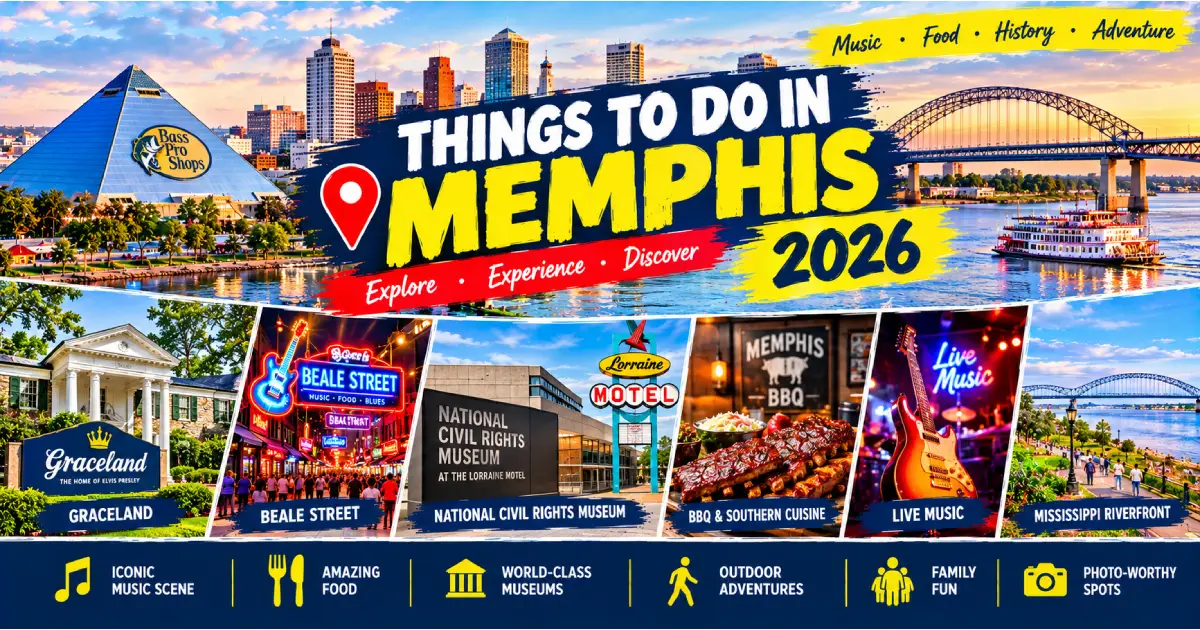
Memphis is one of America’s most soulful cities — a place where the music, the food, the history, and the Mississippi River combine into an experience unlike any other in the United States. This is the city where Elvis Presley walked into Sun Studio and changed the course of popular music; where Beale Street gave birth to the blues and nurtured the careers of B.B. King, Muddy Waters, and W.C. Handy; where the Lorraine Motel, now the National Civil Rights Museum, marks the spot where Dr. Martin Luther King Jr. was assassinated on April 4, 1968. Memphis carries the weight of American history — its music, its racial struggles, its poverty and its genius — more openly than almost any other city, and that honesty is both its challenge and its profound appeal.
The city sits on a bluff above the Mississippi River in the southwestern corner of Tennessee, at the crossroads of cultures that flowed north from the Mississippi Delta, west from Appalachia, and east from the Texas plains. The music that emerged from this convergence — the blues, rock and roll, soul, and gospel — is the soundtrack of the 20th century. Sun Studio, which opened in 1950, recorded not only Elvis but Johnny Cash, Jerry Lee Lewis, Roy Orbison, and Howlin’ Wolf in a single decade that produced more paradigm-shifting music per square foot than any other address in American history. Stax Records, in the South Memphis neighborhood, created the Memphis Sound — a raw, unpolished soul music that produced Otis Redding, Isaac Hayes, and Booker T. & the M.G.’s.
Beyond the music, Memphis offers world-class BBQ (the dry-rub rib tradition here is fundamentally different from Kansas City or Texas, and the arguments about whose ribs are best are conducted with genuine passion), the Mississippi River waterfront, the extraordinary Memphis Brooks Museum of Art, and a neighborhood called Cooper-Young that has developed one of the most vibrant independent restaurant and bar scenes in the mid-South. This guide covers everything worth doing in Memphis in 2026 — from the iconic to the deeply local.
| Category | Top Pick | Neighborhood |
|---|---|---|
| Best Music Experience | Sun Studio | Midtown |
| Best Museum | National Civil Rights Museum | Downtown |
| Best Live Music | Beale Street Entertainment District | Downtown |
| Best BBQ | Charlie Vergo’s Rendezvous | Downtown |
| Best Elvis Experience | Graceland | Whitehaven |
| Best Free Museum | Stax Museum of American Soul Music | South Memphis |
| Best Neighborhood | Cooper-Young | Midtown |
| Best River Experience | Mud Island River Park | Downtown |
| Best Art | Memphis Brooks Museum of Art | Midtown |
| Best Family Activity | Memphis Zoo | Midtown |
Elvis Presley’s home — the most visited house in America after the White House
Graceland is the most important pop culture pilgrimage site in the United States — the home where Elvis Presley lived from 1957 until his death on August 16, 1977, preserved almost exactly as he left it, drawing over 600,000 visitors annually from every country on earth. The 17-room Colonial Revival mansion in the Whitehaven neighborhood of south Memphis has been designated a National Historic Landmark, and the experience of walking through the rooms where Elvis lived, entertained, and died is genuinely moving regardless of your feelings about his music.
The house tour takes you through the living room (mirrored ceiling, white shag carpet, yellow and black color scheme that Elvis chose himself), the jungle room (a Polynesian-themed den that Elvis reportedly had furnished in a single afternoon), the trophy building (three Gold Records Grammy awards, Vegas jumpsuits), and the racquetball building where Elvis played his last game the night before he died. Elvis’s grave, in the Meditation Garden on the property, is visited by thousands daily; the guard changes every hour to prevent visitors leaving gifts on the grave.
The complex has expanded significantly in recent years — the Elvis Presley’s Memphis entertainment complex across the street includes the Graceland Exhibition Center (cars, motorcycles, Lisa Marie airplane), multiple restaurants, and the Guest House at Graceland hotel. Allow at least 3–4 hours for the full experience; the self-guided audio tour of the house itself takes 90 minutes.
The most important history museum in the American South
The National Civil Rights Museum occupies the former Lorraine Motel at 450 Mulberry Street in downtown Memphis — the site where Dr. Martin Luther King Jr. was assassinated on April 4, 1968. Room 306, where King was staying, is preserved exactly as it was that day, visible through a glass window from the museum’s exterior walkway. The museum has expanded to incorporate the building across the street (the former rooming house from which James Earl Ray fired the fatal shot), creating a dual-building complex that is one of the most powerful history museum experiences in the United States.
The permanent collection traces the full arc of the American civil rights movement — from the origins of slavery through Reconstruction, Jim Crow, the NAACP, the Montgomery Bus Boycott, the Little Rock Nine, the sit-in movements, Freedom Riders, Birmingham, Selma, and finally to Memphis and the sanitation workers’ strike of 1968 that brought Dr. King to the city. The exhibits are extensive, expertly curated, and emotionally demanding; many visitors require time outside to process what they’ve seen. Allow 3–4 hours minimum; rushing through diminishes the experience profoundly.
The museum’s location in Memphis is not incidental — the city where King was killed has invested more than any other American city in grappling honestly with the history of racial violence and injustice. The National Civil Rights Museum is the result of that investment, and it stands as one of the finest cultural institutions in the South.
The birthplace of rock and roll — the most important small room in music history
Sun Studio at 706 Union Avenue is the most historically significant recording studio in the world — the 18 x 30-foot room where Sam Phillips recorded Elvis Presley’s first commercial single (“That’s All Right,” July 1954), Johnny Cash’s “I Walk the Line,” Jerry Lee Lewis’s “Great Balls of Fire,” Roy Orbison’s first recordings, Carl Perkins’s “Blue Suede Shoes,” and Howlin’ Wolf, B.B. King, Ike Turner, and virtually every significant figure in early rock and roll and electric blues.
The studio is still a working recording facility — U2, Bonnie Raitt, and many others have recorded here in recent decades — which means the tours run only when the studio isn’t booked. Tours depart hourly and take approximately 45 minutes; they cover the history of Sun Records, Sam Phillips’s role in American music, and the stories behind the legendary recordings. The original equipment (microphones, ceiling tiles, the acoustic panels) is largely preserved, and standing in the room where “That’s All Right” was recorded while the guide plays the original acetate is a genuine frisson.
The gift shop is worth time — Sun Studio branded merchandise, vinyl reissues, and music books that are well-curated and genuinely interesting rather than the standard tourist tat.
The home of the blues — America’s most music-soaked street
Beale Street is a three-block entertainment district in downtown Memphis that has been associated with the blues since the late 19th century — a street where W.C. Handy, the “Father of the Blues,” wrote some of the first published blues compositions in 1909, and where B.B. King launched his career playing for tips outside the clubs in the 1940s. Today it’s a pedestrian entertainment strip of live music venues, bars, restaurants, and souvenir shops that runs nightly and constitutes the most concentrated blues music experience available anywhere in the world.
The music on Beale Street is live, loud, and continuous — multiple venues on the same block competing for your attention simultaneously, with bands often playing until 3am. B.B. King’s Blues Club (named for the legend himself) is the largest and most famous venue; Blues City Café serves excellent BBQ alongside live music; the New Daisy Theatre presents concerts by established acts. The quality of the music varies considerably — some nights feature genuine blues masters; other nights bring competent cover bands working the tourist trade. Regardless of the quality, the atmosphere of Beale Street on a Friday or Saturday night — the neon signs, the smell of BBQ smoke drifting from the restaurants, the competing sounds of different bands mixing in the open air — is something no American city can replicate.
The street has a cover charge system on busy nights (typically $5–$10 to enter certain blocks after 10pm) and open container laws that allow drinks purchased inside licensed premises to be carried outside in plastic cups — a Memphis tradition that contributes significantly to the street’s party atmosphere.
The dry-rub rib capital of America
Memphis BBQ is a distinct tradition — slower-smoked, dry-rubbed with a spice blend rather than sauced, and served with sauce on the side as an afterthought rather than a defining ingredient. The city’s BBQ culture is as deep and contentious as Kansas City’s, with passionate arguments about whose ribs are definitive and a competitive circuit that culminates in the World Championship Barbecue Cooking Contest every May (the largest BBQ competition in the world, with 250+ teams cooking on Tom Lee Park).
Charlie Vergo’s Rendezvous is the most famous Memphis BBQ restaurant in the world — a basement establishment under an alley off Monroe Avenue in downtown Memphis that has been serving its signature dry-rub ribs since 1948. The ribs are cooked over charcoal (not wood smoke — a deliberate difference from most BBQ traditions), seasoned with the Rendezvous proprietary spice blend, and served with a thin tomato-based sauce that functions as a condiment rather than a coating. The atmosphere is deliberately unchanged — red-checked tablecloths, vintage sports photos, Charlie Vergos’s son Nick running the operation with the same formula his father established.
Central BBQ (multiple locations) is the best everyday Memphis BBQ — more consistent, more accessible, and serving excellent pulled pork, brisket, and ribs with a slightly less reverential atmosphere than the Rendezvous.
Cozy Corner on North Parkway is beloved by serious BBQ enthusiasts for the Cornish hen (an unusual BBQ item, cooked low and slow until falling apart) and the bologna sandwich — fried Bologna on white bread with mustard, an unlikely masterpiece.
The definitive museum of American soul — free and extraordinary
The Stax Museum of American Soul Music in South Memphis stands on the site of the original Stax Records studio — the converted movie theater where Otis Redding, Isaac Hayes, Sam & Dave, Booker T. & the M.G.’s, and the Staple Singers recorded in the 1960s and early 1970s. The museum, opened in 2003 after the original studio was demolished in 1989, is a world-class celebration of the Memphis Sound and one of the most compelling music museums in America.
The collection includes Isaac Hayes’s gold-trimmed, fur-covered 1972 Cadillac El Dorado (a vehicle so extraordinary it achieves the quality of art), the actual stage from the original Stax theater, Otis Redding’s original stage clothes, the complete recreation of the Stax recording studio, and an interactive Rhythm Room where visitors can play the instruments used on classic recordings. The museum’s permanent exhibition is excellent — contextualizing the music within Memphis’s racial history and the broader civil rights moment — and the gift shop has the best soul music vinyl selection in the city.
Entry is remarkably affordable, and the museum is rarely as crowded as it deserves to be. Combine with a visit to the adjacent Soulsville neighborhood, where the Stax Music Academy continues the tradition of music education that the original label supported.
The South’s oldest and largest art museum
The Memphis Brooks Museum of Art in Overton Park is the oldest and largest art museum in Tennessee — a distinguished institution with a permanent collection of over 10,000 objects spanning 5,000 years of art history. Founded in 1916 and housed in a beautifully designed Neoclassical building that was expanded in the 1950s and renovated extensively in the 2010s, Brooks offers the kind of encyclopedic collection that rewards multiple visits.
The Italian Renaissance collection is the strongest in the mid-South; the decorative arts galleries (English silver, American furniture, Tiffany glass) are exceptional; and the contemporary American gallery includes significant works by artists with Memphis connections. The museum’s outdoor sculpture garden in Overton Park — featuring rotating installations on the lawn outside the building — is a pleasant addition in warm weather. Admission is free on the second Sunday of each month, drawing families from across the city.
The Mississippi River’s story — told on a scale model you can walk
Mud Island River Park is one of Memphis’s most unusual and underrated attractions — a peninsula jutting into the Mississippi River from downtown that houses the Memphis River Museum and, most remarkably, the River Walk: a five-block-long scale model of the entire lower Mississippi River (from Cairo, Illinois, to the Gulf of Mexico) embedded in the walkway, with the river’s meanders, tributaries, and major cities marked at your feet. Walking the River Walk, stepping across the Arkansas border, passing Vicksburg and Natchez, and finally wading into the Gulf of Mexico (a small pool at the model’s terminus) is a genuinely pleasurable and educational experience unlike anything else in the city.
The Memphis River Museum inside the park covers the history of the Mississippi and the steamboat era with excellent exhibits; the WWII Memphis Belle B-17 bomber (restored and displayed in a dedicated pavilion) is a highlight. The island is accessible by monorail from downtown (included with admission) or on foot via a pedestrian bridge. The park is quieter than most major Memphis attractions and excellent for families.
One of America’s top-ranked zoos — two giant pandas and much more
The Memphis Zoo in Overton Park is consistently ranked among the top ten zoos in the United States — a 70-acre facility housing over 3,500 animals from 500 species, including a pair of giant pandas (Ya Ya and Le Le, on loan from China) that are the primary draw for many visitors. The giant panda exhibit, opened in 2003, has made the Memphis Zoo one of only a few US zoos to house these extraordinary animals.
Beyond the pandas, the zoo’s African Veldt exhibit (white rhinos, hippos, pygmy hippos, and meerkats in naturalistic settings), the Northwest Passage (polar bears and sea lions with underwater viewing), and the Sea Lion Show (included with admission) are all excellent. The zoo occupies the eastern portion of Overton Park, a historic urban greenspace that also contains the Brooks Museum and the Old Forest — one of the last stands of old-growth forest in an American urban park.
Memphis’s most vibrant creative district
Cooper-Young is the intersection of Cooper Street and Young Avenue in Midtown Memphis — and the name for the broader neighborhood that has become the city’s most interesting creative district over the past two decades. The neighborhood is anchored by independent restaurants, bars, galleries, vintage shops, and the Young Avenue Deli (a beloved music venue), concentrated in a walkable eight-block area that draws a mix of artists, students, young professionals, and visitors who discover it through word of mouth.
The Saturday morning Cooper-Young Community Farmers Market is one of Memphis’s best — fresh produce from regional farms, local honey, artisan food products, and a community atmosphere that reflects the neighborhood’s genuinely inclusive character. The Cooper-Young Festival (held annually in September) is one of the largest neighborhood arts festivals in the mid-South, drawing over 100,000 visitors for two days of music, art, and food. Walking Cooper and Young Avenues on a Saturday afternoon — stopping for coffee at a neighborhood café, browsing vintage shops, and finishing with dinner at one of the area’s excellent restaurants — is one of Memphis’s finest experiences.
The Smithsonian’s guide to the music that changed the world
The Memphis Rock ‘n’ Soul Museum, adjacent to FedExForum arena in downtown Memphis, is a Smithsonian Institution-affiliated museum dedicated to the social and musical history that produced Memphis’s defining contribution to American culture. The permanent exhibition traces the origins of soul and rock and roll through Memphis’s unique convergence of African American blues and gospel traditions with white country and rockabilly — documenting how economic desperation and racial segregation paradoxically created the conditions for the most important musical innovations of the 20th century.
The museum’s 7,000-square-foot exhibition features rare instruments, original stage costumes, recording equipment, and documentary photographs from the collections of the Smithsonian and private donors. The audio tour (included with admission) contains 100 songs and is the most comprehensive musical education available in Memphis — listen to the original recordings as you move through the exhibits that contextualize them. Allow 2 hours; the audio tour is genuinely essential.
Memphis’s greatest urban green space — park, zoo, forest, and art museum
Overton Park is 342 acres of historic parkland in Midtown Memphis that houses the Memphis Zoo, the Memphis Brooks Museum of Art, and one of the last stands of old-growth urban forest in the United States — the Old Forest, 126 acres of mature hardwoods (oaks, tulip poplars, dogwoods) that survived a 1960s-era highway project after one of the first successful urban conservation campaigns in American history (the Supreme Court case Overton Park v. Volpe, 1971, is still taught in law schools as a landmark environmental law case).
The Old Forest trails — approximately 2 miles of unpaved paths through genuine old-growth forest in the middle of a major American city — are one of Memphis’s most extraordinary free experiences. In spring (April–May), the dogwood and redbud blooming under the forest canopy is spectacular; in summer, the old-growth canopy provides shade and birdsong that feels utterly removed from the urban environment. The Levitt Shell amphitheater in the park, a WPA-era bandshell where Elvis Presley performed his first concert in 1954, presents free concerts throughout the summer.
The Father of Waters — Memphis’s defining geographic presence
Memphis sits on a bluff above the Mississippi River — the largest river in North America, the defining geographic and cultural force of the mid-South, and a presence that shaped the city’s history as a cotton market, a slave trading center, and a crossroads of American movement and culture. The waterfront offers several excellent experiences that range from the contemplative to the genuinely dramatic.
Tom Lee Park — a long, narrow green space along the river bluff — is Memphis’s most popular outdoor venue, hosting the World Championship BBQ Cooking Contest in May and serving as a general gathering place throughout the year. The Memphis riverboats (BB King’s Big River Blues cruise and the American Queen Steamboat) offer Mississippi River excursions from the dock below Tom Lee Park; the BBQ cruise ($35–$50) combines river views with live music and good food.
The river itself, viewed from the bluff at Tom Lee Park or from the Hernando de Soto Bridge (the “M” bridge visible from the waterfront) at sunset, is genuinely impressive — wide, brown, and powerful in a way that makes the Mississippi’s historical importance immediately tangible.
The South’s best urban farmers market — every Saturday downtown
The Memphis Farmers Market at Central Station in downtown Memphis is one of the finest urban farmers markets in the South — a Saturday morning institution drawing over 50 vendors of produce, artisan foods, prepared foods, crafts, and locally made goods to the train station plaza from April through October. The market reflects Memphis’s position at the agricultural crossroads of the mid-South: exceptional produce from Tennessee and Mississippi farms, extraordinary hot tamales (a Delta tradition), fresh catfish, Southern-grown sweet potatoes, and a prepared food section featuring almost every cuisine represented in Memphis’s diverse population.
The market is also an excellent entry point into Memphis’s community life — the mix of Memphians doing their Saturday shopping, the live music that often accompanies the market, and the conversations with farmers and food producers that are available if you’re willing to engage give a picture of the city that no museum or historic site can provide.
Where the Father of the Blues lived — a tiny Memphis gem
The W.C. Handy House Museum in the Beale Street neighborhood preserves the shotgun house where William Christopher Handy — the composer who first transcribed and published blues music, earning the title “Father of the Blues” — lived from 1905 to 1918, the period during which he wrote “Memphis Blues” (1912), “St. Louis Blues” (1914), and “Beale Street Blues” (1916). The tiny house has been restored to its early 20th-century condition and filled with Handy’s personal effects, original sheet music, and photographs.
The museum is small and the tour takes only 30–45 minutes, but the intimacy of the space — standing in the room where Handy composed music that shaped the entire 20th century — is genuinely powerful. The context it provides for understanding Beale Street and Memphis’s musical legacy makes it an ideal starting point before walking the entertainment district.
Sunday morning gospel with the Reverend Al Green
The Reverend Al Green — the soul legend behind “Let’s Stay Together,” “Tired of Being Alone,” and “Love and Happiness” — has been the pastor of Full Gospel Tabernacle Church in Whitehaven since 1976, when he converted to Christianity and largely stepped away from secular music. Sunday morning services at the church, which Green still leads regularly, are one of the most extraordinary musical experiences available in Memphis — a genuine church service (not a tourist performance) where the congregation sings with the intensity and beauty that produced the greatest soul music in American history.
Visitors are welcome at Sunday morning services (typically 11am), with the understanding that they are attending a religious service, not a concert. Dress respectfully; participate or observe quietly; do not photograph without permission. When Al Green himself is present and singing, the experience is genuinely transcendent.
The largest BBQ competition in the world — every May
The World Championship Barbecue Cooking Contest, held at Tom Lee Park on the Mississippi River every May, is the largest BBQ competition on earth — 250+ teams from across the United States and several foreign countries competing over three days in whole hog, shoulder, and rib categories, with the smell of wood smoke covering the entire downtown area. For BBQ enthusiasts, it is an unmissable event; even for non-specialists, the atmosphere of 100,000 visitors, elaborate team pavilions, and competitive cooking at this scale is a genuinely American spectacle.
Memphis in May is actually a month-long festival that includes the BBQ contest as its headline event, alongside the Beale Street Music Festival (one of the finest music festivals in the mid-South, featuring national acts across multiple stages on the riverfront in the first weekend of May) and the Memphis International Film Festival. Planning a May visit around these events requires advance booking — hotels fill months ahead for BBQ contest weekend.
One of America’s largest urban parks — 4,500 acres of trails and lakes
Shelby Farms Park is a 4,500-acre urban park east of Memphis that is one of the largest urban parks in the United States — more than five times the size of New York’s Central Park. The park was converted from a former working farm and prison farm to public greenspace and has been progressively developed since the 1970s into a comprehensive outdoor recreation destination: paved trails, mountain bike trails, equestrian paths, multiple lakes (fishing, paddleboarding, kayaking), a buffalo herd, and the Shelby Farms Greenline (a 10.6-mile paved trail connecting the park to Midtown Memphis).
The Shelby Farms Greenline is the best cycling experience in Memphis — a flat, shaded, car-free trail that connects the park to Cooper-Young and continues into Midtown. Bike rentals are available at the park entrance. The lakes offer paddleboard and kayak rentals in warm months; the Children’s Activity Farm is excellent for families. On weekends the park draws thousands of Memphians for exercise, picnicking, and outdoor recreation.
92 acres of themed gardens in East Memphis
The Memphis Botanic Garden in East Memphis (adjacent to Audubon Park) covers 92 acres of beautifully maintained themed gardens — the Japanese Garden of Tranquility, the My Big Backyard Children’s Garden, the Sensory Garden, rose gardens, a wetlands boardwalk, and seasonal wildflower meadows. The facility is far less visited than the Brooks Museum or the Zoo but equally rewarding for visitors who enjoy botanical gardens and outdoor walking.
The Japanese Garden, designed with traditional elements including a tea house, a moon bridge, and carefully composed plantings of Japanese maple and azalea, is the finest single garden section and beautiful in every season. The spring azalea season (typically late March–April) transforms the garden into a spectacular display of pink and white that draws local photographers from across the city.
The most beautiful cemetery in the South — 80 acres of history
Elmwood Cemetery, established in 1852 as Memphis’s first rural cemetery, is one of the finest historic cemeteries in the United States — an 80-acre landscape of Victorian funerary architecture, ancient oaks, and remarkable graves that tells the complete story of Memphis across 170 years. The cemetery contains the graves of 72,000 Memphians, including 1,500 yellow fever victims of the 1878 epidemic that killed 5,000 people and nearly destroyed the city, Confederate and Union soldiers, African American sharecroppers and domestic workers, and the wealthiest families of the Memphis cotton aristocracy.
The guided tours offered by the Elmwood Cemetery Foundation are exceptional — the stories of the people buried here illuminate Memphis’s history more vividly than any museum exhibit. The cemetery is also a genuine wildlife haven; the old-growth trees support nesting owls and a resident population of deer. Self-guided tours (maps available at the entrance gate) are offered daily; guided tours require advance registration.
Minor league baseball in one of America’s finest small parks
AutoZone Park in downtown Memphis is the home of the Memphis Redbirds, the Triple-A affiliate of the St. Louis Cardinals — and one of the most acclaimed minor league baseball parks in America. The park, opened in 2000, seats 10,000 and features excellent sightlines, a beautiful downtown setting adjacent to the FedExForum and the Beale Street entertainment district, and the intimate atmosphere that makes minor league baseball one of the finest casual entertainment experiences in American cities.
Memphis Redbirds games are affordable ($10–$25), extremely family-friendly, and offer a quality of baseball (Triple-A, one step below the major leagues) that is genuinely exciting to watch. The park’s downtown location means dinner on Beale Street before a game and drinks after constitute a complete evening. The Redbirds’ season runs April–September; playoff games (if the team qualifies) extend through late September.
Walking the music geography of Memphis — a self-guided tour
Beyond the individual attractions, Memphis rewards a self-guided walking or driving tour of its music geography — a circuit connecting the sites where American music was made and the neighborhoods where its makers lived. Sun Studio (706 Union Ave) is the anchor; from there, the Elvis Trail leads to the Memphis Music Hall of Fame (adjacent to the Rock ‘n’ Soul Museum), Beale Street (W.C. Handy’s blues), and south to Stax Records.
The Memphis Music Hall of Fame, opened in 2012, inductees include Elvis Presley, Johnny Cash, Al Green, Otis Redding, B.B. King, Justin Timberlake (a Memphis native), and Three 6 Mafia alongside dozens of producers, session musicians, and behind-the-scenes figures whose contributions to Memphis music are less known but equally significant. The Hall of Fame museum (adjacent to the Rock ‘n’ Soul Museum) is compact but well-curated and worth an hour before hitting Beale Street.
Getting Around: Memphis is a car-dependent city — distances between major attractions (Graceland is 12 miles from downtown; Stax Museum is 5 miles south of Beale Street) make walking impractical. Rideshare (Uber and Lyft) is widely available and reasonably priced. The Main Street Trolley runs downtown but has limited coverage.
Safety: Memphis has high crime statistics in certain areas, and visitors should exercise common sense: stick to the tourist districts (Beale Street, Downtown, Midtown, Cooper-Young, Overton Park area) at night; take rideshare rather than walking between distant attractions after dark; ask hotel staff about current neighborhood conditions.
Best Combination Days:
Posted By : Vinay
Latest Article
2nd Floor, 39, Above Kirti Club, DLF Industrial Area, Kirti Nagar, New Delhi, Delhi 110015



Travel Tourister is a leading Travel portal where we introduce travellers to trusted travel agents to make their journey hasselfree, memorable And happy. Travel Tourister is a platform where travellers get Tour packages ,Hotel packages deals through trusted travel companies And hoteliers who are working with us across the world. We always try to find new and more travel agents and hoteliers from every nook and corners across the world so that you could compare the deals with different travel agents and hoteliers and book your tour or hotel with the one you have chosen according to your taste and budget.
Copyright © Travel Tourister, India. All Rights Reserved

 Call
Call Enquiry