Published on : 14 Oct 2026
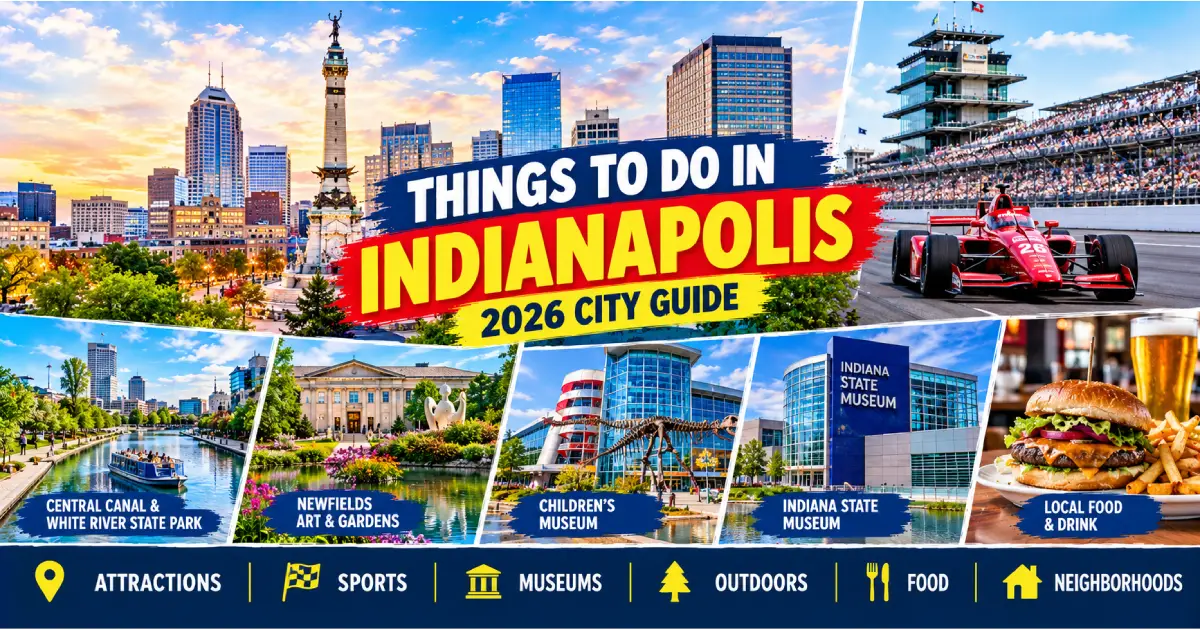
Indianapolis surprises first-time visitors. The reputation that precedes this Midwestern city — that it is flat, functional, and defined entirely by the Indianapolis Motor Speedway — does not prepare you for the reality: a walkable, vibrant downtown with world-class museums, a thriving food and beer scene centered on Massachusetts Avenue, one of the most beloved children’s museums on earth, and a cultural confidence that comes from a city that has quietly invested in itself for decades. The Indiana War Memorial complex alone rivals anything in Washington D.C. in its scale and ambition. The Indianapolis Museum of Art at Newfields, set on 152 acres of manicured grounds, belongs in any serious conversation about regional art museums in America.
But the Indianapolis Motor Speedway is real, too, and it is extraordinary. The 2.5-mile oval track that has hosted the Indianapolis 500 every May since 1911 is the largest spectator sporting facility in the world, with a permanent capacity of more than 250,000 people. Standing in the infield and comprehending the scale of what you’re looking at is a genuinely overwhelming experience, even for people who have no particular interest in motorsport. The Speedway is part of Indianapolis in the way that the Grand Canyon is part of Arizona — a natural wonder of its category, improbable and irreducible.
What makes Indianapolis particularly rewarding is how manageable it is. The downtown core is compact and walkable, the museums cluster conveniently, the neighborhoods each have distinct personalities, and the locals are genuinely warm and helpful in the manner of Midwestern cities that don’t receive enough visitors and appreciate the ones who do show up. Indianapolis has hosted multiple Super Bowls, the NCAA Final Four, and dozens of major sporting events, and the city’s infrastructure — hotels, restaurants, event venues — reflects those investments. Come expecting a quiet Midwestern city and you’ll leave surprised by everything it contains.
| Category | Details |
|---|---|
| Must-Do | Indianapolis Motor Speedway, Children’s Museum of Indianapolis |
| Best Museum | Indianapolis Museum of Art at Newfields |
| Best Neighborhood | Massachusetts Avenue (Mass Ave) |
| Best Free Attraction | Indiana War Memorial / Monument Circle |
| Sports Teams | Colts (NFL), Pacers (NBA), Indians (MiLB) |
| Best Beer Scene | Fountain Square / Mass Ave breweries |
| Day Trip | Brown County State Park (55 miles) |
| Insider Tip | The Speedway is open year-round — no race required |
The Greatest Spectacle in Racing
The Indianapolis Motor Speedway is the largest spectator sporting facility in the world, a 559-acre complex that has hosted the Indianapolis 500 every Memorial Day weekend since 1911. The statistics are staggering: 253,000 permanent grandstand seats, a 2.5-mile oval track, an infield large enough to contain the entire Churchill Downs racetrack with room to spare. When the Indy 500 fills to capacity for the race, it represents the largest single-day sporting event on the planet. But you don’t need to attend race day to experience the Speedway — the facility offers tours and the outstanding Indianapolis Motor Speedway Museum year-round.
The track tour (available daily) takes you around the actual racing surface in a bus, through the pit lane, across the Yard of Bricks finish line — the original brick surface that gave the track its nickname “The Brickyard” — and into the infield where the scale of the facility becomes comprehensible. The museum contains more than 75 historic race cars including winning Indy 500 machines from every era, from Ray Harroun’s 1911 Marmon Wasp to modern INDYCAR machinery. The Hall of Fame display honors every Indianapolis 500 winner with personal artifacts and racing memorabilia. Even confirmed non-racing fans consistently rate the IMS tour as one of the most memorable Indianapolis experiences.
The World’s Largest Children’s Museum
The Children’s Museum of Indianapolis is not merely Indiana’s finest museum — it is the largest children’s museum in the world, a 483,000-square-foot institution that has set the global standard for what a children’s museum can aspire to be since its founding in 1925. The museum’s permanent galleries cover paleontology (a spectacular dinosaur atrium with a Brachiosaurus skeleton emerging through the ceiling), space science (a full-scale Apollo 5 spacecraft and spacesuit), world cultures, natural history, and interactive science exhibits. The Dinosphere gallery, recreating a Late Cretaceous environment with fossil excavation activities, is among the finest exhibit design of any museum in America.
The museum operates on a philosophy that learning should be actively joyful, and every gallery reflects that belief. Children don’t look at exhibits here — they operate, excavate, climb, experiment, and discover. The SpaceQuest Planetarium (included with admission) runs shows throughout the day. A full carousel and outdoor play areas round out the complex. Despite the museum’s focus on children, adults without children consistently report being fascinated — the design, depth, and quality of the permanent collection are simply that good.
152 Acres of Art, Gardens, and Nature
Newfields — formally the Indianapolis Museum of Art at Newfields — is one of the finest regional art museums in America, a 152-acre campus that combines a world-class art collection with formal gardens, a nature park, a historic home, and an outdoor music venue. The permanent collection spans 5,000 years of art history with particular strengths in American paintings, Neo-Impressionist and Post-Impressionist works, Asian art, and African art. The museum holds the largest collection of J.M.W. Turner works outside the United Kingdom, a collection of Claude Monet’s Venetian series, and an exceptional assembly of works by Georgia O’Keeffe and other American modernists.
The grounds are equally impressive. The Virginia B. Fairbanks Art & Nature Park covers 100 acres of woodland and wetland threaded with sculptures. Lilly House, a 1910 National Historic Landmark mansion, is open for tours. The Sutphin Fountain Mall connects the main museum building to the surrounding gardens. During summer, Newfields hosts “A Newfields Holiday: Winterlights” (November–January), a spectacular outdoor light installation that has become one of Indiana’s most popular winter events, and “Tobias Simon Free Days” offer free admission to underrepresented community members throughout the year.
The Heart of Indianapolis
Monument Circle, at the literal and symbolic center of Indianapolis, is anchored by the Soldiers and Sailors Monument, a 284-foot limestone tower completed in 1902 to honor Indiana’s veterans of the Civil War and earlier conflicts. The monument is more impressive in person than any photograph conveys — it dominates the circular plaza around which Indianapolis’s downtown radiates, and the observation deck at the top (accessible by elevator) provides excellent city views. The monument’s base contains a small museum dedicated to Indiana’s military history.
The broader Indiana War Memorial Plaza complex, extending north from Monument Circle, is a five-block Beaux Arts civic district of astonishing ambition for a Midwestern state capital. The Indiana War Memorial building itself (housing the Shrine Room, one of the most impressive patriotic spaces in America) anchors the plaza alongside the Scottish Rite Cathedral, American Legion Mall, and University Park. The entire complex is free and open to the public. Walking the full plaza is a genuine architectural experience that rivals anything in Washington D.C. at a fraction of the tourist congestion.
Indianapolis’s Most Vibrant Cultural District
Massachusetts Avenue — “Mass Ave” to everyone in Indianapolis — is a diagonal corridor running northeast from downtown that functions as the city’s cultural living room: a mile-long stretch of independent restaurants, craft breweries, boutique shops, art galleries, theaters, and public art that concentrates Indianapolis’s creative energy in a walkable district. The Actors Theatre of Indiana, the Phoenix Theatre, the Herron School of Art + Design, and numerous galleries make Mass Ave the city’s arts anchor. The public art — sculptures, murals, and installations distributed along the corridor — is consistently excellent.
The food and drink scene on Mass Ave ranges from casual gastropubs to destination-worthy restaurants. Sun King Brewery, one of Indiana’s most beloved craft brewers, operates a taproom here. Bluebeard (in the Bottleworks hotel complex), Mesh on Mass, and Oakley’s Bistro represent the corridor’s serious dining end. The shops lean toward the independent and locally owned — a refreshing contrast to the homogenized retail of suburban corridors. On warm evenings, the outdoor patios fill and the street feels genuinely alive in the way of great urban commercial streets.
Indiana’s Story, Told Brilliantly
The Indiana State Museum in White River State Park is one of the best state history museums in the country, a beautifully designed institution that uses Indiana limestone, wood, and glass to tell the state’s geological and human story across four floors of permanent and rotating exhibits. The building itself is architecturally distinguished, featuring a limestone exterior composed of fossils from the Silurian period when Indiana was a shallow tropical sea — look at the exterior walls closely and you’ll see coral, crinoids, and brachiopods embedded in the stone.
The permanent exhibits cover Indiana geology (the glaciers that shaped the landscape), the indigenous peoples who inhabited the region for thousands of years before European contact, the pioneer and settlement period, and the 19th and 20th century development that made Indiana a manufacturing and agricultural powerhouse. The Natural History galleries include a world-class collection of Pleistocene megafauna fossils, including mastodons and ground sloths recovered from Indiana bogs. The IMAX theater shows nature and science films throughout the day. The museum’s location in White River State Park places it steps from the Indianapolis Zoo, the Eiteljorg Museum, and the NCAA Hall of Champions.
Downtown Zoo on the White River
The Indianapolis Zoo is among the best urban zoos in America, a 64-acre facility in White River State Park that combines an excellent animal collection with innovative exhibit design and a commitment to conservation science. The zoo operates without government funding — it is entirely self-supporting through admissions and donations — a distinction that drives its focus on the visitor experience and conservation mission. The Oceans dome, housing beluga whales, dolphins, sharks, and rays in a climate-controlled glass structure, is one of the most impressive single exhibits at any American zoo.
The Forests biome recreates tropical and temperate forest environments for primates, orangutans, and other forest species. The Plains biome features African savanna animals. The Waters biome connects to the White River with wetland exhibits. The Deserts biome is particularly strong on native Indiana wildlife in historical context. The zoo also operates a botanical garden component (formally the Indianapolis Zoo White River Gardens) with outstanding butterfly pavilion and rose collections. The combination of zoo quality and downtown location makes the Indianapolis Zoo one of the best urban recreational options in the city.
A World-Class Collection in the Midwest
The Eiteljorg Museum of American Indians and Western Art, in White River State Park, holds one of the finest collections of Native American art and Western American paintings in the eastern United States. Founder Harrison Eiteljorg collected with passion and discernment over decades, assembling a collection that includes works by Frederic Remington, Charles Russell, Georgia O’Keeffe, and Thomas Moran alongside an extraordinary assembly of Native American pottery, textiles, jewelry, and ceremonial objects from across the continent.
The Western paintings collection evokes the 19th-century American West with a vividness that text and photography cannot match — Remington’s bronze cowboys and cavalry charges, Russell’s vast Montana skies, Moran’s luminous Yellowstone landscapes. The Native American collection treats its subjects as living cultures rather than historical artifacts, with contemporary Native American artists represented alongside historic works. The annual Indian Market & Festival (June) transforms the museum’s surroundings into one of the most important Native American art markets in the country. The building itself, designed by Woollen Molzan Architects, incorporates Southwestern adobe forms in a strikingly successful downtown Indianapolis setting.
Downtown Indianapolis’s Green Corridor
The Central Canal Walk is a 1.5-mile paved path along the Indiana Central Canal through downtown Indianapolis, connecting IUPUI to the Broad Ripple neighborhood and passing through the cultural district of White River State Park. The canal was originally constructed in the 1830s as part of an ambitious waterway network; today, the restored section through downtown serves as a recreational greenway lined with public art, fountain features, and connections to the city’s major attractions. Paddle boats are available for rental in summer.
White River State Park, which the canal bisects, is a remarkable achievement — an 8-block urban state park in downtown Indianapolis containing the Indianapolis Zoo, Indiana State Museum, Eiteljorg Museum, NCAA Hall of Champions, Lucas Oil Stadium (adjacent), Gainbridge Fieldhouse (nearby), Victory Field, and the Indiana History Center. The park functions as Indianapolis’s primary public greenspace and cultural commons, linking all of these institutions in a walkable complex. The park hosts free concerts, festivals, and community events throughout the year.
A Victorian Conservatory Gem
Garfield Park on the south side of Indianapolis is the city’s oldest park, established in 1887, and its botanical conservatory is a genuine hidden gem: a free, year-round greenhouse that maintains tropical, arid, and display plantings through Indiana’s cold winters. The conservatory’s sunken garden and seasonal displays are beautifully maintained, and the facility offers a warm, fragrant escape from winter cold that is particularly appreciated by Midwesterners in February and March.
The park itself covers 128 acres with picnic facilities, a swimming pool (summer), playgrounds, a restored 1910 carousel, and extensive walking paths. The Garfield Park Arts Center hosts community art exhibitions and classes. The sunken garden outside the conservatory is planted with formal seasonal displays that peak in summer and fall. For visitors who have covered the downtown cultural institutions and want a different kind of afternoon, Garfield Park offers a glimpse of neighborhood Indianapolis that the tourist circuit rarely reaches.
The Story of College Athletics
The NCAA Hall of Champions in White River State Park is the official museum of collegiate athletics in America, celebrating the history, traditions, and athletes of the NCAA’s 90+ championship sports across three divisions. The museum covers every NCAA sport with interactive exhibits, championship memorabilia, and the stories of the collegiate athletes who went on to define professional sports. The Final Four experience (basketball) and the College Football Hall of Fame partnership exhibits are particularly strong.
Indianapolis serves as the permanent headquarters of the NCAA, making the Hall of Champions especially appropriate to its location. The facility is popular with sports fans of all ages and has particular appeal for anyone who played college athletics and wants to see their sport celebrated at the national level. The building’s location in White River State Park makes it easy to combine with the Indiana State Museum or Indianapolis Zoo.
Living History in the Countryside
Conner Prairie Interactive History Park, 25 miles north of downtown Indianapolis in Fishers, is one of the finest living history museums in America — a 1,000-acre outdoor museum where costumed interpreters recreate life in Indiana from the 1800s through the early 20th century. The museum’s immersive approach puts visitors inside the history rather than observing it from behind glass: in the 1836 Prairietown village, you can negotiate with a blacksmith, help a weaver, or debate the politics of the era with a storekeeper who stays in character. The 1863 Civil War Journey puts visitors in the middle of a Confederate raid on a fictional Indiana town.
The museum’s most spectacular program is “Follow the North Star,” an evening immersive experience that puts participants in the role of freedom-seeking enslaved people escaping to the north. The program is emotionally powerful and historically rigorous, consistently rated among the most moving museum experiences in the Midwest. Conner Prairie also maintains a balloon ride, animals, and extensive walking trails that make it a full-day family destination in good weather.
Indy’s Hippest Historic Neighborhood
Fountain Square, about a mile southeast of downtown along Virginia Avenue, is Indianapolis’s most creative neighborhood — a historic commercial district centered on a small plaza with an ornate 1920s fountain, surrounded by restaurants, bars, galleries, bowling alleys, and entertainment venues that have made it the city’s hipster destination of the last decade. The Murphy Arts Center (a former movie palace) hosts concerts and events. The Fountain Square Theatre Building contains a boutique hotel, duckpin bowling, skating, and a rooftop bar.
The neighborhood’s dining scene is excellent and diverse: Bluebeard’s sister restaurant, Amelia’s Bakery (the city’s best bread), Smoking Goose (artisan charcuterie), and a rotating cast of independent restaurants and bars reflect the neighborhood’s creative energy. The Virginia Avenue corridor connects Fountain Square to Fletcher Place and eventually to the Cultural Trail, a 8-mile protected bike and pedestrian path that loops through Indianapolis’s most vibrant neighborhoods. Fountain Square is at its best on weekend evenings when the streets fill and the entertainment venues draw crowds from across the city.
The Canal Neighborhood
Broad Ripple Village, 5 miles north of downtown along the White River and Central Canal, is Indianapolis’s original bohemian neighborhood — a compact commercial district of bars, restaurants, live music venues, boutiques, and the city’s densest concentration of independent coffee shops and bookstores. The neighborhood has evolved over the decades (the late-night bar scene that defined its 1990s reputation has matured), and today Broad Ripple offers a comfortable blend of excellent dining, craft beer culture, and arts activity that makes it one of Indianapolis’s most pleasant afternoon and evening destinations.
The Central Canal towpath runs through Broad Ripple, providing a scenic walking and cycling connection to downtown. The Broad Ripple Farmers Market (Saturday mornings, May–September) is one of the best in Indianapolis. The Vogue (a concert venue) has been booking national touring acts for decades. Brugge Brasserie (Belgian beer and food), Mimi’s Donuts, Bazbeaux Pizza, and Petite Chou bistro represent the neighborhood’s culinary character. For a relaxed afternoon that feels removed from downtown tourism, Broad Ripple delivers.
NFL Football in a World-Class Stadium
Lucas Oil Stadium, home of the Indianapolis Colts NFL franchise, is one of the finest football stadiums in America — a retractable roof facility completed in 2008 that has hosted multiple Super Bowls, the NCAA Final Four, and dozens of major events. The building’s most distinctive architectural feature is a massive window on the north end that opens to provide natural light and air circulation and frames a spectacular view of the downtown Indianapolis skyline from inside the stadium. Attending a Colts game here is one of the great NFL stadium experiences.
The Colts are consistently competitive and have produced legendary moments in Indianapolis sports history, including the Peyton Manning era Super Bowl championship (Super Bowl XLI, 2007) and the Andrew Luck years. The stadium tours (available on non-game days) take visitors onto the field, through the press box, and into the locker rooms that normally only players see. Lucas Oil Stadium is also home to the Indiana Farm Bureau Football Center (Colts practice facility) adjacent to the main building.
NBA Basketball Downtown
Gainbridge Fieldhouse (formerly Conseco Fieldhouse and Bankers Life Fieldhouse) is Indiana’s pro basketball cathedral, a downtown arena that opened in 1999 and is consistently rated among the best NBA venues in the league for its atmosphere, sightlines, and the passionate fan base it houses. The Indiana Pacers have a proud NBA history including three ABA championships and multiple deep NBA playoff runs, and the team has a loyal regional fan base that makes Pacers games one of Indianapolis’s most reliable entertainment experiences.
The arena’s design evokes the historic fieldhouses of Indiana high school basketball tradition — the sport is taken as seriously in Indiana as football is in Texas, and the Pacers benefit from that cultural context. The arena is within easy walking distance of all downtown hotels and restaurants, making a Pacers game a natural centerpiece for a downtown Indianapolis evening. The NBA season runs October through April.
One of America’s Best Minor League Ballparks
Victory Field, home of the Indianapolis Indians (Pittsburgh Pirates Triple-A affiliate), consistently ranks among the top minor league baseball parks in America. The downtown stadium opened in 1996 and was designed with a baseball-purist’s sensibility — natural grass, excellent sightlines from every seat, a brick exterior that fits the downtown context, and a scoreboard that provides actual game information rather than entertainment distractions. The White River provides a backdrop beyond the outfield fence on clear evenings.
Minor league baseball offers the most relaxed and affordable live sports experience in any American city. Tickets are inexpensive ($10–$22), the games are genuinely competitive (Triple-A prospects are often days away from major league call-ups), and the family-friendly atmosphere makes it an easy option for any group. Victory Field hosts about 70 home games from April through September. The park’s proximity to downtown (it’s in White River State Park) makes it walkable from most downtown hotels.
8 Miles of Urban Cycling and Walking
The Indianapolis Cultural Trail is an 8-mile protected bicycle and pedestrian path that loops through the heart of Indianapolis, connecting the city’s six major downtown cultural districts and providing a genuinely excellent urban cycling infrastructure that is rare in Midwestern cities. The trail runs along dedicated paths separated from vehicular traffic, is beautifully maintained, and is lined with public art, plantings, and connections to every major cultural institution. It is one of the best examples of urban trail infrastructure in America.
The trail connects Mass Ave, Fountain Square, the Cultural Districts, White River State Park, the Canal Walk, and the Wholesale District in a continuous loop that can be walked in about 3 hours or cycled comfortably in under an hour. Pacers Bikeshare stations are distributed along the trail, making it accessible without bringing your own bicycle. The trail makes it possible to move between Indianapolis’s neighborhoods without a car, which is a meaningful achievement in a car-oriented Midwestern city.
Celebrating Indianapolis’s Literary Son
Kurt Vonnegut — born in Indianapolis in 1922, author of Slaughterhouse-Five, Cat’s Cradle, Breakfast of Champions, and a shelf of other masterworks of American fiction — is the most famous writer ever produced by Indiana, and the Kurt Vonnegut Museum and Library on Massachusetts Avenue celebrates his life, work, and enduring cultural relevance. The museum opened in 2011 and houses original manuscripts, personal correspondence, artwork (Vonnegut was a prolific visual artist), and biographical materials that paint a rich portrait of one of the 20th century’s most important novelists.
The museum’s collection is particularly strong in Vonnegut’s relationship to Indianapolis — his family’s history in the city, his Indiana childhood, and the ways that Midwestern experience inflected his globally influential fiction. The gift shop carries the museum’s own editions of Vonnegut’s books. The museum hosts regular literary events, readings, and exhibitions. For literary travelers, the Vonnegut Museum is one of Indianapolis’s essential stops.
Indiana’s Most Beloved Craft Brewer
Sun King Brewing Company, founded in 2009, became Indianapolis’s most beloved craft brewer so quickly and decisively that it has entered the fabric of local culture in a way that few new businesses achieve anywhere. The Mass Ave taproom is the social living room of Indianapolis’s creative class — a spacious, welcoming space that somehow manages to feel intimate and community-oriented despite high traffic. The brewing quality is consistently excellent, with Sun King’s Cream Ale and Sunlight Cream Ale as approachable flagship beers and a rotating seasonal program that has produced some of the most anticipated craft releases in Indiana.
The taproom offers tours of the brewing facility on selected dates, provides an extensive food menu (better than most brewery food), and hosts regular events including live music, trivia nights, and charity events. Sun King’s cans are available throughout Indiana and in neighboring states, but drinking at the source on Mass Ave, surrounded by the neighborhood’s creative energy, is the definitive Sun King experience.
The State’s Premier Professional Theater
The Indiana Repertory Theatre, performing in the beautifully restored 1927 Indiana Theatre building on Washington Street, is the state’s premier professional theater company and one of the finest regional theaters in the Midwest. The IRT’s season of five to seven productions runs October through May, with a commitment to American classics, world premieres, and thoughtful contemporary works that has earned it a national reputation. The building itself — a Spanish Colonial Revival movie palace that has been adapted into an intimate theater complex — is architecturally spectacular.
Attending an IRT production is one of Indianapolis’s most culturally rewarding experiences, and the ticket prices are significantly more accessible than comparable quality in New York or Chicago. The main stage seats approximately 600; the more intimate Upperstage and Cabaret venues host smaller productions. For visitors who want to experience Indianapolis’s cultural life beyond its sporting events and museums, the IRT is the essential theater option.
The Only US President from Indiana
The President Benjamin Harrison Home in Midtown Indianapolis is the meticulously restored Victorian mansion where the 23rd President of the United States lived before and after his single term in office (1889–1893). Harrison, grandson of President William Henry Harrison and the only US President born in Indiana, is not among the most celebrated presidents, but his era — the Gilded Age of industrialization, labor tension, and global expansion — is among the most fascinating in American history, and his home provides a vivid window into the domestic life of a Victorian-era statesman.
The guided tours of the 16-room Italianate mansion are led by historians who bring Harrison and his era to genuine life. The home is authentically furnished with Harrison’s original possessions, including furniture, books, personal effects, and his presidential desk. The museum’s research library holds extensive Harrison family papers. The surrounding Midtown Indianapolis neighborhood, with its intact Victorian residential architecture, enhances the sense of stepping back to the 1880s.
One of America’s Largest Urban Parks
Eagle Creek Park on the northwest side of Indianapolis covers 5,300 acres — making it one of the largest municipal parks in the United States, roughly the size of Manhattan south of 79th Street. The park centers on a 1,400-acre reservoir that provides water recreation (kayaking, sailing, rowing, fishing), swimming at the beach, and one of the finest migratory birding sites in the Midwest. The Eagle Creek Ornithology Center is a dedicated birding facility with observation decks, educational materials, and a habitat that attracts hundreds of species during spring and fall migration.
The park also contains 10+ miles of mountain bike trails, hiking and equestrian trails, a golf course, a shooting range, a velodrome for competitive cycling, and picnic facilities distributed throughout the natural landscape. For visitors who want to escape Indianapolis’s urban environment and experience Indiana’s glacially sculpted landscape, Eagle Creek provides a day’s worth of outdoor recreation opportunities. Rental kayaks and canoes are available at the marina.
Surreal Art in the Basement
Newfields added an extraordinary subterranean contemporary art space — the 100 Acres Art & Nature Park and the lower gallery spaces — that presents large-scale installation art in a way the main museum’s galleries cannot accommodate. The basement space (informally known by visitors as the “underground galleries”) hosts rotating installations by national and international contemporary artists who work at monumental scale. The combination of the refined permanent collection upstairs and the raw, experiential contemporary work below creates one of the most complete art museum experiences in the Midwest.
The 100 Acres outdoor sculpture park, technically part of the same Newfields campus, extends the museum experience into nature with permanent and rotating sculptures distributed through woodland and wetland landscapes. Climbing, sitting, and interacting with the sculptures is encouraged — an unusual museum policy that reflects Newfields’s commitment to accessible, embodied art experiences.
The Greatest Day in American Motorsport
If your Indianapolis visit aligns with the Indianapolis 500 (held on the Sunday closest to Memorial Day — May 24, 2026), attending the race is a bucket-list experience unlike any other in American sports. The event begins before dawn when fans pack the infield, and the atmosphere builds through the morning ceremonies — the singing of “Back Home Again in Indiana,” the famous command “Gentlemen, start your engines,” the pace laps, and then the moment when 33 cars accelerate from a standstill to 230 mph in the space of a quarter mile. The sound of 33 IndyCars at full throttle is a physical sensation, not merely an auditory one.
The Indy 500 is simultaneously one of America’s most prestigious sporting events and one of its most democratic: infield general admission allows fans to bring coolers, barbecue grills, and lawn furniture, creating a massive tailgate party that is partly responsible for the event’s legendary atmosphere. Grandstand tickets provide better race viewing; infield tickets provide the experience. Tickets for the 2026 race should be purchased well before spring — many sections sell out months in advance.
Best Neighborhoods to Explore on Foot: Mass Ave, Fountain Square, Broad Ripple — all compact, walkable, and filled with independent businesses. Downtown is walkable for major attractions.
Getting Around: Indianapolis is a driving city, but the Cultural Trail and Pacers Bikeshare make car-free neighborhood exploration practical. Rideshare (Uber/Lyft) is widely available and affordable.
Sports Calendar: Colts (NFL, September–January), Pacers (NBA, October–April), Indians (MiLB, April–September), Indy 500 (May).
Best Day Trips: Brown County State Park (55 miles south — Indiana’s top fall foliage destination, peak mid-October); Conner Prairie (25 miles north); Nashville, Indiana (75 miles — antique capital of the Midwest).
The Super Bowl Legacy: Indianapolis has hosted multiple Super Bowls and the infrastructure shows — downtown hotels, restaurants, and venues are well-prepared for large events.
Posted By : Vinay
Latest Article
2nd Floor, 39, Above Kirti Club, DLF Industrial Area, Kirti Nagar, New Delhi, Delhi 110015



Travel Tourister is a leading Travel portal where we introduce travellers to trusted travel agents to make their journey hasselfree, memorable And happy. Travel Tourister is a platform where travellers get Tour packages ,Hotel packages deals through trusted travel companies And hoteliers who are working with us across the world. We always try to find new and more travel agents and hoteliers from every nook and corners across the world so that you could compare the deals with different travel agents and hoteliers and book your tour or hotel with the one you have chosen according to your taste and budget.
Copyright © Travel Tourister, India. All Rights Reserved

 Call
Call Enquiry