Published on : 13 Jan 2026
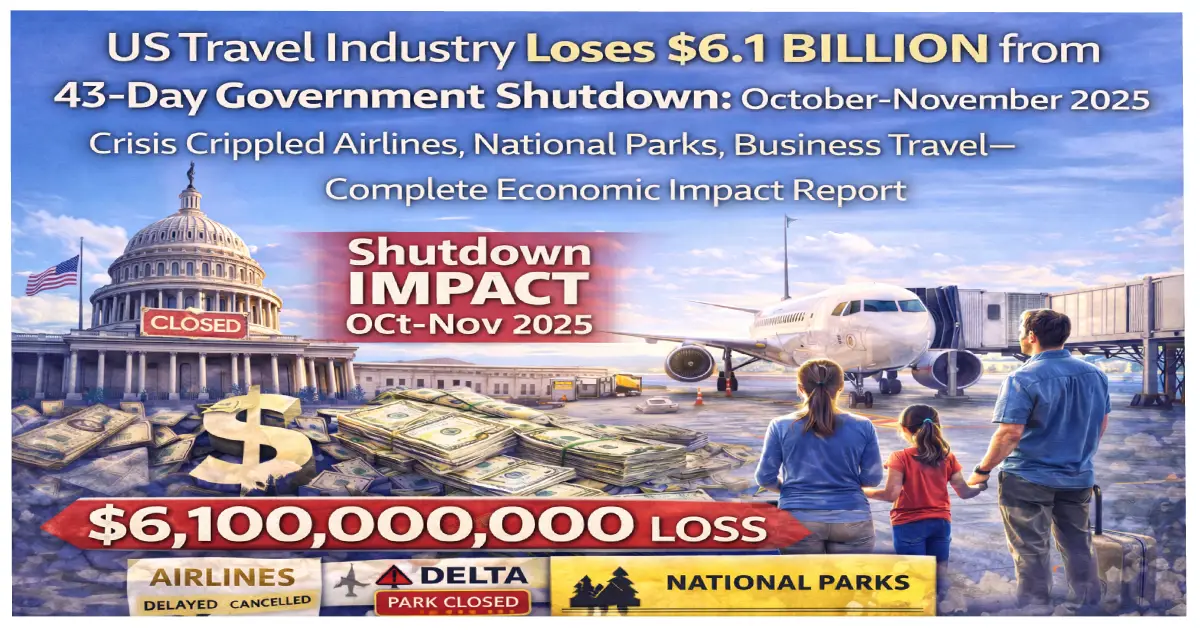
Breaking: The longest government shutdown in US history—43 days from October 1 to November 12, 2025—just cost the travel industry $6.1 billion. Air traffic controllers worked without pay. National parks closed. Business travel evaporated. Here’s the complete breakdown of how political gridlock devastated America’s travel sector just two months ago.
Published: January 13, 2026 Report Released: January 7, 2026 (6 days ago) Shutdown Duration: October 1 – November 12, 2025 (43 days) Total Economic Loss: $6.1 billion across travel and related sectors Daily Trip Reduction: 88,000 fewer trips per day Workers Affected: Air traffic controllers, TSA, CBP officers worked WITHOUT PAY
From October 1 through November 12, 2025, the US federal government shut down for 43 consecutive days—the longest shutdown in American history. Congress failed to pass a funding bill, forcing hundreds of thousands of government employees to work without paychecks or stop working entirely.
The travel industry took a massive hit. National parks closed gates. Smithsonian museums locked doors. Air traffic controllers and TSA officers reported to work without knowing when they’d get paid. Business travelers cancelled trips. Tourists stayed home.
The result? $6.1 billion in total economic losses across the travel sector, according to a new report from the US Travel Association released January 7, 2026.
The Damage Breakdown:
✈️ $6.1 billion total economic losses across travel and related sectors ✈️ 88,000 fewer trips per day throughout 43-day shutdown ✈️ $2.7 billion direct trip-related losses (1.7% reduction in total US travel spending) ✈️ $1 billion lost from government-related air travel alone ✈️ $1.3 billion lost from government-related non-air travel ✈️ $183.3 million lost from flight delays caused by staffing issues ✈️ $650 million lost in hotel business by October 22 (midpoint of shutdown)
The US Travel Association partnered with Tourism Economics to quantify the shutdown’s impact. Here’s where the $6.1 billion went:
What This Covers:
Impact: A 1.7% reduction in total US travel spending during the shutdown period. For context, the US travel industry generates approximately $1.3 trillion annually—losing $2.7 billion in 43 days represents a massive disruption.
Air Travel: $1 billion lost Non-Air Travel: $1.3 billion lost
Federal employees and contractors drastically curtailed travel during the shutdown. Government conferences cancelled. Site inspections postponed. Official business trips disappeared.
Affected Travelers:
Air traffic controllers, TSA officers, and Customs and Border Protection (CBP) agents worked WITHOUT PAY throughout the shutdown. The stress, understaffing, and operational challenges resulted in:
Estimated Loss: $183.3 million from flight delays alone, not counting passenger compensation, rebooking costs, or airline operational expenses.
The remaining losses came from:
On average, the United States saw 88,000 fewer trips per day during the 43-day shutdown compared to normal travel patterns.
What That Means:
Daily Math: 88,000 fewer trips/day × 43 days = 3.78 million total trips cancelled or postponed
Lost Daily Spending: $61.5 million in direct travel spending lost EVERY SINGLE DAY
Compounding Effect: Early shutdown days saw modest declines. By week 3-4, cancellations accelerated as uncertainty mounted and essential workers faced financial pressure.
Government Employees & Contractors:
Leisure Travelers:
Business Travelers:
National parks—America’s crown jewels of tourism—suffered catastrophic losses.
Fully Closed:
Partially Accessible: Some parks remained accessible through state or private funding, but without ranger services, visitor centers, or amenities.
Wyoming: Yellowstone closure devastated Jackson Hole, Cody, and gateway communities. Hotels reported 40-60% occupancy drops.
Arizona: Grand Canyon closure hit Flagstaff, Williams, and Tusayan. Tour operators lost peak fall foliage season revenue.
California: Yosemite closure impacted Mariposa County, where tourism represents 25%+ of the economy.
Utah: The “Mighty Five” national parks (Zion, Bryce Canyon, Arches, Canyonlands, Capitol Reef) closures devastated Moab, Springdale, and other gateway towns.
Hawaii: National parks on Big Island and Maui closed, compounding economic challenges for tourism-dependent islands.
Towns near national parks rely almost entirely on tourism. The shutdown hit them hardest:
The Situation: Air traffic controllers are classified as “essential” employees, meaning they MUST report to work during government shutdowns—but they don’t get paid until the shutdown ends.
The Impact:
Stress & Morale: Controllers managing hundreds of flights daily without paychecks. Financial pressure mounted as mortgages, rent, and bills came due.
Staffing Shortages: Some controllers called in sick (unable to afford childcare or gas). Others worked fatigued, increasing safety concerns.
Operational Slowdowns: Reduced staffing forced flow control measures—deliberately slowing air traffic to match available controller capacity.
Flight Delays: $183.3 million in shutdown-related delays according to US Travel Association estimates.
The Situation: TSA officers also classified as “essential,” required to screen passengers without compensation.
The Impact:
Longer Lines: TSA call-outs increased as workers faced financial hardship. Fewer screeners = longer security queues.
Passenger Frustration: Wait times at major airports (JFK, LAX, ATL, ORD) doubled during peak travel times.
Safety Concerns: Overworked, financially stressed screeners potentially less effective at detecting threats.
Public Sympathy: Passengers tipped TSA officers, brought them food, and advocated for back pay.
Customs and Border Protection officers at international airports also worked without pay, causing:
Airlines didn’t directly lose $6.1 billion—that figure represents total economic impact—but they felt significant pain:
Ticket Sales: Business travel bookings plummeted. Government contracts frozen. Corporate travel managers cancelled trips.
Cancellations: Passengers cancelled flights due to national park closures or uncertainty about government services.
Rebooking Costs: Airlines waived change fees and offered flexible rebooking for affected travelers.
Crew Scheduling: Delays cascaded through networks, requiring expensive crew reassignments and overnight hotel accommodations.
While national park closures grabbed headlines, business travel losses quietly devastated the industry.
Federal Employees:
Government Contractors:
Even private-sector companies reduced travel:
Government-Funded Conferences: Dozens cancelled outright (attendees couldn’t travel without federal funding).
Private Conferences: Many rescheduled or saw lower attendance (government partners couldn’t attend).
Trade Shows: Government exhibitors pulled out, leaving gaps on show floors.
Hotels: Lost $650+ million in conference and meeting revenue by mid-October.
By October 22—just three weeks into the shutdown—hotels had already lost an estimated $650 million according to a letter signed by 30+ hospitality industry associations urging Congress to end the shutdown.
Washington DC: Federal government headquarters, normally packed with government workers and contractors. Hotels near Capitol Hill, White House, and federal agencies saw 50-70% occupancy drops.
National Park Gateway Towns: Hotels in Moab, Springdale, West Yellowstone, Gatlinburg, and similar communities reported catastrophic losses.
Convention Hotels: Government conferences cancelled. Corporate events rescheduled. Meeting space revenue evaporated.
Government-Rate Hotels: Properties near military bases, VA hospitals, and federal facilities lost their primary customer base.
Hilton’s CEO noted in a November 2025 earnings call that the shutdown was costing the company “tens of millions” in lost revenue, with disproportionate impact on properties near federal facilities and national parks.
Chains like Hilton, Marriott, and Hyatt weathered the storm. Small independent hotels—especially in tourism-dependent rural areas—faced existential threats:
Impact:
Lost Revenue: Estimated $200-300 million across tourism and hospitality sectors.
Impact:
Lost Revenue: Estimated $150-200 million (significant for island economy).
Impact:
Lost Revenue: Estimated $400-500 million (largest state economy, widespread impact).
Impact:
Lost Revenue: Estimated $100-150 million (huge for small-population state).
Impact:
Lost Revenue: Estimated $200-250 million.
The human toll of the shutdown extended far beyond economic statistics.
Pay Situation: Required to work, not paid until shutdown ends
Financial Stress:
Safety Concerns:
Union Response: National Air Traffic Controllers Association lobbied Congress, threatened work actions if shutdown continued.
Pay Situation: Essential workers, no pay during shutdown
Financial Stress:
Call-Outs: Sick calls doubled at major airports by week 3.
Morale: Screening passengers without pay while watching travelers fly to vacations created resentment.
Pay Situation: Essential workers at borders and international airports, unpaid
Impact:
Americans overwhelmingly supported paying essential aviation workers during shutdowns:
Survey Results (December 2025):
Congress introduced the Aviation Funding Solvency Act in December 2025:
Purpose: Ensure air traffic controllers, TSA officers, and CBP agents receive pay during government shutdowns
Status: Bipartisan support, expected to pass in 2026
Impact: Would prevent future shutdowns from disrupting aviation workforce
The $6.1 billion figure captures direct travel losses, but the true economic impact extends much further:
Tour Operators: Many near national parks went out of business permanently
Restaurants: Establishments near federal buildings and parks lost 50-80% of revenue
Retail: Souvenir shops, outdoor gear stores, bookstores in tourism areas devastated
Gas Stations: Reduced road trips = lower fuel sales in gateway communities
Layoffs: Hotels, restaurants, tour operators laid off thousands of workers
Furloughs: Many businesses furloughed staff without pay
Reduced Hours: Part-time workers saw hours cut to near-zero
Permanent Closures: Some businesses never reopened after shutdown ended
Vendors: Hotels and restaurants delayed payments to suppliers
Distributors: Food, beverage, linen companies saw orders plummet
Maintenance: Deferred maintenance on equipment (couldn’t afford repairs)
Reputation: US perceived as unstable, unreliable for international travelers
Investment: Tourism businesses hesitant to invest (fear of future shutdowns)
Insurance: Some insurers increased premiums for tourism businesses (government shutdown risk)
The 43-day crisis sparked reforms and policy debates:
Proposed: December 2025 Sponsors: Bipartisan coalition Purpose: Pay air traffic controllers, TSA, CBP during shutdowns Support: 80% of Americans, major airlines, travel industry Status: Expected to pass in 2026
Debate: Should states be allowed to fund national parks during shutdowns?
Precedent: Some states offered to pay park operations in 2025 but were denied
Proposal: Allow states to keep parks open with state funding during federal shutdowns
Status: Under discussion, no legislation yet
Issue: Government-related travel represents massive economic driver
Proposal: Create emergency funding mechanism for essential government travel during shutdowns
Status: Early-stage discussion
Takeaway: Government shutdowns cost far more than they “save”
Cost-Benefit: $6.1 billion travel loss + broader economic damage >> political gains
Future Risk: Travel industry now advocates aggressively against shutdowns
The 43-day government shutdown from October 1 to November 12, 2025—just two months ago—proved to be the most expensive political stalemate in American history for the travel industry.
$6.1 billion in total economic losses. 88,000 fewer trips per day. Air traffic controllers and TSA officers working without pay. National parks closed during peak tourism season. Hotels losing hundreds of millions. Small businesses shuttering permanently. Gateway communities devastated.
And for what? The political dispute that caused the shutdown was resolved November 12 with a compromise both parties could have reached on October 1. The 43-day delay achieved nothing except economic devastation.
For travelers, the lesson is clear: government shutdowns have consequences far beyond Washington DC. Your national park trip gets cancelled. Your flight gets delayed because air traffic controllers are calling in sick. Your hotel loses money and raises rates later to compensate.
For the travel industry, the message is urgent: never again. The $6.1 billion loss—plus unmeasured ripple effects—represents an existential threat to a sector supporting 15 million American jobs and generating $1.3 trillion annually.
The bipartisan support for paying essential aviation workers during shutdowns offers hope. Eighty percent of Americans agree: air traffic controllers and TSA officers shouldn’t work without pay during political disputes.
Whether Congress follows through with the Aviation Funding Solvency Act remains to be seen. But the 2025 shutdown made one thing crystal clear: America’s travel system depends on political stability, functional government, and fair treatment of essential workers.
The $6.1 billion question is: will politicians remember this lesson the next time a funding deadline approaches?
The travel industry—and 88,000 daily cancelled trips—hopes they will.
For More Resources:
Related Articles:
Posted By : Vinay
This article is provided for general informational purposes only and is based on information available at the time of publication. Travel advisories, airline schedules, airport operations, visa requirements, government regulations, and other travel-related information are subject to change without prior notice. While Travel Tourister makes reasonable efforts to verify information using official announcements, government publications, airline and airport communications, and other reliable sources, we cannot guarantee that all information remains complete, accurate, or up to date at all times. Readers should independently verify any information that may affect their travel plans with the relevant airline, airport authority, government agency, embassy, or other official source before making travel, financial, or other decisions. Travel Tourister shall not be liable for any direct or indirect loss, inconvenience, or damages arising from the use of or reliance on the information contained in this article. Nothing in this publication constitutes legal, immigration, financial, or professional travel advice. If you believe any information in this article is inaccurate or outdated, please contact our editorial team. We review all credible correction requests promptly and update our content whenever appropriate.
Lastest News
2nd Floor, 39, Above Kirti Club, DLF Industrial Area, Kirti Nagar, New Delhi, Delhi 110015



Travel Tourister is a leading Travel portal where we introduce travellers to trusted travel agents to make their journey hasselfree, memorable And happy. Travel Tourister is a platform where travellers get Tour packages ,Hotel packages deals through trusted travel companies And hoteliers who are working with us across the world. We always try to find new and more travel agents and hoteliers from every nook and corners across the world so that you could compare the deals with different travel agents and hoteliers and book your tour or hotel with the one you have chosen according to your taste and budget.
Copyright © Travel Tourister, India. All Rights Reserved

 Call
Call Enquiry