Published on : 22 Apr 2026
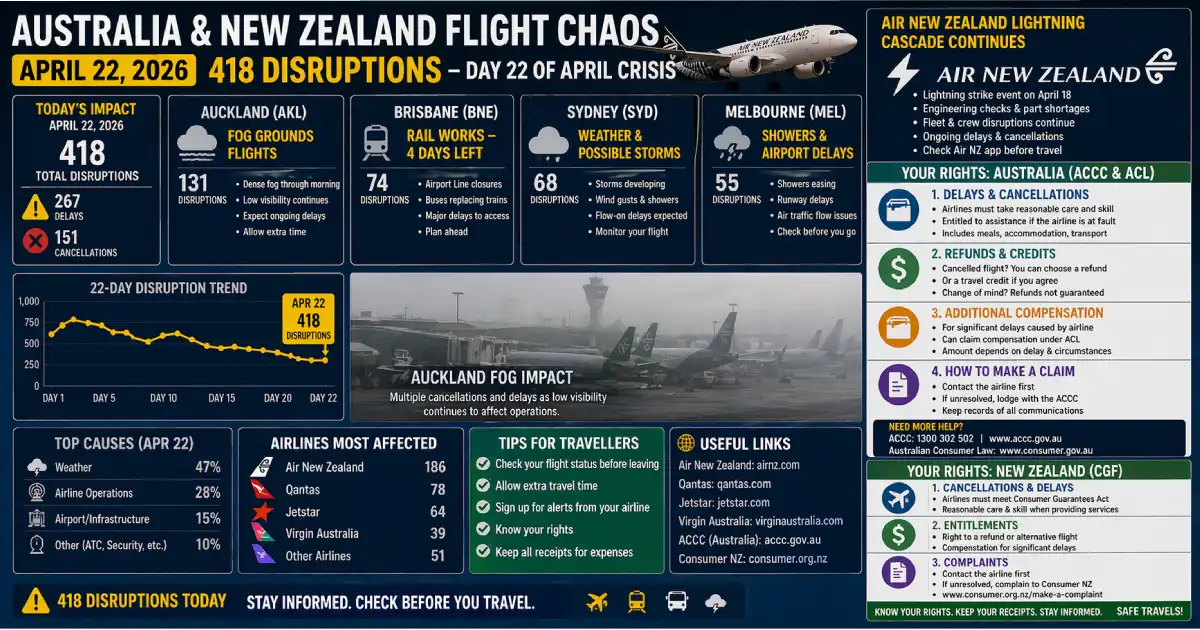
Australia and New Zealand’s aviation networks enter Day 22 of the April 2026 crisis with 418 total disruptions — 394 delays and 24 cancellations — across Auckland, Christchurch, Wellington, Hamilton, Sydney, and Brisbane. The trans-Tasman aviation network has been gripped by a significant wave of operational instability, as Jetstar, QantasLink, and Air New Zealand navigate logistical challenges across Auckland, Christchurch, Wellington, Hamilton, Sydney, and Brisbane. Today’s disruption carries two acute additional angles that make it particularly significant: dense fog is shrouding Auckland Airport — triggering sudden cancellations on New Zealand’s busiest domestic corridors — and the ongoing cascade from Monday’s lightning strike on Air New Zealand’s Singapore service continues to suppress Auckland’s international capacity. Meanwhile, the Brisbane Airport rail link has just 4 days remaining until its April 26 reopening — making today one of the most operationally complex days of the entire 23-day shutdown.
Published: April 22, 2026 🔴 ACTIVE DISRUPTION — Wednesday National Total: 418 disruptions (394 delays + 24 cancellations) Day in April Crisis: Day 22 — Australia and NZ’s longest sustained disruption sequence of 2026 Airports Affected: Auckland (AKL) · Sydney (SYD) · Brisbane (BNE) · Melbourne (MEL) · Wellington (WLG) · Christchurch (CHC) · Hamilton (HLZ) Worst Carrier: Air New Zealand — dominant disruption across all NZ airports Second Worst: Jetstar — widespread delays across Sydney, Melbourne, Brisbane Third Worst: QantasLink — regional route disruptions, particularly in Queensland Also Disrupted: Qantas · Virgin Australia · Rex (Regional Express) · Cathay Pacific (trans-Tasman) Weather Factor: Auckland Airport fog — severe low visibility reducing runway throughput Lightning Strike Cascade: Air NZ NZ281/NZ282 Auckland–Singapore — still not fully recovered Brisbane Rail: 4 days remaining — reopens Saturday April 26 (Anzac Day weekend) Air NZ Capacity Cuts: 4% of May flights + 5% of June flights confirmed cancelled ACCC Status: Enhanced airline monitoring active throughout April 2026 Compensation Regime: Australian Consumer Law (ACL) + NZ Consumer Law + Airline Customer Advocate
Dense fog in Auckland has caused sudden cancellations and schedule changes, highlighting how quickly conditions can impact airport operations. Auckland Airport is New Zealand’s primary international and domestic gateway — when its visibility drops below landing minimums, aircraft on approach must either divert to Hamilton (HLZ), Christchurch (CHC), or hold until conditions improve.
Today’s fog at Auckland is not a full closure — it is what aviation professionals call a “low visibility operation” (LVO) day, where runways can still accept Category II/III instrument approaches but at significantly reduced throughput rates. Instead of landing one aircraft every 90 seconds, the runway accepts one every 4–6 minutes under fog conditions. The result: 40–60% of Auckland’s normal arrival rate, which translates directly into a build-up of inbound holding patterns, diversions to Hamilton, and cascading departure delays as aircraft cannot vacate the runway fast enough for outbound traffic.
Who is most affected by Auckland fog today:
Hamilton Airport (HLZ) — today’s overflow hub: Passengers whose Auckland flights divert to Hamilton face a 90-minute coach transfer back to Auckland. Hamilton Airport has limited facilities — if you are diverted here, go directly to the Air New Zealand or Jetstar service desk at Hamilton Airport before attempting to contact airlines by phone.
On the evening of April 20, an Air New Zealand Boeing 787 (flight NZ281, inbound from Singapore) was struck by lightning during its approach to Auckland. Air New Zealand’s cancellations were linked to operational disruptions, including an incident on April 20, 2026, in which an aircraft was struck by lightning. The Boeing 787 required a full safety inspection before being returned to service — a process that takes a minimum of 24–48 hours and can extend to 72+ hours depending on the extent of damage identified.
The consequence: Air New Zealand’s Auckland–Singapore rotation (NZ281/NZ282) — one of its highest-yield international services — has been operating with a capacity gap for three days. Air NZ flight NZ281 AKL inbound from Singapore on April 20 meant NZ282/NZ281 Singapore services were cancelled. Travel Tourister Today is Day 3 of the cascade. Until the affected aircraft is cleared or a replacement aircraft repositioned, the Singapore service remains at reduced capacity — and the knock-on effects on Air New Zealand’s widebody fleet rotation are propagating through its other long-haul services to London (via Los Angeles), Honolulu, and Tokyo.
Today’s disruption — like yesterday’s, and the day before — is not caused by a single dramatic event. The disruption is impacting frontline carriers such as Qantas, Air New Zealand, and Virgin Australia, leaving passengers waiting hours and scrambling to rearrange travel plans. Delays are not limited to one airport — most major hubs in both countries are experiencing significant disruption. The chaos in the skies and on the tarmac comes down to a complex mix of operational challenges, including: tight rotation schedules while crew availability continues to be stretched.
After 22 consecutive days of above-normal disruption, Australia and New Zealand’s aviation networks have accumulated a structural deficit that compounds every new disruption — whether fog, lightning, weather, or routine capacity strain. Spare aircraft that would normally absorb an unexpected incident are already absorbed. Spare crews that would normally cover for a grounded aircraft are already deployed. The system has no recovery buffer left.
Fog disruption + lightning strike cascade + sustained Air NZ positioning strain
Auckland Airport is among the worst-hit hubs today, with significant delays and cancellations primarily affecting Air New Zealand operations, alongside Jetstar and Qantas.
Auckland is today’s most operationally complex airport in the Southern Hemisphere. Fog is reducing runway capacity. The Air NZ lightning strike is suppressing widebody international capacity. And 22 days of accumulated positioning failure means there are no spare aircraft at Auckland to absorb either disruption.
Most disrupted AKL routes today:
What Auckland passengers must do today:
✅ Check the Air New Zealand app before leaving for the airport — fog conditions are updating every 20–30 minutes and Air NZ is pushing notifications as decisions are made on each flight bank ✅ If you have a tight domestic connection at Auckland (under 75 minutes) — call Air NZ now: 0800 737 000 (NZ) and ask to be rebooked on the next service with a wider connection window ✅ If you are on the NZ281/NZ282 Singapore route — the aircraft is still under inspection. Contact Air NZ directly for the latest status before travelling to the airport ✅ If diverted to Hamilton — do not panic. Air NZ and Jetstar both operate coach transfers back to Auckland. The coach departs approximately 30 minutes after aircraft parking. Retain your boarding pass — it serves as your transfer ticket.
Contact Air New Zealand: airnewzealand.co.nz | 0800 737 000 (NZ) | 1800 132 476 (Australia) | Air NZ app
Trans-Tasman cascade from Auckland fog + domestic positioning strain
Sydney is today’s most disrupted Australian airport. Every Auckland-inbound service that is delayed or diverted creates a late outbound at Sydney — and Sydney operates more trans-Tasman rotations per day than any other Australian airport. When Auckland fog reduces arrivals from NZ by 40%, Sydney’s Qantas and Air NZ trans-Tasman departures are compromised within the same 60-90 minute rotation window.
Sydney Airport recorded 164 delays and 3 cancellations on April 21 — the highest delay count of any airport in both countries. Today’s fog at Auckland means the April 21 recovery that was underway has been set back. Sydney’s delay count today is expected to track at 150+ through the morning peak.
Most disrupted Sydney routes today:
What Sydney passengers must do:
✅ Allow 3 hours for international check-in at Sydney Terminal 1. Congestion is above normal. ✅ If connecting domestically to an international departure — call Qantas or Air NZ and ask them to “protect” your connection. This means they hold your international booking while acknowledging the domestic delay risk, reducing the chance you are marked no-show. ✅ Qantas lounge access: The Qantas International First and Business Lounges at T1 are operating. If you hold Qantas Gold, Platinum, or higher status — access your lounge and manage your connection from there with access to priority rebooking lines.
Contact Qantas: qantas.com | 13 13 13 (AU) | 1800 227 4500 (US) | Qantas app Contact Air NZ (Sydney): 1800 132 476 | airnewzealand.com.au
East coast cascade + positioning strain from April 21 Air NZ lightning crisis
Melbourne Airport recorded 135 delays on April 21, with Virgin Australia, Jetstar, and Qantas among the most affected carriers. Today’s Melbourne picture mirrors April 21 — high delay volume with relatively contained cancellations, reflecting airlines’ preference to operate services late rather than cancel them on a working Wednesday.
Melbourne’s most disrupted routes today: Sydney (SYD) · Auckland (AKL) · Brisbane (BNE) · Perth (PER) · Christchurch (CHC) via Air NZ trans-Tasman
Contact Virgin Australia: virginaustralia.com | 13 67 89 (AU) | Virgin Australia app Contact Jetstar: jetstar.com | 131 538 (AU) | Jetstar app
🚨 Brisbane Airport Rail Link: 4 days remaining — reopens Saturday April 26
Brisbane Airport recorded 99 delays and 8 cancellations on April 21, with Jetstar responsible for all cancellations at the airport.
Brisbane Airport is operating in a double-disruption environment that has persisted since April 3:
Flight disruption: 99+ delays driven by QantasLink regional network positioning failures (particularly on Queensland mining and regional routes) and Jetstar’s east coast service cascade.
Rail shutdown Day 20: The 23-day Brisbane Airport Airtrain shutdown continues. The Airtrain — which connects the airport to Central Station in 22 minutes — will not reopen until Saturday April 26. Every Brisbane Airport passenger today travels by road only.
Getting to/from Brisbane Airport today — road options:
| Option | Time to City | Cost (est.) | Notes |
|---|---|---|---|
| Taxi / Uber | 30–60 min (traffic) | AUD $50–90 | Surge pricing likely morning peak |
| TransLink Bus Route 590 | 40–75 min | AUD $4–5 | Runs every 15 min from Cultural Centre |
| Airport Shuttle | 45–90 min | AUD $20–30 | Operates to Gold Coast + Sunshine Coast |
| Rental Car | 30–45 min | Varies | Parking at terminal available |
Anzac Day warning — April 25 (3 days away): Anzac Day is the final day of the 23-day shutdown and Australia’s highest-volume long-weekend travel day of the year. The combination of maximum passenger volume + no rail + public holiday traffic on roads makes April 25 the most congested day the shutdown has produced. Allow 90–120 minutes to reach the airport from inner Brisbane on Anzac Day.
Contact QantasLink (Brisbane): Via Qantas 13 13 13 (AU) Contact Jetstar (Brisbane): 131 538 (AU) | jetstar.com
Air New Zealand domestic cascade
Wellington Airport recorded 52 delays and 13 cancellations on April 21, largely driven by Air New Zealand.Wellington is New Zealand’s capital and the southern terminus of Air NZ’s highest-frequency domestic route (AKL–WLG). When Auckland fog suppresses AKL arrivals, Wellington’s inbound services are among the first affected — aircraft that should be in Auckland for the morning bank are still sitting in Wellington waiting for Auckland’s fog to lift.
Wellington Airport has a unique operational characteristic: it sits between two parallel ridgelines and has a single runway aligned northeast–southwest. On days with cross-winds or low visibility, the already-challenging approach becomes significantly more restricted. Today’s conditions (fog at Auckland + wind at Wellington) make this one of the most operationally complex days Wellington has seen this month.
Contact Air NZ (Wellington): 0800 737 000 (NZ) | Air NZ app
Air NZ cascade + Jetstar South Island network strain
Christchurch Airport recorded 53 delays and 8 cancellations on April 21, with Air New Zealand and Jetstar being the most impacted carriers. Christchurch is the South Island’s primary gateway — ski season traffic is beginning to build for Queenstown and Mount Cook, making today’s delays particularly frustrating for adventure tourism passengers.
Auckland diversions arriving throughout the morning
Hamilton Airport is not normally a disruption airport. Today it is receiving Auckland fog diversions — aircraft that were on approach to Auckland but diverted due to visibility below minimums. Hamilton’s terminal has limited capacity: one Arrivals hall, one baggage belt, limited gate seating.
If you are diverted to Hamilton today: ✅ Stay with your aircraft or your airline’s ground staff — do not attempt to arrange independent transport to Auckland ✅ Coach transfers to Auckland are operated by the airline and depart within 30–45 minutes of aircraft parking ✅ The coach journey to Auckland International Airport takes approximately 90 minutes ✅ Your airline is responsible for rebooking your onward connections from Auckland — ensure ground staff note your final destination before you board the coach
Air New Zealand recorded the highest level of disruption overall, with extensive delays and the majority of cancellations concentrated across multiple New Zealand airports, including Auckland, Wellington, and New Plymouth.
Air New Zealand is simultaneously managing:
Air New Zealand is the most exposed airline to today’s Auckland fog — its entire domestic network radiates from Auckland. When AKL is in fog, Air NZ’s Wellington, Christchurch, Dunedin, Queenstown, and regional services all cascade simultaneously.
New Plymouth (NPL) — today’s extreme case: New Plymouth Airport is a regional port served almost exclusively by Air New Zealand Q300 turboprop connections to Auckland. With Auckland in fog, New Plymouth’s inbound aircraft cannot land at AKL, and New Plymouth’s outbound passengers cannot depart until Auckland clears. New Plymouth recorded an unusually high number of cancellations relative to its size, almost entirely linked to Air New Zealand operations.
Air NZ passenger rights under NZ Consumer Law: ✅ Full refund if your flight is cancelled — regardless of cause ✅ Rebooking on next available service at no cost ✅ Meals, accommodation, and transport if stranded overnight due to a cause within Air NZ’s control (fog is outside airline control — but ask anyway; Air NZ typically offers goodwill accommodation vouchers) ✅ For weather-caused delays: duty of care applies (meals from 2+ hours at airport)
Contact Air New Zealand: airnewzealand.co.nz | 0800 737 000 (NZ) | 1800 132 476 (AU) | Air NZ app (fastest)
Worst LCC by total delay volume
Jetstar experienced widespread delays across both Australia and New Zealand, particularly in Sydney, Melbourne, and Brisbane, making it one of the most affected low-cost carriers.
Jetstar’s tight rotation schedule — the hallmark of ultra-low-cost operations — means any delay at one airport propagates through the entire day’s rotation at that base. A fog delay on the morning AKL–SYD creates a late SYD–MEL, which creates a late MEL–BNE, which creates a late BNE-return. By evening, Jetstar’s entire east coast + trans-Tasman schedule can be 90–180 minutes behind the published timetable.
⚠️ Critical Jetstar Warning: Jetstar has no interline agreements with any other airline. If your Jetstar flight is cancelled, Jetstar cannot rebook you onto Qantas, Virgin Australia, Air New Zealand, or any other carrier. Your options under Australian Consumer Law are: ✅ Rebooking on the next available Jetstar service on the same route ✅ Full cash refund if you choose not to travel
There is no automatic transfer to Qantas even though Jetstar is a Qantas subsidiary. This is one of the most important things Australian travellers fail to understand during disruptions.
Contact Jetstar: jetstar.com | 131 538 (AU) | 0800 800 995 (NZ) | Jetstar app
QantasLink recorded delays and cancellations, particularly in Brisbane and Adelaide, reflecting regional network disruptions.
QantasLink operates the critical regional Queensland network — Cairns, Townsville, Mackay, Rockhampton, Hamilton Island, Longreach, and FIFO mining routes to Olympic Dam, Newman, and Karratha. When Brisbane is disrupted, QantasLink’s feeder network into BNE is among the first to compress or cancel.
FIFO workers at Brisbane today: If your QantasLink BNE–Newman, BNE–Karratha, or BNE–Moranbah flight is delayed or cancelled today, Qantas’s FIFO disruption policy applies. Contact your employer’s travel manager directly — most major mining operators (BHP, Rio Tinto, Fortescue) have priority rebooking arrangements with Qantas that are outside the standard passenger rebooking queue.
Contact QantasLink: Via Qantas 13 13 13 (AU)
Virgin Australia saw significant delays across major Australian hubs, especially Melbourne, Brisbane, and Sydney.
Virgin Australia’s disruptions today are concentrated on its east coast domestic network — the Sydney–Melbourne–Brisbane golden triangle, which accounts for approximately 60% of Virgin’s total seat capacity. Unlike Jetstar, Virgin Australia does have some interline agreements with select carriers — ask the service desk whether partner options are available if your flight is cancelled.
Contact Virgin Australia: virginaustralia.com | 13 67 89 (AU) | Virgin app
Qantas recorded delays and 5 cancellations, with disruptions concentrated in Sydney, Brisbane, and multiple New Zealand routes.
Qantas’s disruption today is most acute on its international and trans-Tasman services — the routes most vulnerable to Auckland fog cascade. Qantas has been actively restructuring its international schedule throughout April 2026 in response to the Middle East airspace crisis, shifting European flights to avoid Middle East transit. Travel Tourister
Qantas fee-free date changes remain available for bookings through April 30 for travel between February 28 and April 30 — check the Qantas app or qantas.com/travelupdates.
Contact Qantas: qantas.com | 13 13 13 (AU) | 0800 808 767 (NZ) | Qantas app
Cathay Pacific reported limited but notable delays, primarily at Melbourne and Sydney. Carriers like United, Emirates, Fiji Airways, and China Southern also experienced operational disruptions.
International carriers arriving into Auckland today face the fog constraint directly — approach holds, diversions, and reduced runway throughput are all affecting long-haul arrivals from Asia and the Pacific. Emirates’ Dubai–Auckland service, Singapore Airlines’ SIN–AKL, and Cathay Pacific’s HKG–AKL are all subject to Auckland fog-induced delays today.
The 23-day Brisbane Airport Airtrain shutdown (April 3–26) is now in its final stretch. Today is Day 20 of 23. The rail link reopens on Saturday April 26 — Anzac Day.
What this means for the final 4 days:
| Date | Day | Risk Level | Notes |
|---|---|---|---|
| Today (April 22) | Day 20 | 🟡 Moderate | Normal Wednesday road traffic |
| April 23 (Thursday) | Day 21 | 🟠 High | Pre-Anzac Day weekend exodus begins |
| April 24 (Friday) | Day 22 | 🔴 Very High | Pre-Anzac Day peak — heaviest day of shutdown |
| April 25 (Anzac Day) | Day 23 | 🔴 CRITICAL | Public holiday + dawn service + maximum pax volume |
| April 26 (Saturday) | Rail reopens | 🟢 Relief | Airtrain service restored |
Anzac Day April 25 — the most dangerous day of the entire shutdown: Australia’s highest-volume public holiday travel day falls on the final day of the shutdown. Roads will be congested from pre-dawn (Anzac Day dawn services across Brisbane add vehicle volume at 4:00–5:30am), public holiday road conditions persist until mid-afternoon, and airport passenger volumes are at or near record highs for a single day.
Brisbane Airport Anzac Day planning right now: ✅ If flying on April 25 — book your road transport NOW. Uber, taxi, and shuttle services will be at surge pricing all day ✅ Allow a minimum 90 minutes from inner Brisbane to the airport on April 25 — 120 minutes if you live south of the river ✅ The TransLink Airport bus (Route 590) operates on a reduced Anzac Day public holiday schedule — check translink.com.au for the specific Anzac Day timetable ✅ DO NOT plan to arrive at Brisbane Airport in the 45 minutes immediately before your departure on April 25 — gates close 20 minutes before departure for domestic, 45 minutes for international
Australia does not have a statutory cash compensation scheme like EU261. Your rights under ACL are:
If your flight is CANCELLED: ✅ Rebooking on the next available service operated by the same airline — at no cost, no fare difference ✅ Full cash refund if you choose not to travel — this is a legal right under ACL, not a discretionary policy ✅ Meals and refreshments if stranded for 2+ hours due to a cause within airline control ✅ Hotel accommodation if stranded overnight due to a cause within airline control — ask explicitly at the service desk
What the ACCC monitors: The Australian Competition and Consumer Commission (ACCC) is running enhanced airline monitoring throughout April 2026. Airlines that fail to provide refunds, rebook passengers appropriately, or misrepresent their obligations face regulatory action. The ACCC’s airline monitoring report tracks Qantas, Jetstar, and Virgin Australia quarterly.
Escalate to:
Fog vs. airline control — the ACL distinction: Today’s Auckland fog is an extraordinary circumstance outside airline control. This means: ❌ No mandatory compensation for fog-caused delays ✅ Full rebooking or refund rights still apply ✅ Qantas and Air NZ are likely to offer goodwill meal vouchers even for fog — ask explicitly
If your delay was caused by aircraft positioning from the Air NZ lightning strike (Day 3): This is more complex. If Air NZ grounded your flight today because the aircraft was grounded for lightning inspection from April 20, the airline may argue this is an extraordinary circumstance (safety-related technical fault). However, if the relevant aircraft has been inspected and cleared but Air NZ has not yet repositioned it — that repositioning failure may be within airline control. File your claim anyway and let the ACA determine the cause.
New Zealand passengers have equivalent protections under the Consumer Guarantees Act 1993: ✅ Full refund if flight is cancelled and airline cannot rebook within a reasonable time ✅ Consequential damages (meals, accommodation) for failures within airline control ✅ No fixed cash compensation amounts — but courts can award reasonable damages
Escalate to:
Today’s Air New Zealand disruptions sit within a broader financial crisis at the carrier that every Australian and New Zealand traveller needs to understand.
Air New Zealand has cancelled more than 1,100 flights in a first wave through early May and made further cuts of around 4% of its schedule for May and June 2026. The airline has also suspended its financial guidance for the year to June 2026, citing “unprecedented volatility” in jet fuel markets. Travel Tourister
Air New Zealand has made “a small number of schedule changes for travel across May and June” as a result of high jet fuel costs. “These consolidations affect around 4% of flights but only 1% of total passengers due to travel across this period,” it said. The airline stressed it was targeting off-peak and lower-demand services to minimise passenger impact. Key domestic trunk routes between Auckland, Wellington and Christchurch remain broadly protected. Travel Tourister
What this means for passengers with future bookings: If you have an Air New Zealand booking for May or June 2026 — particularly on regional or off-peak routes — check your booking in the Air NZ app now. Air NZ is proactively notifying affected passengers of cancellations and offering free rebooking or refunds. Do not wait to be notified if your travel is time-sensitive.
The Strait of Hormuz reopening (April 17) brings cautious optimism — jet fuel supply is expected to normalize by late May to June 2026 if the ceasefire holds. This could allow Air NZ and Qantas to reverse some of their capacity cuts. But both airlines have confirmed the May cuts are locked in regardless of oil price movements — the operational planning windows have already closed.
Step 1 — Check FlightAware before leaving home. Go to flightaware.com and search your specific flight number. Look at the aircraft’s location right now. If it is still in Wellington, Christchurch, or another city and Auckland is in fog — your Auckland departure is delayed regardless of what the Air NZ website shows.
Step 2 — Auckland passengers: use the Air NZ app, not the phone. Air NZ’s 0800 737 000 phone line is running 30–60 minute wait times today. The app pushes gate change and delay notifications faster than any other channel and allows instant rebooking on alternative flights.
Step 3 — If you are connecting internationally through Auckland — call your airline NOW. Any Auckland domestic-to-international connection under 90 minutes is at risk today. Air NZ and Qantas will “protect” connections if you call ahead — this means flagging your international booking so you are not marked as a no-show if your domestic feeder arrives late.
Step 4 — Brisbane passengers: add 60 minutes to your road transfer. Four days of rail shutdown remain. The road to Brisbane Airport is running at elevated volume with no rail relief. Wednesday is a normal working day — peak hour traffic adds 20–40 minutes versus off-peak. Give yourself 90 minutes from inner Brisbane.
Step 5 — Save every receipt from the moment of disruption. Fog-caused delays at Auckland mean limited mandatory compensation — but Qantas, Air NZ, and Virgin all offer goodwill vouchers for meals. Ask explicitly at the airport service desk when your delay reaches 2 hours. Keep all receipts regardless.
Australia and New Zealand record 418 total flight disruptions on Wednesday April 22, 2026 — Day 22 of the April crisis — with 394 delays and 24 cancellations across Auckland, Sydney, Melbourne, Brisbane, Wellington, Christchurch, and Hamilton. Dense fog at Auckland Airport is suppressing runway throughput to 40-60% of normal, creating diversions to Hamilton and cascading delays across every Air New Zealand domestic route. The Air NZ Boeing 787 lightning strike from April 20 is in its third day of cascade impact on the Auckland–Singapore rotation. Air New Zealand has cut 4% of May flights and 5% of June flights as the jet fuel cost crisis — even after the Strait of Hormuz reopened on April 17 — continues to suppress airline margins. Brisbane’s rail link has 4 days remaining, with Anzac Day (April 25) the most operationally dangerous day of the entire 23-day shutdown. Check the Air NZ app. Allow 90 minutes to Brisbane Airport. Know your ACL rights to a full refund on any cancellation.
Fog lifts. Rail reopens. The Hormuz is open. But today — check your flight before you leave home.
Posted By : Vinay
This article is provided for general informational purposes only and is based on information available at the time of publication. Travel advisories, airline schedules, airport operations, visa requirements, government regulations, and other travel-related information are subject to change without prior notice. While Travel Tourister makes reasonable efforts to verify information using official announcements, government publications, airline and airport communications, and other reliable sources, we cannot guarantee that all information remains complete, accurate, or up to date at all times. Readers should independently verify any information that may affect their travel plans with the relevant airline, airport authority, government agency, embassy, or other official source before making travel, financial, or other decisions. Travel Tourister shall not be liable for any direct or indirect loss, inconvenience, or damages arising from the use of or reliance on the information contained in this article. Nothing in this publication constitutes legal, immigration, financial, or professional travel advice. If you believe any information in this article is inaccurate or outdated, please contact our editorial team. We review all credible correction requests promptly and update our content whenever appropriate.
Lastest News
2nd Floor, 39, Above Kirti Club, DLF Industrial Area, Kirti Nagar, New Delhi, Delhi 110015



Travel Tourister is a leading Travel portal where we introduce travellers to trusted travel agents to make their journey hasselfree, memorable And happy. Travel Tourister is a platform where travellers get Tour packages ,Hotel packages deals through trusted travel companies And hoteliers who are working with us across the world. We always try to find new and more travel agents and hoteliers from every nook and corners across the world so that you could compare the deals with different travel agents and hoteliers and book your tour or hotel with the one you have chosen according to your taste and budget.
Copyright © Travel Tourister, India. All Rights Reserved

 Call
Call Enquiry