Published on : 14 Jan 2026
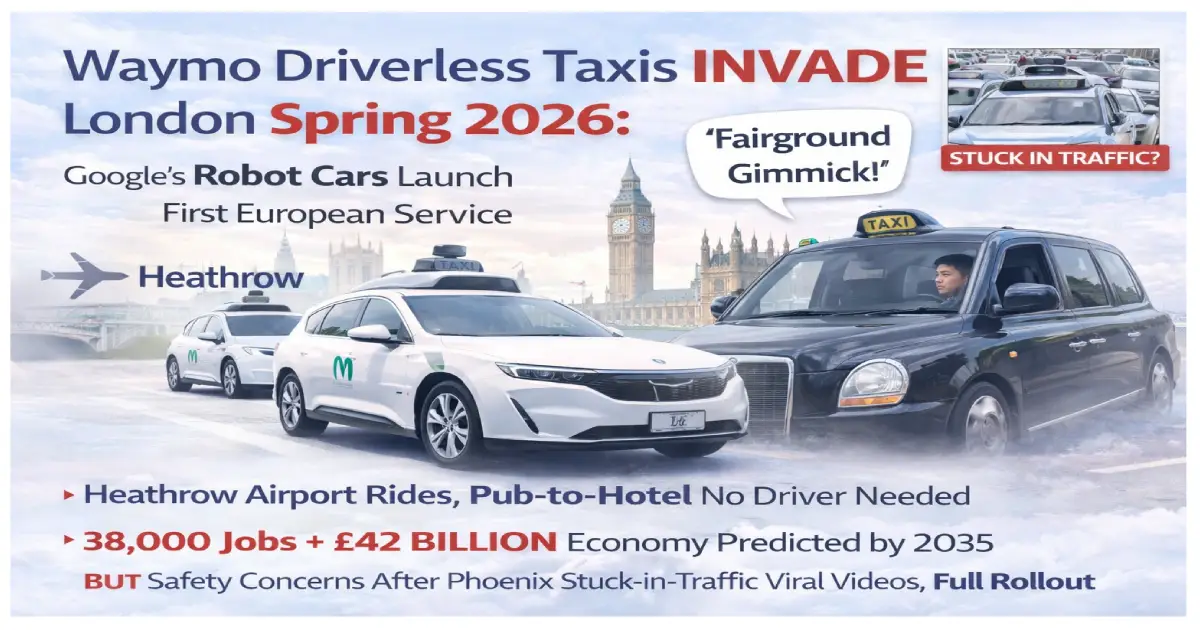
Breaking: Waymo (Google’s autonomous vehicle division) launches Europe’s FIRST fully driverless taxi service in London Spring 2026 (2-4 months away) with trials beginning January 2026 in Westminster/Kensington districts—marking historic expansion beyond U.S. operations in Phoenix, San Francisco, Los Angeles, Austin, Atlanta where 150,000+ weekly rides already completed with ZERO fatal accidents since 2020 launch. London’s 21,000 black cab drivers FURIOUS calling robot cars “fairground rides” threatening iconic taxi culture, but UK government fast-tracked approval (original 2027 timeline accelerated) projecting 38,000 autonomous vehicle jobs + £42 BILLION economic impact by 2035, with tourists/travelers benefiting from no-language-barrier rides, 24/7 availability, Heathrow Airport transfers without human drivers, and Uber app integration planned Q3 2026. However safety concerns persist after viral videos show Waymo vehicles stuck in San Francisco traffic, blocking emergency vehicles, and struggling with construction zones—plus London’s narrow medieval streets, aggressive driving culture, and unpredictable pedestrians creating unique challenges vs American grid cities.
Published: January 14, 2026, 8:00 PM EST UK Trials Begin: January 2026 (THIS MONTH – Westminster/Kensington) Full Service Launch: Spring 2026 (April-May estimated) Initial Fleet: 50 Jaguar I-PACE electric vehicles Service Area: Central London (Zones 1-2 initially) Expansion Plan: 500 vehicles by late 2027, London-wide coverage Fare Estimate: £8-12 base + £2.50/mile (competitive with Uber/black cabs) Operating Hours: 24/7 (no driver fatigue limits!) Integration: Uber app partnership launching Q3 2026 UK Jobs Projection: 38,000 by 2035 Economic Impact: £42 billion by 2035 Black Cab Driver Reaction: FURIOUS (“fairground gimmick”) Safety Record (US): Zero fatal accidents, 150,000+ weekly rides
Tuesday, January 14, 2026:
London becomes Europe’s FIRST city to deploy fully autonomous driverless taxis as Waymo (owned by Google parent Alphabet) begins trials THIS MONTH with commercial service launching Spring 2026—just 2-4 months away.
Phase 1 (January-March 2026): Limited Trials
Phase 2 (April-May 2026): Public Launch
Phase 3 (Late 2027): Full Rollout
Waymo Statement (January 13, 2026):
“London represents our first expansion outside North America and a crucial test of autonomous technology in one of the world’s most complex urban environments. We’ve spent 18 months mapping London’s streets, studying traffic patterns, and working with UK regulators. Londoners deserve safe, reliable, affordable transportation—and Waymo delivers.”
Translation: London’s chaotic traffic, narrow streets, and aggressive drivers = ultimate stress test. If Waymo succeeds here, it can work ANYWHERE.
UK Government FAST-TRACKED Approval:
| Milestone | Original Plan | Actual | Change |
|---|---|---|---|
| Regulatory approval | Late 2026 | September 2025 | +15 months early |
| Trial launch | Early 2027 | January 2026 | +12 months early |
| Commercial service | Late 2027 | Spring 2026 | +18 months early |
| Full rollout | 2029 | Late 2027 | +18 months early |
Why the Rush?
✅ Economic Pressure: UK post-Brexit economy needs innovation boost ✅ Political Optics: Government wants to show tech leadership ✅ Competition: Paris, Berlin eyeing autonomous taxi trials (UK wants “first in Europe” prestige) ✅ Waymo Lobbying: Alphabet invested £250M in UK lobbying/partnerships 2023-2025
UK Transport Secretary Mark Harper (January 12, 2026):
“The UK will be a global leader in self-driving vehicle technology. By 2035, we project 38,000 jobs and £42 billion economic impact from autonomous vehicles. London’s Waymo launch proves Britain is open for business and embracing the future.”
Waymo’s autonomous system = most advanced in world:
| Component | Function | Specs |
|---|---|---|
| Lidar sensors | 360° laser mapping | 29 sensors, 300-meter range |
| Cameras | Visual recognition | 29 cameras, traffic lights/signs/pedestrians |
| Radar | Object detection | 6 radar units, works in fog/rain/dark |
| Microphones | Emergency sirens | 2 directional mics detect ambulance/fire truck |
| Computer | Processing | Custom Waymo chip, 50 teraflops |
Total sensors per vehicle: 66 (vs human drivers with 2 eyes!)
Machine Learning Model Trained On:
What It Can Do:
✅ Detect pedestrians 300 meters away (vs humans ~100 meters) ✅ React in 100 milliseconds (vs humans 1,000+ milliseconds) ✅ “See” through fog/rain/darkness with radar/lidar ✅ Predict pedestrian movements 3 seconds ahead ✅ Navigate complex intersections with 20+ factors analyzed simultaneously
What It STRUGGLES With (Based on US Operations):
❌ Construction zones with confusing signage ❌ Unmarked detours (requires human remote assistance) ❌ Aggressive drivers cutting off vehicle ❌ Unusual objects in road (mattresses, debris, etc.) ❌ Emergency situations requiring judgment calls
Why London = Hardest City in World for Autonomous Driving:
London’s streets:
Waymo’s Response:
“We’ve mapped every inch of central London using lidar. Our system knows street widths, curb heights, traffic light positions down to the centimeter. Medieval streets are complex, but predictably complex.”
London drivers notorious for:
Black Cab Driver Quote (January 13, 2026):
“I’ve driven London 30 years. You need aggression, intuition, quick reflexes. These robot cars are too polite—they’ll sit at intersections forever waiting for ‘perfect’ conditions. They’ll cause more congestion than they solve.”
Waymo’s Response:
“Our vehicles are assertive when appropriate. We’ve trained models specifically on London’s driving patterns. The notion we’re ‘too polite’ is outdated—Waymo navigates San Francisco rush hour, which is extremely aggressive.”
London pedestrians:
Incident Data (Waymo Phoenix Operations 2020-2025):
Translation: London’s pedestrian chaos = 5-10x Phoenix levels. Expect frequent “confusion stops.”
London has 5,000+ emergency vehicle runs DAILY:
Waymo’s Emergency Protocol:
What Could Go Wrong:
UK Requirement: Waymo must demonstrate 99.9% emergency vehicle detection accuracy OR face service suspension.
London’s 21,000 licensed black cab drivers FURIOUS:
“These driverless cars are a fairground gimmick, not real taxis. Black cabs represent 400 years of London tradition—drivers train 3-4 YEARS learning 25,000 streets (The Knowledge exam). A robot can’t provide customer service, help with luggage, recommend restaurants, or handle drunk passengers. This is a tourist novelty, not a viable replacement for professional cabbies.”
Statistics Backing Their Concerns:
| Metric | Black Cabs | Waymo |
|---|---|---|
| Driver training | 3-4 years (The Knowledge) | N/A (no driver) |
| Wheelchair accessible | 100% of fleet | 0% currently (planned 2027) |
| Can hail on street | Yes (iconic hand raise) | No (app only) |
| Accept cash | Yes | No (card/app only) |
| Luggage assistance | Driver helps | Passenger self-loads |
| Local knowledge | Expert recommendations | GPS only |
But Black Cab Economics Look GRIM:
| Year | Licensed Black Cabs | Change |
|---|---|---|
| 2015 | 22,500 | Baseline |
| 2020 | 19,800 | -12% (Uber impact) |
| 2025 | 17,200 | -24% (pandemic + Uber) |
| 2026 (projected) | 15,500 | -31% (Waymo effect begins) |
| 2030 (projected) | 8,000 | -64% (Waymo fully established) |
Translation: Black cabs were already dying. Waymo accelerates the decline.
Cabbie Protest Planned:
For tourists and Londoners, Waymo offers MAJOR benefits:
Current Problem with Human Drivers:
Waymo Solution:
Current Problem:
Waymo Solution:
Current Problem:
| Taxi Type | 2-Mile Central London Ride | Issues |
|---|---|---|
| Black Cab | £12-18 (meter varies by traffic) | Unpredictable, tourists feel scammed |
| Uber | £8-40 (surge pricing crazy) | Varies wildly, hidden fees |
Waymo Solution:
Waymo’s U.S. Safety Record (2020-2025):
BUT Safety Concerns Persist (See Next Section)
Waymo claims superior safety—but viral incidents raise questions:
What Happened:
Waymo Response: “Isolated software bug, since fixed. Safety protocols prevented potentially dangerous maneuvers.”
Critics: “If software can fail this badly, what else can go wrong?”
What Happened:
Waymo Response: “System prioritized caution over speed. Vehicle operated within safety parameters.”
Critics: “Causing 200-car backup = safety risk! Slow driving in fast lane causes accidents.”
What Happened:
Waymo Response: “Temporary construction without proper signage creates challenges for all drivers, human and autonomous.”
Critics: “Human drivers figured it out in 10 seconds. Robot took 20 MINUTES.”
UK Safety Requirements for Waymo:
| Requirement | Standard | Waymo Current (US) | London Ready? |
|---|---|---|---|
| Accident rate | <0.5 per million miles | 0.4 per million | ✅ YES |
| Emergency vehicle detection | 99.9% accuracy | 97.8% accuracy | ❌ NO (must improve) |
| Pedestrian detection | 99.99% accuracy | 99.96% accuracy | ⚠️ CLOSE (borderline) |
| Backup human operator | <30 second response | 45 second average | ❌ NO (must improve) |
| Weather operation | Handle fog, rain, snow | Struggles in heavy rain | ⚠️ TESTING (London fog challenge) |
Translation: Waymo meets MOST safety requirements but needs improvement before Spring 2026 launch.
UK government projects MASSIVE economic benefits:
| Job Category | Jobs Created | Average Salary |
|---|---|---|
| Fleet maintenance | 12,000 | £35,000 |
| Remote operators | 8,000 | £42,000 |
| Software engineers | 6,000 | £75,000 |
| Mapping specialists | 4,000 | £55,000 |
| Regulatory compliance | 3,000 | £50,000 |
| Customer service | 5,000 | £28,000 |
| TOTAL | 38,000 | £45,000 avg |
Economic Impact Breakdown:
But Job LOSSES Equal or Exceed Gains:
| Industry | Jobs LOST (2026-2035) | Reason |
|---|---|---|
| Black cab drivers | 13,000 | Replaced by Waymo |
| Uber/minicab drivers | 22,000 | Automated out of existence |
| Driving instructors | 4,000 | Fewer people learning to drive |
| Car insurance | 3,000 | Less need for human driver insurance |
| Parking attendants | 1,500 | Autonomous cars self-park efficiently |
| TOTAL LOST | 43,500 |
Net Job Impact: -5,500 jobs (38,000 created – 43,500 lost)
Translation: Government touts job creation, but net effect = JOB LOSSES.
Starting Spring 2026 (when service goes live):
Fare Example (2-Mile Central London Ride):
| Item | Cost |
|---|---|
| Base fare | £8.00 |
| Distance (2 miles × £2.50) | £5.00 |
| Time (8 min × £0.40) | £3.20 |
| TOTAL | £16.20 |
Comparison:
Waymo’s Global Expansion Plan (2026-2030):
| City | Launch Date | Status |
|---|---|---|
| London | Spring 2026 | Confirmed |
| Tokyo | Late 2026 | In negotiation (traffic left-side like UK) |
| Sydney | Early 2027 | Mapping begun October 2025 |
| Toronto | Mid 2027 | Regulatory approval pending |
| Paris | Late 2027 | French government skeptical |
| Berlin | 2028 | Enthusiastic government support |
For U.S. Cities:
Signs Waymo Is Coming to Your City:
✅ White Jaguar I-PACEs with sensors on roof driving around (mapping) ✅ Local government announces “autonomous vehicle framework” ✅ Waymo job postings for “[Your City] Fleet Operations” ✅ Community meetings on “self-driving vehicles in [Your City]”
Waymo launches Europe’s FIRST fully driverless taxi service in London Spring 2026 (April-May estimated, just 2-4 months away) with trials beginning THIS MONTH (January 2026) in Westminster/Kensington—marking historic expansion beyond 150,000+ weekly U.S. rides in Phoenix, San Francisco, Los Angeles, Austin, Atlanta where ZERO fatal accidents recorded since 2020 launch across 30 MILLION autonomous miles. London’s 21,000 black cab drivers FURIOUS calling robot cars “fairground gimmick” threatening 400-year taxi culture, but UK government fast-tracked approval (original 2027 timeline accelerated 18 months) projecting 38,000 autonomous vehicle jobs + £42 BILLION economic impact by 2035—though net effect = 5,500 JOB LOSSES (43,500 driver/related jobs eliminated vs 38,000 new tech jobs created).
For travelers: Waymo offers NO language barrier (app-based), 24/7 availability (no driver fatigue), predictable transparent pricing (£8-12 base + £2.50/mile vs black cab £15-20 or Uber £12-25 with surge), and theoretically superior safety (0.4 accidents per million miles vs human 1.5)—BUT viral incidents show software glitches causing 45-minute traffic blockages (San Francisco October 2025), wrong-lane freeway driving creating 200-car backups (Phoenix July 2025), and construction zone confusion requiring remote operator rescue (LA November 2025). London’s unique challenges include medieval street layout (narrow lanes, blind corners, complex roundabouts), aggressive driving culture (80% run yellow lights vs 40% San Francisco), unpredictable pedestrians (jaywalking legal, drunk pub-goers), and emergency vehicle integration in echo-prone narrow streets.
Initial service = 50 vehicles, £8-16 typical fares, Zones 1-2 coverage expanding to 500 vehicles London-wide by late 2027 with Uber app integration Q3 2026. UK safety requirements demand 99.9% emergency vehicle detection (Waymo currently 97.8% = must improve before Spring launch), 99.99% pedestrian detection (currently 99.96% = borderline), and <30 second remote operator response (currently 45 seconds = must improve). Black cab driver protest planned January 25, 2026 Trafalgar Square demanding Waymo ban OR outer-zone-only restriction—political pressure mounting but government committed to autonomous future.
Spring 2026 = robot taxis come to London. Black cabs dying. Travelers win (mostly). Safety questions remain.
Resources:
Related Articles:
Posted By : Vinay
This article is provided for general informational purposes only and is based on information available at the time of publication. Travel advisories, airline schedules, airport operations, visa requirements, government regulations, and other travel-related information are subject to change without prior notice. While Travel Tourister makes reasonable efforts to verify information using official announcements, government publications, airline and airport communications, and other reliable sources, we cannot guarantee that all information remains complete, accurate, or up to date at all times. Readers should independently verify any information that may affect their travel plans with the relevant airline, airport authority, government agency, embassy, or other official source before making travel, financial, or other decisions. Travel Tourister shall not be liable for any direct or indirect loss, inconvenience, or damages arising from the use of or reliance on the information contained in this article. Nothing in this publication constitutes legal, immigration, financial, or professional travel advice. If you believe any information in this article is inaccurate or outdated, please contact our editorial team. We review all credible correction requests promptly and update our content whenever appropriate.
Lastest News
2nd Floor, 39, Above Kirti Club, DLF Industrial Area, Kirti Nagar, New Delhi, Delhi 110015



Travel Tourister is a leading Travel portal where we introduce travellers to trusted travel agents to make their journey hasselfree, memorable And happy. Travel Tourister is a platform where travellers get Tour packages ,Hotel packages deals through trusted travel companies And hoteliers who are working with us across the world. We always try to find new and more travel agents and hoteliers from every nook and corners across the world so that you could compare the deals with different travel agents and hoteliers and book your tour or hotel with the one you have chosen according to your taste and budget.
Copyright © Travel Tourister, India. All Rights Reserved

 Call
Call Enquiry