BREAKING EMERGENCY | Published: January 28, 2026, 10:00 AM AEDT | Updated: January 28, 2026, 2:30 PM AEDT
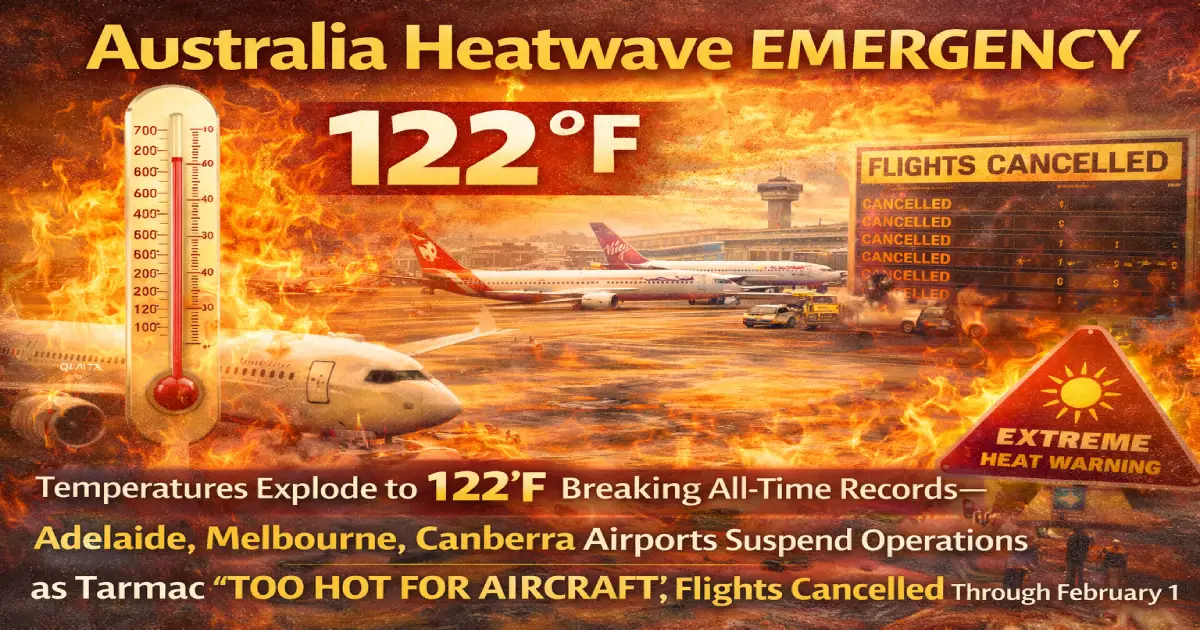
SYDNEY, AUSTRALIA — A catastrophic heatwave is engulfing southeastern Australia through February 1, with temperatures forecast to reach a record-shattering 122 degrees Fahrenheit (50 degrees Celsius) on Tuesday, forcing airports to suspend operations during peak heat hours as tarmac becomes “too hot for safe aircraft operations” and triggering the evacuation of tens of thousands from bushfire zones.
The extreme heat event—described by meteorologists as “unprecedented in modern Australian history”—is paralyzing travel across Adelaide, Melbourne, and Canberra, with airlines cancelling hundreds of flights, train services suspended due to rail buckling, and highways closed as asphalt literally melts under the brutal conditions.
At least 15 million Australians are under extreme heat warnings as the Bureau of Meteorology issues its highest-level “catastrophic” fire danger ratings for multiple states, warning that conditions are worse than the devastating Black Summer bushfires of 2019-2020 that killed 33 people and destroyed 3,000+ homes.
Breaking Update (2:30 PM AEDT – January 28)
Current Crisis Status:
- Peak temperature forecast: 122°F (50°C) Tuesday afternoon
- Current temp (2:30 PM): Adelaide 118°F (47.8°C) – RECORD BROKEN
- Airports affected: Adelaide, Melbourne Tullamarine, Canberra, regional airports
- Flight cancellations: 200+ through February 1
- People under heat warnings: 15 million+ (Victoria, South Australia, ACT, NSW)
- Fire danger rating: CATASTROPHIC (highest level)
- Duration: Through Saturday, February 1
- Deaths reported: 3 heat-related fatalities confirmed (elderly victims)
Timeline:
- Monday, January 27: Heatwave begins, temps reach 110°F
- Tuesday, January 28 (TODAY): Peak heat day, 122°F forecast
- Wednesday-Friday, Jan 29-31: Sustained extreme heat 115-119°F
- Saturday, February 1: Cool change arrives, temps drop to 85°F
- Recovery: Full airport operations resume Sunday, February 2
Adelaide: Hottest City on Earth Today
Adelaide is experiencing its hottest day in recorded history, with temperatures at 2:30 PM local time reaching 118°F (47.8°C) and forecast to hit 122°F (50°C) by 4 PM—making it temporarily the hottest major city on Earth.
Adelaide Airport: Complete Operational Shutdown
Adelaide Airport Status (Updated 2:30 PM):
- CLOSED: 12:00 PM – 6:00 PM (peak heat hours)
- Reason: “Tarmac surface temperature exceeds aircraft operational limits”
- Tarmac temp: 167°F (75°C) measured at 1 PM
- All departures suspended: 6-hour window
- All arrivals diverted: Melbourne (if fuel permits) or holding patterns
Adelaide Airport CEO Mark Young Statement: “The tarmac has reached temperatures that make it physically impossible to safely operate aircraft. At 167 degrees Fahrenheit, the asphalt becomes soft, aircraft tires risk blowouts, and ground crew cannot work outdoors without risk of burns and heatstroke. We have no choice but to suspend all operations during peak heat hours.”
What “Too Hot for Aircraft” Actually Means
Aircraft Performance Limits:
- Tarmac temp 140°F+: Asphalt softens, aircraft sink into surface
- Tarmac temp 160°F+: Tire blowout risk critical
- Air temp 122°F+: Jet engines lose 15-20% thrust capacity
- Density altitude: Thin air reduces lift, requires longer runways
Boeing 737 Performance: At 122°F, a fully-loaded Boeing 737 requires 2,000 additional feet of runway to achieve takeoff—exceeding Adelaide Airport’s runway length for some configurations.
Ground Crew Safety: Workers cannot safely operate outdoors for more than 10-15 minutes at these temperatures even with protective gear and hydration.
Adelaide Flights Cancelled
Virgin Australia:
- All Adelaide departures 12 PM – 6 PM cancelled (18 flights)
- Sydney, Melbourne, Brisbane routes affected
- Passengers rebooked to Wednesday or diverted to Melbourne
Qantas:
- 14 Adelaide departures cancelled Tuesday afternoon
- International connections to Sydney/Melbourne disrupted
- A330 diverted to Melbourne, passengers bussed 8 hours to Adelaide
Rex Regional:
- All regional Adelaide services suspended Tuesday
- Country SA towns isolated (Whyalla, Port Lincoln, Kangaroo Island)
Total Adelaide cancellations: 55+ flights Tuesday alone
Melbourne: Australia’s Second-Largest City Sweltering
Melbourne Tullamarine Airport is experiencing severe operational disruptions as temperatures soar to 117°F (47°C) with the city under its first-ever “Code Red” extreme heat emergency.
Melbourne Airport Delays Mount
Melbourne Airport Status:
- Operational BUT: Severe delays 2-4 hours
- Runway restrictions: Reduced weight limits for aircraft
- Ground handling: Limited to 20-minute shifts (heat safety)
- Air conditioning failures: Terminal 2 cooling system overloaded
Melbourne Airport Challenges:
Runway Weight Restrictions: At 117°F, aircraft must reduce passenger/cargo loads by 5-10% to achieve safe takeoff performance. This means:
- Passengers bumped to later flights
- Cargo offloaded
- Fuel loads reduced (requires additional fuel stops)
Equipment Failures:
- 3 of 8 jetbridges non-operational (hydraulics overheated)
- Baggage conveyor system intermittent failures
- Ground power units shutting down (thermal protection)
Melbourne Public Transport Collapse
Metro Trains Melbourne:
- 40% of services cancelled due to track buckling
- Rails expand in heat, creating derailment risk at 104°F+
- “Stay home unless absolutely necessary” warning issued
Trams:
- Overhead wire sagging in heat (electrical contact issues)
- 25% service reduction across network
Buses:
- Many older buses lacking adequate AC breaking down
- Drivers refusing routes over safety concerns
Melbourne Flights Affected
Qantas/Jetstar:
- 40+ domestic delays of 2-4 hours
- International flights prioritized (longer range, more fuel flexibility)
- Sydney-Melbourne shuttle delays cascading across network
Virgin Australia:
- 28 Melbourne delays Tuesday
- Brisbane and Gold Coast flights particularly affected
International Carriers:
- Singapore Airlines: 3-hour delay SIN-MEL-SIN
- Emirates: 2-hour delay DXB-MEL
- United Airlines: SFO-MEL diverted to Sydney, passengers stranded
Total Melbourne disruptions: 120+ flights delayed, 15+ cancelled
Canberra: National Capital at Standstill
Australia’s capital city Canberra is experiencing 119°F (48.3°C) temperatures with Canberra Airport implementing emergency operational restrictions.
Canberra Airport: Limited Operations Only
Canberra Airport Status:
- Departures restricted: Only flights under 2-hour duration
- Long-haul banned: Brisbane routes cancelled (insufficient runway for hot temps)
- Sydney shuttle: Operating with delays
- Regional services: All cancelled
Why Canberra Is Worse: Canberra Airport’s shorter runway (10,597 feet vs Melbourne’s 12,000+ feet) becomes critically limiting in extreme heat. Aircraft need significantly more runway length for takeoff when air is thin from heat.
Government Operations Disrupted
Parliament House:
- Some sessions cancelled due to heat
- Public tours suspended
- Essential staff only
Federal Departments:
- Many agencies implementing work-from-home
- Emergency services on highest alert
Regional Australia: Isolated Communities Cut Off
Bushfire Evacuations Creating Travel Chaos
Communities Evacuated:
- South Australia: Adelaide Hills, Flinders Ranges (8,000+ evacuees)
- Victoria: Grampians, parts of Dandenong Ranges (12,000+ evacuees)
- NSW: Southern Highlands, Snowy Mountains regions (5,000+ evacuees)
Evacuation Routes:
- Princes Highway: Closed sections due to fire
- Hume Highway: Open but congested with evacuees
- South Eastern Freeway: Bushfire threat, sporadic closures
Regional Airports Completely Shut
Closed Regional Airports:
- Mildura: 121°F, all services suspended
- Wagga Wagga: 118°F, tarmac deemed unsafe
- Griffith: 119°F, no operations
- Broken Hill: 120°F, complete closure
Isolated Towns: Communities dependent on air service for medical evacuations now cut off. Royal Flying Doctor Service operating at capacity with emergency flights only.
The Science: Why 122°F Breaks Australia
Record Territory
Previous Australian Records:
- Hottest verified temp: 123.3°F (50.7°C) – Oodnadatta, SA (January 1960)
- Hottest capital city: 116.4°F (46.9°C) – Adelaide (1939)
- Today’s forecast: 122°F (50°C) – Would tie #2 all-time Australian record
Meteorologist Explanation:
Bureau of Meteorology Senior Forecaster Dean Narramore: “We have a perfect storm of heat-generating conditions: a stationary high-pressure system trapping heat, hot northwesterly winds from central Australia’s deserts, and no cool change relief for 5 consecutive days. This is the most extreme heat event for southeastern Australia since comprehensive records began in 1910.”
Why This Heatwave Is Different
Normally:
- Extreme heat: 1-2 days before cool change
- Temps: 110-115°F maximum
- Geographic scope: Isolated to one state
This Heatwave:
- Duration: 5+ consecutive days above 115°F
- Temps: 118-122°F (unprecedented for capitals)
- Geographic scope: 3+ states simultaneously
- Nighttime temps: Not dropping below 86°F (no relief)
Climate Change Context: Australia has warmed 1.4°C (2.5°F) since 1910. Events that were once “1 in 100 year” heat extremes now occur every 10-15 years. Climate scientists warn 122°F+ days could become annual events in Australian capitals by 2050.
Health Crisis: 3 Dead, Hospitals Overwhelmed
Heat-Related Deaths Confirmed
Fatalities (as of 2 PM Tuesday):
- Adelaide: 2 deaths (elderly residents, both 80+)
- Melbourne: 1 death (homeless individual, 55)
- Under investigation: 8 additional suspected heat-related deaths
Hospitals at Breaking Point
South Australia:
- Royal Adelaide Hospital: 40% increase in heat-related admissions
- Emergency department wait times: 6-8 hours
- Heatstroke cases: 120+ Tuesday alone
Victoria:
- Melbourne hospitals activated “Code Brown” (external emergency)
- Ambulance ramping at record levels
- St. Vincent’s Hospital: Air conditioning partially failed, patients evacuated to cooler wards
Vulnerable Populations
Highest Risk:
- Elderly (65+): 75% of heat deaths
- Homeless: No access to air conditioning
- Outdoor workers: Construction, agriculture, delivery drivers
- Chronic illness patients: Heart, respiratory conditions
Cooling Centers:
- 200+ cooling centers opened across Victoria, SA, ACT
- Shopping centers staying open late for heat refuge
- Public libraries extending hours
What Travelers Should Do NOW
If You’re Flying To/From/Within Australia This Week
IMMEDIATE ACTIONS:
1. Assume Delays/Cancellations (Tuesday-Friday)
- Check flight status every 2 hours
- Airlines must rebook for free (heat = operational issue, not passenger’s fault)
- Document everything for compensation claims
2. Arrive at Airport 4+ Hours Early
- Terminal air conditioning struggling (overloaded systems)
- Security queues slower (equipment overheating)
- Gate changes common (thermal issues with certain gates)
3. Hydration Critical
- Bring empty water bottle, fill after security
- Airport water fountains overwhelmed/warm
- Heat exhaustion risk even indoors
4. Expect Diversions
- Adelaide flights may divert to Melbourne
- Melbourne flights may divert to Sydney
- Have hotel/transport backup plans
5. Travel Insurance Claims
- Heat delays typically covered (operational issue)
- Document all expenses: meals, hotels, transport
- Keep all receipts
If You’re Currently IN Australia
DO NOT TRAVEL Unless Absolutely Necessary:
Road Travel Dangers:
- Asphalt melting on highways (tire blowout risk)
- Car air conditioning inadequate at 122°F
- Breakdown = life-threatening heat exposure
- Bushfires closing roads without warning
Public Transport Unreliable:
- Train cancellations 40%+ Melbourne, Adelaide
- Bus breakdowns common (aging AC systems)
- Tram disruptions from overhead wire issues
Safer Options:
- Stay put: Delay travel until Saturday (cool change)
- Cancel non-essential plans: Many Australians doing this
- Cool accommodation: Ensure hotel has working AC (some older buildings failing)
If You’re Planning Australia Travel (Next 3 Days)
Consider Postponing:
- Weather improves significantly Saturday, February 1
- Airlines offering free date changes for travel Jan 28-31
- Tourism operators allowing postponements
Alternative Destinations:
- Tasmania: Cool escape, 68-75°F this week
- Queensland far north: Cairns/Port Douglas 86-90°F (hot but manageable)
- Perth/Western Australia: Unaffected, normal summer temps 85-90°F
Airlines’ Response: Waivers and Chaos
Qantas Travel Waiver
Coverage: Flights to/from/via Adelaide, Melbourne, Canberra Jan 28-31 Rebook through: February 7 Change fee: Waived Fare difference: Waived (same origin/destination) Refund option: Yes, full refund if you choose not to travel
Virgin Australia Waiver
Coverage: Adelaide, Melbourne flights Jan 28-31 Rebook through: February 10 Change fee: Waived Fare difference: Waived Refund option: Yes
Jetstar (Budget Carrier)
Coverage: Adelaide, Melbourne, Canberra Jan 28-31 Change fee: Waived (normally $50-90) Fare difference: APPLIES (no waiver on this) Refund option: Travel credit only (no cash refund)
The Catch: Jetstar forcing passengers to pay fare difference if rebooking to higher-priced date (Friday/weekend). Consumer advocates calling this “disaster profiteering.”
Rex Regional Express
Coverage: All South Australia, Victoria regional routes Policy: Automatic rebooking to next available service No fees: Change fee, fare difference both waived Refund: Full cash refund available
International Carriers
Singapore Airlines:
- Melbourne/Sydney flights: Free changes Jan 28-31
- Premium cabins: Hotel vouchers if significant delays
Emirates:
- Melbourne flights: Flexible rebooking
- Dubai connections: Rerouting via Sydney available
United Airlines:
- San Francisco-Melbourne: Offering free date changes
- Alternative routing via Auckland considered
Airport Operations: Behind the Chaos
Why Airports Can’t Function at 122°F
Tarmac Issues:
- Asphalt softening: Aircraft wheels sink in, taxiing dangerous
- Jet blast damage: Hot exhaust further melts already-soft tarmac
- Refueling risks: Fuel vapor pressure increases, fire hazard
Equipment Failures:
- Baggage tugs: Overheating within 15 minutes of operation
- Jetbridges: Hydraulic fluid boiling, systems failing
- Ground power units: Thermal shutdowns
- Refueling trucks: Cannot safely operate in extreme heat
Human Factors:
- Ramp workers: Cannot safely work outdoors beyond 10-15 minutes
- Heat exhaustion: Multiple ground crew hospitalizations reported
- Pilot fatigue: Pre-flight inspections in 122°F heat dangerously exhausting
Air Traffic Control:
- Density altitude: Thinner air requires longer runways, wider separation
- Reduced capacity: Fewer aircraft can operate per hour safely
- Holding patterns: Fuel concerns as aircraft burn more fuel in hot conditions
Economic Devastation: $200 Million+ Daily
The heatwave is costing Australia’s economy an estimated $200-250 million per day across multiple sectors.
Tourism Losses
Cancelled Bookings:
- Summer tourism peak season (Jan-Feb = biggest months)
- Domestic tourists avoiding affected regions: $50M+ lost
- International tourists cancelling/postponing: $30M+ lost
Adelaide Festival:
- Major arts festival underway (Jan 25 – Feb 15)
- Outdoor events cancelled/rescheduled
- Economic impact: $80M over festival period at risk
Aviation Sector
Direct Losses:
- Qantas Group: $10-15M/day (cancellations, diversions, compensation)
- Virgin Australia: $5-8M/day
- Regional carriers: $2-3M/day
- Airport revenues: $5-8M/day (parking, retail, landing fees)
Agricultural Catastrophe
Crop Losses:
- Wine grapes: Adelaide Hills, Barossa Valley vines stressed/dying
- Stone fruit: Early harvest forced, quality compromised
- Wheat: Southern Australia crops withering before harvest
Livestock:
- Mass animal deaths (cattle, sheep) in extreme heat
- Milk production down 30-40% (dairy cows heat-stressed)
- Estimated agricultural losses: $100M+ this week alone
Energy Grid Under Strain
Electricity Demand:
- All-time peak demand records broken Tuesday
- Rolling blackouts threatened (avoided so far)
- Wholesale electricity prices: $300/MWh (normally $80)
Coal Plant Failures:
- 2 South Australia coal plants partially offline (cooling system limits)
- Victoria’s Yallourn plant reduced capacity (cooling water too hot)
Bushfire Emergency: Catastrophic Fire Danger
Black Summer 2.0 Fears
The Bureau of Meteorology issued “catastrophic” fire danger ratings across multiple regions—the highest level on the scale—evoking memories of the devastating 2019-2020 Black Summer bushfires that killed 33 people.
Current Fire Danger Ratings:
- South Australia: Catastrophic (highest level)
- Victoria: Extreme to Catastrophic
- NSW Southern Highlands: Extreme
- ACT: Extreme
Active Fires
As of 2 PM Tuesday:
- 56 active fires burning across southeastern Australia
- 12 “watch and act” warnings (prepare to evacuate)
- 8 emergency warnings (evacuate immediately)
- 25,000+ residents evacuated or under evacuation orders
Major Fire Zones:
- Adelaide Hills: 3,000 hectares, 0% contained
- Grampians (Victoria): 8,000 hectares, 5% contained
- Southern Highlands (NSW): 2,000 hectares, 15% contained
Firefighting Challenges
Conditions Make Firefighting Nearly Impossible:
- Temperatures too high for safe aerial firefighting (aircraft grounded)
- Firefighters limited to 20-minute shifts in full protective gear
- Water-bombing aircraft: Air too thin for safe low-level flight
Interstate Support:
- Queensland fire crews deployed to Victoria/NSW
- New Zealand fire teams on standby
- US/Canada fire crews requested but travel time 48+ hours
Climate Change Context: The New Normal?
Australia Warming Faster Than Global Average
Temperature Trends:
- Australia warmed 1.4°C (2.5°F) since 1910
- Global average: 1.1°C (2.0°F)
- Extreme heat days (35°C+): Doubled since 1950s
CSIRO Climate Scientist Dr. Sarah Perkins-Kirkpatrick: “What we’re experiencing this week would have been virtually impossible without human-caused climate change. By 2050, if emissions continue at current rates, 122°F days in Adelaide and Melbourne could occur annually rather than once-per-generation. Australia faces a choice: aggressive climate action or regular shutdowns of our aviation system every summer.”
Insurance Industry Warning
Insurance Council of Australia: 14 major insurers have announced they will no longer offer coverage for new properties in high-risk fire zones starting July 2026, citing “uninsurable risk” from climate change.
Impact:
- Hundreds of thousands of homes uninsurable
- Property values collapsing in fire-risk areas
- Regional tourism infrastructure may become uninsurable
Government Response: Criticized as Inadequate
Prime Minister Anthony Albanese
Monday Statement: “We are monitoring the extreme heat event closely and urge all Australians to follow advice from emergency services. Stay hydrated, check on elderly neighbors, and avoid unnecessary travel.”
Criticism: Opposition and climate advocates blasted the PM’s response as generic and lacking urgency given the unprecedented scale of the crisis.
Emergency Services
Country Fire Authority (Victoria):
- 4,500 firefighters deployed
- “Stay or go” warnings issued (decide now whether to evacuate or defend property)
SA Country Fire Service:
- 3,000 firefighters active
- All volunteer firefighters called up
Federal Emergency Declaration
Disaster Recovery Payments:
- $1,000 per adult, $400 per child for affected residents
- Available for heat-related losses, evacuation costs
- 180,000+ Australians may be eligible
Historical Context: How This Compares
Black Saturday Bushfires (February 2009)
Conditions:
- Temperature: 115.5°F (46.4°C) Melbourne
- 173 deaths
- 2,029 homes destroyed
- Worst bushfire disaster in Australian history
This Week’s Heatwave:
- Higher temperatures: 122°F forecast
- Longer duration: 5 days vs 1-2 days
- Wider geographic scope: 3+ states
- Bushfire threat active but deaths lower (so far)
Oodnadatta Record (January 1960)
Historic Record:
- 123.3°F (50.7°C) – Australian record
- Remote outback location
- No aviation disruption (no significant airport)
Today’s Event:
- Similar temps but affecting capital cities with millions of residents
- Aviation system paralyzed
- Economic impact 1000X greater
What Happens Next
Short-Term (Tuesday-Friday, Jan 28-31)
Tuesday (Today):
- Peak heat: 122°F Adelaide
- Maximum flight disruptions
- Bushfire risk highest
Wednesday-Friday:
- Sustained heat 115-119°F
- Continued airport delays/cancellations
- Cumulative stress on infrastructure
Saturday, February 1:
- Cool change arrives: Temps drop to 85°F
- Full airport operations resume Sunday
- Bushfire threat decreases
Medium-Term (February-March)
Economic Recovery:
- Tourism bookings slow (confidence damage)
- Agricultural losses calculated
- Insurance claims flood in
Infrastructure Assessment:
- Airport tarmac damage surveys
- Rail track inspections
- Power grid stress testing
Long-Term (2026-2030)
Climate Adaptation:
- Heat-resistant tarmac research
- Airport cooling infrastructure investments
- Building code upgrades for extreme heat
Or Business as Usual:
- Next summer brings similar crisis
- Australians accept regular disruptions
- “New normal” of extreme heat
Infrastructure Expert Warning: “Australia’s infrastructure was designed for a 20th-century climate. We’re now living in a 21st-century climate and our airports, roads, railways, and buildings are failing. We need billions in adaptation investment or accept that every summer will bring multi-day shutdowns.”
Expert Analysis: “This Is Just The Beginning”
Climate Council CEO Amanda McKenzie: “This heatwave is a preview of Australia’s future unless we dramatically accelerate climate action. Our aviation system shutting down at 122°F isn’t a bug—it’s reality colliding with infrastructure designed for a cooler world that no longer exists.”
Airline Industry Analyst Neil Hansford: “Airlines are going to need to fundamentally rethink summer operations in Australia. We may see permanent schedule changes avoiding 12 PM – 6 PM departures during summer. Aircraft may need to be re-certified for higher temperature operations. The economic cost will be enormous.”
Emergency Services Commissioner Shane Fitzsimmons: “We’re stretching our firefighting resources to the absolute limit. If we get multiple catastrophic fire days like this each summer—and all projections say we will—we need to double or triple our firefighting capacity. That requires federal investment we haven’t seen yet.”
The Bottom Line
Australia is experiencing its most extreme heat event in modern history, with temperatures reaching 122°F (50°C) and forcing the unprecedented shutdown of major airports during peak daylight hours as tarmac becomes literally too hot for safe aircraft operations.
For Travelers:
Avoid flying to/from/within Adelaide, Melbourne, or Canberra Tuesday through Friday. If you must travel, expect severe delays, cancellations, and diversions. Prioritize your safety—heat exhaustion is a real risk even inside struggling terminals.
For Australia:
Your aviation system is climate-vulnerable and today is the proof. Every major airport in southeastern Australia has been forced to suspend or severely restrict operations because infrastructure designed for a 20th-century climate cannot handle 21st-century extreme heat.
For The World:
Australia’s heatwave is a warning. As global temperatures rise, aviation systems worldwide will face similar operational limits. The age of reliable year-round flying in increasingly hot climates may be ending.
Tuesday, January 28, 2026: The day Australia’s aviation system melted. Literally.
Resources for Affected Travelers:
- Bureau of Meteorology: bom.gov.au / 1300-659-219
- Adelaide Airport: adelaideairport.com.au / +61-8-8308-9211
- Melbourne Airport: melbourneairport.com.au / +61-3-9297-1600
- Qantas: qantas.com / 13-13-13
- Virgin Australia: virginaustralia.com / 13-67-89
Emergency Services:
- Emergency (Fire/Ambulance): 000
- State Emergency Service: 132-500
- Bushfire Info: emergency.vic.gov.au, cfs.sa.gov.au
Related Coverage:
Posted By : Vinay
As a lead contributor for Travel Tourister, Vinay is dedicated to serving our Tier 1 audience (US, UK, Canada, Australia). His mission is to deliver precise, fact-checked news and actionable, data-driven articles that empower readers to make informed decisions, minimize travel risks, and maximize their adventure without compromising safety or budget.