Published on : 31 Jan 2026
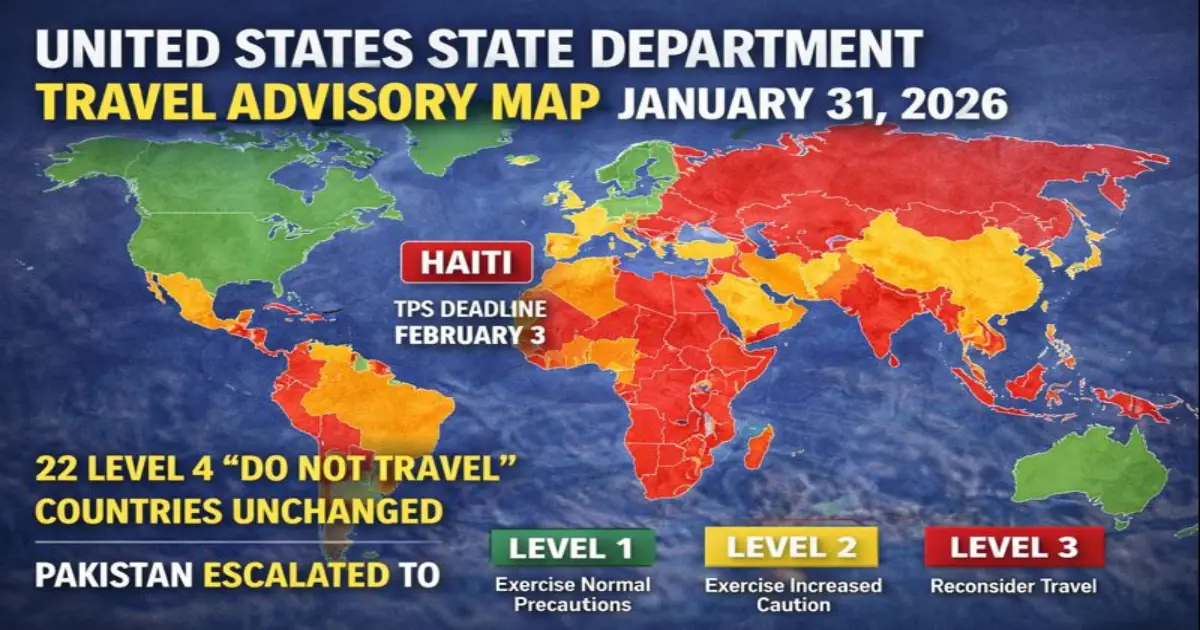
BREAKING JANUARY 31: State Department’s 22 Level 4 “Do Not Travel” countries remain UNCHANGED since January 8 reissue despite fluid global conditions—Pakistan escalated to Level 3 January 29 (Khyber Pakhtunkhwa remains Level 4), Haiti TPS deadline TOMORROW February 3 affects 340,000 deportable Haitians while Port-au-Prince remains 90% gang-controlled making return life-threatening, Lebanon maintains Level 4 despite November ceasefire (Syria/Israel borders still dangerous). Complete 22-country list: Afghanistan, Belarus, Burkina Faso, Burma/Myanmar, Central African Republic, Gaza, Haiti, Iran, Iraq, Lebanon, Libya, Mali, Niger, North Korea, Russia, Somalia, South Sudan, Sudan, Syria, Ukraine, Venezuela, Yemen. Here’s what changed past 16 days since our January 15 comprehensive guide.
TOMORROW (February 3, 2026) marks the deadline for 340,000 Haitians losing Temporary Protected Status making them deportable to a country the US State Department warns is too dangerous for Americans to visit—Haiti remains under Level 4 “Do Not Travel” advisory with gang violence controlling 90% of capital Port-au-Prince, creating humanitarian crisis where deportees face life-threatening risks upon return. Meanwhile the 22 Level 4 countries remain completely UNCHANGED since State Department’s January 8, 2026 reissue (Afghanistan, Belarus, Burkina Faso, Burma/Myanmar, Central African Republic, Gaza, Haiti, Iran, Iraq, Lebanon, Libya, Mali, Niger, North Korea, Russia, Somalia, South Sudan, Sudan, Syria, Ukraine, Venezuela, Yemen) despite ongoing conflicts evolving globally—Russia renewed its warning December 29 emphasizing wrongful detention risks, Venezuela continues “depart immediately” order following December 2025 US airstrikes, Lebanon stays Level 4 despite November 27 ceasefire between Israel-Hezbollah because Syria/Israel border regions remain active combat zones. NEW this week: Pakistan escalated from Level 2 to Level 3 “Reconsider Travel” on January 29 citing terrorism risks (transportation hubs, hotels, markets, military sites, schools, hospitals, places of worship targeted without warning), while Khyber Pakhtunkhwa province maintains Level 4 “Do Not Travel” status due to assassination/kidnapping attempts common against government officials and private citizens including Pakistani-American dual nationals. The static 22-country Level 4 list reflects State Department’s conservative approach—once countries reach highest warning level, they rarely downgrade unless dramatic security improvements occur (Lebanon ceasefire insufficient because borders still dangerous). Here’s complete breakdown of what changed past 16 days since our comprehensive January 15 guide, Haiti TPS crisis, Pakistan escalation, why 22-country list staying unchanged.
Published: January 31, 2026 8:00 PM EST Haiti TPS Deadline: TOMORROW February 3, 2026 (340,000 affected) Previous Comprehensive Coverage: January 15, 2026 Complete 22-Country Guide State Dept Last Level 4 Reissue: January 8, 2026 (22 countries UNCHANGED) Pakistan Escalated: January 29, 2026 Level 2 → Level 3 Russia Warning Renewed: December 29, 2025 (reissued wrongful detention emphasis) Lebanon Status: Still Level 4 (November ceasefire insufficient, borders dangerous) Total Level 4 Countries: 22 (NO CHANGES since January 8) Coordinated Warnings: US, UK, Canada, Australia, NZ aligned on most destinations
If you’re planning international travel, have family affected by Haiti TPS deadline tomorrow, or wondering why Lebanon stays Level 4 despite ceasefire, here’s everything that changed since our January 15 comprehensive 22-country guide—focusing on Haiti TPS crisis, Pakistan escalation, Lebanon ceasefire analysis, why list staying static.
Summary: NOT MUCH. The 22 Level 4 countries remain frozen since January 8 reissue.
Major Updates January 15-31, 2026:
✅ Pakistan: Level 2 → Level 3 (January 29) – terrorism risks, demonstrations ✅ Haiti TPS: Deadline TOMORROW February 3 – 340,000 losing deportation protection ✅ Lebanon: Remains Level 4 despite November 27 ceasefire (borders still combat zones) ✅ Russia: Warning reissued December 29 (wrongful detention emphasis) ✅ Venezuela: “Depart immediately” order continues (December airstrikes aftermath) ❌ No additions to Level 4 list (still 22 countries) ❌ No downgrades from Level 4 (Lebanon ceasefire insufficient)
Why the List Isn’t Changing:
State Department rarely downgrades Level 4 warnings because:
Once a country hits Level 4, it typically stays there for YEARS unless government changes entirely (example: if Taliban fell in Afghanistan, advisory might downgrade).
NEW January 29, 2026: Pakistan upgraded from Level 2 (“Exercise Increased Caution”) to Level 3 (“Reconsider Travel”) marking first major advisory change in South Asia this year.
Why Pakistan Escalated:
State Department warning: “Terrorist attacks may occur without warning, targeting transportation hubs, hotels, markets, shopping malls, military and security sites, airports, trains, schools, hospitals, places of worship, tourist locations, and government buildings.”
Level 4 Regions Within Pakistan (Do NOT Travel):
What Level 3 Means for Travelers: ✅ Reconsider non-essential travel ✅ Avoid demonstrations (US citizens detained for participating) ✅ Expect limited US embassy assistance in Level 4 regions ✅ Travel insurance may not cover Level 3 destinations
Pakistan vs Level 4 Countries: Pakistan remains SAFER than 22 Level 4 nations—you CAN travel but should reconsider. Level 4 means DO NOT TRAVEL under any circumstances.
Other Level 3 Countries (Similar to Pakistan):
The Contradiction: US government says Haiti too dangerous for Americans to visit (Level 4) while simultaneously deporting 340,000 Haitians back to Port-au-Prince starting TOMORROW February 3, 2026.
Haiti Current Situation:
Temporary Protected Status (TPS) Ending:
State Department Advisory Excerpt (Haiti): “Kidnapping is widespread and victims regularly include U.S. citizens. Kidnappers may use sophisticated planning or take advantage of unplanned opportunities, and even convoys have been attacked. Kidnapping cases often involve ransom negotiations and U.S. citizen victims have been physically harmed during kidnappings.”
The Policy Disconnect:
| For Americans | For Haitian Deportees |
|---|---|
| Level 4: DO NOT TRAVEL | Must return to Haiti |
| “Depart Haiti immediately” | Being sent back |
| Embassy has limited ability to help | No US support upon return |
| Life-threatening risks | Life-threatening risks |
Advocacy groups call this “deporting people to a war zone.” State Department hasn’t explained the contradiction.
The Question: Lebanon-Israel ceasefire took effect November 27, 2025. Why is Lebanon STILL Level 4 “Do Not Travel” two months later?
State Department’s Reasoning:
Lebanon Advisory (Current): “Do not travel to Lebanon due to crime, terrorism, civil unrest, kidnapping, unexploded landmines, and the risk of armed conflict. Some areas have increased risk.”
Specific Level 4 Zones Within Lebanon: ✅ Border with Syria – Active conflict spillover, ISIS remnants ✅ Border with Israel – Military activity continues despite ceasefire ✅ Palestinian refugee camps – Hezbollah presence, lawlessness ✅ Bekaa Valley – Drug trafficking, kidnapping risks ✅ Tripoli/Northern Lebanon – Extremist activity
Why Ceasefire Isn’t Enough:
Historical Context: Lebanon has been Level 4 continuously since 2021. Previous downgrades (Level 3 in 2018-2020) happened during brief stability periods—but country relapsed into crisis with 2019 protests, 2020 Beirut explosion, 2023 banking collapse.
When Might Lebanon Downgrade? State Department would need to see:
Bottom Line: Ceasefire is progress but insufficient for Level 4 removal.
Africa (10 countries):
Middle East (7 countries + 1 territory): 9. Afghanistan – Taliban control, terrorism 10. Gaza – Active war zone (Israel-Hamas conflict) 11. Iran – Wrongful detention of Americans 12. Iraq – Terrorism, kidnapping, armed conflict 13. Lebanon – Terrorism, armed conflict (despite ceasefire) 14. Syria – Civil war ongoing since 2011 15. Yemen – Civil war, Houthi attacks on shipping
Europe (3 countries): 16. Belarus – Arbitrary detention, Russia alignment 17. Russia – Wrongful detention, Ukraine war 18. Ukraine – Active war since February 2022 Russian invasion
Asia (2 countries): 19. Burma/Myanmar – Military coup, civil unrest 20. North Korea – Wrongful detention, no US embassy
Latin America (1 country): 21. Venezuela – Civil unrest, crime, arbitrary detention, “depart immediately” since December 2025 US airstrikes
Total: 22 Level 4 destinations
Critical for Americans: Most travel insurance WON’T cover Level 4 destinations—but WILL cover Level 3.
Level 4 (Do Not Travel) Insurance: ❌ Trip cancellation typically DENIED if traveling to Level 4 country ❌ Medical evacuation may be DENIED ❌ “Travel against government warnings” exclusion applies ❌ Some “cancel for any reason” policies may cover—but rare
Level 3 (Reconsider Travel) Insurance: ✅ Trip cancellation usually COVERED ✅ Medical evacuation COVERED ✅ Emergency assistance COVERED ✅ If advisory escalates to Level 4 AFTER purchase, cancellation covered
Pakistan Example (Level 2 → Level 3 January 29):
Scenario: You booked Pakistan trip January 15 (Level 2). Pakistan escalated Level 3 January 29.
What Happens: ✅ You CAN cancel with travel insurance and get refund (advisory change after purchase) ✅ You CAN still travel but insurance coverage active ✅ If Pakistan escalates to Level 4 before your trip, full refund guaranteed
Haiti Example (Level 4):
Scenario: You book Haiti trip today.
What Happens: ❌ Most travel insurance DENIES coverage ❌ “Traveling against government warnings” exclusion applies ❌ Even “cancel for any reason” policies often exclude Level 4
Pro Tip: Buy travel insurance BEFORE advisories escalate. Coverage depends on when you purchased policy vs when warning issued.
The Pattern: Once countries hit Level 4, they stay there for YEARS.
Average Time at Level 4:
What It Takes to Downgrade from Level 4:
Recent Downgrades (Rare Examples):
Requirements for Downgrade:
Why Lebanon HASN’T Downgraded Despite Ceasefire:
Bottom Line: State Department errs on side of caution. Better to keep warnings high than downgrade prematurely and have Americans killed.
Winter Olympics 2026 Milan-Cortina: Opening Ceremony Tomorrow: Mariah Carey, Andrea Bocelli Perform, Europe Flights Down 14%, Milan Hotels Sold Out
US Government Shutdown Deadline: 48 Hours Until TSA Crisis: Congress Deadlock Threatens Air Travel Chaos, 50,000 TSA Agents Unpaid
Grenada Travel Advisory Raised: 2 Americans Murdered: Level 2 Issued After Armed Robbery Deaths, Caribbean Cruise Safety Concerns
Peru Lima Protest Today: Gen Z March Downtown: Travel Disruption, Machu Picchu Access, Airport Road Closures
January 15 Complete 22-Country Guide: Venezuela, Mexico, Iraq Detailed: Original Comprehensive Coverage with Country-by-Country Breakdown
Updated: January 31, 2026 8:30 PM EST | Next Update: When Level 4 list changes (rare) or major advisory escalations occur
When State Department issues Level 4 “Do Not Travel” warning, it’s effectively saying “we cannot guarantee your safety and may not be able to rescue you if something goes wrong.” The 22 countries on this list remain UNCHANGED since January 8, 2026 reissue because conditions haven’t improved enough to warrant downgrades—Lebanon’s November ceasefire insufficient because Syria/Israel borders still dangerous, Russia’s wrongful detention of Americans continuing, Venezuela’s December airstrikes creating ongoing instability, Afghanistan/Syria/Yemen civil conflicts showing no resolution.
The numbers tell the story:
For Americans planning international travel:
The Haiti TPS contradiction:
US government simultaneously says Haiti too dangerous for Americans (Level 4) while deporting 340,000 Haitians back to Port-au-Prince starting TOMORROW where gangs control 90%, kidnapping is epidemic, cholera outbreak ongoing, government collapsed. Advocacy groups call this “humanitarian crisis” but policy continues unchanged.
The Lebanon ceasefire question:
Two months after Israel-Hezbollah ceasefire (November 27), Lebanon remains Level 4 because:
Bottom line: Level 4 warnings rarely lift. Afghanistan (3+ years), Syria (12+ years), Somalia (25+ years) show once countries reach highest alert, they stay there until DRAMATIC security improvements—ceasefires aren’t enough, governments must stabilize, US embassies must fully reopen, American safety guaranteed.
If you’re planning ANY international travel in 2026, check State Department advisories at travel.state.gov BEFORE booking. Advisories can escalate overnight (Pakistan Level 2 → 3 in single day) stranding travelers or invalidating insurance. The 22 Level 4 countries are static for now—but global security is fluid.
Pro Tip from Travel Tourister: Check State Department travel advisories before booking ANY international trip. Sign up for STEP (Smart Traveler Enrollment Program) to receive real-time security updates for your destination. Buy travel insurance BEFORE advisories escalate—coverage depends on whether warning issued before or after policy purchase. For Haiti TPS families facing February 3 deadline, consult immigration attorneys about last-minute options (extension applications, asylum claims, stays of removal). Monitor Pakistan advisory closely as it just escalated Level 3—could escalate further to Level 4 if terrorism increases. Subscribe to US Embassy security alerts for countries you’re visiting—advisories update faster than news coverage.
Posted By : Vinay
This article is provided for general informational purposes only and is based on information available at the time of publication. Travel advisories, airline schedules, airport operations, visa requirements, government regulations, and other travel-related information are subject to change without prior notice. While Travel Tourister makes reasonable efforts to verify information using official announcements, government publications, airline and airport communications, and other reliable sources, we cannot guarantee that all information remains complete, accurate, or up to date at all times. Readers should independently verify any information that may affect their travel plans with the relevant airline, airport authority, government agency, embassy, or other official source before making travel, financial, or other decisions. Travel Tourister shall not be liable for any direct or indirect loss, inconvenience, or damages arising from the use of or reliance on the information contained in this article. Nothing in this publication constitutes legal, immigration, financial, or professional travel advice. If you believe any information in this article is inaccurate or outdated, please contact our editorial team. We review all credible correction requests promptly and update our content whenever appropriate.
Lastest News
2nd Floor, 39, Above Kirti Club, DLF Industrial Area, Kirti Nagar, New Delhi, Delhi 110015



Travel Tourister is a leading Travel portal where we introduce travellers to trusted travel agents to make their journey hasselfree, memorable And happy. Travel Tourister is a platform where travellers get Tour packages ,Hotel packages deals through trusted travel companies And hoteliers who are working with us across the world. We always try to find new and more travel agents and hoteliers from every nook and corners across the world so that you could compare the deals with different travel agents and hoteliers and book your tour or hotel with the one you have chosen according to your taste and budget.
Copyright © Travel Tourister, India. All Rights Reserved

 Call
Call Enquiry