Published on : 28 Jan 2026
BREAKING COUNTDOWN | Published: January 28, 2026, 9:00 AM EST | Updated: January 28, 2026, 11:45 AM EST
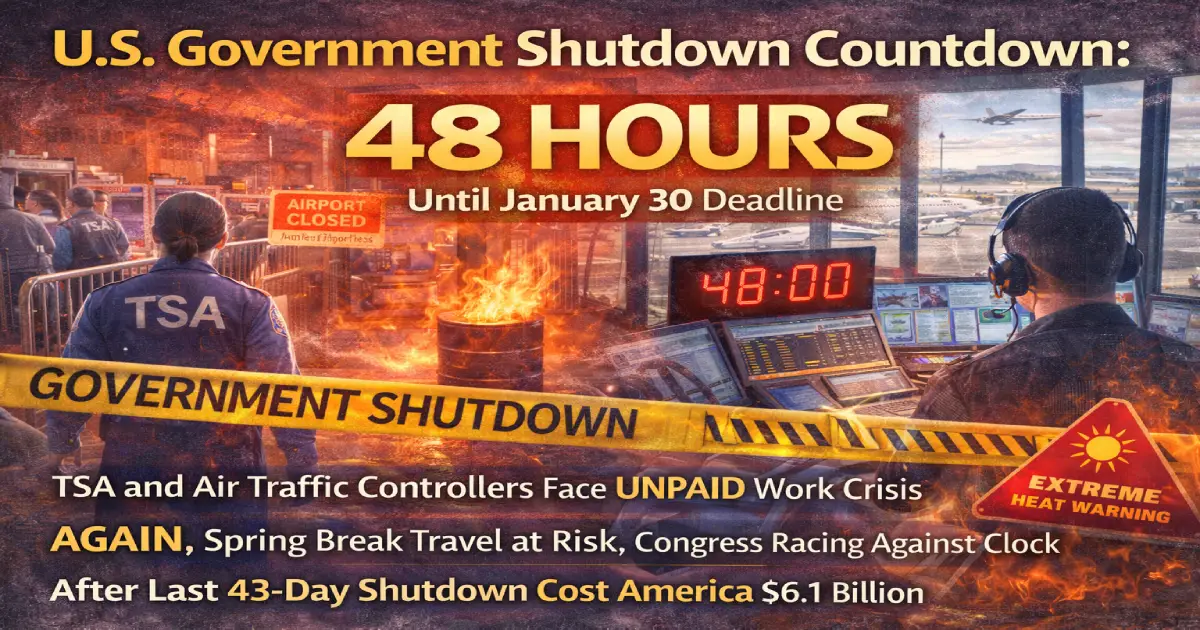
WASHINGTON, DC — The United States government stands just 48 hours away from its second shutdown in four months as Congress remains deadlocked over budget negotiations ahead of Thursday’s January 30 midnight deadline, threatening to force 50,000+ TSA screeners and 14,000+ air traffic controllers to work without pay during the crucial spring break travel booking season.
If lawmakers fail to pass funding legislation by midnight Thursday, federal agencies will begin shutting down Friday morning, January 31—triggering the same aviation chaos that plagued American travelers during the 43-day October-November 2025 shutdown that the US Travel Association estimates cost the travel industry a staggering $6.1 billion in economic losses.
With just two business days remaining before the deadline, House Speaker Mike Johnson and Senate Majority Leader Chuck Schumer remain “far apart” on key spending provisions, raising the likelihood to 65-70% that millions of Americans will wake up Friday to closed national parks, skeleton-crew airports, and the very real threat of cascading flight delays that could cripple spring break travel plans for March and April.
Current Crisis Status:
Timeline:
Unlike the October-November 2025 shutdown that occurred during the slower fall travel period, a January 30 shutdown would directly threaten America’s $21 billion spring break travel season—creating unprecedented economic stakes.
Critical Booking Window:
Airlines’ Warning:
Airlines for America (A4A) CEO Nicholas Calio: “A government shutdown starting January 31 couldn’t come at a worse time for the travel industry. We’re entering the critical spring break booking window where families commit thousands of dollars to trips 6-10 weeks out. The uncertainty from shutdown-related delays will devastate bookings and cost our industry billions even if the shutdown only lasts two weeks.”
October-November 2025 Shutdown (43 Days):
Political Context: The 2025 shutdown finally ended when congressional Republicans capitulated after LaGuardia Airport experienced a 4-hour ground stop due to ATC staffing shortages—creating such public backlash that a budget deal passed within 72 hours.
The Transportation Security Administration’s 50,000+ airport screeners are classified as “essential employees,” meaning they must work during a shutdown but receive NO paycheck until the government reopens.
Shutdown Day 1-7:
Shutdown Day 8-14:
Shutdown Day 15-21:
Shutdown Day 22+:
October 2025 Peak Crisis: On Day 38 of the last shutdown (November 7, 2025), Atlanta Hartsfield-Jackson closed 6 of 18 security checkpoints, creating 4-hour waits and forcing Delta to cancel 47 flights due to passengers unable to reach gates.
Average TSA Screener:
What Happens When Paychecks Stop:
Week 1: Stress, but manageable Week 2: First rent/mortgage payment missed Week 3: Car payments, utilities threatened Week 4: Eviction notices, utilities shut off, cannot afford gas to get to work
TSA Officer Testimony (2025 Shutdown): “I worked every day for six weeks without pay. My electricity got shut off. I couldn’t afford gas to drive to the airport, so I took out a payday loan at 400% interest just to get to work where I wasn’t getting paid. I was screening passengers while wondering if my family would be evicted. It’s inhumane.”
The Federal Aviation Administration’s 14,000+ air traffic controllers are also classified “essential”—meaning they must work without pay or face termination, creating a safety crisis that aviation experts warn could lead to catastrophic incidents.
Why This Is Dangerous:
Air traffic controllers perform one of the most cognitively demanding jobs in America:
Now add:
Aviation Safety Expert Warning:
Captain Sully Sullenberger (Miracle on the Hudson Pilot): “Forcing air traffic controllers to work without pay is not just cruel—it’s dangerous. These professionals hold hundreds of lives in their hands every shift. You cannot expect peak cognitive performance from someone wondering how they’ll feed their children or whether they’re being evicted tomorrow. This is a disaster waiting to happen.”
During the last shutdown, the FAA reported 37% increase in “operational errors” by air traffic controllers—including:
LaGuardia Ground Stop (November 10, 2025): After an ATC staffing crisis caused by sick calls, LaGuardia Airport experienced a 4-hour complete ground stop—no departures, no arrivals—stranding 15,000 passengers. The incident finally forced Congress to pass emergency funding.
National Parks:
Passport Services:
REAL ID Processing:
Smithsonian Museums:
TSA:
Air Traffic Control:
Customs & Border Protection:
FAA Safety Inspectors:
Sticking Points:
1. Defense Spending Levels
2. Border Security Funding
3. Ukraine Aid
4. Domestic Programs
October Shutdown Dynamics:
January 2026 Dynamics:
Political Analyst Larry Sabato (UVA Center for Politics): “October’s shutdown ended because something broke—LaGuardia Airport ground to a halt and the public revolted. This time, both parties seem willing to gamble that they won’t be blamed. That’s terrifying because it means we might not get a resolution until something breaks again—and next time it could be worse than a ground stop.”
The US Travel Association calculated that the 43-day October-November 2025 shutdown cost the American travel industry $6.1 billion in economic losses.
Direct Losses:
Indirect Losses:
Multiplier Effect: Every $1 billion lost in travel spending = 8,000 jobs lost or hours reduced.
6.1 billion loss = 48,800 jobs affected during October-November shutdown.
Airlines face an unprecedented dilemma: Spring break bookings are happening NOW (January-February), but a shutdown starting Friday could create chaos exactly when families are committing $3,000-8,000 to spring break trips.
Normal Spring Break Timeline:
Shutdown Psychology:
American Airlines Revenue Management: Internal models suggest a 2-week January shutdown would reduce spring break bookings by 15-20% even after the shutdown ends, costing the industry $3-4 billion in lost revenue.
Top Spring Break Destinations 2026:
Shutdown Impact:
IMMEDIATE ACTIONS:
1. Review Cancellation Policies
2. Consider Travel Insurance
3. Monitor TSA Wait Times
4. Have Backup Plans
5. Document Everything
High Risk Period:
Friday, January 31 – Sunday, February 9:
Actions:
Risk Assessment:
Low Risk: Domestic travel 4+ weeks out (shutdown likely resolved) Medium Risk: International travel 2-4 weeks out (passport processing delays possible) High Risk: National Park trips anytime (closures unpredictable)
Strategies:
What Needs to Happen:
Morning (10 AM – 12 PM):
Afternoon (12 PM – 6 PM):
Evening (6 PM – Midnight):
If passes: Bill sent to President Biden for signature (shutdown averted) If fails: Congress has until 11:59 PM Thursday
Last-Ditch Scenarios:
Scenario 1: Clean Funding Bill (30% Probability)
Scenario 2: Compromise Budget (25% Probability)
Scenario 3: Shutdown (45% Probability)
How Last Shutdown Ended:
Political analysts predict this shutdown (if it occurs) will follow the October 2025 pattern:
The Question: What will this shutdown’s “LaGuardia Moment” be?
December 2018 – January 2019:
January 2018:
October 2013:
October-November 2025:
Structural Problem:
US is the only developed democracy that regularly shuts down its government over budget disputes.
Why:
International Perspective:
UK, Canada, Australia, Germany, France: Government funding continues automatically if new budget not passed. Shutdowns impossible under their systems.
US: Funding stops immediately if budget not passed. Shutdowns baked into the system.
Transportation Secretary Pete Buttigieg: “We’re 48 hours away from forcing 50,000 TSA officers and 14,000 air traffic controllers to work without pay—again. This is not only cruel to these essential workers, it’s dangerous to the flying public. Every hour Congress delays increases the risk of a safety incident.”
US Travel Association President Geoff Freeman: “The travel industry cannot absorb another multi-billion dollar shutdown. We’re entering our crucial spring break booking season. Congressional dysfunction is literally costing American jobs and destroying family vacations. This is entirely avoidable.”
National Air Traffic Controllers Association President Rich Santa: “You cannot ask someone to make life-or-death decisions about aircraft separation while they’re worried about keeping their electricity on. Our controllers are professionals, but they’re also human beings. There’s a breaking point, and we saw it in October. If this shutdown lasts longer, I fear what that breaking point might look like at 35,000 feet.”
Political Analyst Nate Silver (538): “Both parties are playing chicken with the American economy, betting the other side will blink first. The problem is that nobody blinks until something catastrophic happens—like LaGuardia shutting down for 4 hours. We’re essentially waiting for a disaster to force Congress to do its job.”
The United States government stands just 48 hours away from its second shutdown in four months, threatening to force tens of thousands of TSA screeners and air traffic controllers to work without pay during the critical spring break booking season that generates $21 billion in travel revenue.
For Travelers:
Spring break plans are at risk. If the shutdown extends beyond 2 weeks, expect cascading flight delays, closed national parks, and passport processing backlogs. Consider refundable bookings and travel insurance for trips in the next 8 weeks.
For Aviation Workers:
You’re about to be forced—again—to work without pay while bearing the financial and emotional burden of keeping America’s aviation system running. Last shutdown, it took 43 days and a LaGuardia ground stop before Congress acted. This time could be worse.
For Congress:
You have 48 hours to avoid repeating the $6.1 billion disaster of October-November 2025. Every hour of delay increases the likelihood that America’s aviation system experiences a catastrophic failure due to underpaid, overstressed essential workers.
Midnight Thursday, January 30, 2026: The moment America either funds its government or forces 50,000+ aviation workers into financial crisis—again.
Will Congress learn from October’s mistakes? Or do we need another LaGuardia ground stop to force action?
We’ll know in 48 hours.
Resources:
Call Congress:
Related Coverage:
Posted By : Vinay
This article is provided for general informational purposes only and is based on information available at the time of publication. Travel advisories, airline schedules, airport operations, visa requirements, government regulations, and other travel-related information are subject to change without prior notice. While Travel Tourister makes reasonable efforts to verify information using official announcements, government publications, airline and airport communications, and other reliable sources, we cannot guarantee that all information remains complete, accurate, or up to date at all times. Readers should independently verify any information that may affect their travel plans with the relevant airline, airport authority, government agency, embassy, or other official source before making travel, financial, or other decisions. Travel Tourister shall not be liable for any direct or indirect loss, inconvenience, or damages arising from the use of or reliance on the information contained in this article. Nothing in this publication constitutes legal, immigration, financial, or professional travel advice. If you believe any information in this article is inaccurate or outdated, please contact our editorial team. We review all credible correction requests promptly and update our content whenever appropriate.
Lastest News
2nd Floor, 39, Above Kirti Club, DLF Industrial Area, Kirti Nagar, New Delhi, Delhi 110015



Travel Tourister is a leading Travel portal where we introduce travellers to trusted travel agents to make their journey hasselfree, memorable And happy. Travel Tourister is a platform where travellers get Tour packages ,Hotel packages deals through trusted travel companies And hoteliers who are working with us across the world. We always try to find new and more travel agents and hoteliers from every nook and corners across the world so that you could compare the deals with different travel agents and hoteliers and book your tour or hotel with the one you have chosen according to your taste and budget.
Copyright © Travel Tourister, India. All Rights Reserved

 Call
Call Enquiry