Published on : 16 Feb 2026
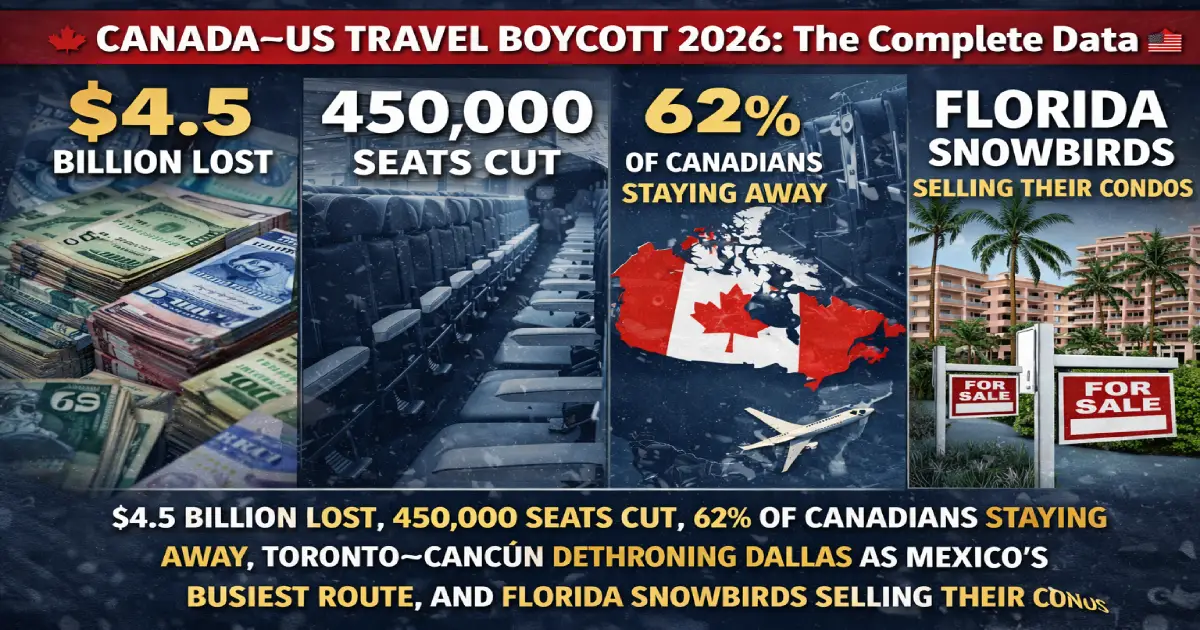
Breaking: The most comprehensive data picture yet assembled of the Canada–US travel boycott confirms an economic catastrophe unfolding in slow motion across the United States — with Forbes Magazine calculating a $4.5 billion USD loss to the US economy, a YouGov survey commissioned by Flight Centre Canada finding that 62% of Canadians say they are less likely to visit the US in 2026 OAG aviation data confirming 450,000 fewer Canada–US seats in Q1 2026 alone representing a 10% capacity reduction, Statistics Canada confirming that last month 30% fewer Canadians crossed into the United States by vehicle — the 10th straight month of declines — while trips by air are down 24% , Canadian visits to Florida dropping 15% in Q3 2025 with the slowdown holding steady if not picking up speed into 2026 , Fort Lauderdale real estate agents listing 35 Canadian-owned properties with zero Canadian buyers, Air Transat eliminating ALL US flights by June 2026, WestJet cutting US capacity 19%, Flair Airlines slashing US-bound seats 58%, and — most dramatically — the Toronto–Cancún corridor officially becoming the busiest international air route into Mexico, dethroning long-standing leaders like Dallas and Houston . This is the definitive data article on the most significant shift in North American travel in a generation. Here is every number, every trend, and every implication for travellers and tourism economies on both sides of the border.
Published: February 16, 2026 Total US Economic Loss (Forbes): $4.5 billion USD Total US Tourism Loss 2025 (US Travel Association): $5.7 billion USD Canadians Less Likely to Visit US in 2026: 62% (YouGov/Flight Centre Canada) Canadians Uncomfortable Travelling US This Winter: 70% (Angus Reid, October 2025) Q1 2026 Seats Cut Canada→US: 450,000 (OAG aviation data — 10.1% reduction) WestJet US Capacity Cut: 19% Air Canada US Capacity Cut: 7% Flair Airlines US Capacity Cut: 58% Vehicle Border Crossings: Down 30% year-over-year — 10th consecutive month of decline Air Travel Canada→US: Down 24% year-over-year Florida Canadian Visits: Down 15% Q3 2025, accelerating into 2026 Toronto→Cancún: Now Mexico’s #1 busiest international route — dethroned Dallas + Houston Canada→Mexico Flights: Up 15.7% year-over-year WestJet Mexico Market Share: 52% of all Canada–Mexico flights this winter Boycott Start Date: February 2025 — triggered by Trump 25% tariff + “51st state” comments Air Transat US Exit: All flights cancelled by June 13, 2026
The downturn in US-bound travel for Canadian airlines can be traced back to February 2025, when President Donald Trump imposed a 25% tariff on Canadian imports. The tariff significantly impacted trade between the two countries, contributing to an ongoing decline in cross-border travel, including air traffic.
The trigger was dual — and the combination proved uniquely toxic to Canadian sentiment toward US travel. Trump’s tariff announcement landed simultaneously with his repeated public statements about Canada becoming America’s “51st state.” For Canadians — who regard their national sovereignty with particular sensitivity given their geographic proximity to a neighbour 9 times their population — the combination of economic aggression and sovereignty dismissal created a political and emotional reaction that translated directly into travel behaviour.
The boycott has received support from Canadian politicians, notably with Prime Minister Justin Trudeau on February 1, 2025, calling on Canadians to “choose Canadian products and services rather than American ones” wherever possible. Foreign Minister Mélanie Joly also suggested to cancel or avoid travel to the US.
When a country’s prime minister and foreign minister publicly endorse a travel boycott, the signal reaches every household. Within weeks, the data began confirming what social media was already showing anecdotally — Canadians were cancelling US trips in unprecedented numbers.
In mid-February 2025, an Angus Reid survey found that 48% of respondents had already “or were seriously likely to” cancel or delay plans to travel to the US. By March 2025, flight bookings to the United States from Canada had fallen by 71–76% in comparison with bookings in March 2024.
A 71–76% collapse in advance bookings within one month of the boycott’s start. That is not a dip — that is a cliff edge.
The critical question entering 2026 was whether the boycott would fade as political noise inevitably does, or whether it would harden into durable behavioural change. The answer from every data source is unambiguous: it is hardening.
According to data released on February 11, 2026, travel from Canada to the United States has fallen for the second consecutive month to start the new year.
Last month 30% fewer Canadians crossed the border into the United States by vehicle than the year before — the 10th straight month of declines. Trips to the US by air are down 24%.
Ten consecutive months of vehicle crossing declines. Not a protest, not a seasonal dip — a sustained, deepening structural shift in how Canadians relate to US travel. The boycott that economists assumed would fade within a quarter has now persisted for twelve months and shows every sign of extending indefinitely into 2026.
A YouGov survey commissioned by Flight Centre Canada found that 62% of Canadians say they are less likely to visit the US in 2026.
An Angus Reid poll found that 70% of Canadians surveyed in late October said they would be uncomfortable travelling to the US this winter. Respondents’ top reasons for avoiding the country were a resolve to stand up for Canada, America’s current political climate, and concerns about heightened security at the border during Trump’s immigration crackdown.
The composition of reasons matters. “Stand up for Canada” is a political-emotional motivation that responds to political developments — it could theoretically soften if the tariff dispute resolves. “Concerns about border security” is a practical safety concern driven by enforcement environment — it is less responsive to political signalling. As the boycott enters its second year, the safety concern component has grown relative to the political solidarity component. This is why the numbers are not recovering even as trade negotiations continue.
Airlines are the most reliable barometer of actual travel demand — they do not reduce capacity based on sentiment surveys, they reduce it based on advance bookings, load factor data, and revenue projections. When airlines cut capacity, they are confirming real demand collapse, not just polling anxiety.
Canadian carriers reducing planned seat capacity to the US by close to 10% compared with the same period last year, according to an analysis by aviation data provider OAG. This reduction translates to roughly 450,000 fewer available seats for flights between the two neighbouring countries. WestJet cut its US seat capacity by about 19%, while Air Canada’s cuts were close to 7%. The most dramatic shift came from Flair Airlines, which reduced its US-bound capacity by approximately 58% for the quarter.
WestJet’s 19% US capacity reduction is the most strategically significant airline decision in this story — because WestJet has not simply cut capacity, it has redirected it. WestJet has emerged as a dominant force, preparing to operate 52% of all flights between Canada and Mexico this winter season, recently launching a direct route from Calgary to the emerging hotspot of Puerto Escondido.
WestJet is not suffering from the boycott. It is profiting from it. Every seat removed from a Houston or Las Vegas route is being redeployed to Cancún, Puerto Vallarta, and Puerto Escondido — where load factors are higher, yields are stronger, and passengers are more satisfied. WestJet’s pivot is a masterclass in demand-responsive network planning.
Air Canada’s 7% US capacity reduction appears modest relative to WestJet’s 19% — but context matters. Air Canada’s US network is significantly larger than WestJet’s, meaning a 7% cut represents a substantial absolute seat removal. Air Canada, Air Transat, and Flair have ramped up capacity to Mexico, collectively operating over 22,000 flights between Canada and Mexico — a 15.7% year-over-year increase.
Air Canada’s capacity decisions arrive simultaneously with its Unifor Local 2002 contract deadline on February 28 — just 12 days away. If 5,826 customer service agents strike, the US capacity question becomes moot: virtually all Air Canada transatlantic and US operations would be affected by strike action. The airline that has already cut 7% of US capacity could see that figure reach 100% within a fortnight.
Flair Airlines’ 58% reduction in US-bound capacity is the most dramatic single-carrier retreat from the US market. For Flair, the pivot has been even more stark, with the ultra-low-cost carrier effectively abandoning its cross-border aspirations and turning its attention north. Flair has redirected its capacity toward domestic Canadian routes — including a 64% increase in Toronto frequency — reflecting a calculation that Canadian domestic demand, boosted by Canadians choosing to stay home rather than cross the border, is now more profitable than US transborder flying.
Air Transat announced it will discontinue ALL flights to the United States by June 2026. Air Transat’s Florida routes from Montréal to Orlando and from Québec City to Fort Lauderdale will cease operation in May 2026, with Montréal to Fort Lauderdale expected to be the last route to terminate by June 13, 2026. In a statement, the airline noted that Florida represented a “marginal” market contributing to only 1% of the airline’s overall seat capacity for the summer.
Air Transat’s complete US exit is the most definitive single corporate statement about the state of Canada–US travel demand. When a carrier that built its entire brand on leisure sun destinations decides the US is “marginal” — not worth the operational complexity of maintaining any presence — the boycott has reached a structural permanence that temporary political thawing will not easily reverse.
Seat capacity to Las Vegas is down by around 82,000 seats in early 2026 compared with the previous year.
Las Vegas was historically one of the top five Canadian tourist destinations in the United States — the combination of gaming, entertainment, and warm weather made it a perennial favourite for Canadian leisure travellers. 82,000 fewer seats translates directly to tens of thousands fewer Canadian visitors, representing hundreds of millions of dollars in lost casino revenue, hotel spend, restaurant visits, and show ticket purchases.
Las Vegas casino operators have responded to the Canadian exodus with aggressive promotions — several Strip properties now offer 1-to-1 Canadian dollar exchange rates for hotel stays, effectively absorbing the CAD/USD currency gap themselves. Whether financial incentives can overcome political sentiment remains unproven.
Orlando has seen nearly 79,000 fewer seats offered in early 2026 compared with the previous year.
Orlando’s Canadian visitor decline is particularly painful because Canadian families represented one of Walt Disney World’s most reliable international visitor groups — multi-generational, high-spend, and strongly loyal to repeat visits. A Quebec-based travel agent specialising in travel to Disney and Universal destinations claims that her reservations dropped by 60% from February to March 2025. Some American travel agencies even left the Canadian market entirely, due to the drop in demand.
A 60% reservation drop at Disney/Universal specialists. American travel agencies abandoning the Canadian market entirely. These are not marginal adjustments — they represent a fundamental reorientation of Canadian leisure travel away from Florida’s theme park economy.
The effects of the Canadian tourism slowdown appear to be hitting Florida’s Gulf Coast the hardest, especially in the southwestern part of the state in and around Lee and Collier counties, where snowbirds from north of the border have long-established ties with vacation rentals and homes and condos they own.
CBC News writes of the Fort Lauderdale, Florida, real estate agent Alexandra DuPont that “She’s currently listing 35 properties, she said, and about 30 of those are owned by Canadians. Meanwhile, she has zero Canadian buyers. It’s unprecedented in her 12 years of selling real estate.” More than a million Canadians go to Fort Lauderdale every year and contribute $600 million USD to the local economy.
35 Canadian-owned properties for sale. Zero Canadian buyers. Fort Lauderdale’s real estate market — which depended on Canadian snowbirds as both buyers and long-term renters — is facing simultaneous supply surge and demand collapse. Along the Gulf Coast, those Canadians are selling into an oversaturated market that is expected to take hard price hits during 2026, with likely declines of 10.2% in Cape Coral, 8.9% in North Port and 3.6% in Tampa, according to projections from Realtor.com.
Canadian snowbirds pump an estimated $6.5 billion into Florida’s coffers annually. Even a 15% reduction in that flow represents nearly $1 billion in annual Florida economic loss from snowbirds alone.
Cuts in capacity extend to major US hub airports such as Newark, Atlanta and Los Angeles, which rank among the top ten for reduced Canadian airline seats.
The hub airport impact is significant because reduced Canada–US transborder capacity at Newark, Atlanta, and Los Angeles affects not just direct Canada–US travellers but also Canadian passengers who use these hubs as connecting points for onward US domestic travel and international connections. Fewer Canadian seats at EWR means fewer Canadians connecting through Newark to Caribbean, South American, and European destinations on US carriers.
The most remarkable data point in the entire Canada–US boycott story is not the American decline. It is the Mexican explosion.
The Toronto–Cancún corridor has officially become the busiest international air route into Mexico, dethroning long-standing leaders like Dallas and Houston. A study by the Center for Advanced Research in Sustainable Tourism (STARC) at Anáhuac University reveals that travel from Toronto to the Mexican Caribbean surged by 26.1% in the last year.
Dallas–Cancún and Houston–Cancún were the busiest international routes into Mexico for years — a reflection of Texas’s geographic proximity and large Hispanic-American population maintaining Mexican travel links. Toronto–Cancún dethroning both of them is not a marginal statistical shift. It is a seismic reorientation of North American leisure travel geography.
For the Canadian traveller, the “default” choice of a Florida or Arizona getaway is being replaced by the welcoming shores of Quintana Roo and Oaxaca. Airlines are wasting no time capitalising on this trend. WestJet has emerged as a dominant force, preparing to operate 52% of all flights between Canada and Mexico this winter season, recently launching a direct route from Calgary to the emerging hotspot of Puerto Escondido. Air Canada, Air Transat, and Flair have also ramped up capacity, collectively operating over 22,000 flights between the two countries — a 15.7% year-over-year increase.
The 15.7% Canada–Mexico flight increase is the mirror image of the 10.1% Canada–US flight decrease. Canadian seat capacity is not being destroyed — it is being redirected. Mexico is the primary beneficiary. The Caribbean is second. Europe is third.
Snowbird Rena Hans of Toronto says she won’t be going to the US this winter even though she owns a condo in Florida. Instead, she’s leaving this weekend for a trip to Costa Rica, followed by another one to Turks and Caicos. In the new year, she plans to spend a month in China and Taiwan. “There’s a lot of other places to go,” she said. “I can’t vote in the US, but I can vote with my dollars.”
Rena Hans is not a statistical outlier — she is a data point in a 62% trend. Costa Rica, Turks and Caicos, China, Taiwan. The Canadian snowbird’s geographic imagination has expanded beyond Florida and Arizona into a genuinely global leisure travel portfolio. Once that expansion happens — once snowbirds discover that Playa del Carmen is cheaper, warmer, and less politically charged than Fort Myers — the Florida habit does not automatically return when political tensions ease.
There is anecdotal evidence of Canadian travellers cancelling trips even at the loss of their deposit. A Florida motel owner said: “I’ve seen a customer dropping a $1,000 deposit to choose to go to Cuba instead.” A woman from British Columbia let go of a $5,000 CAD deposit to cancel a five-week vacation to Palm Springs, California.
Losing a $5,000 deposit to make a political travel statement is not casual behaviour — it is the behaviour of someone whose conviction significantly outweighs their financial self-interest. The depth of sentiment required to absorb that kind of loss and still cancel speaks to the emotional intensity of Canadian reaction to the trade war and sovereignty dismissal.
The US Travel Association report forecasts a 3.2% decline in international tourism spending in the country for 2025, a loss of $5.7 billion USD compared to the previous year. The US Travel Association predicts international travel will rebound in 2026, driven by the US hosting the FIFA World Cup with Canada and Mexico and celebrates its 250th anniversary celebrations. But there are no guarantees Canadians upset about the Trump administration will reverse course.
The FIFA World Cup rebound thesis faces its own complications — as covered in our World Cup 2026 travel advisory article, five nations including Canada have now issued travel advisories warning their citizens about US travel for the tournament. The event that was supposed to reverse Canada’s boycott may instead intensify it, if Canadian fans choose to attend the tournament’s Canadian matches in Toronto and Vancouver rather than crossing the border for US fixtures.
Beyond airline seat capacity, Statistics Canada tracks actual border crossing movements — a more precise measure of real travel behaviour than advance bookings.
Last month, 30% fewer Canadians crossed the border into the United States by vehicle than the year before — the 10th straight month of declines. Trips to the US by air are down 24%.
The car crossing data is particularly significant because it captures a different traveller demographic than air travel. Canadian air travellers to the US are primarily leisure tourists, business travellers, and snowbirds. Canadian car crossers are additionally everyday cross-border shoppers, day-trippers, and border community residents — people whose US travel is habitual and transactional rather than planned vacation behaviour. When car crossings fall 30%, the boycott has penetrated beyond vacation decisions into the fabric of daily cross-border life.
Duty-free shops reported a decline in sales of 40–50% between January and April 2025.
Duty-free shops at border crossings are the canary in the coal mine for cross-border traffic — their revenue directly tracks crossing volumes with minimal lag. A 40–50% duty-free sales decline confirms that the car crossing data understates nothing: when people aren’t crossing, they aren’t shopping, and the economic impact is immediate and measurable.
The factors sustaining the boycott in February 2026 are different from — and more durable than — those that started it in February 2025.
Factor 1 — The tariff dispute remains unresolved. The 25% tariff that triggered the boycott is still in effect. Until the tariff environment changes materially, the foundational economic grievance driving Canadian consumer behaviour remains active.
Factor 2 — Border security anxiety is growing, not shrinking. It’s not only Trump’s threats to Canadian sovereignty and his tariff policies, but also the strong US dollar, aggressive immigration enforcement activities, perceived safety issues and the potential for social media screening at the border that are combining to “make people feel very uncomfortable about going to the US.” The social media screening expansion — announced after the boycott began — adds a new deterrent layer that did not exist in February 2025.
Factor 3 — Alternative destinations have proven themselves. Canadians who switched to Mexico or the Caribbean in 2025 discovered those destinations were often cheaper, equally warm, and free of political tension. Revealed preference is powerful — once a traveller discovers they prefer Cancún to Florida, returning to Florida requires positive motivation, not just the removal of negative barriers.
Factor 4 — The currency gap persists. With the Canadian dollar struggling against a resilient US greenback, the cost of hotel rooms, dining, and attractions in popular hubs like New York City and Orlando has become prohibitive for many families.The CAD/USD exchange rate disadvantage means that even politically neutral Canadians face a meaningful cost premium for US travel relative to alternatives priced in weaker currencies.
The optimistic scenario: Trade war resolution in Q2 2026 + positive FIFA World Cup experience for Canadian fans attending US matches + USD weakening = gradual recovery beginning summer 2026, with full normalisation by 2027.
The pessimistic scenario: Tariffs persist through 2026 + social media vetting expands + Canadian fans choose Toronto/Vancouver World Cup matches over US fixtures = boycott hardens into structural permanent shift, with US market share never fully recovering pre-2025 levels.
Most independent tourism economists currently assign higher probability to the pessimistic scenario — not because they believe the political relationship cannot improve, but because behavioural travel habits once broken take years to rebuild.
Several US tourism organisations have already launched targeted Canadian recovery campaigns with varying degrees of success.
Tourism organisations representing regions such as Buffalo, Seattle and Upstate New York have launched campaigns offering discounts and deals to woo back Canadians. The latest to do so is Discover Kalispell, offering a Canadian Welcome Pass where more than a dozen businesses are offering deals for Canadians through January 15, 2026.
Las Vegas casino operators are offering 1-to-1 CAD/USD exchange rates. Florida real estate associations are actively marketing Canadian-owned properties to US domestic buyers. Several Florida Gulf Coast tourism boards are reorienting marketing from Canadian outreach toward domestic US and European visitor acquisition.
The honest assessment is that financial incentives — discounts, favourable exchange rates, welcome passes — address the currency component of the boycott but not the political-emotional component. Snowbird Rena Hans is adamant she won’t return to the US until Trump is out of office. “Why would I want to give money to a country whose president has stated that they want to annex my country?” No exchange rate promotion changes that calculation.
The Canada–US travel boycott has crossed from political protest into economic emergency. Forbes’ $4.5 billion total US economic loss estimate, confirmed across OAG aviation data (450,000 Q1 seats cut), Statistics Canada border crossing records (30% vehicle decline — 10th straight month), US Travel Association projections ($5.7 billion 2025 tourism loss), and Florida real estate market data (35 Canadian properties listed, zero Canadian buyers in Fort Lauderdale) tells a single coherent story: Canadian travel to the United States has entered a structural decline that outlasts the political cycle that started it. WestJet operates 52% of all Canada–Mexico flights. Air Transat has quit the US entirely. Flair has cut 58% of US capacity. And Toronto–Cancún has dethroned Dallas and Houston as Mexico’s busiest international route. Twelve months in, the boycott is deeper, broader, and more behaviourally entrenched than any single political resolution can quickly reverse.
Key Data Summary:
✅ $4.5B — Total US economic loss from Canadian boycott (Forbes) ✅ $5.7B — US Tourism Association 2025 international tourism spending loss ✅ 450,000 — Fewer Canada→US seats in Q1 2026 (OAG) ✅ 62% — Canadians less likely to visit US in 2026 (YouGov/Flight Centre) ✅ 70% — Canadians uncomfortable with US travel this winter (Angus Reid) ✅ 30% — Vehicle border crossing decline — 10th straight month ✅ 24% — Air travel Canada→US decline year-over-year ✅ 58% — Flair Airlines US capacity cut ✅ 19% — WestJet US capacity cut ✅ 15.7% — Canada→Mexico flights increase year-over-year ✅ 26.1% — Toronto→Cancún surge (now Mexico’s #1 international route) ✅ June 2026 — Air Transat US exit date — complete withdrawal
Track the boycott data:
For More Resources:
Related Articles:
Posted By : Vinay
This article is provided for general informational purposes only and is based on information available at the time of publication. Travel advisories, airline schedules, airport operations, visa requirements, government regulations, and other travel-related information are subject to change without prior notice. While Travel Tourister makes reasonable efforts to verify information using official announcements, government publications, airline and airport communications, and other reliable sources, we cannot guarantee that all information remains complete, accurate, or up to date at all times. Readers should independently verify any information that may affect their travel plans with the relevant airline, airport authority, government agency, embassy, or other official source before making travel, financial, or other decisions. Travel Tourister shall not be liable for any direct or indirect loss, inconvenience, or damages arising from the use of or reliance on the information contained in this article. Nothing in this publication constitutes legal, immigration, financial, or professional travel advice. If you believe any information in this article is inaccurate or outdated, please contact our editorial team. We review all credible correction requests promptly and update our content whenever appropriate.
Lastest News
2nd Floor, 39, Above Kirti Club, DLF Industrial Area, Kirti Nagar, New Delhi, Delhi 110015



Travel Tourister is a leading Travel portal where we introduce travellers to trusted travel agents to make their journey hasselfree, memorable And happy. Travel Tourister is a platform where travellers get Tour packages ,Hotel packages deals through trusted travel companies And hoteliers who are working with us across the world. We always try to find new and more travel agents and hoteliers from every nook and corners across the world so that you could compare the deals with different travel agents and hoteliers and book your tour or hotel with the one you have chosen according to your taste and budget.
Copyright © Travel Tourister, India. All Rights Reserved

 Call
Call Enquiry