Published on : 23 Feb 2026
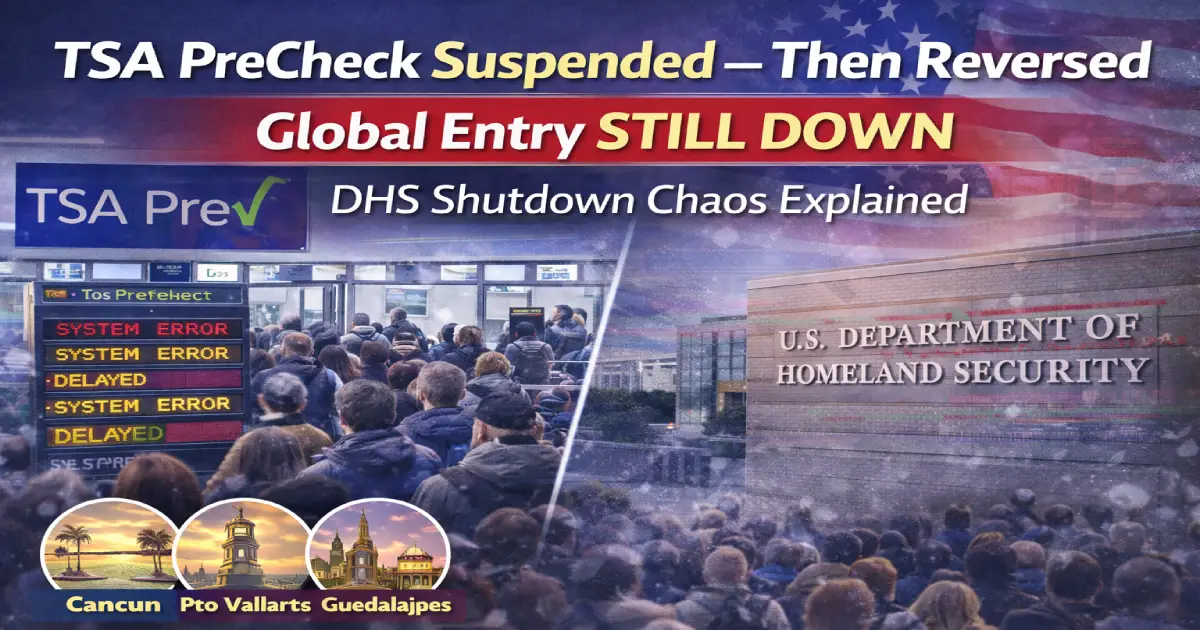
🔴 BREAKING TRAVEL ALERT | Published: February 23, 2026 | Last Updated: February 23, 2026, 9:30 AM EST
Status: TSA PreCheck — OPERATIONAL ✅ | Global Entry — SUSPENDED 🔴 Trigger: Partial US Government Shutdown — DHS Only — Day 9 (started February 14, 2026) Reversal: DHS reversed PreCheck suspension after White House discussions — same Sunday morning Global Entry: Confirmed suspended at multiple US airports and international pre-clearance locations TSA Workers Unpaid: ~63,000 TSA agents working without pay since February 14 Spring Break Warning: 3–4 weeks away — shutdown shows no signs of ending Trusted Traveler Members at Risk: 20+ million TSA PreCheck holders, millions of overlapping Global Entry members
Sunday, February 22, 2026 was a day that exposed exactly how politically fragile America’s airport security infrastructure has become. In the span of roughly six hours, the Department of Homeland Security announced it was suspending TSA PreCheck for 20 million Americans, triggered nationwide panic at airports already reeling from Winter Storm Hernando’s 8,000+ flight cancellations, then abruptly reversed the decision after emergency discussions with the White House — all while leaving Global Entry suspended and 63,000 TSA agents working their ninth consecutive day without pay.
Here is the complete, verified, minute-by-minute account of what happened, what it means for your travel plans today and this spring, and exactly what is and is not working at US airports right now.
To understand Sunday’s chaos, you need to understand how the United States ended up with a partial government shutdown targeting only the Department of Homeland Security.
The third government shutdown in under half a year began on February 14 after Democrats and Republicans reached an impasse over President Donald Trump’s immigration crackdown. DHS was the only department left without federal funding after Democrats walked away from a bipartisan plan released last month. The trigger for the Democratic walkout was the fatal shooting of two US citizens — Renee Good and Alex Pretti — in Minneapolis, Minnesota, by federal immigration agents during anti-ICE demonstrations. Democrats demanded legislative changes to ICE and CBP operations as a condition of any DHS funding deal. The White House and congressional Republicans refused. DHS lost its funding at midnight on February 14.
Personnel at the Federal Emergency Management Agency, the TSA and the Coast Guard are not being paid, though most will continue coming to work because their jobs are considered critical. Roughly 90% of DHS workers were expected to continue working, many without pay, according to the department’s September 2025 government shutdown plan. DHS has jurisdiction over numerous agencies and offices, including CBP, TSA, FEMA, Immigration and Customs Enforcement, the US Coast Guard, and the US Secret Service.
The move comes as a partial US government shutdown that has left thousands of DHS workers, including TSA airport screeners, working without pay since it started on February 14. By Sunday February 22 — Day 9 of the shutdown — DHS leadership decided it was time to escalate, choosing the single moment when the Northeast was already in blizzard chaos to announce the most impactful traveler-facing change yet.
The Washington Post broke the story first, late Saturday night, February 21.
On Saturday, DHS officials said the TSA and the Federal Emergency Management Agency would enter emergency operating status at 6 a.m. ET Sunday. This meant that FEMA would suspend all non-disaster-related responses, while TSA programs PreCheck and Global Entry, as well as all courtesies for members of Congress and family police escorts at airports, would be suspended. FEMA and TSA will resume normal operations when the shutdown concludes, DHS said Saturday. Customs and Border Protection will also be suspending Global Entry, and all officers assigned to process Global Entry travelers would be reassigned to process all other arriving travelers.
Homeland Security previously said it was taking “emergency measures to preserve limited funds.” Among the steps listed were “ending Transportation Security Administration (TSA) PreCheck lanes and Customs and Border Protection (CBP) Global Entry service, to refocus Department personnel on the majority of travelers.”
DHS Secretary Kristi Noem issued a formal statement. “TSA and CBP are prioritizing the general traveling population at our airports and ports of entry and suspending courtesy and special privilege escorts,” Noem said. “Shutdowns have real world consequences, not just for the men and women of DHS and their families who go without a paycheck, but it endangers our national security. The American people depend on this department every day, and we are making tough but necessary workforce and resource decisions to mitigate the damage inflicted by these politicians.”
The plan was clear: PreCheck and Global Entry lanes close at 6:00 AM EST Sunday. Over 20 million Americans with PreCheck memberships and millions of Global Entry members would be folded into standard screening lines starting that morning — on the same day a historic blizzard was already paralyzing the Northeast.
At 6:00 AM EST Sunday, the situation at airports was immediate and contradictory. Some airports went dark on PreCheck. Others kept it open.
For a few hours on Sunday morning, several airports, including Los Angeles International Airport and St. Louis Lambert International Airport, reported TSA PreCheck closures. Meanwhile, at the nation’s capital:
As of Sunday morning, travelers were still able to pass through lines servicing TSA PreCheck at Ronald Reagan Washington National Airport and Dulles International Airport near Washington, DC.
The result was exactly the kind of airport-by-airport patchwork that travelers dread most — no one could tell whether their PreCheck lane would be open or closed when they arrived. Travelers already facing potential blizzard delays were now uncertain whether they needed to budget extra time for standard security lines.
Travel industry leaders were caught completely off guard. Travel industry leaders said they received little, if any, warning of the changes to PreCheck, a program that allows its 20 million pre-screened members to pass through airport security faster than at standard lanes. Industry members spoke with DHS officials in the past few hours and expressed alarm about the sudden decision.
Airlines for America CEO Chris Sununu released a pointed statement. “A4A is deeply concerned that TSA PreCheck and Global Entry programs are being suspended and that the traveling public will be, once again, used as a political football amid another government shutdown. The announcement was issued with extremely short notice to travelers, giving them little time to plan accordingly, which is especially troubling at this time of record air travel.”
The reversal came after discussions with the White House and TSA, an official said.
By mid-morning Sunday, DHS quietly walked back the PreCheck suspension. The reversal was announced not in a high-profile press conference, but through a TSA spokesperson’s statement to news outlets.
Less than a day after the suspension order was announced by DHS Secretary Kristi Noem, the TSA said that PreCheck at the nation’s airports will remain open. “At this time, TSA PreCheck remains operational with no change for the traveling public. As staffing constraints arise, TSA will evaluate on a case-by-case basis and adjust operations accordingly,” a TSA spokesperson said.
The TSA added that courtesy escorts for members of Congress have been suspended and that those resources “can be directed towards keeping the flying public safe.”
Sources familiar with the issue told ABC News that airports are now being advised by the TSA that they can keep their PreCheck lanes open if they have enough staffing.
That final qualifier — “if they have enough staffing” — is the critical phrase every traveler needs to understand. PreCheck is not restored unconditionally. It is restored subject to staffing levels at each individual airport, on a case-by-case basis, with 63,000 TSA agents still working without pay and morale issues mounting across the agency. The reversal is a policy position, not a guaranteed operational reality at every airport.
While PreCheck was reversed, Global Entry was not.
DHS said Global Entry, however, is suspended.
By Sunday night, Global Entry was suspended at some airports across the country and in Canada, including Boston Logan International Airport, Austin-Bergstrom International Airport and Vancouver International Airport.
Global Entry is a US Customs and Border Protection program that allows pre-approved, low-risk travelers to use expedited kiosks when entering the United States from abroad. Travel industry experts estimate that Global Entry cuts the amount of time passengers get through customs from an average of 30 to 90 minutes for regular customs lines to 5 to 10 minutes in Global Entry lines. Those who have Global Entry also receive TSA PreCheck.
The practical impact: if you have Global Entry and are arriving in the United States from an international flight, your automatic kiosk access may not be available. You may be redirected to the standard customs line — the one that can take 30–90 minutes. At Dallas-Fort Worth International Airport Sunday, one traveler said the regular line was long but moved fairly fast. With Global Entry, it usually takes less than five minutes to get through customs. Sunday, it took about 30 minutes. “It feels like Washington is using travelers as a pawn,” she said.
As of Monday morning February 23, DHS has not announced any reversal of the Global Entry suspension. US Travel Association President Geoff Freeman said after the PreCheck reversal his organization was “glad that DHS has decided to keep PreCheck operational and avoid a crisis of its own making.” He added: “We are urging the same for Global Entry. These Trusted Traveler Programs strengthen aviation security and improve screening efficiency. They are funded by user fees, and there is no reason at this time for them to be suspended.”
Freeman’s point about user fees is significant. PreCheck and Global Entry are not funded by taxpayer dollars — they are funded entirely by membership fees paid by travelers. PreCheck costs $78 for a five-year membership. Global Entry costs $100 for five years. The programs are financially self-sustaining. Suspending them during a funding lapse is a political decision, not a financial necessity.
| Time | Event |
|---|---|
| Saturday Feb 21, late night | Washington Post breaks story: DHS plans to suspend PreCheck and Global Entry at 6 AM Sunday |
| Saturday Feb 21, ~11:00 PM EST | DHS Secretary Kristi Noem issues formal statement confirming suspension |
| Sunday Feb 22, 6:00 AM EST | Suspension officially takes effect — PreCheck lanes close at LAX, STL and other airports |
| Sunday Feb 22, ~7:00–9:00 AM | Contradictory reports emerge — some airports open, some closed; industry leaders scramble |
| Sunday Feb 22, ~9:00–10:00 AM | Airlines for America, US Travel Association issue alarm statements publicly |
| Sunday Feb 22, ~10:00–11:00 AM | White House and TSA discussions — reversal decision made |
| Sunday Feb 22, ~11:00 AM–12:40 PM | TSA issues reversal statement — PreCheck operational; DHS updated statement removes PreCheck mention but retains Global Entry suspension |
| Sunday Feb 22, evening | Global Entry confirmed suspended at BOS, AUS, YVR and other airports |
| Monday Feb 23, 9:00 AM | Current status: PreCheck operational (case-by-case, staffing-dependent); Global Entry SUSPENDED |
| Program | Status | What It Means For You |
|---|---|---|
| TSA PreCheck | ✅ OPERATIONAL — staffing-dependent | Use PreCheck lanes as normal; monitor your airport’s real-time wait times via TSA app |
| Global Entry | 🔴 SUSPENDED | Arriving international passengers routed to standard customs — expect 30–90 min lines |
| NEXUS | ⚠️ UNCLEAR | Status being confirmed — check CBP website |
| SENTRI | ⚠️ UNCLEAR | Status being confirmed — check CBP website |
| PreCheck Enrollment | 🔴 IMPACTED | New enrollment appointments and renewals may face delays due to shutdown staffing |
| Congressional Escorts | 🔴 SUSPENDED | TSA has redirected those resources to general traveler screening |
| FEMA Non-Disaster Response | 🔴 SUSPENDED | Not a direct airport impact but indicates scope of DHS emergency measures |
The PreCheck reversal came from the top — but it was implemented with the caveat that individual airports can close PreCheck lanes if they do not have sufficient staffing. With 63,000 TSA agents now nine days into working without pay, absenteeism and morale issues are a real operational concern.
Major airports where PreCheck closures were reported Sunday (now restored but monitor):
Airports where PreCheck remained open through Sunday’s chaos:
Airports where Global Entry is confirmed suspended as of Sunday night:
What to do: Before you go to your airport, check the TSA Wait Times tool (tsaapp.tsa.dhs.gov) for real-time PreCheck lane status at your specific terminal. If PreCheck shows as unavailable when you arrive, budget an additional 20–45 minutes for standard screening.
This is not America’s first government shutdown. But what makes this one different — and potentially more dangerous for travelers — is the combination of factors converging simultaneously:
Factor 1 — Spring break is 3–4 weeks away. The US spring break travel rush typically begins in early-to-mid March. If the DHS shutdown continues through March — which is entirely possible given the depth of the political impasse over ICE reform — TSA staffing shortages and potential PreCheck instability will collide with the single busiest travel period of the year.
Factor 2 — This is the third shutdown in under a year. The cumulative toll on DHS workforce morale and retention is significant. The government shutdown in the fall, the longest ever, cost the travel industry and other sectors $6.1 billion, the group said. Those disruptions affected about 6 million travelers. A third shutdown compounds those effects.
Factor 3 — No end in sight. The political impasse is genuinely deep. Democrats are demanding ICE reform tied to the Minneapolis deaths. The White House has rejected those demands. There is no public indication of any agreement timeline.
Factor 4 — Historic blizzard hit simultaneously. The decision to suspend the programs came as an anticipated winter storm had already prompted the cancellation of more than 7,000 flights across the country. The decision and its quick reversal also comes just weeks before the spring break travel rush. The timing — announcing a major program suspension at the exact moment airports were in blizzard chaos — maximized confusion for travelers and minimized DHS’ ability to manage the fallout cleanly.
The DHS shutdown and Sunday’s chaos quickly became another front in Washington’s ongoing political warfare.
DHS Secretary Noem placed blame squarely on Democrats. Noem said “Shutdowns have real world consequences, not just for the men and women of DHS and their families who go without a paycheck, but it endangers our national security. The American people depend on this department every day, and we are making tough but necessary workforce and resource decisions to mitigate the damage inflicted by these politicians.”
Democratic response was immediate and sharp. Democratic Rep. Bennie Thompson of Mississippi, ranking member of the Committee on Homeland Security, said: “TSA PreCheck and Global Entry REDUCE airport lines and ease the burden on DHS staff who are working without pay because of Trump’s abuse of the Department and killing of American citizens.”
Senate Democratic Leader Chuck Schumer called the moves “bullying tactics” by the Trump administration. “The Trump administration is choosing to inflict pain on the public instead of adopting common sense ICE reforms. In the 43-day historic Trump government shutdown, DHS never changed the Global Entry program’s status. Democrats are fighting against this exact kind of abuse.”
Sen. Andy Kim, a New Jersey Democrat, said Noem’s actions are part of an administration strategy to distract from other issues and shift responsibility. “This administration is trying to weaponize our government, trying to make things intentionally more difficult for the American people as a political leverage,” he told CNN.
For travelers, the political blame game is secondary. The practical reality is that 63,000 TSA agents are working without pay, program status can change with hours of notice, and the shutdown has no confirmed end date.
If you are not familiar with these programs, here is a quick breakdown of what is at stake for the 20+ million Americans enrolled:
TSA PreCheck:
Global Entry:
NEXUS and SENTRI (for US–Canada and US–Mexico border crossings):
If you have TSA PreCheck and are flying domestically this week: PreCheck is currently operational. Use your PreCheck lanes as normal. However, the “case-by-case staffing” caveat means individual terminals may close PreCheck lanes without advance notice. Check TSA real-time wait times at your airport before arriving, and budget extra time in case you need to use the standard lane.
If you have Global Entry and are arriving in the US from an international flight this week: Global Entry kiosks are suspended at multiple airports. Do not count on Global Entry when planning your connection times. Budget 45–90 minutes for customs clearance instead of the usual 5–10 minutes, especially at high-volume airports like JFK, LAX, ORD, MIA, and IAH.
If you have a Global Entry or PreCheck renewal due in the next 30–60 days: Renewal processing may be slower than usual due to shutdown staffing. Submit your renewal application immediately if you have not already done so — do not wait until the last minute during an active shutdown.
If you are traveling for spring break in March: The shutdown shows no signs of ending before spring break begins. Plan for longer security lines, potential PreCheck instability, and Global Entry disruption. Book early morning flights where possible to avoid peak congestion. TSA checkpoint wait times are consistently shorter before 7:00 AM at most major airports.
If you are an international traveler arriving in the US: Global Entry kiosks may not be available. Budget significant extra time at customs. If you are connecting to a domestic flight with a tight layover, contact your airline to flag the situation — airlines are aware of the Global Entry suspension and may be able to assist with tight connections.
The PreCheck and Global Entry crisis is the highest-profile traveler-facing consequence of the DHS shutdown, but it is not the only one. The shutdown is also affecting:
Coast Guard operations: Personnel at the Coast Guard are not being paid, though most will continue coming to work because their jobs are considered critical. Maritime safety and port security operations are maintained but under staffing strain.
FEMA non-disaster response: All FEMA non-disaster-related programs have been suspended under the emergency operating protocol — including preparedness grants, flood map updates, and community resilience programs.
CBP port-of-entry staffing: Beyond Global Entry, Customs and Border Protection staffing at land and sea ports of entry is under strain, with potential for longer processing times at major entry points.
TSA enrollment and training: New TSA PreCheck applications, background check processing, and officer training programs are significantly slowed during shutdown operations, creating a backlog that will take months to clear once funding is restored.
The suspension of Global Entry and the brief suspension of PreCheck represent an escalation in how DHS shutdowns are handled. In the 43-day historic Trump government shutdown, Democrats note that DHS never changed the Global Entry program’s status. This time, the decision to suspend both programs was made proactively — a deliberate policy escalation rather than a passive consequence of staffing shortages.
While previous government shutdowns disrupted enrollment operations and led to longer airport lines, TSA PreCheck lanes and Global Entry kiosks remained open. During last year’s record shutdown, the programs were not formally suspended, but staffing shortages contributed to longer security lines, temporary checkpoint closures at some airports, and lingering flight delays and cancellations as congestion spread across the US air travel system.
The decision to formally announce suspension — even before reversing PreCheck — marks a new chapter in how trusted traveler programs can be weaponized as political leverage during budget standoffs.
There is no confirmed timeline for the DHS shutdown to end. The political positions on both sides remain entrenched:
Key indicators to watch:
For now: plan your travel assuming the shutdown continues through at least early March.
| Program / Resource | Status | Contact |
|---|---|---|
| TSA PreCheck lanes | ✅ Operational (staffing-dependent) | tsaapp.tsa.dhs.gov — live wait times |
| Global Entry kiosks | 🔴 Suspended | cbp.gov for updates |
| NEXUS | ⚠️ Confirm at cbp.gov | cbp.gov/travel/trusted-traveler-programs/nexus |
| SENTRI | ⚠️ Confirm at cbp.gov | cbp.gov/travel/trusted-traveler-programs/sentri |
| PreCheck enrollment / renewal | ⚠️ Slower processing | tsa.gov/precheck |
| TSA official X/Twitter | Monitor for live updates | @TSA |
| DHS official updates | Monitor for program changes | dhs.gov |
| US Travel Association | Industry advocacy / alerts | ustravel.org |
| TSA contact center | 1-866-289-9673 | Available for questions |
TSA PreCheck is working today. It was suspended for a few hours Sunday morning, reversed after White House intervention, and is currently operational at US airports — but on a staffing-dependent, case-by-case basis. Check your airport’s real-time PreCheck lane status before you go.
Global Entry is suspended. If you are arriving in the US from an international flight, your Global Entry kiosk may not be available. Budget 45–90 minutes for standard customs lines. Do not build tight domestic connections around a 10-minute Global Entry process this week.
The shutdown has no end date. 63,000 TSA agents are working without pay. Program status can change with hours of notice. Spring break is weeks away. Stay informed, arrive early, and monitor official TSA and DHS channels continuously.
Your membership fees are not being refunded. PreCheck and Global Entry are funded by user fees — not taxpayer money. If you are not getting access to the programs you paid for, document your experience and contact your congressional representatives.
This is a situation that demands travelers stay ahead of the news cycle. We will update this article as the shutdown develops.
For More Resources:
Related Articles:
Published: February 23, 2026. Information sourced from official statements by the Transportation Security Administration, Department of Homeland Security, DHS Secretary Kristi Noem, the Washington Post, ABC News, CNN, CBS News, NBC News, NPR, Fox News, PBS NewsHour, CNBC, Airlines for America, and the US Travel Association. All program status information is accurate as of 9:30 AM EST February 23, 2026 and is subject to rapid change. Check tsa.gov and dhs.gov for the most current updates.
Posted By : Vinay
This article is provided for general informational purposes only and is based on information available at the time of publication. Travel advisories, airline schedules, airport operations, visa requirements, government regulations, and other travel-related information are subject to change without prior notice. While Travel Tourister makes reasonable efforts to verify information using official announcements, government publications, airline and airport communications, and other reliable sources, we cannot guarantee that all information remains complete, accurate, or up to date at all times. Readers should independently verify any information that may affect their travel plans with the relevant airline, airport authority, government agency, embassy, or other official source before making travel, financial, or other decisions. Travel Tourister shall not be liable for any direct or indirect loss, inconvenience, or damages arising from the use of or reliance on the information contained in this article. Nothing in this publication constitutes legal, immigration, financial, or professional travel advice. If you believe any information in this article is inaccurate or outdated, please contact our editorial team. We review all credible correction requests promptly and update our content whenever appropriate.
Lastest News
2nd Floor, 39, Above Kirti Club, DLF Industrial Area, Kirti Nagar, New Delhi, Delhi 110015



Travel Tourister is a leading Travel portal where we introduce travellers to trusted travel agents to make their journey hasselfree, memorable And happy. Travel Tourister is a platform where travellers get Tour packages ,Hotel packages deals through trusted travel companies And hoteliers who are working with us across the world. We always try to find new and more travel agents and hoteliers from every nook and corners across the world so that you could compare the deals with different travel agents and hoteliers and book your tour or hotel with the one you have chosen according to your taste and budget.
Copyright © Travel Tourister, India. All Rights Reserved

 Call
Call Enquiry