Published on : 27 Feb 2026
🔴 US TRAVEL ALERT | Published: February 27, 2026 | Last Updated: February 27, 2026, 8:00 AM EST
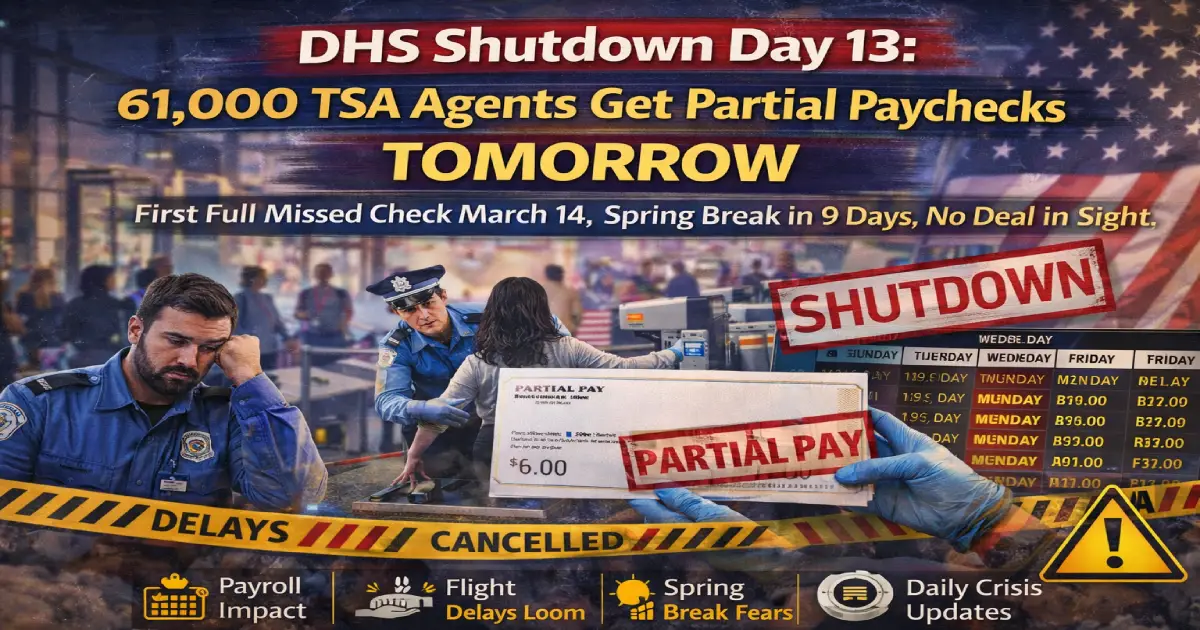
Shutdown Day: 13 — began February 14, 2026 at 12:01 AM EST Status: No deal. No vote scheduled. Congress departed on recess. TOMORROW — February 28: 61,000 TSA agents receive partial paychecks — last pay before missed checks March 14: First full missed paycheck for TSA officers — the financial cliff Spring Break Starts: March 8 — 9 days away — peak travel begins before any realistic resolution TSA PreCheck: ✅ OPERATIONAL — reversed after brief suspension Feb 22 Global Entry: 🔴 SUSPENDED since February 22 — halted at all participating US airports TSA Attrition: 1,110 officers separated in Oct–Nov 2025 — 25%+ increase over prior year TSA Absenteeism Timeline: Historically begins at weeks 3–4 without pay — we reach that window March 7–14 Spring Break Peak: March 8–22 — 6 million+ passengers expected per week World Cup Risk Window: June 11–July 19 — TSA surge staffing plans now at risk Congress Return: No confirmed date. Senate on 24-hour notice. House on 48-hour notice. Political Deadlock: Democrats demanding ICE/CBP reforms. Republicans refusing. No compromise visible. This Shutdown’s Context: Third US shutdown in under 6 months. Previous lasted 43 days — longest in US history at the time. TSA Budget: NOT fundable via reconciliation — “the best way to ensure our frontline workers get paid is through the passage of a DHS budget” — Acting TSA Administrator
Tomorrow morning, 61,000 Transportation Security Administration officers will open their bank apps and see a number smaller than they expected.
TSA workers will only receive a partial paycheck on February 28 if the impasse isn’t resolved by then. They will miss their first full paycheck on March 14.
That partial check represents the last wages these federal employees — the people screening your carry-on bags, staffing the body scanners, and maintaining security at 430+ commercial airports across the United States — will receive before the financial cliff arrives. For the 61,000 TSA officers who live paycheck to paycheck, tomorrow’s partial payment is not relief. It is a countdown.
“People are tired of the uncertainty,” said Johnny Jones, secretary/treasurer of the American Federation of Government Employees TSA Council 100. “It causes so much disruption.”
This is the moment the DHS shutdown stops being a Washington policy dispute and starts being an airport operations emergency. Spring break begins in nine days. The partial paycheck arrives tomorrow. The first full missed paycheck hits in 16 days. Congress has no vote scheduled and no deal in sight.
Here is the complete Day 13 picture — what happened, what is happening now, what the paycheck timeline means for spring break, and exactly what every American traveler needs to do before stepping into an airport security line this March.
The DHS shutdown of 2026 is not a standalone event. It is the third government funding lapse in under six months — and it is the direct successor to the longest shutdown in US history.
Two shutdowns of the U.S. federal government have occurred in 2026, both arising from disputes in Congress about reforms to federal immigration enforcement after the killing of Alex Pretti by Customs and Border Protection (CBP) agents. The first shutdown lasted four days from January 31 to February 3, affecting about half of the departments of the federal government.
| Date | Event |
|---|---|
| Aug–Nov 2025 | 43-day shutdown — longest in US history at that time — all DHS + most federal agencies |
| Nov 2025 | First shutdown ends — Congress passes full-year funding for all agencies except DHS |
| Jan 22, 2026 | Funding package passes House — DHS bill blocked by Senate Democrats |
| Jan 24, 2026 | CBP agents kill Alex Pretti in Minneapolis — Democrats harden position on ICE/CBP reforms |
| Jan 29–Feb 3, 2026 | First 2026 shutdown — 4 days — all agencies, ends with 2-week DHS continuing resolution |
| Feb 12, 2026 | Democrats block second 2-week DHS continuing resolution — Congress leaves for recess |
| Feb 14, 2026 | DHS SHUTDOWN BEGINS — 12:01 AM EST — only agency without funding |
| Feb 15, 2026 | DHS announces PreCheck and Global Entry suspension |
| Feb 22, 2026 | DHS reverses PreCheck suspension. Global Entry remains halted. |
| Feb 22, 2026 | DHS announces emergency measures — FEMA non-disaster grants halted, courtesy airport escorts suspended |
| Feb 28 (TOMORROW) | Partial TSA paychecks |
| Mar 8 | Spring break peak begins |
| Mar 14 | First FULL missed TSA paycheck |
Negotiations on Homeland Security did not reach a resolution during the extended two weeks negotiating period, leading to the second shutdown on February 14, 2026.
The political stalemate is structural. Negotiations collapsed over a 10-point reform package that Democratic leaders say will curb excessive force by ICE and CBP agents, while Republican appropriators seek steeper cuts to asylum processing budgets. With Congress on recess and no confirmed return date, there is no mechanism for a deal to happen before tomorrow’s partial paycheck — and possibly before March 14’s full missed check.
Tomorrow’s partial check covers the days TSA officers worked before the shutdown began on February 14. It represents their final days of paid work before the lapse. The check will reflect a partial pay period — not a full two-week cycle. For an average TSA officer earning $46,000 per year with a biweekly paycheck of approximately $1,769, tomorrow’s partial payment will likely be $800–$1,200 depending on where in the pay cycle February 14 fell.
This is the last paycheck. The next one — due March 14 — will be zero unless Congress funds DHS before that date.
“We don’t have a crystal ball,” said Katy Nastro, a travel expert at Going, in an interview with the Washington Examiner. “But historically, once you hit that three- to four-week threshold without pay, that’s when absenteeism starts to occur, and the financial strain really weighs on essential workers.”
The three-to-four week threshold from February 14 is March 7–14 — exactly when spring break begins and the first full paycheck is missed simultaneously. This is not a coincidence in the sense that anyone planned it — it is a convergence that the TSA itself has been warning Congress about for weeks.
TSA officers are expected to receive one more paycheck before mid-March. After that, Nastro said, the pressure typically intensifies as workers who live paycheck to paycheck begin feeling the strain. “That’s really the timeline we’ve seen in the past,” she said.
The most authoritative guide to what happens when TSA officers stop receiving paychecks is the testimony TSA Acting Administrator Ha Nguyen McNeill delivered to Congress — on the record, under oath — before this shutdown began.
“We heard reports of officers sleeping in their cars at airports to save money on gas, selling their blood and plasma and taking on second jobs to make ends meet,” McNeill said at a House hearing this week.
During the 43-day shutdown last fall, acting Administrator Ha Nguyen McNeill said, TSA saw spikes in unscheduled absences and, in some cases, increases in wait times at airports for screenings. The situation was exacerbated as the lapse dragged on and “the situation became untenable for frontline employees.”
This is not speculation. This is documented history from eight weeks ago. When TSA officers stop getting paid, they start missing shifts — not because they want to abandon their posts, but because they need to earn income to feed their families. During the 43-day shutdown, the combination of TSA absences and FAA absences ultimately helped pressure Congress to act. This time, the FAA is funded — only TSA bears the burden.
The paycheck cliff lands on a TSA workforce that is already smaller and more stressed than it was before the 43-day shutdown.
Around 1,110 TSOs separated from TSA in October and November 2025, a more than 25% increase in TSO separations from the same time period in 2024. Many TSOs that left attributed their separation due to the uncertainty, stress, missed paychecks, and financial hardships of the government shutdown.
That is 1,110 experienced screening officers who quit in the two months after the 43-day shutdown ended. They left because of what they went through. They are not coming back. Their checkpoints are now staffed by newer, less experienced officers — or not fully staffed at all.
Right now, the Agency is focused on surge staffing in March, April, and May, to be prepared for Spring Break, summer, and World Cup travel.
TSA’s entire spring break preparation strategy is a surge staffing plan — hiring and deploying additional screeners specifically to handle the March–May travel peak. That plan is now compromised. You cannot surge-staff a workforce that is simultaneously unpaid, experiencing higher-than-normal attrition, and heading into its first full missed paycheck on March 14.
TSA saw a 25% increase in attrition from the same six-week period the year before the shutdown, which McNeill said the agency can ill-afford as it prepares for increased traffic during spring break and the upcoming World Cup. “It’s affecting recruiting as we speak,” she said of the lingering uncertainty.
Spring break 2026 is not one date — it is a rolling wave that sweeps across the country based on school district calendars. The highest-risk window for TSA disruptions looks like this:
| Date | Event | TSA Status |
|---|---|---|
| Mar 8 (Sun) | Spring break begins — first major travel surge | Day 22 without pay — approaching absenteeism threshold |
| Mar 8–10 | First high-volume spring break weekend | ⚠️ Elevated wait times likely |
| Mar 14 (Sat) | First full missed paycheck | 🔴 Critical — absenteeism expected to begin |
| Mar 15–22 | Spring break PEAK — maximum passenger volumes | 🔴 Maximum risk window |
| Mar 22 (Sun) | Spring break return travel surge | 🔴 Maximum risk window |
| Apr 15 | Spring break fully ends | — |
The convergence of March 14 (first missed check) with March 15–22 (peak spring break return travel) is the scenario that TSA, airlines, and travel industry groups have been dreading since February 14.
Not all airports will be equally affected. The risk is highest where:
Highest spring break concentration + TSA pressure:
| Airport | Code | Spring Break Volume | Risk Level |
|---|---|---|---|
| Orlando International | MCO | 🔴 EXTREME | 🔴 HIGH |
| Fort Lauderdale-Hollywood | FLL | 🔴 EXTREME | 🔴 HIGH |
| Miami International | MIA | 🔴 HIGH | 🔴 HIGH |
| Cancún International | CUN | 🔴 EXTREME (outbound) | 🔴 HIGH |
| Tampa International | TPA | 🟠 HIGH | 🟠 ELEVATED |
| Dallas Love Field | DAL | 🟠 HIGH | 🟠 ELEVATED |
| Los Angeles International | LAX | 🟠 HIGH | 🟠 ELEVATED |
| Phoenix Sky Harbor | PHX | 🟠 HIGH | 🟠 ELEVATED |
| New York area (JFK/LGA/EWR) | — | 🟠 HIGH | 🟠 ELEVATED |
| Smaller hub airports | Various | Variable | 🔴 HIGHER RELATIVE RISK |
The last point is crucial: smaller airports with fewer screeners are more sensitive to individual absences. If MCO has 200 TSA officers and 10 call out sick, the wait time increases moderately. If a smaller airport like Savannah/Hilton Head (SAV) has 20 TSA officers and 3 call out sick, the single security lane that closes doubles the checkpoint wait time.
At this time, TSA PreCheck remains operational with no change for the traveling public. As staffing constraints arise, TSA will evaluate on a case by case basis and adjust operations accordingly.
PreCheck lanes are open and operating. The February 22 suspension lasted less than 24 hours before being reversed following White House discussions. However, the DHS statement includes a critical qualifier: “as staffing constraints arise, TSA will evaluate on a case by case basis.” This means PreCheck status can change with hours of notice — as it did on February 22. Do not assume PreCheck will be available for your flight just because it is available today.
Action: Check tsa.gov the morning of your flight and allow extra time in case PreCheck is not available at your specific checkpoint.
As of 6:00 AM on February 22, 2026, U.S. Customs and Border Protection, Office of Field Operations will halt all Global Entry arrival processing at participating airports. Officers assigned to process Global Entry travelers will be re-assigned to process all other arriving travelers.
Global Entry has not been restored. Every international arrival that previously used Global Entry kiosks is now processed through the standard primary inspection lane — adding an estimated 15–45 minutes to international arrival processing at major US gateways.
Impact airports: JFK, LAX, MIA, ORD, SFO, IAD, BOS, ATL, DFW, IAH, SEA, EWR — all major international gateways.
Action: International travelers returning to the US must add 30–45 minutes to their customs and immigration processing estimate. Pre-book ground transport accordingly. Do not book tight domestic connections off an international arrival.
Typically, a major pain point during a shutdown is the snarling of flights due to staffing issues among air traffic controllers. That won’t be an issue in this case, because controllers are part of the Department of Transportation’s Federal Aviation Administration, which has already received funding for the rest of the fiscal year.
Air traffic control is funded. Flights will not be cancelled because of ATC staffing. This is the single most important distinction between this shutdown and the previous 43-day shutdown, which did affect ATC. Today, the only aviation-security risk is at the TSA checkpoint level — not in the air.
Halting all non-disaster-related Federal Emergency Management Agency (FEMA) response efforts to prioritize disaster response.
For travelers, this has limited direct impact. For residents of disaster-affected areas who depend on FEMA non-disaster grants for housing, rebuilding, and recovery — this is a significant and immediate hardship.
The Coast Guard is curtailing training and grounding some aircraft, while TSA’s leaders warned of delays at airports.
The operational implications for maritime safety are significant. For leisure travelers on cruise ships and recreational boaters, the Coast Guard’s reduced readiness during this shutdown period is a genuine safety concern.
Consular operations abroad have stopped issuing immigrant visas except in life-or-death emergencies; non-immigrant visa interviews are going forward but cannot be finalized without DHS data-sharing clearances, creating a growing backlog.
International travelers applying for US visas face processing delays. H-1B registrations opening March 3 will face slower processing times. USCIS adjudication times are lengthening as contractors are furloughed.
Understanding the political dynamics is essential for any traveler trying to assess when this might end.
Funding for DHS lapsed Feb. 14 after congressional Democrats and the White House failed to reach an agreement on reforms to President Trump’s immigration enforcement crackdown.
The core dispute:
Those accepting voluntary furloughs are taking a risk, as the White House has treated back pay for furloughed workers as non-guaranteed. Congress has approved retroactive compensation in both of the two shutdowns this fiscal year, however, reaffirming a guarantee it passed into law for all future shutdowns in 2019.
The third shutdown of the year is grinding down a workforce already traumatized by the 43-day lapse. “I did not dig out from the last shutdown” before this one began, said a civilian DHS staffer. Some workers are taking voluntary furloughs in rotation — “My unit is rotating voluntary furlough days. [We] conserve finances by not commuting, since we’re only allowed to telework in emergency situations.”
The compromise space is narrow. No moderate Republican has publicly committed to forcing a floor vote over the Speaker’s objection. No Democrat has publicly offered to drop core ICE reform demands. Without one of those moves, the shutdown continues through spring break.
The spring break crisis is the immediate problem. The World Cup is the larger one.
Right now, the Agency is focused on surge staffing in March, April, and May, to be prepared for Spring Break, summer, and World Cup travel.
The 2026 FIFA World Cup runs June 11–July 19 with matches at 16 US cities including New York/New Jersey, Los Angeles, Dallas, San Francisco Bay Area, Seattle, Boston, Atlanta, Houston, Miami, and Kansas City. TSA is planning to deploy surge staffing across all host-city airports specifically to handle the unprecedented international travel volume — an estimated 1.5 million international visitors entering the US for the World Cup.
That surge staffing plan requires:
Every day the shutdown continues is a day TSA cannot advance its World Cup preparation. If the shutdown extends beyond March 14 (first missed paycheck), the resulting attrition wave — potentially another 1,000+ officer separations — directly reduces the headcount available for World Cup surge deployment.
TSA saw a 25% increase in attrition from the same six-week period the year before the shutdown, which McNeill said the agency can ill-afford as it prepares for increased traffic during spring break and the upcoming World Cup. “It’s affecting recruiting as we speak,” she said of the lingering uncertainty.
Add 45–60 minutes to your normal arrival buffer. This is not extreme caution — it is the consistent advice from TSA, Airlines for America, the US Travel Association, and every independent travel expert monitoring the situation. For a domestic flight you would normally arrive 90 minutes before, arrive 2.5 hours before March 8 onwards.
For morning departures (before 9 AM): These flights typically face lower checkpoint congestion because leisure travelers trend toward midday departures. Early morning may be your best mitigation strategy.
For Friday afternoon and Sunday departures: These are the highest-volume, highest-risk windows of spring break week. Friday 2–6 PM and Sunday noon–8 PM represent maximum passenger concentration at security checkpoints. If your schedule has any flexibility, shift to Thursday evening or Monday morning.
Do not abandon TSA PreCheck — it is operational today and remains your best checkpoint mitigation tool even during the shutdown. PreCheck lanes process passengers 3–4x faster than standard lanes and are staffed by the same officers — meaning a shortened PreCheck queue is a genuine time saving.
CLEAR (the biometric pre-screening service) is a private company and is not affected by the government shutdown. CLEAR expedites the identity verification step at security, moving you to the front of the TSA lane. During shutdown-era checkpoint congestion, CLEAR is worth considering as a supplemental tool — though it does not replace PreCheck’s security screening speed advantage.
Global Entry alternative: If you are an international arrival using Global Entry pre-screening, that program is currently suspended. Use the Mobile Passport Control app (free, no membership required) as an alternative — it can reduce standard customs processing from 45 minutes to 20 minutes at most major US international airports.
The FAA and air traffic control remain funded, your flight isn’t going to be canceled because of this shutdown alone.
The shutdown will not cause flight cancellations. It will cause security checkpoint delays — which, in a worst-case scenario, could cause passengers to miss flights due to longer-than-expected screening times. The risk is not in the air. It is before you get there.
Book your flights with these principles:
If you arrive at a checkpoint and the queue stretches 60+ minutes before your scheduled departure time:
| Service | Status | Notes |
|---|---|---|
| TSA checkpoints | ✅ OPEN — agents unpaid | Absenteeism risk grows weekly |
| TSA PreCheck | ✅ OPERATIONAL | Can change with hours notice |
| Global Entry | 🔴 SUSPENDED | Since February 22 — no restoration date |
| Mobile Passport Control | ✅ OPERATIONAL | Best Global Entry alternative |
| CLEAR (private) | ✅ OPERATIONAL | Not government-funded |
| Air traffic control (FAA) | ✅ FULLY FUNDED | No flight cancellation risk |
| FEMA non-disaster grants | 🔴 HALTED | Emergency disaster response continues |
| Coast Guard | ⚠️ REDUCED | Training/some aircraft grounded |
| Immigrant visa issuance | 🔴 HALTED | Emergency exceptions only |
| Non-immigrant visa processing | ⚠️ SLOWING | DHS data-sharing delays |
| USCIS user-fee services | ✅ CONTINUING | Adjudication times lengthening |
| Key Date | Event |
|---|---|
| Tomorrow Feb 28 | Partial TSA paychecks — last payment before cliff |
| Mar 8 | Spring break begins |
| Mar 14 | First full missed TSA paycheck |
| Mar 15–22 | Spring break peak — maximum risk window |
| Jun 11 | World Cup begins — surge staffing plans at risk |
13: Days of shutdown so far — and counting. 61,000: TSA officers working without full pay. 1,110: Experienced TSA officers who already quit after the last shutdown. 9: Days until spring break begins. 16: Days until the first full missed paycheck. 3–4 weeks: The historical threshold when TSA absenteeism begins — we arrive there March 7–14. 0: Confirmed Congressional votes scheduled to end the shutdown.
The TSA agents who will screen your family at MCO, FLL, and LAX during spring break are the same people who survived a 43-day shutdown just a few months ago. They are tired, financially stressed, and working without the certainty of their next full paycheck.
They will still show up. They did during 43 days. But history tells us that as the weeks without pay accumulate, more of them — not all, but more — will start calling out, start taking second jobs, start making choices that prioritize survival over schedule adherence.
“People are tired of the uncertainty. It causes so much disruption.”
Your best spring break insurance is not travel insurance, though that helps. It is arriving early, knowing your rights, having a plan for delays, and understanding that the 61,000 people standing between you and your gate deserve both your patience and your attention to what their government is — or is not — doing for them.
Published: February 27, 2026. Information sourced from CNN Politics (February 12 and 22, 2026), TSA Official Congressional Testimony — Oversight Hearing Potential DHS Shutdown Impacts (tsa.gov, February 11, 2026), Government Executive (February 20 and 25, 2026), Federal News Network (February 12, 2026), Washington Examiner (February 21, 2026), DHS Official Statement — 1 Week Democrats’ Shutdown Emergency Measures (dhs.gov, February 22, 2026), Wikipedia 2026 United States Federal Government Shutdowns (updated February 26, 2026), VisaHQ US Shutdown Advisory (February 18, 2026), American Subcontractors Association DHS Shutdown Impact (February 25, 2026), UpgradedPoints Shutdown Travel Guide (February 22, 2026), AFGE TSA Council 100 statements. All figures accurate as of 8:00 AM EST February 27, 2026.
For More Resources:
Related Articles:
Posted By : Vinay
This article is provided for general informational purposes only and is based on information available at the time of publication. Travel advisories, airline schedules, airport operations, visa requirements, government regulations, and other travel-related information are subject to change without prior notice. While Travel Tourister makes reasonable efforts to verify information using official announcements, government publications, airline and airport communications, and other reliable sources, we cannot guarantee that all information remains complete, accurate, or up to date at all times. Readers should independently verify any information that may affect their travel plans with the relevant airline, airport authority, government agency, embassy, or other official source before making travel, financial, or other decisions. Travel Tourister shall not be liable for any direct or indirect loss, inconvenience, or damages arising from the use of or reliance on the information contained in this article. Nothing in this publication constitutes legal, immigration, financial, or professional travel advice. If you believe any information in this article is inaccurate or outdated, please contact our editorial team. We review all credible correction requests promptly and update our content whenever appropriate.
Lastest News
2nd Floor, 39, Above Kirti Club, DLF Industrial Area, Kirti Nagar, New Delhi, Delhi 110015



Travel Tourister is a leading Travel portal where we introduce travellers to trusted travel agents to make their journey hasselfree, memorable And happy. Travel Tourister is a platform where travellers get Tour packages ,Hotel packages deals through trusted travel companies And hoteliers who are working with us across the world. We always try to find new and more travel agents and hoteliers from every nook and corners across the world so that you could compare the deals with different travel agents and hoteliers and book your tour or hotel with the one you have chosen according to your taste and budget.
Copyright © Travel Tourister, India. All Rights Reserved

 Call
Call Enquiry