Published on : 02 Mar 2026
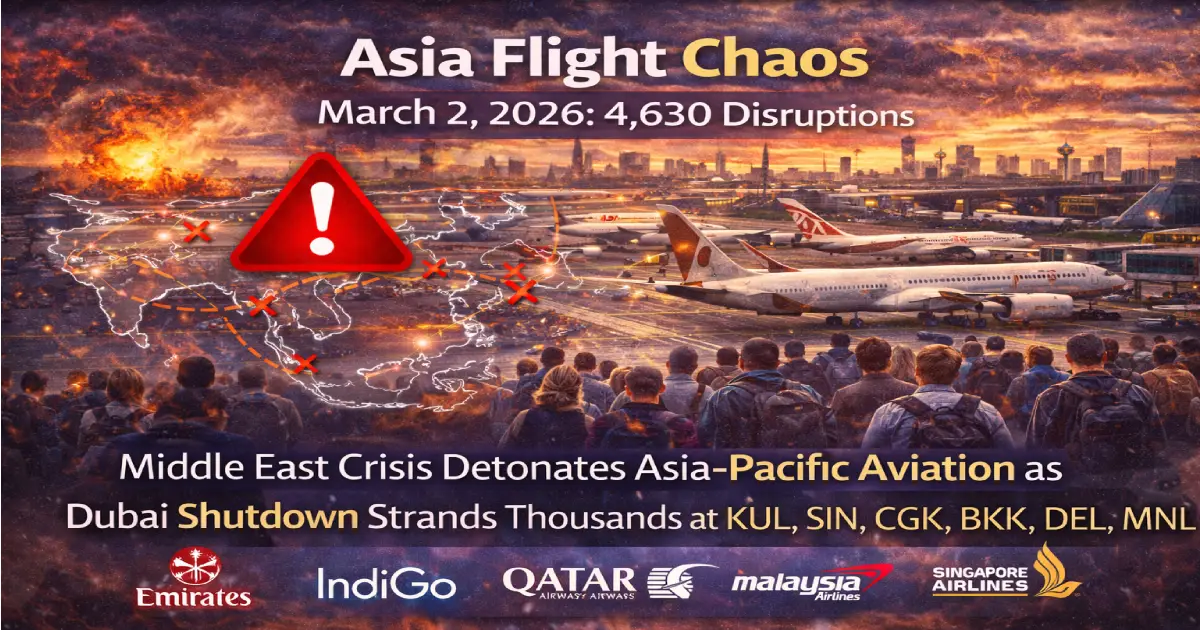
🔴 LIVE UPDATE — Monday March 2, 2026 | This is a developing situation
Four days ago, this website reported on 787 delays and 35 cancellations across Asian airports on February 28 — a significant disruption, driven by the usual culprits of maintenance backlogs, airport congestion, and tight crew scheduling.
That crisis now seems modest in comparison to what is happening today.
The Middle East is on fire — literally and figuratively. Following coordinated US and Israeli strikes on Iran on February 28, retaliatory missile and drone attacks struck UAE airports, Gulf airspace closed across six nations, and the east–west “superhighway” of the sky — the corridor through which nearly every flight between Asia and Europe passes — went dark overnight.
The result: what began as a Gulf crisis has detonated across the entire Asia-Pacific aviation system in real time. Today’s disruption figures are not the product of infrastructure strain or crew rostering problems. They are the direct consequence of the biggest single airspace closure since September 11, 2001 — and Asia, sitting at the crossroads of every long-haul route between Europe and Oceania, is absorbing the full force of the shockwave.
Thousands of passengers are trapped in Asia and the Middle East today as a wave of disruptions has caused 4,630 flight cancellations and delays, hitting major airports including Dubai International (1,152 cancellations), Hamad International Airport in Doha (539 cancellations, 5 delays), Ben Gurion Airport in Tel Aviv (231 cancellations), Mumbai Chhatrapati Shivaji Maharaj International (101 cancellations, 325 delays), Indira Gandhi International in Delhi (73 cancellations, 246 delays), Kuala Lumpur International (26 cancellations, 446 delays), Suvarnabhumi Bangkok (41 cancellations, 246 delays), and Singapore Changi (23 cancellations, 240 delays).
This is a completely different category of crisis from anything Asia’s aviation system has faced in recent weeks. Here is everything you need to know — airport by airport, airline by airline, and exactly what to do if you are affected right now.
To understand today’s disruption, you need to understand the geography of global aviation.
Because the Middle East serves as the primary “bridge” for flights between Europe and Southeast Asia, the closure of Iranian and Gulf airspaces has triggered immediate cancellations and massive logistical shifts for regional carriers. Every flight from London to Singapore, Paris to Kuala Lumpur, Amsterdam to Bangkok, or Frankfurt to Jakarta normally traverses Iranian or Gulf airspace. With those corridors now closed, airlines face one of three choices: cancel the flight, reroute via a significantly longer path (adding 90 minutes to three hours of flying time), or ground the aircraft until the airspace reopens.
Iran and Israel both closed their airspaces, with the United Arab Emirates, Qatar, Bahrain, Iraq, Israel and Iran all confirming closures. The UAE said it had temporarily and partially closed its airspace as a precautionary measure.
The consequences for Asian hubs — which handle millions of these through-connecting passengers every day — are immediate and severe.
Downstream effects have spread quickly across Southeast Asia’s short-haul network. Flights between Kuala Lumpur and Singapore, Jakarta and Bangkok saw knock-on delays as aircraft and crew returning from disrupted long-haul sectors missed their scheduled turns. Passengers heading for connections in Singapore, Jakarta and Bangkok found onward flights to the Middle East and Europe either canceled or severely delayed as Changi, Soekarno–Hatta and Suvarnabhumi airports absorbed their own waves of schedule changes.
| Metric | Feb 28 (Previous Article) | Mar 2 (Today) | Change |
|---|---|---|---|
| Total Disruptions | 822 | 4,630 | +463% |
| Total Delays | 787 | 2,117 | +169% |
| Total Cancellations | 35 | 2,513 | +6,180% |
| Airports Affected | 11 | 14+ | +27% |
| Countries Affected | 6 | 10+ | +67% |
| Primary Cause | Infrastructure/maintenance | Middle East airspace closure | New crisis layer |
| KUL Delays | 202 | 446 | +121% |
| SIN Delays | 61 | 240 | +293% |
| CGK Delays | 51 | 184 | +261% |
The cancellation explosion — from 35 to 2,513 — tells the full story. These are not delayed aircraft that eventually departed. Thousands of flights across Asia have been outright cancelled as airlines determine there is no safe routing available through the Gulf corridor today.
26 cancellations | 446 delays
Passengers at Kuala Lumpur International Airport faced hours-long queues, missed connections and overnight stays as 429 flight delays and 23 cancellations rippled through schedules for Malaysia Airlines, AirAsia, Emirates and other major carriers, following sweeping airspace closures across the Middle East.
This is more than double February 28’s numbers at KUL. The airport, which already carried deep structural pressure from over-capacity operations, is now absorbing both its own operational strain and the cascading effects of the Gulf crisis simultaneously.
Several airlines serving Kuala Lumpur adjusted schedules repeatedly through the day, updating departure times in small increments as they awaited clarity on routing options over alternative corridors such as Saudi Arabian or Central Asian airspace, adding to passenger frustration and confusion.
Malaysia Airlines mid-flight diversions — what happened: Malaysia Airlines, which operates direct services to Doha and Jeddah, had already diverted two Middle East bound flights on February 27, turning flight MH160 back to Kuala Lumpur and rerouting MH156 via Chennai, India, in response to a sudden escalation in airspace risk assessments. Those displaced aircraft and their crews were already out of position before today’s full closure took effect, compounding the disruption for Kuala Lumpur.
Travel agents in Kuala Lumpur reported last-minute requests to reroute via alternative hubs in East Asia or Europe, though options were limited by simultaneous disruption at other major gateways and by airlines’ reluctance to commit aircraft to longer, more fuel-intensive routings while security assessments remained fluid.
What is happening inside the terminal right now: Inside KLIA’s Terminal 1, weary travelers have sprawled across benches and on the floor near departure gates, clutching paper boarding passes that have already been reissued multiple times. Families with young children queued at airline counters late into the night seeking hotel vouchers or assurances of seats on the next available departures.
Malaysia Airports said no passengers had been formally registered as stranded under its crisis response system and emphasized that check-in, security and immigration were functioning normally. That characterization, however, contrasted with scenes of travelers sleeping in public areas and social media posts from passengers who said they had been advised to remain in the terminal while airlines worked through rebooking backlogs.
AirAsia passengers — specific warning: Budget-conscious passengers on low-cost carriers such as AirAsia faced additional hurdles, with limited accommodation support and fewer interline options than full-service rivals, making it harder to switch to alternative routings at short notice.
539 cancellations | 5 delays
Hamad International Airport in Doha recorded 539 cancellations and just 5 delays — meaning Qatar Airways essentially stopped flying. A cancellation-to-delay ratio this extreme means the airport is not running a degraded operation — it is running almost no operation at all. Qatar Airways has confirmed the suspension of all flights due to the full closure of Qatari airspace.
For the tens of thousands of Asian travellers who use Doha as their hub to Europe, the UK, North Africa, and the Americas, this is a crisis within a crisis. There are no seats. The rebooking queue is global.
1,152 cancellations
Dubai Airports reported over 700 flight cancellations after the UAE partially closed its airspace as a precaution. Dubai International Airport — the world’s busiest international airport — is at a virtual standstill.
For Asian passengers, this means every Emirates, flydubai, and Air Arabia service to and from the region is cancelled. Emirates alone carries approximately 250,000 passengers per day globally. Every one of those bookings through Dubai is currently worthless until further notice.
101 cancellations | 325 delays
Chhatrapati Shivaji Maharaj International Airport recorded 101 cancellations and 325 delays, with significant delay volumes led by IndiGo and Air India. Mumbai is one of the primary Indian gateways for connecting travel to the Gulf — Air India, IndiGo, SpiceJet, and Vistara all operate heavy Dubai and Abu Dhabi schedules from BOM. With those routes cancelled, aircraft and crews are stranded, and domestic knock-on effects are materialising across India’s entire aviation network.
73 cancellations | 246 delays
Indira Gandhi International Airport saw 73 cancellations and 246 delays, driven largely by domestic carriers. India is one of the world’s largest sources of outbound travel to the UAE — over 3.5 million Indian nationals live and work in Dubai alone. With the entire UAE route network grounded, IndiGo’s schedule — which relies heavily on Delhi–Dubai, Delhi–Abu Dhabi, and Delhi–Sharjah rotations — has collapsed. Those grounded aircraft are now unavailable for domestic service, creating a cascading shortage across IndiGo’s network.
Air India continues to closely monitor the situation, assessing the evolving circumstances across safety, security, airspace availability, and operational feasibility parameters, before deciding on operations for March 2, 2026.
23 cancellations | 240 delays
Air travel across Singapore and wider Southeast Asia was thrown into fresh turmoil, with a wave of operational disruptions triggering cancellations and hundreds of delays at Singapore Changi Airport, rippling across key carriers including Singapore Airlines, Gulf Air, AirAsia, Thai Airways, Vietjet and Malaysia Airlines.
Singapore Airlines has suspended all flights to the Middle East, with at least six flights cancelled including SQ494/495 on the Singapore–Dubai route and Scoot flights TR596/597 on the Singapore–Jeddah route.
For a hub that handles tens of millions of transit passengers annually — many of them connecting onward to the Gulf and Europe — the loss of Middle Eastern airspace represents a structural rupture in Changi’s business model. Every European connection that flows through Dubai or Doha is now broken, and Singapore is absorbing the queue of passengers seeking alternatives on the Asia-only corridors that remain.
The disruption coincided with heavy traffic flows between Southeast Asia and the Gulf, where airports in the UAE and Bahrain were already battling their own spikes in delays and cancellations. With many flights operating as through-connections between Singapore, Kuala Lumpur, Bangkok and key Middle Eastern hubs, even relatively minor timetable shifts quickly cascaded into missed links and forced rebookings. Ground staff at Changi were deployed to manage crowding at transfer desks and boarding gates.
41 cancellations | 246 delays
Suvarnabhumi Airport recorded 246 delays and 41 cancellations, with delays dominating overall disruption. Bangkok is Thailand’s aviation gateway and a major transit hub for European tourists visiting Southeast Asia. Emirates, Qatar Airways, and Etihad all operate Suvarnabhumi services — all are grounded. Thai Airways, which codeshares with several Gulf carriers and relies on the east–west corridor for its European routes, is running significantly degraded.
Thai Airways and Thai AirAsia reported delays on services linking Bangkok with Singapore and key Malaysian and Vietnamese cities, as aircraft and crews were held up by late inbound legs and longer turnaround times.
27 cancellations | 184 delays
Soekarno–Hatta International Airport saw 184 delays and 27 cancellations, primarily driven by domestic Indonesian carriers. The pattern here is the same as KUL and BOM: Gulf-route aircraft are grounded, their crews are out of position, and the ripple effect is spreading into domestic and regional services that have no direct connection to the Middle East conflict.
For the 1,600 tourists stranded in Bali (reported separately by TTR Weekly), the Jakarta hub disruption is particularly acute — Ngurah Rai Airport in Denpasar feeds into CGK for onward connections to Dubai, Doha, and Abu Dhabi. All of those connections are severed.
Significant disruptions — data emerging
Manila is joining the cascade. The Philippines is one of the world’s largest sources of overseas workers (OFWs) in the UAE — over 700,000 Filipinos live and work in Dubai and Abu Dhabi. With Cebu Pacific, Philippine Airlines, and multiple foreign carriers operating Manila–UAE routes now suspended, Manila is seeing both direct Gulf-route cancellations and secondary ripple delays as aircraft rotations collapse.
231 cancellations
Ben Gurion Airport in Tel Aviv recorded 231 cancellations. The Israeli government has confirmed airport closures will last until at least Tuesday March 3.
Emirates has suspended all flights from Dubai. With approximately 250,000 passengers per day, this is the largest single-carrier suspension in aviation history by passenger volume. Emirates logged 61 cancellations and 1 delay at Dubai alone — but those numbers reflect only the flights that were in operation at the moment of closure, not the full scope of the network shutdown.
Qatar Airways recorded 495 cancellations and 3 delays, accounting for the largest airline-level disruption in the dataset, heavily concentrated in Doha and multiple Southeast Asian hubs.
IndiGo recorded 129 cancellations and 262 delays — a devastating day for Asia’s busiest airline by passenger count. IndiGo’s exposure to Gulf routes is immense, and the cascading domestic effect of grounded international aircraft is now spreading across its entire 300-city network.
Air India recorded 54 cancellations and 198 delays. All UAE, Saudi Arabia, Qatar, and Israel services are suspended.
Etihad Airways recorded 52 cancellations as Abu Dhabi International remains grounded.
Saudia recorded 55 cancellations and 32 delays across its Asian network.
El Al recorded 105 cancellations as Ben Gurion Airport remains closed.
Singapore Airlines recorded 2 cancellations and 46 delays as the carrier suspends Gulf services and manages secondary congestion effects at Changi. SIA has confirmed it is continuing all other routes normally and is exploring alternative routing options where possible.
Malaysia Airlines recorded 9 cancellations and 101 delays as Gulf routes are grounded and mid-flight diversions compound the disruption.
Thai Airways recorded 71 delays across its network as European routes through the Gulf are suspended or rerouted.
Garuda Indonesia recorded 15 delays as Gulf services are grounded and domestic cascades continue.
Cebu Pacific recorded 1 cancellation and 55 delays.
The February 28 article described a crisis of structural origin — chronic infrastructure inadequacy, tight crew scheduling, maintenance backlogs. The solution, over time, is more airports, more aircraft, more staff.
Today’s crisis is exogenous — it came from outside the aviation system entirely. A geopolitical conflict has switched off the world’s most-used east–west air corridor. No amount of airport expansion or airline investment could have prevented what is happening today.
This distinction matters enormously for passengers making decisions right now. Unlike a maintenance or congestion delay — which resolves when the aircraft is fixed or the terminal empties — today’s disruption resolves only when governments reopen airspace. That timeline is entirely outside the airlines’ control, and it means:
There is no “later flight today” solution for most affected passengers. The aircraft that would carry you are grounded. The crews that would fly them are out of position. And the airspace they would fly through is closed.
Passengers on flights between Southeast Asia and Europe should expect 90 minutes to three hours of additional flight time due to detours. The alternative routings now being used by carriers that have chosen to continue flying include:
Northern Route (via Russia/Central Asia): Previously avoided by many Western carriers due to the Russian airspace ban. Some Asian carriers are now reassessing.
Southern Route (via Indian Ocean/East Africa): Extremely fuel-intensive, adding hours to journey times. Emirates had already developed this routing for some African services.
Saudi/Turkish Corridor: Some airspace through Saudi Arabia and Turkey remains accessible. Turkish Airlines, which has suspended Iran and Iraq services but maintains other Gulf routes, is now seeing extraordinary demand as passengers seek alternatives.
Airlines are struggling to find alternative seats on non-Middle Eastern carriers — such as Turkish Airlines, Thai Airways, or direct flights — leading to a massive spike in last-minute ticket prices.
Malaysia Airports has advised anyone due to travel to or through the Middle East, or on long-haul routes that typically overfly the region, to check the latest status of their flights directly with airlines before heading to KLIA. Passengers already at the airport are advised to go to their airline’s service desk rather than the check-in counters.
Changi’s terminal staff have been deployed to transfer desks and boarding gates. Go to your airline’s service desk immediately. Singapore Airlines passengers should call the SIA priority line. Do not queue at check-in — go to the transfer or rebooking desks inside the secure zone.
The biggest hidden impact for Southeast Asian travellers is the total shutdown of Dubai, Doha and Abu Dhabi. Airlines are struggling to find alternative seats on non-Middle Eastern carriers, leading to a massive spike in last-minute ticket prices.
Best currently-operating alternatives from Asian hubs:
Aviation authorities and airlines are bracing for a protracted period of disruption that could test the resilience of Southeast Asia’s air travel recovery in the weeks ahead. With the underlying security situation in the Middle East still volatile, the scene at Kuala Lumpur reflects a broader pattern across Asia where cascading operational challenges have left thousands of passengers in limbo.
Industry analysts drawing on the precedent from the June 2025 Iran–US strikes estimate that meaningful airspace restoration is unlikely before March 7–10 at the earliest, and that even after partial reopening, the backlog of displaced aircraft, out-of-position crew, and rebooked passengers will require a further 5–7 days to clear.
The March 14 Spring Break surge — already under threat from the DHS shutdown — is now at serious risk of being further compounded by a Middle East airspace closure that may not be fully resolved by then.
Posted By : Vinay
This article is provided for general informational purposes only and is based on information available at the time of publication. Travel advisories, airline schedules, airport operations, visa requirements, government regulations, and other travel-related information are subject to change without prior notice. While Travel Tourister makes reasonable efforts to verify information using official announcements, government publications, airline and airport communications, and other reliable sources, we cannot guarantee that all information remains complete, accurate, or up to date at all times. Readers should independently verify any information that may affect their travel plans with the relevant airline, airport authority, government agency, embassy, or other official source before making travel, financial, or other decisions. Travel Tourister shall not be liable for any direct or indirect loss, inconvenience, or damages arising from the use of or reliance on the information contained in this article. Nothing in this publication constitutes legal, immigration, financial, or professional travel advice. If you believe any information in this article is inaccurate or outdated, please contact our editorial team. We review all credible correction requests promptly and update our content whenever appropriate.
Lastest News
2nd Floor, 39, Above Kirti Club, DLF Industrial Area, Kirti Nagar, New Delhi, Delhi 110015



Travel Tourister is a leading Travel portal where we introduce travellers to trusted travel agents to make their journey hasselfree, memorable And happy. Travel Tourister is a platform where travellers get Tour packages ,Hotel packages deals through trusted travel companies And hoteliers who are working with us across the world. We always try to find new and more travel agents and hoteliers from every nook and corners across the world so that you could compare the deals with different travel agents and hoteliers and book your tour or hotel with the one you have chosen according to your taste and budget.
Copyright © Travel Tourister, India. All Rights Reserved

 Call
Call Enquiry