Published on : 25 Apr 2026
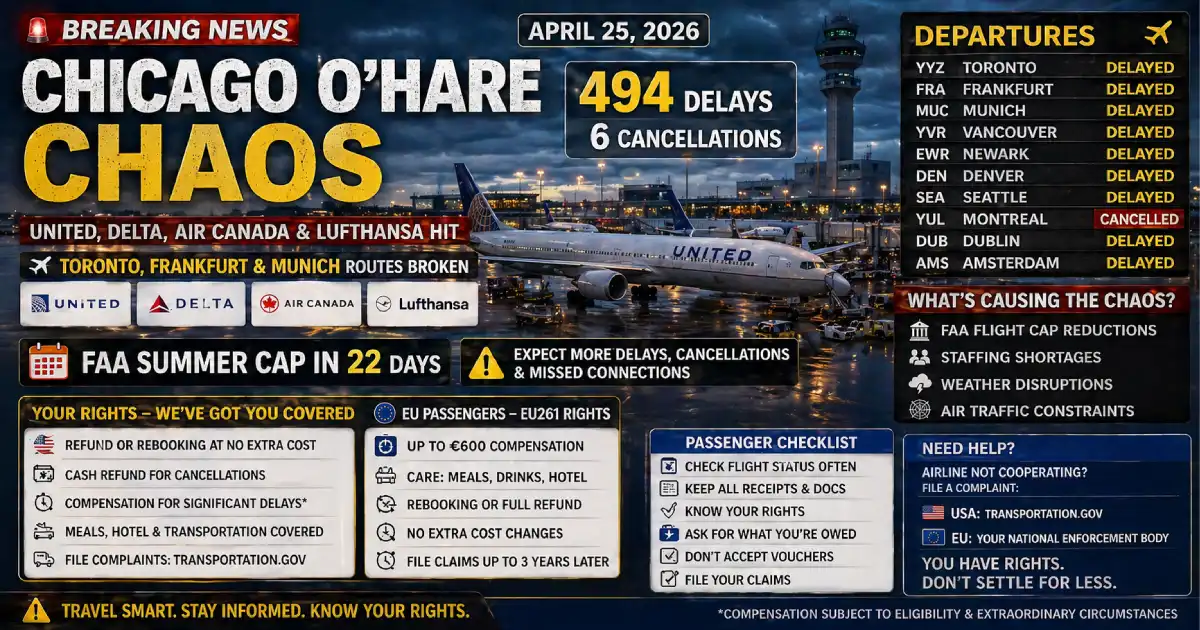
Breaking: An unprecedented aviation crisis has engulfed Chicago O’Hare International Airport, with a volatile mix of severe weather conditions, intense airspace congestion, and cascading operational challenges resulting in a staggering 494 flight delays and 6 outright cancellations. Thousands of passengers have been left stranded as major operators including United Airlines, Delta Air Lines, Air Canada, and Lufthansa desperately attempt to stabilize their fracturing schedules. Today, Saturday April 25, 2026 — Day 25 of the post-Easter US aviation crisis — Chicago O’Hare has again established itself as the single most disruptive hub in the North American aviation network. The 494 delays at O’Hare today are not an isolated event. They are the continuation of a crisis that began on Good Friday April 3 and has not produced a single normal operating day at this airport in 25 consecutive days. The sheer volume of gridlocked aircraft in Chicago is triggering massive ripple effects, severely impacting major economic and passenger hubs across North America and mainland Europe — with Toronto Pearson, Frankfurt International, and Munich International among the most severely disrupted downstream airports. With the FAA’s historic summer flight cap — limiting O’Hare to 2,708 daily operations — arriving in just 22 days on May 17, today’s chaos is the last major unrestricted weekend before the most transformative operational intervention in O’Hare’s history. This is every carrier, every route, every downstream airport, and every right you hold today.
Published: April 25, 2026 — Saturday Day in National Crisis: Day 25 — post-Easter US aviation disruption Airport: Chicago O’Hare International Airport (ORD) — world’s busiest airport by operations Total Disruptions: 500 (494 delays + 6 cancellations) Primary Causes: Severe weather · airspace congestion · aircraft and crew positioning cascade · Day 25 accumulated network stress Carriers Affected: United Airlines · American Airlines · Delta Air Lines · Air Canada · Lufthansa · SkyWest · British Airways International Routes Broken: Toronto (YYZ) · Frankfurt (FRA) · Munich (MUC) · Brussels (BRU) · London Heathrow (LHR) · Amsterdam (AMS) Domestic Ripple Airports: Austin (AUS) · Harrisburg (MDT) · Cleveland (CLE) · Bradley (BDL) · Minneapolis (MSP) · Boston (BOS) FAA Summer Cap: Begins May 17, 2026 — 2,708 daily operations maximum (down from planned 3,080) — 22 days away United Airlines Summer Cut: Approximately 200+ daily arrivals and departures reduced from peak summer schedule Passengers Affected at ORD Today: Est. 50,000–70,000 EU261/UK261: Applies to Lufthansa, British Airways, Air Canada departures from ORD for EU/UK-destination passengers — up to €600/£520 if cause is within airline control
Chicago O’Hare International Airport has recorded elevated disruption on every single day since April 3. Twenty-five consecutive days without a single normal operating period. No other airport in the world — not Atlanta, not London Heathrow, not Dubai — has maintained this level of sustained disruption through a full calendar month. The question that every O’Hare passenger, every United and American Airlines shareholder, and every aviation regulator is now asking is the same: why does this airport, specifically, keep breaking?
The answer is structural, not accidental.
Chicago O’Hare functions as the central nervous system for countless domestic spokes. The immediate catalyst for today’s staggering gridlock is a powerful convergence of severe weather systems and a highly saturated volume of air traffic. Unlike isolated mechanical issues, severe weather events at a mega-hub like O’Hare mandate immediate ground stops and wider separation requirements between airborne aircraft — this rapidly degrades the airport’s hourly arrival and departure capacity.
But weather is only the trigger. The explosive charge it ignites was laid weeks ago:
Force 1 — Dual competing hub operations. Unlike Atlanta (Delta dominates) or Dallas Fort Worth (American dominates), O’Hare has two full competing hub operations — United and American — trying to recover from the same disruption simultaneously using the same limited runway slots, gate positions, and ATC resources. Neither carrier can optimise its recovery without being constrained by the other’s simultaneous demand.
Force 2 — 25 days of accumulated positioning failures. Every day of the April crisis left aircraft and crews in the wrong city. By Day 25, the accumulated weight of mispositioned resources across United’s global network and American’s expanded Chicago footprint means that even a moderate weather day triggers a disproportionate response.
Force 3 — ATC staffing. The Chicago Air Route Traffic Control Center manages high-altitude traffic for a region stretching from the Great Plains to the Atlantic seaboard. Over 300 TSA workers reportedly left during a prolonged shutdown period in early 2026, and ATC staffing shortfalls at Chicago ARTCC have reduced the number of aircraft that can be safely managed per hour. Even when the weather is fine, reduced staffing still limits overall airport capacity.
Force 4 — The summer cap approaching. The FAA has agreed to reduce flight volume at O’Hare from May 17 to October 24, 2026 — limiting daily operations to 2,708, down from the planned 3,080. United Airlines is estimated to lose 200+ daily arrivals and departures at its Chicago hub. American Airlines is estimated to lose approximately 40 per day. Airlines are already managing the transition — and that transition is creating additional operational friction as summer schedules are adjusted.
United Airlines, Air Canada, Delta, Lufthansa, and several other airlines are facing significant delays, with 494 flights delayed and 6 cancelled. This has created a ripple effect across North America and Europe, causing issues for passengers flying to and from key cities like Toronto, Brussels, Frankfurt, and Munich. The disruptions are primarily due to severe weather conditions, operational challenges, and a high volume of air traffic.
| Carrier | Role at ORD | Today’s Status | Key Routes Hit |
|---|---|---|---|
| United Airlines | Primary hub — largest operator | Dominant share of 494 delays | New York (EWR/JFK) · Los Angeles · San Francisco · Toronto · London · Frankfurt · Tokyo |
| American Airlines | Second hub — 100 new daily flights added spring 2026 | Significant delay volume | New York (JFK/LGA) · Miami · Dallas · Philadelphia · London Heathrow · Paris CDG |
| Delta Air Lines | Smaller O’Hare footprint — hub at Atlanta | Moderate delays | Atlanta · Detroit · Minneapolis · Amsterdam · Paris CDG |
| Air Canada | Transborder hub — YYZ and YUL connections | Heavily affected | Toronto Pearson (YYZ) · Montreal (YUL) |
| Lufthansa | Daily transatlantic operations from T1 | Confirmed delays | Frankfurt (FRA) · Munich (MUC) |
| British Airways | Daily ORD–LHR service from T5 | Affected | London Heathrow (LHR) |
| SkyWest | Regional feeder for United and American | Amplifying cascade | All United and American connection banks |
Source: April 25, 2026 — FlightAware data
United Airlines operates O’Hare as its second-largest global hub after Houston George Bush Intercontinental. Every United delay at ORD propagates through the airline’s entire network — Newark, San Francisco, Denver, Washington Dulles, and Houston all feel the ripple when Chicago breaks.
Today’s United situation is compounded by the worst timing in the airline’s calendar year: United is estimated to lose 200+ daily arrivals and departures at O’Hare under the FAA’s summer cap that begins May 17. The airline is currently managing the complex process of notifying passengers, adjusting equipment rotations, and rebuilding its summer schedule — all while simultaneously absorbing Day 25 of the April crisis. The operational bandwidth required for both is enormous.
United’s O’Hare weather waivers have been active in various forms since early April. As of this weekend, any United passenger booked through O’Hare who was affected by the April crisis weather events should check united.com → Travel Alerts to confirm whether a fee-free rebooking waiver applies to their specific ticket.
United’s international routes from O’Hare most at risk today:
What United passengers at O’Hare should do RIGHT NOW: ✅ Open the United app and track your specific aircraft’s tail number on FlightAware before leaving home ✅ If delayed 3+ hours: request meal vouchers at the gate — United’s Customer Commitment requires these for controllable delays ✅ If cancelled: United’s rebooking tool in the app processes faster than counter queues — use it immediately ✅ If overnight stranded due to a controllable cancellation: United is obligated to provide hotel accommodation — request written confirmation at the desk
Critical international flights to Toronto, Brussels, Frankfurt, and Munich are severely delayed. Toronto Pearson International Airport, Canada’s busiest airport, is absorbing a massive rate of delays, heavily impacting cross-border business travel. Frankfurt International and Munich International — key German economic centres — are heavily affected as transatlantic arrivals from Chicago fail to arrive on schedule.
The ORD–YYZ corridor is one of the busiest transborder routes in North America, operated by Air Canada, United, and American Airlines multiple times daily. Air Canada — which has already announced the suspension of its Toronto–JFK flights from June 1 to October 25 — is simultaneously absorbing O’Hare-driven delays on its ORD services today while managing the broader fuel-cost restructuring of its entire network.
For Canadian passengers connecting at Toronto Pearson from ORD to onward domestic Canadian flights, Air Canada’s standard practice is to automatically rebook misconnected passengers onto the next available Air Canada domestic service. Confirm this protection is active via the Air Canada app before your ORD departure.
Air Canada contact: 1-888-247-2262 · aircanada.com → My Bookings
Lufthansa’s daily Chicago O’Hare to Frankfurt service, combined with United’s ORD–FRA operations, makes the ORD–Germany corridor one of the most EU261-exposed transatlantic routes in the US. European carriers such as Lufthansa are seeing delays on transatlantic routes as the disruptions in Chicago cause a ripple effect on their schedules.
Every passenger on a Lufthansa ORD–FRA service today who arrives at their final European destination 3 or more hours late — due to a cause within Lufthansa’s control — is entitled to up to €600 cash compensation under EU Regulation 261/2004. For a Lufthansa passenger connecting FRA to another European city (Munich, Vienna, Zurich, Warsaw, Prague), the €600 applies if the total journey to the final ticketed destination is delayed 3+ hours.
Lufthansa contact at O’Hare: Terminal 1 · Phone: 1-800-645-3880 · lufthansa.com/help-center
Brussels, the vital European capital, is also caught in the shockwave, suffering inbound and outbound connection interruptions from the O’Hare cascade. Brussels Airport serves as a hub for connections to the European Commission, NATO, and major Belgian business districts. EU261 applies to all Brussels Airlines and Lufthansa Group flights between ORD and BRU.
The domestic geographic impact is spreading like wildfire, heavily fracturing connecting routes across the United States. Harrisburg International, Austin-Bergstrom International, Bradley International, and Cleveland-Hopkins International are all facing notable delays and cascading connection failures driven by the O’Hare gridlock.
The mechanism is simple but devastating: O’Hare handles the largest volume of domestic hub-to-hub connections in the United States. When 494 O’Hare flights are delayed, the aircraft and crews that were supposed to arrive at Boston, Cleveland, Austin, and Harrisburg from Chicago don’t arrive on time. The regional airport’s own outbound schedule then slips. And the passengers connecting at those regional airports onto onward flights miss their connections.
Most affected regional airports in the cascade today:
| Airport | What’s Happening |
|---|---|
| Austin-Bergstrom (AUS) | Multiple airlines behind schedule on ORD connections — spring break return traffic adding pressure |
| Harrisburg (MDT) | Significant downstream delays and cancellations driven by ORD cascade |
| Cleveland-Hopkins (CLE) | Notable delays destroying passenger connection itineraries |
| Bradley (BDL) | Connection cascade from Boston and New York corridors fed by ORD delays |
| Minneapolis-St. Paul (MSP) | United and Delta connection banks disrupted |
| Boston Logan (BOS) | United and American ORD connections arriving late — Logan’s own recovery constrained |
Your site has covered every major O’Hare disruption day this month. Today’s 494 delays and 6 cancellations sit in context:
| Date | Delays | Cancellations | Total | Primary Cause |
|---|---|---|---|---|
| April 3 (Good Friday) | 371 | 82+ | 453+ | Weather + peak demand |
| April 4 | 268 | 46 | 314 | Easter cascade |
| April 8 | 316 | 25 | 341 | Post-Easter + new weather |
| April 13 | 157 | 7 | 164 | Severe weather system |
| April 14 | 400+ | Multiple | 400+ | Lufthansa pilot strike + weather |
| April 15 | 790 | 830 | 1,620 | Worst single day — flooding |
| April 17 | 972 | — | 972 | FAA ground stop + flooding aftermath |
| April 18 | 718 | — | 718+ | Storm continuation |
| April 21 | 494 | 6 | 500 | Congestion cascade |
| April 25 (today) | 494 | 6 | 500 | Weather + congestion + Day 25 cascade |
Today’s 500 total matches April 21 almost exactly — the airport is operating in a persistently elevated disruption state well above its pre-crisis baseline of 100–150 daily disruptions.
The most significant structural intervention in O’Hare’s modern history arrives in 22 days. From May 17, 2026, the FAA will limit O’Hare to 2,708 daily operations — down from the 3,080 that airlines had planned to operate this summer.
Approximately 372 flights per peak day will be removed from O’Hare’s summer schedule. United Airlines, estimated to cut 200+ daily arrivals and departures, is the biggest loser. American Airlines estimates cutting no more than 40 per day. On-time performance is expected to improve materially once the cap reduces the overscheduling that has been driving chronic delays.
US Transportation Secretary Sean Duffy said: “We successfully turned Newark Liberty International into the most on-time airport in the Tri-State Area by fixing telecoms issues at record speed and reducing overcapacity. Applying that same strategy at O’Hare — where unrealistic schedules were set to dramatically exceed what they could handle — will reduce delays and make this busy summer travel season a little easier.”
What the cap means for summer passengers:
Fewer flights = higher fares. With 372 daily flights removed from O’Hare’s peak summer schedule, seat capacity falls. Supply drops, demand remains, fares rise. Summer 2026 ORD fares are already running 20–30% above last year’s comparable period, driven by fuel costs and reduced capacity. The cap will tighten this further.
Better on-time performance. The cap’s primary effect is reducing chronic schedule overscheduling that has been the root cause of most April 2026 O’Hare disruption. Once the cap is in force, airlines cannot schedule more flights than the airport can handle — removing the underlying structural cause of the cascading delays.
If you have a summer United booking through O’Hare: Check united.com → My Trips now for any schedule changes driven by the cap. United has been contacting passengers affected by cut flights on a rolling basis. If your ORD flight disappears from your itinerary, you are entitled to free rebooking on the next available United service or a full cash refund.
US carriers (United, American, Delta, SkyWest): Under US DOT rules (enhanced April 2024), a cancelled flight entitles you to a full cash refund to your original payment method — within 7 business days for credit card, 20 calendar days for other methods. No vouchers unless you specifically request them. Free rebooking on the next available same-airline service is also provided at no additional charge.
EU/UK carriers (Lufthansa, British Airways): Under EU261/UK261, cancelled flights entitle you to: (a) full cash refund OR free rebooking — your choice; (b) cash compensation of €250–€600 (EU261) or £220–£520 (UK261) per person depending on route distance, if the cancellation is within the airline’s control and notified less than 14 days before departure.
Weather cancellations: Airlines will claim extraordinary circumstances to avoid cash compensation. They cannot avoid the refund/rebooking or duty of care obligation regardless of cause.
The exact words to say at the O’Hare desk:
For US carriers: “My flight [number] has been cancelled. Under US DOT regulations, I am requesting a full cash refund to my original payment method, not a voucher. Alternatively, please rebook me on the next available [airline] service to [destination] at no charge.”
For EU/UK carriers: “My flight [number] has been cancelled. Under EU Regulation 261/2004, I am requesting free rebooking on the next available service to [destination]. I also require meal vouchers and hotel accommodation under Article 9.”
Meal vouchers (all airlines): Ask at the gate from 2 hours of delay. United, American, Delta, and all major carriers have committed under the DOT enhanced commitment framework to provide meal vouchers for delays of 3+ hours caused by controllable circumstances. State your entitlement clearly — do not wait to be offered.
Hotel accommodation: If a delay extends to an overnight stay caused by the airline — crew, maintenance, scheduling (NOT weather) — all major US carriers have committed to providing hotel accommodation. Request at the service desk before leaving the terminal; reimbursement claims are significantly harder to recover than on-site provision.
EU/UK carrier delays (Lufthansa, British Airways at ORD): For delays of 3+ hours at your final destination, EU261/UK261 cash compensation applies on the same sliding scale as cancellations — up to €600/£520 per person for weather-unrelated causes.
If an O’Hare delay causes you to miss a connecting flight that is on the SAME booking reference:
If your connecting flight is on a SEPARATE ticket (purchased independently), you have no automatic protection from the primary airline — your travel insurance “missed departure” clause is your primary remedy.
ATC staffing shortfalls and FAA traffic management decisions are classified as extraordinary circumstances — airlines are not required to pay cash compensation for delays or cancellations caused directly by ATC ground stops or staffing limitations. However, duty of care (meals, accommodation) remains fully applicable regardless.
Terminal guide:
If your flight is delayed at O’Hare, DO NOT do this:
DO this instead:
Getting to/from O’Hare during Saturday chaos:
| Action | Contact / Link |
|---|---|
| United Airlines rebooking (app) | United app → My Trips · united.com/travel-info |
| United customer service | 1-800-864-8331 (US) |
| American Airlines rebooking | American app → My Trips · aa.com |
| American customer service | 1-800-433-7300 |
| Delta rebooking | Fly Delta app · delta.com |
| Delta customer service | 1-800-221-1212 |
| Lufthansa rebooking (ORD) | lufthansa.com/help-center · 1-800-645-3880 |
| British Airways rebooking | ba.com → Manage My Booking · 1-800-247-9297 (US) |
| Air Canada rebooking | aircanada.com → My Bookings · 1-888-247-2262 |
| FlightAware — ORD live | flightaware.com/live/airport/KORD |
| FAA NAS Status live | nasstatus.faa.gov |
| O’Hare airport live info | flychicago.com/ohare |
| CTA Blue Line status | transitchicago.com |
| US DOT passenger complaint | aviation.consumer.complaints@dot.gov |
| UK CAA — EU261 for UK passengers | caa.co.uk/passengers |
Chicago O’Hare International Airport has recorded 494 flight delays and 6 outright cancellations today, with United Airlines, Delta Air Lines, Air Canada, and Lufthansa all affected. The disruption is rippling to Toronto Pearson, Frankfurt, Munich, and Brussels, while domestic cascade effects are fracturing connections at Austin, Harrisburg, Cleveland, and Bradley airports.This is Day 25 of the post-Easter US aviation crisis — the longest sustained disruption period at O’Hare in the airport’s history. The FAA summer cap that will limit O’Hare to 2,708 daily operations arrives in 22 days on May 17 — and the cap is designed precisely to prevent the kind of chronic overscheduling that has caused every day of this 25-day crisis.
Your five-point survival plan at O’Hare today:
Related Articles:
Sources: (494 delays and 6 cancellations confirmed — FlightAware sourced data, April 25, 2026 ), FAA National Airspace System status (nasstatus.faa.gov), US Department of Transportation (DOT enhanced passenger commitment framework, April 2024), EU Regulation 261/2004 and UK261 (cash compensation thresholds and extraordinary circumstances framework), Lufthansa Conditions of Carriage, United Airlines Customer Commitment, American Airlines Customer Commitment, Delta Air Lines Customer Commitment
Posted By : Vinay
This article is provided for general informational purposes only and is based on information available at the time of publication. Travel advisories, airline schedules, airport operations, visa requirements, government regulations, and other travel-related information are subject to change without prior notice. While Travel Tourister makes reasonable efforts to verify information using official announcements, government publications, airline and airport communications, and other reliable sources, we cannot guarantee that all information remains complete, accurate, or up to date at all times. Readers should independently verify any information that may affect their travel plans with the relevant airline, airport authority, government agency, embassy, or other official source before making travel, financial, or other decisions. Travel Tourister shall not be liable for any direct or indirect loss, inconvenience, or damages arising from the use of or reliance on the information contained in this article. Nothing in this publication constitutes legal, immigration, financial, or professional travel advice. If you believe any information in this article is inaccurate or outdated, please contact our editorial team. We review all credible correction requests promptly and update our content whenever appropriate.
Lastest News
2nd Floor, 39, Above Kirti Club, DLF Industrial Area, Kirti Nagar, New Delhi, Delhi 110015



Travel Tourister is a leading Travel portal where we introduce travellers to trusted travel agents to make their journey hasselfree, memorable And happy. Travel Tourister is a platform where travellers get Tour packages ,Hotel packages deals through trusted travel companies And hoteliers who are working with us across the world. We always try to find new and more travel agents and hoteliers from every nook and corners across the world so that you could compare the deals with different travel agents and hoteliers and book your tour or hotel with the one you have chosen according to your taste and budget.
Copyright © Travel Tourister, India. All Rights Reserved

 Call
Call Enquiry