Published on : 06 Mar 2026
🔴 LIVE UPDATE — Friday March 6, 2026 | DHS Shutdown Day 21 | Spring Break: 8 Days Away
The worst possible weekend to experience a major weather event is the weekend before Spring Break. That is exactly what is happening right now.
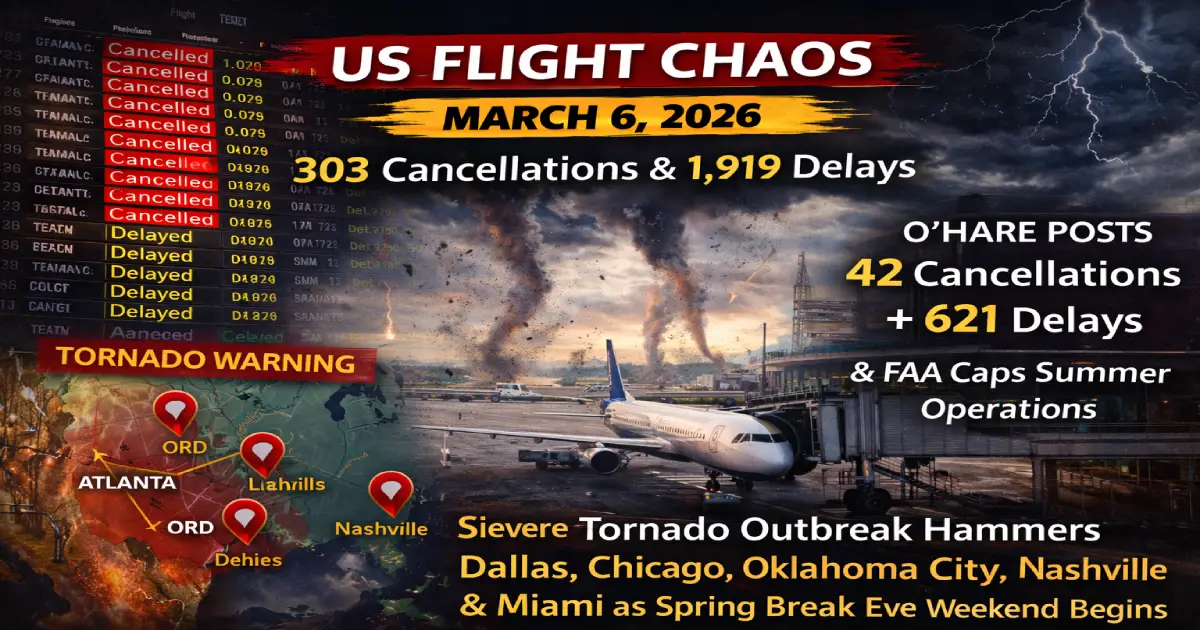
A multi-day severe weather outbreak — bringing supercell thunderstorms, EF-2 capable tornadoes, large hail exceeding three inches, damaging wind gusts, and flash flooding — is tearing through the US aviation system’s most critical central corridor on the first Friday of what travel industry analysts call “Spring Break Eve weekend.” The storm system is targeting the exact airports — Dallas-Fort Worth, Chicago O’Hare, Chicago Midway, Miami, Nashville, Oklahoma City — that form the backbone of domestic US connectivity for the 40 million Americans preparing to travel for Spring Break beginning March 14.
The total verified disruption count for today: 303 cancellations and 1,919 delays across the national network — a total of 2,222 disruptions that is already being compounded by Chicago O’Hare’s separate rolling operational crisis, where 42 additional cancellations and 621 delays are attributed to structural hub problems beyond weather alone.
Layer on top of that: DHS Shutdown Day 21, with TSA officers on reduced pay and no deal in sight. Layer on top of that: the Middle East aviation crisis still grounding Gulf carrier connections. Layer on top of that: a breaking FAA announcement that is going to reshape O’Hare’s operational capacity for the entire summer 2026 season.
This is the day that sets the tone for what Spring Break 2026 actually becomes.
| Airport | Cancellations | Delays | Total | Primary Cause |
|---|---|---|---|---|
| Chicago Midway (MDW) | 118 | 56 | 174 | Severe weather — Southwest hub |
| Dallas-Fort Worth (DFW) | 55 | 164 | 219 | Severe thunderstorms + tornado risk |
| Chicago O’Hare (ORD) | 58 | 913 | 971 | Weather + structural hub congestion |
| Miami International (MIA) | 11 | 57 | 68 | Storm system tracking southeast |
| Nashville (BNA) | Est. 12–18 | Est. 90–120 | Est. 110–140 | Severe weather corridor |
| Oklahoma City (OKC) | Est. 8–14 | Est. 60–85 | Est. 70–100 | Tornado threat zone |
| All Other US Airports | ~53 | ~1,524 | ~1,470+ | Network ripple + weather |
| US TOTAL | ~303 | ~1,919 | ~2,222 | — |
Note: ORD figures combine Travel And Tour World national dataset airport-level data with The Traveler’s O’Hare-specific report (42 cancellations, 621 delays) sourced from FlightAware as of mid-morning March 6. Chicago Midway’s 118 cancellations represent the single highest airport cancellation count in today’s dataset.
| Airline | Cancellations | Delays | Key Hub Exposure |
|---|---|---|---|
| Southwest Airlines | 134 | 285 | MDW (primary hub), DAL, HOU |
| American Airlines | 24 | 198 | DFW (primary hub), ORD |
| United Airlines | 17 | 142 | ORD (primary hub), IAH, DEN |
| SkyWest Airlines | 16 | 208 | Regional feeds DFW, ORD, DAL |
| Other carriers | ~112 | ~1,086 | Network ripple nationwide |
Today’s disruption is not a typical afternoon thunderstorm. It is a multi-day severe weather outbreak that meteorologists have been tracking since Wednesday, driven by a dangerous convergence of atmospheric conditions across the central US.
The mechanism is the dryline — a boundary where dry air pushing east from the Rocky Mountains meets warm, humid air flowing north from the Gulf of Mexico. When that boundary sharpens in the presence of sufficient wind shear, it acts as a factory for supercell thunderstorms. The storm system is bringing thunderstorms, damaging winds, tornado risks and large hail across key flight corridors, with large hail potentially exceeding three inches in diameter causing significant disruption to airports in affected areas.
The specific threats active today:
A favorable area of wind shear is developing as winds strengthen both to the north near Kansas City and south toward Oklahoma City and Dallas, creating conditions conducive to supercell thunderstorms — one of the most dangerous types capable of producing severe hail and tornadoes. Strong tornadoes are expected to form during the early evening hours, with Kansas City, Wichita, and Oklahoma City among the highest-risk areas.
For aviation, the thunderstorm threat produces a cascade of compounding effects: lightning within five miles of an airfield halts ground operations (no fuel trucks, baggage handlers, or pushback tugs move during lightning holds); hail damages aircraft skins and engine inlets, forcing unscheduled inspections; low ceilings and reduced visibility drop airport arrival acceptance rates; and tornado warnings at or near an airport produce mandatory ground stops of all aircraft movement — including taxiing aircraft ordered back to gates.
The storms will continue through Friday and into the overnight hours, increasing the risk of disruptions to nighttime travel across the region.
Chicago Midway International Airport is today’s worst-performing airport in the United States by single-airport cancellation count: 118 cancellations and 56 delays. For context, 118 cancellations at a single airport on a single day is a catastrophic figure — it represents a near-total shutdown of one of Southwest Airlines’ core connecting hubs.
Southwest Airlines alone accounts for 134 cancellations nationally today, and Midway is the primary source. Southwest operates an almost entirely point-to-point domestic network with Midway as a key originating and connecting node. When Midway goes down — as it effectively has today — Southwest cannot simply divert passengers to alternative hub routings the way United or American can at O’Hare. There is no Southwest flight from MDW that can reroute through a secondary hub because Southwest does not operate that kind of hub-and-spoke network. The result: passengers on cancelled Southwest MDW departures face rebooking onto the next available Southwest service, which on busy routes during a Spring Break Eve weekend may be 24–48 hours later.
Southwest is actively working to reschedule flights but delays are expected to continue throughout the weekend.
For Southwest passengers at Midway today: Do not go to the airport before confirming your specific flight is operating. Check the Southwest app or southwest.com. Southwest’s same-day change policy (Anytime and Business Select fares only, no fee) and its 24-hour rebooking window for affected passengers are your primary tools. If your flight is cancelled, Southwest owes you either a full refund or a free rebooking on the next available Southwest service.
Dallas-Fort Worth International Airport has recorded 55 cancellations and 164 delays today, making it the second-hardest hit airport in the dataset. DFW is American Airlines’ largest hub — the airport through which American routes a significant share of its transcontinental, transatlantic, and Latin America traffic. When DFW experiences 55 cancellations, it is not just a Dallas story. It is a network story that reaches Seattle, Boston, London, and Mexico City.
American Airlines has reported 24 cancellations and 198 delays nationally, with disruptions primarily concentrated at DFW and ORD. The tornado threat in the Dallas-Fort Worth metroplex — one of the highest-risk areas in today’s severe weather pattern — means that American’s operations teams are not just managing current disruptions but making real-time aircraft positioning decisions based on whether storm cells are tracking toward or away from DFW’s runways.
The DFW disruption is also the weekend’s most important signal for transatlantic passengers. American operates its London Heathrow, Paris CDG, Frankfurt, and Madrid services from DFW. If those departures — which typically leave in the late afternoon — are delayed by morning operational backlogs, passengers connecting from domestic feed flights to transatlantic departures face missed connections and potentially 24-hour rebooking waits on crowded long-haul services.
Chicago O’Hare International Airport recorded 42 cancellations and 621 delays today according to The Traveler’s FlightAware-sourced report — figures that combine the weather impact with the airport’s now-chronic structural operational problems.
With operational snags rippling across major routes linking the United States to Europe and the Middle East and affecting carriers from SkyWest and PSA Airlines to Qatar Airways, Volaris, United Airlines and American Airlines, O’Hare today is exhibiting exactly the behaviour that has prompted the most significant aviation regulatory intervention of 2026 so far.
The Federal Aviation Administration has already moved to cap daily operations at O’Hare during the upcoming summer season, warning airlines that proposed schedules would significantly exceed the airport’s practical capacity and heighten the risk of chronic delays and cancellations. The FAA is planning to reduce O’Hare’s operations from a proposed 3,080 daily operations to a capped 2,800 daily operations — cutting 280 flights per day during the peak summer season from March 29 to October 25, 2026. That is approximately 50,400 total flights affected by the cap over the seven-month period.
The construction projects, tight runway and gate utilisation and an aggressive build-up of schedules by hub carriers have all been cited by airline and airport sources as contributing factors to the airport’s vulnerability. Today’s 663 disruptions are a live demonstration of the exact dynamics the FAA cap is designed to prevent.
American executives have publicly criticised what they describe as overly dense scheduling by United, warning that without intervention the airport could face extended taxi times, persistent gate holds and cascading network disruptions when irregular operations strike. Today’s wave of disruptions provided a preview of how quickly conditions can deteriorate when those structural constraints collide with a busy travel day.
What the FAA O’Hare cap means for Spring Break and summer travellers: Starting March 29, airlines will be required to cut approximately 280 flights per day from O’Hare’s schedule. Those cuts are being negotiated now — the airlines have not yet publicly confirmed which routes are being reduced. Passengers with O’Hare connections booked for April through October 2026 should monitor their bookings for schedule changes over the next 2–4 weeks. American Airlines and United Airlines are expected to make the majority of the reductions. Regional partners SkyWest and PSA Airlines — which operate under United and American brands at O’Hare — may see route suspensions or frequency reductions on thinner domestic markets.
Today is Day 21 of the DHS shutdown. The situation is now approaching the most dangerous threshold in the timeline: the first full missed paycheck on March 17 falls just three days into Spring Break peak travel week.
The key developments since the March 3 daily article: yesterday, President Trump announced he is replacing DHS Secretary Kristi Noem as the shutdown ground on. The US Travel Association, Airlines for America, and the American Association of Airport Executives held a joint press conference launching the “Pay Federal Aviation Workers” campaign, with US Travel CEO Geoff Freeman saying the industry cannot be run “on IOUs.” The House is expected to vote on a DHS appropriations bill this week, but Senate Democrat objections remain unresolved.
Global Entry remains suspended since Day 8 (February 22). The 61,000 TSA officers working on reduced paychecks are approaching the point where — based on historical shutdown data — callout rates rise measurably. During the 43-day 2025 shutdown, approximately a month in, TSA temporarily closed two checkpoints at Philadelphia International Airport. Day 21 of 2026’s shutdown places the system within two weeks of that historical inflection point — with Spring Break beginning simultaneously.
For travellers heading to airports this weekend — the first Spring Break Eve weekend — allow an additional 45–60 minutes at major hubs beyond your normal pre-departure arrival time. TSA checkpoint staffing at Dallas, Chicago, and Miami is operating under elevated strain today given the combined weather disruptions bringing additional passengers into terminals seeking rebooking assistance while normal checkpoint queues continue.
The severe domestic weather crisis is the dominant disruption narrative today — but the Middle East aviation crisis continues to produce its own layer of US airport disruption running underneath it.
United Airlines’ Tel Aviv flights from the US were cancelled through March 6 — meaning today is the last confirmed cancellation day for United’s TLV routes, with a potential resumption this weekend pending updated NOTAM status. United cancelled Dubai through March 4, meaning DXB service should now be operating — but with significant backlog in crew positioning and aircraft rotation recovery.
For international passengers connecting through O’Hare and DFW today — particularly those attempting to reach Europe or the Gulf on connections from domestic feed flights — the combination of weather delays on the domestic inbound leg and reduced international schedule availability due to Middle East disruption creates compounding missed-connection risk. Airlines must rebook passengers holding single through-tickets to their final international destination at no charge; passengers on two separate tickets must manage each separately.
If your Southwest departure is before 19:00 today: high risk of cancellation or delay. Open the Southwest app before leaving home. Use same-day standby (Business Select and Anytime fares) or request a free rebooking to Saturday or Sunday March 7–8. Call 1-800-435-9792 only if the app fails — phone queues are hours long today.
The tornado threat means afternoon and evening departures (14:00–21:00 local) face the highest disruption risk as storm cells track toward the metroplex. If your DFW departure is afternoon or evening: check aa.com now. Use American’s travel waiver if one has been issued for your departure date. If you are connecting through DFW to an international flight, contact American Airlines proactively about your connection risk before your inbound flight even departs.
O’Hare is running 30–90 minutes behind on most banks today. Minimum recommended connection time: 2 hours for domestic, 3 hours for international. If you have a connection under 2 hours at O’Hare today, call your airline now and ask about alternative connections. United: 1-800-864-8331 (or the United app). American: 1-800-433-7300 (or aa.com). Do not rely on the connection times printed on your ticket — they were set before today’s disruption.
MIA is experiencing moderate disruption (11 cancellations, 57 delays) as the storm system tracks southeast. Afternoon and evening departures to the Caribbean and Latin America — peak routes for Spring Break pre-positioning — face elevated delay risk. JetBlue’s Caribbean hub at MIA is particularly exposed.
Both cities are inside the tornado threat zone for this evening’s most severe storm activity. If you are flying out of Nashville or Oklahoma City this afternoon: consider whether your trip is time-sensitive enough to risk the disruption. Tornado warnings at either airport will trigger mandatory ground stops affecting all operations, including taxiing aircraft ordered back to gates. Morning departures before 12:00 local are the safest window.
Today is Friday March 6. Spring Break begins March 14. Here is the verified threat map for the next 8 days:
Saturday March 7 — Italy ATC Strike: ENAV Rome controllers walk out 10:00–18:00 CET. 1,000–1,500 flights cancelled across Rome Fiumicino, Milan Malpensa, Venice, Naples, Verona. Zero EU261 cash compensation. US passengers with Italy-bound Spring Break trips are directly affected — particularly those routed through FCO for onward Mediterranean connections.
Tuesday March 11 — Brussels Airport Last Day Before Strike: Last full operational day at Brussels. March 12 total shutdown now officially confirmed. US passengers connecting through Brussels on Lufthansa Group, Brussels Airlines, Air Canada, or easyJet face confirmed cancellations on Wednesday.
Wednesday March 12 — Brussels Airport Total Shutdown: Zero departing flights. 65,000 passengers grounded. Alternative airports (Amsterdam, Frankfurt, Paris CDG) absorb overflow, tightening seat availability on Spring Break week services.
Saturday March 14 — Spring Break Begins: An estimated 40 million Americans begin travelling. TSA checkpoint staffing on reduced pay, Day 27 of shutdown. O’Hare operating under heightened congestion. Middle East backlog still not fully cleared. Italy just emerged from three-day strike aftermath.
Monday March 17 — First Full TSA Missed Paycheck: If no Congressional deal by this date, 61,000 TSA agents miss a full paycheck. Day 5 of Spring Break peak.
The probability that Spring Break 2026 is disruption-free is essentially zero. The practical question for every American family planning Spring Break travel is not “will there be disruption?” but “am I prepared to handle it?”
If your flight is cancelled (weather-caused): Under DOT rules, airlines must offer you a full refund to your original payment method OR a free rebooking on the next available flight. For weather cancellations, airlines are not legally required to provide meals or hotel accommodation — but most major carriers provide meal vouchers as a goodwill gesture, and some (Delta, United, American) have committed under DOT agreement to provide hotels for weather-caused overnight delays. Check your carrier’s specific policy.
If your flight is delayed 3+ hours and it is within the airline’s control: Most major US carriers (Delta, United, American, Southwest, Alaska, JetBlue, Frontier) have committed under DOT agreement to provide meal vouchers. If your delay is weather-caused, no cash compensation is owed — but rebooking is still free.
If you miss a connection because of a delay (single ticket): The airline that issued your ticket must rebook you to your final destination at no charge, including on the next available flight regardless of fare class.
If you have a Global Entry or TSA PreCheck appointment this weekend: Global Entry enrollment centres remain suspended due to the DHS shutdown. TSA PreCheck is operational. Check tsa.gov for specific location hours before travelling to a PreCheck enrollment appointment.
✅ Check your flight status before leaving for the airport — southwest.com, aa.com, united.com, delta.com. Not a third-party aggregator — the airline’s own app or website.
✅ If you are at MDW, DFW, ORD, or MIA today — allow an extra 45–60 minutes beyond your normal airport arrival time. Terminals are congested with rebooking queues from cancelled morning flights.
✅ Download your airline’s app if you haven’t already — push notifications arrive faster than departure board updates and faster than gate agent announcements.
✅ Know your Spring Break departure airport — if you are flying out of Chicago, Dallas, or Miami next week and your current routing goes through O’Hare or DFW, check your itinerary for FAA-driven schedule changes being filed this week.
✅ Check your travel insurance — if you purchased travel insurance for Spring Break travel, review whether your policy covers weather delays and what documentation is required. Keep all boarding passes, delay notifications, and receipts.
✅ If your Spring Break includes Italy — re-read the Italy ATC strike article published yesterday. Tomorrow’s strike is real, confirmed, and affecting Rome, Milan, Venice, and Naples.
Sourced From :
All disruption figures in this article are — sourced from FlightAware), The Traveler O’Hare-specific report (March 6, 2026 — sourced from FlightAware), and individual airline status pages as of Friday March 6, 2026. FAA O’Hare summer 2026 capacity cap data is sourced from The Traveler’s March 6 O’Hare report citing federal regulatory filings. DHS shutdown status sourced from US Travel Association press conference transcripts and PBS NewsHour reporting. This is a rapidly evolving situation — always verify your specific flight status directly with your airline before travelling to any airport.
Posted By : Vinay
This article is provided for general informational purposes only and is based on information available at the time of publication. Travel advisories, airline schedules, airport operations, visa requirements, government regulations, and other travel-related information are subject to change without prior notice. While Travel Tourister makes reasonable efforts to verify information using official announcements, government publications, airline and airport communications, and other reliable sources, we cannot guarantee that all information remains complete, accurate, or up to date at all times. Readers should independently verify any information that may affect their travel plans with the relevant airline, airport authority, government agency, embassy, or other official source before making travel, financial, or other decisions. Travel Tourister shall not be liable for any direct or indirect loss, inconvenience, or damages arising from the use of or reliance on the information contained in this article. Nothing in this publication constitutes legal, immigration, financial, or professional travel advice. If you believe any information in this article is inaccurate or outdated, please contact our editorial team. We review all credible correction requests promptly and update our content whenever appropriate.
Lastest News
2nd Floor, 39, Above Kirti Club, DLF Industrial Area, Kirti Nagar, New Delhi, Delhi 110015



Travel Tourister is a leading Travel portal where we introduce travellers to trusted travel agents to make their journey hasselfree, memorable And happy. Travel Tourister is a platform where travellers get Tour packages ,Hotel packages deals through trusted travel companies And hoteliers who are working with us across the world. We always try to find new and more travel agents and hoteliers from every nook and corners across the world so that you could compare the deals with different travel agents and hoteliers and book your tour or hotel with the one you have chosen according to your taste and budget.
Copyright © Travel Tourister, India. All Rights Reserved

 Call
Call Enquiry