Published on : 06 Mar 2026
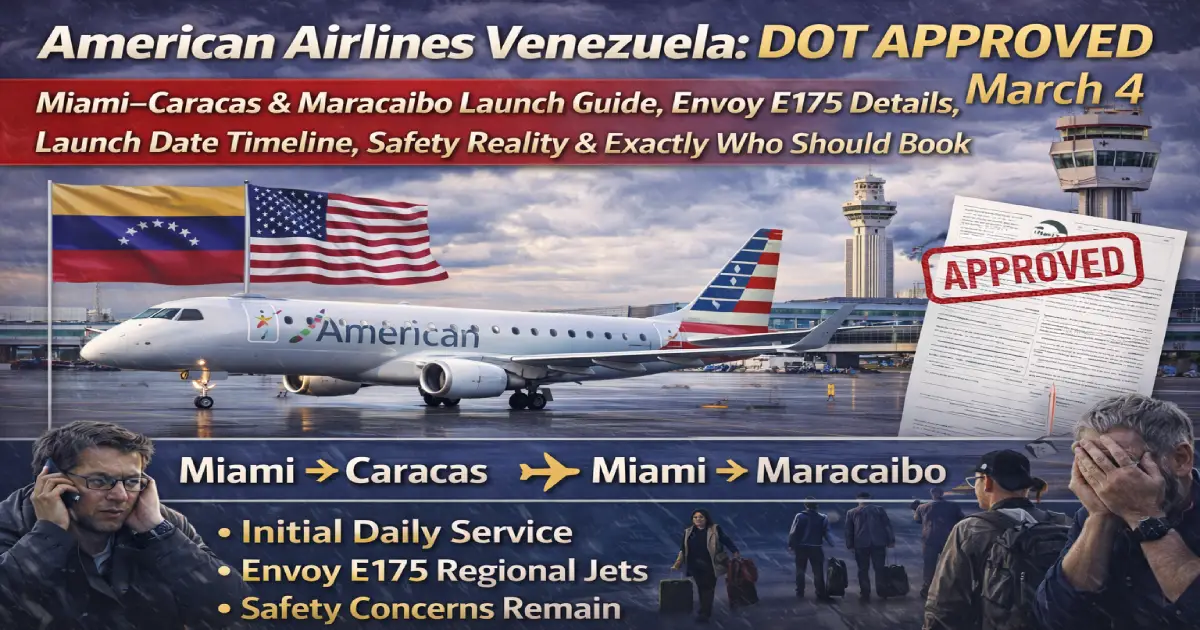
Published: March 6, 2026 Updated from: February 17, 2026 (original filing article) DOT Approval Date: March 4, 2026 — confirmed via Reuters, FlightGlobal, Fox Business DOT Application Filed: February 13, 2026 — American Airlines → US DOT Approval Valid: 2 years (through approximately March 4, 2028) First Flight: No confirmed date — American Airlines says it will “share further details in the coming months.” Industry estimate: late March or April 2026 Operator: Envoy Air (wholly owned AA subsidiary) — flying as American Eagle Aircraft: Embraer E170/E175 regional jet — 66 passengers (12 First Class, 54 Economy) Route 1: Miami (MIA) → Caracas Simón Bolívar International (CCS) — 1,360 miles, ~3 hours Route 2: Miami (MIA) → Maracaibo La Cinta International (MAR) — 1,189 miles, ~2h45m Frequency: Daily nonstop — both routes Crew strategy: Same-day turns initially — no overnight crew stays in Venezuela TSA Caracas review: Completed last week — airport security cleared for commercial restart TSA Administrator confirmation: Acting Administrator McNeill confirmed the Caracas visit State Dept Advisory: ⚠️ Level 4 — DO NOT TRAVEL — in effect and UNCHANGED US Embassy Caracas: Reopened with chargé d’affaires Laura Dogu — first diplomat since 2019 Competition filing: Laser Airlines (Venezuela) filed for twice-daily MIA–CCS on MD-80s Competition filing: Avior Airlines (Venezuela) filed for MIA and IAH service AA Venezuela history: 1987–2019 — 32 consecutive years, largest US carrier in Venezuela AA Venezuela peak (2018): 362,000 two-way seats / year — 58% of total US–Venezuela capacity Venezuelan-American diaspora: 500,000+ in South Florida alone — 7 million+ Venezuelans fled country since 2014 AA Centennial: 2026 — “Forever Forward” — Venezuela return is the flagship Latin America story CCO statement: Nat Pieper, AA Chief Commercial Officer: “We have a more than 30-year history connecting Venezolanos to the U.S. and we are ready to renew that incredible relationship” Ground reality: Delcy Rodríguez serving as acting president — Chavista regime structure intact — Maduro on trial in New York — US “running” Venezuela transition — Level 4 advisory remains for good reason
On March 4, 2026 — the same week the Middle East aviation crisis dominated every headline — American Airlines quietly received the approval that 500,000 Venezuelan-Americans in South Florida have waited seven years to see. The US Department of Transportation cleared American’s request to resume nonstop service from Miami to Caracas and Maracaibo, making American the first US carrier authorised to fly to Venezuela since all service was banned in May 2019. The flights will be operated by Envoy Air on Embraer E175 regional jets under the American Eagle brand. No launch date has been set, but the TSA completed its Caracas security review last week — the final technical hurdle before commercial service can begin. Industry estimates point to late March or April 2026 for the inaugural flight. This is the complete guide: what the approval actually means, what the aircraft and routes look like, when to expect bookings to open, who the flights are for, and the honest safety reality of Venezuela in March 2026.
To understand why this approval matters, you need to understand how fast this happened — and what triggered it.
January 3, 2026 — Operation Absolute Resolve: US forces captured Nicolás Maduro and his wife after weeks of mounting military pressure on Venezuela, with the operation involving more than 150 US aircraft. Maduro and Flores were transported to New York City by US forces to face narcoterrorism charges. The FAA immediately issued a NOTAM prohibiting all US civil aircraft from Venezuelan airspace.
January 5, 2026 — Acting President sworn in: Vice-President Delcy Rodríguez was sworn in as President ad interim in Caracas. The Chavista regime structure — military, bureaucracy, interior ministry — remained intact under Rodríguez.
January 10, 2026 — Trump cancels “second wave,” US oil companies move in: Trump confirmed a second wave of strikes was cancelled due to Venezuelan cooperation. Reuters reported Trump urged US oil giants to repair Venezuela’s “rotting” energy industry — signalling a transactional economic relationship was the intended outcome, not full democratic transition.
January 29, 2026 — Airspace reopened: Transportation Secretary Sean Duffy rescinded the 2019 order barring US airlines from Venezuela, following a direct Trump directive. The same day, American Airlines announced its intent to restart service.
February 4, 2026 — Ground reality one month in: The price of meat and chicken had fallen, real estate prices had risen 22%, and airlines were beginning to return to Venezuela, including American Airlines. The US Embassy in Caracas resumed operations with Laura Dogu as chargé d’affaires, and Venezuela appointed diplomat Félix Plasencia as its representative to Washington — the first formal diplomatic exchange since 2019.
February 13, 2026 — AA files DOT application: American Airlines formally filed its application with the DOT, requesting authorisation for Envoy Air to operate Miami–Caracas and Miami–Maracaibo. The application requested expedited review.
Late February 2026 — TSA Caracas security review: The Transportation Security Administration was in Caracas last week to review airport security procedures, sources told Reuters, a step needed to resume flights. The review of Simón Bolívar International Airport (CCS) was completed satisfactorily — the final regulatory prerequisite for commercial flights.
March 4, 2026 — DOT Approval: On March 4, 2026, the Department of Transportation authorised an application from American Airlines dated February 13, 2026, seeking permission to operate to the South American country. American began operating in Venezuela in 1987 and was the largest US airline in the country before all air service was suspended in 2019. The DOT said the order is valid for two years.
63 days from capture to commercial flight approval. This is the fastest geopolitical-to-aviation-restart timeline in modern US aviation history.
Restarting flights with 65-to-75-seat Embraer 170-family regional jets suggests that American is testing market demand before committing to operating the routes with larger narrowbody aircraft.
Envoy Air, the regional subsidiary that has been earmarked to operate the new services, operates a fleet of 180 Embraer 170 regional jets under the American Eagle brand. Each aircraft accommodates 66 passengers in a two-class configuration — 12 First Class and 54 Economy.
What the E175 cabin looks like on these routes:
| Cabin | Seats | Configuration | What You Get |
|---|---|---|---|
| First Class | 12 | 2-2 across | Wider leather seats, complimentary meals, priority boarding, 2 checked bags |
| Economy | 54 | 2-2 across | Standard regional seats — 30″ pitch typical on Envoy E175 |
| Total | 66 | — | Small-plane feel — similar to a US domestic regional hop |
Why start with regional jets and not a Boeing 737?
Three strategic reasons confirm the E175 is the right opening move:
The upgrade path: If service exceeds the capacity of regional jets, AA would go mainline with A319s. Given that the Venezuelan-American diaspora alone numbers 500,000+ in South Florida, and that pent-up family reunion demand has been building for seven years, mainline upgrades are a matter of when, not if — assuming the political situation stabilises.
Distance: 1,360 miles (2,176 km) Flight time: ~3 hours Airport: Simón Bolívar International Airport (Maiquetía) — the main international gateway serving Caracas, located on the Caribbean coast 21km north of the city centre
The route between Miami International Airport and Simon Bolivar International Airport in Caracas is comfortably within the Embraer E170’s maximum range of about 2,100 miles.
The MIA–CCS context: At AA’s 2018 peak, Miami–Caracas was one of the highest-yielding Latin American routes in the entire US network. Caracas was a business hub, a leisure destination, and the primary VFR (visiting friends and relatives) gateway for Venezuela’s largest diaspora community. All three of those demand streams still exist — they have simply been suppressed for seven years. The first day bookings open will likely be the strongest single-day booking event in AA’s Latin America network since the pandemic.
Getting from CCS airport to Caracas: The airport is 21km from the city centre via the autopista (highway). Taxis and Uber operate from the arrivals hall. Journey time 30–60 minutes depending on traffic. The Caracas Metro does not connect to the airport. Pre-book a hotel transfer or arrange pickup with your accommodation — do not take an unofficial taxi offer in the arrivals hall.
Distance: 1,189 miles (1,902 km) Flight time: ~2h45m Airport: La Chinita International Airport (MAR) — Venezuela’s second busiest airport, serving the oil capital of Maracaibo in the northwest
Why Maracaibo matters: Maracaibo is Venezuela’s second largest city (population ~1.5 million) and sits on Lake Maracaibo — the centre of Venezuela’s oil industry. It has the highest concentration of the Venezuelan diaspora in the US, with particularly strong South Florida connections. Maracaibo also has direct family reunion significance: the city has a large community who could not visit relatives in the US for seven years. When AA’s Nat Pieper said “we are ready to renew that incredible relationship,” Maracaibo was specifically on his mind.
The route from Miami to Maracaibo’s La Cinta International Airport is 1,189 miles — both comfortably within the Embraer E170’s maximum range.
American Airlines has not yet announced a timetable for restarting flights, although the USDOT approval remains valid for two years. American has said it will share further details about its return to service in the coming months as it works closely with the federal authorities on the necessary permissions and security assessments prior to resuming service.
The “coming months” language is deliberately cautious. The remaining steps before first departure:
Step 1 — Pilot union consultation (2–4 weeks): American Airlines’ pilot union (Allied Pilots Association) must be consulted on new international destinations — specifically on crew safety protocols, same-day turn requirements, and hotel provisions if overnight stays are eventually needed. This is the single most unpredictable variable in the timeline. The APA has previously blocked or delayed international route launches citing security concerns. For Venezuela, same-day turns are the compromise position — but union sign-off is still needed.
Step 2 — Ground handling contracts (2–3 weeks): AA needs confirmed ground handling arrangements at CCS and MAR — baggage, fuelling, catering, and boarding. After a seven-year gap, these contracts need to be renegotiated from scratch. Maiquetía Airport (CCS) ground handling was previously done by Avior and local handlers — new agreements required.
Step 3 — Slot and schedule filing (1–2 weeks): Once operational agreements are in place, AA files departure and arrival slots with MIA and Venezuelan airport authorities and publishes the schedule on aa.com and GDS systems. This is when bookings officially open.
Step 4 — First departure: Industry consensus from FlightGlobal, One Mile at a Time, and Aerospace Global News: late March or April 2026 is achievable if Steps 1–3 proceed smoothly. May 2026 is the more conservative estimate if union negotiations are slower.
What to do right now if you want these flights: ✅ Set a Google Flights alert for MIA → CCS and MIA → MAR — you will receive an instant notification the moment fares are published ✅ Check aa.com/destinations/venezuela — AA will post the announcement on this page when service opens ✅ Follow @AmericanAir on X/Twitter — first flight announcements always go here first ✅ Do NOT book via third-party OTAs (Expedia, Kayak) on day one — book directly at aa.com to ensure access to the most current schedule and change options
American is not the only carrier seeking to serve the MIA–CCS market. Two Venezuelan carriers have also filed applications:
Laser Airlines (Venezuela): Venezuelan carrier Laser Airlines has filed an updated application for a US foreign air carrier permit, seeking to launch twice-daily passenger services between Caracas and Miami with its ageing McDonnell Douglas MD-80 fleet.
Laser Airlines operates an all-MD-80 fleet — aircraft that are 30–35 years old. The DOT will scrutinise Laser’s safety record and FAA compliance carefully before granting a foreign air carrier permit. Laser has been operating domestically within Venezuela and on limited regional routes. Its application for US service is ambitious — MD-80 approval for US-bound international service faces significant regulatory hurdles.
Avior Airlines (Venezuela): Avior has filed for service from Miami and Houston to Caracas. Avior is a larger Venezuelan carrier than Laser and has previous experience with US-adjacent operations. No DOT approval date confirmed.
What competition means for you: More competition = lower fares. The MIA–Caracas market at its 2018 peak supported multiple daily flights at prices that made VFR travel affordable for the diaspora community. If AA, Laser, and Avior all eventually win approval, the route will see genuine price competition. In the near term — the first months — American Eagle’s E175 daily service will likely be the only option and prices will reflect that limited capacity.
This section is the most important in the article. The State Department Level 4 “Do Not Travel” advisory is not bureaucratic boilerplate — it reflects genuine risks on the ground that every potential traveller must understand before booking.
The positive developments: The price of meat and chicken has fallen, real estate prices have risen 22%, and airlines are beginning to return to Venezuela. The US Embassy in Caracas has reopened. The government claims to have released more than 800 political prisoners. Some economic stabilisation is visible in Caracas specifically.
Housing prices in Caracas rose 20–50% as investors anticipated a US-backed economic opening. Oil company stocks surged. Venezuela’s bonds, which had been in default since 2017, jumped 30% in the days after the capture.
What has NOT changed:
Maduro is gone, but hardline repressive elements of the regime are still there and, at least for the moment, in control. Hardline Interior Minister Diosdado Cabello released a video showing himself surrounded by armed police, condemning US actions and promising to fight.
There are many paths to instability in Venezuela. Black-masked military counterintelligence agents and para-police colectivos have already mounted an intimidatory presence on the streets of Caracas in the days following the US raid.
Armed robbery, mugging, carjacking and burglary are common in parts of Venezuela and can be accompanied by extreme violence. Some foreigners, including British nationals, have been questioned extensively on the reasons for their visit — this can involve being held at the airport for hours or days and can result in deportation. Some foreign nationals, including Europeans, have been detained and accused of terrorism in Venezuela.
Public services — including healthcare and security, and the supply of electricity, water and fuel — can be limited, particularly outside of Caracas. Prolonged power cuts can affect living conditions and cut mobile networks and internet.
✅ Category 1 — Venezuelan nationals with US residency (VFR travel) This is the primary market for these flights and the group for whom the risk-benefit calculation is most clearly positive. If you are a Venezuelan-American with family still in Venezuela, the opportunity to fly direct Miami–Caracas in 3 hours rather than routing through Bogotá, Panama City, or Mexico City is transformative. You understand the country, you have family support on the ground, and you have made a personal assessment of the risk for your specific situation. These flights exist primarily for you.
✅ Category 2 — Business travellers in oil/energy sector Trump has urged US oil companies to repair Venezuela’s “rotting” energy infrastructure. ExxonMobil, ConocoPhillips, SLB, and Halliburton all have active Venezuela operations or pending re-entry plans. Business travel between Houston, Miami, and Caracas in the energy sector will be high-frequency and high-value from day one. This is a legitimate professional travel category with corporate security support.
⚠️ Category 3 — Journalists and humanitarian workers Venezuela remains a high-risk environment for journalists and NGO workers. The regime structure under Rodríguez is still functioning, and foreign nationals have been detained on terrorism charges. If you are travelling professionally for journalism or humanitarian work, the American Airlines route provides a practical access point — but you need professional security protocols, emergency contacts, and your organisation’s approval before travel.
❌ Category 4 — General leisure tourists The Level 4 “Do Not Travel” advisory exists for you. Venezuela is not a safe general leisure destination in March 2026. The State Department advisory is the clearest possible signal: the US government recommends against all travel. Crime rates remain extreme in most parts of the country. Healthcare infrastructure is severely limited outside Caracas. Power outages affect mobile signal and internet connectivity. Border crossings involve extensive interrogation of foreign nationals. Margarita Island, historically a Caribbean beach destination, saw housing price surges — but the tourism infrastructure needed to support general leisure travel has not recovered. Do not book a general holiday to Venezuela in 2026.
US Citizens:
| Requirement | Status |
|---|---|
| Passport | Required — valid 6 months beyond stay |
| Venezuelan Tourist Visa | Not required for US citizens (waived for 90 days) — but confirm with Venezuelan consulate before travel as rules may have changed |
| STEP Registration | ✅ MANDATORY — register at step.state.gov before travel. Nearest US Embassy is in Caracas (now reopened with chargé d’affaires Laura Dogu) |
| Emergency Contact | US Embassy Caracas: +58-212-975-6411 (reopened) |
| Travel Insurance | ⚠️ Standard policies DO NOT cover Level 4 countries. You must purchase “Cancel for Any Reason” + Level 4 coverage — try World Nomads Adventurer plan or Global Rescue |
| Cash (USD) | Essential — card acceptance is unreliable. Bring sufficient USD cash for your entire stay |
Venezuelan Nationals with US Passports / Green Cards: Same passport and STEP requirements apply. Note that dual nationals may face additional questioning from Venezuelan authorities at the airport.
Connecting passengers via Bogotá, Panama City, or Mexico City: If you currently route to Venezuela via Copa Airlines (PTY–CCS), Avianca (BOG–CCS), or Aeromexico (MEX–CCS) — the new AA MIA direct service reduces travel time from 8–12 hours to 3 hours for South Florida travellers. Once fares are published, compare against your current routing. AA’s First Class on the E175 is also a meaningful upgrade over the economy connections most diaspora travellers have been using.
American Airlines’ strategy here follows a well-established LatAm playbook: test with regional jets, validate demand, upgrade to mainline.
Phase 1 (now — estimated Q2 2026): Envoy E175, 66 seats, daily MIA–CCS and MIA–MAR same-day turns.
Phase 2 (estimated 2026–2027 if demand validates): Mainline American Airlines equipment — most likely Airbus A319 (128 seats) or Boeing 737 MAX 8 (160 seats). This would require full pilot union agreement for crews to overnight in Venezuela — a higher bar than same-day turns.
Phase 3 (if Venezuela stabilises politically, 2027–2028): Additional US cities. At peak in 2018, AA operated from New York (JFK), Houston (IAH), and Dallas (DFW) in addition to Miami. There are large Venezuelan diaspora communities in all three cities. If the political situation normalises and demand validates, the route network expands significantly. American had an Admirals Club in Caracas in 2018 — a measure of how strategically important the route once was.
Other carriers watching: United Airlines (IAH–CCS would serve the Houston energy corridor directly), JetBlue (FLL–CCS serving South Florida’s budget market), and Spirit Airlines (FLL–CCS ultra-low-cost) are all monitoring demand carefully. If AA’s E175 launch is oversubscribed — which it almost certainly will be in the early weeks — expect competitive filings within 60 days.
American Airlines is set to resume nonstop service between Miami and Venezuela, marking the first time a US airline has restored flights to the country since 2019. The DOT approval, confirmed March 4, is the culmination of a 63-day process from Maduro’s capture to commercial flight authorisation — the fastest geopolitical-to-aviation-restart sequence in modern US aviation history.
The Envoy E175 is the right aircraft for the opening act: small enough to manage risk, large enough to validate demand, and operationally flexible enough for same-day crew turns that keep the pilot union in the tent. The 66 seats on day one will be dramatically oversubscribed by the 500,000+ Venezuelan-Americans in South Florida alone.
No launch date has been set. Late March or April 2026 is the industry consensus. Set a Google Flights alert for MIA→CCS now — when AA opens bookings, you want to be first in queue.
And if you are a general leisure traveller wondering whether Venezuela is now a holiday destination: it is not. The Level 4 “Do Not Travel” advisory reflects a real security situation that a commercial flight restart does not change. These flights are for families, businesspeople, and journalists — not beach holidays. That honest reality makes the story no less extraordinary. After seven years, Miami and Caracas are 3 hours apart again.
Posted By : Vinay
This article is provided for general informational purposes only and is based on information available at the time of publication. Travel advisories, airline schedules, airport operations, visa requirements, government regulations, and other travel-related information are subject to change without prior notice. While Travel Tourister makes reasonable efforts to verify information using official announcements, government publications, airline and airport communications, and other reliable sources, we cannot guarantee that all information remains complete, accurate, or up to date at all times. Readers should independently verify any information that may affect their travel plans with the relevant airline, airport authority, government agency, embassy, or other official source before making travel, financial, or other decisions. Travel Tourister shall not be liable for any direct or indirect loss, inconvenience, or damages arising from the use of or reliance on the information contained in this article. Nothing in this publication constitutes legal, immigration, financial, or professional travel advice. If you believe any information in this article is inaccurate or outdated, please contact our editorial team. We review all credible correction requests promptly and update our content whenever appropriate.
Lastest News
2nd Floor, 39, Above Kirti Club, DLF Industrial Area, Kirti Nagar, New Delhi, Delhi 110015



Travel Tourister is a leading Travel portal where we introduce travellers to trusted travel agents to make their journey hasselfree, memorable And happy. Travel Tourister is a platform where travellers get Tour packages ,Hotel packages deals through trusted travel companies And hoteliers who are working with us across the world. We always try to find new and more travel agents and hoteliers from every nook and corners across the world so that you could compare the deals with different travel agents and hoteliers and book your tour or hotel with the one you have chosen according to your taste and budget.
Copyright © Travel Tourister, India. All Rights Reserved

 Call
Call Enquiry