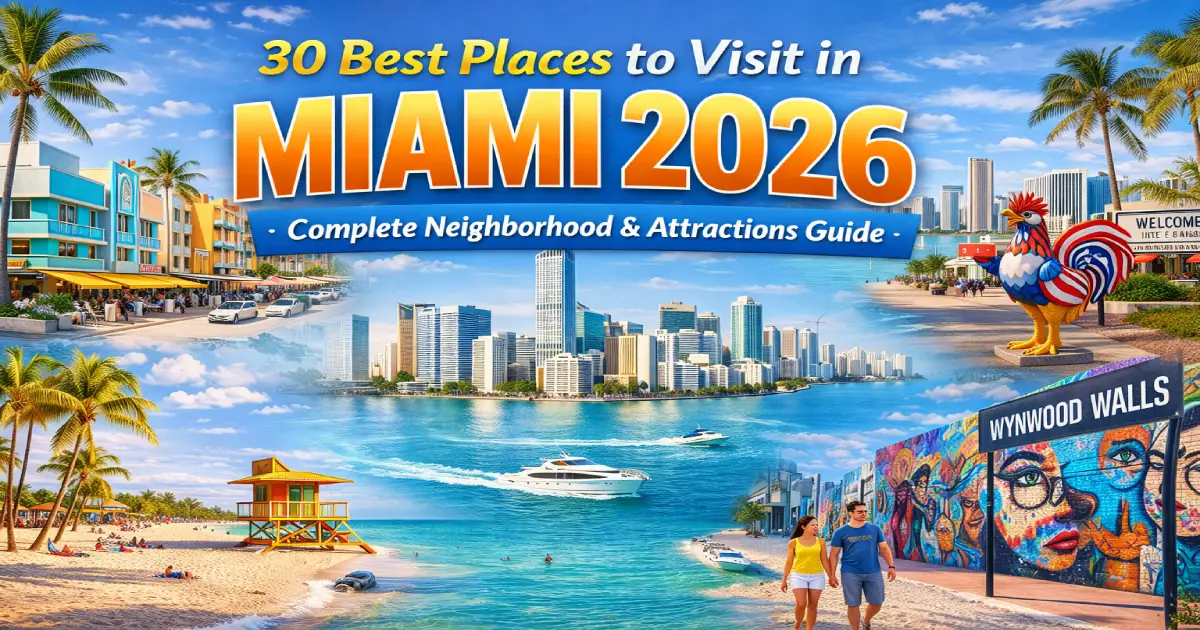
30 Best Places to Visit in Miami 2026: Complete Neighborhood & Attractions Guide
Published on : 09 Mar 2026
Places to Visit in Miami — From Art Deco South Beach to Cuban Little Havana
By Travel Tourister | Updated February 2026
Miami defies simple categorization—it’s simultaneously Caribbean and Latin American, Art Deco historic and ultra-modern, beach resort and major metropolis, nature preserve and urban jungle. This geographic and cultural complexity creates dozens of distinct destinations within the greater Miami area, each offering completely different experiences separated by mere miles.
I’ve explored Miami comprehensively across 15 visits over the past decade, progressively moving beyond South Beach’s gravitational pull to discover mainland Miami’s layered neighborhoods. My journey took me from predictable South Beach Art Deco walks to Little Havana’s authentic Cuban ventanitas, from Wynwood’s street art revolution to Coral Gables’ Mediterranean Revival elegance, from Vizcaya’s Gilded Age opulence to Everglades’ wild alligators, from Design District’s luxury sophistication to Coconut Grove’s laid-back bohemian charm.
This comprehensive 2026 guide breaks down Miami’s 30 best places to visit using verified data from Greater Miami Convention & Visitors Bureau, neighborhood expertise from years of exploration, and honest assessments distinguishing must-visit destinations from skippable tourist traps. We’ll organize places by neighborhood (South Beach, Mainland Miami, Coral Gables, etc.), provide realistic time allocations, reveal optimal visiting strategies, and explain how these diverse places connect into comprehensive Miami experiences.
Whether spending weekend focused on South Beach, week-long deep dive into multicultural Miami, or incorporating Miami into broader Florida itinerary, understanding the metro area’s geographic spread and neighborhood character transforms scattered sightseeing into cohesive, meaningful exploration of America’s most international city.
Financial district, high-rises, young professionals
Rooftop bars, Brickell City Centre
Miami Beach & South Beach (Barrier Island)
1. Art Deco Historic District (South Beach) — MUST VISIT
Why Essential: World’s largest collection of Art Deco architecture (800+ buildings from 1923-1943), Miami Beach’s defining visual character, walking through living museum.
What You’ll See:
Pastel-colored buildings (iconic Miami aesthetic)
Geometric shapes, porthole windows, neon signs
Ocean Drive: Most famous street, sidewalk cafés, people-watching
Collins Avenue: Additional Art Deco hotels
Española Way: Mediterranean Revival pedestrian street
How to Visit:
Self-guided walk: Free, download Art Deco app, 1-2 hours
Guided tour: Miami Design Preservation League, $30, 90 minutes, 10:30 AM daily from Art Deco Welcome Center (Ocean Drive & 10th Street)
Best time: Early morning (7-9 AM) or late afternoon (4-6 PM) for photography
Photography tip: Lifeguard stands with Art Deco backdrop = iconic Miami shot
Iconic Buildings:
Colony Hotel (736 Ocean Drive): Neon sign, classic Art Deco
Carlyle Hotel (1250 Ocean Drive): “The Birdcage” movie location
Breakwater Hotel (940 Ocean Drive): Streamline Moderne style
Time needed: 2-3 hours walking, half day with museum/café stops
Cost: Free to view exteriors, guided tour $30 optional
2. South Beach (Lummus Park Beach)
Why Visit: Miami’s most famous beach, people-watching central, iconic lifeguard stands, Art Deco backdrop.
Beach Details:
Location: 5th-15th Streets, South Beach
Character: International crowds, party atmosphere, spring break energy
Why Unique: Outdoor street art museum, 80+ massive murals, Instagram-famous, transformed warehouse district, international artists.
What You’ll Experience:
Constantly rotating murals (new art every 6-12 months)
Building-sized artworks by Shepard Fairey, Os Gemeos, Retna, Kenny Scharf
Entire neighborhood covered in street art (not just Walls complex)
Why Visit: Miami’s premier contemporary art museum, stunning waterfront architecture, international collection, free days available.
Details:
Location: 1103 Biscayne Boulevard (Museum Park, Downtown)
Admission: $16 adults, FREE first Thursday 4-9 PM + second Saturday 10 AM-noon
Architecture: Herzog & de Meuron design, hanging gardens, bay views
Collection: Contemporary and modern art, strong Latin American/Caribbean focus
Café: Verde at PAMM, waterfront dining, good lunch spot
Time needed: 2-3 hours
Parking: $20 museum lot (validate) or metered street parking
Worth it? Yes, especially on free days. Museum + waterfront setting excellent combination.
11. Vizcaya Museum & Gardens — MUST VISIT
Why Exceptional: Italian Renaissance-style villa (1916), Gilded Age opulence, 10-acre formal gardens, Biscayne Bay waterfront, historic preservation masterpiece.
What You’ll Experience:
James Deering’s winter estate (Deering Harvester fortune)
Best for: Families with children, science enthusiasts, aquarium fans
Time needed: 3-4 hours
Worth it? Yes for families/kids, pricey for adults without children
14. Bayside Marketplace
Honest Assessment: Touristy outdoor shopping mall, waterfront location, decent for killing time but nothing special.
What’s There:
100+ shops (mostly chains, souvenir stores)
Restaurants (overpriced, mediocre)
Marina views, boat tours depart here
Street performers, live music
Worth visiting? Only if: (1) Waiting for boat tour departure, (2) Need air-conditioned shopping break, (3) Desperate for tourist souvenirs. Otherwise skip—better dining/shopping elsewhere.
Coconut Grove & Coral Gables
15. Coconut Grove Village
Character: Miami’s oldest continuously inhabited neighborhood (1873), bohemian past now gentrified-upscale, waterfront, laid-back.
What to See:
CocoWalk: Outdoor mall, dining, entertainment ($)
Peacock Park: Waterfront park, weekend markets, sailing views
Fuller Street Art District: Galleries, murals
Streets: Tree-lined, tropical, walkable village feel
Dinner Key Marina: Sailing, waterfront dining
Dining Highlights:
Lulu in the Grove: Outdoor garden dining
Greenstreet Café: Sidewalk café, people-watching
Jaguar Sun: Upscale, excellent
Vibe: More relaxed than Miami Beach, local feel, family-friendly
Time needed: 2-3 hours stroll, half day with Vizcaya nearby
16. Coral Gables (City Beautiful)
What Makes It Special: Planned community (1920s), Mediterranean Revival architecture, tree-lined streets, wealthy residential, meticulously maintained.
Must-See:
Miracle Mile: Main shopping street, dining, coral rock sidewalks
Venetian Pool: Historic public pool (1923), coral rock construction, waterfalls, grottoes ($15, summer only)
Biltmore Hotel: Historic luxury hotel (1926), golf, free to tour exterior/lobby, afternoon tea available
Books & Books: Independent bookstore, café, cultural institution
Lagniappe: Wine bar, live music nightly, no cover, outdoor garden, excellent
Architecture:
Mediterranean Revival homes (1920s-30s)
Strict building codes maintain aesthetic
Tree canopy streets (beautiful to drive/walk)
Coral Gables Merrick House: Founder’s home, museum ($5)
Best for: Architecture enthusiasts, peaceful strolls, upscale dining
Time needed: Half day exploring, full day with Biltmore spa/golf
17. Venetian Pool (Coral Gables)
Why Unique: Historic public pool created from 1920s coral rock quarry
Features: Spring-fed, waterfalls, grottoes, caves, palm trees
Admission: $15 adults, $10 children
Season: Generally closed winter months, open spring-fall
Capacity limits: Can reach capacity summer weekends (arrive early)
Worth it? Yes for unique experience, beautiful setting, historic significance
Nature & Outdoor Destinations Near Miami
18. Everglades National Park — MUST VISIT
Why Essential: Subtropical wilderness 30-45 minutes from Miami, unique ecosystem, guaranteed alligators, “River of Grass.”
How to Experience:Airboat Tours (Most Popular):
Best Season: December-April (dry season, concentrated wildlife, fewer mosquitoes)
Avoid: May-November (wet season mosquitoes INTOLERABLE)
Time needed: Half day airboat tour, full day national park
19. Biscayne National Park
Character: 95% underwater park, coral reefs, mangroves, maritime heritage
Rentals: Kayaks, paddleboards, bikes available ($30-50)
Best for: Active outdoor enthusiasts, kayakers, bikers
Time needed: 2-4 hours
Additional Miami Neighborhoods & Areas
22. Brickell (Financial District)
Character: “Manhattan of the South,” high-rise condos, young professionals, financial center, rooftop bars.
What to Experience:
Rooftop bars: Sugar at East Miami, Area 31 (views, cocktails $16-22)
Mary Brickell Village: Outdoor dining/shopping complex
Brickell City Centre: Upscale mall, architecture, climate ribbon
Dining: Upscale restaurants (Zuma, Komodo, Crazy About You)
Vibe: Urban, modern, international, young professional, nightlife
Best for: Evening rooftop drinks, upscale dining, modern Miami atmosphere
Time needed: Evening 2-3 hours (dinner + rooftop bar)
23. Little Haiti
Character: Haitian immigrant community since 1970s-80s, authentic cultural neighborhood, art scene, less touristy than Little Havana.
What to See:
Little Haiti Cultural Complex: Art center, performances, galleries, community events
Haitian Restaurants: Chef Creole (griot, tassot, $12-18), Tap Tap (traditional dishes, art-decorated)
Murals & Art: Colorful buildings, street art, cultural expression
Botanicas: Vodou spiritual shops (observe respectfully)
Visiting Notes:
Less developed for tourism than other neighborhoods
Authentic cultural experience
Daytime visits recommended
French/Haitian Creole spoken widely
Time needed: 2-3 hours
Best for: Cultural explorers, Haitian cuisine fans, off-beaten-path seekers
24. Midtown Miami
Character: Mixed-use development (2000s-2010s), residential/retail hybrid
Features: Shops at Midtown Miami, restaurants, apartments
Dining: Sugarcane, Bocce Bar, various chains and locals
Vibe: Modern, pedestrian-friendly, less character than historic neighborhoods
Worth it? Only if staying nearby, nothing essential
Day Trip Destinations from Miami
25. Key Biscayne
Character: Barrier island south of Miami Beach, residential, peaceful, beaches, parks.
Attractions:
Bill Baggs Cape Florida State Park: Historic lighthouse (1825), beach, kayaking ($8 entry)
Crandon Park Beach: 2-mile beach, calm waters, family-friendly
Village Green Park: Weekend farmers market
Dining: The Rusty Pelican (seafood, waterfront views)
Getting there: Rickenbacker Causeway from Downtown Miami (15-20 minutes, $1.75 toll)
Best for: Quieter beach alternative, families, nature
Time needed: Half day to full day
26. Florida Keys (Day Trip or Overnight)
Key Largo: 1 hour, snorkeling John Pennekamp ($35-65 tours)
South Beach’s Art Deco Historic District delivers Miami’s most iconic experience—800+ pastel buildings from 1920s-40s creating world’s largest Art Deco collection. Combined with beach access, Ocean Drive atmosphere, and walking distance to restaurants/nightlife, South Beach concentrates essential Miami character in compact walkable area. However, “best” depends on interests: Culture seekers prioritize Little Havana’s authentic Cuban experience, art enthusiasts choose Wynwood Walls’ street art revolution, history buffs select Vizcaya’s Gilded Age opulence, nature lovers target Everglades wilderness. South Beach introduces you to Miami; mainland neighborhoods reveal its soul. First-timers: Start South Beach, then explore beyond.
How many days do you need to visit Miami?
Minimum depends on focus: Miami Beach only requires 2-3 days (Art Deco, beaches, nightlife sample). Comprehensive Miami experience combining beach, mainland culture, nature needs 4-5 days minimum: Day 1-2 Miami Beach, Day 3 Little Havana + Wynwood, Day 4 Vizcaya + neighborhoods, Day 5 Everglades or Keys day trip. Weekend warriors should choose either beach focus (stay Miami Beach) or culture focus (prioritize mainland), not both. Week-long stays enable thorough exploration without rushing—adds museums (PAMM, Frost), additional neighborhoods (Coral Gables, Coconut Grove, Little Haiti), day trips (Keys, Fort Lauderdale). Miami rewards depth over breadth given cultural diversity and geographic spread.
Is Little Havana worth visiting?
Absolutely yes for authentic cultural immersion. Little Havana delivers genuine Cuban-American experience—not fabricated tourist district—where Spanish dominates conversations, elderly exiles discuss Castro-era politics at domino parks, ventanitas serve café cubano to locals ($1.50-2), Versailles functions as political gathering spot, and Ball & Chain provides legitimate salsa scene. This authenticity requires cultural curiosity and engagement beyond superficial tourism. NOT worth it if expecting polished tourist district—it’s working neighborhood with rough edges, gentrification pressures, and real community character. Best experiences: Weekday morning café cubano ritual, Versailles Cuban breakfast ($12-20), domino park observation (respectfully), Viernes Culturales street festival (last Friday monthly). Worth 3-4 hours minimum for cultural explorers.
Can you visit Miami without going to South Beach?
Yes, but most visitors shouldn’t. South Beach concentrates Miami’s most photographed architecture (Art Deco), most accessible beaches, most intense nightlife, and most iconic imagery (Ocean Drive, lifeguard stands). Skipping South Beach means missing what makes Miami internationally famous. However, mainland Miami offers richer cultural experiences: Little Havana’s Cuban authenticity, Wynwood’s art transformation, Vizcaya’s historic preservation, Everglades’ wild nature, diverse neighborhoods shaped by immigration. Ideal approach: Experience South Beach briefly (1-2 days satisfies most visitors), then dedicate remaining time to mainland’s cultural depth. Only skip South Beach if: Already visited previously, actively dislike tourist intensity, or seeking exclusively cultural/nature experiences. Most first-timers should include it despite touristy atmosphere.
What is Wynwood known for?
Wynwood transformed from neglected warehouse district to international street art destination starting 2009 when developer Tony Goldman invited artists to paint building exteriors. Now known for: Wynwood Walls outdoor museum (80+ massive murals by internationally renowned artists like Shepard Fairey, Os Gemeos), Instagram-famous colorful facades covering entire neighborhood, craft brewery concentration (Wynwood Brewing, J. Wakefield, Veza Sur creating brewery district), trendy restaurants and food halls (Coyo Taco, KYU, 1-800-Lucky), 30+ art galleries, and Second Saturday Art Walk monthly event drawing thousands. Represents gentrification success story or displacement cautionary tale depending on perspective—former working-class neighborhood now hipster arts district with rising rents. Undeniably photogenic, culturally significant in Miami’s evolution from beach city to art destination.
Is Vizcaya Museum worth visiting?
Yes, Vizcaya ranks among Miami’s best attractions for architecture, gardens, history, and photography. James Deering’s 1916 Italian Renaissance villa delivers: Gilded Age opulence (34 ornately decorated rooms with European antiques), 10 acres formal Italian and French gardens (stunning waterfront landscaping), Biscayne Bay setting (stone barge, peacocks roaming), historic preservation achievement, and excellent photography opportunities. Worth $25 admission for 2-3 hours exploring villa and gardens. Best times: Weekday mornings (fewer crowds, better light). Popular wedding venue—check ahead for closures. Appeals especially to: Architecture enthusiasts, history buffs, photographers, garden lovers, and those seeking contrast from beach-and-party Miami stereotype. Skip only if: Time extremely limited, completely disinterested in history/architecture, or budget-conscious (it’s pricey but delivers value).
What should I skip in Miami?
Tourist traps worth avoiding: (1) Ocean Drive restaurants—overpriced ($35-55 mains), mediocre food, eat elsewhere despite atmospheric setting; (2) Bayside Marketplace—generic outdoor mall, nothing unique, skip unless waiting for boat tour; (3) Most Biscayne Boulevard attractions—touristy, dated; (4) Jungle Island unless with young children—overpriced ($50-60) for what it offers; (5) Everglades during wet season (May-November)—mosquitoes unbearable, ruined experience; (6) March spring break South Beach—intolerable crowds, +80-150% prices, chaos; (7) Swimming with captive dolphins—ethical concerns, expensive ($200+), choose wild dolphin boat tours instead. Skip activities mismatched to interests: Art Deco walks bore architecture-haters, Wynwood disappoints street-art skeptics, Little Havana underwhelms rushed tourists expecting theme park Cuba.
Can you walk around Miami?
Miami Beach: Yes, South Beach extremely walkable (Art Deco District, beaches, Lincoln Road, Ocean Drive all within 1-2 miles). Mid Beach and North Beach less walkable but manageable. Mainland Miami: No, generally not walkable city-wide. Individual neighborhoods walkable internally (Wynwood, Design District, Little Havana’s Calle Ocho, Coconut Grove village) but distances between them require vehicle. Downtown/Brickell somewhat walkable but spread out. Strategy: Walk within neighborhoods, Uber/car between them ($15-30 typical ride). Miami sprawls across 36 square miles with inadequate public transit. Rental car ideal for mainland exploration. Budget Uber costs $40-80 daily without car. Only walk entire trip if staying exclusively South Beach and never leaving—doable but limits Miami experience significantly.
South Beach and all Miami beaches offer completely free access (Florida law mandates public beach access)—parking costs $5-15 but beach itself always free. Beyond beaches: Art Deco Historic District walking tour (self-guided free, official tour $30 optional), Wynwood Walls outdoor murals (free to view surrounding streets, enclosed complex $15-20), South Pointe Park (free waterfront park, cruise ship watching, sunset views), Bayfront Park downtown (free concerts/events occasionally), Little Havana domino park observation (free cultural experience), and Design District public art installations (free to view). Museums offer free days: PAMM first Thursday 4-9 PM + second Saturday morning, Bass Museum first Wednesday 5-9 PM, ICA Miami always free. Free activities enable budget Miami exploration—combine free beaches with occasional paid attractions ($25-45 Everglades, $25 Vizcaya).
Final Thoughts: Choosing Your Miami Places
After 15 Miami visits exploring neighborhoods from South Beach to Little Haiti, Wynwood to Coral Gables, three insights emerge about strategic place selection:
1. Miami Beach and mainland Miami offer fundamentally different experiences—choose deliberately or combine strategically. South Beach delivers Instagram-ready Art Deco, beach parties, international resort atmosphere, and walking convenience. Mainland Miami provides authentic cultural neighborhoods (Little Havana’s Cuban soul, Little Haiti’s Haitian character), contemporary art (Wynwood transformation, Design District sophistication), historic preservation (Vizcaya opulence), and natural wilderness (Everglades alligators). Visitors who never cross causeways from Miami Beach experience beautiful barrier island but miss the city’s multicultural essence. Those who skip South Beach entirely miss Miami’s most photographed iconic imagery. Ideal approach: Balance both—2 days South Beach establishing visual Miami expectations, 2-3 days mainland exploring cultural reality.
2. Neighborhood character varies dramatically within short distances—match places to your interests. South Beach party energy differs completely from Coral Gables Mediterranean elegance; Wynwood hipster art scene contrasts Little Havana Cuban authenticity; Brickell modern high-rises diverge from Coconut Grove bohemian waterfront. Generic “Miami” recommendations fail because the metro area encompasses contradictory experiences. Culture seekers prioritize Little Havana + Wynwood + Vizcaya. Architecture enthusiasts choose Art Deco + Coral Gables + Design District. Nature lovers target Everglades + Fairchild Gardens + Key Biscayne parks. Nightlife fans focus South Beach + Brickell rooftops. Family travelers emphasize beaches + Frost Science Museum + outdoor activities. Strategic selection based on interests creates cohesive experiences versus scattered random sightseeing.
3. Time allocation matters more in sprawling Miami than compact cities—prioritize ruthlessly. Attempting all 30 places in one week creates vehicle exhaustion and superficial sampling. Miami sprawls across barrier island plus 36-square-mile mainland requiring constant transportation between neighborhoods. Better approach: Choose 3-4 focus areas matching trip length and interests. Weekend: South Beach only (deep dive). Long weekend: South Beach + one mainland area (Little Havana OR Wynwood). Week: South Beach + Little Havana + Wynwood + Vizcaya + Everglades + one additional neighborhood. Build depth in selected places versus rushed coverage attempting comprehensive exploration. Miami rewards focused immersion over scattered checking boxes.
Miami contains multitudes: Art Deco preservation and street art revolution, Caribbean beaches and subtropical wilderness, Cuban exile politics and international luxury, historic villas and modern skyscrapers, authentic neighborhoods and tourist fabrications. This diversity creates richness but demands strategic choices—you cannot experience everything in single visit.
Your Miami places should reflect your interests: Art Deco architecture or Cuban culture? Beaches or museums? Nightlife or nature? Contemporary art or historic preservation? Party atmosphere or peaceful gardens? Choose deliberately, allocate sufficient time to each place, and resist attempting comprehensive coverage in limited days.
The places that look perfect in Instagram photos (South Beach, Wynwood Walls) introduce you to Miami. The places requiring cultural curiosity and engagement (Little Havana ventanitas, Everglades wilderness, Vizcaya gardens, neighborhood diversity) reveal why this city matters beyond beach-party superficiality.
Both valid. Just know which you’re prioritizing—and give yourself permission to save the rest for next visit.
For official Miami tourism resources and place information, consult Greater Miami Convention & Visitors Bureau, Miami Beach 411, and Everglades National Park for comprehensive guides.
—
—
About Travel TouristerTravel Tourister’s Miami specialists provide honest, neighborhood-focused place recommendations based on extensive exploration across all areas. We understand Miami’s diversity demands strategic place selection matching interests, time constraints, and desired experiences—generic “must-see” lists fail in this multicultural, geographically spread metropolis.Need help choosing Miami places for your trip? Contact our specialists who can recommend optimal combinations, time allocations, and strategic approaches based on your interests, schedule, and whether you’re first-time visitor or returning explorer. We help travelers create cohesive Miami experiences versus scattered random sightseeing.
Posted By : Vinay
As a lead contributor for Travel Tourister, Vinay is dedicated to serving our Tier 1 audience (US, UK, Canada, Australia). His mission is to deliver precise, fact-checked news and actionable, data-driven articles that empower readers to make informed decisions, minimize travel risks, and maximize their adventure without compromising safety or budget.
Travel Tourister is a leading Travel portal where we introduce travellers to trusted travel agents to make their journey hasselfree, memorable And happy. Travel Tourister is a platform where travellers get Tour packages ,Hotel packages deals through trusted travel companies And hoteliers who are working with us across the world. We always try to find new and more travel agents and hoteliers from every nook and corners across the world so that you could compare the deals with different travel agents and hoteliers and book your tour or hotel with the one you have chosen according to your taste and budget.






 Call
Call Enquiry