Published on : 19 Mar 2026
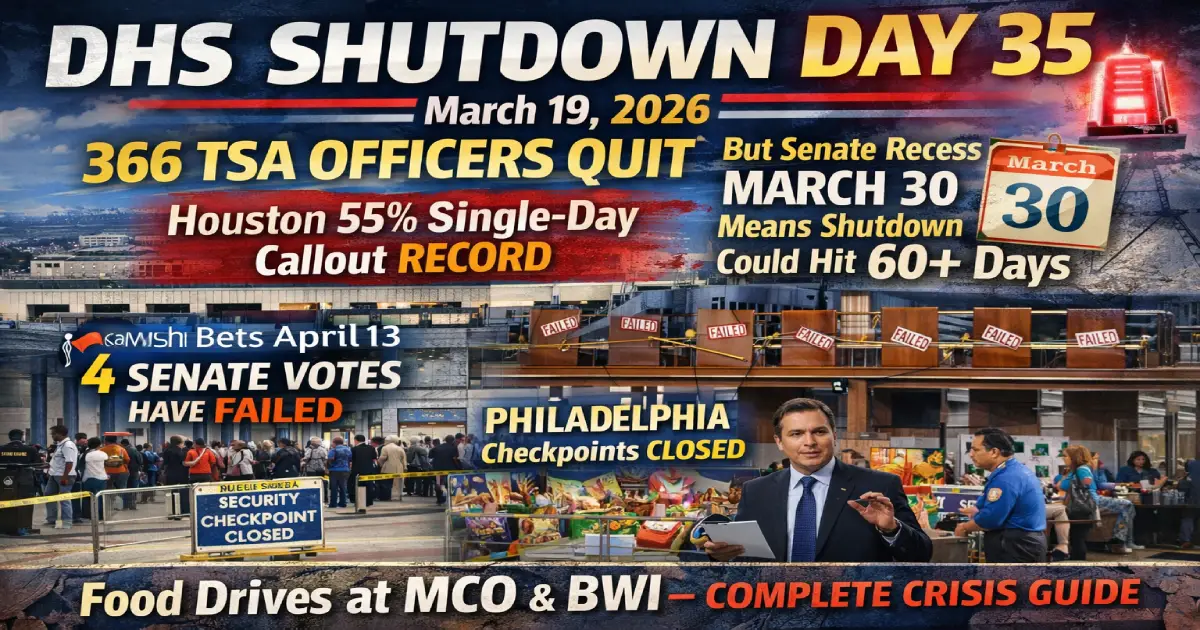
Breaking: The partial Department of Homeland Security shutdown has now entered its 35th consecutive day — and today brings the most consequential set of developments since the zero-paycheck milestone on March 14. Three explosive data points from official government sources published in the last 48 hours that every US traveller needs to know:
1 — 366 TSA officers have now QUIT. Not called out. Not taken sick days. Permanently resigned and left the agency. The DHS press release published Monday March 17 confirms the exact figure: “366 TSA officers have left the force.” This is the highest confirmed departure count since the shutdown began February 14 — and it is irreversible. Unlike callouts (which return to work), resignations are permanent losses to the security workforce. These are screeners, supervisors and experienced officers who will not come back even when the shutdown ends.
2 — Houston Hobby’s callout rate hit 55% on a single day. DHS’s own press statement — published on dhs.gov and reported by TIME — confirms that on March 14, Houston Hobby International Airport recorded a 55% callout rate — the highest single-day, single-airport absenteeism figure of the entire shutdown. On Monday March 16 and Sunday March 15, DHS confirms callouts “spiked over 50%” at Houston and “over 30%” at New Orleans and Atlanta. The CBS News figures of 37–39% were averages. The true single-day peaks are higher.
3 — White House sent a counteroffer to Democrats on Tuesday. The Washington Post reported Tuesday evening: “The White House on Tuesday detailed its counteroffer to congressional Democrats in negotiations to fund the Department of Homeland Security.” CNBC confirmed separately: “Congressional Democrats sent a new counteroffer to the White House… a step that may indicate a thaw in the shutdown of the agency.” For the first time since the shutdown began five weeks ago, both sides are exchanging formal proposals simultaneously. A deal has not been reached — but the negotiating dynamic has shifted.
The warning in the background of all three developments: if no deal is reached by March 28–30, a Senate recess from March 30 to April 10 means the shutdown will almost certainly stretch to 60+ days. Prediction markets on Kalshi and Polymarket are already pricing this in — betting odds forecast the shutdown lasting through April 13, which would encompass the entirety of Easter 2026 and push the TSA crisis deep into the April travel peak.
Published: March 19, 2026 (Thursday — DHS Shutdown Day 35) TSA officers QUIT: 366 confirmed resigned — DHS press release March 17 ✅Houston Hobby single-day callout record: 55% on March 14 — DHS confirmed ✅ Houston + New Orleans callout (Mar 15–16): Over 50% at HOU; over 30% at MSY + ATL — DHS confirmed ✅ White House counteroffer: Sent Tuesday March 17 — Washington Post confirmed ✅ Democratic counteroffer: Sent to White House Tuesday evening — CNBC confirmed ✅ Senate votes failed: 4 total failed votes — last on March 12 (51–46) ✅ Only Democrat to vote yes: Senator John Fetterman (PA) ✅ Senate recess: March 30 – April 10 — if no deal = 60+ day shutdown ⚠️ Prediction markets: Kalshi + Polymarket forecast shutdown through April 13 📊 Philadelphia (PHL): Checkpoints STILL CLOSED — 2.5 hrs domestic / 3.5 hrs international ❌ Food drives: MCO (Orlando) + BWI (Baltimore) — feeding unpaid TSA workers 🍎 Back pay guarantee: TSA officers will eventually receive back pay under 2019 federal law ✅ — but rent is due now New DHS Secretary: Sen. Markwayne Mullin (R-OK) — Trump nominated, effective end of March DHS funding began Feb 14: Day 35 = approaching second-longest partial shutdown in history Longest partial shutdown ever: 43 days (October–November 2025) TSA PreCheck: ✅ Operational throughout Global Entry: ✅ Restarted March 11 after 17-day suspension
The DHS shutdown of 2026 is rooted in a specific event that most travellers are only dimly aware of but that has paralysed Washington for 35 days.
On January 24, 2026, US Customs and Border Protection agents fatally shot Alex Pretti and Renee Nicole Good — both US citizens — during immigration enforcement operations in Minneapolis following Trump’s executive orders on mass deportation. The shootings triggered immediate outrage, particularly among Democratic members of Congress who had been watching DHS enforcement operations expand under the administration’s immigration crackdown.
Senate Democrats announced they would no longer support the DHS appropriations bill unless it included meaningful restrictions on immigration enforcement operations. Their specific demands: require ICE agents to wear body cameras; ban masks during enforcement operations; tighten warrant requirements; restrict “roving patrol” authority that allows agents to stop individuals without specific grounds.
Congressional Republicans criticised the list as excessive and argued it would add unnecessary bureaucracy and endanger federal agents. Republicans made counter-proposals to prevent harassment of federal agents and require local governments to cooperate with federal immigration authorities. No middle ground was found before funding lapsed at 12:01 AM on February 14, 2026.
The four Senate votes that have failed:
✈️ Vote 1 (January 29): Failed 45–55 — seven Republicans joined all Democrats in opposing (fiscal conservatives objecting to spending levels) ✈️ Vote 2 (February 12): Democrats blocked a second two-week continuing resolution — Congress then left for recess, guaranteeing the shutdown began February 14 ✈️ Vote 3 (March 2026 — prior to March 12): Failed — only Fetterman crossed party lines ✈️ Vote 4 (March 12, 2026): Failed 51–46 live on Senate floor — Senator John Fetterman of Pennsylvania was the lone Democrat to vote “yes”
The Senate returned at 10 AM on Tuesday March 17 — but no DHS funding vote was on the Senate calendar. Senate Majority Leader John Thune instead scheduled a vote on the SAVE America Act (S1383 — a voter ID bill requiring proof of citizenship to vote). The DHS shutdown was discussed in floor statements but was not voted on.
The most significant political development of the entire shutdown came Tuesday evening, March 17. The White House detailed its counteroffer to Senate Democrats in negotiations to fund the Department of Homeland Security. Shortly afterward, congressional Democrats sent their own new counteroffer back to the White House.
The fact that both sides are now exchanging formal written proposals — rather than issuing press statements blaming the other — represents the first genuine negotiating activity in weeks. Analysts described it as a possible “thaw.” However, no deal has been announced. The specific gap between the two proposals has not been made public.
The DHS press statement published Monday March 17 contains the most important number in this story: “366 TSA officers have left the force.”
These are not callouts. These are not sick days. These are officers who have submitted their resignations and departed the agency permanently.
The consequences of 366 resignations go beyond the immediate disruption to Spring Break:
✈️ Irreversible: Every resigned officer represents a permanent capacity loss that requires months of recruiting, hiring, background investigation, training and certification to replace. The TSA training pipeline takes 4–6 months from application to credentialed screener. ✈️ Experience loss: Officers who resign are not typically the newest recruits — they are mid-career professionals who have been with TSA long enough to have established families, mortgages and financial obligations that make zero-pay unsustainable. The most experienced screeners are the most financially stressed because they earn more and have more financial commitments. ✈️ Systemic: 366 resignations across a workforce of approximately 60,000 represents a 0.6% permanent reduction in a single month — on top of the triple-normal callout rate already depleting available staffing by 30–55% on peak days.
The TSA union’s language is unambiguous: unscheduled call-out rates are triple normal levels as officers are choosing to use paid-time-off or sick days rather than work for free. Under a 2019 federal law, TSA employees will eventually receive back pay for all hours worked during the shutdown — but it is not comforting as rent comes due in two weeks.
The CBS News figures of 37% (Atlanta), 35% (Houston) and 39% (New Orleans) were shocking enough. The DHS’s own press release contains even worse data.
On Sunday March 15 and Monday March 16, callouts spiked over 50% in Houston and over 30% in New Orleans and Atlanta. The highest single-day airport callout rate was 55% at Houston Hobby International Airport (HOU) on March 14, 2026.
55%. More than half of every scheduled TSA officer at Houston Hobby simply did not show up on March 14. This is the same airport that was posting 3.5-hour standard security wait times on Sunday March 9 — before callout rates hit their peak.
The DHS press release frames this as a Democratic Party failure. The DHS framing is its own political perspective. But the underlying data — confirmed by DHS’s own press release — is the fact every traveller needs to understand: on at least one day this shutdown, the majority of screeners at one of America’s top-20 busiest airports did not report for duty.
The practical reality for Houston passengers:
Even on a cleaner travel day like today, Houston is operating with a depleted workforce. The 366 resignations nationally and the 50%+ callout peaks of last weekend mean Houston’s checkpoint headcount today is lower than the official establishment. Wait times are not predictable at Houston Hobby this week.
This is the development that prediction markets are already pricing in — and that most travel coverage has missed entirely.
The Senate is scheduled to begin a recess from March 30 through April 10, 2026.
If no DHS funding deal is reached and voted on before March 30 — which requires not only agreement but also Senate scheduling, floor time, cloture votes (requiring 60 votes to end debate), and the full amendment process — the shutdown will automatically extend to Day 55 at minimum when the Senate returns April 10.
From April 10, further floor scheduling means the shutdown’s end could not realistically come before April 13 at the earliest — a Day 59 resolution. This is exactly what Kalshi and Polymarket prediction markets are currently pricing as the base case.
The Easter holiday context:
Easter Sunday falls on April 5, 2026. If the shutdown is not resolved before the Senate recess, Easter travel — which annually rivals Spring Break for US aviation volume — will occur entirely under the same zero-pay TSA conditions that produced this Spring Break’s chaos. The industry’s lobbying window for a pre-recess deal is now approximately 10 days.
Betting odds:
A betting odds on how long the government shutdown lasts on Kalshi and Polymarket forecast the shutdown lasting through April 13, well beyond the Easter 2026 holiday. These markets aggregate the probabilistic assessments of thousands of bettors who follow congressional scheduling, negotiating dynamics and political incentives closely. They are not certainties — they are base-case probabilities. The April 13 forecast implies the market assigns a low probability to a pre-recess deal.
Philadelphia International Airport continues to operate with reduced security lane capacity. Additional security checkpoints are closed. Recommended arrival times remain: 2.5 hours before domestic departures, 3.5 hours before international.
Philadelphia’s closure of additional checkpoints is not a temporary measure triggered by a single bad day. It is a structural response to a persistent staffing gap — fewer officers per shift means fewer lanes can be opened without compromising the security integrity of each checkpoint. The TSA determines minimum staffing levels per open lane based on safety protocols. When staffing falls below those minimums, lanes must close.
This situation will persist as long as the shutdown continues. Philadelphia airport passengers for the remainder of March should treat the 2.5/3.5 hour window as mandatory, not advisory.
The images of airport food drives for the people screening your luggage have become the defining visual of the DHS shutdown’s human cost.
Orlando International Airport (MCO): MCO said it is holding a food drive for unpaid TSA workers affected by the partial government shutdown, with donation collection points outside Terminal C and at information kiosks throughout the building.
Baltimore-Washington International (BWI): The Anne Arundel County Food Bank assembled boxes of shelf-stable food for approximately 600 BWI TSA workers and delivered them directly to the airport, with a commitment to continue deliveries throughout the shutdown.
In Washington, this would normally be an all-hands moment. Shutdowns are supposed to be highly embarrassing events for the country’s leaders, the kind that dominate the discourse as the President and Congress hold high-stakes negotiations to end them.
The open letter signed by six airline CEOs — Delta, American, United, Southwest, JetBlue and Alaska — says it directly: “Americans — who live in your districts and home states — are tired of long lines at airports, travel delays and flight cancellations caused by shutdown after shutdown. This problem is solvable, and there are solutions on the table.”
TSA officers at both airports have been photographed working their regular shifts alongside boxes of donated canned goods, gift cards and baby formula for their own colleagues. This is not a metaphor. This is the literal physical reality at two of America’s largest airports, five weeks into a shutdown that both parties agree is harmful and neither has ended.
President Trump announced he wants Senator Markwayne Mullin (R-Oklahoma) to become the next DHS Secretary, effective at the end of March, replacing Kristi Noem who was fired on March 5.
Mullin’s appointment requires Senate confirmation — which, during an active Senate session with the DHS shutdown dominating floor time, adds a scheduling complication. The confirmation process for a cabinet secretary typically requires committee hearings and a floor vote — consuming Senate time that might otherwise be used for DHS funding negotiations.
Whether Mullin’s arrival at DHS as Secretary in late March — coinciding with the Senate recess — would produce any change in negotiating dynamics is unknown. What is known: the DHS leadership transition itself adds another variable to an already highly uncertain political situation.
TIME’s reporting from this week captures the human reality with precision. TSA officers are choosing to use paid-time-off or sick days rather than work for free. Under a 2019 federal law, they will eventually get back pay — but it’s not comforting as rent comes due in two weeks.
The TSA union’s characterisation of why officers are calling out: “eviction notices, vehicle repossessions, empty refrigerators and overdrawn bank accounts.” These are not exaggerations for political effect. These are the direct consequences of a zero-paycheck event for a workforce earning an average of approximately $42,000–$55,000 per year.
Aaron Barker, a local AFGE leader at Atlanta: “We want a paycheck, not a rain check.” The sign he held at the press conference outside Hartsfield-Jackson captured the absurdity perfectly — a government worker asking the government for the pay it owes him.
TSA officer Angela Grana told CNN: agents are calling out “because they can’t afford to buy gas to get to work when they’re not getting paid.” Others, she said, are sleeping at the airport to avoid the fuel cost of commuting. The food drive at MCO and BWI exists because some officers cannot afford lunch.
When a DHS funding deal is eventually reached and signed, the recovery will not be instantaneous:
| Day After Deal | TSA Recovery Stage |
|---|---|
| Day 1 | Back pay processing begins — legislation specifies retroactive pay schedule |
| Day 1–3 | Officers on approved leave return to duty |
| Day 3–7 | Callout rates begin declining toward normal levels |
| Day 7–14 | Checkpoint staffing returns to pre-shutdown levels |
| Day 14–30 | PHL and other closed checkpoints fully reopen |
| Month 2–6 | Recruiting to replace 366 resigned officers begins |
| Month 6–12 | Full pre-resignation workforce strength restored |
The 366 officers who have permanently resigned cannot be recalled by funding restoration alone. Their positions will need to be refilled through the full TSA hiring pipeline — background check (typically 3–4 months), training at the TSA academy (2–4 weeks), on-the-job certification. The workforce damage from the 2026 shutdown will be felt operationally for 12–18 months after the shutdown ends.
Airports with most elevated TSA risk this week:
| Airport | Current Status | Est. Standard Wait | Arrive Early By |
|---|---|---|---|
| Philadelphia (PHL) | ❌ Checkpoints CLOSED | 60–90 min | 3.5 hrs domestic |
| Houston (IAH/HOU) | 🔴 Post-55% callout recovery | 60–90 min | 3 hrs domestic |
| New Orleans (MSY) | 🔴 39% callout peak last week | 60–75 min | 3 hrs domestic |
| Atlanta (ATL) | 🟠 37% callout, recovering | 45–60 min | 2.5 hrs domestic |
| New York (JFK) | 🟠 30% callout, improving | 30–45 min | 2.5 hrs domestic |
| Boston Logan (BOS) | ✅ Smooth — confirmed | 15–25 min | 2 hrs domestic |
| Orlando (MCO) | ✅ Fully operational | 11–45 min | 2 hrs domestic |
If the shutdown ends this week (possible but not base case): Start monitoring Senate floor activity. If a deal is announced, give TSA 72–96 hours before assuming checkpoint conditions meaningfully improve — the recovery process takes days, not hours.
TSA PreCheck: Still fully operational — if you do not have PreCheck, consider enrolling at tsa.gov/precheck ($78, 5-year validity, includes faster processing at 200+ US airports).
✅ Step 1 — Know your airport’s TSA status before leaving home. Use the MyTSA app (live checkpoint wait times) or check specific airport social media for that morning’s staffing situation. Houston, Philadelphia and New Orleans are the highest-risk checkpoints.
✅ Step 2 — Philadelphia passengers: treat 3.5 hours as mandatory. Checkpoints are physically closed. This cannot be overcome with PreCheck or CLEAR — you cannot clear a lane that is locked.
✅ Step 3 — Watch for Senate developments. Both sides are now exchanging counteroffers — the first real negotiating activity in weeks. A deal announced this week would push the shutdown toward resolution before the March 30 recess. Monitor NBC News, CNBC, Washington Post.
✅ Step 4 — Easter travel: book flexibly. Prediction markets give the shutdown a base-case end of April 13 — which means Easter week (April 1–5) falls inside the shutdown. If you are booking Easter travel, choose refundable or changeable fares and expect TSA conditions similar to or worse than this past Spring Break weekend.
✅ Step 5 — Donate at MCO or BWI if you are passing through. Non-perishable food items and grocery gift cards are the most useful donations. Collection points are outside MCO Terminal C and at all information kiosks. TSA officers screening your bags today may genuinely be deciding between commuting costs and having lunch.
Posted By : Vinay
This article is provided for general informational purposes only and is based on information available at the time of publication. Travel advisories, airline schedules, airport operations, visa requirements, government regulations, and other travel-related information are subject to change without prior notice. While Travel Tourister makes reasonable efforts to verify information using official announcements, government publications, airline and airport communications, and other reliable sources, we cannot guarantee that all information remains complete, accurate, or up to date at all times. Readers should independently verify any information that may affect their travel plans with the relevant airline, airport authority, government agency, embassy, or other official source before making travel, financial, or other decisions. Travel Tourister shall not be liable for any direct or indirect loss, inconvenience, or damages arising from the use of or reliance on the information contained in this article. Nothing in this publication constitutes legal, immigration, financial, or professional travel advice. If you believe any information in this article is inaccurate or outdated, please contact our editorial team. We review all credible correction requests promptly and update our content whenever appropriate.
Lastest News
2nd Floor, 39, Above Kirti Club, DLF Industrial Area, Kirti Nagar, New Delhi, Delhi 110015



Travel Tourister is a leading Travel portal where we introduce travellers to trusted travel agents to make their journey hasselfree, memorable And happy. Travel Tourister is a platform where travellers get Tour packages ,Hotel packages deals through trusted travel companies And hoteliers who are working with us across the world. We always try to find new and more travel agents and hoteliers from every nook and corners across the world so that you could compare the deals with different travel agents and hoteliers and book your tour or hotel with the one you have chosen according to your taste and budget.
Copyright © Travel Tourister, India. All Rights Reserved

 Call
Call Enquiry