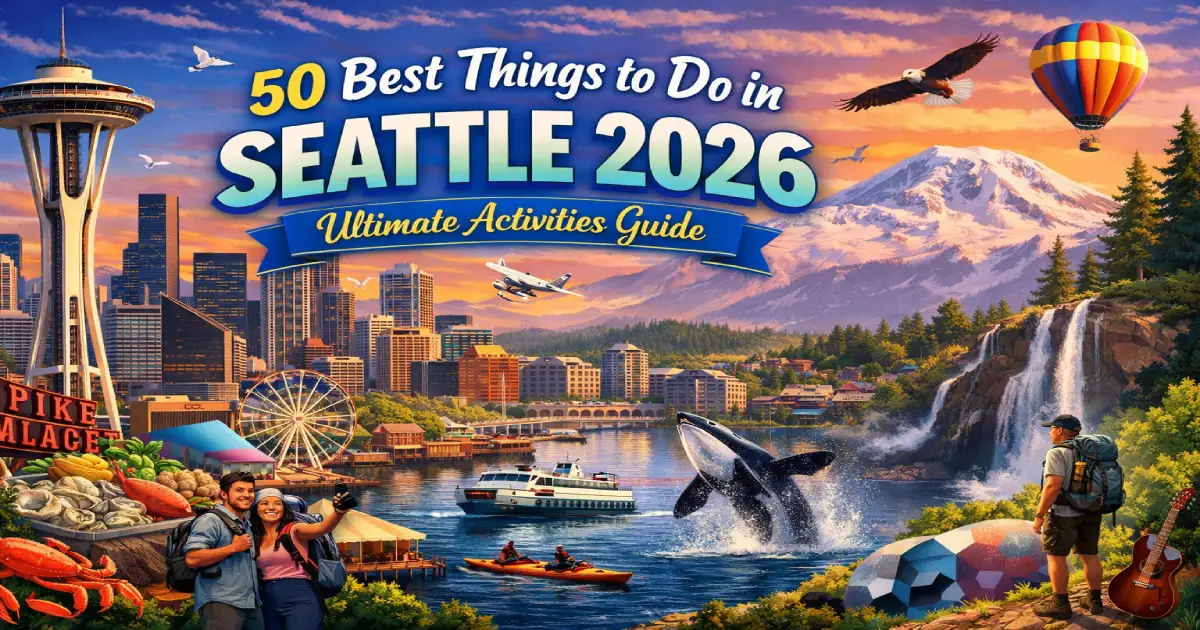
50 Best Things to Do in Seattle 2026: Ultimate Activities Guide
Published on : 19 Mar 2026
Things to Do in Seattle — From Pike Place Fish Throws to Pacific Northwest Wilderness
By Travel Tourister | Updated March 2026
Seattle offers a density and diversity of activities that consistently surprises visitors who arrive expecting only rain and coffee — the city delivers world-class museums (MoPOP’s Frank Gehry temple to rock and roll, Chihuly Garden and Glass’s glass art spectacle), the finest public market in America (Pike Place, operating since 1907), one of the most dramatic waterfront walks in any American city (the Olympic Sculpture Park to Myrtle Edwards Park promenade with the Olympic Mountains above Elliott Bay), ferry rides to islands where resident orca pods swim year-round, craft brewery crawls through Ballard’s Norwegian fishing village heritage, and day trips to Mount Rainier’s wildflower meadows that rank among the most spectacular natural experiences accessible from any major American city.
I’ve done it all in Seattle across dozens of visits spanning every season — early morning Pike Place Market walks before the tourist rush, Kerry Park sunsets with Mount Rainier floating above the skyline, Ballard Locks salmon run watching in September, kayaking on Lake Union with the Space Needle above and seaplanes landing beside me, live music at the Crocodile in Belltown, dawn hikes at Paradise on Mount Rainier when the wildflowers are at peak, Bainbridge Island ferry crossings at sunrise when the skyline glows pink in the east, and rainy November afternoons in the Elliott Bay Book Company that felt exactly like what Seattle should feel like. Each visit confirmed that this city rewards engagement — the more you explore its neighborhoods, its water, its surrounding wilderness, and its indoor culture, the more it gives back.
This comprehensive 2026 guide breaks down Seattle’s 50 best activities using verified information from Visit Seattle, years of on-the-ground expertise, and honest assessments of what delivers genuine memorable experiences. We organize activities by category — iconic experiences, outdoor and nature, neighborhoods and culture, museums and arts, food and drink, live music and entertainment, day trips, and unique Seattle — with realistic costs, timing, and strategic advice for making the most of the Pacific Northwest’s most vibrant city.
Whether planning a 48-hour highlights weekend, a week-long deep dive into Seattle’s neighborhoods and surrounding wilderness, a family trip balancing the Space Needle with outdoor adventures, or a rainy-season visit built around the city’s extraordinary indoor culture, this guide gives you the honest intelligence to experience Seattle brilliantly.
Seattle Activities by Category
Category
Top Activities
Best Location
Cost Range
Iconic Experiences
Pike Place Market, Space Needle, Kerry Park sunset
Downtown, Seattle Center, Queen Anne
Free–$37
Outdoor & Nature
Mount Rainier, kayaking, Ballard Locks, hiking
Citywide, Puget Sound, Cascades
Free–$50
Food & Drink
Pike Place food, Ballard breweries, coffee crawl
Pike Place, Ballard, Capitol Hill
$5–$100
Museums & Arts
MoPOP, Chihuly, SAM, MOHAI, Frye
Seattle Center, Downtown, Capitol Hill
Free–$32
Neighborhoods & Culture
Capitol Hill, Fremont, Ballard, Pioneer Square
Citywide
Free–$60
Day Trips
Mount Rainier, Olympic Peninsula, San Juans, Snoqualmie
30 min–3 hours from Seattle
$9–$80
Iconic Seattle Experiences
1. Explore Pike Place Market — MUST DO
Why Essential: Pike Place Market is not a tourist attraction that happens to sell fish — it is a working public market operating continuously since 1907, where 500+ farmers, craftspeople, and small businesses occupy nine acres of Pike Street above Elliott Bay. Spending a proper morning here — arriving before 9 AM, watching the flower vendors set up, eating the chowder while it’s hot, buying a bouquet for $5, watching the fish throw when a customer actually purchases a whole fish — is the single most Seattle thing a visitor can do.
Best Activities at Pike Place:
Watch the fish throw: Pike Place Fish Market’s legendary toss happens when a customer buys a whole fish — not a scheduled show, a working practice. Arrive early and stay patient ($0 to watch)
Eat Pike Place Chowder: James Beard Award-winning New England clam chowder in a sourdough bread bowl — the essential market meal ($12–$16)
Buy flowers from the market farmers: $5 bouquets of locally grown flowers from the stalls directly facing Pike Street — the best value in Seattle
Visit Beecher’s Handmade Cheese: Watch cheese production through the glass window; buy the Flagship cheddar or the “World’s Best” mac and cheese ($7)
Explore the lower levels: Below the main market level, small shops sell everything from comic books to magic supplies in labyrinthine corridors that most visitors miss
Best time: Weekday mornings 8–10 AM for the most authentic experience; Saturday morning for peak energy and widest produce selection
Cost: Free to walk; budget $15–$30 for food, flowers, and browsing
2. Ride the Bainbridge Island Ferry
Why It’s the Best $9 Activity in Seattle: The 35-minute Washington State Ferry from Pier 52 in downtown Seattle to Bainbridge Island is simultaneously the city’s most practical transit route and its finest inexpensive tourist experience — the outbound crossing delivers a receding Seattle skyline view that is the finest perspective of the city available anywhere, and the return crossing delivers the city growing larger above Elliott Bay with the Cascades behind. The ferry costs $9.25 round trip for a walk-on passenger. Nothing else in Seattle delivers this combination of beauty and value.
Outbound: Stand on the rear deck for the skyline view receding — the Space Needle, the skyscrapers, the hills behind
Return: Stand on the bow for the skyline approaching — the city materializing from the Sound is the finest arrival in Seattle
Bainbridge itself: A walkable waterfront town (Winslow), excellent coffee at Blackbird Bakery, the Bainbridge Island Museum of Art (free), and forested trails within 15 minutes of the ferry dock
Best time: Sunrise crossing (6:20 AM first ferry) for pink sky behind the skyline; any crossing on a clear day for mountain views
Cost: $9.25/adult round trip walk-on; ferries run hourly from Pier 52; no reservation needed for walk-on passengers
3. Watch the Sunset from Kerry Park
The small park on West Highland Drive in Queen Anne delivers the quintessential Seattle view — the Space Needle in the foreground, Elliott Bay behind, the Olympic Mountains to the west, and Mount Rainier 60 miles southeast on clear days — that appears on more photographs of Seattle than any other single location
At sunset: The sky transitions from blue to pink to orange behind the Olympics while the city lights begin activating below — one of the finest free urban sunset views in America
After dark: The city lit up with the Space Needle illuminated is equally spectacular — arrive at sunset and stay until full dark
The park is tiny (a single fence-line of viewing area) — arrive 30 minutes early on summer evenings to secure a position
Cost: FREE; West Highland Drive, Queen Anne; street parking; 10-minute rideshare from downtown ($8–$12)
4. Visit the Space Needle & Chihuly Garden
The two most visited paid attractions in Seattle are best combined: the Space Needle’s 520-foot observation deck (with the Loupe — a slowly revolving glass floor looking straight down 500 feet) and the adjacent Chihuly Garden and Glass (Dale Chihuly’s permanent installation, one of the finest glass art exhibitions in the world)
Space Needle: Best on clear days when Mount Rainier is visible to the southeast (summer mornings most likely); the Loupe glass floor is the most vertigo-inducing and most popular element
Chihuly: The Glasshouse (a 40-foot conservatory with the largest Chihuly sculpture ever created) and the outdoor garden are the highlights — the garden is most beautiful at dusk when the sculptures are internally illuminated
Cost: Space Needle $32–$37; Chihuly $32; combination $56/adult; book at spaceneedle.com
5. Walk the Olympic Sculpture Park
The Seattle Art Museum’s free outdoor sculpture park on the Elliott Bay waterfront — 9 acres of terraced landscape housing monumental works by Alexander Calder, Richard Serra, Louise Bourgeois, and Mark di Suvero with the Olympic Mountains as backdrop
Calder’s “The Eagle” against the Olympics at sunset is one of the finest free visual experiences in Seattle
The park connects directly to Myrtle Edwards Park (1.25-mile waterfront walk north) — the complete waterfront walk from the park to the Myrtle Edwards fishing pier and back is the finest free afternoon activity in downtown Seattle
PACCAR Pavilion café has Elliott Bay views and serves excellent coffee year-round
Cost: FREE always; open dawn to dusk; 2901 Western Avenue
6. Take the Underground Tour
Bill Speidel’s Underground Tour through the buried original streets of Seattle — a 75-minute guided walk beneath Pioneer Square’s sidewalks into the remnants of the city that existed before the 1889 Great Fire reconstruction raised street levels by 22 feet, leaving the original ground floor of every building underground
The tour’s combination of genuine history (the Great Seattle Fire of 1889, the Klondike Gold Rush, the underground plumbing system’s colorful failure), genuine underground architecture, and genuinely funny guides makes this one of the most entertaining paid tourist activities in Seattle
Book online to avoid the standby line — tours fill on weekends
Cost: $22/adult, $10/child; book at undergroundtour.com; tours depart from Doc Maynard’s Public House in Pioneer Square
Outdoor & Nature Activities
7. Kayak on Lake Union
Why Essential: Kayaking on Lake Union — the 580-acre lake in the heart of Seattle, surrounded by houseboats, seaplane bases, the Gas Works Park ruins, and with the Space Needle visible from the water — is the most distinctly Seattle outdoor activity available within city limits. Paddling past the houseboat community where Sleepless in Seattle was filmed, watching a Kenmore Air floatplane take off 50 feet away, and looking up at the Space Needle from the water surface creates an experience available nowhere else.
Rental operators: Northwest Outdoor Center (Westlake Ave N), Agua Verde Paddle Club (Portage Bay) — both rent single and double kayaks by the hour
Route: Paddle south from NWOC toward the Fremont Cut, west toward the houseboat community, or north under the Aurora Bridge — all routes deliver extraordinary Seattle views
Portage Bay: The quieter eastern arm of Lake Union — excellent for beginners, connection to the Washington Park Arboretum waterway
Best time: July–September for calm water and warm temperatures; early morning for glass-still water
Cost: $20–$30/hour single kayak; $30–$45/hour double kayak; guided tours $45–$65/person
8. Watch the Salmon Run at Ballard Locks
Why Uniquely Seattle: The Hiram M. Chittenden Locks (Ballard Locks) are where the Puget Sound tides meet the freshwater Lake Washington Ship Canal — boats lock through continuously, and from late July through October, Chinook, sockeye, and coho salmon pass through the adjacent fish ladder on their way to spawning grounds in the Lake Washington watershed. Watching a 30-pound Chinook salmon pressing through a glass observation window in the fish ladder, driven by millions of years of biological imperative, in the middle of a city of 750,000 people, is one of the most powerful and most accessible wildlife encounters in America.
Fish ladder viewing: Underground windows allow close-up salmon viewing — free, open daily 7 AM–9 PM
Boat lock watching: Stand above the locks to watch boats of every size — kayaks to 100-foot yachts — rising and falling 6–26 feet as water flows in or out
Carl S. English Jr. Botanical Garden: The beautifully maintained grounds surrounding the locks — free, open daily
Best salmon viewing: Late July–August for sockeye; September–October for Chinook; fish ladder most active on overcast days
Cost: FREE; open daily; 3015 NW 54th St, Ballard
9. Hike in Griffith Park… Wait — Hike Mount Si or Tiger Mountain
The Issaquah Alps — a series of forested ridges 20–30 miles east of Seattle accessible without a car (King County Metro bus service from downtown) — deliver serious hiking within an hour of Pike Place Market
Mount Si (Little Si): The 5-mile round trip Little Si trail near North Bend delivers 1,200 feet of elevation gain and summit views of the Snoqualmie Valley, Mount Rainier, and the Cascades ($5 parking, Discover Pass required)
Tiger Mountain State Forest: 30 miles of trails ranging from easy walks to serious technical climbs through Douglas fir and western red cedar old-growth — the finest hiking accessible by bus from Seattle
Rattlesnake Ledge: The most popular day hike from Seattle — 4 miles round trip, 1,150 feet gain to a dramatic cliff-top view of Rattlesnake Lake, the Cascades, and Rainier on clear days ($5 parking)
Cost: $5 Discover Pass parking; bus fare if car-free; trailhead facilities free
10. Cycle the Burke-Gilman Trail
The 27-mile paved trail connecting Ballard to Redmond through four Seattle neighborhoods (Fremont, University District, Magnuson Park, Kenmore) — the most accessible and most scenic urban cycling route in the Pacific Northwest, running alongside Lake Washington for 10+ miles of its length
Urban Surf Rentals (Fremont) and Recycled Cycles (U-District) rent bicycles by the day — a complete Burke-Gilman ride from Ballard to Kenmore and back takes 4–5 hours at a comfortable pace
The Sammamish River Trail extension continues from Kenmore to Redmond — connecting to the Microsoft campus and the wine country of the Woodinville wine district
Cost: $30–$50/day bike rental; trail free; ferry connection possible for loop routes
11. Go Whale Watching on Puget Sound
The Pacific Northwest’s resident orca pods (J, K, and L pods of the Southern Resident Killer Whales) frequent the waters around the San Juan Islands, and gray whales migrate through Puget Sound in spring and fall — whale watching tours from Seattle’s waterfront deliver the highest probability marine wildlife encounter available from any major American city
Day cruises from Seattle (5–7 hours): Puget Sound Express and San Juan Clipper operate seasonal whale watching cruises ($95–$145/person)
San Juan Island land-based watching: Lime Kiln Point State Park on San Juan Island is the finest land-based whale watching site in North America — orcas swim close to the rocky shore June–September (free with San Juan Islands ferry cost)
Best season: May–September for resident orcas; March–April for gray whale migration
Cost: Day cruise $95–$145/person from Seattle; San Juan Island viewing free (+ ferry cost)
12. Fly in a Floatplane from Lake Union
Kenmore Air operates scheduled floatplane service from Lake Union’s south end directly to the San Juan Islands, Victoria BC, and scenic flight tours over the Seattle region — the most dramatically Seattle way to begin a trip to the islands or to see the city from the air
Scenic flight tours (30–60 minutes): Puget Sound, the Seattle skyline, Mount Rainier, and the Olympics visible simultaneously on clear days
San Juan Islands flight: A 30-minute floatplane crossing versus a 3-hour ferry drive — the price difference ($125 vs $25) buys a memory that lasts considerably longer
Cost: Scenic tour $99–$199/person; San Juan Islands $125–$195 one way; book at kenmoreair.com
13. Paddleboard on Lake Union at Sunrise
Stand-up paddleboarding on Lake Union before 8 AM — when the water is glass-still, the houseboats are quiet, and the Space Needle reflects in the surface — is the most meditative and most visually extraordinary outdoor activity in Seattle during summer months
Rental operators: SUP rentals at Northwest Outdoor Center and Agua Verde from May–October
No experience required: Lake Union’s protected water is ideal for beginners
Cost: $20–$30/hour SUP rental
Food & Drink Activities
14. Seattle Coffee Crawl — MUST DO
Why Essential: Seattle invented American specialty coffee culture — and the best way to engage it is not the original Starbucks (a tourist line) but a deliberate crawl through the independent roasters that represent the city’s actual coffee identity. A half-day coffee crawl from Victrola (Capitol Hill) to Slate (Belltown) to Lighthouse (Capitol Hill) to Milstead (Fremont) to Elm (Pioneer Square) covers the full arc of Seattle’s extraordinary coffee culture, from the neighborhood café that has anchored Capitol Hill for 20 years to the technically precise pour-over bar that treats coffee with the rigor of a Michelin kitchen.
Victrola Coffee Roasters (15th Ave E, Capitol Hill): Single-origin pour-overs, excellent espresso, the neighborhood anchor of Seattle specialty coffee ($4–$7)
Slate Coffee Roasters (Belltown): The most technically precise coffee experience in Seattle — staff-to-customer ratio like a fine dining restaurant ($5–$9)
Lighthouse Coffee (Capitol Hill): The most diverse and most community-rooted specialty roaster in Seattle — rotating single-origin beans with detailed tasting notes ($4–$8)
Milstead & Co (Fremont): Guest roaster program rotating weekly, the most curated bean selection at any Seattle café ($5–$9)
Elm Coffee Roasters (Pioneer Square): The most beautiful café room in Seattle — the Pioneer Square space is architecturally extraordinary, the coffee equally so
Cost: $4–$9 per drink; a complete coffee crawl costs $20–$35; connect via bus or rideshare between neighborhoods
15. Ballard Brewery Crawl
Why Ballard for Beer: Ballard has the highest concentration of craft breweries per block in Seattle — a walkable corridor along NW Ballard Way, Leary Avenue, and the surrounding blocks contains Stoup Brewing, Populuxe Brewing, Reuben’s Brews, Peddler Brewing, Urban Family Brewing, and a dozen more within a 15-minute walk. The Norwegian fishing village heritage makes the beer-and-boats culture entirely coherent.
Stoup Brewing: The neighborhood’s most decorated — a taproom of extraordinary warmth with an outdoor patio heated year-round, consistently excellent IPAs and stouts
Reuben’s Brews: The most award-winning brewery in Seattle — Imperial Rye IPA and Crushable series beers are the benchmarks of Seattle craft brewing
Peddler Brewing: The most neighborhood-feeling taproom — bicycle-themed, family-friendly, excellent wheat beers and seasonals
Fremont Brewing (nearby in Fremont): The largest outdoor beer garden in Seattle — Urban Wheat and Rusty Truck IPA in a dog-friendly industrial space
Cost: $6–$9/pint; taprooms generally free to enter; Ballard is 30 minutes from downtown by bus or rideshare
16. Eat at Pike Place — A Full Meal Itinerary
The market’s food destinations reward a deliberate strategy: start with Pike Place Chowder’s bread bowl ($12–$16), move to Beecher’s for the mac and cheese ($7), continue to Piroshky Piroshky for a salmon-filled pastry ($5–$7), stop at the Three Girls Bakery for a sourdough sandwich ($10–$13), and finish with a DeLaurenti specialty food shop browsing session for Italian imports
Pike Place Chowder: James Beard Award semifinalist — clam chowder, salmon chowder, and the “Smoky Salmon” bisque; the bread bowl presentation is correct
Piroshky Piroshky: Russian baked pastries — the salmon and cream cheese piroshky is the market’s finest handheld food, line always present but always moving
DeLaurenti Specialty Food: Italian deli and specialty grocery at the market’s main corner — best cheese selection, excellent prepared foods for picnics
Cost: $30–$50 for a complete Pike Place market meal crawl
17. Dinner at a Capitol Hill Restaurant
Capitol Hill’s restaurant density makes it the finest dining neighborhood in Seattle — Spinasse (hand-rolled tajarin pasta, the most celebrated dish in Seattle), Lark (Pacific Northwest seasonal cooking, consistently James Beard-nominated), Altura (Italian tasting menu, the most ambitious cooking in the neighborhood), and Archipelago (Filipino-American small plates, the most exciting new voice in Seattle dining)
Spinasse: The hand-rolled tajarin with butter and sage is worth building a Seattle trip around — make a reservation 2–3 weeks ahead ($22–$26 for the pasta alone, $55–$90 for a complete dinner)
Lark: The Pacific Northwest larder expressed through small plates — excellent for groups who want to share broadly
Cost: $55–$90/person at the neighborhood’s best restaurants; reservations 2–3 weeks ahead for Spinasse and Lark
18. Visit Fremont Brewing’s Beer Garden
The largest outdoor beer garden in Seattle — Fremont Brewing’s converted industrial space with picnic tables, a retractable roof for rainy days, and the most reliably excellent pint of Urban Wheat Ale in the Pacific Northwest
Dog-friendly, child-friendly, open seven days a week from noon — the most democratic and most beloved taproom in Seattle
Adjacent to the Fremont Sunday Market (when operating) and the Fremont Troll — a natural Fremont afternoon loop
Cost: $6–$8/pint; free to sit; 1050 N 34th St, Fremont
19. International District Food Tour
The most authentic ethnic food corridor in Seattle — a self-guided tour through the International District’s Vietnamese, Japanese, Chinese, Filipino, and Korean restaurants, starting at Pho Bắc (the original Seattle pho restaurant, open since 1983), continuing to Jade Garden for weekend dim sum, and ending at Uwajimaya for Japanese grocery browsing and the food court’s rotating Asian lunch options
Pho Bắc: Vietnamese beef noodle soup that has fed the Seattle Vietnamese community for 40 years — $12–$15 per bowl, the city’s most authentic pho
Jade Garden: Weekend cart-service dim sum, the most traditional dim sum experience in Seattle — $20–$35/person
Cost: $20–$45/person for a complete ID food tour
Museums & Arts Activities
20. Museum of Pop Culture (MoPOP)
Why Essential: Frank Gehry’s titanium-and-steel crumpled guitar building at the base of the Space Needle houses the Pacific Northwest’s finest museum of popular culture — Nirvana artifacts (including Kurt Cobain’s guitars and handwritten lyrics), the most comprehensive Jimi Hendrix collection outside the Experience Music Project’s original archives, a 500-guitar gallery spanning electric guitar history, and rotating exhibitions on science fiction, horror film, and American music that are consistently among the finest popular culture exhibitions anywhere.
Nirvana: Taking Punk to the Masses — original instruments, handwritten lyrics, personal correspondence from the most important Seattle band
Jimi Hendrix gallery — guitars, performance clothing, and primary documents from the Seattle-born artist who changed rock guitar permanently
Sky Church: The museum’s central 85-foot LED screen playing music videos — the most theatrical single room in any Seattle museum
Dale Chihuly’s permanent installation at Seattle Center — eight interior galleries and the Glasshouse (a 40-foot-tall conservatory housing the largest Chihuly piece ever created, 100 feet of orange and amber glass) alongside an outdoor garden of sculptural glass forms among Pacific Northwest plants
The most visually extraordinary paid attraction in Seattle — photographs cannot capture the scale and translucence of the glass installations in person
Best visited: At dusk when the outdoor garden pieces are internally illuminated and the glass takes on a quality of colored light unavailable at any other time
Cost: $32/adult; combination with Space Needle $56; closed Tuesday
22. Seattle Art Museum (SAM)
Downtown Seattle’s primary art museum — exceptional Northwest Coast Indigenous art, one of the finest African art collections at any US regional museum, and the Hammering Man (a 48-foot kinetic sculpture outside the entrance that strikes its arm every minute)
Free first Thursday evening monthly — the most useful museum free day in Seattle (the museum is open until 9 PM, less crowded than weekend afternoons)
SAM also operates the Seattle Asian Art Museum (Volunteer Park, $17) and the Olympic Sculpture Park (free always) — the three-site institution is the finest overall art museum in the Pacific Northwest
Cost: $29/adult; free first Thursday evening
23. Frye Art Museum
The finest free art museum in Seattle — a First Hill institution housing the Frye collection of 19th and early 20th-century German, Austrian, and American figurative painting alongside rotating contemporary exhibitions of consistently high ambition
The permanent collection surprises most visitors: the quality of the academic figurative painting (Munich and Vienna Salon pieces) is significantly above what most visitors expect from a free neighborhood museum
The most intellectually rigorous free museum program in Seattle — contemporary exhibitions are selected with a curatorial intelligence that makes the Frye competitive with museums charging $25 admission
Cost: FREE always; open Tuesday–Sunday; 704 Terry Avenue, First Hill
24. MOHAI (Museum of History & Industry)
Seattle’s finest local history museum in a stunning 1932 Naval Reserve Armory on Lake Union — the most comprehensive documentation of Seattle’s full history, from the Duwamish people’s 10,000-year habitation through the technology era, with rotating exhibitions of genuine historical ambition and a permanent collection of primary objects of extraordinary depth
Free first Thursday evening monthly; the Lake Union view from the museum café is among the finest indoor waterfront views in the city
Cost: $22/adult; free first Thursday evening; 860 Terry Ave N
25. Attend a First Thursday Art Walk (Pioneer Square)
The monthly evening gallery openings across Pioneer Square’s 20+ galleries — the most accessible, most community-rooted art event in Seattle, free, first Thursday of every month from 6–9 PM
Pioneer Square’s concentration of contemporary galleries (Carolyn Staley Fine Prints, Greg Kucera Gallery, James Harris Gallery) makes the First Thursday walk one of the finest free art evenings in the Pacific Northwest
The neighborhood bars and restaurants extend their hours for First Thursday — the evening combines art viewing with one of Seattle’s most historically atmospheric neighborhoods
Cost: FREE; first Thursday monthly; Pioneer Square, downtown Seattle
Neighborhood & Cultural Activities
26. Browse Elliott Bay Book Company
Why It’s More Than a Bookshop: The Elliott Bay Book Company on Capitol Hill is the finest independent bookshop in the Pacific Northwest and one of the great bookshops in America — a two-floor labyrinth of new and used books, a basement café serving coffee and light food, and an author events program that brings significant literary figures to a 200-seat venue where the relationship between Seattle’s reading public and its authors is as serious and as warm as any city in America. Spending an afternoon browsing here is a genuinely Seattle activity.
Pacific Northwest section: The most comprehensive regional literature section in any Seattle bookshop — Native American literature, Pacific Northwest nature writing, Seattle history, and Cascadia ecology
Author events: Free and ticketed readings throughout the year — check elliottbaybook.com for the current schedule
The basement café: Warm, well-lit, serves Elliott Bay’s own coffee blend — the ideal rainy afternoon destination
Cost: Free to browse; books $10–$35; café $4–$12; 1521 10th Ave, Capitol Hill
27. Explore Fremont on a Sunday Morning
The “Center of the Universe” neighborhood’s Sunday morning is Seattle’s most distinctly neighborhood-feeling experience: the Fremont Sunday Market (10 AM–4 PM, year-round, beneath the Aurora Bridge), the Fremont Troll photo opportunity before the tour groups, coffee at Milstead & Co, and the Lenin statue — all within a 10-minute walk of each other in a neighborhood that takes its eccentricity as seriously as it takes its coffee
Fremont Brewing’s garden opens at noon — the natural endpoint to a Sunday morning Fremont walk
Best time: Arrive before 10 AM for the Troll and market setup; stay until 2 PM for the market at full energy and Fremont Brewing’s opening pints
Cost: Free to explore; market free; budget $20–$40 for coffee, market browsing, and beer
28. Fly a Kite at Gas Works Park
Gas Works Park’s great mound — the grass hill above the 1906 gasification plant ruins on Lake Union’s north shore — is the finest urban kite-flying location in the Pacific Northwest: consistent Puget Sound winds, an unobstructed hilltop, and the most distinctive skyline view in Seattle (downtown framed by the Space Needle and the Lake Union seaplane traffic)
The industrial ruins themselves are freely explorable — the boiler house and retort house have been converted to covered picnic areas and a children’s play barn
Lake Union view from the mound: The definitive Gas Works Park experience — the city spread across the water, the Space Needle visible, seaplanes ascending and descending
Cost: FREE; kite purchase $15–$30 at nearby shops if needed; parking free on Northlake Way
29. Walk Alki Beach at Sunset
West Seattle’s 2.5-mile waterfront on Puget Sound delivers the finest view of the downtown Seattle skyline from water level — the Space Needle, the skyscrapers, and the hills behind them composing a panorama that has made Alki Beach West Seattle’s most-visited destination since the city’s 1851 founding here
The water taxi from Pier 50 ($6 each way) is the most scenic approach — arriving by water, watching the skyline approach, and walking the beach before returning by the last ferry
Best time: Sunset, when the sky behind the Olympics turns pink and the city begins to illuminate across the water
Cost: FREE beach; water taxi $6 each way from Pier 50; parking free along Alki Ave SW
30. Attend a Seattle Mariners Game at T-Mobile Park
T-Mobile Park — the Mariners’ retractable-roof stadium in SoDo, south of downtown — is consistently ranked among the finest baseball parks in America for sightlines, food quality, and the ability to watch baseball in a climate where rain is possible on any day from March through October
The retractable roof: The ability to close the stadium roof mid-game is Seattle’s most practical architectural feature — attend without weather anxiety
Edgar’s Cantina and the Pen (craft beer bar): The two finest ballpark food and drink destinations in the Mariners’ park — arrive early to eat properly before the game
Cost: $25–$150/ticket depending on seat and game; book at mlb.com/mariners
Live Music & Entertainment Activities
31. See Live Music at the Crocodile or Neumos
Why Seattle for Live Music: Seattle’s live music scene is one of America’s finest — a city that produced Nirvana, Pearl Jam, Soundgarden, Jimi Hendrix, and Death Cab for Cutie continues to incubate artists of national significance in venues that haven’t changed their essential character since the 1990s.
The Crocodile (Belltown): Seattle’s most historically significant club — Pearl Jam, Nirvana, and Soundgarden all played here during the grunge era; still booking national and emerging artists nightly in a 500-person room that feels genuinely intimate ($15–$35 most shows)
Neumos (Capitol Hill): The finest mid-size venue in Seattle — 850 capacity, excellent sound, national touring acts and Seattle’s best emerging talent on a nightly calendar ($20–$50)
The Showbox (Pike Place area): The most historically significant large club in Seattle — 1,100 capacity, the room where Billie Holiday, Duke Ellington, and Benny Goodman played in the 1940s, now hosting national touring acts ($25–$75)
Cost: $15–$75 depending on venue and artist; check Do206.com for complete Seattle show listings
32. Hollywood Bowl of Seattle — Wait, Attend a Show at McCaw Hall
McCaw Hall at Seattle Center — the home of the Seattle Symphony (one of the finest orchestras in America), the Seattle Opera, and Pacific Northwest Ballet — is the finest classical music venue in the Pacific Northwest, a 2,900-seat opera house of considerable acoustic excellence
Seattle Symphony (Benaroya Hall): The Symphony performs at the adjacent Benaroya Hall — equally excellent acoustics in a 2,500-seat concert hall that is the finest purpose-built concert hall in the Pacific Northwest
Rush tickets: Both the Symphony and Opera offer significantly reduced rush tickets on the day of performance — often $20–$35 for seats that sell at $85+ in advance
Seattle Sounders FC — the most consistently successful team in Major League Soccer — plays at Lumen Field (the Seahawks’ stadium) to crowds of 40,000+ in the most passionate soccer atmosphere in America. The pregame march from Pike Place Market to the stadium is a Seattle football-culture ritual worth participating in even if you don’t attend the match.
OL Reign FC: Seattle’s National Women’s Soccer League team, playing at Lumen Field during their home schedule — the finest women’s professional soccer atmosphere in the American West
Cost: $35–$150/ticket; book at soundersfc.com or olreign.com
34. Catch a Seattle Seahawks Game
Lumen Field at full capacity for an NFL Seahawks home game — the loudest outdoor stadium in America (the crowd noise has registered on seismographs during key plays), the 12s flag culture, and the most engaged NFL fan base in the Pacific Northwest
Home games September–January (regular season); book tickets 4–6 weeks ahead for non-premium games
Cost: $85–$400/ticket; parking $40–$60 or ride the Link Light Rail from downtown
Unique Seattle Activities
35. Ride the Seattle Center Monorail
The 1962 World’s Fair monorail connecting downtown Seattle (Westlake Center) to Seattle Center — a 1.3-mile journey through the city’s urban fabric in a genuinely 1960s-feeling elevated rail car, with the Space Needle visible throughout the journey
The monorail is a functional transit system (not a theme park ride) — it carries actual commuters and visitors between the shopping district and Seattle Center in 2 minutes each way
The most distinctive transit experience in Seattle — different from every other city in America
Cost: $3.50/adult each way; operates daily; departs from Westlake Center (5th Ave level)
36. Take an Argosy Cruises Harbor Tour
The one-hour narrated harbor cruise from Pier 55 — the finest way to see the Seattle waterfront, the Port of Seattle’s container operations, the Puget Sound shipping lanes, and the city skyline from the water without committing to a full-day whale watching or island excursion
Sunset cruise option (summer months): The 90-minute sunset cruise on Elliott Bay delivers the finest evening skyline and mountain view from the water ($49/person)
Seattle CityPass includes a choice of Argosy cruise or Woodland Park Zoo — the cruise is typically the better value
Cost: $35–$45/adult for standard harbor tour; sunset cruise $49; book at argosycruises.com
37. Visit the Original Starbucks (and Then a Better Coffee Shop)
The 1912 Pike Place storefront that claims the original Starbucks location — the line typically extends 20–40 minutes, the interior is worth seeing once (the original siren logo, the 1970s design elements), and the coffee is identical to any Starbucks anywhere on earth
The honest recommendation: After seeing the original, walk two blocks to Stumptown Coffee (Pine Street) or take the Capitol Hill bus to Victrola for what Seattle coffee culture actually became after Starbucks left the building in the late 1970s
Cost: $5–$8; line time 20–40 minutes; 1912 Pike Pl, Pike Place Market
38. Explore the Seattle Public Library Central Branch
Rem Koolhaas’s 2004 Central Library is one of the finest public building designs in America — 11 floors of angular glass and steel containing the Books Spiral (a continuous ramp shelving the entire non-fiction collection in call number order), the Reading Room (the most spectacular interior public space in downtown Seattle), and the fourth floor’s distinctive yellow-carpeted stacks
Free to enter, free to browse, open to the public without a library card — the most underrated free architectural experience in Seattle
Kenmore Air’s floatplane service from Lake Union to the San Juan Islands — a 30-minute flight over Puget Sound delivering a perspective of the islands, the Cascades, and the Olympic Peninsula available from no other transit mode at any price
The experience of boarding a floatplane on an urban lake and emerging 30 minutes later on a remote island is uniquely Pacific Northwest — and uniquely Seattle in a way that no land-based activity replicates
Cost: $125–$195 one way; book at kenmoreair.com well in advance for summer travel
Day Trip Activities
40. Hike Mount Rainier’s Paradise — BUCKET LIST
Why It’s the Best Day Trip in America: Mount Rainier’s Paradise visitor area at 5,400 feet elevation delivers, in July and August, the most spectacular subalpine wildflower meadows in the contiguous United States — a landscape of glacier lilies, paintbrush, lupine, and bistort blooming beneath a glaciated summit that rises another 9,000 feet above. Nothing accessible by a single day’s driving from a major American city competes with this experience in peak wildflower season.
Skyline Trail (5.5 miles round trip): The definitive Paradise hike — panoramic views of the Nisqually Glacier, the Tatoosh Range, and on clear days Mount Adams and Mount St. Helens to the south
Narada Falls (0.2 miles from the road): A 168-foot waterfall accessible without a serious hike — the most accessible dramatic waterfall on Rainier
Henry M. Jackson Visitor Center: The finest visitor center building in any national park in the Pacific Northwest — free exhibits on Rainier’s geology, ecology, and mountaineering history
Best time: Mid-July through mid-September for wildflower peak; October–June for snowshoeing
Cost: $35/vehicle park entry; 1.5-hour drive from Seattle; depart by 7–8 AM for best experience
41. Visit Snoqualmie Falls by Bus
A 268-foot waterfall on the Snoqualmie River 30 miles east of Seattle — accessible without a car on King County Metro bus #209 from downtown Seattle ($2.75 bus fare), making it the finest public-transit day trip in the Pacific Northwest
The upper observation platform (free) delivers the full view; the lower trail (0.75 miles round trip) reaches the riverbank below for the most immersive experience
Salish Lodge & Spa (above the falls): Famous as the Great Northern Hotel from Twin Peaks — brunch ($55/person) with a falls view is the most theatrical meal near Seattle
Cost: $2.75 bus fare each way; falls free; Salish Lodge brunch $55/person optional
42. Ferry to Bainbridge Island for a Day
The 35-minute ferry from Pier 52 delivers Bainbridge Island’s walkable Winslow town (excellent coffee at Blackbird Bakery, the Bainbridge Island Museum of Art — free, one of the finest small art museums in Washington), forested hiking trails (Bloedel Reserve, a 150-acre woodland garden, $20/person), and the genuine Pacific Northwest island atmosphere unavailable from within Seattle city limits
Bloedel Reserve: 150 acres of formal and naturalistic woodland garden — the finest garden experience accessible from Seattle by ferry ($20/person, reservation required)
The ferry ride itself: The finest inexpensive water view in Seattle, both directions
Cost: $9.25/adult round trip ferry; Bloedel Reserve $20; free to walk Winslow
43. Explore Leavenworth in the Cascades
The Bavarian-themed village in the Wenatchee Valley 2.5 hours east of Seattle — surrounded by the Cascades’ eastern slopes, apple and pear orchards, and the Icicle Creek canyon’s hiking trails, Leavenworth’s Bavarian architectural district is improbable, entirely committed, and genuinely charming in a way that requires visiting to understand
Christmas Lighting Festival (December weekends): The most visited seasonal event in Leavenworth — the village decorated in lights with carolers and Glühwein, a genuinely magical winter experience in the Cascades
Icicle Creek trail: A 4-mile creekside walk through granite canyon and pine forest — the finest easy Cascade hiking accessible from Leavenworth without a permit
Cost: Free to explore Leavenworth village; parking $5–$8 on event weekends; hotels book 3+ months ahead for Christmas weekends
44. Whale Watch from San Juan Island
Lime Kiln Point State Park on San Juan Island’s west shore is the finest land-based whale watching site in North America — the resident J, K, and L pods of Southern Resident Killer Whales swim close to the rocky limestone shore June through September, often close enough that a hydrophone at the park plays their calls live through an outdoor speaker
Combined with the ferry crossing from Anacortes, the Friday Harbor farmer’s market, and a rental bicycle tour of the island, this is the finest full-day excursion from Seattle available
Cost: Ferry from Anacortes $15–$22/person walk-on; park entry free; bicycle rental $30–$45/day on island
45. Hike in the Olympic Peninsula
The Hoh Rain Forest — one of only four temperate rain forests in the world, 2.5 hours west of Seattle via the Bainbridge Island ferry — delivers the Hall of Mosses (a grove of massive bigleaf maple trees draped in clubmoss that is among the most beautiful forest environments in North America) and the Hoh River Trail (the most accessible extended old-growth forest walk in the Pacific Northwest)
Hurricane Ridge (5,242 feet): 90-minute drive from Port Angeles — alpine meadows with Olympic marmots, black-tailed deer, and panoramic views of the Cascades, the Strait of Juan de Fuca, and on clear days Vancouver Island
The Olympic Peninsula is the most ecologically diverse National Park in the Pacific Northwest — a single day covers rain forest, alpine, and Pacific coast ecosystems
Cost: $35/vehicle Olympic National Park entry; ferry to Peninsula $9.25 (if using Bainbridge route); 2.5-hour drive from Seattle
Family Activities
46. Woodland Park Zoo
One of the finest zoos in the American West — 92 acres in Seattle’s Phinney Ridge neighborhood, with excellent African Savanna, Tropical Asia, and Northern Trail exhibits housing lions, gorillas, and Amur tigers in naturalistic habitats that were pioneering when first built in the 1970s and remain among the finest in any US city zoo
The zoo’s commitment to natural habitat design — eliminating bars in favor of moats, plantings, and naturalistic barriers — produces animal exhibits of genuine behavioral richness
Best for families with children under 14; adults without children will find 2–3 hours sufficient
Cost: $23/adult, $15/child; open daily 9:30 AM–6 PM summer; Seattle CityPass option available
47. Seattle Aquarium
Pacific Northwest marine life in the most accessible waterfront location — the Seattle Aquarium on Pier 59 houses a giant Pacific octopus (the largest octopus species in the world, reaching 150 pounds), sea otters, harbor seals, and a 360-degree underwater dome for viewing the Pacific’s marine ecosystem from below
The aquarium’s ongoing expansion connects it to the new Seattle Waterfront promenade — the finest family waterfront activity in downtown Seattle
Marine mammal feeding demonstrations: Sea otter and harbor seal feedings at scheduled times throughout the day
Cost: $35/adult, $25/child; Seattle CityPass accepted; book at seattleaquarium.org
48. Seattle Children’s Museum (Seattle Center)
The hands-on children’s discovery museum at Seattle Center — exhibits on global cultures, science, and creative arts designed for children 0–10, with role-play areas, sensory exploration spaces, and the most comprehensive early-childhood museum programming in the Pacific Northwest
Best for children under 10; older children typically prefer the adjacent MoPOP or the Space Needle experience
Cost: $12.50/person; open Tuesday–Sunday; Seattle Center, lower level
49. Visit the Burke Museum
The University of Washington’s natural history museum — Washington State’s finest paleontology and anthropology collection, with the working fossil preparation laboratory visible through floor-to-ceiling windows (watch paleontologists cleaning actual specimens in real time) and the Pacific Northwest’s most significant Northwest Coast Indigenous cultural objects
The new building (2019) represents a model of transparent natural history museum design — the “working museum” concept is the most compelling family educational experience in Seattle outside the aquarium
Cost: $22/adult, $12/child; free first Thursday monthly; UW campus
Seattle Activities: Practical Tips
Topic
What to Know
Weather Strategy
Seattle’s rain is persistent drizzle rather than heavy downpour — a waterproof jacket handles 90% of Seattle weather. Always layer. Rainy day activities: Pike Place Market (covered), Elliott Bay Book Company, Frye Art Museum (free), MoPOP, MOHAI, any Seattle coffee shop. The city’s indoor culture is genuinely excellent and genuinely local — rainy days force visitors into the city’s best spaces.
Getting Around
Link Light Rail connects the airport to downtown, Capitol Hill, and the University District ($3/ride). Buses cover all neighborhoods. Walk between downtown, Pike Place, Pioneer Square, Belltown, and Seattle Center. Rent a car for Mount Rainier, Olympic Peninsula, and day trips north or east. Rideshare for Ballard, Fremont, and cross-neighborhood evening travel. Bainbridge ferry walk-on from Pier 52.
Best Time to Visit
July–September: Seattle’s finest months for outdoor activities — 70–80°F, reliably sunny, Mount Rainier visible most mornings, all outdoor activities at peak. October delivers excellent fall color and fewer crowds. November–March: Gray and rainy but ideal for indoor culture (museums, coffee, bookshops, live music) at budget hotel rates ($80–$150/night vs summer’s $200–$350).
Free Activities
Olympic Sculpture Park, Kerry Park, Gas Works Park, Ballard Locks, Fremont Troll, Myrtle Edwards Park, Alki Beach (free), Discovery Park, Seward Park, Frye Art Museum, Klondike Gold Rush NPS Museum, Seattle Central Library, First Thursday art walks, Fremont Sunday Market, Volunteer Park grounds and conservatory — an extraordinary day in Seattle requires almost no admission spending.
Seattle CityPass
$109/adult covers Space Needle, Chihuly Garden and Glass, MoPOP, Seattle Aquarium, and one choice of Woodland Park Zoo or Argosy Cruises harbor tour — saves 46% vs individual admission. Worth purchasing if visiting 4+ of these attractions in a single trip. Buy at the first attraction you visit.
Day Trip Planning
Mount Rainier: Depart by 7–8 AM for Paradise; arrive before 10 AM to beat afternoon clouds. Snoqualmie Falls: Bus #209 from downtown, no car needed. Bainbridge Island: First ferry 6:20 AM for sunrise crossing; any weekday for shortest waits. Olympic Peninsula: Full day required, consider overnight. San Juan Islands: Early start, ferry reservation recommended in summer.
Frequently Asked Questions: Things to Do in Seattle
What is the #1 thing to do in Seattle?
Pike Place Market in the early morning is the single most universally rewarding Seattle experience — not because of the fish throw (which is entertaining but secondary) but because the market at 8 AM is still primarily a working marketplace for Seattle’s residents, and spending time in it reveals the city’s relationship to its waterfront, its farmers, and its food culture in a way that no paid attraction can replicate. For paid experiences, Chihuly Garden and Glass at dusk is the most visually extraordinary; the Bainbridge Island ferry is the best value; and a hike at Mount Rainier’s Paradise in July is the most memorable single day achievable within a Seattle visit. Any of these could reasonably claim the title.
What can you do in Seattle for free?
An extraordinary amount: the Olympic Sculpture Park (free always), Kerry Park (the finest viewpoint in Seattle, free), Gas Works Park (including kite flying from the mound), Ballard Locks salmon run watching, the Fremont Troll, Myrtle Edwards Park waterfront walk, Alki Beach, Discovery Park, Seward Park’s old-growth forest, the Frye Art Museum (always free), the Klondike Gold Rush NPS Museum in Pioneer Square, the Seattle Central Library’s architectural experience, First Thursday art walks in Pioneer Square, the Fremont Sunday Market, and Pike Place Market’s main arcade are all free. The first Thursday of each month, most major Seattle museums (SAM, MOHAI, Burke Museum, Wing Luke) offer free evening entry. A complete week of extraordinary Seattle activities is achievable at near-zero admission cost.
How many days do you need in Seattle?
Four to five days covers Seattle’s essential experiences: Day 1 — Pike Place Market morning, Olympic Sculpture Park walk, waterfront exploration, Kerry Park sunset; Day 2 — Space Needle and Chihuly, MoPOP, Seattle Center, Capitol Hill evening (Elliott Bay Book Company, dinner at Spinasse); Day 3 — Ballard (Locks salmon run, brewery crawl, Nordic Museum), Fremont (Troll, Sunday Market, Fremont Brewing); Day 4 — Mount Rainier day trip (Paradise wildflowers and Skyline Trail); Day 5 — Bainbridge Island ferry day, Pioneer Square Underground Tour, First Thursday art walk if timing allows. Seven days adds the Olympic Peninsula, the San Juan Islands whale watching, and deeper neighborhood time in the U-District, Leimert Park, and South Lake Union.
Is Seattle good for outdoor activities?
Exceptionally good — and dramatically underestimated by visitors who associate Seattle exclusively with rain and indoor coffee culture. The city is surrounded by world-class outdoor opportunity: Mount Rainier (1.5 hours), the Olympic Peninsula (2.5 hours), the North Cascades (2 hours), the San Juan Islands (accessible by ferry), Discovery Park (within city limits, 534 acres of bluff and beach), Seward Park’s old-growth forest (within city limits), and the Burke-Gilman Trail’s 27 miles of waterfront cycling. Kayaking on Lake Union with Space Needle views, hiking the Issaquah Alps by bus from downtown, and cycling the Sammamish River Trail to wine country are all accessible without a car. The critical constraint: summer (July–September) for the finest outdoor conditions; outdoor activities in winter require rain-appropriate gear and acceptance of the gray.
What should I skip in Seattle?
Several Seattle activities consistently disappoint or represent poor value: (1) The original Starbucks line — 20–40 minutes for coffee identical to any other Starbucks anywhere; see it for 5 minutes and move on to a better coffee shop; (2) Seattle Great Wheel (Pier 57) — a Ferris wheel with Elliott Bay views, $16/person, significantly less interesting than the free viewpoints available at Kerry Park and Gas Works Park; (3) Most waterfront tourist restaurants — the new Seattle Waterfront has improved overall quality, but generic seafood restaurants trading on waterfront location rather than cooking quality still exist; (4) Attempting Mount Rainier without checking the weather — the mountain is frequently hidden in clouds; check the NPS forecast and the mountain webcam before committing to the 3-hour round trip drive; (5) Rushing too many neighborhoods in one day — Seattle’s topography and neighborhood distinctiveness reward depth over breadth; two neighborhoods deeply is worth more than five neighborhoods superficially.
What is unique to Seattle that you can’t do elsewhere?
Several Seattle activities are genuinely singular: (1) Watching the salmon run through the Ballard Locks fish ladder — Chinook salmon pressing upstream through glass-walled observation windows in the middle of a city of 750,000 people; (2) The Bainbridge Island ferry as casual transit — a 35-minute Puget Sound crossing delivering the finest inexpensive skyline view available from any American city, used daily by commuters; (3) Boarding a floatplane on Lake Union and arriving on a San Juan Island 30 minutes later — the most distinctly Pacific Northwest transit experience; (4) The Gas Works Park kite-flying mound — a grass hill above a converted gasification plant overlooking Lake Union and the Space Needle, with the consistent Puget Sound winds making it the finest urban kite-flying location in America; (5) A morning at Pike Place Market’s lower level — the small antique shops, magic supply stores, and booksellers in the market’s labyrinthine lower floors that most visitors walk past entirely.
Final Thoughts: Engaging Seattle Beyond the Tourist Trail
After dozens of Seattle visits building a complete picture of the city’s activities — from Kerry Park at golden hour to Ballard Locks salmon run watching in September, from the Elliott Bay Book Company on a rainy Tuesday to Mount Rainier’s Paradise wildflowers in late July — three principles emerge for experiencing the Pacific Northwest’s most complex and most rewarding city:
1. Seattle’s finest activities are not concentrated in a tourist corridor — they are distributed across neighborhoods, waterways, and surrounding wilderness. The visitor who spends four days within sight of the Space Needle has seen the city’s most famous elements and missed its most extraordinary ones: the salmon pressing through the Ballard Locks fish ladder, the old-growth Douglas firs in Seward Park, the Bainbridge Island ferry crossing at sunrise, the Spinasse tajarin in Capitol Hill, the Fremont Sunday Market under the Aurora Bridge in November rain, and the Paradise wildflower meadows accessible by a single morning’s drive. Seattle’s best activities require intention and geographic range — the city distributes its finest experiences broadly, rather than concentrating them in a single district, and rewards visitors who engage its full geography accordingly.
2. The rainy season is not a barrier to excellent Seattle activities — it is the key that unlocks the city’s indoor culture. The Elliott Bay Book Company is better in November rain than in July sunshine. Victrola Coffee’s morning pour-over is more meaningful when the window is streaming with October drizzle. The Frye Art Museum’s free galleries are extraordinary on a gray February Tuesday when the crowds are nonexistent and the figurative paintings have the light and the room to themselves. Pioneer Square’s First Thursday art walk is more intimate in March than in August. The coffee shop culture, the bookshop culture, the live music venue culture, and the neighborhood bar culture that make Seattle genuinely distinctive are products of the rain — they exist in this form because Pacific Northwest people needed compelling indoor lives. Visitors who treat rain as an obstacle miss the culture it produced.
3. The single most important Seattle activity decision is to go to Mount Rainier on a clear day. Everything else in Seattle — the markets, the museums, the neighborhoods, the coffee — is excellent and available on any day in any weather. Mount Rainier’s Paradise wildflowers in July are available on clear summer mornings and nowhere else on earth. Check the NPS forecast and the mountain webcam the evening before, set an alarm for 6 AM if the forecast is clear, and drive southeast on I-90 toward the most spectacular subalpine landscape accessible from any major American city. The drive takes 1.5 hours each way. The wildflower meadows take 4 hours to properly hike. The view of Rainier’s glaciated summit from the Skyline Trail overlook is available for exactly 6–8 weeks per year. No other Seattle activity has this specificity of timing, this difficulty of access, and this extraordinary payoff. Go on a clear day.
Seattle is a city that rewards patience, curiosity, and a waterproof jacket. The Pike Place Market fish throw is real and worth seeing. The Bainbridge ferry skyline view is free and extraordinary. The Capitol Hill bookshop is warm and the coffee is excellent. The salmon will press through the Ballard Locks glass in September with or without an audience. And Mount Rainier will be out, on the right morning, with wildflowers from horizon to horizon and a glacier that has been there since before the city existed and will be there — diminished but present — long after. That combination of urban and wild, intimate and vast, free and accessible, is what makes Seattle worth visiting and worth returning to.
For current event listings, activity schedules, and Seattle visitor information, consult Visit Seattle, Do206 for live music and events, and Mount Rainier National Park for current road conditions and Paradise wildflower status.
—
—
About Travel TouristerTravel Tourister’s Seattle specialists provide honest activity recommendations based on extensive exploration across every neighborhood, waterfront, museum, outdoor trail, and day-trip destination the city and surrounding Pacific Northwest offer. We understand Seattle rewards geographic engagement, outdoor ambition, and the willingness to visit in the rain — which is when the city’s coffee culture, bookshops, and indoor cultural institutions are most authentically themselves.Need help planning your Seattle activities itinerary? Contact our specialists who can recommend optimal day-trip timing for Mount Rainier wildflower season, ferry schedules for Bainbridge Island and the San Juans, neighborhood activity clusters for any visit length, and live music venue recommendations for any musical taste. We help travelers experience the full Seattle — from Pike Place at dawn to Paradise at noon to Kerry Park at sunset.
Posted By : Vinay
As a lead contributor for Travel Tourister, Vinay is dedicated to serving our Tier 1 audience (US, UK, Canada, Australia). His mission is to deliver precise, fact-checked news and actionable, data-driven articles that empower readers to make informed decisions, minimize travel risks, and maximize their adventure without compromising safety or budget.
Travel Tourister is a leading Travel portal where we introduce travellers to trusted travel agents to make their journey hasselfree, memorable And happy. Travel Tourister is a platform where travellers get Tour packages ,Hotel packages deals through trusted travel companies And hoteliers who are working with us across the world. We always try to find new and more travel agents and hoteliers from every nook and corners across the world so that you could compare the deals with different travel agents and hoteliers and book your tour or hotel with the one you have chosen according to your taste and budget.




 Call
Call Enquiry