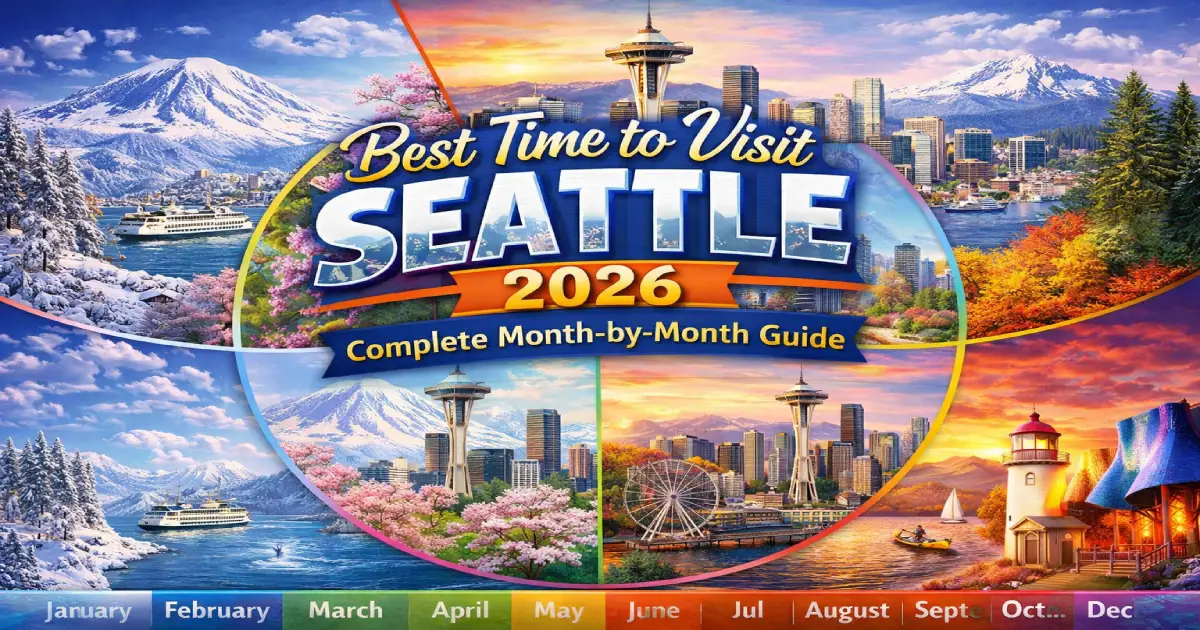
Best Time to Visit Seattle 2026: Complete Month-by-Month Guide
Published on : 19 Mar 2026
Best Time to Visit Seattle — Understanding the City’s Four Very Different Seasons
By Travel Tourister | Updated March 2026
Seattle’s seasons are more dramatically different from each other than any other major Pacific Northwest city — and more misunderstood by visitors who arrive with a single image of the city (usually: gray, wet, perpetually overcast) and discover something considerably more complex. Seattle’s summer (mid-June through September) delivers 280+ hours of sunshine per month in July and August, temperatures in the low-to-mid 70s°F, the reliably visible Mount Rainier above a skyline that genuinely glows, and outdoor activity conditions that rank among the finest of any American city. Seattle’s winter (November through February) is indeed gray and persistently rainy — but the rain is Pacific Northwest drizzle rather than tropical downpour, the temperatures never approach freezing (averaging 45–48°F), and the city’s coffee culture, bookshops, and indoor cultural institutions were built specifically for these months and operate at their most authentically Seattle character during them.
I’ve visited Seattle in every month of the year — the crystalline August morning when Mount Rainier appeared so clearly above the downtown skyline that pedestrians stopped mid-stride, the gray November Tuesday when the Elliott Bay Book Company basement café was the warmest place in the Pacific Northwest, the March week when the University of Washington’s cherry trees hit their peak bloom and turned the campus into a tunnel of pink, the September afternoon at the Ballard Locks when the Chinook salmon were pressing through the fish ladder with the specific purposefulness of creatures who have been doing exactly this for millions of years. Each month offered something genuine and specific — and each month also had honest limitations that a good guide should acknowledge.
This comprehensive 2026 guide breaks down Seattle’s best and worst visiting times using current weather data from National Weather Service Seattle, event calendars, hotel pricing patterns, and honest assessments of what each month actually delivers. We cover every month in detail, identify the best times for specific activities, flag the events and crowd patterns that make specific weeks meaningfully different, and give you the strategic intelligence to choose the right Seattle window for your specific trip priorities.
Whether planning a summer outdoor adventure, a cherry blossom spring visit, an October shoulder-season escape, or a budget winter trip built around Seattle’s extraordinary indoor culture, this guide gives you the honest, month-by-month picture of what Seattle is actually like throughout the year.
Seattle: Quick Season Overview
Season / Month
Weather
Crowds
Hotel Prices
Best For
January
44–48°F, frequent rain
Very Low
$80–$130
Budget travel, museums, coffee culture
February
45–50°F, rain easing
Low
$85–$140
Budget, early flowers, quiet
March
48–55°F, mixed rain/sun
Low–Moderate
$100–$160
Cherry blossoms, spring hiking
April
52–58°F, sun increasing
Moderate
$120–$185
Gardens, tulip festival, outdoor start
May
55–65°F, improving
Moderate–High
$140–$220
Pre-summer outdoor activities
June
60–68°F, variable
High
$165–$260
Pride, outdoor events, early summer
July
65–76°F, mostly sunny
Peak
$200–$340
Best weather, outdoor activities
August
66–77°F, peak sunshine
Peak
$210–$360
Rainier wildflowers, Seafair, beaches
September
62–70°F, clear and warm
Moderate
$165–$260
Salmon run, best overall value
October
55–62°F, fall color
Low–Moderate
$130–$200
Best shoulder month
November
48–54°F, rain returning
Low
$90–$150
Indoor culture, budget, authenticity
December
44–50°F, rain and holiday
Low–Moderate
$95–$160
Holiday markets, budget, cozy
Best Overall Times to Visit Seattle
1. July–August — THE BEST WEATHER MONTHS
Why July and August Are Peak: Seattle’s summer is genuinely extraordinary — the city that spends nine months managing gray drizzle transforms in July and August into one of America’s most beautiful urban environments. The Cascade and Olympic ranges frame the city in every direction, Mount Rainier rises above the southeastern skyline with the clarity of a painting, the days run to 16+ hours of light, temperatures sit in the comfortable 65–77°F range that makes outdoor activity a pleasure rather than an endurance test, and every outdoor venue, waterfront park, and lake fills with people who have been waiting since October for exactly this.
July–August Highlights:
Mount Rainier wildflower meadows at Paradise: Mid-July through mid-August is the peak of the wildflower season at the Paradise visitor area (5,400 feet) — glacier lilies, paintbrush, lupine, and bistort blooming beneath the glaciated summit in a landscape of extraordinary beauty accessible by a 1.5-hour drive
Seafair (late July–early August): Seattle’s largest annual summer festival — hydroplane races on Lake Washington, the Blue Angels aerobatic display, and the Seafair Torchlight Parade, drawing 300,000+ attendees
Seattle Pride (last weekend of June, extending into July energy): Capitol Hill Pride parade and festival, one of the Pacific Northwest’s largest LGBTQ celebrations
Outdoor kayaking, Alki Beach, and Lake Washington: The summer months make Lake Union kayaking, Lake Washington swimming, and the Burke-Gilman Trail cycling among the finest outdoor urban activities in America
Kerry Park sunsets: 16+ hours of daylight means the best Kerry Park sunsets happen after 9 PM in July — the city lit up below a long Pacific sunset behind the Olympics
Challenges: Peak hotel prices ($200–$360/night), peak crowds at Pike Place Market and the Space Needle, advance booking required for popular restaurants (3–4 weeks), and Mount Rainier Paradise parking fills by 8–9 AM on summer weekends
Average temperatures: 65–77°F; rain rare July–August (fewer than 4 rain days per month average)
Hotel rates: $200–$360/night mid-range; summer peak
2. September — BEST OVERALL VALUE MONTH
Why September is the Smart Choice: September is the Pacific Northwest’s secret finest month — summer’s warmth and clarity persist well into the month, the tourist crowds thin dramatically after Labor Day, hotel prices drop 20–25% from August peak, the Ballard Locks salmon run reaches its most dramatic phase (Chinook salmon pressing upstream through the fish ladder), the Mount Rainier wildflower season enters its final weeks, and the city’s cultural fall season launches. September delivers almost everything July and August offer at significantly lower cost and with meaningfully smaller crowds.
Post-Labor Day drop: Hotel prices fall within 48 hours of Labor Day weekend, crowds thin at all major attractions, Pike Place Market becomes navigable before 10 AM again
Ballard Locks salmon run: September is peak Chinook salmon run season — the fish ladder viewing windows are at their most dramatic, and the sockeye run overlaps in early September
Mount Rainier: Paradise wildflowers are past peak but the meadows are still beautiful, and the fall color on the lower slopes (September–October) is exceptional
Bumbershoot (Labor Day weekend): Seattle’s largest music and arts festival at Seattle Center — 50,000+ daily attendance, major headliners, free neighborhood programming ($75–$125/day pass)
Average temperatures: 62–70°F; 8–10 rain days in September, generally as brief showers rather than all-day gray
Hotel rates: $165–$260/night — 20–25% below August peak
3. October — BEST SHOULDER SEASON MONTH
Why October Works Brilliantly: October is Seattle’s most underrated visiting month — fall color turns Volunteer Park, the Washington Park Arboretum, and the Cascade foothills gold and crimson, temperatures hold at a comfortable 55–62°F, hotel prices drop 30–40% from summer peak, the summer crowds have completely cleared, and the city’s fall arts and restaurant season is fully launched. The rain that October brings (averaging 15 rain days) is the persistent Pacific Northwest drizzle that is more atmospheric than debilitating — excellent weather for the coffee shops, bookstores, and indoor cultural institutions that are most essentially Seattle.
Fall color: Washington Park Arboretum, Volunteer Park, Seward Park, and the Burke-Gilman Trail through the University District all reach peak fall color in late October — the finest urban fall foliage in the Pacific Northwest
Fewer crowds: Pike Place Market is fully navigable, Space Needle queues are short, and restaurant reservations open up — the city returns to something closer to its residents-only character
Cozy season launches: The coffee shops, bookstores, and neighborhood bars that define Seattle’s authentic culture enter their most comfortable season — a fire at a Capitol Hill café on an October evening is peak Seattle atmosphere
Hotel rates: $130–$200/night — excellent value for the experience delivered
4. Late March–April — CHERRY BLOSSOM SEASON
Why Spring is Worth Planning Around: The University of Washington’s 30 Yoshino cherry trees along the Quad allée bloom for approximately two weeks in late March and early April — the most spectacular cherry blossom display in the American West, transforming the UW campus into a tunnel of pale pink that draws photographers from across the Pacific Northwest. Additionally, the Skagit Valley Tulip Festival (60 miles north of Seattle, April) delivers 16,000 acres of tulip fields in bloom — one of the most spectacular agricultural landscape events in America.
UW Cherry Blossoms (late March–early April): The 30 Yoshino cherry trees at the UW Quad bloom for 10–14 days — arrive at 8 AM on a weekday for the quietest experience; weekends at peak bloom draw enormous crowds ($0, free campus access)
Skagit Valley Tulip Festival (all of April, Mount Vernon, 60 miles north): 16,000 acres of tulip and daffodil fields — one of the most visited annual events in Washington State ($10 parking at the fields; free to drive by on the roads)
Descanso Gardens equivalent: Washington Park Arboretum’s Japanese Garden and Azalea Way are at peak spring bloom in April
Weather caveat: March and April remain variable — rain is frequent but the cherry blossom bloom is weather-independent once begun; a rainy cherry blossom morning has its own particular beauty
Hotel rates: $100–$185/night — excellent spring value; spikes during specific cherry blossom and tulip festival weekends
Month-by-Month Breakdown
January: The Authentic Seattle Winter
Weather: 44–48°F average; 18–19 rain days; occasional snow above 500 feet (rare in the city proper, maybe 1–3 days per year with any accumulation); the darkest month, with only 8–9 hours of daylight
What’s Great:
Lowest hotel prices of the year (post-holiday, pre-spring): $80–$130/night for hotels that cost $250+ in August
Museum visiting at its best: MOHAI, SAM, MoPOP, Frye Art Museum, and Burke Museum at their least crowded — the entire Seattle museum circuit in a single week without a single queue
Coffee shop culture at its most authentic: The neighborhood cafés of Capitol Hill, Fremont, and Ballard fill with locals in January in a way they don’t in July
Restaurant reservations: The city’s best restaurants (Spinasse, Lark, The Walrus and the Carpenter) have realistic availability with 1–2 weeks lead time in January vs 3–4 weeks in summer
Seattle Restaurant Week (mid-January): Prix-fixe dinners at top Seattle restaurants for $20–$45/person — the best value dining event of the year
What’s Challenging: Persistent gray and rain; limited daylight; outdoor activities (hiking, kayaking, Alki Beach) significantly less appealing; Mount Rainier typically socked in (Paradise road may be closed for snowshoeing access only)
Verdict: Excellent for budget travelers and indoor culture enthusiasts; challenging for outdoor activity-focused visitors
Average hotel rate: $80–$130/night
February: First Signs of Spring
Weather: 45–50°F; rain frequency begins declining slightly from January; occasional clear days become more frequent by late February; 9–10 hours of daylight by month’s end
What’s Great:
Still the cheapest hotel month of the year — post-holiday rates before spring demand begins
Early flowers: The Washington Park Arboretum’s earliest camellias and witch hazels bloom in February — the first color of the Pacific Northwest spring
Seattle Restaurant Week (late January–early February): Prix-fixe menus at 200+ restaurants, the best dining value window in Seattle
Orcas Island and San Juan Islands off-season: February ferry crossings with almost no crowds and significantly reduced accommodation rates on the islands
Snowshoe at Crystal Mountain or Stevens Pass: The Cascades get their heaviest snowfall in January–February — cross-country and snowshoe conditions at their peak within 1.5 hours of the city
What’s Challenging: Still predominantly gray and wet; limited outdoor appeal; Valentine’s Day weekend spikes restaurant prices and availability
Verdict: Good for budget travel and winter outdoor sports; the most rewarding Seattle month for visitors who genuinely enjoy the rainy-season culture
Average hotel rate: $85–$140/night
March: Cherry Blossom Month
Weather: 48–55°F; rain frequent in early March, increasingly mixed with sunny spells by late month; the Pacific Northwest spring begins its tentative appearance in the third week of March
What’s Great:
UW Cherry Blossoms (late March, 10–14 day window): The most spectacular spring event in Seattle — 30 Yoshino cherry trees at the UW Quad bloom simultaneously in a display that draws 50,000+ visitors over the bloom period. The specific bloom dates vary year to year (check the UW Botanic Gardens website for current season predictions); typically peak mid-to-late March
St. Patrick’s Day (March 17): The Seattle Irish Week events around Pike Place Market and Capitol Hill — the city’s most festive mid-March gathering
Cascade skiing and snowboarding: March is prime Cascade ski season — excellent snow depths at Stevens Pass and Snoqualmie Pass, 1–1.5 hours from downtown
Hotel rates trending up but still reasonable: $100–$160/night, rising toward April
What’s Challenging: Rain remains frequent; cherry blossom timing is impossible to predict precisely — a late bloom can extend into early April, and an early warm spell can advance it to mid-March; the UW Quad at peak bloom on a weekend afternoon is extremely crowded
Pro tip: Visit the UW Quad before 8 AM on a weekday for a near-private cherry blossom experience; the famous crowds form from 10 AM onward
Verdict: Excellent for the cherry blossom experience; challenging if that specific window is missed
Average hotel rate: $100–$160/night (spikes during cherry blossom peak weekends)
April: Gardens and Tulips
Weather: 52–58°F; rain still frequent but sunshine increasing; the Pacific Northwest spring in full expression — green hills, flowering trees, and the occasional crystalline clear day when the Cascades appear with startling sharpness above the city
What’s Great:
Skagit Valley Tulip Festival (all month, 60 miles north): 16,000 acres of tulip and daffodil fields in the Skagit Valley — one of the most visited annual events in Washington State. Drive north on I-5, park at Roozengaarde or Tulip Town ($10 parking), and walk through fields of red, yellow, purple, and white tulips stretching to the Cascade foothills
Washington Park Arboretum at peak spring: The Japanese Garden, Azalea Way, and the full spring bloom sequence — the finest free garden experience in Seattle in April
Hiking returns: Lower elevation trails (Tiger Mountain, Little Si, Rattlesnake Ledge) dry out and become accessible with longer daylight hours — spring wildflowers on south-facing slopes
Seattle Sounders FC season opens: MLS season kicks off — T-Mobile Park pre-season games with smaller crowds than peak summer matches
What’s Challenging: Rain remains frequent; Tulip Festival weekends draw enormous crowds (arrive before 9 AM or expect 45-minute traffic delays); hotel prices rising toward summer
Verdict: Excellent for garden and nature lovers; good overall value before summer prices arrive
Average hotel rate: $120–$185/night
May: Pre-Summer Sweet Spot
Weather: 55–65°F; rain declining significantly; the longest daylight days begin approaching (over 15 hours by late May); the city’s outdoor culture begins activating — patios filling, kayak rentals opening, Kerry Park getting crowded at sunset again
What’s Great:
Northwest Folklife Festival (Memorial Day weekend, Seattle Center): Free folk music and dance festival — 100,000+ attendees, world music stages, the most diverse free music event in Seattle ($0 entry)
Seattle International Film Festival (May–June): The largest film festival in the US by attendance — 400+ films, 200,000+ attendees, premieres and retrospectives at venues across the city ($15–$20/screening)
Outdoor culture launches: Lake Union kayaking opens properly, the Burke-Gilman Trail fills with cyclists, and the rooftop bars begin their summer operations
Mount Rainier opens: The Paradise road typically opens for the season in late May — first wildflower sightings at lower elevations
What’s Challenging: Memorial Day weekend drives hotel price spike; early May rain still possible; ocean water too cold for Puget Sound swimming (55–58°F)
Verdict: Excellent pre-summer value — good weather beginning, prices below summer peak, events launching
Average hotel rate: $140–$220/night (Memorial Day weekend higher)
June: Transitional Excellence
Weather: 60–68°F; the “June-uary” phenomenon — Seattle’s version of June Gloom, where cooler and cloudier conditions can persist into the first two weeks of June before the summer pattern fully establishes. By mid-to-late June, the weather typically breaks into genuine summer clarity. The longest days of the year: solstice daylight runs nearly 16 hours.
What’s Great:
Seattle Pride (last weekend of June): Capitol Hill’s Pride parade and festival — one of the Pacific Northwest’s largest LGBTQ celebrations, the most energetic weekend on Capitol Hill’s annual calendar
Summer Solstice: At 47°N latitude, Seattle’s June solstice delivers nearly 16 hours of daylight — the Fremont Solstice Parade (naked cyclists, elaborate floats, the most exuberant free street event of the year) celebrates it with characteristic Northwest eccentricity
Seattle International Film Festival continues: Through mid-June — the festival’s final weeks often feature the most anticipated screenings
Outdoor concert season launches: The Hollywood Bowl equivalent — summer outdoor concerts at Marymoor Park, Chateau Ste. Michelle Winery in Woodinville, and the outdoor stages at venues across the city
What’s Challenging: “June-uary” weather uncertainty in early June; hotel prices rising significantly; Pride weekend spikes accommodation costs in WeHo equivalent areas
Verdict: Good with managed weather expectations; excellent for Pride and Solstice cultural events
Average hotel rate: $165–$260/night
July: Peak Summer
Weather: 65–76°F; reliably sunny (Seattle averages fewer than 4 rain days in July); 16 hours of daylight; the Pacific Northwest summer at full expression — clear blue skies, Mount Rainier visible most mornings, the Olympic Mountains gleaming white above Puget Sound, lake temperatures warm enough for swimming
What’s Great:
4th of July: The gasworks Park fireworks show over Lake Union — watched from the Gas Works Park mound, the Fremont Bridge, or any Lake Union waterfront — is one of the finest urban 4th of July displays in America (free from the park)
Seafair (late July–early August): Hydroplane races on Lake Washington, the Blue Angels aerobatic display, and the Seafair Torchlight Parade through downtown — Seattle’s largest summer festival ($35–$65 for hydroplane viewing; parade free)
Mount Rainier Paradise wildflowers: Mid-July is the beginning of the wildflower peak season — glacier lilies, paintbrush, and lupine blooming simultaneously beneath the glaciated summit
Capitol Hill Block Party (mid-July): Three-day outdoor music festival on Pike/Pine Street — indie, electronic, and hip-hop acts on outdoor stages in the city’s most vital neighborhood ($75–$100/day pass)
All outdoor activities at peak: Kayaking, cycling, Alki Beach, whale watching, ferry rides — July is the month for everything Seattle can do outside
What’s Challenging: Peak hotel prices ($200–$340/night); maximum crowds at all tourist attractions; Pike Place Market impassable on summer Saturday afternoons; Mount Rainier Paradise parking full by 8–9 AM on weekends (arrive before 7 AM or take the shuttle from Ashford)
Verdict: Best weather month; highest cost; plan farther ahead than any other Seattle month
Average hotel rate: $200–$340/night
August: Summer Peak Continues
Weather: 66–77°F; the warmest month of the year; statistically Seattle’s sunniest month (August averages slightly more sunshine hours than July); the Pacific Northwest at its most California-adjacent — warm enough for shorts, cool enough at night for a layer, virtually no rain
What’s Great:
Seafair continues (early August): The Blue Angels display over Lake Washington is the most spectacular free airshow in the Pacific Northwest — watch from Gas Works Park, Seward Park, or any Lake Washington access point
Mount Rainier wildflower peak: Early-to-mid August is typically the peak wildflower week at Paradise — the meadows at full bloom, the glaciers gleaming above, the most spectacular day trip accessible from any major American city
Bumbershoot (Labor Day weekend, technically straddles August–September): Seattle’s largest music and arts festival at Seattle Center
Lake Washington swimming: Lake Washington and Green Lake reach their warmest temperatures (72–74°F) in August — the finest urban freshwater swimming in the Pacific Northwest
Outdoor markets and festivals: Nearly every Seattle neighborhood hosts its own summer street festival in August — Fremont’s annual events, Ballard Seafood Fest, and the Capitol Hill outdoor venues all peak in August
What’s Challenging: Highest hotel prices of the year ($210–$360/night); wildfire smoke — eastern Washington wildfires occasionally send smoke west over the Cascades into Seattle in August, degrading air quality for 3–7 days; advance booking essential for all popular restaurants
Wildfire smoke note: Check the AirNow.gov app before outdoor activities in August–September; on heavy smoke days (AQI 150+), outdoor activities in the mountains are inadvisable
Verdict: Finest overall weather; maximum cost; wildfire smoke risk; plan 6+ weeks ahead
Average hotel rate: $210–$360/night
September: The Connoisseur’s Month
Weather: 62–70°F; summer warmth and clarity persist through mid-September; the “Second Summer” that Pacific Northwest residents treasure — warm days, cool evenings, increasingly clear air after any August smoke, and the first beautiful fall days beginning in the final week
What’s Great:
Ballard Locks salmon run: The most dramatic Chinook salmon run through the Ballard Locks fish ladder — large fish pressing upstream through the glass observation windows in the most powerful and most accessible urban wildlife encounter in Seattle (free, fish ladder open daily 7 AM–9 PM)
Bumbershoot (Labor Day weekend): Seattle’s largest music festival, straddling August–September — $75–$125/day passes
Post-Labor Day crowd drop: Hotel prices fall 20–25% within 48 hours of Labor Day; Pike Place Market becomes navigable again; the Space Needle has walkup availability
Mount Rainier final wildflower weeks: The Paradise meadows transition from summer wildflowers to fall color — September huckleberry turn delivers brilliant reds on the lower slopes
Chateau Ste. Michelle harvest season (Woodinville, 30 minutes east): Washington wine country’s crush season — winery harvest events and tastings at their most festive
What’s Challenging: Labor Day weekend is still expensive and crowded; wildfire smoke possible in early September; fall rain begins returning in the final week
Verdict: The best month for value-conscious visitors who want summer weather — the strongest recommendation in this guide for travelers with schedule flexibility
Average hotel rate: $165–$260/night (drops post-Labor Day)
October: Fall Color and Shoulder Season
Weather: 55–62°F; rain returning (averaging 12–15 rain days); the Pacific Northwest fall in full expression — dramatic skies, fall color, and the occasional crystalline day when the air has been washed clean by rain and the mountains appear with stunning clarity
What’s Great:
Fall color: Washington Park Arboretum (peak usually third week of October), Volunteer Park, Seward Park, and the Burke-Gilman Trail all deliver excellent fall color — the maples, oaks, and ginkgos of the Arboretum are spectacular
Oktoberfest in Leavenworth (first two weekends of October): The Bavarian Cascade village at its most festive — crowded but genuinely excellent ($5–$8 parking; Leavenworth hotels book months ahead)
Seattle restaurant season: The city’s best restaurants have their fall menus launched and their summer crowds departed — October is the finest month for restaurant reservations at the city’s most celebrated spots
Post-summer serenity: Kerry Park, Gas Works Park, and the Olympic Sculpture Park are much less crowded — the viewpoints that were shoulder-to-shoulder in July have space for quiet contemplation
What’s Challenging: Rain increasing; some outdoor activities (kayaking, mountain hiking) becoming less comfortable; Leavenworth Oktoberfest weekends drive accommodation spikes in the Cascades
Verdict: The best shoulder season month — good weather windows, excellent fall color, finest restaurant access, meaningful price reduction from summer peak
Average hotel rate: $130–$200/night
November: Entering the Seattle Season
Weather: 48–54°F; rain returning in earnest (17–18 rain days average); the transition into Pacific Northwest winter — persistent low gray clouds, frequent drizzle, and the occasional spectacular clearing when the mountains appear unexpectedly brilliant above the city
What’s Great:
Genuinely the most authentically Seattle month to visit — the coffee shops, bookshops, and neighborhood bars that define the city’s character are most themselves when the gray is outside and the warmth is inside
Dia de los Muertos celebrations (early November): The International District and other neighborhoods host increasing cultural events for the holiday
Seattle Symphony and Opera full season: Both institutions are in full swing — the finest weeks for classical music at Benaroya Hall and McCaw Hall
Hotel prices at near-winter lows: $90–$150/night for hotels that cost $300+ in August
Thanksgiving week: Mixed — the Wednesday before Thanksgiving sees Pike Place Market exceptionally crowded; Thanksgiving Day itself is quiet and contemplative
What’s Challenging: Persistent gray and rain; outdoor activities significantly less appealing; Mount Rainier Paradise typically closes for the season mid-November (reopens for snowshoeing only)
Verdict: Excellent for visitors who genuinely want to experience Seattle’s authentic rainy-season culture; challenging for outdoor activity-focused visitors
Average hotel rate: $90–$150/night
December: Holiday Seattle
Weather: 44–50°F; rain frequent (18–19 days average); the shortest days of the year (8 hours of daylight); occasional snow above 500 feet; downtown holiday decorations create a specific Seattle festive atmosphere
What’s Great:
Seattle Christmas Market (Westlake Park, entire month): The European-style holiday market in downtown Westlake Park — the Pacific Northwest’s most comprehensive holiday market, with local artisans, food vendors, and the city’s most concentrated holiday lighting
ZooLights at Woodland Park Zoo (December): Annual holiday light display at the zoo — 750,000+ lights across the zoo grounds, one of Seattle’s most visited winter attractions ($18/adult)
Holiday ship parade on Lake Union: A flotilla of decorated boats circling Lake Union in early December — visible free from the Gas Works Park mound or the Lake Union waterfront
Leavenworth Christmas Lighting Festival (first three weekends of December): The Bavarian village decorated in Christmas lights with carolers and Glühwein — 2.5 hours east, the most magical winter day trip from Seattle
Early December budget window: The first two weeks of December (before the holiday travel surge) deliver the year’s lowest hotel prices alongside full holiday atmosphere
What’s Challenging: Holiday week (December 22–January 1) drives hotel price spikes and airport congestion; the shortest daylight days make outdoor activities very time-constrained; rain is frequent and persistent
Verdict: Excellent in early-to-mid December (budget rates, holiday atmosphere, cozy indoor culture); crowded and expensive during the holiday week
Average hotel rate: $95–$160/night (holiday week $180–$280+)
Best Times for Specific Activities
Best Time for Outdoor Activities
Optimal: July–September — reliably sunny and warm (65–77°F), all trails open, kayaking and cycling conditions peak, Lake Washington and Lake Union warm enough for swimming. September is the connoisseur’s choice: summer conditions with thinner crowds and lower prices.
Good: May–June (improving conditions, early outdoor access), October (fall hiking excellent in lower elevations)
Avoid for outdoor activities: November–March (persistent rain makes hiking and cycling uncomfortable; kayaking possible but gear-intensive)
Best Time for Mount Rainier
Wildflower meadows (Paradise): Mid-July through mid-August — the most spectacular window. Check the NPS Mount Rainier webcam and forecast the evening before; the summit is frequently obscured by clouds even when Seattle is sunny.
Shoulder season hiking (Rainier): September–early October — lower elevation fall color, fewer crowds, good trail conditions, open roads. Snowshoeing at Paradise: December–March (Paradise road closes to vehicles; snowshoe rental available at the visitor center).
Avoid: May–June for Paradise (road may still be closed or wildflowers not yet bloomed); November for Paradise (road closing for winter).
Best Time for Cherry Blossoms
University of Washington Quad: Typically late March to early April — a 10–14 day window that varies year to year by 2–3 weeks depending on winter temperatures. Check the UW Botanic Gardens Twitter/social media for the current season’s prediction (usually posted 2 weeks ahead). Arrive before 8 AM on weekdays to avoid the photo crowds that form from 10 AM onward.
Best Time for Budget Travel
Optimal: January (post-New Year’s through mid-February) — $80–$130/night hotels, easy restaurant reservations, uncrowded museums. Early December is nearly as good ($95–$140/night) with the added bonus of holiday atmosphere.
Strategy:
Avoid the specific high-price events: Labor Day weekend, 4th of July, Cherry Blossom peak weekends (late March–April), Pride weekend (late June), Bumbershoot (Labor Day weekend)
Midweek travel (Monday–Thursday) saves 15–25% on hotels year-round vs weekend rates
Seattle Restaurant Week (mid-January and mid-September): Prix-fixe dinners at top Seattle restaurants for $20–$45 — the best fine dining value in the annual calendar
Best Time for the Ballard Locks Salmon Run
Optimal: Late August through October — the Chinook (King) salmon run peaks in late August and September; the sockeye run overlaps in August; the coho (silver) run follows in October through November. September is typically the most dramatic single month for fish ladder viewing. The fish ladder is open daily 7 AM–9 PM year-round, but the salmon only run in their specific seasonal windows.
Best Time for Photography
Optimal: September–October — post-wildfire-smoke clarity, fall light quality, and the combination of fall color with mountain views creates the finest photography conditions of the year. The clearing storms of October deliver crystalline visibility when the mountains appear with extraordinary sharpness above the city.
Good: July–August (summer clarity, long golden hours after 8 PM), March (cherry blossoms, dramatic spring light)
Notable: Rainy day photography (November–March) has its own compelling aesthetics — Pike Place Market in morning mist, the waterfront in gray Pacific light, the coffee shop windows steamed from inside
Best Time for Wine and Day Trips
Woodinville wine country (30 minutes east): Harvest season (September–October) for the most festive winery experience; all year round for tastings at 100+ Woodinville tasting rooms.
Leavenworth: Oktoberfest (first two October weekends), Christmas Lighting (first three December weekends), summer hiking (July–September). Avoid: Oktoberfest and Christmas weekends without accommodation booked 3+ months ahead.
San Juan Islands: June–September for whale watching (resident orcas); May and October for fewer crowds and lower ferry demand. Winter ferry crossings are beautiful if you’re not dependent on whale watching.
Seattle Timing: Practical Tips
Topic
What to Know
The Rain Reality
Seattle gets less annual rainfall than New York City, Miami, or Houston — the difference is that Seattle’s rain falls as persistent drizzle across 150+ days rather than heavy downpours concentrated in a wet season. A waterproof jacket (not an umbrella — locals don’t use umbrellas) handles 90% of Seattle weather. The gray is real and persistent October–May; manage expectations accordingly.
Mount Rainier Timing
The mountain is frequently obscured by clouds even when Seattle is sunny — always check the NPS Mount Rainier webcam (nps.gov/mora) and the Paradise weather forecast the evening before driving. A clear day at Paradise is worth 3 hours of driving; an overcast day delivers a $35 park entry fee and limited views. Departing Seattle by 7 AM and arriving Paradise before 9 AM maximizes parking availability and morning clarity before afternoon clouds build.
Cherry Blossom Timing
The UW Quad cherry blossom bloom is completely unpredictable more than 10 days ahead — follow the UW Botanic Gardens social media for the current season’s prediction. The bloom lasts 10–14 days total and can be significantly shortened by wind or rain at peak. Visiting on a weekday before 8 AM is the most reliably uncrowded experience; weekend afternoons at peak bloom are extremely dense with photographers.
Hotel Booking Lead Times
Summer peak (July–August): Book 6–8 weeks ahead. Cherry blossom peak weekends (late March–April): 3–4 weeks. Specific events (Pride, Bumbershoot, Seafair): 4–6 weeks. Leavenworth Oktoberfest and Christmas: 3–4 months. January–February: Book 1–2 weeks ahead or sometimes same week — lowest demand of the year. Always check if a major convention (large tech conferences, PAX gaming convention) overlaps your dates.
What to Pack
Year-round: Waterproof jacket (mandatory), layers (Seattle’s temperature varies 15–20°F between morning and afternoon), comfortable walking shoes. Summer additions: Sunscreen (Seattle’s UV is higher than its overcast reputation suggests), sunglasses, light layers for cool evenings. Winter additions: Warm mid-layer under the waterproof jacket; umbrella is optional but considered unnecessary by locals. Mountain day trips: Bring an extra layer year-round — Paradise is 20–30°F colder than Seattle at altitude.
Wildfire Smoke
Eastern Washington’s summer wildfires can push smoke westward over the Cascades into Seattle in August and September — check AirNow.gov for real-time AQI before outdoor activities during this period. Smoke events typically last 3–7 days and then clear. On heavy smoke days (AQI 150+), outdoor hiking and mountain activities are inadvisable; indoor Seattle activities remain unaffected. The frequency and severity of smoke events has increased in recent years — this is a real planning consideration for August visits.
Frequently Asked Questions: Best Time to Visit Seattle
What is the best month to visit Seattle?
September is the best single month for most visitors — summer warmth and clarity persist well through mid-September, hotel prices drop 20–25% from August peak within days of Labor Day, the Ballard Locks Chinook salmon run is at its most dramatic, the Bumbershoot music festival fills Labor Day weekend, Mount Rainier’s wildflower meadows are in their final beautiful weeks, and the city’s fall cultural season launches with the energy of a population that has been enjoying summer and is ready for indoor culture again. For visitors prioritizing absolute best weather over value, August is the finest weather month. For visitors prioritizing the cherry blossom experience specifically, late March to early April is non-negotiable. For budget travelers, January delivers the lowest hotel prices of the year alongside genuine rainy-season Seattle culture.
What is the worst time to visit Seattle?
No month is genuinely bad in Seattle — the city’s Mediterranean-adjacent summer and the extraordinary indoor culture of its rainy season both deliver genuine value. However, January and February present the most challenging conditions for outdoor activity-focused visitors: persistent gray (17–19 rain days per month), only 8–9 hours of daylight, and limited outdoor appeal. For visitors whose primary Seattle activities are hiking, kayaking, and outdoor sightseeing, January and February are genuinely difficult months. Paradoxically, these are also the cheapest months and the most authentically Seattle months for visitors interested in the coffee, bookshop, live music, and restaurant culture that the city does better than anywhere in the Pacific Northwest.
How many rainy days does Seattle actually get?
Seattle averages approximately 152 rain days per year — days with any measurable precipitation. The crucial context: Seattle’s total annual rainfall (38 inches) is less than New York City (46 inches), Miami (62 inches), and Houston (51 inches). The difference is entirely in the delivery — Seattle’s rain falls as persistent light drizzle across many days rather than heavy downpours in a concentrated season. July and August average fewer than 4 rain days each — genuinely among the sunniest months of any American city. November through March average 17–19 rain days each — persistent and gray. A waterproof jacket (not an umbrella — umbrellas mark tourists in Seattle) is the correct year-round response.
Is Seattle good to visit in winter?
Yes — for the right kind of visitor, Seattle in winter is excellent and genuinely rewarding. The city’s coffee culture (Victrola, Slate, Milstead, Elm), its bookshops (Elliott Bay Book Company), its live music venues (The Crocodile, Neumos, The Showbox), its restaurant scene (winter menus are the year’s most ambitious at Spinasse, Lark, and the Walrus and the Carpenter), and its museum circuit (MOHAI, SAM, MoPOP, Frye) are all at their most authentically Seattle in the winter months. Hotel prices are 40–60% below summer rates. Restaurant reservations are easy. The city feels like itself rather than a tourist destination. The challenge: outdoor activities (hiking, kayaking, Alki Beach) are significantly less appealing; Mount Rainier Paradise is closed to vehicles; and 8–9 hours of gray daylight requires genuine psychological adaptation for visitors from sunnier climates.
When should I visit Seattle to see Mount Rainier?
Mid-July through mid-September for the wildflower meadow experience at Paradise — the most compelling reason to visit Rainier. The wildflower peak at the 5,400-foot Paradise visitor area typically occurs in the third week of July through first week of August, varying year to year by 1–2 weeks depending on snowpack. Always check the NPS Paradise webcam (nps.gov/mora) the evening before driving — the mountain is frequently obscured by clouds even when Seattle is sunny, and a 3-hour round trip drive to a socked-in mountain is frustrating. September delivers excellent lower-elevation fall color and significantly lighter crowds. October–June, Paradise is either under snow or in the transition to summer — winter snowshoeing (December–March) is excellent, but the wildflower experience requires July–August.
When are hotel prices lowest in Seattle?
The three lowest hotel price windows in Seattle: (1) Mid-January through mid-February — the cheapest sustained hotel rates of the year, 45–55% below summer peak, with $80–$120/night for hotels that cost $280+ in August; (2) Early December (December 1–19) — comparable to January pricing before the holiday travel surge; (3) November (excluding Thanksgiving week) — $90–$150/night with full access to the fall cultural season. The cheapest single days of the year are typically Tuesday–Thursday in mid-January, when the combination of post-holiday departure and winter rain keeps demand minimal. A mid-range hotel room costing $320 in August can be found for $95 in mid-January — the same property, same location, same bed.
What should I pack for a Seattle trip?
The single most important item is a quality waterproof jacket — not a rain poncho, not an umbrella (neither locals nor the rain infrastructure of Seattle supports umbrella use effectively), but a properly waterproof breathable jacket you can wear over anything from a T-shirt to a fleece. Beyond that: layers are essential because Seattle’s temperature regularly varies 15–20°F between a cool morning and a warm afternoon; comfortable waterproof walking shoes or boots; and sunscreen year-round (Seattle’s latitude and the Pacific’s reflective surface deliver UV exposure even on overcast days that surprises visitors). For summer: sunglasses, a light breathable layer for cool evenings. For mountain day trips (Rainier, Olympics): bring an extra mid-layer regardless of summer temperatures — Paradise is 20–30°F colder than Seattle and the wind exposure at elevation is significant.
Final Thoughts: Choosing Your Seattle Season
After years of visiting Seattle across every month and every season, three principles emerge for choosing the right time for a specific Seattle trip:
1. Seattle’s seasons serve different travelers — and the “best” month depends entirely on what you came for. The visitor who wants Mount Rainier’s wildflower meadows and Lake Union kayaking and Alki Beach at sunset must come in July or August and pay summer prices, accept summer crowds, and check the AQI for wildfire smoke. The visitor who wants cherry blossoms and spring hiking and restaurant reservations at the year’s most ambitious menus must come in late March or April and accept that it will rain on at least half the days. The visitor who wants the lowest hotel prices and the most authentic coffee-shop-and-bookshop Seattle experience must come in January and accept 17 rain days and 8 hours of daylight. None of these is a compromise if it aligns with the right visitor. Seattle’s seasons are not a hierarchy with summer at the top — they are four genuinely distinct experiences of the same city, each of which rewards visitors who understand what they’re getting.
2. September is the objectively best value month, and more travelers should plan around it. The logic is straightforward: September delivers 80–90% of July’s outdoor appeal (similar temperatures, similar sunshine, similar mountain clarity) at 75–80% of July’s hotel cost, with significantly reduced crowds at every attraction, the Ballard Locks salmon run as a unique seasonal bonus, and the Bumbershoot music festival filling Labor Day weekend with Seattle’s largest cultural event. The reason September is underbooked relative to July and August is the same reason October is underbooked relative to June: people plan around the school summer vacation calendar rather than around actual weather and experience data. Travelers with flexible schedules who book September will find the Seattle that residents experience — warm, clear, uncrowded, and fully available.
3. The rain is not the enemy — it is the context that makes Seattle’s indoor culture world-class. The Elliott Bay Book Company exists in its specific form because Pacific Northwest people needed excellent bookshops for the months when outdoor recreation was impossible. Victrola Coffee exists because Seattle needed coffee shops that were genuinely worth spending three hours in during a November afternoon. The neighborhood bars of Capitol Hill, the live music venues of Belltown, the intimate restaurant scene of Ballard — all of these were shaped by the knowledge that they would need to be extraordinary to justify leaving the house in the rain. Visitors who arrive in November or February expecting Seattle’s summer and find instead its winter are disappointed. Visitors who arrive understanding that the rain has produced one of America’s finest indoor culture cities find something unexpected and genuinely rewarding. The Pacific Northwest winter built Seattle. Visiting in it is not a consolation prize — it is a different trip to a better-understood city.
Seattle is a city that changes more dramatically with the seasons than almost any other American destination. Plan for the season you want, not the season the photographs show. The photographs show July. The city is most itself in October. The best value is September. The cheapest beds are in January. All of these are true. Choose accordingly.
For current weather forecasts, event calendars, and Seattle visitor information, consult Visit Seattle, National Weather Service Seattle for seasonal forecasts, and Mount Rainier Paradise Road Status for current road and wildflower conditions.
—
—
About Travel TouristerTravel Tourister’s Seattle specialists provide honest seasonal guidance based on extensive year-round exploration of the city’s neighborhoods, outdoor trails, cultural institutions, and surrounding Pacific Northwest wilderness. We understand that the best time to visit Seattle depends entirely on what you want to experience — and that the city’s rainy season is not a liability but the context that produced one of America’s finest indoor cultures.Need help choosing the right time for your Seattle visit? Contact our specialists who can recommend optimal travel windows based on your specific interests — from Mount Rainier wildflower timing to cherry blossom prediction to salmon run scheduling to Leavenworth Christmas Lighting Festival booking. We help travelers find their perfect Seattle season.
Posted By : Vinay
As a lead contributor for Travel Tourister, Vinay is dedicated to serving our Tier 1 audience (US, UK, Canada, Australia). His mission is to deliver precise, fact-checked news and actionable, data-driven articles that empower readers to make informed decisions, minimize travel risks, and maximize their adventure without compromising safety or budget.
Travel Tourister is a leading Travel portal where we introduce travellers to trusted travel agents to make their journey hasselfree, memorable And happy. Travel Tourister is a platform where travellers get Tour packages ,Hotel packages deals through trusted travel companies And hoteliers who are working with us across the world. We always try to find new and more travel agents and hoteliers from every nook and corners across the world so that you could compare the deals with different travel agents and hoteliers and book your tour or hotel with the one you have chosen according to your taste and budget.




 Call
Call Enquiry