Published on : 21 Mar 2026
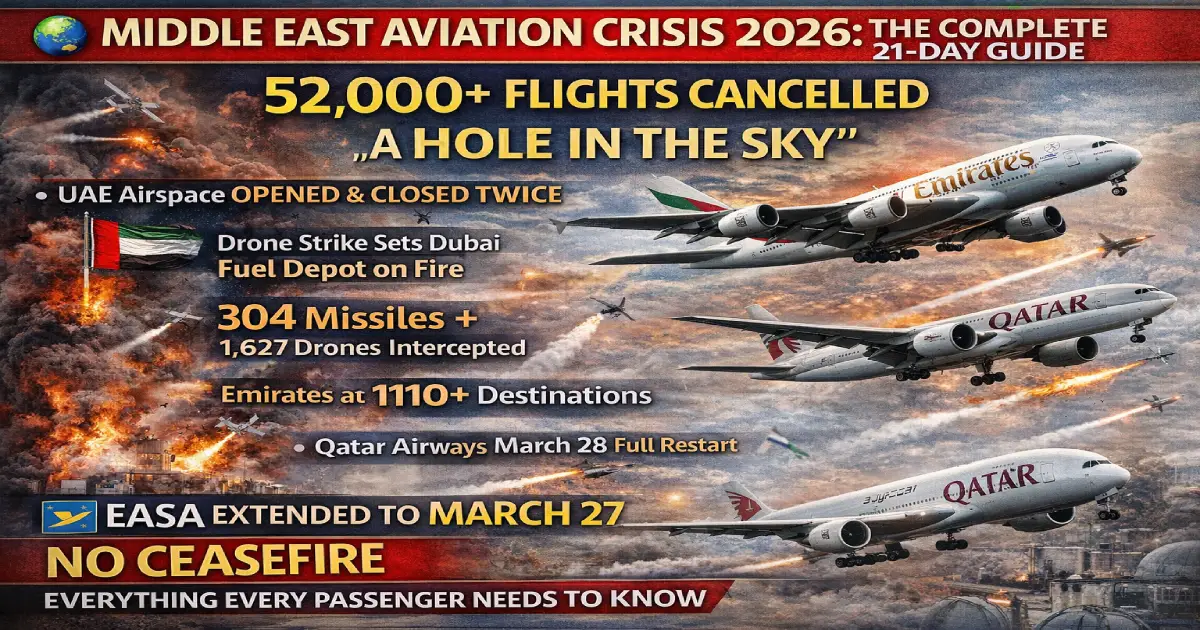
“Hole in the Sky”: Open Flightradar24 right now and look at the Middle East. Where one of the world’s busiest aviation crossroads should be — a dense web of aircraft linking Europe, Asia and Africa — there is instead a yawning gap. A hole in the sky. That is how CNN described it on March 2. Twenty-one days later, the hole is smaller than it was — but it has not closed.
Since February 28, 2026, the US-Israel military operation against Iranian nuclear and missile infrastructure — and Iran’s sustained retaliatory drone and missile campaign against Gulf states — has triggered the most severe aviation disruption the world has seen since the COVID-19 pandemic. More than 52,000 flights have been cancelled to and from the Middle East since the conflict began. At the peak of the disruption, more than 50% of all departing flights from Middle Eastern airports were cancelled or unable to operate. 304 ballistic missiles, 15 cruise missiles, and 1,627 drones have been intercepted by UAE air defences alone. Dubai International Airport — the world’s busiest international airport by passenger volume — was briefly closed twice, including once after a drone strike set a fuel depot on fire. And no ceasefire is in place or imminent.
This is the complete guide — the one article that explains everything that happened, why, what is currently operating, and what comes next for every passenger connecting through the Gulf.
Published: March 21, 2026 (Saturday — Crisis Day 21) Crisis began: February 28, 2026 — US-Israel strikes on Iranian military targets Total flights cancelled since Feb 28: 52,000+ (over 50% of all planned Gulf flights) First-week alone: 15,600 flights cancelled or grounded UAE air defences intercepted: 304 ballistic missiles + 15 cruise missiles + 1,627 drones Dubai Airport closures: Twice — briefly each time; once after drone struck fuel depot March 16 UAE airspace brief full closure: March 16–17 overnight — 2 hours — caused holding patterns EASA CZIB 2026-03: Extended to March 27, 2026 — covers all major Gulf + Levant airspace Emirates destinations today: 110+ — rebuilding toward 140-destination full network Qatar Airways: Limited schedule — ~70 destinations from Doha until March 28 full restart Qatar March 28: Confirmed full restart date — BNE/ADL/AKL/MEL/SYD all restore No ceasefire: Conflict ongoing — Iran continuing missile and drone attacks as of March 21 Jet fuel prices: Hit $109/barrel (Brent crude) on March 18 after Israel struck South Pars gas field War-risk insurance: Multiple Lloyd’s syndicates cancelled/suspended Gulf coverage; premiums +50–500% Air cargo rates: +70% — pharmaceutical, automotive and e-commerce chains severely impacted Asia-Europe capacity: Down 35–40% (Aevean Consulting) Paul Charles (PC Agency CEO): “Pretty well the biggest shutdown we’ve seen certainly since the COVID pandemic”
The crisis began on February 28, 2026, when US-Israel strikes on Iranian military targets triggered immediate Iranian retaliation with ballistic missiles and drones across Israel and several Gulf states. Multiple waves of attacks targeted military bases and infrastructure across the region.
Within hours of the first strikes, the following countries closed their airspace simultaneously — an event with no modern aviation precedent:
✈️ Iran (OIIX FIR): Complete closure ✈️ Iraq (ORBB FIR): Total closure ✈️ Qatar (OTDF FIR): Closed for overflights — PPR only for approved departures/arrivals ✈️ UAE (OMAE): ESCAT (Emergency Security Control of Air Traffic) zones activated ✈️ Bahrain (OBBB FIR): Effectively closed ✈️ Kuwait (OKAC FIR): Total closure ✈️ Israel (LLLL FIR): Ben Gurion Airport operational halts
On Flightradar24, the aircraft that would normally form a dense web across Iran, Iraq, and the Gulf simply disappeared. Simultaneously. Within the span of a few hours on February 28, one of the world’s most important aviation corridors went dark.
The immediate cascade: Crew members and aircraft already in flight through the region were diverted to Muscat (Oman), which initially remained open as a transit corridor. Austrian Airlines ran a crew evacuation flight to Muscat. Airlines scrambled to find alternative routings. The Caucasus bypass (north of Iran via Armenia and Azerbaijan) and the Egyptian/Saudi corridor (south of Iraq) became the two viable routes connecting Europe to Asia — but both added 2–4 hours to typical flight times and consumed dramatically more fuel.
In the first week, more than 15,600 flights were cancelled or grounded across Middle Eastern airspace alone. The Gulf’s three megahubs — Dubai International (DXB), Hamad International in Doha (DOH), and Abu Dhabi’s Zayed International (AUH) — went from their combined normal processing of 100,000+ passengers per day to near-zero operations.
Emirates: Initially suspended all operations from DXB — the first full operational suspension in the airline’s 40-year history. Hundreds of thousands of passengers stranded across 140 cities. Qatar Airways: Suspended nearly all departures from Doha. Only emergency and approved PPR flights. Etihad: Full suspension from Abu Dhabi. flydubai: Complete suspension from DXB and DWC. Air Arabia: Suspended from Sharjah.
The stranded passenger count globally reached over 100,000 in the first 72 hours. Airports in Bali, Bangkok, Singapore, Mumbai, London, Frankfurt, Sydney, Melbourne, Toronto and New York reported passengers stranded waiting for Gulf carrier connections that would not come for days.
The UAE partially reopened its airspace under controlled conditions. Emirates began a phased restart, prioritising trunk routes to London-Heathrow, Mumbai, Sydney and New York.
The March 16 Dubai fuel depot drone strike:
In the most dramatic single incident of the aviation crisis, a drone strike hit a fuel depot near Dubai International Airport on the morning of March 16. The Dubai Government Media Office confirmed: “On the morning of March 16, a drone attack on a fuel tank near Dubai International Airport triggered a fire.” Airport operations were briefly suspended as a “precautionary measure.” Flights were placed in holding patterns southeast of the city. The incident lasted approximately 2 hours before DXB reopened. This was the second drone-related incident to affect DXB operations — the fourth overall in the UAE since February 28.
The March 16–17 overnight full UAE closure:
Just one day after the fuel depot strike, the UAE briefly closed its entire airspace overnight on March 16–17 as an “exceptional precautionary measure” during new missile and drone threats. It lasted about two hours before reopening — but demonstrated that even FIRs that are technically open can shut with little or no warning.
By the third week, Emirates had rebuilt to 80+ destinations, then 100+, then 110+. Qatar began its limited revised schedule of approximately 70 destinations — confirming March 28 as the full restart target. European carriers began announcing specific resumption dates. The EASA safety advisory was extended repeatedly — most recently to March 27.
Current airspace status as of March 21, 2026 (OPSGROUP/EASA/airline NOTAM confirmed):
| Airspace | FIR Code | Status | Notes |
|---|---|---|---|
| UAE | OMAE | 🟡 Restricted open | ESCAT zones; single western routing via LUDID; overflights limited |
| Qatar | OTDF | 🟡 PPR only | Approved arrivals via LAEEB; departures via DATRI; ~70 QR destinations |
| Saudi Arabia | OEJD | 🟡 Contingency routings | Some routes unavailable; expect delays; carry extra fuel |
| Bahrain | OBBB | 🔴 Effectively closed | Only approved departures from OBBI via NARMI |
| Kuwait | OKAC | 🔴 Closed | No civilian traffic |
| Iran | OIIX | 🔴 Closed | Complete closure, all civilian traffic |
| Iraq | ORBB | 🔴 Closed | Total closure |
| Israel | LLLL | 🟡 Limited | PPR basis only — BizAv approvals not being granted |
| Oman | OOMM | 🟡 Open with restrictions | NOTAM-defined routings; viable as Gulf bypass corridor |
| Jordan | OJAC | 🟡 Restricted | EASA caution applies |
| Lebanon | OLBB | 🔴 Effectively closed | |
| Syria | OSTT | 🔴 Closed |
The two viable routing corridors (replacing the direct Gulf route):
✈️ North Corridor: Europe → Turkey → Armenia/Azerbaijan (Caucasus) → Central Asia → Afghanistan → South/Southeast Asia. Adds 2–3 hours. Requires extra fuel stops for some aircraft types.
✈️ South Corridor: Europe → Egypt → Saudi Arabia (western FIR) → Oman → India/Southeast Asia. Adds 1–2 hours. More viable but subject to Saudi contingency routing requirements.
EASA CZIB 2026-03 (updated to March 27):
The European Union Aviation Safety Agency’s Conflict Zone Information Bulletin — which recommends all European commercial aviation avoid the airspace of Iran, Iraq, Israel, Jordan, Lebanon, Bahrain, Kuwait, Qatar, UAE, Oman and Saudi Arabia at ALL flight levels — has been extended from its previous March 18 expiry to March 27, 2026. This means European carrier pilots, insurers and operations centres will not clear the Gulf routing for their flights until March 28 at the earliest — which is precisely why March 28 is also Qatar’s chosen full restart date.
The numbers are genuinely staggering.
Over 52,000 flights to and from the Middle East have been cancelled since the war began on February 28, accounting for more than half of all planned flights in the region.
For further context:
The economic cascade:
The disruption has had consequences far beyond cancelled holidays:
✈️ Jet fuel prices hit $109/barrel (Brent crude) on March 18 after Israel struck the South Pars gas field — pushing potential airfare hikes of 11% for summer 2026 (your site’s existing oil price article) ✈️ War-risk insurance: Multiple Lloyd’s syndicates cancelled Gulf route coverage entirely; premiums for those that continue surged 50–500% ✈️ Air cargo rates: Up 70% — pharmaceutical cold chain, automotive parts, Amazon/e-commerce shipments severely disrupted ✈️ Strait of Hormuz: Effectively closed to commercial shipping, compounding the supply chain disruption ✈️ GCC states: UAE, Qatar and Bahrain facing billions in weekly tourism and trade losses ✈️ Oxford Economics projection: 11–27% decline in Middle East international visitor arrivals in 2026 = 23–38 million fewer visitors
Emirates (EK — Dubai DXB): ✅ 110+ destinations as of March 21 — targeting full 140-destination network “within days” ✅ Sydney, Melbourne, Brisbane prioritised as trunk routes ✅ Waiver: Travel Feb 28–April 15, rebook by April 30 — up to 9 rebook changes allowed ✅ City check-in: CLOSED — check in at airport only; arrive early — staffing reduced
Qatar Airways (QR — Doha DOH): 🟡 ~70 destinations — limited schedule until March 28 🟡 BNE/ADL/AKL: 100% cancelled — restart target March 28 ✅ Waiver: Travel Feb 28–March 28, refund or date change within 10 days of travel date
Etihad Airways (EY — Abu Dhabi AUH): 🟡 70+ destinations — limited schedule, expanding March 19–20 ✅ Full restart expected around April 1
flydubai (FZ — Dubai DXB): 🟡 ~50% capacity — ~196 daily flights vs 350 pre-crisis ✅ Rebuilding alongside Emirates
Air Arabia (G9 — Sharjah/Abu Dhabi): 🟡 Limited number of flights from Sharjah, Abu Dhabi, Ras Al Khaimah
Gulf Air (GF — Bahrain/Dammam): 🔴 Bahrain suspended — operating from Dammam (DMM) instead 🔴 Limited flights to Frankfurt, London, Nairobi, Mumbai, Bangkok from DMM until March 28
| Carrier | Route | Resumed |
|---|---|---|
| Turkish Airlines | All TK routes | Resumed March 19 ✅ |
| Air France | Dubai, Riyadh | Resumed March 20 ✅ |
| Transavia France | Selected routes | Resuming |
| Air India | DXB, Dubai | Resumed — adding 36 extra flights March 19–28 ✅ |
| Oman Air | Muscat connections | Partially operating (not Dubai/Doha etc. until March 31) |
| EL AL | Limited special TLV-JFK | Coordinated with US State Dept |
| Carrier | Routes Suspended | End Date |
|---|---|---|
| Qatar Airways | Limited — full network after Doha FIR opens | March 28 |
| Lufthansa Group (LH/LX/OS/SN/ITA/EW) | DXB/AUH/AMM/EBL + TLV to Apr 9 + BEY/THR | March 28 (DXB/AUH/AMM) |
| KLM | Riyadh, Dammam, Dubai + TLV (winter season) | March 28 |
| Finnair | Doha + Dubai | March 28–29 |
| Gulf Air | Bahrain (operating from Dammam) | March 28 |
| IndiGo | Doha, Kuwait, Bahrain, Dammam, Fujairah, RAK, Sharjah | March 28 |
| Philippine Airlines | Manila–Riyadh/Dubai/Doha | March 28 |
| LOT Polish | Dubai + Riyadh | March 28 |
| Air Canada | Dubai + Tel Aviv | March 28 (Dubai) / May 2 (TLV) |
| Iberia | Tel Aviv | April 10 |
| Transavia France | TLV/BEY to March 27; Jeddah to March 23 | March 27 |
| Aegean Airlines | Dubai/Riyadh to April 19; TLV/BEY/AMM to April 23 | April 19–23 |
| Oman Air | Dubai, Doha, Bahrain, AMM, Kuwait, Copenhagen, Baghdad, Khasab, DMM | March 31 |
| Cathay Pacific | Dubai + Riyadh | April 30 |
| Pegasus Airlines | Dubai, AUH, Sharjah, DOH + others | April 12 |
| Wizz Air | Israel to March 29; Dubai/AUH/AMM/Jeddah | Mid-September |
| airBaltic | Tel Aviv + Dubai | April 5 (TLV) / October 24 (DXB) |
| British Airways | DXB/BAH/AMM/TLV | May 31 ← longest extension |
| British Airways | Doha (DOH) | April 30 |
| British Airways | Abu Dhabi (AUH) | “Until later this year” |
| Delta Air Lines | TLV (ATL route to Aug 4–5) | August 4–5 |
| American Airlines | Tel Aviv | June 15 |
| United Airlines | Tel Aviv | June 1 |
| Carrier | Key Routes | Use For |
|---|---|---|
| Singapore Airlines (SQ) | All cities via SIN | Best Europe→Asia/Australia bypass |
| Qantas QF9/QF10 | Perth–London nonstop | Australia→UK, bypasses Gulf entirely |
| Korean Air (KE) | Via Seoul ICN | Europe→Asia, Australia→Europe +2–3hrs |
| Japan Airlines (JL) | Via Tokyo NRT | Europe→Asia +2–3hrs |
| Cathay Pacific | Via HKG (not DXB) | Asia/Australia→Europe via HKG |
The fuel shock:
Jet fuel prices reached $109 per barrel on March 18 after Israel struck the South Pars gas field — a multi-year high and a 60%+ increase from February levels. For US airlines, every 1 cent per gallon increase in jet fuel equals approximately $40 million in additional annual costs for Delta alone. The industry-wide impact runs into the tens of billions of dollars.
Airlines have been forced to absorb these costs, pass them through via fuel surcharges (Air India added $50–$85 per ticket immediately on long-haul routes), or both. Airfare increases of 11% for summer 2026 are already being forecast. US airlines are facing approximately $5 billion in additional fuel costs.
The insurance crisis:
Multiple Lloyd’s of London syndicates cancelled or suspended coverage for Gulf routes entirely. Airlines operating on emergency carve-outs are paying war-risk premiums 50–500% above normal rates. This is not theoretical — it directly affects whether any given airline can legally operate a flight through or near the conflict zone. A carrier without current war-risk insurance cannot dispatch aircraft into the region regardless of what NOTAM says the airspace status is.
The route economics:
An extra 2–4 hours of flight time on Europe–Asia routes adds: ✈️ Approximately 5,600 extra gallons of fuel per flight (JAL Tokyo-London comparison) ✈️ Additional crew duty-time costs (sometimes requiring an extra crew member pair) ✈️ Potential fuel stop if the bypass route exceeds aircraft range (affects some narrowbodies) ✈️ Reduced aircraft utilisation (aircraft fly fewer rotations per day when each rotation is longer)
The human cost of the crisis has been told in thousands of individual moments:
Bali, March 1: Stranded passengers at Ngurah Rai International Airport waited near the Emirates customer service desk after flights to Doha, Dubai and Abu Dhabi were cancelled following the strikes on Iran. REUTERS/Johannes Christo photographed the scene — it became one of the defining images of the crisis.
Bangkok, March 2: Air France deployed larger-capacity aircraft on Bangkok, Singapore, Delhi, Mumbai, Shanghai, Tokyo and Phuket departures in response to surging demand from Asian passengers seeking European connections as Middle Eastern carriers suspended operations.
Sydney, March 3: Australian government activated emergency consular services for the estimated 115,000 Australians stranded across the UAE, Qatar, Kuwait and Bahrain. Qatar and Virgin Australia code-share passengers in Brisbane and Adelaide found themselves with no Dubai or Doha service for the foreseeable future.
Muscat, March 10: Oman emerged as the key transit and evacuation corridor. Oman Air added extra flights between March 16–22 to Paris, London Heathrow, Rome, Cairo, Kuala Lumpur, Bangkok and Phuket as Muscat Airport handled overflow from closed Gulf hubs.
Perth–London nonstop: Qantas adjusted its ultra-long-haul QF9 Perth–London service, with the outbound flight now operating via Singapore for a refuelling stop because the extended routing to avoid restricted Middle Eastern airspace pushes beyond the aircraft’s range. The return QF10 London–Perth continues to operate nonstop.
The European Union Aviation Safety Agency’s Conflict Zone Information Bulletin — EASA CZIB 2026-03-R4 — has been extended to March 27, 2026 with revised Saudi/Oman airspace recommendations.
This has three specific implications:
1 — Why March 28 is Qatar’s chosen date: EASA’s March 27 expiry perfectly synchronises with Qatar’s March 28 full restart target. Once EASA clears its advisory, European carrier insurers and operations departments can begin processing Gulf routing clearances — and Qatar can fully reopen Hamad International.
2 — What happens if EASA extends again: If the conflict produces further incidents before March 27, EASA may extend to April 3 or beyond — pushing the Qatar restart and the broader European carrier recovery further.
3 — The carrier-by-carrier insurance trigger: Many suspension announcements used “until March 28” or “until further notice — review March 27” language precisely because EASA’s advisory expiry on March 27 is the regulatory trigger date for their insurers’ coverage to be reinstated.
Scenario A — Ceasefire or Significant De-escalation Before March 27: ✅ EASA allows advisory to expire March 27 ✅ Qatar Airways full restart March 28 — BNE/ADL/AKL all restore ✅ Lufthansa Group, KLM, Finnair, IndiGo, Philippine Airlines all restart late March ✅ Emirates reaches full 140-destination network by end of March ✅ Airfares begin normalising April/May ✅ Easter travel (April 5) disrupted but manageable
Scenario B — Conflict Continues at Current Intensity: 🟡 EASA extends advisory again — April 3 or April 10 🟡 Qatar’s March 28 restart is delayed — new date announced 🟡 BNE/ADL/AKL passengers wait longer 🟡 Airfare surcharges persist through Q2 2026 🟡 Easter travel heavily disrupted
Scenario C — Escalation (New Strikes, Extended Conflict): 🔴 Emirates and Etihad reduce rebuilt schedules 🔴 Insurance premiums spike further 🔴 Multiple carriers with current “March 28” ends extend to April or beyond 🔴 Full Gulf hub recovery pushed to Q3 2026
✅ Coverage: Feb 28 – April 15 (extended from March 31) ✅ Rebook by: April 30 ✅ Options: Full refund OR free date change (up to 9 times) ✅ City check-in: CLOSED — check in at airport only ✅ Contact: emirates.com/managebooking or Emirates app
✅ Coverage: Feb 28 – March 28 ✅ Options: Full refund OR change within 10 days of travel date ✅ Contact: 1300 340 600 (Australia) | 1-877-777-2827 (US/Canada)
✅ Coverage: All Qatar-operated VA flights until March 28 ✅ Options: Refund, credit or reschedule at no cost ✅ Contact: 13 67 89 (VA) or Qatar directly
✅ Coverage: Feb 28 – March 31 (booked on/before March 6) ✅ Rebook by: April 30 ✅ Contact: 13 13 13 or Qantas app
✅ Coverage: DXB/BAH/AMM/TLV (cancelled to May 31); DOH (April 30); AUH (later this year) ✅ Options: Full refund or rebook ✅ Contact: ba.com or 1-800-247-9297
✅ Coverage: DXB/AUH/AMM/EBL cancelled to March 28; TLV to April 9; BEY to March 28; Tehran to April 30; Riyadh to April 5 ✅ Free rebooking to March 10–23 window still active (strike waiver also active for LH separately) ✅ Contact: lufthansa.com/help-and-contact
Australian passengers (ACL — Australian Consumer Law): ✈️ Full cash refund OR free rebooking on next available service to your destination ✈️ Do NOT accept a travel credit if you want cash — insist on a refund to your original payment method ✈️ For indirect losses (hotel, tour operator prepayments): travel insurance is your primary recourse
UK passengers (UK261): ✈️ Article 8: Full refund OR free rerouting to destination ✈️ Article 9: Duty of care — meals, hotel, transport for delays within airline control ✈️ Article 7: Cash compensation (€250–€600) — may not apply for extraordinary circumstances (conflict-related) ✈️ Escalate to UK CAA if airline refuses: caa.co.uk
US passengers: ✈️ Full refund or rebooking under DOT rules ✈️ No EU261-style cash compensation for international disruptions outside airline control ✈️ File with DOT if airline refuses refund: transportation.gov/airconsumer
Canadian passengers (APPR): ✈️ Rebooking on any carrier’s next available service ✈️ Full refund if you choose not to travel ✈️ File complaints at otc-cta.gc.ca
✅ Step 1 — Identify your ticketing carrier vs. operating carrier. If you have a Virgin Australia booking but it says “operated by Qatar Airways” — Qatar is your refund/rebooking contact.
✅ Step 2 — Know whether you want a refund or a rebook. Airlines default to offering credit or rebooking. If you want cash, explicitly state: “I want a full refund to my original payment method.” Do not accept a travel credit.
✅ Step 3 — Watch the March 27–28 milestone. If EASA’s advisory expires March 27 and Qatar confirms its March 28 restart, the crisis begins genuine resolution. Subscribe to your airline’s email updates for announcements.
✅ Step 4 — Book replacements on non-disrupted carriers. Singapore Airlines, Korean Air, Japan Airlines, Qantas QF9/QF10 and Cathay Pacific (via HKG) are all fully operational and have been throughout the crisis.
✅ Step 5 — Document everything for travel insurance. All cancellation notifications, rebooking confirmations, and costs incurred. Middle East crisis travel insurance claims have strict documentation requirements — retain everything.
Posted By : Vinay
This article is provided for general informational purposes only and is based on information available at the time of publication. Travel advisories, airline schedules, airport operations, visa requirements, government regulations, and other travel-related information are subject to change without prior notice. While Travel Tourister makes reasonable efforts to verify information using official announcements, government publications, airline and airport communications, and other reliable sources, we cannot guarantee that all information remains complete, accurate, or up to date at all times. Readers should independently verify any information that may affect their travel plans with the relevant airline, airport authority, government agency, embassy, or other official source before making travel, financial, or other decisions. Travel Tourister shall not be liable for any direct or indirect loss, inconvenience, or damages arising from the use of or reliance on the information contained in this article. Nothing in this publication constitutes legal, immigration, financial, or professional travel advice. If you believe any information in this article is inaccurate or outdated, please contact our editorial team. We review all credible correction requests promptly and update our content whenever appropriate.
Lastest News
2nd Floor, 39, Above Kirti Club, DLF Industrial Area, Kirti Nagar, New Delhi, Delhi 110015



Travel Tourister is a leading Travel portal where we introduce travellers to trusted travel agents to make their journey hasselfree, memorable And happy. Travel Tourister is a platform where travellers get Tour packages ,Hotel packages deals through trusted travel companies And hoteliers who are working with us across the world. We always try to find new and more travel agents and hoteliers from every nook and corners across the world so that you could compare the deals with different travel agents and hoteliers and book your tour or hotel with the one you have chosen according to your taste and budget.
Copyright © Travel Tourister, India. All Rights Reserved

 Call
Call Enquiry