Published on : 23 Mar 2026
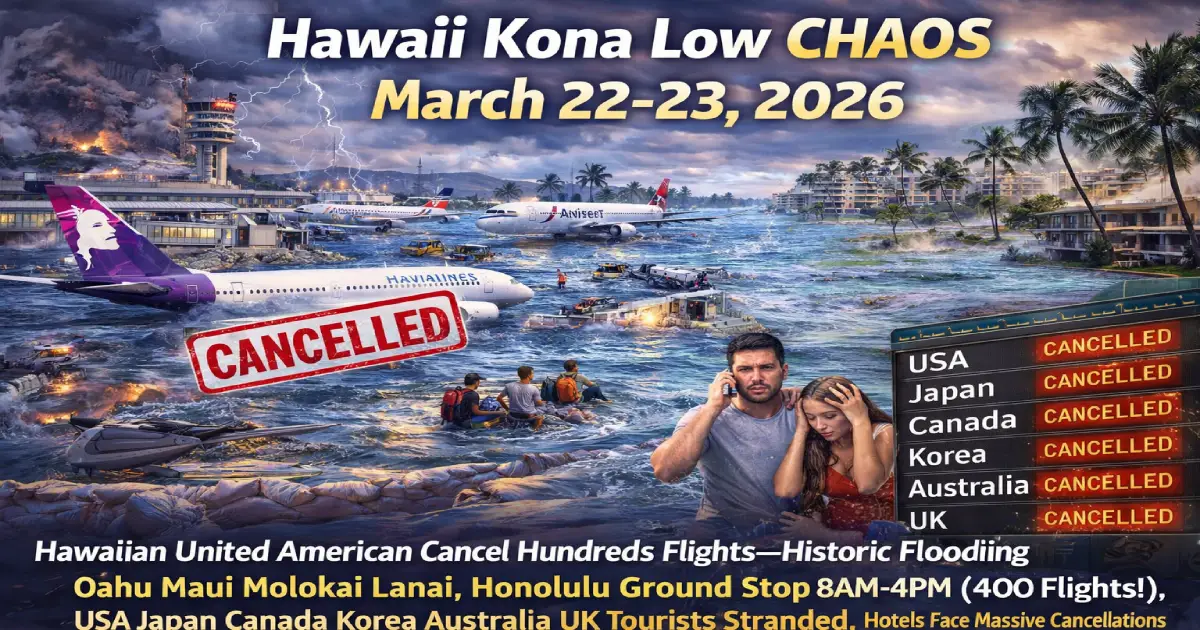
Breaking: Hawaii’s island chain experiences catastrophic natural disaster March 22-23 as a historic Kona Low atmospheric phenomenon—occurring only once per decade—delivers record-breaking rainfall (up to 46 inches in 10 days!), triggering mass evacuations across Oahu, Maui, Molokai, and Lanai, forcing Hawaiian Airlines, United Airlines, and American Airlines to cancel hundreds of flights while Daniel K. Inouye International Airport (Honolulu) implements 8-hour ground stop (8:00 AM – 4:00 PM HST) affecting approximately 400 daily flights. With 15+ inches of rainfall in 24 hours saturating ground conditions, Wahiawa Dam on Oahu’s North Shore faces potential failure prompting mandatory evacuations, while international tourists from USA, Japan, Canada, Korea, Australia, and UK (representing 60% of Hawaii arrivals!) face stranded situations as major hotels including Hilton Hawaiian Village, Four Seasons Resort Maui, Ritz-Carlton experience 40% occupancy drops and massive spring break cancellations. Here’s what every traveler needs to know about this unprecedented natural disaster.
Published: March 22-23, 2026 (Weekend) Event: Historic Kona Low atmospheric phenomenon Rainfall: Up to 46 inches (1,170mm) in 10 days, 15+ inches in 24 hours single-day records! Ground Stop: Honolulu (HNL) 8:00 AM – 4:00 PM HST (8 hours!) = ~400 flights affected Flight Cancellations: Hundreds (Hawaiian, United, American, Southwest, Alaska, Delta) Evacuations: Thousands from Oahu North Shore (Wahiawa Dam), Maui Iao Valley, Molokai, Lanai Hotel Occupancy Drop: 40% in affected regions (Oahu, Maui) Spring Break Impact: Peak March 6-24 travel = worst timing
Weekend of March 22-23, 2026 marks one of Hawaii’s worst natural disasters in decades as a rare Kona Low atmospheric phenomenon—typically occurring once every 10+ years—delivers record-breaking rainfall that triggers flash flooding, landslides, mass evacuations, and complete aviation shutdown across the Hawaiian island chain. Hawaiian Airlines, United Airlines, American Airlines, Southwest Airlines, Alaska Airlines, and Delta Air Lines all cancel hundreds of flights while Honolulu’s Daniel K. Inouye International Airport implements an unprecedented 8-hour ground stop affecting approximately 400 daily passenger flights during peak spring break travel.
Hawaii Kona Low Disruptions (March 22-23):
✈️ Rainfall totals: Up to 46 inches (1,170mm) in 10 days across Maui! ✈️ 24-hour records broken: Honolulu 5.51 inches (140mm), Kahului Maui 7.4 inches (188mm) = highest since 1951/1954! ✈️ Ground stop: Honolulu 8:00 AM – 4:00 PM HST (8 hours!) = ~400 flights affected ✈️ Flight cancellations: Hundreds across Hawaiian, United, American, Southwest, Alaska, Delta ✈️ Islands affected: Oahu, Maui, Molokai, Lanai, Kauai, Big Island (Hawaii Island) ✈️ Evacuations: Thousands from Oahu North Shore, Maui Iao Valley, coastal communities ✈️ Hotel occupancy drop: 40% in Oahu/Maui affected regions ✈️ Power outages: 121,020 customers without electricity at peak (Hawaiian Electric) ✈️ Spring break: Day 17-18 of March 6-24 peak travel = worst timing
Worst Affected Airlines:
✈️ Hawaiian Airlines: Hundreds of cancellations (state’s largest carrier, dominant inter-island!) ✈️ United Airlines: Major cancellations (West Coast → Hawaii routes severed!) ✈️ American Airlines: Significant cancellations (mainland → Hawaii disrupted!) ✈️ Southwest Airlines: Cancellations (West Coast services grounded!) ✈️ Alaska Airlines: Cancellations (Pacific Northwest → Hawaii routes broken!) ✈️ Delta Air Lines: Cancellations (nationwide → Hawaii access delayed!)
Worst Affected International Markets:
✈️ USA mainland: California, Washington, Oregon, Nevada, Arizona = West Coast tourism paralyzed! ✈️ Japan: Tokyo Narita, Osaka Kansai = largest international market stranded! ✈️ Canada: Vancouver, Toronto = Canadian spring break chaos! ✈️ South Korea: Seoul Incheon = Korean tourism market disrupted! ✈️ Australia: Sydney, Melbourne = long-haul Pacific tourism blocked! ✈️ United Kingdom: London Heathrow = ultra-long-haul tourism severed!
Interpretation: This is NOT typical operational delay/cancellation crisis—this is a natural disaster comparable to hurricanes/typhoons that completely shuts down aviation infrastructure + forces mass evacuations + threatens dam failures. The Kona Low atmospheric phenomenon occurs when winds reverse from typical northeast trade winds to southwesterly/westerly patterns, funneling deep tropical moisture across islands and creating unprecedented rainfall totals that saturate ground, trigger landslides, and overwhelm drainage systems.
Kona Low = Decade-Level Natural Disaster Event:
A Kona Low is a rare atmospheric phenomenon that affects Hawaii approximately once every 10+ years, characterized by:
✈️ Wind reversal: Normal northeast trade winds reverse to southwesterly/westerly patterns ✈️ Deep tropical moisture: Warm ocean temperatures + moisture-laden air = extreme rainfall ✈️ Slow-moving system: Storm stalls near Hawaii = prolonged rainfall (10+ days!) ✈️ Record-breaking totals: 40-50+ inches rainfall = far beyond normal Hawaiian storms
Why Kona Lows = Catastrophic:
Normal Hawaii Weather:
Kona Low Weather:
March 2026 Kona Low: Historic Records Broken:
Rainfall Totals (March 10-23, 2026):
✈️ Maui: Up to 46 inches (1,170mm) in 10 days = worst in recent memory! ✈️ Honolulu (Oahu): 5.51 inches (140mm) in 24 hours March 13 = breaks 1951 record (3.3 inches)! ✈️ Kahului Airport (Maui): 7.4 inches (188mm) in 24 hours March 13 = breaks 1954 record (6.4 inches)! ✈️ Multiple locations: 15+ inches in 24 hours = flash flooding inevitable!
Comparison to Historical Events:
Daniel K. Inouye International Airport (HNL)—Hawaii’s busiest aviation hub processing 21+ million passengers annually—implemented an unprecedented 8-hour ground stop March 22 (8:00 AM – 4:00 PM HST), affecting approximately 400 daily passenger flights during peak spring break travel.
Honolulu Ground Stop Details:
✈️ Duration: 8:00 AM – 4:00 PM HST (8 hours!) ✈️ Flights affected: Approximately 400 daily flights (arrivals + departures) ✈️ Passengers affected: Est. 60,000+ (400 flights × 150 passengers average) ✈️ Reason: Extreme rainfall, flooding risk, runway safety, crew positioning issues ✈️ Lifted: 4:00 PM HST, but delays/cancellations continue through March 24
Why 8-Hour Ground Stop = Unprecedented:
Normal Airport Operations:
March 22 Ground Stop:
What Ground Stop Means for Passengers:
Departures:
Arrivals:
Example—Los Angeles Passenger Scenario:
Sarah books Hawaii vacation:
Reality:
Hawaiian Airlines—Hawaii’s largest carrier operating inter-island and transpacific routes—cancelled hundreds of flights March 22-23, representing the most severe operational disruption in the carrier’s modern history outside of hurricanes.
Hawaiian Airlines Crisis:
✈️ Hundreds of cancellations: Inter-island + West Coast routes severed ✈️ Inter-island dominance: Hawaiian operates most Honolulu ↔ Maui/Kauai/Big Island flights ✈️ Transpacific routes: Los Angeles, San Francisco, Seattle, Las Vegas, Phoenix, San Diego = all disrupted ✈️ Passengers stranded: Thousands on islands cannot leave, thousands on mainland cannot arrive
Why Hawaiian Airlines Cancellations = Catastrophic:
Inter-Island Transportation:
Hawaiian Airlines operates the majority of inter-island flights:
When Hawaiian Cancels = Islands Isolated:
Molokai + Lanai = Completely Cut Off:
Example—Molokai Tourist Scenario:
Michael books Molokai eco-tourism:
Reality:
Transpacific Routes Severed:
Hawaiian Airlines operates primary transpacific service:
When Transpacific Routes Cancel = Tourism Paralyzed:
West Coast = Largest Hawaii Tourism Market:
United Airlines, American Airlines, Southwest Airlines, Alaska Airlines, and Delta Air Lines all cancelled significant numbers of Hawaii flights March 22-23, proving the Kona Low natural disaster affected all carriers serving the islands.
Multi-Carrier Cancellations:
✈️ United Airlines: Major West Coast → Hawaii cancellations (San Francisco, Los Angeles, Denver!) ✈️ American Airlines: Mainland → Hawaii disrupted (Dallas-Fort Worth, Phoenix, Los Angeles!) ✈️ Southwest Airlines: West Coast → Hawaii cancelled (Oakland, San Jose, San Diego, Las Vegas!) ✈️ Alaska Airlines: Pacific Northwest → Hawaii severed (Seattle, Portland, Anchorage!) ✈️ Delta Air Lines: Nationwide → Hawaii delayed (Los Angeles, Seattle, Atlanta connections!)
Why Multi-Carrier Cancellations = Complete Tourism Shutdown:
United Airlines = San Francisco Bay Area Market:
American Airlines = Dallas-Fort Worth Connections:
Southwest Airlines = Budget Leisure Travel:
Alaska Airlines = Pacific Northwest Market:
The Kona Low crisis affects international tourists from six key markets representing 60% of all Hawaii arrivals in Q1 2026:
International Markets Affected:
✈️ USA mainland: 50%+ of Hawaii tourism (West Coast, Midwest, Southeast all disrupted!) ✈️ Japan: 15%+ of Hawaii tourism (Tokyo Narita, Osaka Kansai flights cancelled!) ✈️ Canada: 8%+ of Hawaii tourism (Vancouver, Toronto spring break chaos!) ✈️ South Korea: 5%+ of Hawaii tourism (Seoul Incheon flights disrupted!) ✈️ Australia: 3%+ of Hawaii tourism (Sydney, Melbourne long-haul blocked!) ✈️ United Kingdom: 2%+ of Hawaii tourism (London Heathrow ultra-long-haul severed!)
Why International Tourists = Hardest Hit:
Long-Haul Flights = Massive Rebooking Delays:
Japan Example:
Australia Example:
Canada Spring Break Coincidence:
March Break = Concurrent with US Spring Break:
UK Ultra-Long-Haul Crisis:
Hawaii’s hotel and resort industry experiences catastrophic revenue losses as occupancy drops 40%+ in affected regions (Oahu, Maui) with major properties including Hilton Hawaiian Village, Four Seasons Resort Maui, Ritz-Carlton all facing massive spring break cancellations.
Hotel Crisis Statistics:
✈️ Occupancy drop: 40%+ in Oahu/Maui affected regions ✈️ Cancellations: Thousands of spring break reservations forfeited ✈️ Revenue losses: Estimated $50-100+ million across Hawaii hotel industry (March 22-25 alone!) ✈️ Major properties affected: Hilton, Marriott, Hyatt, Four Seasons, Ritz-Carlton, Fairmont
Why 40% Occupancy Drop = Catastrophic:
Normal Hawaii Hotel Operations:
Kona Low Hotel Operations:
Math—Hilton Hawaiian Village Example:
Multiply Across Hawaii Industry:
Major Properties Affected:
Oahu:
Maui:
Why Hotels Offer Flexible Rebooking:
Preserve Future Revenue:
Hotels offer free cancellation/rebooking for March 22-25 to:
The Kona Low flooding triggered mass evacuations affecting thousands of residents + tourists:
Evacuation Zones:
✈️ Oahu North Shore: Wahiawa Dam potential failure = mandatory evacuations (Haleiwa, Waialua!) ✈️ Maui Iao Valley: Flash flooding + landslides = residents evacuated ✈️ Molokai coastal communities: Storm surge + flooding = evacuations ✈️ Lanai low-lying areas: Flooding risk = evacuations
Wahiawa Dam Crisis:
Most Critical Situation:
What Dam Failure Would Mean:
Oahu North Shore = Major Tourist Destination:
When North Shore Evacuates:
Example—Tourist Evacuation:
Carlos books North Shore surfing vacation:
Reality:
If You’re Currently in Hawaii:
If You Have Upcoming Hawaii Trip (March 23-27):
If You’re Stranded:
Short Answer: Operations expected to normalize March 24-25, but full recovery takes weeks.
Timeline:
✈️ March 22-23: ACTIVE NATURAL DISASTER (ground stops, evacuations, cancellations!) ✈️ March 24: Rainfall decline, airports reopen, limited flight operations resume ✈️ March 25: Most flights operating, but delays continue (aircraft/crew repositioning) ✈️ March 26-27: Return to near-normal operations ✈️ Late March: Tourist attractions reopen, roads cleared ✈️ April: Full recovery (hotels, tours, activities all operational)
National Weather Service Forecast:
FAA Projections:
Hotel Recovery:
Wild Cards:
Hawaii’s historic Kona Low natural disaster (March 22-23, 2026) delivers record-breaking rainfall (up to 46 inches in 10 days, 15+ inches in 24 hours!) that triggers mass evacuations across Oahu, Maui, Molokai, and Lanai, forcing Hawaiian Airlines, United Airlines, American Airlines, Southwest Airlines, Alaska Airlines, and Delta Air Lines to cancel hundreds of flights while Daniel K. Inouye International Airport (Honolulu) implements unprecedented 8-hour ground stop (8:00 AM – 4:00 PM HST) affecting approximately 400 daily flights during peak spring break travel. This rare atmospheric phenomenon—occurring approximately once per decade—breaks 75-year rainfall records at Honolulu (1951) and Kahului Maui (1954), proving this is NOT typical operational disruption but rather a catastrophic natural disaster comparable to hurricanes.
The Wahiawa Dam potential failure on Oahu’s North Shore creates life-threatening emergency as mandatory evacuations displace thousands of residents + tourists from popular areas (Haleiwa, Waialua, Turtle Bay Resort), while Maui Iao Valley flash flooding + landslides force additional evacuations. Hawaii’s $20+ billion tourism economy suffers immediate losses as hotel occupancy drops 40% in affected regions (estimated $50-100+ million lost March 22-25 alone!) with major properties including Hilton Hawaiian Village (2,860 rooms), Four Seasons Resort Maui, and Ritz-Carlton all experiencing massive spring break cancellations.
International tourists from USA, Japan, Canada, Korea, Australia, and UK (representing 60% of all Hawaii arrivals!) face catastrophic vacation disruptions: Japanese tourists lose $1,500-3,000+ per person on cancelled long-haul flights + forfeited hotels, Australian travelers forfeit $3,000-6,000+ per person on week-long vacation losses, UK ultra-long-haul passengers waste $5,000-10,000+ per person on 2-week trip cancellations. The inter-island transportation collapse leaves small island communities (Molokai 7,400 population, Lanai 3,100 population) completely isolated as Hawaiian Airlines cancels Honolulu connections + Molokai Ferry suspends service indefinitely.
For travelers: POSTPONE all Hawaii travel through March 24 (active natural disaster!). If currently in Hawaii, shelter in place unless evacuated. Contact airlines for free rebooking (Hawaiian, United, American, Southwest, Alaska, Delta all waiving fees March 22-25). Hotels offering flexible cancellation/rebooking (Hilton, Marriott, Hyatt, Four Seasons). File travel insurance claims IMMEDIATELY (natural disaster = covered if policy purchased before alert!). Monitor emergency.hawaii.gov for evacuation orders. Do NOT drive through flooded areas. Operations expected to normalize March 24-25, but full recovery takes weeks (attractions, roads, tours gradually reopen through late March). This is a once-per-decade natural disaster—not typical flight delays—requiring patience + flexibility + safety-first approach.
Historic Kona Low. 46 inches rainfall. 400 flights grounded. Hundreds cancelled. Wahiawa Dam evacuations. $50-100M hotel losses. 60% international tourism stranded. Decade-level disaster. Hawaii paralyzed.
For More Resources:
Related Articles:
Posted By : Vinay
This article is provided for general informational purposes only and is based on information available at the time of publication. Travel advisories, airline schedules, airport operations, visa requirements, government regulations, and other travel-related information are subject to change without prior notice. While Travel Tourister makes reasonable efforts to verify information using official announcements, government publications, airline and airport communications, and other reliable sources, we cannot guarantee that all information remains complete, accurate, or up to date at all times. Readers should independently verify any information that may affect their travel plans with the relevant airline, airport authority, government agency, embassy, or other official source before making travel, financial, or other decisions. Travel Tourister shall not be liable for any direct or indirect loss, inconvenience, or damages arising from the use of or reliance on the information contained in this article. Nothing in this publication constitutes legal, immigration, financial, or professional travel advice. If you believe any information in this article is inaccurate or outdated, please contact our editorial team. We review all credible correction requests promptly and update our content whenever appropriate.
Lastest News
2nd Floor, 39, Above Kirti Club, DLF Industrial Area, Kirti Nagar, New Delhi, Delhi 110015



Travel Tourister is a leading Travel portal where we introduce travellers to trusted travel agents to make their journey hasselfree, memorable And happy. Travel Tourister is a platform where travellers get Tour packages ,Hotel packages deals through trusted travel companies And hoteliers who are working with us across the world. We always try to find new and more travel agents and hoteliers from every nook and corners across the world so that you could compare the deals with different travel agents and hoteliers and book your tour or hotel with the one you have chosen according to your taste and budget.
Copyright © Travel Tourister, India. All Rights Reserved

 Call
Call Enquiry