Published on : 26 Mar 2026
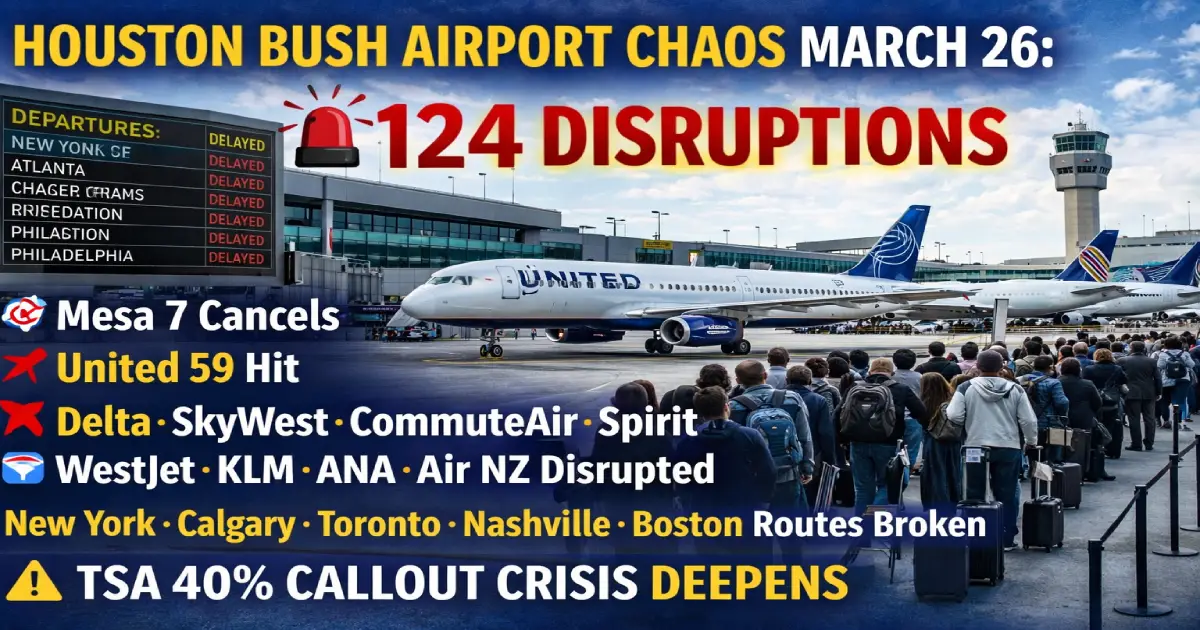
Breaking: Houston George Bush Intercontinental Airport records 110 delays + 14 cancellations TODAY (Thursday March 26, 2026) as a devastating triple crisis — operational failures, TSA staffing collapse (40% callout rate!), and Runway 9/27 closure — devastates Mesa Airlines (7 cancellations + 15 delays — worst cancel count at IAH today!), United Airlines (2 cancellations + 36 delays = 38 total), CommuteAir/United Express (21 delays), SkyWest (14 delays), Delta Air Lines (4 cancellations + 5 delays), Spirit Airlines (1 cancellation + 5 delays) plus WestJet, KLM, Air Canada, All Nippon Airways, Air New Zealand, VivaAerobus, Volaris, PSA Airlines, Avianca El Salvador disrupting flights to New York, Calgary, Toronto, Nashville, Boston and international destinations while TSA wait times averaging 3-4 hours — with security lines spilling outside terminal buildings — leave hundreds of passengers missing flights entirely before even reaching the gate, as Houston Mayor John Whitmire publicly declares the situation “unfortunate” and ICE agents patrol lines passing water bottles instead of screening passengers, creating one of the worst airport experiences in the United States today. Here’s what every IAH traveler needs to know right now.
Published: March 26, 2026 (Thursday) — ONGOING CRISIS Total Disruptions: 110 delays + 14 cancellations = 124 total Crisis Type: TRIPLE THREAT — Flight disruptions + TSA staffing collapse + Runway closure Airlines Affected: Mesa, United, CommuteAir, SkyWest, Delta (primary) + Spirit, WestJet, KLM, ANA, Air NZ, American, Air Canada, VivaAerobus, Volaris, PSA, Avianca TSA Callout Rate: ~40% at IAH — security lines 3-4 hours, spilling outside buildings Runway Status: Runway 9/27 CLOSED — 90-day resurfacing project reducing capacity Terminal B Status: United Terminal B check-in CLOSED — passengers rerouted to Terminal C Passengers Stranded: Hundreds missing flights due to TSA lines alone; more via cancellations Recovery Timeline: TSA crisis has NO immediate resolution — federal shutdown continues
Thursday, March 26, 2026 brings the most complex travel crisis of any US airport today to George Bush Intercontinental Airport (IAH) — United Airlines’ largest Texas hub and one of the busiest aviation gateways in the United States — not because of a single problem but because of three simultaneous crises converging on one airport: 14 flight cancellations and 110 delays (124 total flight disruptions), a 40% TSA officer callout rate driven by the ongoing federal government shutdown creating 3-4 hour security lines that spill outside terminal buildings, and a Runway 9/27 closure for 90-day resurfacing that reduces the airport’s operational buffer, as Mesa Airlines leads the cancellation count (7 flights grounded), United Airlines suffers the highest overall disruption total (38 flights: 2 cancellations + 36 delays), and 15+ carriers including Delta, SkyWest, CommuteAir, Spirit, WestJet, KLM, All Nippon Airways, Air New Zealand, VivaAerobus, Volaris, American Airlines, Air Canada, PSA Airlines, and Avianca El Salvador all record disruptions, hitting routes to New York, Calgary, Toronto, Nashville, and Boston while ICE agents patrol IAH security lines passing out water bottles — a scene Houston Mayor John Whitmire himself has publicly called “unfortunate.”
IAH Disruptions (March 26) — Full Airline Breakdown:
| Airline | Cancellations | Cancel % | Delays | Delay % |
|---|---|---|---|---|
| Mesa Airlines (UAL) | 7 | 3% | 15 | 7% |
| Delta Air Lines | 4 | 8% | 5 | 10% |
| United Airlines | 2 | 0% | 36 | 6% |
| Spirit Airlines | 1 | 3% | 5 | 15% |
| CommuteAir (UAL) | 0 | 0% | 21 | 15% |
| SkyWest Airlines | 0 | 0% | 14 | 13% |
| VivaAerobus | 0 | 0% | 2 | 28% |
| WestJet | 0 | 0% | 2 | 50% |
| American Airlines | 0 | 0% | 3 | 7% |
| Air Canada | 0 | 0% | 1 | 12% |
| KLM | 0 | 0% | 1 | 50% |
| All Nippon Airways | 0 | 0% | 1 | 50% |
| Air New Zealand | 0 | 0% | 1 | 50% |
| PSA Airlines (AAL) | 0 | 0% | 1 | 50% |
| Avianca El Salvador | 0 | 0% | 1 | 50% |
| Volaris | 0 | 0% | 1 | 25% |
| TOTAL | 14 | 110 |
✈️ Total disruptions: 110 delays + 14 cancellations = 124 total ✈️ Cancel leader: Mesa Airlines — 7 cancellations (50% of today’s total cancellations!) ✈️ Overall disruption leader: United Airlines — 38 total (2 cancellations + 36 delays) ✈️ United feeder collapse: CommuteAir adds 21 more delays = United network total 59 flights hit! ✈️ International carriers hit: KLM, ANA, Air New Zealand, WestJet, Air Canada, Avianca, Volaris ✈️ TSA crisis: 40% callout rate — 3-4 hour security lines, passengers missing flights before boarding
Major Destinations Affected:
Domestic:
✈️ New York (LaGuardia, JFK, EWR): Primary Northeast corridor disrupted ✈️ Nashville (BNA): Southern hub connection broken ✈️ Boston (BOS): Northeast business corridor affected ✈️ Chicago O’Hare (ORD): Midwest hub connections disrupted
International:
✈️ Calgary (YYC): Canada cross-border route hit (WestJet!) ✈️ Toronto (YYZ): Canada’s busiest airport connection broken (Air Canada + WestJet!) ✈️ Amsterdam (AMS): KLM flagship trans-Atlantic route disrupted ✈️ Tokyo (NRT/HND): All Nippon Airways Japan route affected ✈️ Auckland (AKL): Air New Zealand Pacific route disrupted ✈️ Mexico/Central America: VivaAerobus, Volaris, Avianca routes hit
Triple Crisis Root Causes:
✈️ CRISIS 1 — Flight disruptions: Mesa/United operational strain, regional carrier fragility ✈️ CRISIS 2 — TSA shutdown: 40% callout rate, 3-4 hour security lines, lanes consolidated ✈️ CRISIS 3 — Runway closure: Runway 9/27 shut for 90-day resurfacing (zero buffer capacity) ✈️ Compounding factor: Terminal B United check-in closed — passengers rerouted to Terminal C ✈️ ICE at IAH: Federal agents patrolling lines but NOT helping with security screening
The Scale That Makes IAH Unique Today:
Unlike other disrupted airports today (ORD, STL), IAH passengers face a situation where you can be stranded even if your flight is operating perfectly — because the 40% TSA callout rate means 3-4 hour security queues are causing passengers to miss flights entirely. This is a crisis both on the airside AND the landside — a combination no other major US airport is experiencing at this intensity today.
Mesa Airlines — operating regional United Express flights at IAH, feeding passengers into United’s mainline network — leads all carriers today with 7 cancellations and 15 delays, making it the single most cancellation-intensive operator at Houston Bush Intercontinental on March 26.
Mesa Airlines at IAH:
✈️ Operator: United Express (contract regional carrier for United Airlines) ✈️ Aircraft: Bombardier CRJ-700 and CRJ-900 regional jets ✈️ Role: Connects smaller US cities and select regional markets into United’s IAH hub ✈️ March 26 impact: 7 cancellations (3%) + 15 delays (7%) = 22 total disruptions
Why Mesa’s 7 Cancellations Hurt Most:
United Express Cascade:
Mesa’s Structural Fragility:
Mesa Airlines has been one of the most operationally strained regional carriers in the US throughout early 2026. The carrier has faced pilot retention challenges, an aging fleet, and thin operational margins — all compounded by the federal shutdown’s impact on airport operations broadly. A 3% cancellation rate and 7% delay rate on a Thursday in late March signals the carrier is operating with minimal buffer against any additional disruption.
Routes Affected:
Mesa’s IAH regional network connects Houston to smaller US cities — including routes to Albuquerque (ABQ), Corpus Christi (CRP), and other secondary markets where Mesa may be the only United Express operator. Passengers in these smaller cities face the starkest rebooking challenge: if Mesa cancels, United may have no alternative regional aircraft to send.
Example — Albuquerque Business Traveler:
Carlos booked Mesa/United Express IAH → Albuquerque:
Mesa Passengers: What To Do:
United Airlines — operating IAH as its largest Texas hub and one of its five primary US hubs — has suffered 2 cancellations and 36 delays in its own mainline operations today. But the true United network disruption at IAH is 59 total flights when you include Mesa United Express (22 disruptions) and CommuteAir United Express (21 delays) — making United’s combined IAH exposure today the most significant of any carrier network at the airport.
United Airlines Full IAH Network (March 26):
✈️ United mainline: 2 cancellations + 36 delays = 38 disruptions ✈️ Mesa United Express: 7 cancellations + 15 delays = 22 disruptions ✈️ CommuteAir United Express: 0 cancellations + 21 delays = 21 disruptions ✈️ United network total at IAH: 9 cancellations + 72 delays = 59 total disruptions
The United Hub Reality at IAH:
United operates approximately 60% of all flights at George Bush Intercontinental Airport. IAH is United’s southern hub — the gateway through which millions of passengers connect to Latin America, the Caribbean, Europe, and Asia. When United’s IAH network (including feeders) records 59 disruptions on a single Thursday, the cascade reaches far beyond Houston.
United’s Hub-and-Spoke Cascade:
Terminal B Check-In Crisis:
United’s Terminal B check-in lobby at IAH has been closed since January 2025 and remains shut until late 2026. All Terminal B passengers must check in at Terminal C and take the Skyway back to Terminal B gates. On a normal day this adds 10-15 minutes. During today’s TSA crisis — with Terminal C security lines running 3-4 hours — this rerouting is creating extraordinary stress for Terminal B passengers who must navigate the closure PLUS the extended security wait.
Example — United Trans-Pacific Passenger:
Priya booked United IAH → Tokyo (NRT) via evening departure:
Delta Air Lines — operating a secondary hub presence at IAH connecting to its Atlanta (ATL) mega-hub — has recorded 4 cancellations and 5 delays today, with a 8% cancellation rate that represents the highest cancellation percentage of any major carrier at IAH on March 26.
Delta Air Lines at IAH:
✈️ Hub role: Secondary presence — Delta flies IAH primarily to Atlanta (ATL) hub connections ✈️ Terminal: Terminal E (international arrivals) + shared domestic terminals ✈️ March 26 impact: 4 cancellations (8%) + 5 delays (10%) = 9 total disruptions ✈️ Key routes: IAH → ATL (primary) + New York, Minneapolis connections via Atlanta
Why Delta’s 8% Cancel Rate Matters:
Delta is known for industry-leading reliability metrics — the airline consistently ranks #1 or #2 among US carriers for on-time performance. A 8% cancellation rate at IAH on a non-weather Thursday is dramatically out of character for Delta, signaling that the triple crisis at IAH (TSA shutdown, runway closure, operational strain) is forcing even the most reliable US carrier into cancellation territory.
The Atlanta Connection Cascade:
Example — Atlanta-Connecting International Traveler:
James booked Delta IAH → ATL → Amsterdam (KLM codeshare):
Two of IAH’s most critical United Express feeders — CommuteAir (21 delays) and SkyWest (14 delays) — are simultaneously experiencing elevated disruption, adding 35 more disruptions to United’s network total and compounding the operational pressure on United’s IAH hub.
CommuteAir (21 Delays — 15% Delay Rate):
✈️ Operator: United Express (contract carrier for United Airlines) ✈️ Aircraft: Embraer ERJ-145 regional jets ✈️ Routes: Smaller US regional cities into IAH United hub ✈️ March 26 impact: 21 delays at 15% rate = significant portion of CommuteAir’s IAH schedule disrupted
CommuteAir’s 15% delay rate at IAH today is not a surprise to industry watchers. The carrier has faced persistent operational challenges throughout early 2026, including crew scheduling pressures amplified by the federal shutdown’s airport disruption effect. With 21 delays, CommuteAir’s IAH passengers face significant connection risk — anyone relying on a CommuteAir regional flight to connect to a United mainline international departure should treat their connection as at serious risk today.
SkyWest (14 Delays — 13% Delay Rate):
✈️ Operator: Delta Connection + United Express (dual operator, like at ORD) ✈️ March 26 impact: 14 delays at 13% rate ✈️ Network impact: SkyWest delays at IAH affect both Delta AND United mainline connections
SkyWest’s dual-carrier operation at IAH means its 14 delays today hit passengers ticketed under both Delta and United — creating disruption confusion where passengers may not know whether to call Delta or United for assistance. The answer: check your ticket — the operating airline (SkyWest) and the ticketing airline (Delta or United) are different; always call the ticketing carrier for rebooking.
Today’s IAH disruptions extend far beyond domestic routes — IAH’s position as a United global gateway means international carriers are caught in the crossfire, with passengers facing broken connections to Amsterdam, Tokyo, Auckland, Calgary, and Toronto.
✈️ Route: Houston IAH ↔ Amsterdam Schiphol (AMS) ✈️ Aircraft: Boeing 787 Dreamliner (trans-Atlantic widebody) ✈️ March 26 impact: 1 delay (50% of KLM’s IAH schedule disrupted) ✈️ Connection risk: AMS hub connects to entire KLM/Air France network across Europe + Africa
Why KLM Matters:
KLM’s IAH → AMS flight is a premium trans-Atlantic service used heavily by business travelers and passengers connecting through Schiphol to destinations across Europe, Africa, and the Middle East. Even a single KLM delay at IAH triggers a cascade — Amsterdam connections to Amsterdam → Nairobi, Amsterdam → Mumbai, Amsterdam → Cairo are all potentially at risk for passengers who built tight layovers into their itineraries.
✈️ Route: Houston IAH ↔ Tokyo (NRT/HND) ✈️ Aircraft: Boeing 787 Dreamliner (trans-Pacific widebody) ✈️ March 26 impact: 1 delay (50% of ANA’s IAH schedule disrupted) ✈️ Connection risk: Tokyo hub connects ANA’s network across Japan + Asia-Pacific
ANA’s IAH → Tokyo flight is one of the most important trans-Pacific services from Texas, serving Houston’s large Japanese business community (energy, petrochemical, trading companies) and passengers connecting to Japan, South Korea, Southeast Asia, and Australia via Tokyo. A delayed ANA departure from IAH cascades into Tokyo arriving late — passengers with ANA domestic connections within Japan to Osaka, Sapporo, or Fukuoka may miss them entirely.
✈️ Route: Houston IAH ↔ Auckland (AKL) — long-haul Pacific route ✈️ March 26 impact: 1 delay (50% of Air NZ’s IAH schedule disrupted) ✈️ Connection risk: Auckland hub connects to New Zealand domestic + Australia trans-Tasman routes
Air New Zealand’s IAH service is a critical long-haul route connecting Houston to New Zealand and the broader Pacific. Any delay on this ultra-long-haul route (16+ hours) is amplified — a 2-hour IAH departure delay means a 2-hour late Auckland arrival, potentially breaking connections to Wellington, Christchurch, or Sydney for passengers on tight itineraries.
✈️ WestJet: 2 delays (50% delay rate) — Calgary (YYC) + Toronto (YYZ) routes ✈️ Air Canada: 1 delay (12% delay rate) — Toronto (YYZ) route ✈️ Routes disrupted: IAH ↔ Calgary + IAH ↔ Toronto (cross-border US-Canada!)
Why Canada Routes Matter:
IAH’s Calgary and Toronto routes serve Houston’s enormous energy sector — oil and gas executives traveling between Texas (the US energy capital) and Alberta (Canada’s oil sands hub) and Ontario (Canada’s financial hub). A WestJet Calgary delay disrupts the Houston → Calgary oilfield executive corridor that drives billions in cross-border energy sector transactions.
Charles Benton, a Toronto passenger quoted by Houston Public Media this week, had already waited an hour in the IAH security line and was facing an additional two-hour wait with his flight departing within the hour — a scenario that perfectly captures the IAH experience today.
The flight disruption numbers — 14 cancellations, 110 delays — tell only half of today’s IAH story. The other half is a security screening crisis that is causing passengers to miss perfectly operational flights simply because the TSA staffing collapse has created 3-4 hour security queues that are physically impossible to navigate in standard airport arrival windows.
The TSA Numbers:
✈️ IAH TSA callout rate: ~40% — four in ten TSA officers not showing up for work ✈️ Federal shutdown context: TSA officers working without pay since February 14 (Day 41 today!) ✈️ Security wait times: 3-4 hours standard lanes; as long as 4 hours early morning ✈️ Lines: Extending outside terminal buildings into non-standard queueing areas ✈️ PreCheck: Consolidated — only available in certain terminals/checkpoints ✈️ CLEAR: Not operating at all checkpoints
The Federal Shutdown Behind the Crisis:
The US federal government partial shutdown — which began February 14, 2026 and continues today (Day 41) — has stripped TSA officers of their paychecks while requiring them to continue working. As of today, 450+ TSA officers have resigned nationally rather than continue working without pay, and Houston’s IAH is experiencing the most acute version of this crisis among major US airports. The 40% callout rate at IAH is more than three times the national average callout rate.
Houston Mayor John Whitmire’s Response:
Houston’s mayor has publicly acknowledged the crisis — calling it “unfortunate” — but made clear that the federal government, not the city, holds responsibility. “We’ve sent every message to Washington to get it resolved,” Whitmire told reporters. “But that’s unfortunately a federal condition.” The mayor’s comments confirm what passengers arriving at IAH today can see with their own eyes: this is not a problem the airport can fix locally.
ICE Agents at IAH — Passing Water, Not Screening:
In a development that captures the surreal nature of today’s IAH situation, ICE agents are now visible at IAH security lines — but they are not performing TSA screening functions. ICE officers have continued receiving pay throughout the shutdown (unlike TSA officers), and their deployment to airports like IAH is a DHS response to the staffing crisis. However, as TSA union leaders have noted: they are not helping with wait times. At IAH, ICE agents have been seen passing water bottles to passengers waiting in hours-long queues — a humanitarian gesture, but not a solution to the 40% staffing shortfall.
Terminal-by-Terminal TSA Status:
✈️ Terminal A: TSA checkpoint OPEN — but reduced lanes ✈️ Terminal C: TSA checkpoint OPEN — primary screening for Terminal B passengers too ✈️ Terminal E: TSA checkpoint OPEN — handles international departures ✈️ Terminal D: No TSA checkpoint — passengers must check bags at D, then go to Terminal E for screening (two-movement process adding 15-20 minutes minimum) ✈️ Terminal B: No independent check-in (closed since Jan 2025) — all check-in at Terminal C
What This Means for Your Airport Math:
On a normal IAH day: Arrive 90 minutes before domestic departure, 2 hours for international.
Today, March 26, IAH: Arrive 3 hours early for domestic, 4 hours early for international — Houston Airports’ own official recommendation. If you arrive at the standard 90 minutes, you are at serious risk of missing your flight even if your plane is ready, boarded, and waiting.
Example — Passenger Who Followed Normal Rules:
Alanna, flying IAH → Providence (Rhode Island):
While TSA chaos and flight cancellations dominate the headlines, a third operational constraint is quietly amplifying IAH’s March 26 crisis — the 90-day closure of Runway 9/27, IAH’s longest runway, for resurfacing and lighting upgrades.
Runway 9/27 — What’s Being Done:
✈️ Runway length: 10,000 feet (approximately 1.5 million square feet of concrete) ✈️ Work: Grinding half-inch off existing surface + retexturing + regrooving for better wet-weather traction ✈️ Lighting: 380 new LED runway lights replacing existing infrastructure ✈️ Closure duration: 90 days — reducing IAH’s runway capacity through the spring travel season ✈️ Why it matters: IAH normally operates with more runway flexibility — reduced capacity means zero buffer
Operational Impact:
On a normal day with full TSA staffing and normal flight operations, losing one runway for 90 days is a manageable constraint at IAH. But combine runway closure with:
…and the runway closure becomes the constraint that removes the airport’s last cushion for absorbing disruption. Airlines cannot run recovery operations as flexibly when runway capacity is reduced — early morning delays cascade harder through the day because the airport’s airfield infrastructure is operating at reduced capacity from the start.
IAH’s March 26 disruptions reach across the United States and into Canada, hitting five of IAH’s most important corridors simultaneously.
Airlines Affected:
Why New York Matters:
Houston → New York is one of the busiest US domestic business corridors — energy executives, finance professionals, and legal firms maintaining both Houston and New York offices depend on reliable IAH → NYC service. With United recording 36 mainline delays and Mesa adding 7 cancellations at IAH today, the Houston-to-New York pipeline is severely compromised.
Airlines Affected:
Why Canada Routes Matter:
The Houston → Calgary route is the US-Canada energy corridor — Texas oilfield executives and Alberta oil sands professionals travelling between the two energy capitals of North America. WestJet’s 50% delay rate today disrupts this high-value business travel corridor. The Toronto route (both WestJet and Air Canada) connects Houston’s international business community to Canada’s financial capital.
Airlines Affected:
Why Nashville Matters:
Nashville has been one of the fastest-growing US domestic markets over the past three years — a booming business hub and major entertainment destination. Houston → Nashville is a high-demand leisure + business route, and disruptions during spring travel season hit both corporate travelers and tourists heading to Music City for weekend visits.
Airlines Affected:
Why Boston Matters:
Houston → Boston is the Texas → Massachusetts academic and biotech corridor — connecting Texas Medical Center professionals to Boston’s world-class research hospitals and universities, and energy companies to Boston’s financial and legal community.
IAH’s March 26 disruptions land at a critical moment for Houston’s economy — the end of spring break travel season, the opening of the Houston Energy Conference calendar (CERAWeek ran March 17-21), and the ongoing recovery of the city’s tourism industry following a difficult early 2026.
Houston and IAH By Numbers:
✈️ IAH annual passengers: ~50 million (making it one of the 10 busiest US airports) ✈️ Houston economy: 4th-largest US city — energy, healthcare, space, logistics hub ✈️ Energy sector: Houston = global energy capital (ExxonMobil, Shell, BP, Chevron all headquartered or major operations here) ✈️ Medical Center: Texas Medical Center = world’s largest medical complex — major travel hub ✈️ Port of Houston: Largest US port by foreign tonnage — heavy international traveler base
March 26 Economic Impact:
Energy Sector:
Texas Medical Center:
Tourism:
Example — International Tourist First Impression:
Hans (Netherlands) flew KLM AMS → IAH to begin a Texas road trip vacation:
Today’s IAH crisis requires different tactics than a normal airport delay situation because the TSA crisis means you can miss a flight even if your aircraft is ready and waiting.
If You Haven’t Left for IAH Yet:
If You’re Currently at IAH:
Regional Carrier Passengers (Mesa, CommuteAir, SkyWest):
International Passengers (KLM, ANA, Air New Zealand, WestJet, Air Canada):
Short Answer — Flight disruptions: Today’s operational picture may ease by evening. Mesa and CommuteAir disruptions are tracking with their recent pattern and should partially resolve as the day progresses.
Short Answer — TSA crisis: There is NO short-term resolution. The federal shutdown continues, TSA officers continue working without pay, and the 40% callout rate at IAH is not improving from day to day. This crisis will persist until Congress resolves the funding lapse or TSA officers reach a breaking point and callout rates climb even higher.
Recovery Timeline:
Thursday March 26 Evening:
Friday March 27:
Looking Further Ahead:
The TSA crisis at IAH has now been running for weeks. The 40% callout rate is the worst of any major US airport. Until the federal shutdown ends and TSA officers receive backpay, Houston travelers face this crisis every single day. Houston Airports is doing what it can with National Deployment Officers (NDOs) — additional TSA personnel sent from other regions — but NDO deployments are temporary and insufficient to fill a 40% staffing hole.
Today’s 124 disruptions fit into a wider March 2026 crisis pattern at IAH that has been escalating throughout the month, driven by the intersection of the TSA shutdown and normal operational challenges.
Recent IAH Disruption History:
March 10, 2026:
March 14, 2026:
March 16, 2026:
March 23, 2026:
March 26, 2026 (TODAY):
Pattern Analysis:
Houston George Bush Intercontinental Airport’s 110 delays + 14 cancellations Thursday March 26, 2026 — 124 total flight disruptions — tell only half the story of today’s IAH crisis, with Mesa Airlines recording the day’s highest cancellation count (7 flights grounded), United’s combined network exposure reaching 59 total disruptions when Mesa Express and CommuteAir are included, Delta recording an unusually high 8% cancellation rate, and international carriers KLM, All Nippon Airways, Air New Zealand, WestJet, and Air Canada all experiencing disruptions on routes to Amsterdam, Tokyo, Auckland, Calgary, and Toronto — while the real crisis is a 40% TSA callout rate creating 3-4 hour security lines that are physically spilling outside terminal buildings, causing passengers like Alanna from Rhode Island to miss perfectly operational flights simply because the security queue is four hours long, as ICE agents pass water bottles to waiting passengers, Houston Mayor John Whitmire publicly blames Washington, and the federal government shutdown enters Day 41 with no resolution in sight — all compounded by Runway 9/27’s 90-day closure reducing IAH’s operational buffer to zero and Terminal B’s check-in closure forcing United passengers to navigate Terminal C’s overwhelmed TSA lanes.
For travelers: If you haven’t left for IAH yet — add 90 minutes to your normal arrival time (minimum 3 hours domestic, 4 hours international — Houston Airports’ official recommendation). Check your terminal’s TSA status before leaving (Terminal D has NO security — proceed to Terminal E for screening). Mesa/CommuteAir/SkyWest passengers — call United (1-800-864-8331) for all rebooking. Delta cancellation? Call Delta (1-800-221-1212) directly. International passengers on KLM, ANA, Air NZ — call your airline immediately; same-day alternatives are extremely limited. If you miss your flight due to the TSA queue — airlines are not legally required to rebook you, but ask anyway given the well-publicized crisis. Document the line length with photos for travel insurance. The TSA crisis has NO quick resolution — every IAH departure until the federal shutdown ends carries this risk.
14 cancellations. 110 delays. 124 disruptions. TSA 40% callout. 4-hour security lines outside the building. ICE agents with water bottles. Runway closed. Terminal B check-in gone. Day 41 of shutdown. Houston’s triple crisis — and Washington has no fix.
For More Resources:
Related Articles:
Posted By : Vinay
This article is provided for general informational purposes only and is based on information available at the time of publication. Travel advisories, airline schedules, airport operations, visa requirements, government regulations, and other travel-related information are subject to change without prior notice. While Travel Tourister makes reasonable efforts to verify information using official announcements, government publications, airline and airport communications, and other reliable sources, we cannot guarantee that all information remains complete, accurate, or up to date at all times. Readers should independently verify any information that may affect their travel plans with the relevant airline, airport authority, government agency, embassy, or other official source before making travel, financial, or other decisions. Travel Tourister shall not be liable for any direct or indirect loss, inconvenience, or damages arising from the use of or reliance on the information contained in this article. Nothing in this publication constitutes legal, immigration, financial, or professional travel advice. If you believe any information in this article is inaccurate or outdated, please contact our editorial team. We review all credible correction requests promptly and update our content whenever appropriate.
Lastest News
2nd Floor, 39, Above Kirti Club, DLF Industrial Area, Kirti Nagar, New Delhi, Delhi 110015



Travel Tourister is a leading Travel portal where we introduce travellers to trusted travel agents to make their journey hasselfree, memorable And happy. Travel Tourister is a platform where travellers get Tour packages ,Hotel packages deals through trusted travel companies And hoteliers who are working with us across the world. We always try to find new and more travel agents and hoteliers from every nook and corners across the world so that you could compare the deals with different travel agents and hoteliers and book your tour or hotel with the one you have chosen according to your taste and budget.
Copyright © Travel Tourister, India. All Rights Reserved

 Call
Call Enquiry