Published on : 28 Sep 2026
By Travel Tourister | Updated Sep 2026
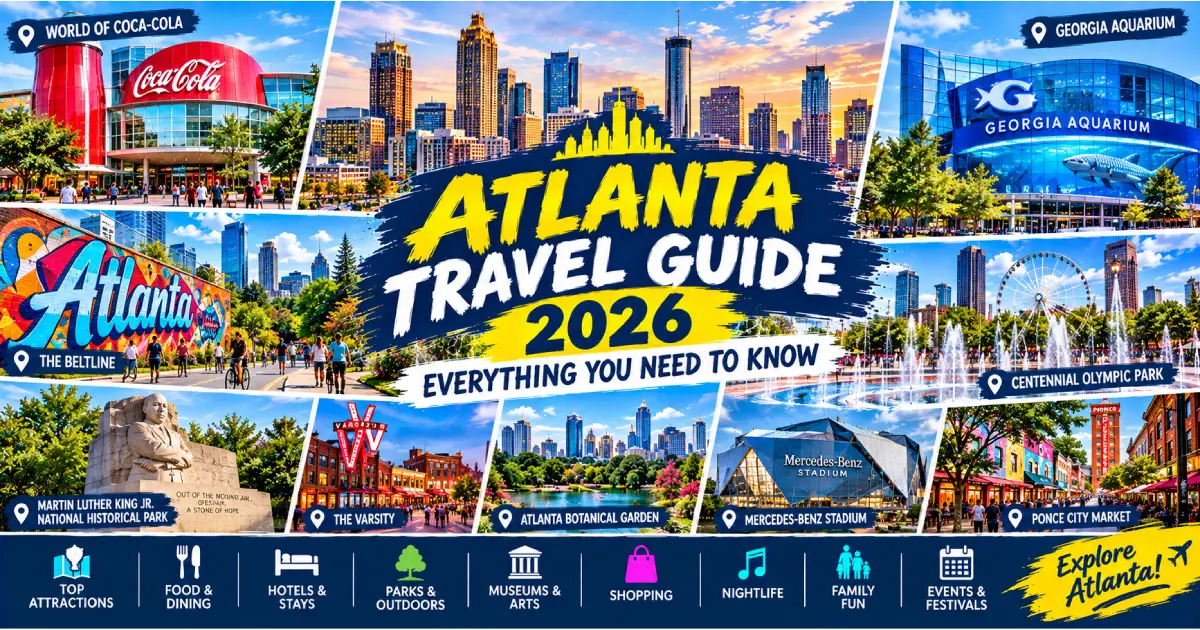
Atlanta is the American city that most consistently rewards the visitor who approaches it without the preconceptions that the standard American city hierarchy imposes. It is not as internationally famous as New York or San Francisco, not as architecturally distinguished as Chicago, not as culinarily specific as New Orleans — but it is the American city with the most specifically profound civil rights heritage (the birthplace and home church of Martin Luther King Jr., the site of the 1996 Summer Olympics, and the headquarters of the civil rights organizations whose specific work transformed American society), the most dramatically improving restaurant scene of any major Southeastern city (the James Beard Award winner Staplehouse, the nationally-recognized cuisine of chef Kevin Gillespie, and the extraordinary Buford Highway food corridor providing the most diverse single food experience in the American South), and the most specifically forward-looking single urban infrastructure investment of any American city (the Atlanta BeltLine — the 22-mile former railroad corridor converted to a multi-use trail and park system that has become the most cited single American urban trail success story of the current generation).
Planning an Atlanta visit in 2026 requires understanding several things that standard travel resources frequently underemphasize: the driving reality (Atlanta is one of America’s most car-dependent major cities — the MARTA rail system covers the airports and the downtown-Midtown-Buckhead corridor but leaves the majority of the city’s most interesting neighborhoods [Virginia-Highland, Little Five Points, Inman Park, Buford Highway] requiring either a car or rideshare), the neighborhood dispersal (Atlanta’s most rewarding experiences are not concentrated in a walkable downtown but distributed across a 20+ neighborhood landscape accessible by car within 20–30 minutes), the heat (the July–August Atlanta heat and humidity creates the most specifically demanding single outdoor-activity period in the American South — the heat index regularly reaching 100–108°F/38–42°C during peak afternoon hours), and the BeltLine (the specific planning value of organizing a multi-day Atlanta visit around the BeltLine trail network, which provides the most efficiently structured single framework for connecting the Old Fourth Ward, Inman Park, Ponce City Market, and Piedmont Park without a car).
This complete Atlanta Travel Guide for 2026 covers everything from getting there and getting around through neighborhood orientation, budget planning, the best seasons, practical advice, and the insider knowledge that transforms an Atlanta visit from a list-checking exercise into a genuinely rewarding experience.
For specific activity and dining guidance, see our Things to Do in Atlanta 2026, Places to Visit in Atlanta 2026, Best Restaurants in Atlanta 2026, and Best Time to Visit Atlanta 2026.
| Category | Details |
|---|---|
| Nickname | The ATL; Hotlanta; the City in a Forest |
| Population | 500,000 (city); 6.2 million (metro) |
| State | Georgia |
| Founded | 1837 (as Terminus, the end of the Western & Atlantic Railroad) |
| Elevation | 1,050 feet (320 meters) — the highest major US East Coast city |
| Airport | Hartsfield-Jackson Atlanta International Airport (ATL) — world’s busiest |
| Airport to downtown | 10 miles south; 25–30 minutes (car/MARTA) |
| Time zone | Eastern Time (ET) — UTC-5 standard; UTC-4 DST |
| Currency | US Dollar (USD) |
| Language | English (primary); Spanish widely spoken in Buford Highway area |
| Best neighborhoods | Old Fourth Ward, Inman Park, Virginia-Highland, Little Five Points, Midtown, Buckhead |
| Best season | March–May (spring) and September–November (fall) |
| Avoid | July–August (extreme heat + humidity) |
| Mid-range hotel | $150–$250/night |
| Car necessary? | Strongly recommended for most visitors |
| Transit | MARTA rail (airports + downtown + Buckhead); rideshare for neighborhoods |
Airport code: ATL | Distance: 10 miles south of downtown | Drive time: 25–40 minutes (traffic-dependent) | Claim to fame: The world’s busiest passenger airport since 1998 | Website: atl.com
Hartsfield-Jackson Atlanta International Airport (ATL) is the world’s busiest passenger airport — processing approximately 104 million annual passengers through the most comprehensively connected single American domestic hub (Delta Air Lines’ primary hub, the specific Delta-ATL relationship providing the most extensive single-carrier domestic network at any American airport, with direct service to virtually every US city of any commercial significance) alongside significant international service (direct routes to London, Amsterdam, Paris, Frankfurt, Tokyo, Seoul, and the various other international destinations that Atlanta’s role as the capital of the American South and the largest single African American majority metropolitan area in the US generates).
Getting from ATL to the city:
MARTA Gold and Red Lines (most recommended): The most cost-effective and most reliable airport transfer — the MARTA rail service from the ATL Airport Station (located directly within the airport’s international terminal, connected by the airport’s underground people mover from all concourses to the baggage claim level) runs every 10–20 minutes to downtown (Peachtree Center, Civic Center), Midtown (Arts Center), and Buckhead (Buckhead Station). Cost: $2.50 one-way. Travel time: 20 minutes to downtown, 30 minutes to Midtown, 40 minutes to Buckhead.
The specific MARTA airport advantage: the most dramatically cost-efficient single major American airport-to-city transfer after New York’s JTA/Subway — the $2.50 MARTA fare vs. the $35–$55 rideshare or the $45–$65 taxi making the MARTA option the most specifically recommended single ATL transfer for visitors staying in the downtown, Midtown, or Buckhead hotel corridors.
Rideshare (Uber/Lyft): $25–$45 (to downtown, standard conditions); $45–$65 (to Midtown/Buckhead); significantly higher during peak Atlanta traffic (the specific I-285/I-85 interchange congestion that adds 20–45 minutes to any rideshare during rush hours). The rideshare pickup at ATL (the designated rideshare staging area outside Domestic Arrivals — follow “Ground Transportation” signage to the rideshare area, separate from the taxi stand) is well-organized and typically provides 5–10 minute pickup waits in standard conditions.
Taxi: $35–$45 fixed-rate to downtown; $45–$55 to Midtown; the most consistent non-surge-susceptible ATL transfer option for visitors who prefer the predictable fixed rate to the rideshare variable pricing.
Rental car: The ATL rental car facility (the ATL Rental Car Center, connected by the ATL’s automated people mover from the main terminal complex) houses all major rental companies. The specific Atlanta rental car consideration: for visitors planning to explore Virginia-Highland, Little Five Points, Buford Highway, Stone Mountain, or any Atlanta attraction beyond the MARTA rail corridor, a rental car is the most specifically useful single Atlanta transport tool. For visitors staying in downtown/Midtown and focusing on the BeltLine, MARTA, and the walking neighborhoods, a car may not be necessary for the urban portion of the visit.
Station: Atlanta Peachtree Station, 1688 Peachtree St NW | Amtrak routes: Crescent (New York–Washington DC–Atlanta–New Orleans — the most specifically Southern-American train journey, the route through the Carolinas and into Georgia providing the most specifically landscape-rich single East Coast Amtrak corridor)
The Crescent (New York Penn Station to New Orleans via Atlanta — the 30-hour New York-to-Atlanta journey, the 8.5-hour Atlanta-to-New Orleans southward continuation making Atlanta the natural mid-point stop for East Coast visitors combining Atlanta and New Orleans on a single Southeastern trip) provides the most specifically relaxed single Atlanta arrival mode for visitors traveling from the Northeast or the Gulf South.
Note: The Atlanta Peachtree Station is in Midtown (not downtown) and is not on the MARTA rail line — taxi or rideshare from Peachtree Station to hotels is the most practical specific transfer.
From Charlotte, NC: I-85 South; 4 hours (245 miles) From Nashville, TN: I-24 South to I-75 South; 4 hours (250 miles) From New Orleans, LA: I-20 West; 7.5 hours (470 miles) From Miami, FL: I-95 North to I-75 North to I-285; 9.5 hours (660 miles) From Washington DC: I-95 South to I-85 South; 10 hours (640 miles) From Chicago, IL: I-65 South to I-24 South to I-75 South; 12 hours (730 miles)
The Atlanta driving reality: The I-285 (the perimeter highway circling Atlanta — the “Perimeter” as Atlantans call it, the 63-mile loop that defines the boundary between intown Atlanta and the suburban communities) and the specific interstate interchanges within the Perimeter (the Spaghetti Junction [the I-285/I-85 interchange whose specific complexity [the 13-level stack of ramps creating the most architecturally complex single road interchange in Georgia] makes it the most distinctively Atlanta single interstate feature) create the most specifically congestion-prone single urban highway environment in the American South. The specific Atlanta rush hour (the 7–9 AM and 4:30–7 PM windows on the primary interstates creating traffic that reduces normal highway speeds to stop-and-go for extended periods) is the single most practically important planning variable for any Atlanta driving visit.
Atlanta’s MARTA rail system (the 4 rail lines [Red and Gold lines running east-west; Blue and Green lines running north-south] with 38 stations covering the downtown, Midtown, Buckhead, and the airport) is the most practically useful single Atlanta public transit for visitors staying in the hotel corridors along the rail lines.
The most visitor-relevant MARTA stations:
| Station | Line | Nearby attractions |
|---|---|---|
| Airport | Red/Gold | ATL Airport arrival/departure |
| Five Points | All four | Downtown center; transfer hub |
| Peachtree Center | Red/Gold | Downtown hotels, Centennial Olympic Park |
| North Avenue | Red/Gold | Georgia Tech, The Varsity |
| Arts Center | Red/Gold | High Museum, Woodruff Arts Center |
| Midtown | Red/Gold | Ponce City Market (15 min walk); Piedmont Park |
| Buckhead | Red/Gold | Atlanta History Center (15 min walk) |
| King Memorial | Blue/Green | MLK National Historical Park (10 min walk) |
| Inman Park/Reynoldstown | Blue/Green | BeltLine Eastside Trail; Krog Street Market |
MARTA fares (2026 approximate):
MARTA limitations: The specific MARTA coverage gap that most significantly affects Atlanta visitors — the system does not serve Virginia-Highland, Little Five Points, the Buford Highway corridor, Stone Mountain, or the majority of Atlanta’s most interesting dining neighborhoods. For these destinations, rideshare is the most practical alternative.
Rideshare is the most practically important single Atlanta transport tool for visitors — the combination of MARTA for the airport and the main hotel corridors and rideshare for the neighborhood restaurants, the BeltLine access points outside the MARTA-served areas, and the Buford Highway food corridor creates the most practical single Atlanta visitor transport strategy.
Typical Atlanta rideshare costs (non-peak):
The peak-hour ATL rideshare reality: The specific Atlanta rush-hour rideshare premium (the 4:30–7 PM weekday window when the I-285 and I-85 congestion drives both the route time and the surge pricing to their maximums) can increase typical rideshare fares by 50–150% during the most congested periods. MARTA is the most specifically recommended single alternative for any airport-to-hotel or downtown-to-Midtown trip during rush hour — the rail’s grade-separated track providing the most traffic-immune single Atlanta transport option.
For visitors staying near the BeltLine corridor (the Old Fourth Ward, Inman Park, Ponce City Market area, or Midtown), the BeltLine Eastside Trail provides the most specifically car-free connection between the key mid-city attractions:
BeltLine Relay Bikeshare: The bikeshare system with docking stations throughout the BeltLine corridor provides the most efficiently mobile single BeltLine transport for covering the 2.25-mile Eastside Trail in a single outing. Cost: approximately $4–$7 for a single trip; day passes available.
Walking the BeltLine: The Eastside Trail walking (the full 2.25 miles from Irwin Street to Piedmont Park, approximately 45 minutes at a comfortable pace without stops) is the single most rewarding car-free Atlanta outdoor experience — the art installations, the neighborhood character visible from the former railroad corridor, and the Ponce City Market midpoint creating a specifically engaging walking circuit.
Character: Business hotels, major attractions, convention center, sports arenas | Best for: First-time visitors basing at major hotels; Centennial Olympic Park; Georgia Aquarium; World of Coca-Cola; CNN Center | MARTA access: Excellent (Peachtree Center, Five Points, Garnett)
Downtown Atlanta is the conventional tourist center — the Georgia Aquarium, the World of Coca-Cola, Centennial Olympic Park, the CNN Center, and the major convention hotels all concentrated within walking distance of the MARTA Peachtree Center station. The specific downtown character: the most specifically tourist-facing and the least specifically local-feeling single Atlanta area, the pedestrian environment improving dramatically in the daytime convention/tourist hours but limited in the evening and weekend residential character. Visitors who base downtown have the best single access to the major attractions but will need rideshare for the neighborhood restaurants and the BeltLine experiences that make Atlanta most specifically rewarding.
Character: Arts, culture, the High Museum, Atlanta Botanical Garden, Piedmont Park, the most walkable Atlanta core | Best for: Culture-focused visitors; the most walkable hotel base; MARTA access to Buckhead and downtown | MARTA access: Excellent (Arts Center, Midtown stations)
Midtown is the most specifically cultural and most specifically walkable single Atlanta neighborhood for visitors — the High Museum, the Atlanta Symphony Orchestra’s Woodruff Arts Center, the Alliance Theatre, the Atlanta Botanical Garden, and Piedmont Park all within walking distance of each other and of the MARTA rail line. The specific Midtown hotel base advantage: the 15-minute walk to Ponce City Market and the BeltLine Eastside Trail (via the 10th Street and Monroe Drive approach) from the core Midtown hotel cluster, the 5-minute walk to Piedmont Park from the northern Midtown hotels, and the direct MARTA connection to the airport (25 minutes southbound) and Buckhead (10 minutes northbound) creating the most transit-efficiently connected single Atlanta hotel base.
Character: The BeltLine’s most active neighborhood; Ponce City Market; the most specifically creative current Atlanta neighborhood | Best for: BeltLine enthusiasts, food-forward visitors, the most specifically up-to-the-moment Atlanta character | MARTA access: Limited (Edgewood/Candler Park station 15 min walk)
The Old Fourth Ward (the neighborhood east of Downtown and south of Virginia-Highland — the historic Black neighborhood [the birthplace and childhood neighborhood of Martin Luther King Jr., whose boyhood home at 501 Auburn Ave is in the OFW] that has been most dramatically transformed by the BeltLine, the Ponce City Market redevelopment, and the specific creative-class influx that the BeltLine corridor has generated) provides the most specifically forward-looking single Atlanta neighborhood experience: the BeltLine Eastside Trail through the OFW, the Ponce City Market as the neighborhood’s most comprehensively programmed commercial node, and the restaurants along Edgewood Avenue and Randolph Street (the most specifically restaurant-innovative single Atlanta neighborhood street outside of the Midtown and Buckhead corridors) together creating the most specifically current-Atlanta-character single neighborhood.
Character: Victorian residential architecture, BeltLine access, Krog Street Market | Best for: Architecture enthusiasts, BeltLine connections, neighborhood-character Atlanta experience | MARTA access: Good (Inman Park/Reynoldstown station)
Inman Park (Frederick Law Olmsted-influenced 1889 planned suburb — the most specifically Victorian residential neighborhood in Atlanta, the curved streets and the surviving Queen Anne and Craftsman houses providing the most architecturally distinguished single Atlanta residential neighborhood) is the most specifically historically-residential-character Atlanta neighborhood accessible from the BeltLine: the Krog Street Market at the neighborhood’s southern edge, the Krog Street Tunnel (the most specifically muraled single Atlanta underpass, the constantly-updated street art providing the most dynamically changing single Atlanta art installation), and the BeltLine Eastside Trail access providing the direct connection to Ponce City Market and Piedmont Park.
Character: The most walkable Atlanta neighborhood; independent restaurants, bungalows, evening social culture | Best for: Visitors who want the most European-feeling single Atlanta commercial street; food enthusiasts | MARTA access: None (rideshare required)
Virginia-Highland (the northeast Atlanta neighborhood — the most specifically walkable single Atlanta commercial neighborhood, the 1920s–1930s commercial building scale [the one-and-two-story storefront buildings maintaining the pedestrian scale that most Atlanta commercial corridors have abandoned], the independent businesses [Alon’s Bakery, the Highland Tap, the various Virginia-Highland restaurants], and the residential character [the surrounding bungalow and Craftsman houses]) provides the most specifically pleasant single Atlanta evening walk: the Highland Avenue restaurants active from 5 PM through 11 PM, the specific Virginia-Highland bar culture (the most specifically neighborhood-community single Atlanta bar scene), and the residential streets providing the most livable single Atlanta neighborhood visual.
Character: Atlanta’s most specifically alternative neighborhood; vintage, independent, counter-cultural | Best for: Alternative culture enthusiasts, vintage shopping, the most specifically non-mainstream Atlanta character | MARTA access: None (rideshare or BeltLine from adjacent Inman Park)
Little Five Points (the Moreland-Euclid commercial triangle — the most specifically alternative single Atlanta neighborhood, the vintage clothing, the independent record stores, the tattoo culture, and the specific L5P street character providing the most specifically non-mainstream single Atlanta commercial experience) is the neighborhood most specifically beloved by Atlanta’s creative community and most specifically surprising to visitors who arrive expecting a Southern American city to be uniformly conventional. The specific L5P character (the Criminal Records independent record shop, the Stefan’s vintage clothing, and the various other L5P independents) is most specifically rewarding for visitors who specifically seek the counter-cultural Atlanta that the tourism marketing rarely features.
Character: Atlanta’s upscale district; luxury shopping, fine dining, Atlanta History Center | Best for: Luxury shopping, fine dining, the Atlanta History Center (and Swan House) | MARTA access: Good (Buckhead station)
Buckhead (the affluent northern Atlanta neighborhood — the luxury retail [Phipps Plaza, Lenox Square, and the Buckhead Village commercial development housing the most concentrated single luxury retail environment in the American South], the fine dining [Aria, Bones, and the various other Buckhead fine dining restaurants maintaining the most prestigious single Atlanta restaurant address zone], and the Atlanta History Center [the 33-acre campus housing the most comprehensively documented single Georgia history collection and the Swan House]) provides the most specifically affluent-character single Atlanta neighborhood experience.
| Type | Cost Per Night | Best Areas |
|---|---|---|
| Budget hostel (dorm) | $35–$55 | Downtown and Midtown options |
| Budget hotel | $80–$120 | Airport corridor; requires MARTA or car |
| Mid-range hotel | $150–$250 | Downtown, Midtown, Buckhead |
| Boutique hotel | $180–$300 | Inman Park, Old Fourth Ward, Midtown |
| Luxury hotel | $300–$600+ | Four Seasons Midtown, Waldorf Astoria Buckhead |
| Vacation rental | $100–$250 | Virginia-Highland, Inman Park, Old Fourth Ward |
| Category | Cost Per Person | Examples |
|---|---|---|
| Buford Highway restaurant | $10–$20 | Pho, Korean BBQ, Vietnamese |
| Sweet Auburn Market | $8–$15 | Southern fast-casual |
| The Varsity | $8–$15 | Chili dogs, rings |
| Food hall (Ponce City Market, Krog) | $12–$25 | Various |
| Casual neighborhood restaurant | $20–$40 | Virginia-Highland, Inman Park spots |
| Mid-range restaurant | $40–$70 | Staplehouse, The Lawrence, Empire State South |
| Fine dining | $70–$150+ | Staplehouse, Atlas, Aria |
| Activity | Cost |
|---|---|
| MLK National Historical Park | Free |
| Georgia Aquarium | $40–$55 |
| National Center for Civil and Human Rights | $20 |
| High Museum of Art | $22 |
| World of Coca-Cola | $20 |
| Atlanta History Center | $21 |
| Atlanta Botanical Garden | $23 |
| Jimmy Carter Presidential Library | $10 |
| Fox Theatre tour | $20 |
| BeltLine walk/cycling | Free |
| Piedmont Park | Free |
| Oakland Cemetery | Free |
Budget ($80–$120/day/person):
Mid-Range ($160–$240/day/person):
Luxury ($350–$600+/day/person):
| Season | Temperatures | Key Characteristic |
|---|---|---|
| Spring (March–May) | 65–78°F/18–26°C | Most pleasant; azaleas bloom in March–April |
| Summer (June–August) | 88–92°F/31–33°C | Hot and humid; heat index 100–108°F |
| Fall (September–November) | 65–80°F/18–27°C | Excellent; best overall season |
| Winter (December–February) | 50–58°F/10–14°C | Mild by Northern standards; occasional ice |
The Atlanta summer heat reality: The most important single Atlanta practical planning consideration — the July–August heat index (the specific combination of the 90°F/32°C temperature and the 70–80% relative humidity creating felt temperatures of 100–110°F/38–43°C in the peak afternoon hours [2–5 PM]) creates the most specifically demanding single outdoor-activity period in the American South. The outdoor activities (BeltLine, Piedmont Park, the MLK National Historical Park walking) are most specifically rewarding when scheduled before 10 AM or after 6 PM; the midday window (11 AM–4 PM) is most specifically appropriate for indoor activities (the Georgia Aquarium, the National Center for Civil and Human Rights, the High Museum).
The “City in a Forest” moderating factor: Atlanta’s specific tree canopy (the most extensive single urban tree canopy in any major American city — the approximately 50% tree canopy cover creating the specific “City in a Forest” visual character visible from any aerial view of Atlanta) provides meaningful temperature moderation relative to less-treed American cities at equivalent temperature — the specific shade available on Atlanta’s tree-lined streets and in Piedmont Park making the summer outdoor experience more tolerable than the heat index statistics suggest for street-level walking.
Atlanta is a safe destination for tourists in the neighborhoods and areas covered in this guide — the civil rights historic sites, the Midtown cultural institutions, the BeltLine trail, the Georgia Aquarium, and the specific neighborhood restaurants of Virginia-Highland, Inman Park, and Little Five Points all maintain safe visitor environments throughout the standard tourism hours.
Practical considerations:
**Be aware of driving:**The specific Atlanta traffic complexity (the I-285 and I-85 interchange congestion, the unfamiliar street grid in the less-mapped neighborhoods, and the specific GPS navigation challenges in the BeltLine-adjacent area where the formerly industrial zones have seen rapid recent development) requires specific attention — never navigate while driving, use voice-guided GPS, and allow extra time for any Atlanta driving day.
Downtown after business hours: The specific downtown Atlanta character (the convention hotel concentration and the major attraction adjacency creating a bustling daytime environment that quiets significantly after 8 PM on non-event evenings) means that evening dining and entertainment in downtown is more limited than the hotel density suggests — Virginia-Highland, Inman Park, and Midtown provide more specifically active evening restaurant and bar environments.
Buford Highway food corridor: The most specifically “look both ways” single Atlanta pedestrian caution — the Buford Highway commercial strip is designed for car traffic, and the pedestrian infrastructure (sidewalks, crosswalks, and pedestrian signals) is more limited than in the intown neighborhoods. Parking in the specific restaurant lot and walking within the immediate restaurant cluster is the most practically safe single Buford Highway navigation strategy.
Standard US tipping applies throughout Atlanta:
Day 1 — Civil Rights and Downtown: Morning: MLK National Historical Park (Birth Home 9 AM tour — book in advance), Ebenezer Baptist Church, Sweet Auburn Avenue walk Midday: National Center for Civil and Human Rights (the lunch counter simulation is the emotional centerpiece of the visit — allow time for recovery) Afternoon: Centennial Olympic Park → World of Coca-Cola (1.5 hours) Evening: Georgia Aquarium (the 5–8 PM evening window is the least crowded single aquarium time slot)
Day 2 — BeltLine and Neighborhoods: Morning: Ponce City Market breakfast → BeltLine Eastside Trail south (cycle or walk from Ponce City Market to Krog Street Market) Midday: Krog Street Market lunch Afternoon: Inman Park Victorian walking tour → Little Five Points browse Evening: Virginia-Highland dinner (Alon’s pastries, then one of the Highland Avenue restaurants)
Day 3 — Midtown Culture: Morning: Atlanta Botanical Garden (the canopy walk before the midday heat) Midday: High Museum of Art (the most rewarding single midday Atlanta activity — the air conditioning and the collection quality making the High the most specifically pleasant single Atlanta summer afternoon destination) Afternoon: Piedmont Park (evening, when the heat has moderated) Evening: Midtown restaurant (Empire State South, The Lawrence, or the various Midtown options)
Days 1–3 as above, plus:
Day 4 — History and Buckhead: Morning: Atlanta History Center (the museum) and Swan House (garden tour) Afternoon: Buckhead shopping (Phipps Plaza, Lenox Square) or the Fox Theatre tour Evening: Buckhead fine dining (Aria or Bones)
Day 5 — Buford Highway Food Day or Day Trip: Option A: Full Buford Highway food exploration (Vietnamese pho breakfast, Korean BBQ lunch, a Buford Highway Farmers Market browse) Option B: Stone Mountain State Park day trip (20 miles east — the granite monadnock visible from throughout Atlanta, the Summit Skyride, and the Confederate Memorial carving [the most controversial single Georgia outdoor monument] providing the most specifically Atlanta-regional day trip experience)
About Travel Tourister Travel Tourister’s destination specialists have visited Atlanta across multiple seasons and from every visitor perspective — arriving via MARTA from ATL to the Five Points station and navigating the first rideshare to Virginia-Highland, calculating the MARTA King Memorial station walk to the MLK Birth Home for the advance-booked timed entry, surviving the National Center for Civil and Human Rights lunch counter simulation with hands-on-counter longer than consciously intended, watching whale sharks at the Georgia Aquarium from the Ocean Voyager tunnel at 9 AM before the school groups arrive, cycling the BeltLine Eastside Trail from Irwin Street to Piedmont Park on a relay bike with a Ponce City Market lunch midway, eating Buford Highway pho at Pho Dai Loi as the only non-Vietnamese table in the restaurant, exploring the Inman Park Victorian walking tour with a Fox Theatre architectural tour to follow, and eating the Varsity chili dog with the “What’ll ya have?” ritual on a Georgia Tech football Saturday — to deliver the most practically calibrated and most honestly useful Atlanta travel guide for every type of 2026 visitor.
Posted By : Vinay
Latest Article
2nd Floor, 39, Above Kirti Club, DLF Industrial Area, Kirti Nagar, New Delhi, Delhi 110015



Travel Tourister is a leading Travel portal where we introduce travellers to trusted travel agents to make their journey hasselfree, memorable And happy. Travel Tourister is a platform where travellers get Tour packages ,Hotel packages deals through trusted travel companies And hoteliers who are working with us across the world. We always try to find new and more travel agents and hoteliers from every nook and corners across the world so that you could compare the deals with different travel agents and hoteliers and book your tour or hotel with the one you have chosen according to your taste and budget.
Copyright © Travel Tourister, India. All Rights Reserved

 Call
Call Enquiry