Published on : 11 Aug 2026
By Travel Tourister | Updated Aug 2026
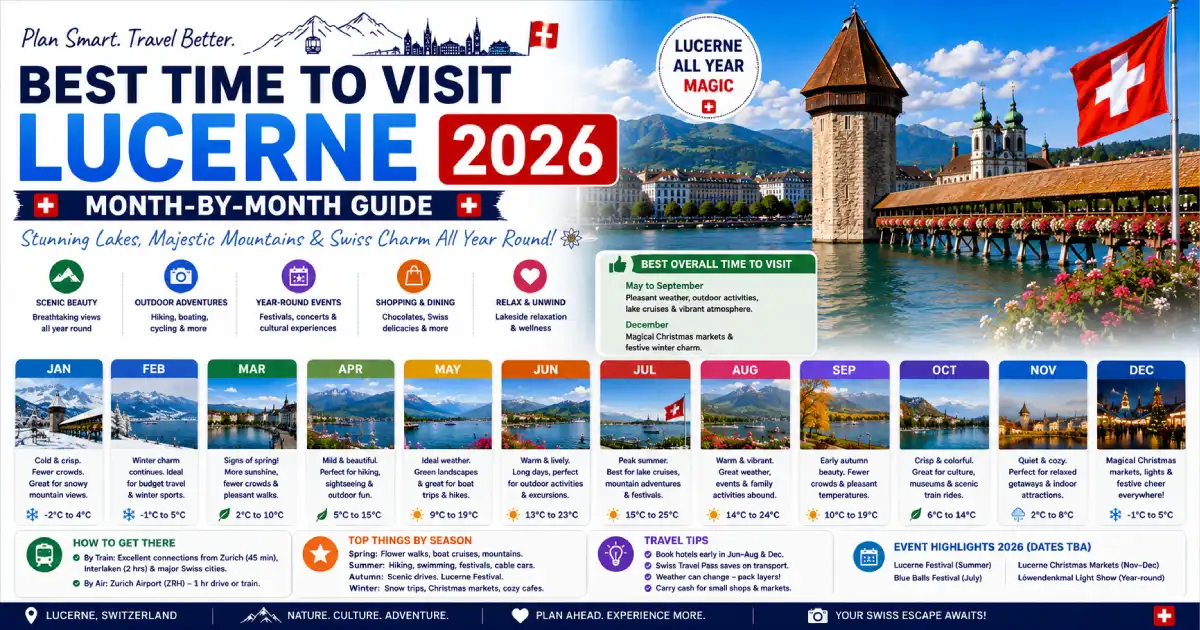
Lucerne operates as a genuinely year-round destination — the Chapel Bridge, the Lion Monument, the Old Town’s painted facades, the Rosengart Collection’s Picasso and Klee, and the lake are all accessible and rewarding in every month of the year, with the weather, crowd levels, mountain accessibility, and specific events determining which version of Lucerne any particular visit experiences rather than whether the city is worth visiting at all. The best time to visit Lucerne depends primarily on what you’re prioritizing: the Pilatus Golden Round Trip (the world’s steepest rack railway operating only May–November), the Rigi Rack Railway (year-round but best in clear conditions), the SGV lake steamers (year-round but full fleet and schedule only May–October), the Lucerne Festival (late August through September), the Luzerner Fasnacht carnival (February), or simply the best combination of comfortable weather, reasonable pricing, and manageable crowd levels for a first-time visit.
What makes Lucerne’s seasonal planning specifically interesting is the mountain dimension — unlike purely urban Swiss destinations (Zurich, Bern, Basel) where seasonal variation affects primarily weather and crowd levels rather than activity availability, Lucerne’s mountain excursion infrastructure creates genuine seasonal access windows: the Pilatus-Bahn rack railway (operating May–November only), the Stanserhorn CabriO open-top cable car (May–October), and the full SGV lake steamer fleet with all stops (May–October) are all seasonally restricted. A January visit to Lucerne is genuinely excellent for city exploration, Old Town photography, and the Rosengart Collection — but the Pilatus rack railway ascent that many visitors specifically come for requires returning in a different season. Understanding these infrastructure limitations before booking 2026 Lucerne dates is the foundational planning step.
For specific Lucerne recommendations, see our Best Places to Visit in Lucerne 2026, Things to Do in Lucerne 2026, Best Restaurants in Lucerne 2026, and Best Places to Visit in Switzerland 2026 guides.
| Month | Avg High/Low (°C) | Avg High/Low (°F) | Crowd Level | Hotel Prices | Best For |
|---|---|---|---|---|---|
| January | 3°C / -2°C | 37°F / 28°F | Low | $ | Budget, quiet city, Fasnacht prep |
| February | 5°C / -1°C | 41°F / 30°F | Low–Medium | –– $ | Fasnacht Carnival, budget, quiet |
| March | 10°C / 3°C | 50°F / 37°F | Low–Medium | $$ | Spring beginning, quieter Old Town |
| April | 15°C / 6°C | 59°F / 43°F | Medium | $$ | Pilatus/Rigi opening, spring flowers |
| May | 19°C / 10°C | 66°F / 50°F | Medium | $$$ | Full mountain season opens, wildflowers |
| June | 23°C / 14°C | 73°F / 57°F | Medium–High | $$$ | Swimming begins, mountain railways peak |
| July | 26°C / 16°C | 79°F / 61°F | Very High | $$$$ | Peak season, Lido swimming, maximum crowds |
| August | 25°C / 15°C | 77°F / 59°F | Very High | $$$$ | Lucerne Festival (late Aug), lake swimming |
| September | 20°C / 12°C | 68°F / 54°F | High (Festival week) | $$$ | Lucerne Festival, ideal weather, reduced crowds |
| October | 14°C / 7°C | 57°F / 45°F | Medium | $$ | Autumn colour, shoulder pricing, cozy |
| November | 7°C / 2°C | 45°F / 36°F | Low | $ | Quietest month, budget, city focus |
| December | 3°C / -1°C | 37°F / 30°F | Medium–High | –$ | Christmas markets, Fasnacht prep begins |
Avg Temp: 10°C / 50°F | Mountain access: Rigi open year-round; Pilatus aerial gondola open (rack railway closed until May) | Crowds: Low–Medium | Hotel Prices: $$
March in Lucerne brings the city’s first genuine spring signals — the Old Town’s lime trees beginning to bud, the lakefront promenade increasingly hospitable for afternoon walks (temperatures reaching 12–15°C on warmer March afternoons), and the first mountain excursion season beginning cautiously with the Rigi rack railway (operating year-round) and the Pilatus aerial gondola (from Kriens — the alternative Pilatus access when the rack railway is closed). The Pilatus Bahn rack railway (the world’s steepest, the more dramatic of the two Pilatus ascent options) doesn’t open until May — March visitors wanting the full Pilatus experience need to use the aerial gondola route, which provides excellent summit access but without the specific rack railway drama.
Hotel prices in March remain at winter’s low-to-moderate levels — a meaningful discount compared to the summer peak that July and August produce, particularly for the Old Town-adjacent properties where summer premiums are most significant. March is one of Lucerne’s better value months for visitors whose priorities are the city’s cultural content (Rosengart Collection, Chapel Bridge, Old Town, Lion Monument) rather than the mountain excursion infrastructure whose full season hasn’t yet opened.
What to do: Old Town exploration (the first spring light on the Chapel Bridge’s flower boxes, the painted facades in the morning sun, and the relative quiet of March weekdays provides the most contemplative version of the Old Town walk available between the February Fasnacht energy and April’s increasing tourist activation), the Rosengart Collection (Picasso and Klee without weekend crowding), and the Rigi rack railway for visitors specifically wanting a mountain experience within the March limitations.
Insider tip: Late March specifically (the final week before April’s tourist activation begins) provides Lucerne’s finest “between seasons” visiting opportunity — the city’s spring character is clearly established (warmth, lengthening days, first outdoor café seating appearing on the Old Town squares) while visitor numbers haven’t yet begun the April–May upswing. This specific window often produces Lucerne’s most photographic combination of spring light with empty lanes.
Avg Temp: 15°C / 59°F | Mountain access: Rigi open; Pilatus aerial gondola open; Pilatus rack railway closed until May | Crowds: Medium | Hotel Prices: $$
April activates Lucerne’s spring season visibly — the lakefront parks (the Ufschötti park, the Schweizerhofquai, and the lakefront promenades) reach their ornamental bloom peak in mid-to-late April, the lake itself begins reflecting the snow-dusted pre-Alpine peaks in conditions of specific visual clarity (spring’s air quality before summer haze develops), and the tourist infrastructure begins transitioning from winter quiet toward summer activation. The Pilatus rack railway’s May opening is the seasonal event most significant for mountain-focused visitors — April remains the last month before the full Pilatus experience becomes available, making late April the boundary between reduced and complete Lucerne mountain access.
The Easter holiday period (date varies, typically falling in April) brings a noticeable visitor uptick — primarily European families whose school holidays create short-break demand for Lucerne’s accessible Swiss heritage experience. Hotel prices during Easter weekend specifically rise above April’s general shoulder rates; the surrounding weekdays maintain moderate pricing.
What to do: April rewards the visitor who specifically wants spring Lucerne’s visual character — the Chapel Bridge with its first seasonal flower boxes in place (the flowers planted on the bridge railing when weather allows, typically April), the Lion Monument in the specific morning light of April’s longer days, and the Old Town squares where the outdoor café seating begins appearing on warmer afternoons. The Rigi (year-round accessible) provides the spring mountain experience for April visitors who want altitude perspective on the lake-and-city landscape before summer crowds arrive.
Insider tip: The Kapellbrücke flower boxes (the geraniums and other seasonal plants installed on the bridge’s railing each spring — a tradition maintained throughout the bridge’s history) are replanted each April, creating a transitional period when some boxes are freshly planted (not yet fully established) and others display their mature growth. Visiting specifically in late April rather than early April provides the most complete flower-box display before the summer’s full bloom peak in June–July.
Avg Temp: 19°C / 66°F | Mountain access: Full mountain season — Pilatus rack railway opens mid-to-late May; all Rigi services; Stanserhorn CabriO opens | Crowds: Medium | Hotel Prices: $$$
May is Lucerne’s most balanced visiting month — the Pilatus Bahn rack railway (typically opening in mid-to-late May once the summit snowpack allows safe operation — check pilatus.ch for the specific 2026 opening date) activates the full Pilatus Golden Round Trip that many visitors specifically come for, the complete SGV lake steamer fleet and all stops are operational, the Stanserhorn CabriO open-top cable car opens for the season, and the city’s hiking trail network above 1,000 meters begins clearing of snow. All of this full-season activity occurs before the July–August crowd and pricing peaks — May provides the complete Lucerne experience at prices noticeably below summer’s ceiling.
The Lake Lucerne May character (the lake reflecting the last spring snow on the surrounding pre-Alpine peaks before summer warmth melts the lower elevations, the wildflower display beginning on the hillsides above the lake, and the specific May light quality that precedes summer haze) creates photographic conditions specifically valued by visitors who’ve researched Lucerne’s seasonal character. The Pilatus rack railway’s first operating weeks (mid-to-late May) occasionally provide the specific visual pleasure of the rack railway ascending through snow at the higher stations while spring warmth prevails at the lake below — a specifically Swiss seasonal juxtaposition available only in the opening weeks.
What to do: The complete Lucerne activity program opens in May — the Pilatus Golden Round Trip, the full SGV steamer circuit, the Stanserhorn CabriO, and the city’s complete cultural and restaurant infrastructure all operating simultaneously with pre-peak crowd levels and pre-peak pricing. May represents the best combination of access and value available in Lucerne’s annual calendar for visitors whose priority is the mountain excursion experience alongside the Old Town.
Insider tip: The Pilatus rack railway’s specific opening date varies year to year based on snow conditions — the pilatus.ch website announces the opening several weeks ahead once the summit conditions are assessed. Visitors specifically targeting the rack railway experience and traveling in May should check the opening date before finalizing travel dates, and have the Pilatus aerial gondola (from Kriens, open year-round) as an alternative plan if dates don’t align with the rack railway’s opening.
Avg Temp: 23°C / 73°F | Mountain access: Full | Crowds: Medium–High | Hotel Prices: $$$
June marks Lucerne’s transition into full summer — Lake Lucerne warming to temperatures that make the Lido Lucerne’s swimming genuinely pleasant (approximately 18–20°C by late June), the Pilatus rack railway and Stanserhorn CabriO in full operation, the SGV paddle steamers running their complete summer schedules, and the city’s outdoor restaurant infrastructure (the lakefront terraces, the Old Town square cafés) at full capacity in conditions that are warm without July–August’s occasional oppressive heat. The mountain panoramas benefit from June’s pre-haze clarity — the early summer air quality produces the sharpest Alpine views from the Rigi and Pilatus summits before July–August’s heat occasionally builds haze over the lower lake valleys.
June hotel prices represent summer’s beginning — above May’s shoulder rates but not yet at the July–August absolute peak, with some availability at preferred Old Town properties still achievable with 6–8 weeks’ advance notice rather than the 3–5 months July–August requires.
What to do: The complete June Lucerne program — Pilatus Golden Round Trip in June’s clear early-summer air, the first Lido lake swimming (water warming through the month), Old Town photography in the flower-box season (the Chapel Bridge’s geraniums and other plantings at their mid-season fullness), and the SGV paddlesteamer routes at full summer schedule. The Pre-Festival programming (some Lucerne Festival satellite events begin in June) adds cultural programming to the summer activity mix.
Insider tip: June’s mountain visibility (the clearest of the summer months, before July–August’s heat haze develops over the lowlands) makes it specifically the optimal month for the Pilatus and Rigi summit experiences — the panoramas from both summits in clear June conditions typically include the Bernese Alps in sharper definition than the same views in July or August. Prioritizing the mountain excursions for the clearest-forecast June days (checking mountain-specific webcams on pilatus.ch and rigi.ch the day before) maximizes the panoramic payoff.
Avg Temp: 26°C / 79°F | Mountain access: Full | Crowds: Very High | Hotel Prices: $$$$
July is Lucerne at its summer peak — the city’s visitor infrastructure at maximum capacity, the Lido’s lake water at its warmest (22–24°C, genuinely comfortable for extended swimming), the Chapel Bridge at its most photographed (and most crowded), and the SGV steamer fleet at its busiest. The specific July Lucerne experience — lake swimming, outdoor dining on the lakefront terraces, the evening promenade along the Schweizerhofquai with Mount Pilatus lit in the last evening light — is genuinely extraordinary and specifically not available in any other month. The practical tradeoffs (hotel prices at their annual peak, the Chapel Bridge requiring early-morning visits to avoid crowds, the Pilatus rack railway’s queue potentially extending to 30+ minutes at the base station) are real but manageable with appropriate planning.
The Asian market (Chinese, Japanese, Korean, and Indian tourist groups) is most concentrated in July–August, making Lucerne’s most internationally-diverse visitor population of the year simultaneously its most crowded. The Pilatus and Rigi excursions specifically attract large Asian tour groups — understanding this concentration (and planning accordingly, with first-train morning departures minimizing queue impact) allows managing the experience.
What to do: July’s Lake Lucerne character is the primary recommendation — the Lido swimming, the evening lakefront walk (sunset behind Mount Pilatus from the Schweizerhofquai creates the year’s most dramatic single lake vista), and the outdoor café culture of the Old Town squares constitute the specifically July Lucerne pleasures that no other month replicates. The mountain excursions (Pilatus, Rigi, Stanserhorn) all reward early departures — first-boat-of-the-day timing from the Bahnhofquai pier consistently provides the best combination of mountain visibility and manageable crowds.
Insider tip: The “Good Morning Ticket” for Mount Pilatus (the discounted first-ascent-of-the-day offering, check pilatus.ch for current 2026 pricing and availability) rewards early-morning visitors with both cost savings and significantly better crowd conditions at the summit — arriving at the Alpnachstad rack railway base station on the first boat from Lucerne (departing approximately 7:30–8 AM in summer, check current SGV timetable) consistently produces the most complete Pilatus experience.
Avg Temp: 25°C / 77°F | Mountain access: Full | Crowds: Very High (Festival week = exceptional) | Hotel Prices: $$$$ (Festival week even higher)
August maintains July’s peak conditions while adding the Lucerne Festival (late August through September, centered on the KKL Luzern — one of Europe’s most important classical music events) and Switzerland’s National Day (August 1, with fireworks over Lake Lucerne visible from the entire lakefront promenade, free, approximately 10 PM). The National Day fireworks over Lake Lucerne (launched from barges on the lake, with the surrounding mountain silhouettes visible behind the fireworks and the Chapel Bridge lit simultaneously) constitute one of Switzerland’s most dramatically beautiful annual public celebrations — positioned anywhere along the Schweizerhofquai or the south bank lakefront by 9 PM provides excellent viewing without ticketing or reservation.
The Lucerne Festival’s late August opening (the specific festival start date varies annually — check lucernefestival.ch for 2026 program announcement, typically in January) creates a specific hotel demand spike beyond standard August tourist peak, with the most sought-after Festival Orchestra concert and the opening weekend’s premium events requiring accommodation booking 6+ months ahead. Visiting Lucerne for the Festival without accommodation pre-booked is essentially not feasible for preferred properties.
What to do: August 1 National Day fireworks (free, lakefront — position by 9 PM), the Lucerne Festival opening events (if dates align and tickets have been secured), continued lake swimming at the Lido, and the full mountain excursion calendar. Late August specifically (the final week) provides the best access to the Festival’s opening events combined with the summer season’s continuing fullness — a specific window that regular Festival visitors specifically target.
Insider tip: The Lucerne Festival’s free outdoor events (the Piano Off-Stage series, various outdoor concerts in different Lucerne locations outside the KKL’s ticketed main hall, and the Festival’s street-programming events) provide access to the festival’s atmosphere and some of its musical content without the premium ticketing cost of the main KKL concerts — a valuable option for visitors who want the Festival’s special-event energy without the advance booking and full ticket investment the main concerts require.
Avg Temp: 20°C / 68°F | Mountain access: Full through month | Crowds: High (Festival week), Medium (other weeks) | Hotel Prices: $$$
September is many experienced Lucerne visitors’ preferred month — the Lucerne Festival continues through most of September (the festival’s duration spanning late August through mid-September in most years, check lucernefestival.ch for 2026 specific dates), the summer warmth persists (18–22°C, comfortable for outdoor activities and occasional lake swimming in early September), the mountain excursion infrastructure remains at full operation, and the tourist crowd pressure drops meaningfully as European school holidays conclude and the main summer travel wave subsides.
The specific September pleasure: watching a Lucerne Festival Orchestra concert in the KKL’s world-class acoustic environment (one of the finest concert hall experiences available anywhere in Europe), then walking across the illuminated Chapel Bridge in the September evening’s warm golden-hour light, constitutes one of Switzerland’s most complete single-day cultural experiences — combining the country’s finest classical music event with its most photogenic medieval bridge in a single evening that no other Swiss city can replicate.
September’s autumn character begins developing in the final weeks — the lake’s light quality shifts (lower sun angle, warmer directional color in the golden-hour light), the first hints of colour appear on the lower hillside forests, and the mountain panoramas benefit from autumn’s air clarity (typically sharper than August’s heat-haze-affected views). The Rigi and Pilatus summit experiences in September — still fully operational, with autumn conditions that the summer crowds have vacated — provide some of the year’s finest mountain excursion conditions.
What to do: The Lucerne Festival (if dates align — the single most important reason to specifically target September Lucerne), the full mountain excursion circuit in September’s reduced-crowd conditions (the Pilatus rack railway with manageable queues compared to July’s peak, the Rigi with early-morning clarity exceptional in September’s clean autumn air), and the Old Town in the first golden autumn light that begins appearing in late September.
Insider tip: The Lucerne Festival Orchestra concert (the single most sought-after Lucerne Festival event, featuring the assembled global-virtuoso ensemble under music director Riccardo Chailly) requires booking immediately when the festival’s full program is announced — check lucernefestival.ch from January onward for the 2026 program announcement, and book simultaneously with accommodation confirmation rather than sequentially. The specific concert dates should drive the Lucerne visit dates rather than the reverse.
Avg Temp: 14°C / 57°F | Mountain access: Pilatus rack railway closes late October; Rigi year-round | Crowds: Medium | Hotel Prices: $$
October transforms Lucerne into its most autumnal character — the forested hillsides above the lake transition through yellows and oranges as the deciduous trees reach their colour peak in mid-to-late October, the mountain panoramas sharpen in October’s typically clear autumn air (Mount Pilatus and Mount Rigi visible in specific definition against deep blue autumn skies), and the lake’s surface achieves the mirror-calm morning reflections that summer’s afternoon winds consistently disturb. The Chapel Bridge in October morning light (the reflection of the flower boxes in the still river, the autumn colours of the hillside above the Musegg Wall visible through the gaps between buildings) creates photographic conditions that summer’s visitor density and haze prevent.
The Pilatus rack railway typically closes for the season in late October (check pilatus.ch for the specific 2026 closing date — it varies by year based on snowfall onset). Visiting specifically before the rack railway closing date while taking advantage of October’s reduced crowds and lower pricing provides the best single-month combination of Lucerne’s mountain excursion access and autumn shoulder-season value.
Hotel prices in October drop meaningfully from September’s levels — the post-Festival, post-summer adjustment that creates 20–35% reductions in comparable properties without any reduction in the city’s core attractiveness. The Old Town, the Rosengart Collection, and the lake all remain fully accessible and fully rewarding in October’s quieter conditions.
What to do: The Chapel Bridge at dawn in October (the autumn colour of the hillside behind the Musegg Wall visible through the bridge’s railing gaps, the reflection conditions at their best in the morning calm), the Pilatus rack railway while it remains open (checking the closing date and visiting before it), and the Old Town in October’s golden afternoon light (the painted facades catching the lower sun angle’s warm directional illumination more flatteringly than summer’s overhead light).
Insider tip: The October Lucerne photography opportunity (early morning, calm lake conditions, autumn colour in the hillsides above the Old Town, the Chapel Bridge reflection in the still Reuss River, and the pre-Alpine peaks catching the first light behind the tower) creates conditions unavailable in any other month. Visitors who specifically prioritize landscape and architectural photography of Lucerne should consider October as their primary target month, with the mountain excursion timing (before rack railway closing) as the secondary planning constraint.
Avg Temp: 7°C / 45°F | Mountain access: Pilatus rack railway closed; aerial gondola open; Rigi year-round | Crowds: Low | Hotel Prices: $ (lowest of year)
November is Lucerne’s quietest and most affordable month — the Lido closed, the Pilatus rack railway closed, the Stanserhorn CabriO closed for the season, and the city’s activity focus shifts entirely to cultural and indoor programming. Hotel prices reach their annual nadir in November, with properties that command CHF 250–400/night in July frequently available for CHF 120–180 in November — a difference that represents genuine purchasing power for visitors whose Lucerne priorities are the cultural attractions (Rosengart Collection, Glacier Garden, Bourbaki Panorama, Historisches Museum) rather than the mountain excursion infrastructure.
The specific November Lucerne pleasures: the Old Town in rain (Lucerne’s medieval architecture revealed in a different quality by wet cobblestones and grey autumn light that spring and summer visitors never experience), the Rosengart Collection in the absolute quiet of a November weekday (Picasso and Klee without any visitor competition for gallery space or attention), and the KKL concert season in its autumn-winter programming phase (the KKL and the Luzerner Sinfonieorchester maintaining full concert schedules throughout November).
What to do: The November museum circuit (Rosengart Collection + Swiss Museum of Transport + Glacier Garden — three of Lucerne’s finest museums in sequence over 2 days, without any crowd management required), the KKL concert season programming, and the specific quiet-city character of Old Town exploration in November’s conditions. The Rigi rack railway (open year-round from Vitznau) provides November’s mountain option — the summit in November’s clear autumn/early winter conditions occasionally provides exceptional visibility, particularly after the first snowfall whitens the summit while the lake below remains unfrozen.
Insider tip: The Rigi Kulm Hotel’s November availability (the summit hotel, far less competitive than summer’s booking crunch — rooms available with relatively short notice in November) combined with November’s statistically clear mountain conditions creates one of the most underrated Lucerne-area overnight experiences: the Rigi in early winter, with the first seasonal snowfall on the summit and the lake’s autumn character visible below, provides a specifically transitional season encounter unavailable in either summer’s full-tourist or winter’s full-snow conditions.
Avg Temp: 3°C / 37°F | Mountain access: Rigi year-round; Pilatus aerial gondola; rack railway closed | Crowds: Medium–High | Hotel Prices:
–$December activates Lucerne’s Christmas market season — the Weihnachtsmarkt (Christmas market on the Franziskanerplatz and adjacent Old Town squares, typically running late November through Christmas Eve) provides the standard Swiss Christmas market pleasures (Glühwein, artisan gifts, Christmas foods) in the specific atmospheric setting of Lucerne’s medieval Old Town, where the historic facades and the Christmas market’s warm lighting create a specifically photogenic combination. The Old Town’s narrow lanes lit by market stalls and Christmas decoration, with the Chapel Bridge illuminated against the dark Reuss River in the evening, constitute December Lucerne’s defining visual experience.
Hotel prices in December divide between the Christmas market period (late November through December 20, moderate premiums above November’s low rates — 30–40% higher but still below summer levels) and the Christmas–New Year period (December 20–January 2, when Swiss domestic holiday travel combines with international visitors to push prices toward summer levels at the most desirable properties).
What to do: The Weihnachtsmarkt (check specific 2026 dates and locations at luzern.com — the market format has varied in recent years), the Chapel Bridge in December’s evening illumination (the bridge’s specific lighting at night in winter, with the Christmas market’s warm glow from the adjacent squares creating a specifically atmospheric evening photography environment), and the pre-Fasnacht energy that begins building in December as Lucerne’s carnival societies begin their preparations for February’s celebration.
Insider tip: The specific photographic opportunity of Lucerne in December fog (the Alpine lake effect that occasionally produces morning fog over the lake and lower city while the surrounding mountains remain in clear sunshine above the fog layer — a specifically atmospheric inversion condition that creates the lake surface appearing to float in cloud) is unpredictable but extraordinarily photogenic when it occurs. Monitoring the weather forecast for fog-inversion conditions during a December Lucerne visit and positioning at the Schweizerhofquai before sunrise on such mornings delivers one of Lucerne’s most distinctive seasonal photography opportunities.
Avg Temp: 3°C / 37°F | Mountain access: Rigi year-round; Pilatus aerial gondola; rack railway closed | Crowds: Very Low | Hotel Prices: $ (lowest of year, alongside November)
January brings Lucerne’s lowest prices and lowest visitor volumes — the post-Christmas drop-off that creates the year’s most affordable accommodation window, with the city’s full cultural infrastructure (Rosengart Collection, Swiss Museum of Transport, KKL concerts, Glacier Garden, Old Town) operating normally while the mountain excursion infrastructure is at its winter minimum (Rigi year-round, Pilatus aerial gondola, both providing genuine mountain access in January’s clear-winter conditions that often exceed summer’s haze-affected views).
The specific January mountain opportunity: both the Rigi and Pilatus summits in January’s clear cold conditions occasionally provide the year’s finest distant-mountain visibility — the Bernese Alps’ Eiger-Mönch-Jungfrau trio visible in specific definition from both summits on clear days, the lake below potentially partially frozen in severe winters, and the snow-covered landscape creating winter photography conditions that summer visitors never experience.
What to do: The Rosengart Collection in January’s absolute quiet (genuinely one of the finest small art collections in Switzerland, more rewarding in contemplative conditions that January uniquely provides), the Rigi rack railway for the winter summit experience, and the Old Town’s specifically winter character (the Fasnacht preparations building through January as Lucerne’s carnival community begins its six-week countdown to the February carnival).
Insider tip: The Fasnacht preparation calendar (the various carnival society meetings, costume workshops, and rehearsal events that precede February’s main celebration) is partially visible to attentive January Lucerne visitors — the Old Town’s mask and costume shops activating their displays, the Fritschibrunnen figure already in costume character on the Old Town square, and the general buildup energy in the city’s community life create a specifically pre-carnival January atmosphere that summer visitors never encounter.
Avg Temp: 5°C / 41°F | Mountain access: Rigi year-round; Pilatus aerial gondola | Crowds: Low (pre-Fasnacht) to Very High (Fasnacht week) | Hotel Prices: $ (pre-Fasnacht) to $$$$ (Fasnacht week)
February is Lucerne’s most dramatically split month — the weeks before Fasnacht (the carnival’s specific dates are determined by the liturgical calendar, beginning on the Thursday before Ash Wednesday and running through Shrove Tuesday, typically falling in late February but varying by year) maintaining winter’s low prices and visitor volumes, while the Fasnacht week itself transforms Lucerne into one of Switzerland’s most energetically celebratory public events, filling hotels to capacity (booked months ahead by Fasnacht-specific visitors) and creating the most specifically local public atmosphere of the year.
The Luzerner Fasnacht’s character: a participatory, democratic, multi-day celebration centered on the Old Town’s streets and squares, with the Fritschiumzug (the major Saturday parade through the Old Town), the Monsterkonzerte (late-night Old Town concerts in multiple squares simultaneously), the Wey-Zunft’s traditional ceremonies, and the general city-wide carnival energy that requires costume participation for full integration. The Fasnacht’s Lucerne-specific traditions (the Fritschi figure, the Ueli, the Holzwurm band, and the specific Lucerne carnival mythology that locals know from childhood) differentiate it meaningfully from Basel’s more internationally-known Fasnacht in character and atmosphere.
What to do: Fasnacht attendance (costume strongly encouraged — even a basic mask or carnival accessory signals participation rather than spectator status, transforming the experience from observation to genuine involvement), the Fritschiumzug parade (the most visually concentrated Fasnacht event, providing the specific Lucerne carnival imagery), and the Monsterkonzert (the late-night Old Town square music gatherings that Fasnacht’s most committed participants sustain through the night).
Insider tip: Fasnacht accommodation in Lucerne books out 3–6 months ahead — the Old Town hotels (most directly in the celebration’s geography) filling first, then city-periphery properties. Visitors specifically targeting Fasnacht as the visit’s primary purpose should book as soon as the specific 2026 Fasnacht dates are determinable (the liturgical calendar dates are fixed years in advance — check luzerner-fasnacht.ch for 2026 specific dates and book accommodation simultaneously with the date confirmation).
Best months: May, June, September. All three provide the complete Lucerne experience — full mountain excursion access (Pilatus rack railway, Rigi, Stanserhorn CabriO), the full SGV steamer fleet, comfortable weather, and the city’s cultural infrastructure operating without compromise. May provides the best value; June the warmest lake conditions; September the Lucerne Festival opportunity with reduced summer crowds.
Best months: January, February (pre-Fasnacht), November. Winter hotel prices drop 40–60% below summer peak while the Old Town, Rosengart Collection, Swiss Museum of Transport, and KKL concerts operate normally. The Rigi (year-round) and Pilatus aerial gondola provide mountain access within the winter infrastructure limitations.
Best month: Late August–September. The Lucerne Festival (late August through mid-September in most years) is the primary reason and requires booking concert tickets and accommodation simultaneously when the program is announced (typically January). No other Lucerne-timing consideration exceeds this for music-focused visitors.
Best month: February (Fasnacht week). The Luzerner Fasnacht is Switzerland’s most participatory carnival and Lucerne’s most distinctively local annual celebration — requiring accommodation booked 3–6 months ahead and a specific date commitment around the liturgical calendar’s determination of the carnival week.
| Target | Best Month | Specific Timing |
|---|---|---|
| Chapel Bridge reflection | October–March | Dawn, calm conditions |
| Spring flower boxes on bridge | May–July | Morning light |
| Mountain panoramas (clarity) | September–October, January | Clear days, morning |
| Fasnacht parade colour | February | Fritschiumzug Saturday |
| Lake Lucerne autumn reflections | October | Dawn, calm morning |
| Winter fog inversion | December–January | Pre-sunrise, check forecast |
| National Day fireworks | August 1 | 10 PM, lakefront |
Light to medium layers — temperatures ranging from March’s still-cool 8–12°C through May’s comfortable 17–20°C. Waterproof jacket for spring rain (April particularly). Walking shoes adequate for Old Town cobblestones; hiking footwear recommended for mountain excursions above 1,500 meters. Sunscreen for Pilatus and Rigi summit visits (UV at altitude significantly exceeds valley-level exposure).
Light clothing for warm conditions (22–26°C typically). Swimwear for Lido Lucerne. Warm mid-layer and waterproof for mountain excursions (summit temperatures at Pilatus and Rigi regularly 10–15°C below valley, with wind-chill below that in exposed positions). Sunscreen and sunglasses essential for mountain visits.
Medium-weight layers — September still warm (18–20°C), October requiring genuine jacket. Rain jacket for October’s increasing precipitation. Hiking boots recommended for mountain excursions on autumn-condition trails. Camera battery spares (cold temperatures drain batteries faster than summer conditions).
Genuine winter clothing — temperatures regularly approaching 0°C, mountain summits (Rigi, Pilatus aerial gondola) well below freezing. Waterproof boots for Old Town walking in potential rain, sleet, and occasional snow. Fasnacht-visiting in February: costume or mask if specifically attending the carnival (comfortable walking shoes critical — Fasnacht involves hours of Old Town walking and standing).
About Travel Tourister Travel Tourister’s destination specialists have visited Lucerne across all twelve months — from January’s Rigi winter summit clarity and February’s Fasnacht Fritschiumzug through May’s Pilatus rack railway opening and September’s Lucerne Festival Orchestra concerts to October’s Chapel Bridge dawn reflections and December’s Old Town Christmas market evenings — to deliver the most practical and honest month-by-month guide for planning your 2026 Lucerne trip.
Posted By : Vinay
Latest Article
2nd Floor, 39, Above Kirti Club, DLF Industrial Area, Kirti Nagar, New Delhi, Delhi 110015



Travel Tourister is a leading Travel portal where we introduce travellers to trusted travel agents to make their journey hasselfree, memorable And happy. Travel Tourister is a platform where travellers get Tour packages ,Hotel packages deals through trusted travel companies And hoteliers who are working with us across the world. We always try to find new and more travel agents and hoteliers from every nook and corners across the world so that you could compare the deals with different travel agents and hoteliers and book your tour or hotel with the one you have chosen according to your taste and budget.
Copyright © Travel Tourister, India. All Rights Reserved

 Call
Call Enquiry