Published on : 23 Sep 2026
By Travel Tourister | Updated Sep 2026
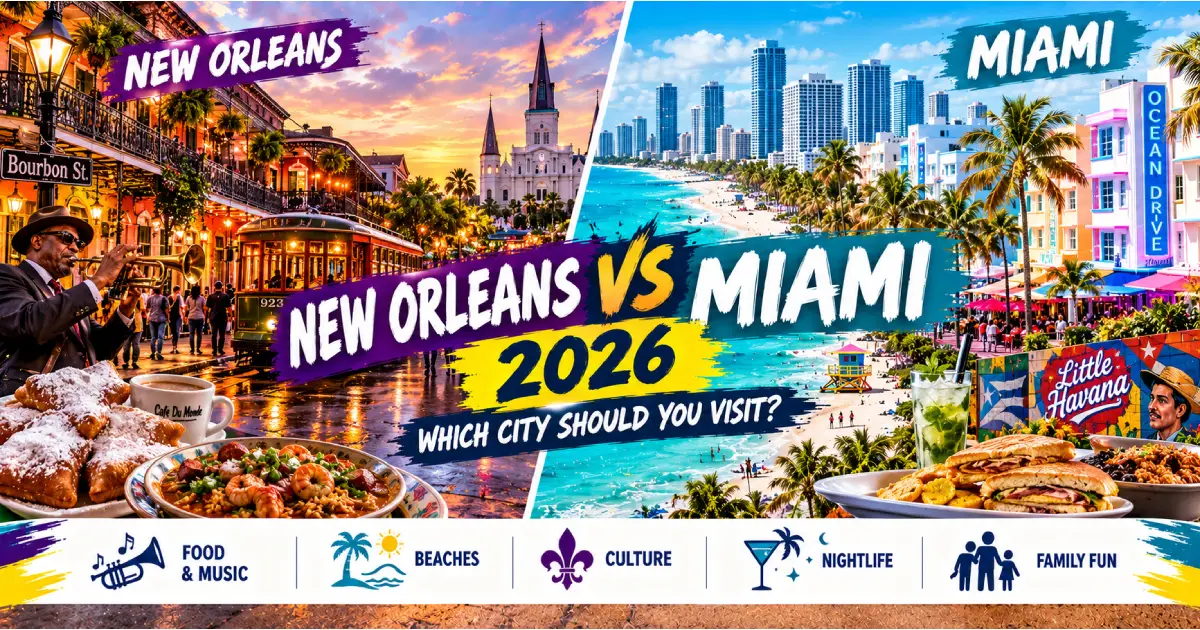
New Orleans versus Miami is one of the most genuinely interesting travel comparisons in the American South — not because the two cities are similar (they are, in fundamental character, nearly opposites) but because they are the two American cities most specifically defined by a non-Anglo-European cultural majority, and the two American cities where the specific cultural character most completely permeates every aspect of the visitor experience: the food, the music, the architecture, the language, the nightlife, and the specific social atmosphere that each city generates in its most authentic neighborhoods. New Orleans is French-Spanish-African-Caribbean in cultural origin, profoundly anti-commercial in its authentic character (the Frenchmen Street clubs that play for the love of the music as much as for the tourist dollar, the Commander’s Palace that has been serving the same Creole food in the same Garden District Victorian mansion for 130 years, and the Mardi Gras that is simultaneously the world’s most elaborately organized free public celebration and the most genuinely communal public ritual available at any American city), and consistently surprising in its depth relative to its size. Miami is Latin American in cultural majority, extravagantly commercial in its most visible character (South Beach’s Art Deco hotels, the $30 club covers, and the model-and-celebrity culture that the global nightlife marketing has made synonymous with the city name), and consistently surprising in its depth relative to its reputation.
The New Orleans vs. Miami decision requires understanding what each city specifically provides that the other doesn’t: New Orleans provides the most singular American urban experience — the food tradition with the most specific historical lineage, the music culture with the most specific continuing vitality, and the urban character with the most concentrated authenticity per city block. Miami provides the beaches (New Orleans has none), the nightlife infrastructure (South Beach has no American equivalent), the Latin American cultural diversity (Little Havana’s Cuban culture, the Wynwood arts scene), and the winter weather (consistently 5–8°F warmer than New Orleans in January–February, the difference between comfortable beach weather and merely pleasant outdoor weather). This guide provides the complete comparison.
For complete city guides, see our Things to Do in New Orleans 2026, Best Restaurants in New Orleans 2026, Places to Visit in New Orleans 2026, and Best Cities to Visit in USA 2026.
| Category | New Orleans | Miami |
|---|---|---|
| Population (city) | 383,000 | 470,000 |
| Population (metro) | 1.3 million | 6.2 million |
| Primary identity | America’s most unique city — food, jazz, Mardi Gras | American Riviera — Art Deco, Latin culture, beaches |
| Beaches | None (Gulf of Mexico 1 hr south) | World-class (South Beach, Key Biscayne) |
| Ocean swimming | Not accessible within city | Immediately accessible — South Beach steps from hotel |
| Food culture | Most distinctive American regional cuisine | Excellent Cuban, seafood, Latin American diversity |
| Music scene | Birthplace of jazz; most living music culture in US | Electronic, Latin pop; limited authentic live music scene |
| Nightlife | Bourbon Street + Frenchmen Street — genuine local culture | South Beach mega-clubs — global nightlife brand |
| Architecture | French Quarter Creole ironwork; Garden District mansions | Art Deco Historic District (800+ buildings) |
| Average high (July) | 91°F / 33°C | 90°F / 32°C |
| Average high (January) | 62°F / 17°C | 77°F / 25°C |
| Hurricane risk | High (historically significant) | High (coastal) |
| Mid-range hotel/night | $140–$280 (off-peak); 3–5× during Mardi Gras | $200–$450 (South Beach); $120–$200 (Miami proper) |
| Best for food | ✅ Strongly — the most distinctive US regional cuisine | ✅ Very good — Cuban, seafood, Latin American |
| Best for music | ✅ Strongly — live music capital of the Gulf South | ⚠️ Limited authentic live music |
| Best for beaches | ❌ None | ✅ Strongly — world-class South Beach |
| Best for nightlife | Frenchmen Street authentic; Bourbon Street tourist | South Beach world-famous; Wynwood artistic |
| Best for culture | ✅ Most historically complex US city | ✅ Art Deco, Latin American, Wynwood arts |
| Car necessary? | Not for French Quarter/Garden District | Partially (South Beach walkable) |
| Best season | October–November; February (Mardi Gras) | December–April (dry season) |
| Worst season | July–August (extreme heat + humidity) | August–October (hurricane season peak) |
| Trip cost (4 days, couple) | $1,800–$3,500 | $2,200–$4,500 |
New Orleans possesses the most specifically irreplaceable and most historically rooted American regional food culture — the specific convergence of French haute cuisine technique, Spanish seasoning, African ingredient knowledge and cooking methods, Caribbean spice culture, and the extraordinary natural pantry of the Louisiana Gulf that 300 years of accumulated culinary tradition has produced. No other American city’s food culture is as specifically itself as New Orleans’.
The New Orleans food canon:
Creole cuisine at the grand institutions: Commander’s Palace (the turquoise Victorian mansion in the Garden District — the turtle soup au sherry, the Creole bread pudding soufflé, and the Saturday jazz brunch with 25-cent martinis creating the most specifically New Orleans single restaurant experience), Galatoire’s (the 1905 Bourbon Street institution — the shrimp rémoulade, the trout meunière amandine, and the Friday afternoon extended lunch tradition creating the most specifically Creole social ritual available at any restaurant), and Antoine’s (the oldest family-operated restaurant in America, 1840 — the birthplace of Oysters Rockefeller, the most historically significant single New Orleans restaurant address).
The democratic food culture: The New Orleans plate lunch (red beans and rice on Monday at Café Reconcile for $12–$15 — the most authentic and most affordable single New Orleans meal), the po’boy (Domilise’s dressed shrimp po’boy and Parkway Bakery’s debris roast beef representing the most specifically New Orleans single sandwich), the muffuletta (Central Grocery’s original 1906 preparation — the most specifically New Orleans single lunch), and the beignets at Café Du Monde ($6 for three, open 24 hours) together provide the most democratic food culture of any American city’s most celebrated culinary tradition.
What New Orleans food provides that Miami doesn’t: The specific historical depth — the recipe lineage from the 18th-century French colonial kitchens, the specific Creole-soul food fusion that Dooky Chase’s represents, and the Frenchmen Street Thursday red beans tradition that the city maintains as a food-cultural calendar. Miami’s food is excellent; New Orleans’ food is irreplaceable.
Miami’s food culture is the most specifically Latin American of any US city — the Cuban food in Little Havana (the ropa vieja at Versailles Restaurant, the most celebrated single Miami Cuban restaurant since 1971; the café cubano from the ventanita counter service windows that serve the neighborhood’s residents their specific 2 PM daily espresso; and the Cuban sandwich, whose Miami version disputes with Tampa’s over the original preparation), the Peruvian food (the ceviche and the tiradito that the Miami Peruvian community maintains at a level of authenticity approaching Lima), the Venezuelan food (the arepa culture [the Arepas & More restaurant community], the tequeño, and the specific Venezuelan comfort food that the large Miami Venezuelan population supports), and the seafood (Joe’s Stone Crab — the most historically significant single Miami seafood institution, operating since 1913, the stone crab claws available October–May creating the most specifically seasonal and most specifically Miami single seafood experience).
What Miami food provides that New Orleans doesn’t: The Latin American diversity — the specific range from Cuban to Venezuelan to Peruvian to Argentine to Colombian food traditions all represented at a level of community authenticity that New Orleans’ more historically homogeneous (though deeply complex) food culture doesn’t match. Miami also provides the most specifically excellent fresh fish preparations (the snapper, mahi-mahi, and grouper from the Atlantic and Keys fisheries) at a level of sourcing quality that surpasses New Orleans’ Gulf seafood in specific species variety if not in absolute Gulf-seafood quality.
The food verdict: New Orleans wins for the most specific and most irreplaceable single American regional cuisine — the Creole tradition is uniquely New Orleans and cannot be approximately experienced elsewhere. Miami wins for food diversity — the breadth of Latin American culinary traditions at authentic quality levels. For food-first travelers, New Orleans is the more specifically rewarding single destination; for food-diversity enthusiasts, Miami provides more cultural range.
The most one-sided single category in the New Orleans vs. Miami comparison — New Orleans is the birthplace of jazz, the home of the second-line parade tradition, and the city with the most specifically dense and most specifically authentic live music culture of any American city; Miami’s music identity is primarily in electronic music production, Latin pop, and the South Beach club DJ culture rather than the live music performance tradition.
Frenchmen Street: The most concentrated live-music-per-block density in the United States — the 10+ clubs (the Spotted Cat, the d.b.a., the Blue Nile, the Maison, Three Muses) operating simultaneously every night, the brass bands playing in the street between the venues, and the specific New Orleans music community character (the musicians playing for each other as much as for the tourist audience) creating the most authentically lived music scene available at any American city destination.
Preservation Hall: The most historically significant single American traditional jazz venue — the 1750s French Quarter building where the Preservation Hall Jazz Band has performed traditional New Orleans jazz nightly since 1961, the 400-square-foot acoustic space creating the most intimate large-audience jazz encounter available in the United States.
The second-line tradition: The New Orleans second-line parade (the Social Aid and Pleasure Clubs’ Sunday afternoon parade tradition — the brass band leading the official first line, the community following as the second line, the spontaneous dancing and the specific New Orleans street-community engagement creating the most participatory single music tradition available at any American city) provides the most specifically New Orleans single cultural experience outside the formal music venues.
Jazz Fest: The New Orleans Jazz and Heritage Festival (late April–early May — 12 simultaneous stages across 10 days at the Fair Grounds Race Course, the most comprehensive single American music festival for cultural depth if not for commercial scale) is the most specifically irreplaceable single annual music event in the American South.
Miami’s music identity — primarily in the production and recording side (the specific Miami bass tradition, the Latin pop productions, and the electronic music scene centered on Ultra Music Festival) rather than the live performance tradition — is genuinely significant in the recorded music world but provides little of the live music density that New Orleans offers.
Ultra Music Festival (March): The annual electronic music festival (one of the largest and most globally significant EDM festivals, the lineup consistently featuring the most commercially significant electronic music artists) is Miami’s most specifically significant annual music event — but primarily DJ-performed electronic music rather than the live acoustic performance tradition that New Orleans provides.
The live music gap: Miami’s live music scene (the Wynwood music venues, the Little Havana cultural performances, the various hotel bars with live music) is perfectly adequate but nowhere near the specific density or the specific authenticity of Frenchmen Street’s nightly simultaneous multi-venue jazz, brass, funk, and R&B programming.
The music verdict: New Orleans wins completely — it’s not close. New Orleans is the birthplace of the most specifically American musical form and the city with the most concentrated living expression of that tradition. For any visitor whose travel is music-motivated, New Orleans is the only choice between these two cities.
The second most one-sided category — New Orleans has no beaches accessible from the city; Miami has world-class Atlantic Ocean beaches immediately accessible from the hotel corridor.
South Beach: The 3.5-mile iconic beach — the white sand, the turquoise Atlantic (75–82°F/24–28°C in summer; 66–70°F/19–21°C in winter), the Art Deco hotels facing the sand from Ocean Drive, and the specific South Beach culture (the beach volleyball, the weekend crowd scene, and the nighttime transformation of the same stretch into the most specifically famous American outdoor nightlife corridor) creating the most comprehensively complete American beach destination.
Key Biscayne (Crandon Park): The more naturally beautiful alternative — the crystal-clear water (the specific Key Biscayne geography producing calmer, clearer water than the open Atlantic South Beach), the less commercially developed shoreline, and the specific national park character creating the most relaxing single Miami beach experience at a fraction of the South Beach crowd density.
The winter beach advantage: Miami’s January at 77°F/25°C with 68–70°F/20–21°C ocean temperature provides the most reliably warm US Atlantic beach experience available from November through April — the specific reason that Miami’s winter visitor volume exceeds its summer visitor volume in terms of intentional beach-vacation tourists.
New Orleans has no beaches — the city sits on the Mississippi River delta, the surrounding water being the muddy river, the Lake Pontchartrain (a large tidal lake with sandy shores but murky, uninviting water), and the Gulf of Mexico bayous and estuaries that are most specifically experienced via swamp tour rather than swimming beach.
The Gulf beach alternative: The nearest genuine Gulf beaches to New Orleans are in Mississippi (Biloxi, approximately 90 miles east — the Gulf water warm but the white sand beaches heavily developed) and in Alabama/Florida (Gulf Shores and Pensacola Beach, 3+ hours east — the most specifically beautiful Gulf beaches accessible from New Orleans as an overnight trip rather than a day trip). Grand Isle (the Louisiana barrier island 2 hours south) provides the most accessible Gulf swimming from New Orleans but is a genuine beach destination only by Gulf Coast standards rather than by comparison with Miami.
The beach verdict: Miami wins completely. New Orleans has no meaningful beach access; Miami has immediate world-class beach access.
New Orleans nightlife operates on two entirely different registers simultaneously — the Bourbon Street entertainment district (the tourist-facing bars, the daiquiri dispensaries, the strip clubs, and the specific Bourbon Street energy [the open-container culture, the crowds moving between establishments, and the 24-hour operation that New Orleans’ specific alcohol regulations permit creating the most continuously operating single American entertainment street]) and the Frenchmen Street local music scene (the most authentically community-based nightlife environment in any US city — the musicians playing the music they love, the local residents and the most specifically music-motivated tourists sharing the three-block corridor nightly).
What distinguishes New Orleans nightlife: The specific authenticity gradient — from the tourist-performance of Bourbon Street to the genuine community of Frenchmen Street, the New Orleans nightlife contains both the most accessible and the most specifically genuine single American nightlife experiences within a 15-minute walk of each other.
The open-container culture: New Orleans’ specific legal permission for alcoholic beverages in plastic cups on public streets (the “go cup” culture — bars providing plastic cups for departing customers to take their drink to go) creates the most specifically pedestrian-mobile drinking culture of any American city, the specific New Orleans nightlife freedom allowing an evening that moves organically between venues, streets, and the specific live music environment without the indoor-only constraint that most American cities impose.
Miami’s South Beach nightlife is the most globally celebrated and most specifically commercially ambitious of any American city — the mega-clubs (LIV at the Fontainebleau, E11EVEN Miami’s 24-hour operation, the various Ocean Drive hotel rooftop bars) whose specific celebrity DJ culture, the $30+ cover charges, and the model-and-celebrity social scene creates the most internationally marketed single American nightlife brand.
What distinguishes Miami nightlife: The scale and the commercial ambition — the specific South Beach mega-club experience (the production quality, the celebrity DJ bookings, and the specific South Beach social energy of the most aspirationally-positioned single American nightlife environment) provides something genuinely different from what any other American city offers, and specifically different from New Orleans’ more democratically accessible and more authentically music-focused nightlife.
Wynwood nightlife: The most specifically local Miami nightlife alternative — the Wynwood bars (the Boxelder craft beer, the Wood Tavern, and the specific Wynwood warehouse-venue character) providing the most community-feeling single Miami nightlife experience and the most specifically accessible Miami nightlife for visitors who find South Beach’s VIP culture alienating.
The nightlife verdict: Neither city is superior — they offer genuinely different nightlife characters. New Orleans wins for authentic live music nightlife and democratic accessibility (Frenchmen Street costs nothing to experience, while South Beach’s clubs cost $30+ before the first drink). Miami wins for production quality, the specific beach-adjacent nightlife, and the global nightlife brand that international visitors specifically travel to experience. The visitor’s specific nightlife preference — live music authenticity vs. club production scale — determines which city better matches.
The most specifically irreplaceable architectural landscape in the American South — the French Quarter’s Creole townhouse ironwork (the only surviving example of French colonial urban design at this scale and completeness in the United States), the Garden District’s antebellum Greek Revival mansions (the most concentrated surviving pre-Civil War residential architecture in the South), and the Tremé’s historic African American buildings (the most historically significant neighborhood in American music history) together creating the most architecturally layered single American city outside of New York or Boston.
The French Quarter’s specific uniqueness: The specific Creole townhouse format (the ground-floor commercial space opening directly onto the sidewalk, the residential upper floors with the iron-lace balconies projecting over the street, and the interior courtyard hidden behind the street facade) is specifically Mediterranean-European in character — more specifically similar to the French colonial cities of the Caribbean (Martinique, New Caledonia) than to any other American city’s residential building tradition.
The Art Deco Historic District (the 800+ buildings along Ocean Drive, Collins Avenue, and Washington Avenue — the most concentrated surviving Art Deco architectural neighborhood in the world, the specific pastel-painted facades, the porthole windows, the eyebrows [the horizontal projections above windows providing shade in the Florida climate], and the neon sign program creating the most specifically 1930s-Hollywood-South-Florida single American streetscape) provides the most specific architectural identity of any single American beachfront neighborhood.
The Art Deco evening walk: The most specifically Miami architectural experience — Ocean Drive in the early evening (the specific low-angle sunset light illuminating the pastel facades at the most dramatically lit moment of the daily architectural light cycle, the outdoor restaurant terraces beginning to fill, and the specific South Beach Art Deco evening energy beginning) provides the most cinematically beautiful single American beachfront street experience.
The cultural verdict: New Orleans wins for cultural depth and historical complexity — the 300-year layering of French, Spanish, African, and American cultures creates a city whose cultural identity is more specifically complex than any other American city. Miami wins for the most immediately dramatic architectural setting (the Art Deco-to-beach juxtaposition) and the most dynamic contemporary culture (the Wynwood arts scene, Art Basel, and the Latin American cultural vitality).
New Orleans January: Average high 62°F/17°C — pleasant for walking and outdoor restaurant dining, cool enough to require a light jacket in the evenings, occasionally cold-front-driven cold (40–45°F/4–7°C for 2–3 days during any winter month). The New Orleans winter is mild by Northern standards but definitively not beach weather.
Miami January: Average high 77°F/25°C — warm enough for beach activity (the ocean at 68–70°F/20–21°C, cold by summer standards but swimmable for cold-tolerant visitors), comfortable for outdoor dining without any jacket requirement, and the driest month of the Miami year. Miami’s December through March is consistently the most sought-after single US winter-weather window, the specific Gulf Stream warming creating reliably warm beach weather.
The 15°F winter gap: The January temperature difference between Miami (77°F) and New Orleans (62°F) is the single most practically significant weather difference between the two cities — the difference between beach swimming weather and pleasant-walking weather. For visitors specifically motivated by warm winter beach access, this gap is decisive in Miami’s favor.
Both cities share the subtropical summer character — hot, humid, with the specific Gulf/Atlantic moisture creating heat indices that exceed the thermometer reading:
New Orleans July: Average high 91°F/33°C with very high humidity — the heat index regularly reaching 105–110°F/40–43°C, the highest single sustained heat-discomfort of any major American city given the specific combination of the Mississippi River delta humidity and the Gulf Coast moisture.
Miami July: Average high 90°F/32°C with high humidity — similar to New Orleans but marginally moderated by the sea breeze that the Atlantic coastal position provides. Miami’s summer heat is virtually equivalent to New Orleans’ at the thermometer level but marginally more bearable at the felt-temperature level.
The hurricane comparison: Both cities face genuine hurricane season risk (June 1–November 30) — but in different ways. Miami’s coastal position makes it directly exposed to Atlantic hurricane landfalls; New Orleans’ inland (relative to the Gulf coast) position provides some geographic protection but the specific levee vulnerability (the post-Katrina infrastructure improvements notwithstanding) creates a different risk profile. For summer or fall visits, both cities warrant travel insurance with hurricane cancellation coverage.
The weather verdict: Miami wins significantly in winter (the beach weather gap is decisive for beach-motivated visitors); the two cities are essentially tied in summer (both hot and humid, both in hurricane season, Miami marginally more comfortable at the coast).
New Orleans provides the most affordable major-city food and entertainment experience in America outside of specific budget markets — the democratic food culture (red beans and rice at Café Reconcile for $12–$15, the Central Grocery muffuletta at $15–$18 for two, and the Domilise’s shrimp po’boy at $14–$16 representing genuine quality at genuinely accessible prices) and the free entertainment culture (Mardi Gras parades free, Frenchmen Street free, second-line parades free, the French Quarter walk free) creating the most complete city experience available at minimal entertainment cost.
New Orleans 4-day couple budget (off-peak):
Mardi Gras pricing adjustment: The Mardi Gras hotel premium (3–5× normal rates) can push a 4-night New Orleans stay to $1,800–$2,800 in accommodation alone — Mardi Gras is the most specifically expensive single New Orleans visiting period and requires specifically budgeted planning.
Miami’s cost structure is significantly influenced by the South Beach hotel premium — the Art Deco district hotels (the Betsy, the Catalina, the Surfcomber, and the various Marriott/Hilton/Hyatt properties on or within a block of South Beach) commanding prices that reflect the beach adjacency, the architectural character, and the South Beach brand.
Miami 4-day couple budget (South Beach, peak season):
The cost verdict: New Orleans is generally more affordable than Miami for equivalent-quality experiences — the democratic food culture, the free entertainment, and the generally lower hotel baseline (outside Mardi Gras) making New Orleans the more budget-accessible destination. Miami’s South Beach hotel premium is the primary cost driver that makes Miami more expensive, particularly during the December–March peak season.
✅ Food is the primary travel motivation — the Creole food tradition is the most specifically irreplaceable American regional cuisine ✅ Live music is the primary travel motivation — New Orleans provides the most concentrated and most authentic live music culture in America ✅ First-time visitors to the American South — New Orleans is the most specifically Southern and the most specifically unique single American city ✅ Mardi Gras attendance — the world’s most elaborately organized free public celebration is uniquely New Orleans ✅ Jazz Fest attendance — the most culturally comprehensive single American annual music event ✅ History and architecture enthusiasts — the French Quarter’s 300-year architectural layering is the most historically complex single American historic district ✅ Budget-conscious travelers — New Orleans provides more genuine cultural richness per dollar than any other major American tourist destination ✅ Halloween travelers — New Orleans’ Halloween (the Gothic architecture, the voodoo tradition, and the specific New Orleans costume culture creating the most atmospherically genuine American Halloween)
✅ Beach access is the primary travel motivation — South Beach and Key Biscayne provide world-class beach experiences that New Orleans cannot approach ✅ Winter warmth is essential — Miami’s January at 77°F vs. New Orleans’ 62°F; the beach swimming in January is possible in Miami, not in New Orleans ✅ Latin American culture and food diversity — Little Havana’s Cuban culture, the Venezuelan food, the Colombian restaurants ✅ Art Deco architecture — the most concentrated surviving Art Deco neighborhood in the world ✅ South Beach nightlife — the most globally famous American nightclub scene ✅ Wynwood arts district — the most impressive single American outdoor street art concentration ✅ Art Basel December attendance — the most important US art event outside New York ✅ Water sports and marine activities — the Atlantic access, the Biscayne Bay snorkeling, and the Keys proximity ✅ The Everglades — the most accessible US departure point for Everglades National Park
✅ 10+ days in the American South — the two cities complement each other’s characters almost perfectly ✅ Food and culture + beach and nightlife — New Orleans provides the food and music culture; Miami provides the beach and nightlife infrastructure; together they cover the full spectrum ✅ The Gulf South road trip — New Orleans to Miami via the Florida Panhandle and Tampa provides the most specifically varied single American South road trip ✅ International visitors wanting the American South beyond Atlanta and Nashville — New Orleans and Miami together provide the most internationally distinctive and most culturally complex pair of American cities available in the South
For visitors with 10+ days, the New Orleans-to-Miami (or Miami-to-New Orleans) route provides the most specifically varied single American South journey:
Option 1 — The Gulf Coast Route (7–8 hours driving total): New Orleans → Mobile, Alabama (2 hours: Fort Condé, the USS Alabama battleship memorial) → Pensacola/Gulf Shores, Florida (2 hours: the most specifically beautiful white-sand Gulf beaches on the route) → Tampa (3 hours: Ybor City’s Cuban food, the Tampa Bay waterfront, the Florida Aquarium) → Miami (4 hours from Tampa, or overnight in Tampa)
Option 2 — The I-75 Interior Route (7–8 hours direct): New Orleans → Tallahassee (5 hours: the Florida State Capitol, the Wakulla Springs State Park — the most crystal-clear single Florida spring accessible by boat tour) → I-75 south → Miami (4 hours from Tallahassee)
Option 3 — Fly and add the Keys: New Orleans → Miami by air (Spirit/Southwest $50–$80 one-way) + overnight Key West drive → return to Miami for departure
About Travel Tourister Travel Tourister’s destination specialists have extensively explored both New Orleans and Miami across multiple visits and all seasons — from New Orleans Frenchmen Street Spotted Cat jazz nights and Commander’s Palace Saturday 25-cent martini jazz brunches through Café Du Monde 6 AM beignet mornings and Dooky Chase Thursday gumbo z’herbes lunches to Miami South Beach January morning beach walks and Joe’s Stone Crab October claw dinners, from New Orleans Mardi Gras Zulu parade front-row positions and Jazz Fest Gospel Tent Sunday morning communal experiences to Miami Wynwood Walls Saturday evening gallery walks and Art Basel December satellite fair explorations, from New Orleans Congo Square historical meditations and Preservation Hall 10 PM traditional jazz encounters to Miami Key Biscayne Crandon Park afternoon snorkeling sessions and Little Havana café cubano ventanita counter morning rituals — to deliver the most comprehensively experienced and most honestly calibrated New Orleans vs Miami comparison for every type of 2026 visitor.
Posted By : Vinay
Latest Article
2nd Floor, 39, Above Kirti Club, DLF Industrial Area, Kirti Nagar, New Delhi, Delhi 110015



Travel Tourister is a leading Travel portal where we introduce travellers to trusted travel agents to make their journey hasselfree, memorable And happy. Travel Tourister is a platform where travellers get Tour packages ,Hotel packages deals through trusted travel companies And hoteliers who are working with us across the world. We always try to find new and more travel agents and hoteliers from every nook and corners across the world so that you could compare the deals with different travel agents and hoteliers and book your tour or hotel with the one you have chosen according to your taste and budget.
Copyright © Travel Tourister, India. All Rights Reserved

 Call
Call Enquiry