Published on : 30 Sep 2026
By Travel Tourister | Updated Sep 2026
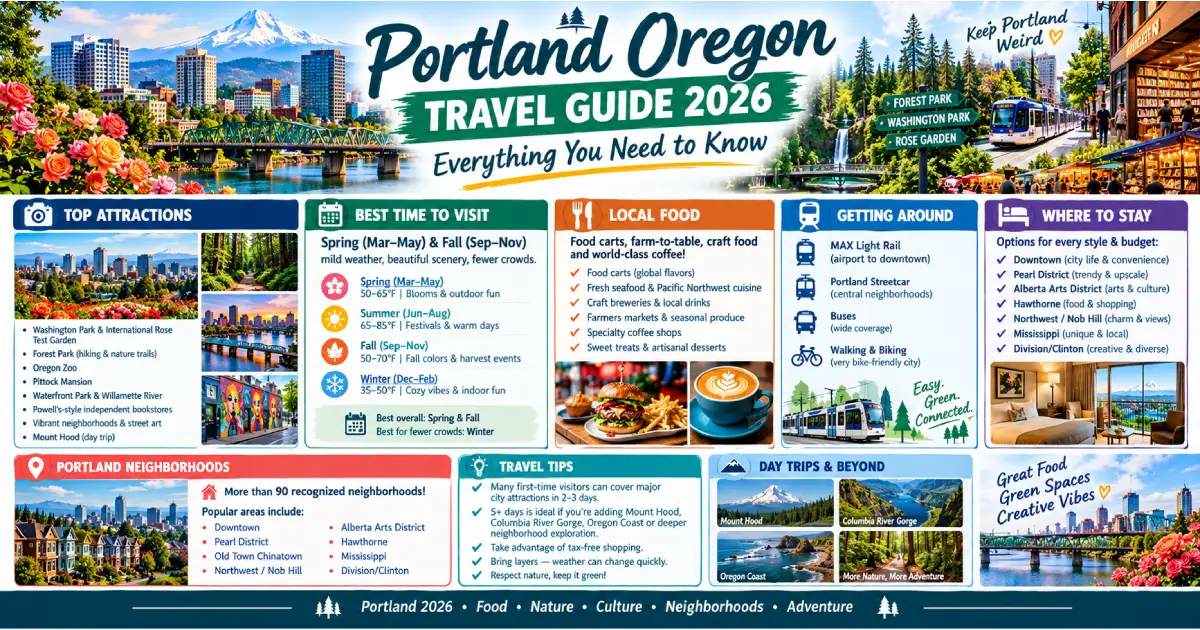
Portland, Oregon is the American city that most rewards the visitor who arrives without a fixed itinerary and most punishes the visitor who tries to experience it as a checklist of landmarks. The landmarks are genuinely excellent — Powell’s City of Books is the largest independent bookstore in the world, the Portland Japanese Garden is the most acclaimed Japanese garden outside Japan, and Multnomah Falls is the second-tallest year-round waterfall in the United States — but the specific Portland quality that makes the city most rewarding is the specific texture of the neighborhoods themselves: the way that Mississippi Avenue in North Portland shifts from vintage shop to craft brewery to community garden within three storefronts, the way that the Lan Su Chinese Garden exists as a completely enclosed classical Ming Dynasty garden world inside Portland’s Chinatown two blocks from Powell’s, and the way that the Forest Park trail system begins within 2 miles of Powell’s Books and extends for 80 miles through a genuinely wild urban forest without a single traffic signal.
Planning a Portland visit in 2026 requires understanding several things that standard travel resources frequently underemphasize: the rain (the Pacific Northwest winter drizzle that runs from November through March is real, persistent, and manageable with proper gear — but it is the specific reason that Portland’s July and August are the most recommended visiting months for first-time visitors), the neighborhood geography (Portland’s east-west Willamette River divide creates a specific city geography whose west side [the Pearl District, Nob Hill, Washington Park, the Japanese Garden] and east side [the Division Street restaurants, the Mississippi Avenue shops, the Hawthorne neighborhood, and the Alberta Arts District] require specific planning to experience comprehensively without a car), and the specific Portland food cart culture (the most democratic and most globally diverse single outdoor food format in any American city, the specific food cart pods requiring specific navigation that the generic Portland tourist itinerary frequently skips).
This complete Portland Oregon Travel Guide for 2026 covers everything from getting there and getting around through neighborhood orientation, budget planning, the best seasons, and the specific insider knowledge that transforms a Portland visit from a Powell’s-and-Voodoo-Doughnut checklist into the most genuinely surprising and most specifically rewarding major American Pacific Northwest city experience.
For specific activity, dining, and seasonal guidance, see our Things to Do in Portland Oregon 2026, Best Time to Visit Portland Oregon 2026, and Best Restaurants in Portland Oregon 2026.
| Category | Details |
|---|---|
| Nickname | The City of Roses; PDX; Stumptown; Bridgetown |
| Population | 650,000 (city); 2.5 million (metro) |
| Founded | 1845 |
| State | Oregon |
| Elevation | 50 feet (15 meters) at the Willamette River; up to 1,073 feet (West Hills) |
| Airport | Portland International Airport (PDX) — 12 miles northeast of downtown |
| Time zone | Pacific Time (PT) — UTC-8 standard; UTC-7 DST |
| Currency | US Dollar (USD) |
| Sales tax | Oregon has NO sales tax — the most practically significant single Portland shopping advantage |
| Language | English (primary) |
| Best neighborhoods | Pearl District, NW 23rd, Mississippi Ave, Division Street, Hawthorne, Alberta Arts District |
| Best season | July–September (summer); June (Rose Festival); April (cherry blossoms) |
| Worst season | November–February (persistent rain) |
| Mid-range hotel | $140–$220/night |
| Car necessary? | Not for central Portland; TriMet MAX excellent; car needed for Gorge and coast day trips |
| Transit | TriMet MAX Light Rail; buses; Portland Streetcar |
| Cannabis | Legal for adults 21+ at licensed dispensaries throughout Portland |
| No sales tax | Oregon’s 0% sales tax makes Portland the most tax-advantaged major US shopping destination |
Airport code: PDX | Distance from downtown: 12 miles northeast | Drive time: 20–35 minutes | Website: flypdx.com
Portland International Airport (PDX) is consistently ranked among America’s most passenger-friendly airports — the specific PDX character (the natural light flooding the terminal through the massive window walls, the extensive local Oregon food and beverage vendor presence [the Rogue Ales, the Stumptown Coffee, and the various other Oregon-origin airport vendors making PDX the most specifically Oregon-identity single American airport terminal], and the overall passenger experience [the PDX consistently ranking in the top 5 of J.D. Power’s North America Airport Satisfaction Study]) making it the most specifically pleasant single Pacific Northwest airport arrival experience.
Airlines serving PDX: Alaska Airlines (the primary PDX hub carrier, the most extensive single-carrier domestic network from Portland), Southwest (the most significant budget carrier presence), Delta, United, and American alongside various international carriers (Air Canada, Condor, KLM, Icelandair, and Lufthansa among the most significant international PDX routes).
Getting from PDX to downtown Portland:
MAX Red Line (most recommended): The TriMet MAX light rail service from the PDX terminal (the station directly adjacent to baggage claim, the most specifically airport-terminal-integrated single Pacific Northwest transit connection) to downtown Portland (Pioneer Courthouse Square, the most central single downtown MAX station) in approximately 38 minutes. Cost: $2.50 one-way. Frequency: every 15 minutes. The PDX MAX Red Line is the most cost-effective, most traffic-immune, and most specifically Portland-identity single airport transfer — the 38-minute ride through NE Portland’s neighborhoods providing the most comprehensive single introduction to Portland’s specific urban character available in a transit trip.
Rideshare (Uber/Lyft): $25–$45 to downtown in standard conditions; $40–$65 during surge (the I-205 and I-84 corridor congestion creating variable rideshare pricing). The rideshare pickup area at PDX (the designated area adjacent to the terminal’s ground level) is well-organized with typical 5–10 minute availability.
Rental car: The PDX rental car facility (the consolidated Rental Car Center accessible by shuttle) houses all major companies. A rental car is most specifically useful for the Columbia River Gorge day trip, the Oregon Coast, and the Mount Hood day trip — Portland’s central neighborhoods are well-served by TriMet.
Station: Union Station, 800 NW 6th Ave, Old Town | Routes: Coast Starlight (Los Angeles–San Francisco–Portland–Seattle), Cascades (Eugene–Portland–Seattle–Vancouver BC — the most specifically Pacific Northwest single Amtrak route, the daily service between Portland and Seattle [3.5 hours] and Portland and Eugene [2 hours] providing the most convenient single Pacific Northwest intercity train connection)
Portland’s Union Station (the 1896 Romanesque Revival building — the most dramatically clock-towered single Portland building, the specific Union Station character [the terra-cotta “Go By Train” sign on the tower facing the Willamette River and the Broadway Bridge, the most specifically Portland single building message, the specific Union Station position [the Old Town location adjacent to the Pearl District providing the most conveniently central single Amtrak arrival point in any Pacific Northwest city]) is a 10-minute walk from Powell’s Books and a MAX/streetcar connection from all Portland neighborhoods.
From Seattle, WA: I-5 South; 3 hours (175 miles) — the most traveled single Pacific Northwest intercity route From Eugene, OR: I-5 North; 2 hours (110 miles) From San Francisco, CA: I-5 North through the Central Valley and Sacramento; 10 hours (640 miles) From Boise, ID: I-84 West through the Columbia River Gorge; 5 hours (430 miles) — the most specifically scenic single Portland highway approach, the Columbia River Gorge visible throughout the final 90 miles From Vancouver BC: I-5 South through Bellingham and Tacoma; 5.5 hours (315 miles)
The Portland driving reality: Portland’s urban core is the most specifically bicycle-and-transit-friendly single Pacific Northwest city, the specific Portland street grid (the William Overton 1845 original plat whose specific 200-foot square block size [the smallest standard block in any major American city] creating the most specifically walkable and most specifically bicycle-navigable single urban grid) making central Portland less car-dependent than virtually any other American city its size. However: the Columbia River Gorge, the Oregon Coast (both the most essential day trips from Portland), and the Mount Hood day trip all require a car.
The most specifically visitor-relevant Portland transit system — the TriMet MAX (Metropolitan Area Express) light rail operating five lines (Red, Blue, Green, Yellow, and Orange) covering downtown, the Pearl District, NE Portland (Alberta, Hollywood), SE Portland (Division, Hawthorne), N Portland (Mississippi, Interstate), and the airport.
Most visitor-relevant MAX stations:
| Station | Line | Nearby |
|---|---|---|
| PDX Airport | Red | Airport arrival/departure |
| Pioneer Courthouse Square | All lines | Downtown hub; hotels |
| Library/SW 9th & 10th | Red/Blue | Powell’s Books (2 blocks north) |
| NW 23rd & Marshall (Streetcar) | Portland Streetcar | NW 23rd shopping/dining |
| Mississippi/Albina | Yellow | N Mississippi Ave |
| Alberta | Yellow | NE Alberta Street Arts District |
| Division/SE Clinton | Orange | SE Division Street restaurants |
| JELD-WEN Field/Providence Park | Blue/Red | Portland Timbers games |
TriMet fares (2026 approximate):
The fareless square: Downtown Portland historically maintained a fareless zone on MAX — check trimet.org for 2026 current status as this policy has been modified in recent years.
The Portland Streetcar (two lines running through the Pearl District, NW 23rd, the South Park Blocks, and the Central Eastside — the most specifically Pearl District and NW Portland single transit service) connects the most specifically visitor-relevant neighborhoods (the Pearl District, NW 23rd Avenue, Portland State University, and the Central Eastside) with the most walkable and most specifically boutique single Portland transit option.
Portland is consistently ranked as America’s most bicycle-friendly major city — the specific Portland cycling infrastructure (the most extensively bike-lane-networked single American city street system, the dedicated bike lanes on virtually every major Portland street, and the specific Portland cycling culture [the most bicycle-commuter-percentage single major American city] creating the most specifically cycle-friendly single Pacific Northwest city transport) makes cycling the most specifically Portland-identity single visitor transport.
Biketown PDX (Portland’s bikeshare): The orange Biketown bikes (the Nike-sponsored Portland bikeshare system, the electric-assist e-bikes available at stations throughout central Portland) provide the most specifically accessible single Portland cycling option for visitors: Cost: approximately $1 to unlock + $0.20/minute (e-bikes); day pass $20. Available throughout the Pearl District, downtown, NE Portland, and SE Portland.
Character: Powell’s Books territory; the most gallery-concentrated Portland neighborhood; converted warehouse aesthetic; the NW Portland creative hub | Best for: Powell’s Books, First Thursday art walk, Pearl District restaurants and boutiques | Transit: MAX Red/Blue to Library station; Portland Streetcar throughout
The Pearl District (the former warehouse and rail yard district north of Burnside — the most specifically gallery-concentrated single Portland neighborhood, the specific Pearl character [the converted warehouses [the Powell’s City of Books building, the Ecotrust Building “living roof,” and the various other Pearl District conversions whose exposed brick, industrial window systems, and loft-scale proportions create the most specifically warehouse-chic Portland aesthetic], the First Thursday art walk [the most consistently attended single Portland monthly art event, the Pearl galleries opening simultaneously on the first Thursday evening of every month], and the restaurant and boutique hotel concentration) is the natural Powell’s-Books-adjacent base for first-time Portland visitors.
Old Town/Chinatown (adjacent): The Lan Su Chinese Garden (the most authentically Chinese classical garden in the Western Hemisphere, hidden behind Old Town’s Chinatown walls), Voodoo Doughnut (the 24-hour original location on SW 3rd), and the specific Old Town character (the most specifically gritty and most specifically contrasting single Portland neighborhood to the Pearl’s polish — the specific Old Town street life most authentically Portland in its specific diversity) are all within walking distance.
Character: Portland’s most specifically European-feeling single commercial street; independent boutiques, restaurants, and coffee shops in Victorian commercial buildings | Best for: The most walkable upscale Portland neighborhood shopping and dining experience | Transit: Portland Streetcar to NW 23rd & Marshall
NW 23rd Avenue (the “Trendy-Third” — the NW Portland neighborhood commercial street whose specific Victorian commercial building stock [the 1880s–1910s brick commercial buildings maintaining the most specifically human-scale single Portland commercial streetscape] and the concentration of independent boutiques, restaurants, and coffee shops create the most specifically European-feeling single Portland commercial walk) and the surrounding Nob Hill neighborhood (the Victorian and Craftsman residential houses of the surrounding streets providing the most architecturally consistent single Portland residential neighborhood) together constitute the most specifically upscale-neighborhood-character Portland experience.
Character: Portland’s most beloved neighborhood commercial street; vintage shops, craft breweries, Mississippi Studios, community gardens | Best for: The most specifically Portland-neighborhood-community single commercial walk; Mississippi Studios live music | Transit: MAX Yellow Line to Mississippi/Albina
Mississippi Avenue (the North Portland neighborhood commercial corridor — the most specifically community-character single Portland street, the specific Mississippi Avenue combination [the vintage clothing shops, the independent restaurants, the community garden that the Mississippi community maintains between storefronts, the Mississippi Studios intimate concert venue, and the Prost! German beer hall] creating the most specifically Portland-neighborhood-social-fabric single commercial experience) is the Portland street most consistently cited by Portland residents as the street they most specifically love.
Character: The most restaurant-dense single Portland outside-of-downtown street; the most nationally recognized single Portland food corridor | Best for: Portland’s best restaurant concentration outside of downtown; the Pok Pok experience; the most food-motivated single Portland neighborhood walk | Transit: MAX Orange Line to Division/SE Clinton
Division Street (the SE Portland restaurant corridor — the most specifically nationally food-media-recognized single Portland neighborhood commercial street, the specific Division Street restaurants [Pok Pok [the Andy Ricker Thai restaurant that most specifically put Portland on the national food map, the original Pok Pok location whose specific northern Thai cooking [the fish sauce chicken wings, the khao man gai, and the Ike’s Vietnamese Fish Sauce Wings that James Beard-recognized and national food media celebrated] creating the most nationally-known single Portland restaurant brand], the various other Division Street restaurants representing the most comprehensively quality-focused single Portland outside-of-downtown restaurant concentration) is the single most food-motivated Portland neighborhood walk.
Character: Portland’s most community-arts neighborhood; the Last Thursday art walk; the most specifically diverse and most specifically community-character single Portland commercial street | Best for: The Last Thursday art walk; the most authentically Portland-neighborhood-creative community experience | Transit: MAX Yellow Line to Alberta
Alberta Street (the NE Portland neighborhood commercial corridor — the most specifically community-arts and most specifically diverse single Portland commercial street, the specific Alberta character [the street art murals covering the most building facades of any Portland commercial corridor, the Last Thursday art walk [the most specifically counter-cultural single Portland monthly event — the last Thursday of every month, the Alberta Street galleries opening, the street closed to traffic, the fire dancers and street performers creating the most specifically “weird Portland” single monthly street experience]], and the specific Alberta restaurant concentration [the Tasty n Daughters, the Salt & Straw ice cream, and the various other Alberta restaurants]) provides the most specifically community-character Portland neighborhood experience.
Character: Portland’s most specifically bohemian single commercial street; the most vintage-shop-concentrated Portland corridor; New Seasons Market territory | Best for: Vintage shopping, the most specifically 1990s-Portland-character single commercial street, the most neighborhood-residential-feeling SE Portland walk | Transit: Bus 14 on Hawthorne
Hawthorne Boulevard (the SE Portland neighborhood commercial street — the most specifically bohemian and most specifically vintage-shop-concentrated single Portland commercial corridor, the specific Hawthorne character [the used bookshops [the Powell’s Hawthorne branch, the largest single Powell’s branch outside the main Pearl District store], the vintage clothing shops, the New Seasons Market [the most specifically Portland-origin single natural grocery, the most community-oriented and most locally-sourced single Portland grocery store], and the specific Hawthorne neighborhood residential character [the surrounding Victorian and Craftsman bungalows creating the most specifically livable single SE Portland residential streetscape]) provides the most specifically Portland-alternative-residential-culture single neighborhood walk.
| Type | Cost Per Night | Notes |
|---|---|---|
| Budget hostel (dorm) | $30–$55 | Several Old Town and SE Portland options |
| Budget hotel | $80–$130 | Near PDX; outer Portland neighborhoods |
| Mid-range hotel | $140–$220 | Pearl District, NW Portland, downtown |
| Boutique hotel | $180–$300 | Ace Hotel, Jupiter Hotel, The Nines |
| Luxury hotel | $280–$500+ | The Heathman, Kimpton Hotel Vintage |
| Vacation rental | $100–$220 | Most rewarding in Hawthorne or Alberta neighborhoods |
| Category | Cost Per Person | Examples |
|---|---|---|
| Food cart meal | $8–$15 | Alder Pod, SE Division carts |
| Voodoo Doughnut | $2–$4 | The essential Portland snack |
| Casual restaurant | $18–$35 | Hawthorne, Mississippi Ave spots |
| Mid-range dinner | $40–$65 | Luce, Tasty n Daughters, Nostrana |
| Fine dining | $70–$130+ | Ox, St. Jack, Tusk |
| Activity | Cost |
|---|---|
| Powell’s City of Books | Free (browsing); books priced individually |
| Forest Park hiking | Free |
| International Rose Test Garden | Free |
| Portland Japanese Garden | $20 |
| Lan Su Chinese Garden | $14 |
| Multnomah Falls timed entry | $2/person (parking $5–$10) |
| Portland Art Museum | $25 |
| Oregon Museum of Science and Industry | $18 |
| Oregon Zoo | $25 |
| Pittock Mansion | $15 |
| Biketown PDX (day pass) | $20 |
The single most specifically underappreciated Portland financial advantage — Oregon’s 0% state sales tax means that every purchase made in Portland (the Powell’s Books haul, the Powell’s staff-picks purchases, the NW 23rd Avenue boutique shopping, and the Pearl District gallery purchases) costs exactly the marked price. For visitors from states with 8–10% sales tax, a $500 shopping trip in Portland saves $40–$50 relative to purchasing the same items at home.
Budget ($80–$120/day/person):
Mid-Range ($150–$220/day/person):
Luxury ($300–$500+/day/person):
Cannabis (recreational and medical) is legal in Oregon and available at licensed dispensaries throughout Portland. The most practically relevant visitor considerations:
| Season | Pack |
|---|---|
| November–March | Waterproof jacket (mandatory); waterproof shoes; mid-layer; hat and gloves for coldest days |
| April–May | Waterproof jacket; layering; waterproof hiking shoes |
| June–August | Light clothing; light jacket for evenings (drops to 53–57°F); sunscreen |
| September–October | Light jacket becoming medium jacket; waterproof jacket returning by mid-October |
The single most important Portland packing item in any season outside of July–August: a genuinely waterproof jacket with hood. Water-resistant is insufficient; waterproof is required.
Day 1 — West Side Portland: 9 AM: Powell’s City of Books (2–3 hours minimum; purchase the store map at the entrance) 12 PM: Alder Street food cart pod lunch (the most Portland midday meal) 2 PM: Pearl District walk → Portland Saturday Market (weekends) or Lan Su Chinese Garden 4 PM: Voodoo Doughnut (original Old Town location) Evening: Pearl District dinner; First Thursday gallery walk if applicable
Day 2 — Washington Park and the Gorge: 9 AM: International Rose Test Garden (the mountain view before the crowds) 10:30 AM: Portland Japanese Garden (book tickets in advance) 1 PM: Pittock Mansion (the best single Portland city view) 3 PM: Drive to Columbia River Gorge; Multnomah Falls (timed entry pre-booked) Evening: Return to Portland; SE Division Street dinner
Day 3 — East Side Neighborhoods: Morning: Forest Park hiking (Wildwood Trail from the Hoyt Arboretum trailhead) Lunch: Mississippi Avenue food options (Tasty n Daughters or similar) Afternoon: NE Alberta Street walk; Last Thursday if applicable Evening: SE Hawthorne dinner; craft brewery (Ecliptic Brewing or Deschutes Pub)
Days 1–3 as above, plus:
Day 4 — Oregon Coast: 7 AM departure for Cannon Beach (US-26 West; 90 minutes) Morning: Haystack Rock, Ecola State Park, tide pool exploration Lunch: Cannon Beach restaurants Afternoon: Seaside OR or Oswald West State Park (surfing beach) Return to Portland by 6 PM
Day 5 — Mount Hood: 7:30 AM departure for Mount Hood (US-26 East; 90 minutes) Morning: Timberline Lodge tour (the WPA architecture and craftsmanship) Late morning: Mount Hood meadow hike (summer) or ski (winter) Lunch: Timberline Lodge Ram’s Head Bar Afternoon: Government Camp village; drive back via Sandy River Return to Portland by 5 PM
Posted By : Vinay
Latest Article
2nd Floor, 39, Above Kirti Club, DLF Industrial Area, Kirti Nagar, New Delhi, Delhi 110015



Travel Tourister is a leading Travel portal where we introduce travellers to trusted travel agents to make their journey hasselfree, memorable And happy. Travel Tourister is a platform where travellers get Tour packages ,Hotel packages deals through trusted travel companies And hoteliers who are working with us across the world. We always try to find new and more travel agents and hoteliers from every nook and corners across the world so that you could compare the deals with different travel agents and hoteliers and book your tour or hotel with the one you have chosen according to your taste and budget.
Copyright © Travel Tourister, India. All Rights Reserved

 Call
Call Enquiry