Published on : 02 Jan 2026
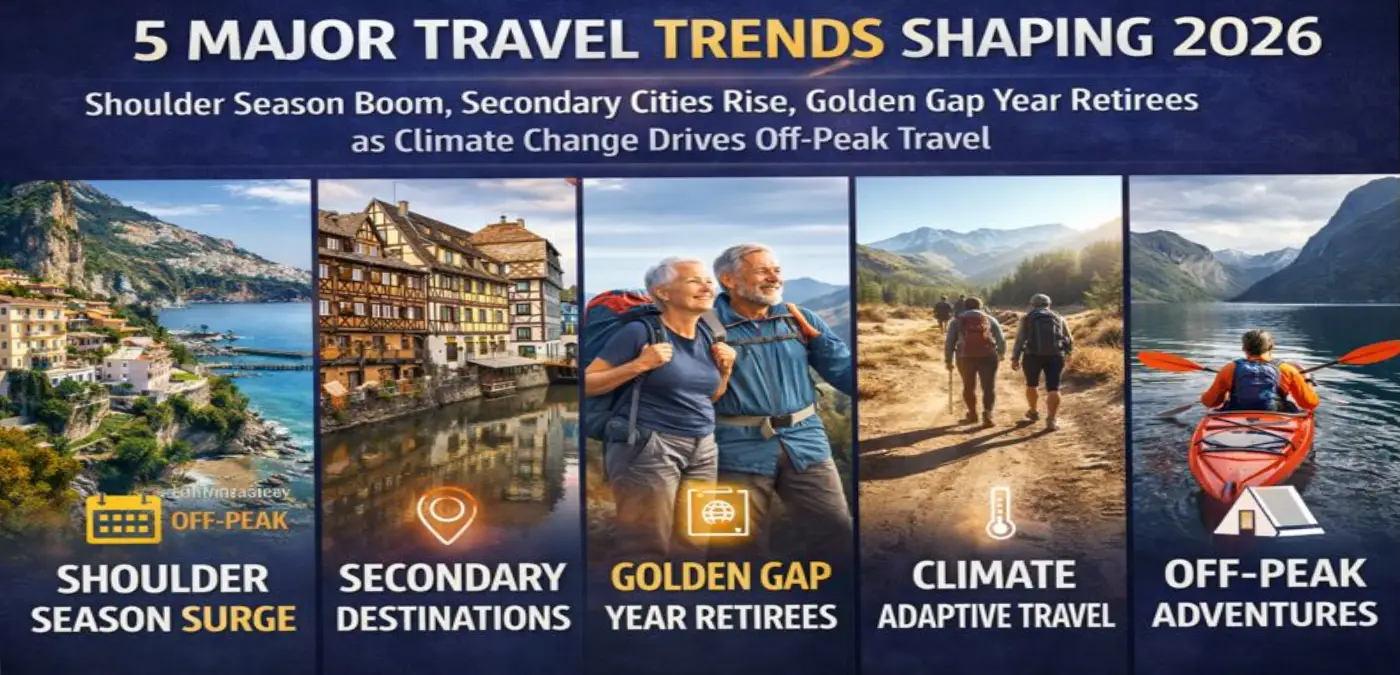
TRENDING: 76% of travel advisors report increased shoulder season demand as 45% of travelers adjust plans for climate concerns—driving shift toward off-peak European travel (May-June, Sept-Oct outperforming July-Aug), secondary cities like Adelaide Australia (+35% searches) over overcrowded capitals, nostalgia trips to childhood destinations, “golden gap year” retirees taking extended adventures, and AI-powered trip planning reshaping how travelers book 2026 journeys
Published: January 2, 2026 Source: CNBC analysis of 25 travel industry reports, Virtuoso, Oracle Hospitality, Multiple Sources Key Finding: Traditional July-August high season now less popular than shoulder months across Europe’s top 5 cities Climate Impact: 45% of travelers considering climate when planning trips (heat avoidance primary driver) Retiree Revolution: 25% of retirees traveled full year or would consider doing so ANZ Feature: Adelaide Australia emerges as trending secondary city (+35% booking growth)
CNBC’s comprehensive analysis of 25 major travel industry reports reveals five transformative trends reshaping 2026 travel patterns—with climate-driven shoulder season migration leading the shift as European occupancy data shows May-June and September-October now outperforming traditional July-August peak across Barcelona, Istanbul, London, Paris, and Rome, while travelers increasingly bypass overcrowded capital cities for authentic secondary destinations like Adelaide Australia (up 35%), Romania, Slovenia, and Bulgaria offering cultural depth without overtourism challenges, alongside nostalgic journeys to childhood vacation spots, “golden gap year” retirees taking extended multi-month adventures rather than brief retirement trips, and artificial intelligence fundamentally transforming trip planning as 40% of global travelers already use AI tools for itineraries, accommodations, and deals.
The convergence of these trends reflects fundamental transformation in traveler priorities post-pandemic, where affluent consumers with accumulated savings and remote work flexibility increasingly value authentic experiences, climate comfort, and crowd avoidance over traditional peak-season mass tourism to famous landmarks suffering infrastructure strain and environmental degradation from visitor volumes exceeding sustainable capacity.
“Travel in 2026 is expected to emphasize less-traveled destinations, decision-free planning, wellness retreats, nostalgia trips, and AI-powered hotel stays,” confirms CNBC’s synthesis of industry forecasts. “The steady shift shows that travelers are getting more sophisticated about timing, destinations, and booking methods—climate awareness, overtourism fatigue, and technology adoption drive behavioral changes that reshape tourism economics as shoulder seasons steal revenue from traditional peaks and secondary cities compete with established capitals.”
For Australian and New Zealand travelers—among the world’s highest per-capita travel spenders who typically book long-haul journeys months in advance—these trends offer strategic opportunities to visit European destinations during comfortable weather (avoiding 40°C+ summer heatwaves), discover emerging cities like Adelaide gaining international recognition without Sydney/Melbourne crowds, and leverage AI tools to optimize complex multi-city itineraries that maximize value while minimizing crowds during shoulder periods when hotels offer better rates and attractions remain accessible without hour-long queues.
Lighthouse hospitality data analyzing occupancy rates across Europe’s five most-visited cities—Barcelona, Istanbul, London, Paris, and Rome—reveals that July and August 2025 performed noticeably softer than May-June and September-October, marking the first time in modern tourism history that traditional peak summer months lost dominance to shoulder periods as travelers actively avoid extreme heat, crowds, and inflated pricing characteristic of school holiday travel.
“When averaging occupancy across the five cities and plotting it over 2025, the shift becomes clear,” reports Lighthouse analysis. “The traditional peak months of July and August were noticeably softer than May–June and September–October. This pattern appears consistently across both hotels and short-term rentals, underscoring a broader move toward off-peak travel.”
Why shoulder seasons now outperform summer peak:
“Rising accommodation and flight prices across Europe are cementing this trend,” confirms industry analysis. “For households already squeezed by the cost of living, peak summer travel (especially during school holidays) is becoming financially out of reach, forcing a migration to the more affordable shoulder seasons.”
The emergence of “coolcations”—travel specifically to escape heat rather than seek sunshine—represents fundamental inversion of historical tourism patterns where Mediterranean beaches, Greek islands, and Spanish costas dominated summer bookings as Northern European families sought guaranteed warm weather unavailable at home.
Coolcation destinations trending 2026:
“Cooler European countries like Finland and Norway are seeing an influx of inbound travelers during the summer months, making them a potential alternative to the Mediterranean as European temperatures continue to reach record-breaking levels,” notes RateHawk travel trends analysis.
Virtuoso’s 2026 “Luxe Report” surveying high-end travel advisors confirms the shoulder season migration with 76% reporting increased client interest in off-peak travel, while 75% say clients specifically request destinations with moderate weather—demonstrating that climate comfort now equals or exceeds cultural attractions, cuisine, and activities when affluent travelers select destinations.
“Of those advisors, 76% report increased interest in shoulder-season or off-peak travel, while 75% say clients prefer destinations with moderate weather,” according to Virtuoso data, confirming that this isn’t budget-driven compromise but deliberate choice by travelers who can afford peak season but refuse to endure heat, crowds, and diminished experiences characterizing July-August tourism in traditional destinations.
For Australians and New Zealanders visiting Europe, the shoulder season trend offers strategic advantages:
Adelaide’s emergence as trending global destination—featured prominently in 2026 travel forecasts alongside Romanian cities, Slovenia, and Bulgaria—demonstrates how secondary cities offer authentic cultural experiences, manageable tourism volumes, and livable urban environments that contrast sharply with overcrowded capitals where infrastructure strain and local resentment toward tourists diminish both visitor experiences and resident quality of life.
Adelaide advantages attracting international travelers:
“Adelaide ranks among emerging secondary cities globally as travelers seek alternatives to overtouristed Sydney and Melbourne,” confirms destination trend analysis, noting that the South Australian capital benefits from increased international flight capacity (Qatar Airways, Singapore Airlines) making the city accessible for European and Asian travelers seeking Australian experiences without Sydney’s crowds or Melbourne’s chaos.
Romania: Trafalgar’s new “Best of Romania, Transylvania & Hungary” itinerary highlights Bucharest, Cluj-Napoca, and Transylvania region as alternatives to overcrowded Prague, Vienna, Budapest where visitor numbers strain medieval infrastructure designed for populations one-tenth current tourism volumes.
Slovenia: Ljubljana and Lake Bled offer Alpine beauty, medieval charm, and outdoor activities without Austria’s crowds and Switzerland’s pricing—making Slovenia exceptional value for travelers seeking mountain scenery and cultural depth.
Bulgaria: Sofia, Plovdiv, and Black Sea coast provide Mediterranean climate, Roman ruins, Orthodox churches, and authentic Balkan culture at prices dramatically lower than Greece or Croatia where overtourism drives up costs while diminishing local character.
Belgium’s Ghent: Car-free center, strong local food systems, circular economy policies, and manageable tourism volumes make Ghent sustainable alternative to Brussels or Bruges where day-tripper crowds overwhelm historic centers.
Germany’s Freiburg: Solar energy leadership, green districts, dense cycling infrastructure, and environmental consciousness attract sustainability-minded travelers seeking progressive urban models.
Portugal’s Porto: Walkability, heritage protection, and manageable tourism volumes compared to Lisbon—which now suffers housing affordability crisis driven by short-term rentals converting residential neighborhoods into tourist zones.
Japan regional campaigns: Beyond Tokyo-Osaka-Kyoto, regional cities like Kanazawa, Takayama, Kumamoto offer authentic Japanese culture without overtourism—with JR Pass making rail travel affordable for exploring lesser-known destinations.
Thailand beyond Bangkok: Chiang Mai, Chiang Rai, Khao Lao offering northern culture, trekking, and mountain scenery vs beach crowds of Phuket, Krabi, Koh Samui.
Vietnam emerging cities: Da Nang, Hue, Hoi An provide central Vietnam culture without Hanoi’s traffic or Ho Chi Minh City’s density.
Indonesia beyond Bali: Yogyakarta, Bandung, Malang offer Javanese culture without Bali’s overtourism crisis driving locals to protest tourist behavior and environmental degradation.
The nostalgia travel trend reflects broader cultural movement toward comfort, familiarity, and emotional connection during uncertain times—with travelers returning to destinations they visited as children to recapture magical memories, share experiences with their own families, and escape the anxiety of exploring unknown places in an era of geopolitical instability and climate unpredictability.
“Many travelers are returning to the destinations they visited as children in a bid to escape the problems of modern living and make new memories by going off grid,” notes RateHawk analysis. “Camping is once again becoming popular, and there’s a new interest in ‘retro’ activities, whether it’s visiting an old-school arcade or connecting with their heritage by visiting a museum or going on an ancestry-inspired trip.”
Nostalgia travel manifestations:
“Set-jetting is set to become one of the key upcoming trends for travelers in 2026,” confirms industry forecasting, as popular streaming shows and films drive tourism to filming locations where fans can walk the streets, visit landmarks, and experience places they’ve seen on screen.
Major set-jetting destinations 2026:
Taylor Swift’s Eras Tour demonstrated massive economic impact of concert tourism, with fans traveling internationally to see performances, booking hotels months in advance, and spending thousands on travel, accommodation, dining, and merchandise—creating economic impacts exceeding $5 billion globally across 2023-2024.
“While we all saw the impact of Taylor Swift’s Eras tour in 2024 and 2025, the trend of traveling for major concerts and reunion tours is set to continue throughout 2026 and beyond,” confirms RateHawk analysis, noting that aging Gen X and Millennial fans with disposable income increasingly combine concert attendance with destination travel, treating performances as anchors for larger trips.
The “golden gap year” phenomenon—where newly-retired Baby Boomers and older Gen X travelers take extended multi-month or full-year trips rather than brief vacations—represents fundamental shift in retirement travel patterns as healthier, wealthier, more adventurous retirees reject sedentary retirement models in favor of exploration while physically able.
“With no bosses to report to and no kids in tow, they are taking extended trips, both overland and via cruise ship, that are more adventurous than retiree trips of the past,” notes industry forecasting. “Nearly 25% of retirees have traveled for a year, or would consider doing so, citing research from the UK retirement village operator Inspired Villages.”
Golden gap year characteristics:
Today’s retirees grew up during the travel revolution of the 1960s-1980s when commercial aviation made international travel accessible to middle-class families, creating generation that values experiences over possessions and views retirement as opportunity for adventure rather than withdrawal from active life.
Enabling factors:
The golden gap year trend drives demand for:
Australian and New Zealand retirees particularly embrace extended travel, with “grey nomads” driving caravans around Australia for months or years representing domestic version of golden gap year trend now extending internationally as Aussie/Kiwi retirees spend Australian winters (June-August) exploring Europe, Asia, or South America during those regions’ more favorable weather.
Kantar research reveals that 40% of global travelers have already used AI-based tools to plan trips, with 62% open to using them in the future—demonstrating rapid adoption of technologies like ChatGPT, Google Gemini, and travel-specific AI platforms that build itineraries, advise on accommodations, activities, transportation, and find deals within seconds vs hours of manual research.
“Your old-school travel agent has now gone digital,” confirms Trafalgar trend analysis. “Recent data shows that 40% of global travellers have already used AI-based tools to plan their trips, and 62% are open to using them in the future. Its main uses? Building itineraries, advising on accommodations, activities or transportation, and finding the best deals.”
How travelers use AI in 2026:
Oracle Hospitality’s 2026 forecast predicts significant shift from reactive to predictive hotel service, where properties use artificial intelligence to anticipate guest preferences before arrival and personalize rooms, amenities, and services without requiring explicit requests that add friction to guest experience.
“Next year is expected to mark a significant turn in hotels moving from reacting to guests’ requests to predicting their wants—using predictive intelligence to personalize stays before guests arrive,” according to Oracle analysis. “Some hotels already allow guests to personalize every detail of their room, such as adding a reformer Pilates machine and blackout blinds, or choosing a room closest to the breakfast buffet.”
Predictive AI hotel applications 2026:
While AI offers convenience, travelers should understand limitations:
Human travel advisors remain valuable for complex international trips, luxury travel requiring relationship with properties, and travelers wanting expertise that AI cannot yet replicate despite improving capabilities.
The five major trends shaping 2026 travel—climate-driven shoulder season migration, secondary city boom over overcrowded capitals, nostalgia travel and set-jetting, golden gap year retirees, and AI revolutionizing planning—collectively demonstrate how travelers increasingly prioritize comfort, authenticity, value, and convenience over traditional peak-season mass tourism to famous landmarks suffering infrastructure strain and environmental degradation from visitor volumes exceeding sustainable capacity.
For Australian and New Zealand travelers planning 2026 international trips, these trends offer strategic opportunities to visit European destinations during comfortable shoulder seasons when May-June and September-October provide ideal 15-25°C temperatures without July-August’s 40°C+ heatwaves and overwhelming crowds, discover emerging cities like Adelaide gaining international recognition alongside Romanian, Slovenian, and Bulgarian destinations offering cultural depth without overtourism challenges, and leverage AI tools to optimize complex multi-city itineraries that maximize value while minimizing tourist hordes during peak periods when hotels charge premium rates and attractions require hour-long queues diminishing experiences that should feel special rather than stressful.
Key takeaways for travelers in 2026:
✓ Book shoulder seasons (May-June, Sept-Oct Europe outperform July-Aug for weather, crowds, value) ✓ Consider secondary cities (Adelaide, Romania, Slovenia, Bulgaria offer authenticity without overcrowding) ✓ Embrace climate-smart planning (45% of travelers now factor weather/heat into destination selection) ✓ Explore nostalgia destinations (childhood vacation spots, heritage tourism, retro accommodations trending) ✓ Use AI strategically (40% already using tools—build itineraries, compare options, find deals) ✓ Extended trips if retired (25% of retirees consider year-long travel—golden gap year booming) ✓ Avoid overtouristed peaks (Barcelona, Rome, Paris July-Aug see softer occupancy than shoulder months) ✓ Research coolcations (Finland, Norway, Iceland, Scotland offer comfortable summer alternatives to 40°C+ Mediterranean) ✓ Book early for shoulder (growing demand means May-June, Sept-Oct no longer “off-season” pricing) ✓ Combine trends (AI planning + shoulder season + secondary cities = optimal 2026 travel strategy)
“The steady shift shows that travelers are getting more sophisticated about timing, destinations, and booking methods,” confirms CNBC trend analysis. “Climate awareness, overtourism fatigue, and technology adoption drive behavioral changes that reshape tourism economics as shoulder seasons steal revenue from traditional peaks and secondary cities compete with established capitals for visitors who increasingly value comfort, authenticity, and crowd avoidance over Instagram-famous landmarks where diminished experiences no longer justify premium pricing or environmental damage caused by unsustainable visitor volumes.”
For the global tourism industry, 2026 represents inflection point where climate change transforms from abstract concern into concrete planning factor—with 76% of travel advisors reporting shoulder season demand increases reflecting travelers’ unwillingness to endure extreme heat regardless of price or destination fame, while secondary cities capitalize on overtourism backlash in capital cities where resident protests, tourist taxes, and visitor caps signal that traditional mass tourism models are unsustainable both environmentally and socially as local populations reject the displacement and degradation caused by tourism volumes optimized for economic extraction rather than community wellbeing or environmental protection.
For More Resources:
Related Travel Guides:
Final Reflection: The transformation of 2026 travel patterns from peak-season mass tourism to shoulder-season strategic planning reflects maturation of travelers who now recognize that authentic experiences, comfortable weather, and manageable crowds matter more than visiting during traditional high seasons when extreme heat, overwhelming tourist volumes, and inflated pricing diminish the very experiences that made destinations desirable in the first place. For Australian and New Zealand travelers with flexibility to choose travel timing and willingness to explore beyond famous capitals, 2026 offers unprecedented opportunities to visit Europe’s secondary cities during ideal May-June or September-October weather, discover emerging destinations before overtourism arrives, and leverage AI tools that democratize the expert trip-planning knowledge once accessible only through expensive travel advisors. The future of travel isn’t about visiting the same places at the same times as everyone else—it’s about strategic timing, authentic destinations, and technological tools that enable smarter, more sustainable, more satisfying journeys.
Posted By : Vinay
This article is provided for general informational purposes only and is based on information available at the time of publication. Travel advisories, airline schedules, airport operations, visa requirements, government regulations, and other travel-related information are subject to change without prior notice. While Travel Tourister makes reasonable efforts to verify information using official announcements, government publications, airline and airport communications, and other reliable sources, we cannot guarantee that all information remains complete, accurate, or up to date at all times. Readers should independently verify any information that may affect their travel plans with the relevant airline, airport authority, government agency, embassy, or other official source before making travel, financial, or other decisions. Travel Tourister shall not be liable for any direct or indirect loss, inconvenience, or damages arising from the use of or reliance on the information contained in this article. Nothing in this publication constitutes legal, immigration, financial, or professional travel advice. If you believe any information in this article is inaccurate or outdated, please contact our editorial team. We review all credible correction requests promptly and update our content whenever appropriate.
Lastest News
2nd Floor, 39, Above Kirti Club, DLF Industrial Area, Kirti Nagar, New Delhi, Delhi 110015



Travel Tourister is a leading Travel portal where we introduce travellers to trusted travel agents to make their journey hasselfree, memorable And happy. Travel Tourister is a platform where travellers get Tour packages ,Hotel packages deals through trusted travel companies And hoteliers who are working with us across the world. We always try to find new and more travel agents and hoteliers from every nook and corners across the world so that you could compare the deals with different travel agents and hoteliers and book your tour or hotel with the one you have chosen according to your taste and budget.
Copyright © Travel Tourister, India. All Rights Reserved

 Call
Call Enquiry