Published on : 20 Apr 2026
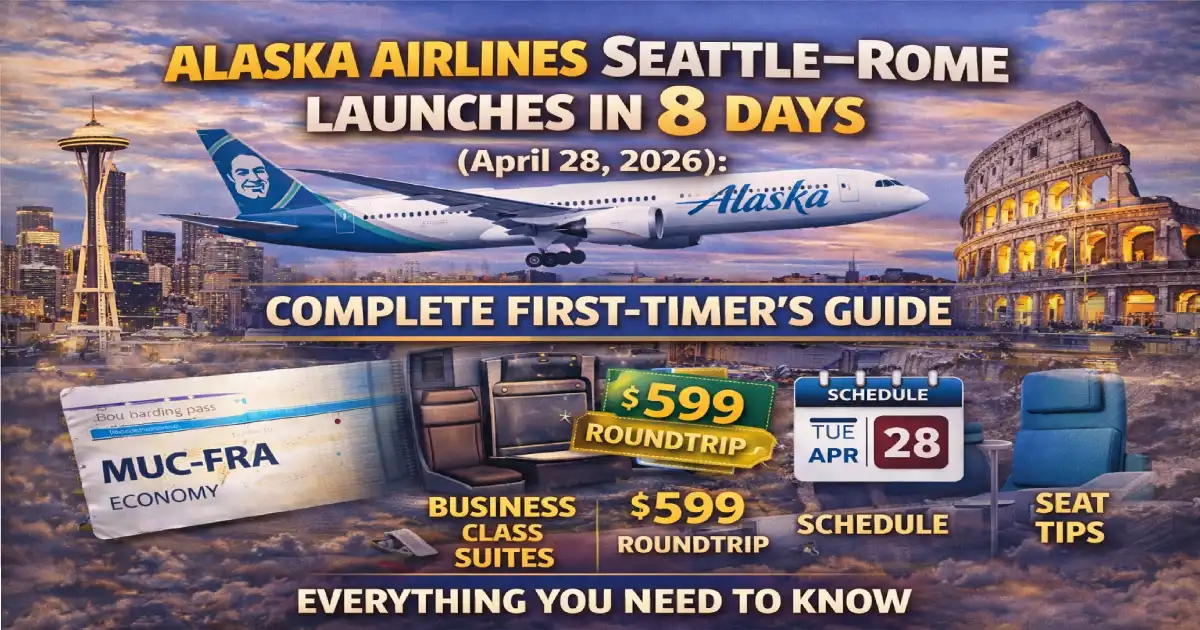
In eight days, one of the most significant moments in West Coast aviation history will happen quietly at Seattle-Tacoma International Airport at 5:30 PM. Alaska Airlines flight AS180 will push back from the gate, point its Boeing 787-9 Dreamliner nose east across the Atlantic, and land in Rome at 1:15 PM the following afternoon — completing the first nonstop flight between Seattle and Europe in the history of either airport. For 93 years Alaska Airlines has flown passengers across the Americas and the Pacific. On April 28, 2026, it crosses the Atlantic for the first time. If you have a booking on this route — or you are considering one before the summer season fills — this is the complete guide to everything about the flight, the aircraft, the product, the schedule, and how to make the most of Alaska’s most ambitious route launch.
Route: Seattle-Tacoma International Airport (SEA) ↔ Rome Leonardo da Vinci Fiumicino International Airport (FCO) Launch Date: Monday, April 28, 2026 Service Type: Daily, seasonal (April 28 → early October 2026) Aircraft: Boeing 787-9 Dreamliner (Alaska’s widebody fleet, acquired through Hawaiian Airlines merger) Cabin Configuration: 34 Business Class suites + 79 International Premium Class seats + 187 Main Cabin seats = 300 total seats AS180 (Seattle → Rome): Departs SEA 5:30 PM · Arrives FCO 1:15 PM (+1 day) AS181 (Rome → Seattle): Departs FCO 3:25 PM · Arrives SEA 5:45 PM Flight Duration: 10 hours 45 minutes eastbound · 11 hours 20 minutes westbound Distance: 5,688 miles (9,154 km) Introductory Fares: From $599 roundtrip (Main Cabin) · From ~$3,500 roundtrip (Business Class) Book: alaskaair.com Historical significance: First-ever nonstop Seattle–Italy · First-ever Alaska Airlines transatlantic flight · First nonstop between the Pacific Northwest and continental Europe Competition: Delta Air Lines launches SEA–FCO May 6, 2026 (Airbus A330-900neo, 4×/week) — Alaska has a 8-day head start and daily frequency advantage Coming next: Seattle–London Heathrow (AS, daily year-round, May 21) · Seattle–Reykjavik (Boeing 737 MAX, daily summer, May 28)
The connection between Seattle and Rome is not a routine airline scheduling decision. It is the culmination of a strategic transformation that Alaska Airlines has been building since its $1.9 billion acquisition of Hawaiian Airlines in October 2024. What Alaska really wanted from that merger — beyond Hawaiian’s Pacific routes — was Hawaiian’s Boeing 787-9 Dreamliner fleet. Without widebody aircraft, Alaska had zero transatlantic capability. With them, it had the tool to turn Seattle into what it has been calling the “West Coast’s new premier global gateway.”
The numbers support the ambition. Rome was not chosen arbitrarily. Alaska identified it as the single most-requested European destination among its Mileage Plan members — the largest European city with no nonstop service from Seattle. And Seattle’s geography is doing Alaska a favour that Los Angeles and San Francisco cannot: Seattle sits further north, meaning the great-circle route to Europe from Seattle is genuinely shorter than from its southern California rivals. Alaska has calculated that Seattle has a 10% distance advantage over LAX and SFO on flights to Rome.
For Alaska CEO Ben Minicucci — an Italian-American whose parents emigrated from Italy — the route is personal. His words at the announcement: “Serving Rome nonstop from Seattle is a dream come true. Rome has been at the top of the list ever since we announced our new global gateway out of Seattle. Our guests have been asking for an easy way to get to Italy for years. Andiamo — let’s go!”
The response from the market confirmed the decision. Alaska originally planned to operate the Seattle–Rome route four times a week. Demand was so strong that it upgraded to daily service before the first ticket was sold.
The 787-9 is one of the most passenger-friendly commercial aircraft ever built. Alaska’s fleet came through the Hawaiian Airlines merger — these are the same jets that Hawaiian operated — now rebranded in Alaska’s livery and equipped with the airline’s brand new international product.
Why the 787-9 is different from any other jet you’ve flown:
The Dreamliner is built primarily from carbon composite materials rather than aluminium. This matters to passengers in two specific ways. First, the cabin can maintain a higher atmospheric pressure equivalent — the equivalent of 6,000 feet altitude rather than the 8,000 feet typical on older aircraft. This means less fatigue and dehydration on a 10-hour flight. Second, the windows are larger than any other commercial aircraft and use electrochromic dimming rather than physical window shades — you can dim the window through five levels without blocking your view of the sky.
The cabin air is 100% fresh outside air (no recirculated cabin air) and humidity levels are higher than on older narrowbody aircraft. Passengers consistently report arriving on 787 flights feeling less tired and less dehydrated.
Alaska’s 787-9 cabin configuration:
The 787-9 is also significantly quieter than older widebody aircraft — the engines use a distinctive serrated “chevron” noise reducer that makes the cabin noticeably quieter at cruise altitude.
Alaska’s new International Business Class product — launched specifically for the Rome route and its upcoming European expansion — is the most significant premium product the airline has ever operated. Here is what you actually get.
Each of the 34 Business Class seats is a fully enclosed lie-flat suite with a sliding privacy door, direct aisle access, and a true flat-bed sleeping surface. The 1-2-1 configuration means every single seat has direct aisle access — no climbing over a neighbour. The suites convert to a bed that is wide enough to sleep on your side comfortably, with a full mattress pad, duvet, and multiple pillows from Filson — Alaska’s Pacific Northwest brand partner.
Suite features:
An important note for aviation enthusiasts: The hard product (the seat shell itself) is the same suite that Hawaiian Airlines was already flying on its Dreamliners — specifically the Collins Aerospace suite that Hawaiian marketed as its Leihōkū Suites. What Alaska has layered on top is a new soft product, new dining, new amenities, and an entirely new service philosophy. The result is a competitive transatlantic Business Class that rivals the products offered by American, Delta, and United on Europe routes.
Alaska has designed a dining programme specifically for the Rome route that reflects both the destination and the airline’s Pacific Northwest identity.
Business Class dining service (Seattle → Rome):
Advance meal ordering: Alaska allows Business Class passengers to pre-select their main course entrée in the Alaska app — reducing the risk of your preferred option being sold out in flight.
Beverages: Premium wine list curated for each route, craft beers, spirits, Stumptown Coffee (another Portland-based Pacific Northwest brand), and non-alcoholic options throughout the flight.
Business Class passengers receive amenity kits in a reusable bag featuring Salt & Stone skincare products (cleanser, moisturiser, lip balm) alongside a custom reusable water bottle by PATH Water. The kit reflects Alaska’s commitment to West Coast sustainability brands.
Filson — the legendary Seattle outdoor brand — supplies the bedding: a genuine Filson blanket, mattress pad, and pillow that feel markedly different from the mass-produced equivalents on many carriers.
Business Class passengers have access to Alaska’s own lounges at Seattle-Tacoma International Airport before departure, as well as oneworld alliance partner lounges worldwide — including British Airways lounges at London Heathrow, Iberia lounges at Madrid, Cathay Pacific lounges in Hong Kong, and hundreds more through the oneworld network. At Rome Fiumicino, Alaska does not yet operate its own lounge — passengers should use the oneworld partner lounge (currently Iberia) at FCO’s Terminal 1.
If Business Class is beyond budget, Alaska’s International Premium Class is the option that most US airlines call “Premium Economy” — and on the Rome route, it is genuinely good value.
International Premium Class features:
Who should book Premium Class: Premium Class is the smart choice for passengers who want a noticeably better seat than Main Cabin without paying Business Class prices, particularly on a 10h45min flight. The extra legroom and complimentary spirits alone are worth the upgrade for most passengers over a nearly 11-hour journey.
Main Cabin on Alaska’s 787-9 is a solid economy product for a long-haul flight. The 3-3-3 configuration gives most rows 17–18 inches of seat width, which is the international widebody standard.
Main Cabin features:
Best seats in Main Cabin:
Wi-Fi note: Starlink ultra-fast Wi-Fi is not yet installed on Alaska’s 787-9 fleet for the April 28 launch. Alaska has confirmed Starlink installation will begin this fall 2026. Until then, the aircraft has the existing Wi-Fi system from the Hawaiian Airlines era. Starlink will be free for Atmos Rewards members when it launches, through Alaska’s T-Mobile partnership.
AS180 departs Seattle at 5:30 PM and arrives Rome at 1:15 PM the next day (10h45m flight, plus 9 hours time difference).
Why the 5:30 PM departure works: Departing late afternoon means you can work a full day in Seattle before the flight. You board at approximately 4:45 PM, take off at 5:30, dinner service begins around 7–8 PM Pacific time (4–5 AM Rome time), and with the cabin in darkness for most of the overnight Atlantic crossing, you have approximately 7–8 hours to sleep before the pre-arrival breakfast service and your 1:15 PM Rome arrival. You land in early afternoon, check into your hotel by 3 PM, and have the entire afternoon in Rome on Day 1.
AS181 (Rome → Seattle) 3:25 PM departure: Departing Rome at 3:25 PM means a late lunch on your last day in Rome is achievable. You arrive Seattle at 5:45 PM the same calendar day (the time zone change works in your favour westbound), making it feasible to fly back on a Sunday and be at work Monday morning.
One of Alaska’s key selling points for the Rome route is that Seattle serves as a gateway for the entire West Coast and Hawaii — not just Seattle passengers.
Alaska Airlines operates short-haul connections to SEA from:
| Origin | Flight Time | Key Connection Window |
|---|---|---|
| Portland (PDX) | 45 min | Multiple daily — easy connection |
| San Francisco (SFO) | 2h 15m | Early afternoon departures work |
| Los Angeles (LAX) | 2h 30m | Afternoon flights connect to AS180 |
| San Diego (SAN) | 2h 45m | Afternoon flights connect |
| Anchorage (ANC) | 3h 30m | Works for Alaska connections |
| Honolulu (HNL) | 5h 30m | Same-day connection viable |
| Maui (OGG) | 6h | Day-of connection requires early Hawaii departure |
For California travelers specifically: The routing SEA–FCO compares surprisingly well to LAX–FCO or SFO–FCO on competitor airlines, because Alaska’s Seattle hub is north of both cities, and the great-circle route to Rome from the Pacific Northwest is noticeably shorter than from Southern California. Alaska has calculated a 10% distance advantage from Seattle vs LAX/SFO to Rome.
For Hawaii travelers: Flying Honolulu → Seattle → Rome creates one of the most direct routing options from Hawaii to Italy — and it operates entirely on Alaska metal, meaning Atmos Rewards points earn on every leg.
For oneworld connection passengers: Alaska is a full member of the oneworld alliance. Passengers arriving on partner airlines — British Airways, American Airlines, Cathay Pacific, Japan Airlines, Iberia, and others — can connect seamlessly to AS180 on a single ticket, earning status miles throughout.
Introductory pricing was set at $599 roundtrip in Main Cabin. As the April 28 launch approaches and seats fill, prices have risen from the introductory floor for peak summer dates. For the best remaining availability:
Book at: alaskaair.com (avoid third-party booking for this route — changes, upgrades, and seat selection are most easily managed directly with Alaska)
Alaska’s Atmos Rewards programme (the replacement for Mileage Plan, though many passengers still call it by the old name) earns points on the Seattle–Rome route.
Earning rate:
Titanium status upgrade perk: Alaska’s top Atmos tier — Titanium — provides complimentary upgrade to Business Class suites on day of departure on all intercontinental routes, subject to availability. This is currently unique in the US loyalty market: no other major US airline loyalty programme offers complimentary same-day lie-flat upgrades on transatlantic routes as a standard elite benefit.
oneworld partner earning: British Airways Executive Club, American AAdvantage, Cathay Pacific Asia Miles, Japan Airlines Mileage Bank, and Iberia Plus members can earn miles on Alaska flights. Check your programme’s partner earn rates before booking.
8 days out — do this today: ✅ Confirm your booking on alaskaair.com and check seat assignments — Business Class suites and Premium Class seats with extra legroom may have had seat assignments reset ✅ Pre-order your Business Class main course entrée through the Alaska app — particularly the pasta carbonara option on Rome flights, which is likely to be popular ✅ Download the Alaska app and enable push notifications — AS180 is a new route and gate assignments may update close to departure day ✅ Check your passport expiry — Italy requires your passport to be valid for at least 6 months beyond your planned stay; US passports issued in the last 5 years are almost certainly fine ✅ US citizens: No ESTA or visa required for Italy — Italy is in the Schengen Area and US citizens can stay up to 90 days in 180 days without a visa ✅ UK citizens travelling via Seattle: Ensure your UK ETA is in order — if you are transiting through a UK airport connection or have a UK leg, the ETA is now mandatory. Italy itself requires no ETA for UK travellers. ✅ Arrange Rome airport transfer in advance — Leonardo Express train from FCO to Roma Termini central station runs every 30 minutes and takes 32 minutes (€14). This is the fastest option from the airport to central Rome.
Day of departure (at SEA): ✅ Arrive at SEA Terminal N (Alaska’s international terminal) at minimum 2.5 hours before 5:30 PM departure — aim for 2:45 PM arrival (2h45m before departure) ✅ Business Class passengers: Use Alaska Lounge in Concourse N before departure ✅ Premium Class and Main Cabin passengers: Alaska Sky Club-adjacent seating areas and a wide range of gate restaurants are available in Concourse N ✅ Check your boarding pass for the gate — AS180 will depart from the international gates in SEA’s N concourse ✅ Consider downloading offline entertainment — the current Wi-Fi on the 787-9 fleet (pre-Starlink) may not support heavy streaming
At Rome Fiumicino (FCO): ✅ AS180 arrives at Terminal 3 (international arrivals), FCO’s largest terminal ✅ US and Canadian passport holders: use the e-gates at Italian border control for automated passport scanning — significantly faster than staffed desks ✅ Luggage claim is in Terminal 3 arrivals hall — allow 20–30 minutes after deplaning ✅ Leonardo Express train departs from the airport train station (follow signs: “Treni / Train to Rome”) — platform 1 or 2 for direct Roma Termini services ✅ Taxi to central Rome: fixed fare of €48–50 from FCO to anywhere within Rome’s Aurelian Walls (confirm “tariffa fissa” with the driver before departure — official white taxis only)
This is one of the most directly competitive new route launches in recent US airline history. Alaska launches April 28. Delta launches May 6 — just eight days later. Both airlines’ primary hub is Seattle-Tacoma International Airport. Both are targeting the same passengers. The comparison is worth knowing before you choose.
| Feature | Alaska AS180 | Delta DL — SEA/FCO |
|---|---|---|
| Launch date | April 28 | May 6 |
| Frequency | Daily | 4× weekly |
| Aircraft | Boeing 787-9 | Airbus A330-900neo |
| Business Class | Lie-flat suites, privacy doors, 1-2-1 | Delta One Suites — strong product |
| Premium Economy | International Premium Class | Delta Premium Select — slightly stronger hard product |
| Main Cabin meals | Complimentary — both classes | Complimentary on transatlantic |
| Loyalty programme | Atmos Rewards (oneworld) | SkyMiles (SkyTeam) |
| Alliance | oneworld | SkyTeam |
| Daily frequency advantage | Alaska — daily vs 4×/week | — |
| Fares | From $599 roundtrip | Similar introductory pricing |
Alaska’s advantages: Daily frequency (vs 4× weekly for Delta), first-mover advantage for summer 2026, the unique Titanium complimentary upgrade perk, and oneworld partner connectivity.
Delta’s advantages: A330-900neo may offer a marginally stronger Premium Economy product (Delta Premium Select), Delta One Suites are well-regarded, and SkyMiles earners on SkyTeam will prefer Delta’s loyalty integration.
Our recommendation: For passengers already in the Alaska/oneworld ecosystem, AS180 is the clear choice. For Delta SkyMiles loyalists or passengers connecting from SkyTeam partner airlines, Delta’s May 6 launch may suit better. For everyone else, Alaska’s daily frequency and the earlier launch date mean more seat availability in the summer peak.
If your first Rome trip is built around an 8–12 day visit, here is how to structure the first 48 hours after AS180 lands:
Day 1 (Arrival day — afternoon/evening):
Day 2 (Rome essentials):
Day 3 and beyond:
The Rome launch on April 28 is the opening chapter of Alaska’s European story. Here is the full picture of what Seattle gains as an international gateway in 2026:
| Route | Start Date | Frequency | Aircraft |
|---|---|---|---|
| SEA → Rome FCO | April 28 | Daily (seasonal) | 787-9 |
| SEA → London LHR | May 21 | Daily (year-round) | 787-9 |
| SEA → Reykjavik KEF | May 28 | Daily (seasonal) | 737 MAX 8 |
| SEA → Seoul ICN | Now flying | 5×/week (year-round) | 787-9 |
| SEA → Tokyo NRT | Now flying | Daily (year-round) | 787-9 |
By mid-summer 2026, Seattle-Tacoma will operate nonstop services to Rome, London, Reykjavik, Seoul, and Tokyo — establishing it as a genuinely global hub on the US West Coast. Alaska’s long-term plan targets at least 12 intercontinental destinations from Seattle by 2030, with Paris CDG, Madrid, Frankfurt, Amsterdam, and Singapore among the most frequently speculated future additions.
In eight days, Alaska Airlines will make history. Flight AS180 will be the first nonstop service between Seattle and Europe — and it will do so on a Boeing 787-9 Dreamliner with a Business Class product that genuinely competes with the major transatlantic carriers.
The key facts you need:
If you have been waiting for a West Coast airline to fly you nonstop to Rome — the wait ends in eight days.
Book at: alaskaair.com/SEA-FCO
Related Articles:
Sources: Alaska Airlines official press release (November 13, 2025 — route announcement, schedule, fare launch), Alaska Airlines official press release (Business Class Suites unveil, April 2026), Alaska Airlines News Hub (Starlink timeline, Atmos Rewards earning, Titanium upgrade policy),
Posted By : Vinay
This article is provided for general informational purposes only and is based on information available at the time of publication. Travel advisories, airline schedules, airport operations, visa requirements, government regulations, and other travel-related information are subject to change without prior notice. While Travel Tourister makes reasonable efforts to verify information using official announcements, government publications, airline and airport communications, and other reliable sources, we cannot guarantee that all information remains complete, accurate, or up to date at all times. Readers should independently verify any information that may affect their travel plans with the relevant airline, airport authority, government agency, embassy, or other official source before making travel, financial, or other decisions. Travel Tourister shall not be liable for any direct or indirect loss, inconvenience, or damages arising from the use of or reliance on the information contained in this article. Nothing in this publication constitutes legal, immigration, financial, or professional travel advice. If you believe any information in this article is inaccurate or outdated, please contact our editorial team. We review all credible correction requests promptly and update our content whenever appropriate.
Lastest News
2nd Floor, 39, Above Kirti Club, DLF Industrial Area, Kirti Nagar, New Delhi, Delhi 110015



Travel Tourister is a leading Travel portal where we introduce travellers to trusted travel agents to make their journey hasselfree, memorable And happy. Travel Tourister is a platform where travellers get Tour packages ,Hotel packages deals through trusted travel companies And hoteliers who are working with us across the world. We always try to find new and more travel agents and hoteliers from every nook and corners across the world so that you could compare the deals with different travel agents and hoteliers and book your tour or hotel with the one you have chosen according to your taste and budget.
Copyright © Travel Tourister, India. All Rights Reserved

 Call
Call Enquiry